Conformal Alpha Shape-based Multi-scale
Curvature Estimation from Point Clouds
Lin Li
Dept. of Computer Software Engineering, Chongqing College of Electronic Engineering, Chongqing University City, Chongqing, P. R. China 401331
Sujuan Rui, Qiang Nie, Xiaoyong Gong and Faping Li
Dept. of Computer Software Engineering, Chongqing College of Electronic Engineering, Chongqing University City, Chongqing, P. R. China 401331
{78151792, 709973290, 961350176, 459183769}@qq.com
Abstract—Multi-scale geometrical and topological analyses of point clouds can reveal their rich structures. Because conformal alpha shapes of point clouds are hierarchical shapes under different mesh resolution or internal alpha values, their surface curvature estimations are one of the multi-scale geometrical analyses. We present a robust method for computing surface curvature of conformal alpha shapes on point cloud data, and provide theoretical guarantees on the robustness of our method. An approach is proposed to estimate the internal alpha scale parameters. The methods can be used to extract local curvatures of hierarchical shapes and as a multi-scale geometrical analysis method of point clouds. It is useful in many applications ranging from bio-geometric modeling to surface reconstruction. We describe an implementation of the algorithm and show example outputs.
Index Terms—conformal alpha shape, curvature estimation, surface reconstruction, internal alpha scale, multi-scale geometrical analysis
I. INTRODUCTION
Curvature of surfaces can be used to identify features such as ridges and valleys, and planar, convex, concave, or saddle shapes. Principal curvatures are rotation-invariant local descriptors, which have proven useful in detecting structural regularity [19], global matching [2], modeling and rendering of point-based surfaces [14], and anisotropic smoothing [17]. Multi-scale surface descriptors capture statistically shapes of the neighborhood of a central point [6].
Curvature calculation methods applicable to triangular meshes fall into three categories [12]. Surface fitting involves finding an analytic function that fits the mesh locally. The curvature of the analytic function is well-defined. Discrete methods develop either a direct approximation for the curvature, or an approximation of the curvature tensor, from which curvature and curvature directions can be calculated. Discrete curvature equations are made from the continuous equations by approximating integrals as a summation of contributions attributed to each face or edge adjacent to a vertex.
There has been substantial work in estimating discrete surface curvature. A flexible disk around a given triangle is used as a geodesic neighborhood of the face for approximating principal curvatures [21]. Statistical estimation allows generation of lines of curvature on noisy point clouds with outliers [16]. Voronoï covariance of a point cloud is used for curvature estimation [18]. Local discrete surface is modeled by a set of discrete curves, and principal curvatures and principal directions from discrete surfaces are estimated using the curves [3]. Curvature estimation on deformable meshes is explored with methods limited to CPU algorithms [15].
While various curvature estimations based on local shapes exist, their inability to summarize the shape of larger regions limits their utility. It is important to development a method of curvature estimation that is applicable at different scales to summarize the shapes of differently sized neighborhoods. This allows it to be applied to smaller regions to capture small-scale detail, or to larger neighborhoods to summarize their overall shape. Regions of the surface may have one shape at a small scale, but a different shape at a larger scale (e.g. a small bump within a large bowl).
This paper introduces an approach of curvature estimations based on conformal alpha shape that meets this goal, because conformal alpha shapes of point clouds are hierarchical shapes under different mesh resolution or internal alpha values.
With conformal alpha shape filtration, curvature provides detailed local features of point cloud under high mesh resolution or small internal alpha values, and summary local features under low mesh resolution or large internal alpha values. A key insight of this method is that it is a coarse-grained view of point cloud, capable to capture details of local shapes as well as the most significant aspects of finite regions.
However alpha shape has its limits. First, alpha shapes define a family of complexes, but it is not clear which
α
-complex is suitable for reconstruction. Second, the chosenα
fixes a global scale, so the method can be successful only for uniform sampling. The algorithms that have been successful in practice all use local filters to cope with nonuniform sampling.Conformal alpha shapes, similar to alpha shapes, use a local scale parameter ˆα instead of the global scale parameter α [5]. Conformal alpha shapes can be used for surface reconstruction of non-uniformly sampled surfaces, which is not possible with alpha shapes.
In the rest of the paper, we estimate curvatures of surface reconstructed with conformal alpha shape. In Section 2, we describe conformal alpha shapes largely following Edelsbrunner [9] and Cazals [5]. In Section 3, we describe the curvatures estimation on conformal alpha shapes with works of Dong [8] and Seibert [20]. In Section 4, we present an algorithm to compute internal alpha scale parameters and to estimate surface curvature of conformal alpha shapes. In Section 5, we discuss results on the sample of Stanford Bunny. In this work, we are primarily interested in estimating face-based curvatures on 3D conformal alpha shapes. One of our key motivating applications is the matching of molecular surface regions to identify potentially similar chemical functionality.
II. CONFORMAL ALPHA SHAPES
In this section, we begin by briefly describing the background necessary for our work, including the definition of alpha complexes as well as conformal alpha complexes as families of subcomplexes of the Delaunay triangulation.
Conformal alpha shapes use a local scale parameter ˆα
instead of the global α[5]. A. Preliminaries
Voronoï diagram V P( ) of point set P is a cell decomposition of Rd into convex polyhedra. Every
Voronoï cell Vp corresponds to exactly one sample point p P∈ and contains all points ofRd closest to p [11].
That is,
{
d ,}
p
V = ∈x R x p− ≤ −x q ∀ ∈q P
Delaunay triangulation D P
( )
of P is the dual of the Voronoï diagram [11]. Whenever a collection1, , k
p p
V V of Voronoï cells have a non-empty
intersection, the simplex defined on the corresponding points p1, ,pk is in D P
( )
. D P( )
is a simplicial complex that decomposes the convex hull of the points in P.Alpha shape is a filtration of the Delaunay triangulation of P restricted to alpha balls, which are balls of radiusα∈ ∞
[
0,)
around points in P. A simplex belongs to the alpha complex if the Voronoï cells of its vertices have a common non-empty intersection with theset of alpha balls. At α = 0, the alpha complex consists just of the set P, and for sufficiently large α, the alpha complex is the Delaunay triangulation D P
( )
of P. For any simplexσ∈D P( )
, let α σ( )
be α value at which σappears for the first time in the alpha complex. The alpha shape filtration is the sequence of alpha complexes obtained from growing σ from zero to infinity. The filtration may be used for multi-scale topological analysis of the point cloud. It is this rich structure that makes alpha shapes popular in many applications ranging from bio-geometric modeling to surface reconstruction. B. Conformal Alpha Shape filtration
Conformal alpha shape is a filtration of the Delaunay triangulation of P similar to the alpha shape filtration. In contrast to alpha shapes the former filtration is parameterized by a local scale parameter instead of the global scale parameter in alpha shapes.
For p P∈ , let Dp ⊆D P
( )
denote the simplicesincident on p. Alpha values α determine a partial ordering onDp, one which is made into a total ordering by sorting according to dimension and breaking the remaining ties arbitrarily. Dpmay be viewed as a sequence of simplices
with non-decreasing alpha values 1 n
p p
α ≤ ≤α . 1
p
α = 0 since the first simplex in Dp is the point p which appears
at α = 0. Letαp−≤αp+, internal alpha scale parameters, be
two values in
{ }
i p iα . We re-scale i p
α using these local values:
(
)
ˆ
i
p p
i p
p
α α α
α
− +
−
= , (2.1)
where ˆi p
α is called the internal alpha scale. This scale is invariant to Euclidean transformations and scaling, so it is conformal [5].
We put a ball of radiusαpat each pointp P∈ , where
( )
ˆ ˆp p p
α α =α α α+ + − , and a ball of negative radius is
defined to be empty. Let ˆ
p
Cα be the intersection of the
Voronoï cell Vp and the ball at p and let Cαˆ be the
interior of ˆ
p P∈ Cαp
∪ . The conformal alpha shape
(complex) is the Delaunay triangulation of P restricted to Cαˆ . The theoretical guarantees and topological
property was discussed by Cazals and Giesen [5]. For any simplexσ∈D P
( )
, let α σˆ( )
be the αˆvalue at which σ appears for the first time in the conformal alpha shape. We may compute the α σˆ( )
from the value of α σ( )
. Let p1, ,pk∈Pbe the vertices of σ. Then,( )
1{
( )
( )
}
ˆ max inf ˆ| pi ˆ
i k
C. Internal alpha scale parameters
Let Vpbe the Voronoï cell of a sample pointp P∈ . If
p
V is bounded, we let u be the vector from p to the Voronoï vertex in Vp that has the largest distance to p.
Otherwise, Vp is unbounded and we let u be a vector in the average direction of all unbounded Voronoï edges incident to Vp. The pole of Vp is the Voronoï vertex
p∗in
p
V with the largest distance to p such that the vector u and the vector from p top∗make an angle larger
thanπ 2[1].
For the internal alpha scale parameters αp−and αp+ for
a sample point p P∈ , let αp− = 1
p
α = 0, and letαp+be the
αvalue at which the simplex dual to the polep*appears
in the ordinary alpha shape, that is *
p p p
α+ = − .
D. Theoretical Guarantees
On a smooth surface S embedded inR3, an open ball is
empty if it does not contain any point from S. An empty ball is maximal if it is not contained in a larger empty ball. The medial axis M(S) of S is the union of the centers of all maximal open balls. The distance of a point
x S∈ to the medial axis is M(S) its local feature size, which is defined as
( )
inf( )y M S
f x x y
∈
= − . (2.3)
An ε-sample of S is a subset P⊆S such that every point x S∈ has a point p P∈ at distance at mostεf x
( )
.The restricted Voronoï diagramV PS
( )
is the Voronoï diagram V P( )
intersected with the surface S. The restricted Delaunay triangulation D PS( )
is its dual and is necessarily a subset of the Delaunay triangulation.Lemma 1 Let P be an ε-sample of a smooth surface S.
Then, all conformal alpha shapes for α ηˆ≥ contain
( )
S
D P , whereη ε=
( )
1-ε [5].It asserts that the conformal alpha shape for a large enough ˆα contains certain simplices of the Delaunay triangulation of a surface sampling.
Lemma 2 Let P be an ε-sample of a smooth surface S.
The neighbors of p P∈ in a conformal alpha shape for small values of αˆare at distance at most [5]
( )
ˆ1 2
ˆ
1 sin 3arcsin 2
f p
α η
π
α η
+
⎛ ⎞
⎜ − ⎟ ⎛ ⎞
⎝ ⎠ −
⎜ ⎟
⎝ ⎠
(2.4)
It states that the conformal alpha shape does not contain simplices that are too large. Thus the Voronoï cells of the sample points are long and thin and directed almost along the normal at the sample points.
III. CURVATURES ESTIMATION
We use a discrete method for curvature estimation to avoid the computational costs associated with fitting
algorithms. These methods do not involve solving a least square problem and are very fast.
For the Delaunay triangulation D P
( )
of a point set P, its surface S is assumed to be oriented and consistent. Because each face f of D P( )
is planar, face f has a well defined unit length normal vectorNf . From face normal,we can estimate the principal curvatures and principal directions of the surface.
A. Surface normal estimation
Surface normal is estimated based on the local neighborhood of Delaunay triangulation [13]. Local regions are typically based on a 1-ring neighborhood. A 1-ring neighborhood around a vertex is the set of faces incident at that vertex, and the associated vertices of those faces. We denote byNeighbor p
( )
the set of one-ring neighbor vertices of p and m the number of pointsinNeighbor p
( )
. The radius of a neighborhood can berecursively enlarged by defining a k-neighborhood
( )
k
Neighbor p as
( )
( )
1
Neighbor p =Neighbor p
(3.1)
1
1 ( )
k k k
Neighbor (p) p Neighbor (p)Neighbor pi
i
− −
=∪ ∈
2
k≥
(3.2)
According to Chen and Wu [7], the normalNp at
vertex p can be computed as a weighted average normal of the faces incident to p:
1 1
i
i
m
i f i
p m
i f i
w
w
=
=
=
∑
∑
N N
N
,
(3.3)
where m is the number of faces incident to p, Nfiis the
unit length normal of face fiincident to p, and the weight
i
wis chosen as
1
i i
w
g p
=
− ,
(3.4)
where gi is the center of the triangle facefi determined as
(
)
3 1, ,
j i
i p f j
g =
∑
∈ p i= m .(3.5) B. Surface curvature estimation
Dong and Wang [8] described an algorithm to estimate the principal curvatures by Euler formula.
For eachpiconnected to p through an incident edge of
p, pi∈Neighbor p
( )
, ti is define as the unit length2 ˆ e 1 ˆ e 1 e 2
e tt
0
θ θi
Figure 1. The coordinate system on the tangent plane at p, the tangent directionsti and the principal directions e1ande2
(
)
(
)
(
)
,
1, , ,
i i p p
i
i i p p
p p p p
i n
p p p p
− − − = = − − − N N t N N (3.6) where n is the number of edge incident to p.
Supposing kn
( )
tid is the maximum normal curvatureinkn
( )(
ti i=1, ,n)
, we choose a coordinate system{
e e1, 2}
on the tangent plane at p:1 id
e =t , 2 1
1 e e e × = × N N (3.7)
According to Euler formula, the normal curvaturekn
along tiis given by is
( )
( )
2 2
1cos 2sin
n
k =k θ +k θ
where θ is the angle between ti and e1.
Simple calculations show that
( )
2 1 2
0
1
2 n 2
k k
k d H
π θ θ π + = =
∫
(3.8)( )
2 2 2
0
1 3 1
2 kn d 2H 2K
π
θ θ
π
∫
= −(3.9)
where H is the mean curvature and K= ×k1 k2 is the
Gaussian curvature. These integral formulas allows us to estimate the mean and Gaussian curvatures of a triangulated surface.
According to Dong [8] and Seibert [20], we choose a special coordinate system
{
e eˆ ˆ1, 2}
on the local tangentplane. The angle between the vector eˆ1and e1is θ0. Let
i
θ be the angle between the tangent vector ti and eˆ1
(Fig.1). The Euler formula become
( )
2(
)
2(
)
1cos - 0 2sin - 0
n i i i
k t =k θ θ +k θ θ (3.10)
It can be rewritten as
( )
cos2( )
cos( ) ( )
sin sin2( )
, 1, ,n i i i i i
k a b c
i n θ θ θ θ = + + = t (3.11) where
( )
( )
2 21cos 0 2sin 0
a k= θ +k θ (3.12)
(
2 1) ( ) ( )
0 02 cos sin
b= k −k θ θ (3.13)
( )
( )
2 2
1sin 0 2cos 0
c k= θ +k θ (3.14)
The normal curvature kn
( )
ti can be estimated by acircle fitting algorithm, or is approximated by
( )
,(
1, ,)
,
i i p
n i
i i
p p
k t i n
p p p p
− −
= =
− −
N N
(3.15)
Constants b and c can be computed with the least square method. The principal curvatures and the angle θ0
can be solved by their relation with a, b, c.
( )
13 22 23 12 2 11 22 12
a a a a
b
a a a
− =
− , (3.16)
( )
11 23 12 13 2 11 22 12
a a a a
c
a a a
− =
− (3.17)
where
( )
( )
2 2 11 1 cos sin m i i ia θ θ
=
=
∑
, (3.18a)( )
3( )
12 1 cos sin m i i i
a θ θ
=
=
∑
, (3.18b)21 12
a =a , (3.18c)
( )
4 22 1 sin m i i a θ ==
∑
(3.18d)( )
( )
(
2)
( ) ( )
13 1
cos cos sin
m
n i i i i
i
a k a θ θ θ
=
=
∑
t − (3.18e)( )
( )
(
2)
2( )
23 1
cos sin
m
n i i i
i
a k a θ θ
=
=
∑
t − (3.18f)From the equations above, mean curvature H, Gaussian curvatureKG, maximum and minimum normal curvature k1and k2at p are obtained:
2 4
G
K =ac b− , (3.19)
(
)
2H= a c+ , (3.20)
2
1,2 G
k =H± H −K (3.21)
Ifk1and k2 are different, the angle is
(
)
0 0.5arcsin b k2 k1
θ = ⎡⎣ − ⎤⎦, (3.22)
and then the principal directions can be estimated
( )
( )
1=cos θ0 ˆ1+sin θ0 ˆ2
e e e (3.23)
( )
( )
2 =cos θ0 ˆ2−sin θ0 ˆ1
e e e . (3.24)
IV. DESCRIPTION OF ALGORITHM
The following framework computes surface curvatures of conformal alpha shapes. It mainly consists of three consecutive parts. At first it computes Delaunay triangulation of a sample point set, then conformal alpha shape filtration, and at last computes surface curvatures.
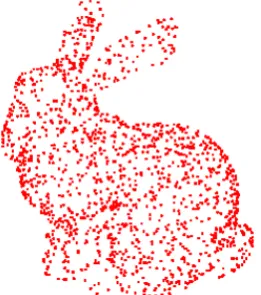
Figure 2. Sample point cloud of the Stanford Bunny
1. Compute the Delaunay triangulationD P
( )
of the sample point set P.2. For each pointp P∈ , compute its dual Voronoï cell
p
V from D P
( )
1). Get incident faces of point p of D P
( )
; 2). Get Voronoï dual edges of the incident facets; 3). Get vertices of Voronoï cell Vp from the endpoints of the dual edges. If a dual edge is a ray, it is unbounded, and then Vpis unbounded.
3. Compute the pole p*of point p P∈ from Voronoï
cell Vp
If Vp is bounded, let u be the vector from p to the
Voronoï vertex in Vp that has the largest distance to
p. Otherwise, let u be a vector in the average
direction of all unbounded Voronoï edges incident to Vp. The pole p∗of
p
V is the Voronoï vertex in
p
V with the largest distance to p such that the vector
u and the vector from p top∗make an angle larger
thanπ 2
4. Compute the pole p*of faces of D P
( )
from thepoles of vertexes of faces.
5. Compute the internal alpha scale parameters for each p
The internal alpha scale parameter is *
p p p
α+ = − .
6. Compute the conformal alpha shape, which is a subcomplex of D P
( )
of P restricted to Cαˆ .1). The radius of a ball at each point p P∈ is
( )
ˆ ˆp p p
α α =α α α+ + −.
2). Conformal alpha shape filtration is the sequence of conformal alpha complexes obtained from growing the internal alpha scale ˆα from zero to infinity.
7. Compute normal of faces of conformal alpha
complexes. The faces are simple planar triangular. 8. Calculate the normal of each vertex p from normal
of faces incident to p with equation (3.3).
9. Compute normal curvaturek tn
( )
i at point p withequation (3.15).
10. Compute angleθibetween ti and eˆ1 at p, where ti is
the projection of the vector p - pi onto the tangent
plane at p obtained by equation (3.6), and eˆ1 is tidat
which kn
( )
tid is the maximum normal curvatureink tn
( )
i .11. Compute mean curvature H, Gaussian curvatureKG, maximum and minimum normal curvature k1and
2
k at p with equations (3.19) ~ (3.22).
Step 1 compute the Delaunay triangulationD P
( )
of a sample point set P⊂R3in general position.Steps 2-6 compute the conformal alpha shape filtration. The sampling density may vary non-uniformly across surface S ofD P
( )
, the density is bounded below by the smallest local feature size, defined by medial axis( )
M S of S[1]. The Voronoï cells of the sample points are long and thin and directed almost along the normals at the sample points. Therefore, edges that are almost tangential to the surface will appear early in the conformal alpha shape[5].
Steps 2-5 compute the internal alpha scale parameters by the polep*of each face of surface S ofD P
( )
. Becausethe Voronoï cells of the sample points are long and thin and directed almost along the normals at the sample points, from the polep*to the face is almost along the
normal of the face.
Step 6 compute the conformal alpha shape with the internal alpha scale parameter. The conformal alpha shape filtration is the sequence of conformal alpha complexes obtained from growing the internal alpha scale ˆα from zero to infinity.
Steps 7-8 calculate the normal of a vertex p from normals of the incident faces.
Steps 9-11 compute mean curvature H, Gaussian curvatureKG, maximum and minimum normal curvature
1
k and k2 at p.
V. EXPERIMENTAL RESULTS
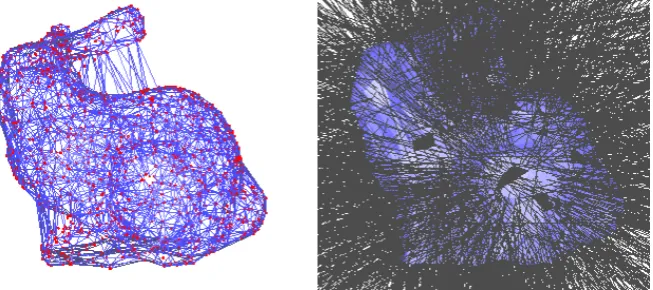
We implemented the algorithm using the C++ library CGAL. The sample is a Stanford Bunny. The Fig. 2 shows the sample points of the Stanford Bunny. The Fig. 3 to 6 show conformal alpha shapes and illustrates the conformal alpha shapes with normal for each face triangle with a scale parameter ˆα from 10% to 50% of the range of regular face alpha-value sorted in an increasing order. It forms a filtration and multi-scale analysis.
VI. CONCLUSION
Figure 3. Left is a conformal alpha shape for this sample. Right illustrates the conformal alpha shape filtration with normal for each face triangle. The straight lines are the normal of the faces.αˆ = 10% of the range of regular face alpha-value sorted in an increasing order.
the robustness of our method. An approach is proposed to estimate the internal alpha scale parameters. Multi-scale geometrical and topological analyses of point clouds can reveal their rich structures. The methods can be used to extract local curvatures of hierarchical shapes and as a multi-scale geometrical analysis method of point clouds. It is useful in many applications ranging from bio-geometric modeling to surface reconstruction. We describe an implementation of the algorithm and show example outputs. The computation complexity of this algorithm is low. The algorithm is robust to data with strong noise.
Further work will investigate if the behavior of curvature estimation methods, based on mesh resolution and other factors, can be used to place bounds on the error in the curvature estimates. We also intend to parallelize our algorithm and make the computations purely local. In addition, it would be interesting to apply our method to more challenging surface reconstruction problems. It would be interesting to try other methods such as Voronoi covariance and curvature tensor of a point cloud.
There are still some problems that need further investigation, such as how to assess the quality of the estimation and extend to multivariate adaptive procedure.
REFERENCES
[1] N. Amenta, M. Bern: Surface reconstruction by Voronoï filtering. Discrete and Computational Geometry 22 (1999), 481–504. 1, 3
[2] D. Aiger, N. Mitra, and D. Cohen-Or: 4-points congruent sets for robust pairwise surface registration, ACM Trans. Graph., vol. 27, no. 3, 2008.
[3] Yi An, Cheng Shao, Xiaoliang Wang, Zhuohan Li: Estimating Principal Curva-tures and Principal Directions from Discrete Surfaces Using Discrete Curve Model, Journal of Information & Computational Science 8: 2 (2011) 296– 311.
[4] Banchoff T., Lovett S.: Differential Geometry of Curves and Surfaces. A K Peters Ltd, 2010.
[5] F. Cazals, J. Giesen, M. Pauly, A. Zomorodian: Conformal Alpha Shapes. 2nd Symposium on Point Based Graphics, 2005
[6] Gregory Cipriano, George N. Phillips Jr., and Michael Gleicher: Multi-Scale Sur-face Descriptors, IEEE Transactions on Visualization and Computer Graphics, Dec. 2009, vol.15, no.6, pp. 1201-1208.
[7]Chen, G., Wu, Y., Estimating normal vectors and curvatures by centroid weights. Computer Aided Geometric Design, 21:447-458, 2004.
[8]Dong Chenshi, Wang Guozhao, Curvatures estimation on triangular mesh, Journal of Zhejiang University -SCIENCE, Volume 6, Supplement 1, 128-136, 2005.
[9] H. Edelsbrunner: Geometry and Topology for Mesh Generation. Cambridge Univer-sity Press, New York, NY, 2001. 2
[10] Edelsbrunner: Alpha shapes --- a survey. In Tessellations in the Sciences, 2010.
[11]S. Fortune: Voronoi diagrams and Delaunay triangulations. In J. E.Goodman and J. O’Rourke, editors, Handbook of Discrete and Computational Geometry. CRC Press, second edition, 2004.
[12] Gatzke T., Grimm C.: Estimating curvature on triangular meshes. International Journal of Shape Modeling 12, 1 (2006), 1--29.
[13]Cindy Grimm, William D. Smart: Shape classification and normal estimation for non-uniformly sampled, noisy point data, Computers and Graphics (2011).
[14]J. P. Gois, E. Tejada, T. Etiene, L. G. Nonato, A. Castelo, and T. Ertl: Curva-ture-driven modeling and rendering of point-based surfaces, in Braz. Symp. Comp. Graph. Imag. Proc, 2006, pp. 27–36.
[15] Wesley Griffin, Yu Wang, David Berrios, Marc Olano: GPU curvature estimation on deformable meshes, I3D '11 Symposium on Interactive 3D Graphics and Games.
[16]E. Kalogerakis, D. Nowrouzezahrai, P. Simari, K. Singh: Extracting lines of curva-ture from noisy point clouds, pecial Issue of the Computer-Aided Design on Point-Based Computational Techniques, Vol. 41, No. 4, April 2009. [17] C. Lange and K. Polthier: Anisotropic smoothing of point
sets, Comp. Aided Geom. D., vol. 22, no. 7, pp. 680–692, 2005.
[18] Quentin Merigot, Maks Ovsjanikov, and Leonidas Guibas: Voronoi-based Curva-ture and Feature Estimation from Point Clouds, Visualization and Computer Graphics, IEEE Transactions, Vol. 17, Issue 6, June 2011, pp. 43 – 756 [19] M. Pauly, N. Mitra, J. Wallner, H. Pottmann, and L. Guibas:
Discovering struc-tural regularity in 3d geometry, ACM Trans. Graph., vol. 27, no. 3, 2008.
[20] Helmut Seibert, Dietmar Hildenbrand, Meike Becker, Arjan Kuijper: Estimation of curvatures in point sets based on geometric algebra, 2010.
[21] Szilvasi-Nagy, M., About Curvatures on Triangle Meshes, KoG•10–2006.
Figure 4. Left is a conformal alpha shape for this sample. Right illustrates the conformal alpha shape filtration with normal for each face triangle. The straight lines are the normal of the faces.αˆ= 25% of the range of regular face alpha-value sorted in an increasing order.
Figure 5. Left is a conformal alpha shape for this sample. Right illustrates the conformal alpha shape filtration with normal for each face triangle. The straight lines are the normal of the faces.αˆ = 35% of the range of regular face alpha-value sorted in an increasing order.