IJSRSET1732188 | 15 April 2017 | Accepted : 22 April 2017 | March-April-2017 [(2)2: 712-720]
© 2017 IJSRSET | Volume 3 | Issue 2 | Print ISSN: 2395-1990 | Online ISSN : 2394-4099 Themed Section: Engineering and Technology
712
Reframing Public Procurement Challenges in Ghanaian
Hospitals through Systems Thinking
Patrick Boateng Sarpong, Du Janguo, Henry Asante Antwi, Kofi Baah Boamah, Adeleke Banguo
Oladepo
School of Management, Jiangsu University, 301 Xuefu Road, Zhenjiang, Jiangsu, P.R. China
ABSTRACT
The past two decades has witnessed the growing appreciation of relationships between precise public sector objectives and public procurement practice. In Ghana, the Public Procurement Act of 2003 (PPA) (Act 663) is a comprehensive legislation designed to eliminate the shortcomings and organizational weaknesses which were inherent in public procurement process in Ghana. Despite the influence of the PPA on transparent public procurement process, the nearly two and half decades of implementation have revealed emerging symptoms of genetic lags that were not addressed at the onset of the new procurement reform, hence decrease adherence. The study sampled data from 150 selected officers in 15 public health institutions in Ghana over a three month period. A feed forward artificial neural network was developed. Our final model contained five input layers, 12 hidden layers and 5 output layers. Each network-input-to-unit and unit-to-unit connection is modified by a weight. We observed that, the PPA is weak on the five configurations (design a dynamic and negotiable bidding process, user-friendly procurement policy language, reduction in bureaucracy, shift from technological to relationship competencies, and changes to their strategic model). The study provides evidence of the importance of systems thinking in formulating public policy formulation such as public procurement.
Keywords: Public Procurement, Challenges, Public Hospitals, Ghana
I.
INTRODUCTION
Public procurement policies are seen as an important counterpart in development. The decrease in poverty and attainment of health, education among the population demands limited availability of public funds for public procurement of goods , services and works are well managed (Kotoka, 2012). The past two decades has witnessed the growing appreciation of relationships between precise public sector objectives and public procurement practice. In the opinion of (Adusei & Awunyo-Vitor, 2015) suggest that, public procurement laws can impact positively towards a sound management of public expenditures. This notion is shared by Evenett and Hoekman (2005) who suggested that, public procurement concerns, normally aims to address corruption and to prevent authorities and government workers from taking advantage of private firms.
A review by Ohashi (2009) shows that, in most parts of the world especially in developing countries such as Ghana, public procurement has become famous for the levels of corruption attained by fraudulent public officials. In Ghana specifically, public procurement challenges include the prevalence of low capacity of procurement specialists, low interaction between procurement entities and public procurement authority, deliberate controlling of competition, non-compliance with provisions of the law, the division of contracts into smaller lots, lack of funds and non-cooperativeness of suppliers. These challenges remains the major impediments in the process of implementing the Public Procurement Laws (Ameyaw et al., 2012). Several authors have given varied perspectives into the challenges that are associated with public procurement practice.
to eliminate the shortcomings and organizational weaknesses which were inherent in public procurement process in Ghana. The Government of Ghana, in consultation with its development partners had identified the public procurement system as an area that required urgent attention in view of the widespread perception of corrupt practices and inefficiencies, and to build trust in the procurement system. Neupane et al. (2012) observed that, the process must be open, objective and clear. Nevertheless, corruption in government procurement processes results in problems that includes, lack of accountability and transparency, lack of political control and auditing, weak professionalization of red tape and so on.
In several nations, public procurement has dedicated a large portion of government funds to procure necessary goods, services and works to provide public amenities. For instance, the World Bank reports the value of 10,838 contracts before review in the month of February 2014 amounts to US$12.8 billion in several region of nations. A study by the World Bank as cited in Ameyaw et al. (2012) reported that, about 50-70% of the national budget (after personal emoluments) is procurement related. The greater part of government spending, too is centred on the management of District Assemblies, Public Hospitals, and other institutions. Therefore, an efficient public procurement system will ensure value for money in government spending, which is essential to a country facing enormous developmental challenges. To actualize this objective, (The Public Procurement Act, 2003) was passed by the parliament of Ghana in 2003 as the common benchmark, regulatory framework and ethical/moral compass for public entities responsible for public procurement. Adjei (2005) claimed, that before the passage of the PPA (Act 663), bodies such as Ghana National Procurement Agency (GNPA) and Ghana Supply Company Limited (GSCL) were mandated to act as agents to procure all public goods and services for the government as no comprehensive procurement guideline existed. The two agencies were not involved in controlling public procurement nevertheless, they were mandated to purchase goods and services and to award contracts on behalf of public entities.
On the other hand, the procurement method used for public works was the traditional method which offers mandatory registration and classification for contractors and vendors under guidelines directed for by Ministry of
Works and Housing (Anvuur et al., 2006; Eyiah & Cook, 2003) the classification by the Ministry of Works and Housing has been observed to be too broad and obsolete and the registration criteria, lists of contractors and monetary thresholds are not often rationalised. Owing to lack of a comprehensive legal regime and a central body with the responsibility to harmonize procurement process in Ghana, several sector ministries (e.g. Ministry of Health, Donor Agencies, World Bank etc) implemented its procurement system to make sure funds were used wisely.
According to Anvuur et al. (2006) ,the World Bank has offered procurement guideline for all projects they embark upon. While ,procurement entities were engaged in procurement from 1999, the Ministry of Finance developed a National Procurement Code using the success in the procurement at the Ministry of Health as a reference point. Yet ,Kotoka (2012) observed that, the uncoordinated and unregulated systems of procurement led to poor procurement situation leading to the much talked about reform of public procurement practices to instill trust and confidence in the public and the donor community. In that regard, the Public Procurement Act,(PPA) sought to offer general guidelines on regulations and administrative instructions, that are central to procurement in public institutions such as hospitals.
II.
LITERATURE REVIEW
Procurement is generally defined as acquisition of goods, services, capabilities and knowledge required by businesses, from the right source, at the right quality, in the right quantity, at the right price and at the right time to sustain and administer the firm„s main and support activities. However, procurement activities involves: determining specifications in terms of required quality and quantities; selecting the right suppliers to provide the required goods and services; establishing agreements with suppliers; supplier relationship management and placing orders with the particular contractors;(Cousins et al., 2006; Van Weele, 2009)
suppliers to take part. The procedure, nonetheless, must be adhered to and applied wholly on goods and works agreements. The process is made up of planning, inviting offers, evaluating offers, awarding contracts and contracts administration to its execution(Amo-Richmond, 2014).
Njeru (2015) revealed that, effective implementation of procurement practices is depended on the level of compliance with procurement regulations, minimization of procurement expenditure, transparency and accountability of procurement funds including the quality of goods and services bought. Effective implementation of procurement practices and policies are essential for government financial administration towards proper controlling of earmarked allocation of funds.
Asakeya (2014) found out that, the Ghana Health Service (GHS) is a public service body established under Act 525 of 1996 as required by the 1992 Constitution. It is an independent Executive Agency responsible for execution of national policies under the auspices of the Minister for Health through its central Council. Ghana Health Service do not entails all health institutions.
The formation of the Ghana Health Service is vital strategy recognized in the Health Sector Reform process, as outlined in the Medium Term Health Strategy (MTHS), which are essential steps in forming a more equitable, efficient, accessible as well as timely delivery of wellbeing as a care in the health institution.
At the heart of the PPA (Public Procurement Act ) are the three-fold principles of fairness, transparency and non-discriminatory which are the inherent expectations of effective public procurement. The foundational expectations of the PPA are explained by Suleiman (2010) who noted that, the law was enacted to preserve the situation where operational methods where needed to guide and monitor procurement activities in Ghana. Further, the opinion of Suleiman (2010) served to bridge the absence of an outlined policy or existing framework for public procurement activities, institutional arrangement, documentation and principal organization for procurement. In that spirit, it was expected that the PPA will stimulate a systematic and sound government expenditure as the result of good procurement for realizing value for money in Ghana (Adusei, 2016). Although, the Public Procurement Act
has experienced certain impediments, the Act has contributed a lot to economic development in Ghana (Toku, 2015). Nonetheless, it appears that, those involved in the day to day management and operations of these processes are faced with many challenges. These challenges being observed by a plethora of literature if not dealt with would elude entities of various benefits of this purpose(Thai, 2008).
Adusei (2016)studied the conformance of current procurement practices in a tertiary institution in Ghana to the Public Procurement Act (PPA) 2003 (Act 663). A well-structured questionnaire was used in collecting data from the staffs while a one sample t-test and Kendall‟s Coefficient of Concordance were deployed to analyze the data. The authors revealed that, strict procurement procedures were not followed prior to PPA. Even though the PPA has brought sanity into the Polytechnic in their procurement processes, its applications were bedeviled with several impediments. The paper suggested that, management of the Polytechnic allow the procurement unit to operate freely without any form of interference in its quest to adhere to the PPA (Act 663). According to a related study by Toku (2015) they sought to assess the operational woes of the procurement practitioner in their day to day activities in the context of Ghanaian tertiary institutions. Subsequently a comprehensive investigation revealed that, the function is entangled with mirage of impediments among which consists of high level of red tape in the procurement process, lack of logistics such as photocopiers, fax machines, scanners, printers, telephones and vehicles have all to slow characteristics of some requirements/clauses of the Public Procurement Act (Act 663 of 2003). Hence, the author concluded that, the procurement function should be upgraded to a strategic position where it would be independent, well-resourced and be involved more in the institutions long term strategic planning process.
(PPA), deliberate controlling of competition, non-compliance with provisions of the law, splitting of contracts into smaller lots, lack of funds and non-cooperativeness of suppliers, as the major challenges militating against the implementation of the Public Procurement Law.
Also Anvuur et al. (2006) interrogated the key challenges in implementing the PPA in the construction industry in Ghana. The industry like many others the world over, has experienced fair share of damning independent examinations. It is beset with huge and unsustainable foreign debt, excessive budget deficits, huge contractual payment arrears, poor construction performance, corruption and pressure from foreign financial bodies, coerced governments to commit to a reform of public procurement, which ended in the passing of the Public Procurement Act, 2003 (Act 663). The research numerated events that, resulted to, and features of, the public procurement reform in Ghana and evaluates its potential impact and other impediments found. Comparisons are likewise derived from important scenarios further, from nations. The author concludes that, while the Procurement Act sets out the legal, institutional and regulatory framework to secure fiscal transparency and public accountability, the sole reliance on traditional contracting and price-based selection limits the scope for the value for money intended. Expanding the reforms to cover procurement and project delivery methods and strategies, with a focus on „best value‟, will increase the potential and likelihood of achieving value for money in public built environment.
Sekyere (2014) studied, the performance of procurement practices of Suntreso government hospital and to find out the extent to which the Hospital followed the requirement of (PPA 2003, Act 663) in the planning, execution and monitoring of procurement processes. The author also sought to analyze the challenges the Hospital encountered in performing procurement practices in the management of procurement process. The study revealed that, National Competitive Tendering and price Quotation were usually used as a procurement methods in the operations of the entity. The study again revealed that, the use of ICT in their procurement operations was very low because no specialized procurement software was available hence almost all their procurement activities were done traditionally.
Further the study revealed that, the entity encountered in its operations which includes difficulty in obtaining funds, lack of understanding of the procurement Act on the part of the local suppliers, cost overrun, interference from top hierarchy and insufficient qualified staff. The researcher ,recommended that, the procurement entity should further liase with the public procurement authority outfit, address the challenges and effective monitoring and evaluation of procurement activities in the entity as well as applying sanctions to punish conflict of interest and interference from top management to improve its performance.
Etse and Asenso-Boakye (2014) investigated, an exploratory exercise to find out factors which deter effective performance of public procurement audit. Knowledge of the challenges is of importance especially to public procurement entities, the Ghana Audit Service, and the country. To the procurement entities, their study highlights procurement practices which serve as barriers to successful audits for remedial actions; the audit service will be aided by the findings of this study so that they can prepare adequately to conduct more successful audits knowing in advance challenges they are likely to encounter; to the state, results of the study offer relevant information for policy reforms and resource distributions. The major findings of the study included the following poor documentation and improper record keeping; habitual violation of public procurement laws and regulations; unskillfulness of procurement and audit personnel; and insufficient supply of funds for the audit work.
procurement, political interference by the executive and lack of public procurement specialists. The study however recommended that, procurement studies should be made as a top priority in the curriculum of tertiary institutions in order to transit public procurement from office to strategic stage. In addition for the Act to thrive, the political class should gather the necessary courage that is sufficient, to enforce political will towards proper process operation. What is more, systems ought to be put in place in order to observe the interference of the process by the political elites.
While these many studies have evaluated the procurement challenges in Ghana from a purely administrative point of view(Kusi et al., 2016) and other emerging evidence from practice suggest symptoms of genetic lags that were not addressed at the onset of the new procurement reform. In the case of the University of Toronto‟s (UofT) Procurement Division (Ryan & Leung, 2014)for instance ,argues for an overhaul of management thinking as the basis for proposing new initiatives including public procurement policies. It requires the adoption of public policy reform approach from the perspective of users as the basis for stimulating compliance or adherence to policy. Such a process requires the policy makers to „deep dive‟ to better understand the broader ecosystem of stakeholders and develop more effective solutions with an empathic appreciation of the user‟s overall conditions.
This enables the organisation to develop a simplification and engagement policy initiative that aims to make purchasing more accessible and efficient while creating a more collaborative relationship with stakeholders(Anderson, 2015). The process must capture the need to design a dynamic and negotiable bidding process, user-friendly procurement policy language, reduction in red tape, shift from technological to relationship competencies, and changes to their strategic model, all with the user ecosystem awareness(Barnes, 2014). These changes enable users to reframe their perceptions of Procurement Services from „enforcers of policy and regulation‟ to „a reliable counselor. The current literature is still silent on the degree to which these systems thinking concepts underpin the current public procurement system in Ghana, hence the need for this study. When completed, the study will provide evidence of the importance of systems thinking in formulating public policy formulation such as public procurement.
III.
METHODS AND MATERIAL
1. Sample Data
The study sampled data from 150 selected officers in 15 public health institutions in Ghana over a three month period. The study adopted the purposive sampling procedure considering the fact that this is a very technical area and not all the staff in the administrative departments has adequate knowledge about procurement. In response to further studies by Kusi et al (2016) to collect the views of doctors and nurses who uses procured materials, a total of 20 of them were selected. Their presence helped to identify some of the possible challenges associated with procurement delays and unacceptable tendencies that proceed out of poor procurement planning. A closed-ended questionnaire was developed based on questions extracted from previous attempts to test the five systems thinking challenges in change management that equally affects the development and implementation of the Public Procurement Act. Five questions were asked to determine the extent to which the Public Procurement Act include simplifies and engages users in the process while another five were asked to determine the extent of its dynamism and negation in the bidding process. Simplification involves eliminating inane to encourage the creation of value and purpose. It is the process of making a complex process faster, easier, or more efficient. Simplification is not a “one-and-done” concept, rather a consistent mindset that organizations must adopt in order to do it successfully. On the other hand, engagement is the emotional connection one has with a process. It is the positive attitudes, beliefs, and behaviors towards a process. On the other hand, negotiation refers to the ability of the hospitals to discuss and change or make amendments as they deem fit for their organization.
supporting inter-business activities related to business networking. Business relationship management consists of knowledge, skills, and behaviors (or competencies) that foster a productive relationship between a service organization (e.g. human resources, information technology, a finance department, or an external provider) and their business partners. Additionally, the researcher asked questions relating to whether the Public Procurement Act shifts to relationship competencies and its effect on changes in organizations strategic model. Overall, a total of 151 questionnaires were received altogether and these were prepared for analysis.
2. Data Analysis
We performed a two staged statistical analysis to obtain the results. Firstly, we performed factor analysis to investigate the dimensions of collaborative relationship with stakeholders, simplification and engagement of process, dynamic and negotiable bidding process, user friendly policies and language and reduction in bureaucracy. Similar test was also done for the dimensions of shift to relationship competencies and changes in organizations strategic model. Further we designed a multilayer perceptron neural network model to examine the effect of simplification and engagement of process, dynamic and negotiable bidding process, user friendly policies and language and reduction in bureaucracy on adherence to government policy in the management of their respective hospitals.
We, thoroughly verified the basic assumptions i.e. the constant variance and normality and these did not affect the results. We determined the appropriateness of the data for factor analysis by employing Kaiser– Meyer-Olkin measure of sampling adequacy (KMO-MSA) and Bartlett‟s Test of Sphericity. We recorded a KMO value of more than 0.60 and a significant value for the Bartlett‟s Test of Sphericity. We performed Varimax rotation and principle components analysis for factor analysis. We eliminated all the factors that had factor loadings lower than 0.50 after which we conducted the Cronbach‟s alpha reliability analysis. We ensured that all measure of sampling adequacy exceeded the Cronbach‟s alpha reliability value threshold level of 0.60 and large and significant Bartlett‟s Test of Sphericity. We eliminated 10 items of the initial 35 basically relating to shift to relationship
competencies and changes in organizations strategic model since they had a factor loading lower than 0.50. To determine the relationship between the moderating factors (simplification and engagement of process, dynamic and negotiable bidding process, user friendly policies and language, reduction in bureaucracy, shift to relationship competencies, changes in organizations strategic model and collaborative relationship with stakeholders) and increase adherence to government policy, a feed forward artificial neural network was developed. According to (Ansong et al., 2015) it is possible for neural networks to have many different layers, units per layer, network inputs, and network outputs.
Our final model contained five input layers, 12 hidden layers and 5 output layers. Each network-input-to-unit and unit-to-unit connection (the lines in Error! Reference source not found.) is modified by a weight.
In addition, each unit has an extra input that is assumed to have a constant value of one. The weight that modifies this extra input is called the bias. All data propagate along the connections in the direction from the network inputs to the network outputs, hence the term feed-forward. When the network is run, each hidden layer unit performs the calculation in Error! Reference source not found. on its inputs and transfers the result (Oc) to the next layer of units. The activation function of our model artificial neural networks can be expressed mathematically as follows:
x Hidden
c P
p cp cp Hidden
c
h
i
w
b
where
h
x
e
O
1
1
)
(
1 , ,
Oc is the output of the current hidden layer unit c, P is either the number of units in the previous hidden layer or number of network inputs, ic,p is an input to unit c
from either the previous hidden layer unit p or network input p, wc,p is the weight modifying the connection from either unit p to unit c or from input p to unit c, and
bc is the bias. In Error! Reference source not found.,
makes training the network difficult, the training data must be scaled appropriately. Similarly, before training, the weights and biases are initialized to appropriately scaled values.
Figure Error! No text of specified style in document.. Sigmoid activation function. Chart limits are x=7 and y=-0.1, 1.1.
Each output layer unit performs the calculation in Error! Reference source not found. on its inputs and transfers the result (Oc) to a network output.
x x h where b w i h
O P c Output
p cp cp Output
c
1 , , ( )
Ocis the output of the current output layer unit c, P is the number of units in the previous hidden layer, ic,p is
an input to unit c from the previous hidden layer unit p,
wc,p is the weight modifying the connection from unit p
to unit c, and bc is the bias. For this research, hOutput(x) is a linear activation function. For each specific dimension, we created a composited score by summing up all the scores for the set of questions under the dimension for each respondent. The composite scores were then used as variables.
IV.
RESULTS AND DISCUSSION
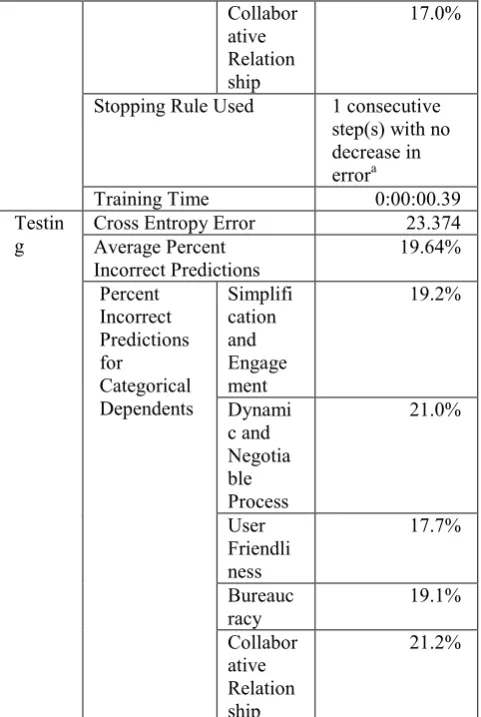
Model Summary Traini
ng Cross Entropy Error Average Percent 21.048 Incorrect Predictions 17.86% Percent Incorrect Predictions for Categorical Dependents Simplifi cation and Engage ment 18.6% Dynami c and Negotia ble Process 12.1% User Friendli ness 22.3% Bureauc
racy 19.3%
Collabor ative Relation ship
17.0%
Stopping Rule Used 1 consecutive step(s) with no decrease in errora
Training Time 0:00:00.39 Testin
g Cross Entropy Error Average Percent 23.374 Incorrect Predictions 19.64%
Percent Incorrect Predictions for Categorical Dependents Simplifi cation and Engage ment 19.2% Dynami c and Negotia ble Process 21.0% User Friendli ness 17.7% Bureauc
racy 19.1%
Collabor ative Relation ship
21.2%
a. Error computations are based on the testing sample.
The testing models are inflation adjusted of the training and helps but the results equally gives and impressive prediction of the independent variables on decrease adherence to the Public Procurement Act. For example, the testing model shows that the effect of simplification and engagement is 80.8% accurate in predicting decrease adherence to the Public Procurement Act while dynamic and negotiable process is 79% accurate in predicting decrease adherence to the Public Procurement Act. On the other hand, the effect of user friendliness is 82.3% accurate in predicting decrease adherence to the Public Procurement Act whiles the prediction accuracy of decrease adherence to the Public Procurement Act by the reduction in bureaucracy is 80.9%. Finally collaborative relationship is 78.8% accurate in predicting decrease adherence to the Public Procurement Act. Overall, the incorrect prediction is 19.64%.
V.
CONCLUSION
As indicated in earlier sections of the study, the past two decades has witnessed the growing appreciation of relationships between precise public sector objectives and public procurement practice. At the onset, the objective of Ghana‟s Public Procurement Law, 2003 (Act 663) was to provide a comprehensive legislation designed to eliminate the shortcomings and organizational weaknesses, which were inherent in public procurement process in Ghana. Nearly, a decade and half of implementation, it is evident that, the Public Procurement Act alone is not the antidote to the inherent challenges confronting public procurement in Ghana. Our analyses have demonstrated beyond the known factors affecting compliance, the PPA also suffer from structural inadequacies that significantly limits interest and potential adherence to the practice. Statistically, it is evident from this study that the Public Procurement Act of Ghana fails the simplification and engagement of process. It is necessary for the Act to eliminate inane to encourage the creation of value and purpose.
It is the process of making a complex process faster, easier, or more efficient. As observed earlier, simplification is not a “one-and-done” concept, rather a consistent mindset that organizations must adopt in order to do it successfully. On the other hand, engagement is the emotional connection one has with a process. Users must have a positive attitudes, beliefs, and behaviors towards the PPA process. There is also the need for the PPA to be user negotiable and flexible,
while maintaining its core standards. This entails granting hospitals the ability to make few changes as they deem fit, based on the peculiar cases. The fact that, the administrative structures of the PPA is large and is deterrent to its compliance. This is also the case with the complete elimination of relationship. The current healthcare market requires hospitals to fundamentally and constantly transform the way they function and identify new foundations or avenues to gain or consolidate any competitive advantage. Hospitals must constantly develop internal capacities to enhance continuous innovation of their products, services, organizational processes, technologies and markets (Bodunkova & Chernaya, 2012).
To that extent hospitals must understand, define, and support inter-business activities related to business networking. As it stands now, it appears the PPA disables institutions from developing knowledge, skills, and behaviors (or competencies) that foster a productive relationship with their business partners. This is because of the strict, non-negotiable and inflexible compliance tests that have been set by the PPA. It has been suggested that, the use of e-procurement approaches can play a major role in ameliorating the challenges identified above but, it still remains an adventure in transition.
VI.
REFERENCES
[1]. Adjei, A. (2005). Public Procurement Authority:
What are we learning from different approaches to monitoring capacity and development. An Assessment Tool for Public Procurement System and its application to monitoring Capacity and Performance of the Procurement System in Ghana, Accra.
[2]. Adusei, C. (2016). Adherence to Public
Procurement Act in Tamale Polytechnic of Ghana: Rhetoric or Reality in practice? Archives of Business Research, 4(3).
[3]. Adusei, C., & Awunyo-Vitor, D. (2015).
Implementation Challenges of the Public
Procurement Act by Selected Metropolitan, Municipal and District Assemblies in the Ashanti Region, Ghana. iBusiness, 7(01), 39.
[5]. Amo-Richmond, F. (2014). Achieving value for money in Ghana‟s Public Procurement (Case Study: three procurement entities in Greater Accra Region).
[6]. Anderson, M. J. (2015). The American census: A
social history: Yale University Press.
[7]. Ansong, M. O., Huang, J. S., Yeboah, M. A., Dun,
H., & Yao, H. (2015). Non-Gaussian hybrid transfer
functions: memorizing mine survivability
calculations. Mathematical Problems in
Engineering, 2015.
[8]. Anvuur, A., Kumaraswamy, M., & Male, S. (2006).
Taking forward public procurement reforms in Ghana. Paper presented at the Proceedings of the 2006 CIB W107: Construction in Developing Countries International Symposium: Construction in Developing Economies: New Issues and Challenges.
[9]. Asakeya, G. K. (2014). COLLEGE OF
ARCHITECHTURE AND PLANNING. KWAME NKRUMAH UNIVERSITY OF SCIENCE AND TECHNOLOGY, KUMASI.
[10]. Barnes, C. (2014). Independent living, politics and policy in the United Kingdom: A social model account. Review of Disability Studies: An International Journal, 1(4).
[11]. Bodunkova, A. G., & Chernaya, I. P. (2012). Fractal organization as innovative model for entrepreneurial university development. World Applied Sciences Journal, 18, 74-82.
[12]. Cousins, P. D., Giunipero, L., Handfield, R. B., & Eltantawy, R. (2006). Supply management's evolution: key skill sets for the supply manager of the future. International Journal of Operations & Production Management, 26(7), 822-844.
[13]. Etse, D., & Asenso-Boakye, M. (2014). Challenges
of Public Procurement Audit a Perspective of Ashanti Regional Office of Ghana Audit Service. [14]. Evenett, S. J., & Hoekman, B. (2005). International
cooperation and the reform of public procurement policies.
[15]. Eyiah, A. K., & Cook, P. (2003). Financing small and medium-scale contractors in developing countries: a Ghana case study. Construction management and economics, 21(4), 357-367.
[16]. Familoye, O., Ogunsemi, D. R., & Awodele, O. A.
(2015). ASSESSMENT OF THE CHALLENGES FACING THE EFFECTIVE OPERATIONS OF THE NIGERIA PUBLIC PROCUREMENT ACT 2007. International Journal of Economics, Commerce, and Management, 3(11), 957-968.
[17]. Familoye, O., Ogunsemi, D.R.,& Awodele, O.A.
(2015). Assessment of the Challenges Facing The Effective Operations of the Nigeria Public Procurement Act 2007. International Journal of
Economics,Commerce and Management,, 3(11), 957-968.
[18]. Kotoka, F. A. (2012). Assessing the level of
Compliance with the Public Procurement Act 2003(Act 663)in Public Entities in Ashanti Region of Ghana. Unpublished Commonwealth Executive Masters in Public Administration thesis,Kwame Nkrumah University of Science and Technology.
[19]. Kusi, B., Antwi, H. A., Nani, G., Mensah, S. O., &
Akomeah, M. O. (2016). Exogenous and Endogenous Factors in E-procurement Adoption among Ghanaian Hospitals: A Co-Integration Analysis.
[20]. Neupane, A., Soar, J., Vaidya, K., & Yong, J. (2012). Role of public e-procurement technology to reduce corruption in government procurement. Paper presented at the Proceedings of the 5th International Public Procurement Conference.
[21]. Njeru, S. E. (2015). Factors affecting effective
implementation of Procurement Practices in tertiary public training institutions in Kenya. Jomo Kenyatta University of Agriculture and Technology.
[22]. Ohashi, H. (2009). Effects of transparency in procurement practices on government
[23]. expenditure: A case study of municipal public works. Review of Industrial
[24]. Organization,, 34, 267-285.
[25]. Ryan, A., & Leung, M. (2014). Systemic Design: Two Canadian Case Studies. FORMakademisk– research journal for design and design education, 7(3).
[26]. Sekyere, O. (2014). Performance assessment of
procurement practices of the Suntreso Government Hospital, Kumasi.
[27]. Suleiman, Y. (2010). Overview of public
procurement reforms in Commonwealth Africa: strategy, successes and challenges. Paper presented at the A paper presented at Public Procurement Forum at St. Lucia, the Caribbean.
[28]. Thai, K. V. (2008). Measuring losses to public
procurement corruption: The Uganda Case. Paper presented at the 3rd International Public Procurement Conference Proceedings,(August 28-30).
[29]. The Public Procurement Act, A. (2003).
[30]. Toku, L. I. (2015). Exploring the Operational
Challenges that Confront Procurement Practitioners in Ghanaian Polytechnics. Global Journal Of
Commerce&Management Perspective,
4(3):1-6(2319-7285).
[31]. Van Weele, A. J. (2009). Purchasing & supply chain