Griffith University, Queensland, Australia
Griffith Institute for Tourism Griffith University, Queensland, Australia
School of Information and Communication Technology Griffith University, Queensland, Australia
Abstract. The growing number of social media users and vast volume of posts could provide valuable information about the sentiment toward different locations, services as well as people. Recent advances in Big Data analytics and natural lan-guage processing often means to automatically calculate sentiment in these posts. Sentiment analysis is challenging and computationally demanding task due to the volume of data, misspelling, emoticons as well as abbreviations. While significant work was directed toward the sentiment analysis of English text there is limited at-tention in literature toward the sentiment analytic of Chinese language. In this work we propose method to identify the sentiment in Chinese social media posts and to test our method we rely on posts sent by visitors of Great Barrier Reef by users of most popular Chinese social media platform Sina Weibo. We elaborate process of capturing of weibo posts, describe a creation of lexicon as well as develop and explain algorithm for sentiment calculation. In case study, related to sentiment to-ward the different GBR destinations, we demonstrate that the proposed method is effective in obtaining the information and is suitable to monitor visitors’ opinion.
Keywords:Sentiment Analysis, Social Media, Natural Language Processing.
1.
Introduction
reviews by consumers themselves. These types of reviews are known as user-generated content, and they have been found to play an important role in customers future behaviors due to the electronic word-of-mouth [38].
The growing role of social media is attracting increasing research interest. Social me-dia plays significant role in many aspects of life including retails, politics, tourism, and decision-making behavior. A large number of users actively engage with social media, for example, Twitter has 313 million monthly active users worldwide[27]. Furthermore, over 1.94 billion people monthly use Facebook [39] and 700 Million users use Instagram [15], and the Chinese Social Media platform Sina Weibo has over 400 million active users [11]. People use social media to post stories from their daily life, and they are particularly likely to share impressions or emotions related to their travel experience. For the tourism industry, it is therefore possible to examine social media and understand what visitors share and how they perceive destinations, attractions and products.
The Great Barrier Reef (GBR) is the world’s largest coral reef system stretching over 2,600 kilometers along the coast of Queensland and it attracts over two million visitors each year from all around the world [12]. Significant proportion of GBR visitors are from China. While Chinese visitors are very active users of social media they typically use Chinese platforms such as Sina Weibo rather than those commonly used by other English speaking visitors. To take advantage of this huge number of users and media posts on Weibo in this work we decided to capture those posts which specifically talk about the GBR.
Advances in Big Data analytic and natural language processing provide the opportu-nity to analyse visitor experience and their sentiment toward certain services or places [26]. Sentiment analysis is a method which can be used for analyzing social media con-tent. It basically converts social media post text into quantitative data, whereby it can extract information about special events and to identify patterns. Sentiment analysis is a challenging and computationally demanding task not just because of vast volume of data but also due to the common grammatical errors and misspelling, slang and abbrevia-tions. Additionally, social media post can contain sentiment emoticons that carry valuable information for calculating the sentiment scores and should not be discarded.
Social media posts have been harnessed for different purposes including monitoring environmental changes [4], [5] as well as sentiment analysis in tourism [19], [22], [37]. In most cases concept relied on sentiment derived from short text of social media posts and analytics of posts’ meta data along other available online or scientific data. Different sta-tistical and machine learning methods have been used, such as Support Vector Machines (SVM) and Naive Bayes. Recent literature also addresses the issues with regard to trust and reputation measures in social network systems, especially in presence of thematic social groups [10].
emotions [36]. Authors of [21] claimed that they improved sentiment analysis by identify-ing features with SVM as a learnidentify-ing engine, which they named global optimization-based sentiment analysis approach. However, the authors pointed out that if the parameters are not selected well the result will not be accurate and that the sentiment feature subset choice influences appropriate kernel parameters, and vice versa. On the other hand authors of [41] relied on lexicon from National Taiwan University Sentiment Dictionary (NTUSD) [32], which has both traditional Chinese and simplified Chinese characters. NTUSD contains 2810 positive words (which are assigned +1 as sentiment intensity) and 8276 negative words (assigned -1 as sentiment intensity). Also [33] adopted NTUSD as lexicon to cal-culate a sentiment score to monitor the public opinion and forecast election [6], however, they also rely on lexicon which has limited number of words and additionally has only two levels of sentiment intensity +1 or -1, associated with positive and negative words.
To overcome above mentioned shortcomings of existing approaches, in this work we propose and test method to identify sentiment in Chinese social media posts and we rely on most popular Chinese social media Sina Weibo [25]. We developed method to crawl the web and collect Weibo posts that mentioned specific words (in this case word ”Great Barrier Reef” in Chinese language). We elaborate process of capturing, managing, we describe creation of comprehensive Chinese lexicon with sentiment intensity and we also propose algorithm for sentiment calculation, which takes into consideration length of the post as well as number of matching words with lexicon. Additionally as a proof of con-cept, we provide sample of additional information, which can be extracted from the social media post meta data; such as where from Chinese people who have interest and comment on GBR originate from as well as what is average sentiment depending on province poster originate from.
2.
Background
Social media has influenced the way people search information and make decisions. Tourism organizations and destination marketing organizations are aware of ongoing trends and thus try to explore the opportunities to use tourist-generated content for their own marketing and include it as an integral part of their branding and positioning.
2.1. Social Media Data
Social media data has many forms, Figures 1 and 2 show several samples only to demonstrate the diversity, while below we list and highlight main characteristics of social media data:
1. It generate massive volume of data.
2. Data are generated with unprecedented speed.
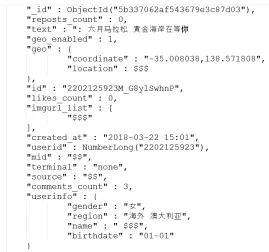
3. Data are complex and high-dimensional, attribute-value data such as text, comments, and other meta data about the poster, Figure 1.
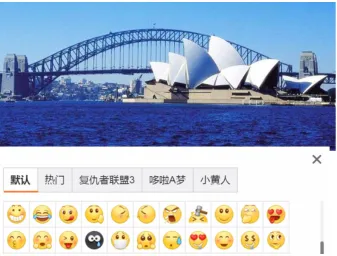
4. Data exist in different forms: text, emotions, images, videos, etc. See Figure2 5. Additionally, data can be noisy as well as incomplete and contain a lot os misspelling,
slang and abbreviations.
Fig. 1.Sample Weibo data indicates complex high-dimensionality of data
Social media platforms including Twitter, Flickr, and Sina Weibo also offer possibility of geo-referencing the content shared by users. This enables opportunity to trace social media users and compare findings with other sources of data.
Fig. 2.Several samples of data formats.
2.2. Sentiment Analysis
Sentiment analysis or opinion mining relates to the study of opinions, attitudes, and emo-tions toward entities, individuals, issues or events. Sentiment analysis dates back to 1970s and is conceptually grounded in the work of Osgood and his associates on content analysis of peoples judgments by evaluating text [24]. Osgood and colleagues distinguish between three dimensions of meaning: Evaluation, Potency,andActivity. Assessment good-bad or favorable-unfavorable are along theEvaluationdimension of meaning, while intensity of these evaluations such as strong/weak or powerful/powerless representPotency, and fast/slow or active/passive comprise theActivitydimension.
Today we talk about sentiment analysis as a process of computationally identifying and categorizing opinions in order to determine the writer’s attitude toward a particular issue. This can be achieved by employing computer-based natural language processing which aims to detect sentiment by relying on Artificial Intelligence system that would be able to reason about emotion [18].
A comprehensive sentiment analysis also considers meta data such as, who provided the information and at what time. Literature elaborates methods of sentiment analysis which in general falls into one of three categories [1]:
– Dictionary-based: Also refereed as Lexicon based, as there is associated polarity and weight on each word in dictionary. These systems mainly rely on the use of dictio-naries containing comprehensive sentiment lexicons and sets of fine-tuned rules. A sentiment dictionary can be created either by humans (manually), by machine (auto-matically) or by humans and machine (semi-auto(auto-matically).
– Hybrid approaches: These methods combine dictionary-based and machine learning-based approaches and they work in parallel to compute sentiment polarities.
As mentioned earlier, typical representative of Dictionary based methods is VADER, it is suited for sentiment analysis of short text [14]. Clear advantage of dictionary based methods for sentiment analysis is that there is no need for annotation of the text for train-ing. Another advantage is possibility to create domain specific dictionaries which ensure higher accuracy of calculated sentiment scores. But there is still need to create dictionary and annotate polarity of words, however, it needs to be done only once. This is obviously less costly considering that the annotation for supervised machine learning method needs to be undertaken for each new context.
In hybrid approaches both dictionary and machine learning are used to independently compute sentiment and then individual results are combined to provide sentiment inten-sity and polarity [16]. Specific hybrid model which is using keywords and Naive Bayes algorithm has been recommended to calculate sentiment polarities of social media tweets [8].
3.
Methodology
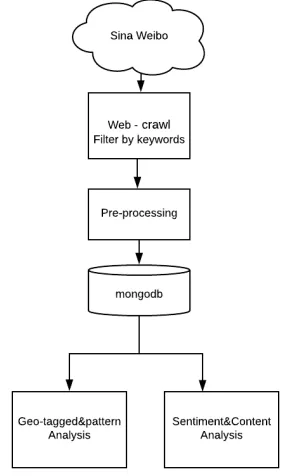
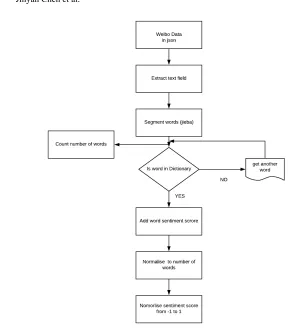
A sentiment analysis process is composed of several independent steps as it can be seen in Figure 3. It starts with data collections which in case of social media data most often relies on utilization of dedicated available Application Programming Interface (API). In cases when purpose built API is not available web crawling is needed. Crawling initially involves an identification of a data source, for example, a commercial website or a social media network. Dedicated web crawling code needs to be developed and used to collect data from these sources. Considering that huge amount of post have been generated by users there is need to filter and acquire only relevant posts, most often filtering is related to particular geographic area or to particular keywords. After initial cleaning, which discards data that do not contain full records, data are saved in database.
Once data have been stored in a database, it is possible, for example, to calculate the sentiment from content of the text within a set of data fields in particular posts. In addition to the actual text of the post additional meta data fields, if publicly available can also be captured. These field can be used to analyze locations where from posts have been sent or where users originate from, which is based on place users indicated as their location when they created accounts.
Fig. 3.Global Sentiment analysis process of Weibo data
The following procedure was implemented: we extracted only posts that contained the keywords ”Great Barrier Reef”, in Chinese language. Extraction process is shown in Figure 3. We identified that about 15% of posts have exact geo location (Latitude, Longitude), which can help in analysis of meta data and for example provide information about visited places. In addition, the analysis involves assessment of the ’emotional’ tone of the text; which will be calculated with method proposed in this paper.
Our experiments were conducted on in-house Big Data cluster running Hadoop (2.6.0) and MongoDB (3.2.9).
3.1. Creation of Chinese Lexicon
In creating our lexicon we considered the following dictionaries:
– Chinese Sentiment Word Weight Table from BoYuan in Tinghua University: It con-tains 23,419 phrases with a positive or negative weight [7].
– How Net: has 17,887 phrases which are divided into 6 groups based on the phrases emotional tendency, which are ”Positive Evaluation”, ”Negative Evaluation”, ”Posi-tive Emotion”, ”Nega”Posi-tive Emotion”, ”perception” and ”Adverb of degree” [40].
– Chinese emotional vocabulary from Dalian University of Technology Information Research Laboratory. It contains 22,012 phrases [35].
– National Taiwan University Sentiment Dictionary - NTUSD: has both Simplified and Traditional Chinese Character. It has 2,810 positive words and 8,276 Negative words [31], [32].
– Tsinghua University Positive and Negative Dictionary which contains 4,468 negative words and 5,567 positive words [20].
Apart of being limited in content and number of words these dictionaries have short-coming as there is no sentiment intensity measures of individual words. Weight has been mostly addressed by creating dedicated dictionaries for specific words which are grouped based on association with: most, very, more, half, etc. This causes lower accuracy of senti-ment score and also requires dedicated code in programming for calculation of sentisenti-ment, which significantly slows down the sentiment calculation.
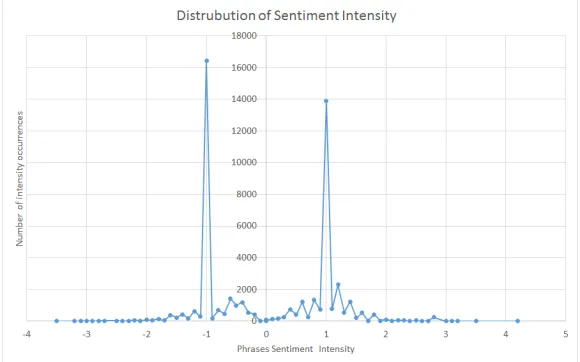
Fig. 4.Distribution of sentiment intensity of BoYuan Tinghua University lexicon
In Figure 4 is shown the distribution of BoYuan Tinghua University lexicon and Fig-ure 5 presents the distribution of lexicon we compiled as part of this work, which is the combination of several existing dictionaries.
Fig. 5.Distribution of sentiment intensity of our Lexicon
3.2. Sentiment Analysis of Chinese Short Text
As indicated in Section 2 there are many sentiment analysis methods proposed for En-glish language and they are mostly lexicon based. With regard to sentiment analysis of short Chinese language text there is limited work and process itself is more complicated when compared to the sentiment analysis of English language, because text also requires segmentation into meaningful terms. In Chinese language there are no spaces between characters and specific meaning is often defined by combination of characters or words. Encouraged by work of our Big data group on sentiment analysis for English language we decided to follow same direction and propose lexicon based sentiment analysis method for Chinese language. In Figure 6 we show concept of sentiment analysis of Chinese text that has been proposed and developed in this work.
Fig. 6.Sentiment analysis concept
format, with regard to sentiment calculation of posts first step is to only consider the con-tent of the posted text within the postTEXT and encode text with UTF-8 encodingD, suitable for Chinese language. Individual encoded textdis then considered for sentiment calculation. In the next step, considering that there is no space to separate characters and words in Chinese language, there is need to do the segmentation to meaningful words. In Chinese language, one character usually does not have meaning, which is a challenge itself to segment text written in Chinese into meaningful terms. For example, in English ”I love traveling”, ”traveling” is one word , however, in Chinese language, it needs two characters ”lv” and ”you” to have the meaning of ”traveling”. Additionally, as there is no space to separate words in a sentence, if we need to find ”traveling” in Chinese language it is required to take into consideration both ”lv” and ”you” in order to have the meaning of ”traveling”. Segmentation of Chinese language is research topic itself, and it is obviously outside of content of this work, it attracted significant attention in literature [13], [29], [2], [30], [23].
(seg) are matched with lexicon (LEX). If segment exist in lexicon associated intensity (wordsentiment) is obtained and added to the Sentence sentiment (sen sentiment). Be-cause post in Weibo can be short or very long, we count number of segments (words) as well as number of matching segments with lexicon (dictwords), which we take into con-sideration when calculating sentiment of individual post. This is required because there are more positive than negative words in Lexicon and therefore it is more likely that the lengthy posts have more matching words with lexicon and therefore result in higher posi-tive sentiment if adjustment was not performed.
Algorithm 1:SENTIMENT CALCULATION OF SHORTCHINESE TEXT Input:Weibo posts in JSON format
Output:Text and Sentiment scores
WEIBO = Input Weibo posts in JSON format LEX = Import Lexicon with sentiment intensity
T EXT =Extract only text f ield f rom post(W EIBO) D = encode with U T F8(T EXT)
sen sentiment = 0 ford∈Ddo
words = 0 dictwords = 0 sentiment = 0
SEG=P erf orm Segmentation of text with jieba(d) forseg ∈ SEGdo
words = words + 1 ifseg∈LEXthen
wordsentiment=LEX(seg)
sen sentiment = sen sentiment + wordsentiment dictwords = dictwords + 1
adjusted sent = sentiment ∗ dictwords / words
normalize to one = adjusted sent /padjusted sent2 + 2 R = append(d, normalize to one)
returnR
When all segments from individual post are taken into consideration at first adjusted sentiment (adjusted sent) was calculated with the following equation:
wheredictwordsrepresent number of words in post which has been matched with lexicon andwordsis total number of words in post (to avoid influence of the length of the post to sentence sentiment score).
Finally post sentiment is normalized to 1 to ensure that the sentiment is always be-tween -1, for negative, and +1 for positive post. The following equation is used to normal-ize sentiment to 1:
normalize to one = adjusted sent /padjusted sent2 + 2
Normalized sentiment score is stored in database along the associated text and loop continue to the next post until all posts are finished.
4.
Experimental Evaluation
In our experimental evaluation we considered Sina Weibo posts posted in 2016 and 2017 that mentioned ’Great Barrier Reef’, in Chinese language. A total of 24,308 relevant posts have been captured. As a demonstration of sentiment calculation we relied on our previ-ous experience on Great Barrier Reef project [4], and selected several relevant keywords including key locations (Townswille, Cairns, etc), food (Seafood), hotel and some rele-vant activities such as ’snorkeling’ and calculated overall sentiment for these keywords. In Table 1 we provide some sentiment scores calculated by method proposed in this work. It can be seen, for example, that all related posts are positive in these 2 years, however, the overall sentiment about the travel destinations was increasing, while only seafood sentiment score dropped from 0.4474 to 0.4043.
Table 1.Sentiment Score of GBR related posts
Key words SentimentScore2016 SentimentScore2017
Cairns 0.3828 0.4042
Townswille 0.385 0.4484
Whitehaven Beach 0.3713 0.423
Whitsunday 0.3626 0.3473
Hamilton Island 0.354 0.343
Green Island 0.4398 0.4406
Heart Reef 0.481 0.4747
Hotel 0.3261 0.4314
Seafood 0.4474 0.4043
Snorkeling 0.3551 0.3525
Coral 0.3326 0.3766
Heart Reef 0.481 0.474
Fish 0.250 0.328
It has been also previously demonstrated that the social media data correlates well with scientific observations [5]. Therefore, considering also observation in this work related to first-tier cities it is evident that the metadata can be used to gain valuable information. It is interesting to note that there are posts from all provinces in China, indicating that the GBR is very popular in Chinese social media.
Fig. 7.Heat map of user locations that mentioned GBR from 2016 to 2017
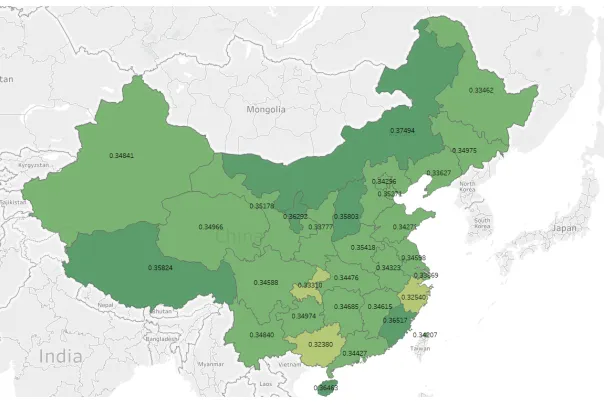
Another analysis, shown in Figure 8, presents average sentiment in all posts that men-tioned GBR depending on province where user opened their accounts. It is possible to see that some provinces have higher or lower sentiment, which could be investigated and found the reason for hihger or lower sentiment toward the GBR and findings can be used for change in marketing strategy. This is another sample how meta data can be used.
Also, we noticed that about 15% od posts have exact geographic locations (longitude, latitude) of posts, which can be used to identifythe points of interest.
from November to February, covering several important holidays such as Christmas and New Year’s Eve. Our finding correlates with this observation.
Fig. 8.Heat map of average sentiment in posts that mentioned GBR, depending on where users originate from
tap into available social media post and perform Big Data analytics. Due to the fact that there are many Chinese tourist in Australia, specifically in area of Great Barrier Reef, we decided to gain insight into tourists with Chinese background by capturing and calculating sentiment of Sina Weibo Chinese social media posts.
Despite sentiment analysis is well researched and matured area for English language there is limited attention for Chinese language and is mostly concentrated to lexicon cre-ation, which itself are small and do not have word sentiment intensities. To overcome shortcomings of existing approaches, in this work we proposed and tested method to identify sentiment in Chinese social media posts. We developed method to crawl the web and specifically collected Weibo posts that mentioned word Great Barrier Reef both in Chinese language and English language. We also elaborated process of capturing, man-aging, described creation of comprehensive Chinese lexicon with sentiment intensity and proposed algorithm for sentiment calculation. In contrast to all other existing methods proposed method takes into consideration length of the text as well as number of identi-fied words in lexicon. To the best of our knowledge this is the very first method which avoid bias because there are more negative than positive words in lexicon and therefore longer posts tend to be more negative, due to the fact that in longer posts there are more likely to have more matching words in lexicon.
Additionally we provided samples of other valuable information, as a proof of con-cept, which can be extracted from social media posts meta data; such as where from Chinese people who have interest and comment on GBR originate from as well as what is the average sentiment depending on locations users indicated as their place of residence. In case study related to sentiment toward the different GBR destinations we demonstrated that the proposed method is effective to obtain information and to monitor visitors’ opin-ion.
As of future work to further improve accuracy of sentiment analysis a more compre-hensive lexicon is needed, especially a lexicon that can include words that people like to use in social media, as well as emoji, need to be taken into consideration.
References
1. Alaei, A.R., Becken, S., Stantic, B.: Sentiment analysis in tourism: Capitalizing on big data. Journal of Travel Research 58(2), 175–191 (2017)
2. Ansjsun:http://www.cnblogs.com/en-heng/p/6274881.html
3. BBC: Sina weibo ends 140-character limit ahead of twitter (2016), https://www.bbc.com/news/technology-35361157
5. Chen, J., Wang, S., Stantic, B.: Connecting social media data with observed hybrid data for environment monitoring. In: Proceedings of the 11th International Symposium on Intelligent Distributed Computing - IDC 2017. pp. 125–135 (2017)
6. Chen, S., Ding, Y., Xie, Z., Liu, S., Ding, H.: Chinese weibo sentiment analysis based on character embedding with dual-channel convolutional neural network. In: 2018 IEEE 3rd In-ternational Conference on Cloud Computing and Big Data Analysis (ICCCBDA). pp. 107–111. IEEE (2018)
7. Chinese Sentiment Word Weight Table, BoYuan, T.U.:https://github.com/bung87/ bixin/tree/master/dictionaries
8. Claster, W.B., Cooper, M., Sallis, P.: Thailand–tourism and conflict: Modeling sentiment from twitter tweets using na¨ıve bayes and unsupervised artificial neural nets. In: Computational In-telligence, Modelling and Simulation (CIMSiM), 2010 Second International Conference on. pp. 89–94. IEEE (2010)
9. Dong, P.Z.: Hownet (2000),http://www.keenage.com/html/e_index.html 10. Duong, C.T., Nguyen, Q.V.H., Wang, S., Stantic, B.: Provenance-based rumor detection. In:
28th Australasian Database Conference - ADC. pp. 125–137 (2017)
11. Fan, B.: Weibo data report in 2016 (2016), http://data.weibo.com/report/reportDetail?id=346 12. Greatbarrierreef: www.greatbarrierreef.org,
http://www.greatbarrierreef.org/about-the-reef/great-barrier-reef-facts/ 13. Hua-ping, Z., Qun, L.: Ictclas (2013)
14. Hutto, C., Gilbert, E.: Vader: A parsimonious rule-based model for sentiment analysis of social media text. In Proceedings of the 8th International AAAI Conference on Weblogs and Social Media (2014)
15. instagram: instagram (26 April,2017), http://blog.instagram.com/post/160011713372/170426-700million
16. Kasper, W., Vela, M.: Sentiment analysis for hotel reviews. In: Computational linguistics-applications conference. vol. 231527, pp. 45–52 (2011)
17. Kim, S.E., Lee, K.Y., Shin, S.I., Yang, S.B.: Effects of tourism information quality in social media on destination image formation: The case of sina weibo. Information & Management 54(6), 687–702 (2017)
18. Kirilenko, A.P., Stepchenkova, S.O., Kim, H., Li, X.: Automated sentiment analysis in tourism: Comparison of approaches. Journal of Travel Research p. 0047287517729757 (2017) 19. Leung, D., Law, R., Van Hoof, H., Buhalis, D.: Social media in tourism and hospitality: A
literature review. Journal of Travel & Tourism Marketing 30(1-2), 3–22 (2013)
20. Li, J.: Chinese positive and negtive lecxion (22 January,2011), http://nlp. csai.tsinghua.edu.cn/site2/index.php/resources/13-v10%
20Seeaustralia,%202017
21. Li, X., Li, J., Wu, Y.: A global optimization approach to multi-polarity sentiment analysis. PloS one 10(4), e0124672 (2015)
22. Liu, Z., Shan, J., Balet, N.G., Fang, G.: Semantic social media analysis of chinese tourists in switzerland. Information Technology & Tourism 17(2), 183–202 (2017)
23. Manning, C., Surdeanu, M., Bauer, J., Finkel, J., Bethard, S., McClosky, D.: The stanford corenlp natural language processing toolkit. In: Proceedings of 52nd annual meeting of the association for computational linguistics: system demonstrations. pp. 55–60 (2014)
24. Osgood, C.E.: The nature and measurement of meaning. Psychological bulletin 49(3), 197 (1952)
25. Sina: (2009-2018), https://weibo.com
26. Stantic, B., Pokorn`y, J.: Opportunities in big data management and processing. Databases and Information Systems 270, 15–26 (2014)
33. Wang, M.H., Lei, C.L.: Boosting election prediction accuracy by crowd wisdom on social fo-rums. In: Consumer Communications & Networking Conference (CCNC), 2016 13th IEEE Annual. pp. 348–353. IEEE (2016)
34. Xiao, K., Zhang, Z., Wu, J.: Chinese text sentiment analysis based on improved convolutional neural networks. In: Software Engineering and Service Science (ICSESS), 2016 7th IEEE In-ternational Conference on. pp. 922–926. IEEE (2016)
35. Xu, L., Lin, H., Pan, Y., Ren, H., Chen, J.: Chinese emotional vocabulary. ???? 27(2), 180–185 (2008)
36. Xu, Y., Liu, Z., Zhao, J., Su, C.: Aweibo sentiments and stock return: A time-frequency view. PloS one 12(7), e0180723 (2017)
37. Yin, F., Zhang, B., Su, P., Chai, J.: Research on the text sentiment classification about the social hot events on weibo. In: IEEE Advanced Information Management, Communicates, Electronic and Automation Control Conference (IMCEC). pp. 1537–1541 (2016)
38. Zeng, B., Gerritsen, R.: What do we know about social media in tourism? a review. Tourism Management Perspectives 10, 27–36 (2014)
39. zephoria: Valuable facebook statistics (2017), hhttps://zephoria.com/top-15-valuable-facebook-statistics/
40. Zhendong, D., Qiang, D.: Hownet And The Computation Of Meaning. World Scientific (2006) 41. Zhuo, S., Wu, X., Luo, X.: Chinese text sentiment analysis based on fuzzy semantic model. In: Cognitive Informatics & Cognitive Computing (ICCI* CC), 2014 IEEE 13th International Conference on. pp. 535–540. IEEE (2014)
Jinyan Chen is a doctoral student from the Department of Tourism, Sport and Hotel Management at Griffith University. Her research interest is related to Big Data Analysis in tourism and tourists travel pattern and sentiment. Jinyan has been also working as research assistant on different projects related to social media and tourists’ behavior.
Dr Susanne Beckenis the Director of the Griffith Institute for Tourism and a Professor of Sustainable Tourism at Griffith University, Australia. Susanne has published widely in the field of sustainable tourism, is on the editorial board of 10 journals, and works closely with Government, businesses and international organisations on issues related to tourism management.
Bela Stanticis Professor in Computer Science and Director of “Big Data and Smart Ana-lytics” Lab within the Institute of Integrated and Intelligent Systems at Griffith University. Bela is internationally recognized in field of Big Data analytics and efficient management of complex data structures. He successfully applied his research interdisciplinary to many areas including health, environment and tourism.