Volume 3, No. 1
April 1998
Newsletter of the Climate Variability and Predictability Programme (CLIVAR)
Exchanges
In this issue
New Director of the ICPO
Advertisement of a Senior Scientist
position at ICPO
International CLIVAR Conference
Investigating the Role of Polar Regions
in Global Climate
Paleoclimate record of climate: Polar ice
cores
CLIVAR related research in the tropical
Atlantic
The 1997-98 El Niño event
U.S. Atlantic Climate Variability
Experiment
CLIVAR VAMOS Planning Meeting
CLIVAR Calendar
1
3
3
4
6
9
11
12
14
16
New Director of the ICPO
D
ear CLIVAR community,It is with great pleasure that we announce the appoint-ment of Dr. John Gould as the Director of the Internation-al CLIVAR Project Office, to be co-located with the WOCE Project Office at the Southampton Oceanography Centre, Southampton, UK. John Gould will formally be-come ICPO Director on 1 April, 1998. We would like to welcome John on board and look forward to working with him during the coming exciting years for CLIVAR.
CLIVAR
- Exchanges
V
olume 3 No. 1, April 1998
WOCE Directorship, was also very supportive of the proposed changes. On the basis of these discussions, the Director of the World Climate Research Pro-gramme, Prof. Hartmut Grassl has offered the posi-tion to John Gould and he has accepted that offer.
The initial staffing plan to be put in place dur-ing 1998 will have two quite separate office struc-tures for WOCE and CLIVAR but with these sharing a strengthened secretarial and publications staff. The longer-term evolution of the Project Office structure will be discussed by the CLIVAR SSG at its late April meeting. Each branch of the Office will be headed be a Chief Scientist whose role will be to pro-vide advice to the Office Director on science issues. For WOCE this person will be Dr. Peter Saunders who has been on the staff of the WOCE IPO for the past 4 years.
We are currently recruiting for the CLIVAR Chief Scientist position. Applicants for the Director's position have been informed of the outcome of that competition and have been asked whether they wish their applications to remain active for the Chief Sci-entist position, now in the UK. An advert (see next page) will be posted in EOS and on various web sites within the next week. Please encourage likely candi-dates to apply for the post.
The movement of the office from Hamburg to Southampton will take time. Andreas Villwock and Anne Stephan will continue in the Office, working out of Hamburg, until the end of 1998. You should continue to contact them at the usual phone and fax numbers, emails and web sites. We will be negotiat-ing with nations to develop a broader fundnegotiat-ing base for the ICPO so that it will have adequate resources, including staff, to do the co-ordination and develop-ment that CLIVAR impledevelop-mentation requires.
Dr. Lydia Dümenil will complete her term as Acting Director and return to her research position at MPI as of 1 April. She stepped into the post at what was the busiest and most important time in the devel-opment of CLIVAR and she has successfully lead and guided the CLIVAR Project Office as it brought the Implementation Plan to fruition. We all owe her our gratitude; the SSG co-chairs and panel chairs are especially aware of how much work needs to be done to co-ordinate CLIVAR. Lydia won't be leaving CLI-VAR completely. She will continue as a member of the Asian-Australian Monsoon Panel and will be contributing as a scientist to CLIVAR's goals and ob-jectives.
Moving the CLIVAR Office out of Hamburg was not an easy decision. Germany and Prof. Lennart Bengtsson were early and strong supporters of CLI-VAR. We have been well supported and housed at the Max-Planck-Institut für Meteorologie (MPI). The assistance of MPI staff with regard to scientific and technical expertise has been frequent, vital and very much appreciated. Working with Lydia over the past seven months has also made us realize what a sacri-fice Lennart made when he encouraged her to serve as Acting Director. We very much appreciate Len-nart's and Germany's support over the years and hope that we can find mechanisms by which Germany and MPI can continue to play strong roles in CLIVAR planning and co-ordination.
Allyn Clarke and Kevin Trenberth CLIVAR SSG Co-chairs
D
ear CLIVAR community,I am pleased to have this opportunity to intro-duce myself to you as the New ICPO Director. For the past 4 1/2 years I have directed the WOCE IPO and helped steer WOCE through the end of its obser-vations and into an active analysis phase. It was a great honour to have been selected to head both the CLIVAR and WOCE International Project Offices.
CLIVAR presents many challenges as it builds on the legacies of TOGA and WOCE to address the climate issues that are now in the minds of a large part of the earth's population. I am convinced that it is sensible to bring these various research strands to-gether in one project stretching from the seasonal/in-terannual ENSO and monsoon phenomena, through the rapidly-emerging evidence of decadal variability in the climate system to the vexing questions of long-term climate change and mankind's possible influ-ence. All of these elements interact and CLIVAR needs to explore these interactions and to fit its re-search foci into a global framework of observations and modelling. The CLIVAR Conference in Decem-ber 1998 will be a key step in moving CLIVAR from planning to implementation.
In embarking on the task of ICPO Director I will endeavour to develop an Office that will be re-sponsive to the needs of the project and the individual scientists working in it and will help to raise aware-ness of the importance of the research being under-taken by CLIVAR. To do this I seek your help and co-operation in the coming years.
V
olume 3 No. 1, April 1998
CLIVAR
- Exchanges
INTERNATIONAL CLIVAR CONFERENCE
UNESCO, Paris, 1-4 December 1998
F
ollowing the successful TOGA (Tropical Ocean Global Atmosphere) and WOCE (World Ocean Cir-culation Experiment) programmes and responding to scientific challenges which evolved during those pro-grammes, CLIVAR, the Climate Variability and Pre-dictability Programme, has become the primary atmosphere-ocean research component of the World Climate Research Programme (WCRP). CLIVAR focusses on the role of the coupled ocean and atmos-phere within the overall climate system, with empha-sis on variability, especially within the oceans, on seasonal to centennial time scales.CLIVAR will study and continue to improve predictions of climate variability using existing, re-analyzed and new global observations, enhanced coupled ocean-atmosphere models, and paleoclimate records. CLIVAR will promote the development of skillful regional and global predictive models and will enable a more accurate detection of anthropo-genic modification of the natural climate. CLIVAR will strongly support the design and implementation of global ocean and atmosphere observing systems for long-term climate research and will specifically address the variability of regional coupled
ocean-at-mosphere systems such as monsoons in relation to global patterns such as ENSO. The CLIVAR Science Plan (WCRP No. 89, 1995) and the summary volume of the CLIVAR Implementation Plan (WCRP No. 101) provide extensive descriptions of the CLIVAR scientific foci and research goals. A more detailed In-itial Implementation Plan (WCRP No. 103) will be-come available in early summer 1998.
To advance the planning and begin the imple-mentation of CLIVAR, the WCRP sponsors, namely WMO, ICSU and IOC, will hold a major internation-al Implementation Conference on CLIVAR at UNESCO Headquarters, Paris, France, from 1 to 4December 1998. Dr. D. Carlson of NCAR, USA, chairs the international Conference Organizing Com-mittee.
The purpose of the Conference is to:
• present the Initial CLIVAR Implementation Plan to nations;
• receive comments on and endorsement of the Plan;
• receive expressions of interest in and commit-ments to CLIVAR;
• set time scales and priorities for implementing individual elements of the Plan based on these commitments and subject to any major gaps which are identified;
• examine and make recommendations for institu-tional arrangements to support CLIVAR;
ADVERTISEMENT
SENIOR SCIENTIST
INTERNATIONAL CLIVAR PROJECT OFFICE
The CLIVAR (Climate Variability and Predictability) project is building on existing research to implement a major programme of observations and modelling of the physical climate system.
The project plans to appoint a Senior Scientist to work in the International CLIVAR Project Office. Following the appointment of Dr. John Gould as the ICPO Director, the Office will relocate during 1998 to be co-located with the World Ocean Circulation Experiment IPO in the Southampton Oceanography Centre, Southampton, UK.
The CLIVAR Senior Scientist will work with the ICPO Director and staff to implement a coherent international research effort that will achieve the project's objectives. A proven record in a CLIVAR-related research area and an ability to work effectively in a small team are required. The candidate should be fluent in English. The post may be supported from funds already allocated to the CLIVAR Office or could be a secondment from a country or organisation willing to make a commitment to CLIVAR.
Applications, including a curriculum vitae, an outline of the candidate's experience in CLIVAR-related science and the names of 3 referees should be sent to:
Dr. W. John Gould, Director ICPO, SOC, Empress Dock, Southampton, SO14 3ZH, UK. Fax (+44) 1703 596204 no later than 24 April 1998.
CLIVAR
- Exchanges
V
olume 3 No. 1, April 1998
• ensure linkages are in place for society to benefit from advances made by CLIVAR
The Conference will begin with an overview of the Implementation Plan. This will be followed by na-tional comments and responses and a detailed assess-ment of resource commitassess-ments and gaps. Lastly, the Conference will address ways of participating in CLI-VAR, finding the needed resources, and determining whether the existing institutional arrangements are appropriate and sufficient. The outcome of the confer-ence will provide the CLIVAR Scientific Steering Group and national funding agencies with guidance on the priorities and how to implement CLIVAR. All countries will be asked to come to the conference with a written statement detailing their interest and likely commitments to and comments on the Imple-mentation Plan. These will be requested well before the start of the conference to ensure their availability to all participants and facilitate the proceedings. This exchange of information will be important to ensure the effectiveness of the conference since only limited time will be available at the conference for oral pres-entations.
Further information about the Conference can be obtained by returning the attached pre-registration form or by contacting the Conference Secretariat at ICPO, c/o MPI, Hamburg, Germany.
Investigating the Role of Polar Regions in
Global Climate
Douglas G. Martinson, Lamont Doherty Earth Observatory, Palisades, NY, USA and CLIVAR SSG
M
uch of my research has been motivated by the premise that the polar regions play a significant and complex role in global climate.Conceptually, this influence is often attributed to the fact that the poles lock the cold-end of the pole-to-equator thermal gradient which drives the Earth's climate. Changes in polar region temperature, and thus presumably this gradient, can be driven by a mul-titude of geographically-unique polar processes such as the ice-albedo feedback, ice-cloud feedback, ocean-ice feedback, deep convection, and ice sheet-ocean feedbacks.
Unfortunately, exactly how, or even whether, these different processes actually influence the trans-fer of heat from the equator to the pole is not fully un-derstood. At the moment, our best estimate of what
mechanisms are involved is determined through mod-el studies. This reflects the fact that it is extremmod-ely dif-ficult to collect data in the hostile polar regions so we are hindered in our ability to fully address these issues through observations themselves. However, models do provide support to the notion that changes in the polar regions may significantly influence global cli-mate. For example, several studies using models that attempt to simulate the earth's climate suggest that reasonably-sized changes in the ice albedo or other polar surface conditions, have consequences that are ultimately felt globally. Most dramatically, recent nu-merical simulations of global climate, under condi-tions of doubled atmospheric CO2 using the GISS atmospheric general circulation model, have shown that over one-third of the annual average global warm-ing in that model is attributed (directly and indirectly) to the response of the sea ice distribution (Rind et al., 1995).
In addition to these expected influences on present day climate, other studies suggest that chang-es in the polar ice fields may help trigger the ice agchang-es through amplification of the small Milankovitch forc-ing; alter the global deep water circulation; and insti-gate dramatic abrupt changes in climate. In addition, climate change may alter the mass balance of the polar ice sheets, or even destabilize the West Antarctic ice sheet, driving considerable sea level change. Beside their potentially unique role in the Earth's climate sys-tem, the polar regions provide some of the best diag-nostics for studying climate in the form of high resolution ice cores. Finally, being one of the most easily and unambiguously observed properties of the Earth's surface from space, sea ice is often targeted as an early warning indicator of greenhouse warming -assuming we can understand how to interpret any ob-served change.
While the potential influences of the Ocean-At-mosphere-Ice (OAI) system on global climate are tan-talizing, most have yet to be validated and mechanisms have yet to be proposed. Therefore, in or-der to properly represent polar oceans in global cli-mate models and ulticli-mately predict the influences they may impart, it is necessary to: (1) document that polar regions do indeed influence global climate, and establish the distribution and nature of the links (or teleconnections), (2) isolate those characteristics and/ or variables of the polar oceans that seem most likely to drive the extra-polar responses, and (3) determine the mechanisms, interactions and various feedbacks that control the evolution and response of these criti-cal characteristics or variables.
V
olume 3 No. 1, April 1998
CLIVAR
- Exchanges
role of the ocean-atmosphere-ice (OAI) system. Sea ice, at the interface in this system, is clearly the distin-guishing characteristic that differentiates polar oceans from all others. The temporal and spatial distribution of this sea ice reflects a complex interaction between the ice, ocean and atmosphere. The complexities are underscored by the fact that the sea ice (and snow cov-er) plays a central role in the surface heat balance through its high albedo and albedo feedbacks, ice-cloud feedbacks, strong insulation capability that min-imizes the ocean-atmosphere exchange of heat and at-mospherically-active gases, and ability to influence the ocean sensible heat flux. The latter is due to the role of sea ice in the upper ocean stratification, partic-ularly through its prominent role in the surface fresh-water balance and its salt rejection during ice growth, and its ability to modify the atmosphere-ocean mo-mentum transfer.
Much of my research has involved process-ori-ented modelling studies and field programmes de-signed to better understand and quantify these complex OAI interactions and their role in the ice dis-tribution, underlying ocean stratification and deep wa-ter formation. Such studies typically fall under the auspices of CLIVAR's companion WCRP gramme: ACSYS, as well as SCOR and SCAR pro-grammes, all of which, among other things, strive to improve our understanding of the important regional and local polar processes underlying the global scale impacts and interactions. Of more direct interest to CLIVAR itself, particularly Section D5 of the CLI-VAR Implementation Plan, I and a Lamont colleague, Xiaojun Yuan, have undertaken a study designed to identify the linkages between the Antarctic polar sea ice fields and global climate (Yuan and Martinson, 1998). Simultaneously, I and another Lamont col-league, Richard Iannuzzi, have been examining the nature of the spatial and temporal distribution of the upper ocean characteristics within the polar gyres in an attempt to identify those physical changes in the polar ocean that covary with the extra-polar climate variations (Martinson and Iannuzzi, 1998, and work in progress).
With regard to our study investigating the role of Antarctic sea ice in global climate, our specific ob-jectives were to quantify: (1) the variability docu-mented in Antarctic sea ice fields themselves in an effort to identify specific patterns of variability and their characteristics; and, (2) the distribution and sig-nificance of linear covariations between the Antarctic sea ice fields and regional climate elsewhere on the globe. With regard to the latter, we wished to identify: regions around Antarctica with the strongest global
connectivity; extra-polar regions with strongest links to the Antarctic sea ice fields; and linkages with fun-damental modes of climate variability (e.g. ENSO, PNA, NAO, etc.).
For convenience, we used 16 years of satellite microwave data to generate a sea ice edge (SIE) index reflecting monthly anomalies from climatology of the northernmost latitude of the ice edge. The index was detrended and binned into 10 degree bands around Antarctica (which approximates the spatial decorrela-tion length). These SIE anomaly time/space series were then compared to extra-polar climate data con-sisting of: (1) Jones' (1986) monthly mean near-sur-face temperature anomaly data for the globe on a 5˚ x 5˚ grid from 1975 to 1993; (2) the time series (princi-pal components) of the leading EOFs for the near sur-face temperature data; and (3) standard climate indices such as Niño-3 (an ENSO proxy), a tropical land precipitation index (28˚S - 28˚N), a tropical Indi-an OceIndi-an SST index (Indi-an IndiIndi-an monsoon intensity proxy), and indices for the NAO and PNA. Particular care was given to evaluating the statistical signifi-cance of the extensive correlations using Monte Carlo and resampling statistics to account for spatial and temporal correlations inherent in the data.
Variability within the Antarctic sea ice fields is characterized as follows. Spatially, the SIE anomaly is strongest in regions around the Antarctic: the eastern Pacific (Amundsen and Bellinghausen Seas; 50-90˚ W), eastern Weddell gyre/western Indian Ocean (0-50˚ E) and Weddell Sea (20-30˚W). Temporally, the variability is concentrated roughly in cycles of 1-2 and 4-5 years. The 4-5 year cycle is associated with a co-herent mode of behaviour that displays a wavenumber 2 pattern that has been named the Antarctic Cir-cumpolar Wave by White and Peterson (1996). This pattern is clearly apparent without any filtering of the data, and it shows eastward propagation of the SIE anomaly, strong covariability with ENSO and even stronger covariability (though only marginally so) with the Asian monsoon index. The spatial coherence of this pattern appears to be constrained to the three primary gyre regions around Antarctica, with little signature between them. This suggests to us that the signal is not spatially continuous in the SIE, and there-fore, likely to represent the individual response of each polar gyre to a spatially-continuous atmospheric forcing. The 1-2 year cycle appears to be regional in extent and does not show any clear evidence of prop-agation.
expect-CLIVAR
- Exchanges
V
olume 3 No. 1, April 1998
ed by correlating to red noise. Specifically, the Weddell Gyre/western Indian Ocean region, and East-ern Pacific region of Antarctic shows the strongest global connectivity, particularly with regions linked by ENSO/Monsoon variability, while the Weddell Sea shows strong correlation with the climate mode dominated by the tropical and northern Atlantic SST variability. In general, the SIE appears to be well cor-related to the first two modes of global climate varia-bility as expressed by the EOF analysis; the first mode is dominated by ENSO. Some of the correlations show the ice leading changes in extra-polar surface temperature, while others show a lag. We are current-ly investigating the significance and implications of the leads and lags, and isolating those regional corre-lations that most likely reflect causal links.
References:
Jones, P.D., 1994: Hemispheric surface air temperature var-iations: a reanalysis and an update to 1993. J.Climate, 7, 1794-1802.
Martinson, D.G. & R. A. Iannuzzi, 1998: Antarctic Ocean-Ice Interaction: Implications From Ocean Bulk Property Distributions. Antarctic Research Series Volume on Ant-arctic Sea Ice Physical Properties and Processes, AGU, M. Jeffries, ed., in press.
Rind, D., R. Healy, C. Parkinson and D. Martinson, 1995: The role of sea ice in 2xCO2 climate model sensitivity. Part I: The total influence of sea ice thickness and extent. J. Cli-mate, 8, 449-463.
White, B. W. and R. G. Peterson, 1996: An Antarctic cir-cumpolar wave in surface pressure, wind, temperature and sea ice extent. Nature, 380, 699-702.
Yuan, X. and D.G. Martinson, 1998: Spatial/Temporal Var-iations in Antarctic Sea Ice and Its Global Connectivity. J. Climate, in revision.
Dr. Douglas G. Martinson is senior research sci-entist at Lamont Doherty Earth Observatory, Pali-sades, USA of Columbia University, and adjunct professor in Columbia's Department of Earth and En-vironmental Sciences. He got his M.A and his Ph.D. at the Lamont Doherty Geological Observatory in 1979 resp. 1982. During 1982 to 1984 he did research on a postdoctoral position at Woods Hole Oceano-graphic Institution. In 1984 he returned to Lamont as a research associate and adjunct professor, where he
has been ever since. He has also worked at the Alfred Wegener Institute for Polar and Marine Research in Germany (1988) and the Université Catholique de Louvain in Belgium (1992) as a visiting scientist. His successful scientific career is documented in a long list of publications, his participation as a PI or chief scientist on a number of cruises, mainly in the Wed-dell Sea and in the tropical Atlantic. Additionally, he won a number of awards and fellowships and is very active in many scientific committees, e.g. the Scientif-ic Steering Groups of CLIVAR and ACSYS, as the chairman of the NRC DecCen panel, and his present and past memberships in various NRC, NSF and NASA committees.
Paleoclimate record of climate: Polar ice cores
Jean Jouzel, LSCE Saclay and CLIVAR SSG
V
olume 3 No. 1, April 1998
CLIVAR
- Exchanges
contain.
Ice cores offer the opportunity to obtain high resolution (annual or even seasonal) records and give access on a continuous and largely quantifiable basis to the most important climatic parameters. Except for regions such as the East Antarctic Plateau where accu-mulation is too low, the existence of seasonal varia-tions in the isotopic or chemical composition of the ice allows accurate dating and, correspondingly, accu-rate estimates of the annual precipitation. Information on local temperature changes can be inferred from the deuterium or oxygen 18 content of the ice whereas an-nual accumulation can be estimated from the exist-ence of seasonal variations. Information about atmospheric circulation can be retrieved from the changes in the concentration of aerosols or chemical compounds. In parallel, the analysis of trapped air bubbles and of various impurities contained in the ice allows reconstruction of changes in the chemical and gaseous composition of the atmosphere. This gives access in particular to the concentration of aerosols of various origin (terrestrial, marine, volcanic, anthropo-genic or cosmoanthropo-genic) and of greenhouse gases.
EPICA is a long-term (~7 years) European deep ice-core drilling project in Antarctica to derive high resolution records of climate and atmospheric compo-sition through several glacial-interglacial cycles. The project, in which 10 European countries are involved, is designed to complement the highly successful cen-tral Greenland projects and it will allow extension and full documentation of the East Antarctic record so far essentially limited to the analysis of the Vostok core. To achieve EPICA's goals, it will be necessary to drill at two sites, both to achieve the required resolution on different time scales and an adequate continent-wide perspective. The first phase (1996-2000) focusses on the major climate shifts that have characterized the past several glacial interglacial cycles. This will be done by analyzing a 3500 m long ice core drilled at Dome Concordia, south of the Indian Ocean in East Antarctica. A core from this location, which is ideally placed to secure an undisturbed long record, will al-low examination of the relative phasing of climate and climate-forcing parameters associated with these ma-jor climate-change events. During the second phase of the project, a core will be obtained from Dronning Maud Land, an area of Antarctica most strongly influ-enced by the Atlantic ocean, and a region of somewhat higher annual snowfall rate and thinner ice cover. This phase of the project is designed to focus specifically on the rapid climate oscillations that have been detect-ed across Greenland throughout the last glaciation, and that are believed to have been associated with
[image:7.595.326.542.194.511.2]mode-shifts in the Atlantic thermohaline circulation. Recent results have shown those North Atlantic rapid changes have counterparts in Antarctica and it is use-ful, and probably indispensable, to decipher the links between northern and southern hemisphere climate if we want to fully understand their behaviour. In this re-spect, obtaining high resolution records of the Antarc-tic climate is of relevance to CLIVAR.
Fig. 1: The Deuterium Excess d=δD-8*δ18O of the central Greenland ice core GRIP. The precision of the d measurements is +/- 0.9 permill. The excess signal is interpreted as a signal transporting informa-tion on the climatic condiinforma-tions (temperature, relative humidity) in the vapour source region to the deposi-tion site. The anomalous low deuterium excess in the 18th and 17th century indicates about 1 degree cooler conditions in the subtropical North Atlantic and thus corresponds to a cool period in Europe known as the Little Ice Age.
In MileClim, also a European project, informa-tion derived from ice-cores, corals and tree-rings will be combined to study the decadal-centennial climatic variability by looking at long time series of climatic and oceanographic parameters in the North Atlantic area over the last few centuries. In relatively high ac-cumulation areas such as central Greenland ice cores can be dated year by year by using seasonal changes
12 11 10 9 8 7
1800 1600 1400 1200 Deuterium Excess from GRIP for the last 800 Years
Deuterium Excess in Permill
CLIVAR
- Exchanges
V
olume 3 No. 1, April 1998
in various indices and absolutely dated volcanic events. Whereas past temperatures can be estimated from profiles of either deuterium, δD, or oxygen 18, δ18O additional information on the water cycle can be
obtained from the combination of these two isotopes through the deuterium excess (d=δD-8*δ18O). The deuterium-excess of a precipitation depends on the conditions (temperature, relative humidity and wind-speed) prevailing in the oceanic source region, and model results support the idea that polar deuterium ex-cess values contain information on meteorological conditions at distant evaporative sources. For exam-ple, we interpret the deuterium-excess decrease seen in the GRIP record between years 1640 and 1800 (see Figure 1) as reflecting lower temperatures in the North Atlantic during the Little Ice Age. This result, ob-tained in collaboration with the Geophysical Institute in Copenhagen, illustrates one promising use of water isotopes in ice cores in the context of CLIVAR.
Jean Jouzel is with the Laboratoire des Scienc-es du Climat et de l'Environnement (LSCE), a joint laboratory between the French Atomic Energy agency (CEA) and the Centre National de la Recher-che Scientifique (CNRS). In this laboratory located near Paris (Saclay and Gif sur Yvette) he is in charge of the climate group. Jean Jouzel has worked at CEA Saclay since 1968 and has also been with CNRS from 1988 to 1995 (as associate Director of LGGE, Laboratoire de Glaciologie et Géophysique de l'Environnement, in Grenoble). A geochemist, Jean Jouzel is a specialist of water stable isotopes in precipitation (deuterium and oxygen 18) and of their use to reconstruct past climates from ice cores.
As a result of isotopic fractionations that occur at each phase change of the water during its atmos-pheric cycle, the isotopic content of a precipitation strongly depends on the meteorological conditions that have prevailed from the origin of the air mass to the precipitation site. The present-day isotopic distri-butions are well documented with, at middle and high latitudes, a linear relationship between water isotopes and surface temperature particularly well obeyed over
polar ice caps. Jean Jouzel has dedicated part of his re-search to modelling the relationship between the deu-terium and oxygen 18 content of precipitation and meteorological parameters. This encompasses the de-velopment of dynamically simple isotopic models in which the complexity of the fractionation processes that occur in an air mass can be explicitly treated, as well as the implementation of water isotopes in atmos-pheric General Circulation Models. In this latter case, fractionation processes are highly parameterized but the dynamical complexity of the atmospheric process-es leading to the formation of precipitation can be tak-en into account. One of the advantages of isotopic GCMs is that they allow to simulate isotopic distribu-tions for different climate condidistribu-tions such as those of the Last Glacial Maximum. It is through this isotopic approach that he gained interest in paleoclimate mod-elling and initiated the launching of PMIP (Paleocli-mate Modelling Project) which under the responsibility of Sylvie Joussaume and Karl Taylor is now one key element of the global modelling effort in the CLIVAR programme.
One of the most useful characteristics of water isotopes is that they allow reconstructing past temper-ature changes from the isotopic content of ancient pre-cipitation; even if the present-day relationship between cannot be directly used for interpreting pale-odata it is recognized that the change in water isotopic contents registered in ice cores is a faithful paleother-mometer. Polar, and more recently tropical, ice cores have provided climatic series covering a variety of time scales. In close collaboration with his colleagues of LGGE Grenoble, Jean Jouzel has been involved in major international ice coring programmes, Vostok in Antarctica (collaboration between Russia, France and USA) and GRIP, a European Programme conducted in Central Greenland; he is currently chairman of EP-ICA (European Programme for Ice Coring in Antarc-tica).
[image:8.595.38.284.328.458.2]V
olume 3 No. 1, April 1998
CLIVAR
- Exchanges
CLIVAR related research in the
tropical Atlantic
Antonio J. Busalacchi, GSFC, Greenbelt, MD, USA and CLIVAR SSG
E
ven though significant advances in our ability to monitor, understand, and predict the coupled climate system were made during the TOGA Programme, most of the research on seasonal to interannual cli-mate variability was centred in the tropical Pacific Ocean. At the outset of CLIVAR, steps have been taken to build upon the accomplishments of TOGA and expand this focus both meridionally and zonally out from the low-latitude Pacific Ocean. This is be-ing enabled, in part, by routine global altimeter, scat-terometer, passive microwave, and rain radar obser-vations that were never realized during TOGA. Con-nections with higher latitudes are being considered from the point of view of tropical-subtropical Pacific ocean interactions and possible links to decadal vari-ability of the El Niño/Southern Oscillation (ENSO). Studies of the western Pacific warm pool are being broadened to include consideration of the Indonesian Throughflow and extension to the warm pool in the eastern Indian Ocean. Similarly, the tropical Atlantic Ocean is receiving increased attention not seen since the joint US-France SEQUAL-FOCAL experiment of 1982-1984.Although the tropical Atlantic basin is charac-terized by a fairly regular seasonal cycle, it can also
experience significant anomalous perturbations (Fig-ure 1). While the frequency and amplitude of such deviations from climatology may be smaller than in the Pacific, their socio-economic ramifications can be, nonetheless, quite severe. This holds for countries that border the Atlantic on both ends of the basin where societies have become accustomed to a regular and unbroken seasonal cycle. Hence, when signifi-cant perturbations occur the societal impacts can be severe. For example, the Nordeste region of Brasil is a semi-arid area typified by subsistence farming among the population of approximately 30 million people. Through the course of Brasilian history this economically depressed portion of the country has undergone severe periodic droughts. It has been esti-mated that one of every three individuals born in the Northeast emigrates from the region. Brasilian liter-ature contains many accounts of large-scale migra-tions tied to the drought phases. More often than not the ‘Nordestinos’ flee to the favelas, or shantytowns, of the big cities such as Rio de Janeiro and São Paulo, or where they become a major source of labor in-volved in the tropical deforestation. Thus there is an intricate link between climatic and social change (and possible feedback onto the climate system in the case of Amazonia) going back at least 100 years. However, it has only been in the last 20 years that the scientific community has established a link between these droughts and cross-equatorial sea surface tem-perature (SST) patterns in the tropical Atlantic Ocean.
[image:9.595.65.420.514.765.2]The overarching scientific question for the
CLIVAR
- Exchanges
V
olume 3 No. 1, April 1998
tropical Atlantic sector centres on the role of the trop-ical Atlantic Ocean in influencing (i.e., initiating, regulating, and modulating) seasonal, interannual, and longer time scale climate anomalies both region-ally and hemisphericregion-ally. The key to an improved un-derstanding of the climatic influence of the tropical Atlantic Ocean is a better appreciation for the proc-esses that determine the space-time variability in SST within the basin. Superimposed on the mean seasonal cycle are two types of ocean-atmosphere variability. One potential mode of variability, which has no counterpart in the Pacific, is characterized by a north-south interhemispheric gradient in SST. This so called Atlantic dipole consists of anomalies of op-posite sign in each hemisphere with seasonal, inter-annual, and decadal time scales. The occurrence of these antisymmetric SST anomalies is not always si-multaneous and there is considerable debate regard-ing whether the northern and southern components are dynamically related in the form of a coupled mode. Notwithstanding this, changes in the meridi-onal gradient in SST are highly correlated with the north-south translation of the ITCZ and its influence on continental precipitation over South America and Africa.
A second type of climate variability in the trop-ical Atlantic is similar to the ENSO mode in the Pa-cific, with attributes centred mainly near the equator. This equatorial mode, like the interhemispheric di-pole, varies on seasonal to interannual time scales. During a warm phase, tradewinds in the western equatorial Atlantic are weak and SST near the equa-tor is unusually high, especially in the east. During a cold phase, the tradewinds in the western equatorial Atlantic are strong and SST near the equator is anom-alously low. The onset of an equatorial cold or warm event can occur rapidly on time scales of weeks to months, involving the excitation and propagation of wind-forced equatorial Kelvin and Rossby waves. Climatic impacts of equatorial warm events include increased rainfall in the Gulf of Guinea and the dis-ruption of the marine ecosystem in the Benguela cur-rent region.
The in situ observation system in the tropical Atlantic Ocean consists primarily of volunteer serving ships. The space-time coverage of these ob-servations is insufficient for monitoring the interannual variability across the basin. Recently, a Pilot Research Array in the Tropical Atlantic (PIRA-TA) has begun to be implemented to provide an im-proved description of the seasonal to interannual variability in the upper ocean and at the air-sea inter-face. Following the success of the TAO Array of
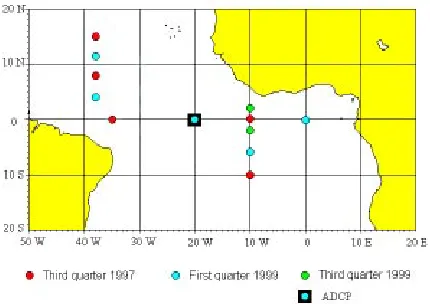
[image:10.595.312.527.166.318.2]moored buoys in the tropical Pacific, the joint Brasil-France-US PIRATA programme will deploy 12 moored ATLAS buoys between 1997 to 2000 for monitoring the surface variables and upper ocean thermal structure at key locations in the tropical At-lantic (Figure 2).
Fig. 2: Array design and deployment schedule for the PIRATA moorings in the tropical Atlantic.
The PIRATA array has been designed to pro-vide an improved understanding of the relative con-tributions of the different components of the surface heat flux and ocean dynamics to the seasonal and in-terannual variability of SST within the tropical At-lantic basin. The deployment of the first PIRATA moorings came at an opportune time as the tropical Atlantic Ocean was undergoing a significant anoma-lous warming (Figure 1) coincident with the ENSO event in the Pacific basin. More information on PI-RATA and the real-time data stream can be obtained from:
http://www.ifremer.fr/orstom/pirata/pirataus.html.
mod-V
olume 3 No. 1, April 1998
CLIVAR
- Exchanges
els combined with in situ and space-based ocean ob-servations to study the tropical ocean circulation and response to surface fluxes of momentum and heat. His research in these areas has supported a range of international and national research programmes deal-ing with global change and climate, particularly as affected by the oceans. Most notably, he has helped to define and plan the Tropical Ocean Global Atmos-phere (TOGA) Programme within the US. From 1989-1996 he served on the National Academy of Sciences/National Research Council (NAS/NRC) TOGA Advisory Panel and for 1991-1993 he was a member of the NAS/NRC Panel on Ocean Atmos-phere Observations Supporting Short-Term Climate Predictions. More recently, he has served on the In-ternational Science Steering Groups for CLIVAR, PIRATA, and VAMOS. Since 1985 he has served as Associate Editor of JGR Oceans and in 1997 began service as Editor of the Journal of Climate.
Since 1982 he has been an oceanographer at the NASA/Goddard Space Flight Center in Greenbelt, Maryland. In 1991, he was appointed to the Senior Executive Service in the U.S. Government as the Chief of the NASA/Goddard Laboratory for Hydrospheric Processes. In this capacity he furnishes scientific direction to a broad, many-faceted pro-gramme in Earth system science. NASA’s Laborato-ry for Hydrospheric Processes is responsible for an extensive range of programmes dealing with theoret-ical and experimental research in the oceanic, cry-ospheric, and hydrologic sciences. The expertise within the laboratory constitutes an end-to-end capa-bility involving instrument, algorithm, and numerical model development; the validation and analysis of remotely sensed data from a wide variety of sensors with in situ hydrological data, and ultimately, the ap-plication of these data to geophysical process studies and global change investigations. One example of which is the SeaWiFS ocean colour project within the laboratory which provides space-based daily esti-mates of chlorophyll concentration for the world’s oceans. Dr. Busalacchi has received numerous awards internal and external to NASA. Among these, in 1991, he was the recipient of the prestigious Arthur S. Flemming Award, as one of five outstand-ing young scientists in the US Federal Government. In 1995 he was selected as Alumnus of the Year at Florida State University and in 1997 he was the H. Burr Steinbach Visiting Scholar at the Woods Hole Oceanographic Institution.
The 1997-98 El Niño event
T
he development of the 1997-98 El Niño event in-to, by some measures, the biggest on record in over a century has given the CLIVAR community a won-derful opportunity to exploit an experiment mounted for us by nature. This event is the best observed ever and the worth of the TAO moored buoy system strad-dling the equatorial Pacific has been clearly demon-strated by its ability to provide data:1. that showed the evolution of subsurface tempera-ture anomalies exceeding 10oC at about 100 m depth, which developed into sea surface tempera-ture anomalies exceeding 5oC, and subsequently into a cooling of over 5oC that progressed east-ward; and
2. for initializing models for successful prediction of the future evolution.
Clearly, this event demands a careful, in-depth analysis of its many aspects and has lessons for CLI-VAR. It is expected that several workshops and con-ferences will touch on aspects important for a full post mortem of the 1997-98 event. There are a huge number of possible subtopics, with many of direct concern to CLIVAR. These would include a compre-hensive description of the event, diagnosis of proc-esses, verification of numerical predictions, verifi-cation of forecasts, forecast verifiverifi-cation techniques, implications for the observing system, implications for model development, whether global warming is playing any role, and possible process studies that should follow. Also of interest to CLIVAR, but more on the human dimensions and applications side, are topics such as: proliferation of “information” (e.g. on the World Wide Web - which has been of mixed quality), attribution of local and regional climate anomalies to the event, impacts of El Niño, the as-sessment of human dimensions information, actions taken or not taken, impacts of invalid forecasts, utili-ty of information, communication, and benefits of forecasts (mitigating losses etc.).
CLIVAR
- Exchanges
V
olume 3 No. 1, April 1998
(IDNDR), has led to the establishment of an El Niño “Task Force” encompassing several UN agencies and programmes. The WMO, for example, has been asked to take the lead in coordinating the provision of scien-tific and technical advice on El Niño, other agencies will coordinate the socioeconomic impacts and re-sponse aspects.
As the 1997/98 El Niño event has unfolded there have been several joint agency meetings and briefings for the press and Permanent Missions in Geneva on its status and expected course. These briefings and the fact that the WMO Secretariat itself felt compelled to issue a monthly “ENSO Update” has brought to the fore, with some force, the question of how the interna-tional community should approach the infrastructure requirements for making and disseminating informa-tion on operainforma-tional seasonal predicinforma-tions. The number of groups producing seasonal predictions is continu-ing to grow, and significantly we are beginncontinu-ing to see some of those predictions based on ensemble runs of coupled models.
To accelerate discussion on the question of in-frastructure and to link it to the response to the UN Resolution, the WMO under its Climate Information and Prediction Services (CLIPS) Project is conduct-ing a scientific and technical retrospective on the 1997/98 El Niño event. The results of this review will serve as a basis for discussion in a wider review of the event being organized by the UN Task Team. Specif-ically, the science and technical review will focus on the following three aspects:
• How good were the predictions of the 1997/98 El Niño event?
• How well was the event monitored?
• How effective was the communication of informa-tion on the event to governments, internainforma-tional relief agencies and to the public at large?
The review will make a preliminary assessment of the range of significant climate anomalies observed during the course of the event throughout the world that were due directly or indirectly to the event. How-ever, as noted above, it is expected that the 1997/98 El Niño event will occupy the interest and resources of the climate research community for some time to come.
Kevin Trenberth and Mike Coughlan
U.S. Atlantic Climate Variability Experiment
Antonio J. Busalacchi, GSFC, Greenbelt, MD, USA
A
planning meeting for the U.S. Atlantic Climate Variability Experiment (ACVE) was held in Dallas, Texas, from Feb. 2-4, 1998. This meeting was devel-oped to put together a plan for a U.S. contribution to CLIVAR along the lines of an Atlantic BECS (Basin-wide Extended Climate Study) activity.The meeting was opened with a series of scien-tific overview presentations on various aspects of the North Atlantic Oscillation (NAO) and tropical Atlan-tic variability. A historical overview of the NAO giv-en by J. Hurrell was followed by a presgiv-entation by P. Rhines on NAO and sub-polar gyres, and M. McCart-ney talked about the NAO and its signal at mid-lati-tudes. I. Held spoke about the NAO and atmospheric dynamics and Y. Kushnir gave a presentation on sta-tistical analyses of the NAO. Lastly, S. Zebiak spoke about climate variability in the tropical Atlantic.
In the following, three working groups were formed for the tropics, mid-latitudes, and sub-polar regions. The main topics or hypothesis of these work-ing groups can be summarized as follows:
1. Within the tropics, three main hypotheses were considered.
(i) The first being the negative/positive coupled ocean atmosphere feedback mechanisms for-warded by P. Chang as it relates to the meridi-onal SST gradient and changes in location of the ITCZ.
(ii) Next, was the discussion of tropical subtropical interactions. The mechanism of Gu and Philan-der was discussed as probably not being oper-ant whereby a |v|T' signal comes in to the tropics, but rather in the tropical Atlantic there may be a possibility of a v'|T| impact on tropics. (iii) The third hypothesis discussed was the impact of the ENSO signal projecting into the Atlantic Ocean.
2. The mid-latitude working group discussed SST forcing of the mid-latitude atmosphere, the need for enhanced work on coupled ocean atmosphere modelling, and the extent to which there is cou-pling at mid-latitudes, and the need for enhanced resolution in these coupled studies. The need to better understand the propagation of heat content anomalies was emphasized.
V
olume 3 No. 1, April 1998
CLIVAR
- Exchanges
how to measure air sea fluxes and energy balance of the atmosphere, the NAO with apparent interac-tion with the stratospheric polar vortex, and a white/red noise model for the ocean.
The second day of the meeting started with some brief presentations of related and relevant activ-ities. C. Wunsch spoke about global ocean data assim-ilation followed by a presentation of B. Owens on the proposed ARGO array, a global array of 3,000 PAL-ACE floats of which order 750 per year are to be de-ployed to monitor the upper 1,000 meters of temperature and salinity. B. Molinari talked about the ACCE cross gyre exchanges being measured with floats and drifters whereas M. Visbeck reviewed some of the European activities in the Atlantic. W. Robin-son presented AGCM responses to mid-latitude SST anomalies, followed by R. Saravanan speaking on coupled model responses to SST as they compare with correlation analyses of observations.
In summary there is little evidence of the NAO being a coupled mode in terms of the mid-latitude atmos-phere responding to sea surface temperature anoma-lies. It was evident that there was a certain amount of “hope” from some of the oceanographers in attend-ance that there might exist a coupled mid-latitude SST atmosphere mode. In terms of predictability, the pros-pects are much better in the tropics for coupled mode behaviour. In terms of the clarity of understanding at this point, there was mention that the order might rank tropical dipole, North Atlantic Oscillation, and then the link between the two phenomena.
The participants formed two new working groups, one addressing numerical studies and the oth-er one working on historical data.
The working group on historical data came out with two major recommendations. One was to secure re-sources to establish an Atlantic Climate Variability Data Center and the other was the need for strong con-nection to the Paleo climate community.
The modelling group addressed the issues related to the tropics and to the NAO / resp. anthropogenic change separately.
The discussions for the tropics can be summa-rized as follows: There were three main hypotheses: 1. The Atlantic dipole as modelled by P. Chang and
that this approach was really the bottom of a required hierarchy of systems that needed to be considered in more sophisticated coupled models. 2. The second hypothesis was the interaction between
tropics and subtropics for the ocean via a subduc-tion mechanism which could be attacked initially from an ocean only mode forced with NAO wind patterns (and also the need to consider the links
from the south Atlantic). Next might come atmos-pheric AGCM studies to consider the feedback from the ocean to the atmosphere.
3. The last hypothesis question was how do ENSO anomalies manifest themselves over the Atlantic Ocean? This is primarily an AGCM approach.
For modelling issues addressing the NAO and higher latitudes, the question involved is, how much of the observed variability in the NAO is internal to the atmosphere. This would require a quantification of modes of variability in the atmosphere, how does the atmosphere respond to SST anomalies, what are the time scales in which the ocean is active, and the use of ocean models as synthesis tool to perform budget ex-periments. Another area of interest was the potential anthropogenic affect on the collapse of the thermoha-line cell.
CLIVAR
- Exchanges
V
olume 3 No. 1, April 1998
question was what determines ocean heat content variability and does the atmosphere respond to this? Observations and support of this question would in-volve tracking water mass anomalies, studies of at-mospheric boundary layer physics, budgets in the atmosphere and the ocean, and sustained observa-tions, e.g. in Florida Straits, Bermuda, Labrador, etc. P. Rhines presented the observational strategy for the sub-polar regions. This is an area of important water mass transformation in the center of activity for the NAO, and an area of fast transients in the ocean. Among the topics and issues were the need to better understand the freshwater cycle, Arctic-Atlan-tic convection, which would include instrumentation of the Canadian Archipelago, hydrographic studies, monitoring the Fram and Denmark straits. Next, sub-polar water masses for which it was proposed to im-plement a VOS line along 60oN, standard hydrogra-phy moorings, and PALACE floats. For sub-polar subtropical connections, monitoring boundary cur-rent outflow, and the use of IES and deep ADCP's was mentioned. Not much was discussed with re-spect to the atmosphere other than the need for ex-tended high resolution studies of the ETA model and high resolution re-analyses. Potential process exper-iments at the high latitudes might involve studies of entrainment and water mass transformation and overflows, the rapid recycling pathways, and wind/ buoyancy forced transients.
The third day of the conference started with an-other set of short presentations on relevant activities in which S. Esbensen spoke about PACS, R. Mechoso on VAMOS, and B. Large speaking about the European Center and NCEP re-analyses.
In summary the following issues were addressed by ACVE:
• the response of the atmosphere to SST anomalies, • coupled interactions of tropical Atlantic
variabil-ity,
• the basin scale ocean response to atmospheric or to NAO forcing, and
• coupling between tropical Atlantic variability and the mid-latitude/NAO.
At the end of the meeting a potential timeline was discussed for ACVE planning: March 30, first draft of ACVE document; April 30, revised draft to larger group; May 12, Euroclivar meeting on Atlantic variability; mid-June, the formation of an observing system design group. A workshop on atmospheric re-sponse to SST anomalies in autumn was discussed as well as a timeline for the launching of proposals to the funding agencies (NSF).
A summary of the day also included discus-sions of data analysis, modelling, and observations,
as the three components of ACVE. At this point, however, no real process studies have been brought to the table. As a result of this meeting, a U.S. per-spective on Atlantic CLIVAR will be brought to the Euroclivar meeting in Florence to determine to what extent it matches and is complementary to European interests. This will then serve as a basis to establish the level of commitment and co-ordination with Eu-rope.
CLIVAR - VAMOS Planning Meeting
Jan. 12, 1998, Hyatt Regency Hotel, Phoenix, USA
T
he session was opened by the chairman of the CLIVAR - VAMOS panel, Prof. C. R. Mechoso. 15 participants were able to attend this planning meet-ing.The purpose of this meeting was to review the progress since the CONAM (Conference on Ameri-can Monsoons) conference held in March 1997 and to prepare the future panel meetings and a workshop to be held by this group. In particular this meeting should:
• Review the VAMOS panel objectives and their place in CLIVAR;
• Discuss the way in which programme compo-nents will participate in the overall structure of CLIVAR;
• Develop plans for future activities.
Prof. Mechoso recalled the draft terms of refer-ence given by the CLIVAR SSG for the CLIVAR VAMOS panel:
• To be responsible to the CLIVAR SSG for the for-mation of a detailed scientific plan and conceptual design of an international project to investigate the variability and predictability of the American monsoon systems (VAMOS) in the context of glo-bal climate variability and predictability.
• To develop an implementation plan for a VAMOS project for consideration by the CLIVAR SSG. • To co-ordinate and promote interactions amongst
meteorologists, oceanographers and hydrologists from interested nations to work on VAMOS prob-lems.
• To oversee the implementation of a VAMOS project.
CLIVAR
- Exchanges
V
olume 3 No. 1, April 1998
Please return to the International CLIVAR Project Office by mail or email ([email protected]) Special requests:
Change of address
Please send CLIVAR-Exchanges to the following address: Remove as recipient
Name:
(Title) (First) (M.I.) (Last)
Organization:
Mailing address:
City: State: Zip: Country:
Telephone: Fax:
E-mail address:
❑
❑
❑
✎
organizations interested in this area of research, e.g. the Inter-American Institute, the International Research Institute for Seasonal to Interannual Prediction, PACS, GEWEX and START.
Prof. Mechoso emphasised the importance of this programme especially for the South American countries. He reported from a tour he made in De-cember taking him to Brazil, Argentina, Uruguay and Chile to promote the VAMOS programme in South America. The initiative was very well received at funding agencies, universities and meteorological services. Prof. Mechoso recommended that work on this programme should start as soon as possible. In the following there was a comprehensive discussion about the programmes participating in VAMOS. Dr. Victor Magaña, one of the panel vice-chairs, was en-couraged to soon make a similar tour within Central America.
In the discussion about the framework that VA-MOS will provide, a number of participants stated that programmes like PACS, LBA, GCIP will cer-tainly support the needs of VAMOS and VAMOS may build on the outcome of those programme. On the other hand those programmes are independent projects from VAMOS, i.e. VAMOS cannot set the directions of those programmes but can contribute to the closer co-operation between these projects and to the identification and remedy of gaps in their science plans.
The representative of the CLIVAR Project Of-fice, Dr. A. Villwock, reported about the progress made with the Initial CLIVAR Implementation Plan and the plans for the International CLIVAR confer-ence. As all other CLIVAR groups, the VAMOS panel should prepare a presentation of the project at the Conference. Thereafter, the co-chair of the
CLI-VAR SSG, Dr. K. Trenberth presented some guide-lines how the CLIVAR core projects should work out their specific implementation plans with special em-phasis on readiness, feasibility and prioritization.
In the following, the planned VAMOS/PACS Workshop on Field Programmes and the first session on the VAMOS panel were discussed in depth. The original plan to have the workshop in March and a full panel meeting the following September was re-vised. First it was argued that there were issues of programme definition that required the panel to meet as early as possible. One example of this is the extent which VAMOS would like to achieve beyond the goals of PACS, LBA, etc. Second, it was considered that those issues had to be clarified in preparation to the VAMOS presentation at the CLIVAR SSG meet-ing in late April. It was decided that the workshop be held in conjunction with the first panel session in late March 1998. A general discussion about the principal scientific goals of VAMOS will be included as the first part of the workshop. The meeting should then review the existing observing system and the field programmes, identify the gaps and then develop plans to achieve the scientific goals of VAMOS. On the last day the VAMOS panel will meet to sum up the results achieved in the workshop, and to prepare for future activities.
The venue for the meeting will be São Paulo, Brazil. It was felt that a location in South America would set a positive sign on CLIVAR commitment for the countries involved in this project. About 30-40 peo-ple will be invited. NOAA/OGP and the CLIVAR will jointly fund and organise this meeting with local support. Prof. Edmo Campos (Univ. of São Paulo) would be asked to chair the local organizing commit-tee.
CLIVAR
- Exchanges
V
olume 3 No. 1, April 1998
CLIVAR- Exchanges
Newsletter of the Climate Variability and Predictability Programme (CLIVAR), published by the International CLIVAR Project Office, c/o Max-Planck-Institut für Meteorologie, Bundesstr. 55, D-20146 Hamburg, Germany, Tel.: +49-40-41173-412, Fax.: +49-40-41173-413, e-mail : [email protected]
ISSN No.: 1026 - 0471 Note on Copyright
Permission to use any scientific material (text as well as figures) published in CLIVAR-Exchanges should be obtained from the
CLIVAR
Calendar
For more information, please contact the ICPO or check out our web-page: http://www.dkrz.de/clivar/latest.html
1998 Meeting Location Attendance
March 29 - April 3 VAMOS/PACS Workshop in Field Programmes and CLIVAR VAMOS Panel - 1st Session
São Paulo, Brazil Invitation
April 20 - 24 23rd European Geophysical Society Meeting Nice, France Open
April 20 - 22 CLIVAR Asian - Australian Monsoon Panel, 2nd Session
Kyongju, Korea Invitation
April 21 - 23 International Conference on Monsoon and Hydrolog-ic Cycle
Kyongju, Korea Open
April 27 - 30 CLIVAR Scientific Steering Group, 7th Session Santiago de Chile, Chile
Invitation
April 27 - 29 CLIVAR Upper Ocean Panel, 3rd Session Toulouse, France Invitation
May 7 - 9 CLIVAR Africa Study Group Abidjan, Ivory Coast Invitation
May 11 - 14 Euroclivar Workshop on “The role of the Atlantic in climate variability”
Florence, Italy Invitation
May 24 - 29 International WOCE Conference Halifax, Canada Open
May 25 - 29 9th Conference on Satellite Meteorology and Ocea-nography
Paris, France Open
May 26 - 29 AGU Spring Meeting Boston, USA Open
June 3 - 5 Euroclivar Workshop on “African Climate Variabili-ty”
Bologna, Italy Invitation
July 7 - 14 COARE 98 Boulder, CO, USA Open
August 10 - 13 WOCE/CLIVAR Workshop on Ocean Modelling for Climate Studies
Boulder, CO, USA Limited
August 17 - 21 International Conference on Satellites, Oceanogra-phy and Society (Expo'98)
Lisbon, Portugal Open
September 14 - 16 Euroclivar Workshop on Climatic Impact of Scale In-teractions for the tropical Ocean-Atmosphere System
Paris, France Invitation
September 22 - 25 WOCE Indian Ocean Workshop New Orleans, USA Limited
October 12 - 16 WOCE Scientific Steering Group, 25th Session Brest, France Invitation
October 19-24 JSC/CLIVAR Working Group on Coupled Model-ling, 2ndSession
Melbourne, Australia Invitation
November 9 -13 CLIVAR - NEG-1 (preliminary date !) Palisades, NY, USA Invitation
November 9 - 13 CLIVAR/GCOS TAO Implementation Panel, 7th Session, PIRATA-5
Abidjan, Ivory Coast Invitation