Efficient Verifiable Fuzzy Keyword Search over
Encrypted Data in Cloud Computing
Jianfeng Wang1, Hua Ma1, Qiang Tang2, Jin Li3, Hui Zhu4,5, Siqi Ma6, and Xiaofeng Chen4⋆
1
Department of Mathematics, Xidian University, China [email protected],ma−[email protected]
2 APSIA group, SnT, University of Luxembourg 6, rue Richard Coudenhove-Kalergi, L-1359 Luxembourg
3 School of Computer Science, Guangzhou University, China [email protected]
4 State Key Laboratory of Integrated Service Networks, Xidian University, China
5 Network and Data Security Key Laboratory of Sichuan [email protected]
6 School of Computer Science and Technology, Xidian University, China
Abstract. As cloud computing becomes prevalent, more and more sensi-tive data is being centralized into the cloud by users. To maintain the confi-dentiality of sensitive user data against untrusted servers, the data should be encrypted before they are uploaded. However, this raises a new chal-lenge for performing search over the encrypted data efficiently. Although the existing searchable encryption schemes allow a user to search the encrypted data with confidentiality, these solutions cannot support the verifiability of searching result. We argue that a cloud server may be selfish in order to save its computation ability or bandwidth. For exam-ple, it may execute only a fraction of the search and returns part of the searching result. In this paper, we propose a new verifiable fuzzy key-word search scheme based on the symbol-tree which not only supports the fuzzy keyword search, but also enjoys the verifiability of the search-ing result. Through rigorous security and efficiency analysis, we show that our proposed scheme is secure under the proposed model, while correctly and efficiently realizing the verifiable fuzzy keyword search. The extensive experimental results demonstrate the efficiency of the proposed scheme. Keywords:searchable encryption, verifiable fuzzy search, cloud comput-ing.
1.
Introduction
As cloud computing becomes prevalent, storage outsourcing is widely used to reduce operational costs or private backups. By outsourcing their data in the cloud, data owners can obtain high quality data storage services, while reducing the burden of data storage and maintenance. To securely store the outsourced data on an untrusted cloud server, sensitive data should be encrypted before outsourcing [16], [18]. However, it is intractable for data owners to search the encrypted data in the server efficiently. The trivial solution of downloading the whole database and decrypting locally is clearly impractical, due to the huge amount of communication and computation cost [20]. Moreover, data owners may share their outsourced data with a large number of users. The individual users might want to only retrieve certain specific data files they interested in during a given session [15]. It is desirable to support the searching functionality on the server side, without decrypting the data and loss of data confidentiality. A popular method is searchable encryption, which can offer the user to selec-tively retrieve files through keyword-based search. In addition, the keyword pri-vacy should be protected effectively since keyword usually contains important information of the data files.
Although various searchable encryption schemes have been proposed to perform search securely and effectively without decrypting the data files, it is assumed that the server is “honest-but-curious”. Specifically, the cloud server will follow our proposed protocol, but try to find out as much secret information as possible based on their possessions. However, we noticed that the cloud server may be selfish in order to save its computation ability or bandwidth, which is significantly beyond the conventional “honest-but-curious” server model. We consider a stronger adversary called “semi-honest-but-curious” server [9]. That is, the server may execute only a fraction of the search and returns part of the searching result honestly. Chai et al. firstly addressed this problem and proposed a verifiable keyword search scheme (VSSE) in [9]. In their solution, when the search behavior is completed, the server needs to prove to the user that the search result is correct and complete, which is named asverifiable searchability. However, the solution only supports the exact keyword search. In 2010, Li et al. [15] proposed a fuzzy keyword search scheme over encrypted data in cloud computing. However, they have not considered the issue of verifi-able keyword search.
In this paper, we propose a new efficient verifiable fuzzy keyword search scheme, which not only supports verifiable fuzzy keyword search, but also re-duces the verifying computation cost toO(1). Specifically, our contribution can be summarized as follows:
– To the best of our knowledge, we propose the first verifiable fuzzy keyword search (VFKS) scheme, which not only enables fuzzy keyword search over encrypted data, but also maintains keyword privacy and the verifiability of the searching result.
– Our solution is highly efficient. For each query, the verifying computation cost is a constant complexity. Compared with the solution in [9], we reduce theverifying computation cost fromO(L)toO(1), whereL is the length of the searched keyword.
The organization of this paper is as follows. The related works are analyzed in Section 2 . Some preliminaries are given in Section 3.The proposed verifiable fuzzy keyword search scheme is given in Section 4. The extension scheme in hybrid cloud is given in Section 5. The security and performance analysis is given in Section 6 and 7. Finally, conclusion will be made in Section 8.
2.
Related Work
Recently, plaintext fuzzy keyword search solutions have been proposed [4], [14], [13]. These solutions are based on approximate string matching techniques, which allow user to search without using try-and-see approach for finding rel-evant information. At a first glance, it seems possible for one to directly apply these string matching algorithms to the context of searchable encryption by computing the trapdoors on a character base within an alphabet. However, this trivial construction suffers from the dictionary and statistics attacks and fails to achieve the search privacy.
Searchable encryption has also been studied in the asymmetric setting. The first public-key based searchable encryption scheme is presented by Boneh et al. [6] in 2004, where anyone with the public key can encrypt data but only au-thorized users with the private key are able to search. Subsequently, Abdalla et al. [1] proposed a novel public-key encryption with temporary keyword search. Compared to symmetric searchable encryption, public key solutions are usually very computationally expensive.
All existing secure index based schemes support only exact keyword search. Hence, such schemes are not suitable for cloud computing. Li et al. [15] pro-posed the first fuzzy keyword search over encrypted data in cloud computing, which utilized the multi-way tree to enhance the search efficiency. However, note that the semi-honest-but-curious cloud server may be selfish in order to save its computation ability or bandwidth. It may execute only a fraction of the search and returns part of the searching result honestly. To solve this problem, Chai et al. [9] proposed a verifiable SSE (VSSE) scheme, which ensures that the user can verify the correctness and completeness of the search result.
3.
Preliminaries
3.1. Notions
C= (F1, F2, . . . , Fn): a set ofnencryption files;
W ={w1, w2, . . . , wp}: the set of distinct keywords ofC; ID{Fi}: the identifier of documentFi;
IDwi: the identifiers of documents containing the keywordwi;
FK,·: a pseudo-random function; defined as{0,1}⋆×K→ {0,1}l; {Tw′}: the trapdoor set of all fuzzy keywords ofw′ ∈Sw,d;
△={αi}: the predefined symbol set, where|△|= 2n, andα
i ∈ △can be
denoted bynbits;
GW: a tree covering all fuzzy keywords ofw∈W is built up based on symbols
in|△|;
Tw[i]: the i-th symbol of the symbol sequence of trapdoorTw;
ord(Tw[i]): the alphabetic order of the characterTw[i]in△;
3.2. Definitions
A verifiable fuzzy keyword search scheme (VFKS) consists of the polynomial-time algorithms (Keygen,Buildindex,Trapdoor,Search), which are similar to those of standard symmetric searchable encryption scheme (SSE), as well as a new algorithmVerify. These algorithms are defined as follows:
– Buildindex(sk, W): This algorithm is run by the data owner to create the index. It takes a secretskand the distinct keyword setW of the document collectionCas inputs, and outputs a symbol-treeGW.
– Trapdoor(sk, Sw,d): This algorithm is run by the user to generate
trap-doors for all fuzzy keywords of the user input keywordw. It takes a secret keyskand a fuzzy keyword setSw,das inputs, and outputs a trapdoor set
{Tw′}w′∈S
w,d.
– Search(GW,{Tw′}): This algorithm is run by the server in order to search
for the files inCthat contain keywordw. It takes the symbol-treeGW of the
file collectionC and a trapdoor set{Tw′}of the fuzzy keyword setSw,das
inputs, and if search is successful outputsIDw and the proof, otherwise
outputs theproof.
– Verify(k, proof): This algorithm is run by the user to test whether the server is honest. It takes a secretkandproof as inputs, and outputsT rueif pass, otherwise outputsF alse.
Edit Distance Edit distance is a measure of similarity between two strings.
The edit distance ed(w1, w2) between two words w1 and w2 is the minimum number of operations required to transform one to the other. There are three primitive operations. (1) Substitution:changing one character to another in a word; (2) Deletion: deleting one character from a word; (3) Insertion: inserting a single character into a word. Given a keywordw, we letSw,d denote the set
of keywordsw′ satisfyinged(w, w′)< dfor a certain integerd.
Trapdoors of Keywords Trapdoors of the keywords are realized by applying a
hash functionf as follows: Given a keywordw, we compute the trapdoor ofw asTw=f(sk, w), where theskis the user’s index generation key.
Verifiable of Keyword Search The server executes search for the user when
receiving the search request, and returns the search result and the proof. If the server executes all operations honestly, the probability that the search re-sult is incorrect should be negligible; but if the server just returns a fraction of the search result honestly, the user can detect the cheating behavior with overwhelming probability through theverif yalgorithm.
3.3. System Model
In this paper, we consider a cloud data-outsourcing system, which consists of three different entities: the data owner, the user and the cloud server. The data owner has a collection of n encrypted data files C = (F1, F2,· · ·, Fn) to be
stored in the cloud server. A predefined set of distinct keywords inCis denoted asW = (w1, w2,· · · , wp). The cloud server performs fuzzy search for the
data owner and users is appropriately done. In the initialization phase, the data owner shares the trapdoor generation keyskwith authorized users, and builds an indexGW for the encrypted file collectionCtogether with the encrypted files
outsourcing to the cloud server. To search the file collection for any keyword w, an authorized user generates the trapdoor of w, and sends it to the cloud server. Upon receiving the search request by the user, the server performs the search over the index GW and returns all the encrypted files containing the
specific keywordw. For the fuzzy keyword search, the server returns the clos-est possible results based on pre-specified similarity metrics. An architecture of verifiable fuzzy keyword search is shown in Fig. 1.
encryp ted file
s & ind
ex search req
uest file retrieva
l
Fig. 1.Architecture of verifiable fuzzy keyword search
3.4. Security Model
In this work, we consider a “semi-honest-but-curious” cloud server, which is different with most previous searchable encryption schemes. We assume the cloud server acts in an “semi-honest” fashion, that is to say, it may not correctly follow our proposed protocol but forge part of search result or execute only a fraction of searching operations honestly. In addition, the cloud server tries to analyze the message flow received during the protocol in order to learn ad-ditional information. When designing verifiable fuzzy keyword search scheme, we follow the security definition deployed in the traditional searchable encryp-tion [11]. Namely, it is required that noting should be leaked from the remotely stored files and index beyond the outcome and the pattern of search queries.
3.5. Design Goals
from learning either the data files or the searched keywords beyond the search pattern and the access pattern; 3) to design efficient verifiable fuzzy keyword search scheme and enable user to verify the correctness and completeness of search result.
4.
A New Verifiable Fuzzy Keyword Search Scheme
4.1. Construction of the VFKS scheme
In this section, we present the proposed scheme in detail. We assume the data files are separately encrypted by a symmetric cipher in a conventional man-ner before the user build the index. Our scheme consists of five algorithms (KeyGen,Buildindex,Trapdoor,Search,Verify).
• Keygen
In this process, the data owner generates the index generation keyskand a secret keyk. TheKeygenis a randomized key generation algorithm, which generate the key in this way :sk, k← {R 0,1}k.
Algorithm 1Generate Fuzzy Set (wi, d)
Input: Keywordwiand Edit distanced Output: Fuzzy keyword setSwi,d
1: ifd >= 1then
2: Generate Fuzzy Set (wi, d−1); 3: end if
4: ifd= 0then 5: SetSwi,d={wi};
6: else
7: fork←1to|Swi,d|do
8: forj←1to2× |Swi,d[k]|+ 1do
9: ifjis odd then
10: SetT emp=|Swi,d[k]|;
11: Insert⋆at positionj+ 1/2;
12: else
13: SetT emp=|Swi,d[k]|;
14: Replacej/2-th character with⋆;
15: end if
16: ifT empis not inSwi,d−1then
17: SetSwi,d=Swi,d∪ {T emp};
18: end if
• Buildindex
In this process, we utilize a symbol-based trie-traverse search scheme, where a multi-way tree is constructed for storing the fuzzy keyword set
{Swi,d}wi∈W over a finite symbol set. The key idea behind this construction
is that all trapdoors sharing a common prefix may have common nodes. The root is associated with an empty set and the symbols in a trapdoor can be recovered in a search from the root to the leaf that ends the trapdoor. All fuzzy keywords in the trie can be found by a depth-first search. Assume ∆={αi}is a predefined symbol set, where the number of different symbols is|∆|= 2nand each symbolα
i∈∆can be denoted bynbits.
1. Initialization
- The data owner scans theC and buildsW, the set of distinct key-words ofD.
- The data owner outsources the encryption file collection D to the server and receives the identifiers of each file ( denote as ID{Fi} ). For all files of containing the keywordwi, denote the identifier set
asIDwi =ID{F1}∥ID{F2}. . . ,∥ID{Fi}.
2. Build Fuzzy Keyword Set
To build a storage-efficient fuzzy keyword set, we utilize the wildcard technique proposed in [15]. The idea is to consider the positions of the three primitive edit operations. Namely, we use a wildcard “ ⋆” to denote all edit operations at the same position. The wildcard-based fuzzy keyword set of wi with edit distance d is denoted as Swi,d =
{S′w
i,0,· · ·, S
′
wi,d}, where S
′
wi,d denotes the set of keywordsw
′
i withd
wildcards. For example, for the keywordcat with the pre-set edit dis-tance 1, its wildcard-based fuzzy keyword set can be constructed as Scat,1={cat, ⋆cat, ⋆at, c ⋆ at, c ⋆ t, ca ⋆ t, ca⋆, cat⋆}. The procedure for the wildcard fuzzy keyword set construction is shown in Algorithm 1.
3. Build Symbol-based Index Tree
- The data owner computesTw′
i =f(sk, w
′
i)for eachw ′
i ∈Swi,d(1≤
i ≤p)with the index generation keysk. Then he divides the hash value into a sequence of symbols as αi1, αi2,· · ·, αil/n, wherel is
the output length of one-way functionf(x).
- The data owner builds up a trieGW covering all the fuzzy keywords
wi ∈ W. each node inGW has a two-tuples(r0, r1), r0 stores the
symbol;r1stores a globally unique valuepath||mem||Fk(path||mem),
whereFk(·)is a pseudo random function. Thepathcontains a
se-quence of symbols from root to the current node and thememis a bitstream of length 2n, which represents the set of children of the
current node. For example, if the current node is a child of root and has only one child whose r0 is the i-th symbol in ∆, the i-th bit of the bitstream of length2nis set to ”1” while other bit positions
are set to zero. That is, path = αi,mem = 0· · ·1· · ·0. Ther1 of
- The data owner attaches {IDwi|gk(IDwi)}1≤i≤p to GW and
out-sourcesGW with encrypted files to the cloud server. • Trapdoor
- For search inputw, the user generates the fuzzy keyword setSw,dusing
the Algorithm 1;
- For each w′ ∈ Sw,d, the user computes Tw′ = f(sk, w ′
) and sends
{Tw′}w′∈S
w,d to the cloud server. Meanwhile, the user needs to
tempo-rary storage the{Tw′}w′∈S
w,d, which is used during the verify process.
Algorithm 2Searching Tree(GW,{Tw′})
Input: A trapdoor set{Tw′}and The index treeGW
Output: The set of proofP roof Setand The set of files IDIDSet; 1: for i←1to|{Tw′}| do
2: Set currentnode as root of(GW; 3: forj←1tol/ndo
4: Setαasαij in the i-thTw′;
5: ifno child of currentnode containsαthen 6: Append currentnode.proof toP roof Set;
7: break;
8: end if
9: Set currentnode as child containingα; 10: end for
11: ifcurrentnode is leafnodethen
12: Append currentnode.proof toP roof Set; 13: Append currentnode.ID toIDSet; 14: ifi = 1then
15: return P roof SetandIDSet; 16: end if
17: end if 18: end for
19: return P roof SetandIDSet;
• Search
Upon receiving the search request, the server divides eachTw′ into a
se-quence of symbols, then performs the search overGW using Algorithm 2
and returns the file identifiersIDwi andproof to the user. According to the
IDwi, the user can retrieve the files of his interest. Note that theproof is
ther1of each node, which is a globally unique value.
• Verify
In this process, we introduce the method of verifying the searching result. The idea is that each node inGW has a globally unique value, calledproof.
Due to the construction ofGW, the path of each node is unique, without
- When the search is successful, firstly, the user utilizes theIDSetto test the completeness of search result. Specifically, he computesgk( ˆIDw)
and tests whethergk( ˆIDw)is equal to the receivedgk(IDw), whereIDˆw
is the concatenation of identifiers received by the user. If pass, then he utilizes theP roof Setto test the correctness of search result. Similarly, the user computesFk(path||ˆmem)and test whetherFk(path||ˆmem)is
equal to the received Fk(path||mem), wherepath||ˆmem is the former
part ofr1 of the current node returned by the server. IfFk(path||ˆmem)
is not equal to the receivedFk(path||mem), the user can defect that the
server is not honest.
- When the search is not successful, the user directly tests the correct-ness of searching result. The process contains two steps:
∗ The user tests whether Fk(path||ˆmem) = Fk(path||mem), if not
equal, the user can defect that the server is not honest.
∗ If step 1 pass, he tests whether mem[ord(Tw[i+ 1])] = 1, where
theTw[i+ 1]is the next character of the current node in the symbol
sequence of the trapdoor. If not equal, the user can defect that the server is not honest.
4.2. Performance Comparison
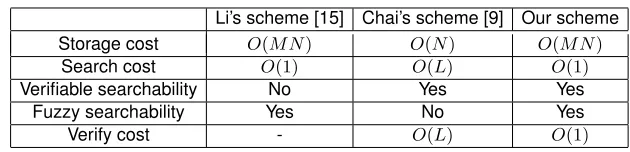
We compare the proposed algorithm with Li’s scheme [15] and Chai’s scheme [9]. To make the comparison easier, we assume thatN is the total number of key-words and M is the maximum size of the fuzzy keyword set Swi,d. Table 1
presents the comparison of the search efficiency and the verifiability among the above schemes.
Table 1.Comparison of the three scheme
Li’s scheme [15] Chai’s scheme [9] Our scheme Storage cost O(M N) O(N) O(M N)
Search cost O(1) O(L) O(1)
Verifiable searchability No Yes Yes
Fuzzy searchability Yes No Yes
Verify cost - O(L) O(1)
Though our scheme need more space to store the fuzzy keyword(O(M N)), it achieves the the fuzzy searchability. All in all, our scheme not only supports the fuzzy search but also achieves the verifiable searchability more efficiently.
5.
Verifiable Fuzzy Keyword Search in Hybrid Cloud
5.1. System and Security Model
Recently, Bugiel et al. [8] provided an architecture consisting of two clouds for secure outsourcing of data and arbitrary computations to an untrusted com-modity cloud. Their approach consists of a private cloud and a public cloud. The private cloud performs the security-critical operations, whereas the public cloud performs the performance-critical ones. This allows maximum utilization of the expensive resources of the private Cloud, while high loads of queries can be processed on-demand by the public Cloud. Based on their two clouds archi-tecture, we consider to address the privacy-preserving fuzzy keyword search problem simultaneously supporting verifiability of search result in hybrid cloud model.
In this section, we consider a extension from single cloud model to hybrid cloud model. There are four entities defined in the hybrid cloud model, that is, the data owner, the user, the private cloud and the public cloud. The data owner outsources the encrypted files to the public cloud and shares them with the authorized users. The user performs fuzzy keyword search and decrypts the encrypted files retrieved from the public cloud. The private cloud is addition-ally introduced to facilitate user’s secure usage of cloud service. Specificaddition-ally, since the computing resources at user side are restricted and the public cloud is not fully trusted in practice, the private cloud is able to provide users with an execution environment and infrastructure working as an interface between user and the public cloud. The interface offered by the private cloud allows user to securely submit files and queries to be securely stored and computed re-spectively. An architecture of verifiable fuzzy keyword search is shown in Fig.2.
In this model, we assume that the public cloud is “semi-honest-but-curious”, which may not correctly follow our proposed protocol but forge part of search result or execute only a fraction of searching operations honestly. As for the private cloud, we assume that it is “honest-but-curious”, which will follow our proposed protocol, but try to find out as much secret information as possible based on their possessions. In addition, the user’s input keywords are allowed to be known by the private cloud. Actually, approximately relaxing security de-mands by allowing keywords leakage to private cloud is innocuous because the private cloud in practice is located in the premises of the organization [17].
5.2. Scheme Description
exact k eyword
input keywo rd identifier encry
pted f iles
in de x
qu er y
file retriev
al
Fig. 2.Architecture of verifiable fuzzy keyword search
leads to a large amount of overhead at user side. In addition when receiving the search result retrieved from the public cloud, the user has to compute Pseudo-random function values for all the search results.
To fill the gap, we will show how to achieve efficient verifiable fuzzy keyword search under hybrid cloud model. The key idea is to outsource the expensive operation (i.e. trapdoor generation and search result verification) to the private cloud and only left the light-weight computation (file encryption and decryption) at user side.
Consider that theKeygenoperate identically to that in Section 4.1, we just provide the other four algorithms as follows.
– BuildindexWhen outsourcing a file F, the data owner performs an en-cryption onF by himself but outsources the task of generating the fuzzy keyword set{Sw,d}w∈W and building the index to the private cloud.
– TrapdoorandVerifyWhen retrieving the interest files, the private cloud works as a proxy of the user. Firstly, it translates user’s query into a set of trapdoors and sends to the public cloud. Later, upon receiving the search results returned by public cloud, the private cloud is to perform verification on them to test whether the public cloud is honest.
– SearchUpon receiving the search request from the private cloud, the public cloud divides each trapdoor into a sequence of symbols, then performs the search and returns the search result to the private cloud.
it can perform the operations of index generation and search result verification. Moreover, due to the private cloud performs all the overhead operations for the data owner/user, the whole process can be processed more efficiently.
6.
Security Analysis
In this section, we prove the correctness and security of the proposed verifiable fuzzy keyword search scheme.
Theorem 1. The intersection of the fuzzy sets Sw,d andSwi,d for keyword w
andwiis not empty if and only ifed(w, wi)≤d.
Proof. First, we prove thatSw,d
∩
Swi,d is not empty ifed(w, wi)≤d. To prove
this, it is enough to find out an element inSw,d ∩
Swi,d. According to the
defini-tion of edit distance, we can transformwto wi aftered(w, wi)edit operations.
Fromw, we get an elementw⋆by marking the positions of thoseed(w, w i)
oper-ations onwas⋆. Fromw⋆, we can perform theed(w, wi)edit operations on the
same positions containing⋆atw⋆and transformw⋆towi. Sinceed(w, wi)≤d,
w⋆is an element in bothSw,dandSwi,d.
Next, we prove thated(w, wi)≤difSw,d ∩
Swi,dis not empty. We usew
⋆to
denote the common element inSw,d ∩
Swi,d. Assume the number of⋆inw
⋆is
k, there are two cases should be considered: Ifk= 0, it means that we do not need any edit operation to transformwtowi. That is,w=wi =w⋆. Obviously,
ed(w, wi) = 0≤ d. If k >0, for any⋆inw⋆, we can perform edit operation on
the position of the⋆ and transform it to the corresponding character in wand wi. We usew⋆1 and wi⋆1 to denote the result variants, respectively. Due to the
two variants only have at most one position is different, we can transformw⋆
1to w⋆
i1 by at most one edit operation. That is,ed(w
⋆
1, w⋆i1)≤1. After all thek ⋆be
performed inw⋆, we getwandw
i, respectively. Due tow⋆ ∈Sw,d ∩
Swi,d, the
number of⋆inw⋆is not greater thand. we get thated(w, w
i) =k≤d.
Theorem 2. The verifiable fuzzy keyword search scheme is secure regarding
the search privacy.
Proof. Similar to [15], suppose the proposed scheme is not achieve the index
privacy against the indistinguishability under the chosen keyword attack (IND-CPA), which means there exists an algorithm A who can get the underlying information of keyword from the index. Then, we build an algorithmA′ that uti-lizesAto determine whether some functionf′(·)is a pseudo-random function such thatf′(·)is equal tof(sk,·)or a random function. A′ has an access to an oracleOf′(·) that takes as input secret valuexand returnf
′
and sendsw∗b to the challenger. Then,A′ is given a challenge value y, which is either computed from a pseudo-random function f(sk,·)or a random func-tion.A′ sendsyback toA, who answers withb′ ∈ {0,1}. SupposeAguesses b correctly with nonnegligible probability, which indicates that the value is not randomly computed. Then,A′ makes a decision thatf′(·)is a pseudo-random function. As a result, based on the assumption of the indistinguishability of the pseudo-random function from some real random function,Aat best guessesb correctly with approximate probability 1/2. Thus, the search privacy is obtained.
Theorem 3. The verifiable fuzzy keyword search scheme is secure based on
the verifiable fuzzy search.
Proof. To prove the verifiability, we need to prove that the attacker can not forge
a validproof. To tamper the search result, the attacker need to forge theproof. There are three ways: (1) generate ar1with different parameterpath||mem; (2) randomly generate ar1to replace the original one; (3) return ther1of another node back to the user.
– For method (1) and (2), due to the collision resistance properties of hash function, each node inGW has a unique r1, the attacker can successful
cheat with a negligible probability without the secret keyk. That is, the at-tacker can not return part of the search result or some fault one.
– For method (3), According to the construction ofGW, there has a unique
pathfrom root to the current node. In other words, thepathof any node can be called signature of the node. Ther1with the differentpathwill be reject by the algorithmverif y.
Baesd on the above analysis, without the secret keyk, the attacker can not construct a validprooof. That is, our proposed scheme is secure based on the assumption of collision resistance of hash function.
7.
Performance Analysis
In this section, we analyze the efficiency of the proposed scheme based on simulation. Since the process of file encryption is independent to the process of index construction, we focus on the symbol-tree based search algorithm. Our experiment is simulated on a LINUX machine with Intel Pentium Dual Core E5800 3.2GHz and 2G memory.
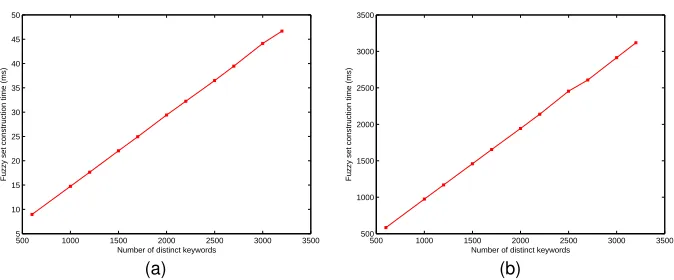
Performance of Generating Fuzzy Keyword Set In our experiment, we focus
500 1000 1500 2000 2500 3000 3500 5
10 15 20 25 30 35 40 45 50
Number of distinct keywords
Fuzzy set construction time (ms)
(a)
500 1000 1500 2000 2500 3000 3500 500
1000 1500 2000 2500 3000 3500
Number of distinct keywords
Fuzzy set construction time (ms)
(b)
Fig. 3.Fuzzy keyword set construction time using wild-based approach:(a)d=1,
(b)d=2.
10000 2000 3000 4000 5000 6000 7000 8000 9000 10000 500
1000 1500 2000 2500 3000 3500 4000 4500
Number of distinct keywords
tree construction time (ms)
threshold=1 threshold=2
(a)
10001 1500 2000 2500 3000 3500 4000 4500 5000 5500 6000 2
3 4 5 6 7 8 9 10 11
Number of distinct keywords
keyword quering time (s)
(b)
Fig. 4. The evaluation of symbol-based index tree :(a) construction time (b)
Performance of Building Symbol-based Index Given the fuzzy keyword set constructed using wildcard-based approach, we measure the time cost of based Index construction. Fig. 4(a) shows the time cost of building the symbol-based index tree in the case edit distanced=1 and 2. Although the time cost is not very low,the index construction process can be conducted off-line, it will not affect the searching efficiency. Fig. 4(b) shows the time cost of a single keyword query.
8.
Conclusion
In this paper, we investigated the fuzzy keyword search problem in the sce-nario of a semi-honest-but-curious server, which may execute only a fraction of the search and return part of the searching result honestly. We proposed a new efficient verifiable fuzzy keyword search scheme, which not only supports fuzzy keyword search over encrypted data, but also enjoys the verifiability of the searching result. Though rigorous security and efficiency analysis, we showed that our method is secure and privacy-preserving, while correctly realizing the verifiable fuzzy keyword search.
Acknowledgments.This work is supported by the National Natural Science Foundation of China (No. 61272455 and 61100224), major national science and technology projects (No. 2012ZX03002003), the Project Supported by Natural Science Basic Research Plan in Shaanxi Province of China (No. 2011JQ8042) and the Fundamental Research Funds for the Central Universities (Nos. JY10000901034 and K50510010030).
References
1. Abdalla, M., Bellare, M., Catalano, D., Kiltz, E., Kohno, T., Lange, T., Malone-Lee, J., Neven, G., Paillier, P., Shi, H.: Searchable encryption revisited: Consistency prop-erties, relation to anonymous ibe, and extensions. In: Proceedings of Advances in Cryptology - CRYPTO 2005. pp. 205–222 (2005)
2. Agudo, I., Nu ˜nez, D., Giammatteo, G., Rizomiliotis, P., Lambrinoudakis, C.: Cryp-tography goes to the cloud. In: Lee, C., Seigneur, J.M., Park, J., Wagner, R. (eds.) Secure and Trust Computing, Data Management, and Applications, Communica-tions in Computer and Information Science, vol. 187, pp. 190–197. Springer (2011) 3. Bao, F., Deng, R.H., Ding, X., Yang, Y.: Private query on encrypted data in multi-user settings. In: Proceedings of the 8th International Conference on Information Security Practice and Experience. pp. 71–85. Springer, Sydney, Australia (2008) 4. Behm, A., Ji, S., Li, C., Lu, J.: Space-constrained gram-based indexing for efficient
approximate string search. In: Proceedings of the 25th IEEE International Confer-ence on Data Engineering. pp. 604–615. IEEE, Shanghai, China (2009)
5. Bellare, M., Boldyreva, A., O’Neill, A.: Deterministic and efficiently searchable en-cryption. In: Proceedings of Advances in Cryptology - CRYPTO 2007. pp. 535–552. Springer, Santa Barbara, CA, USA (2007)
7. Boneh, D., Waters, B.: Conjunctive, subset, and range queries on encrypted data. In: Proceedings of the 4th Theory of Cryptography Conference. vol. 4392, pp. 535– 554. Springer, Amsterdam, The Netherlands (2007)
8. Bugiel, S., Nurnberger, S., Sadeghi, A.R., Schneide, T.: Twin clouds: An architecture for secure cloud computing. In: Proceedings of the Workshop on Cryptography and Security in Clouds(WCSC’11). Zurich, Switzerland (2011)
9. Chai, Q., Gong, G.: Verifiable symmetric searchable encryption for semi-honest-but-curious cloud servers. CACR, University of Waterloo (2011), [Online]. Avail-able: http://www.cacr.math.uwaterloo.ca/techreports/2011/cacr2011-22.pdf (current December 2012)
10. Chang, Y., Mitzenmacher, M.: Privacy preserving keyword searches on remote en-cypted data. In: Proceedings of the 3rd Applied Cryptography and Network Security. pp. 391–421. New York, NY, USA (2005)
11. Curtmola, R., Garay, J., Kamara, S., Ostrovsky, R.: Searchable symmetric encryp-tion: improved definition and efficient constrcutions. In: Proceedings of the 13th ACM Conference on Computer and Communications Security. pp. 79–88. ACM, Alexan-dria, Virginia, USA (2006)
12. Goh, E.: Secure indexes. Report 2003/216, Cryptology ePrint Archive (2003), http://eprint.iacr.org/2003/216
13. Ji, S., Li, G., Li, C., Feng, J.: Efficient interactive fuzzy keyword search. In: Pro-ceedings of 18th International World Wide Web Conference. ACM, Madrid, Spain (2009)
14. Li, C., Lu, J., Lu, Y.: Efficient merging and filtering algorithms for approximate string searches. In: Proceedings of the 24th IEEE International Conference on Data Engi-neering. pp. 257–266. IEEE, Cancun, Mexico (2008)
15. Li, J., Wang, Q., Wang, C., Cao, N., Ren, K.and Lou, W.: Fuzzy keyword search over encrypted data in cloud computing. In: Proceedings of the 29th IEEE International Conference on Computer Communications(INFOCOM’10). pp. 441–445. IEEE, San Diego, CA, USA (2010)
16. Lu, Y., Tsudik, G.: Privacy-preserving cloud database querying. Journal of Internet Services and Information Security 1(4), 5–25 (2011)
17. Poisel, R., Tjoa, S.: Discussion on the challenges and opportunities of cloud foren-sics. In: Proceedings of the International Cross-Domain Conference and Work-shop on Availability, Reliability, and Security(CD-ARES’12). pp. 593–608. Springer, Prague, Czech Republic (2012)
18. Shiraishi, Y., Mohri, M., Fukuta, Y.: A server-aided computation protocol revisited for con-fidentiality of cloud servic. Journal of Wireless Mobile Networks, Ubiquitous Computing, and Dependable Applications 2(2), 83–94 (2011)
19. Song, D., Wagner, D., Perrig, A.: Practical techniques for searches on encrypted data. In: Proceedings of the 2000 IEEE Symposium on Security and Privacy. pp. 44–55. IEEE, Berkeley, California, USA (2000)
20. Wang, C., Ren, K., Yu, S., Mahendra, K.: Achieving usable and privacy-assured similarity search over out-sourced cloud data. In: Proceedings of the 31th IEEE International Conference on Computer Communications(INFOCOM’12). pp. 451– 459. IEEE, Orlando, USA (2012)
Jianfeng Wangis a graduate student at the Faculty of Science, in Xidian
Hua Ma received her Masters degree in Applied Mathematics from the Xid-ian University in 1990. She is currently a Professor at the Faculty of Science, Xidian University. Her research interests include public key cryptography, net-work security, and electronic commerce.
Qiang Tang is a postdoc researcher in the Interdisciplinary Centre for
Secu-rity, Reliability and Trust at University of Luxembourg. Before this, he was a postdoc researcher at the Distributed and Embedded Security Research Group in the Computer Science department at University of Twente, the Netherlands. He received his MSc degree from Peking University , China in 2002 and ob-tained his PhD degree from Royal Holloway, University of London , UK in 2007.
Jin Li He received his B.S. (2002) and M.S. (2004) from Southwest
Univer-sity and Sun Yat-sen UniverUniver-sity, both in Mathematics. He got his Ph.D degree in information security from Sun Yat-sen University at 2007. Currently, he works at Guangzhou University. His research interests include Applied Cryptography and Security in Cloud Computing (secure outsourcing computation and cloud storage). He served as a senior research associate at Korea Advanced Institute of Technology (Korea) and Illinois Institute of Technology (U.S.A.) from 2008 to 2010, respectively. He has published more than 40 papers in international con-ferences and journals, including IEEE INFOCOM, IEEE Transaction on Parallel and Distributed Computation, IEEE Transaction on Information Forensics and Security, ESORICS etc. He also served as TPC committee for many interna-tional conferences on security. He received a Nainterna-tional Science Foundation of China (NSFC) Grant for his research on secure outsourcing computation in cloud computing. He was selected as one of science and technology new stars in Guangdong province.
Hui Zhuassociate professor, born in 1981, received the Ph.D. degree in
infor-mation security from Xidian University in 2009. His current research interests include network security and security authentication protocol.
Siqi Ma is a student at the School of Computer Science and Technology, in
Xidian University. Her research interests include cloud computing security and network Security.
Xiaofeng Chenreceived his Ph.D. in cryptography from the Xidian University in
2003. He is currently a Professor at the School of Telecommunications Engin-nering, Xidian University. His research interests include public key cryptography, financial cryptography, and cloud computing security.