RESEARCH ARTICLE
BOTANICAL ANTHELMINTICS
*
Dr. Veerakumari, L.
Department of Zoology, Pachaiyappa’s College, Chennai 600 030, Tamilnadu, India
ARTICLE INFO
ABSTRACT
Helminth parasitism especially gastrointestinal parasitism is one of the major health problems severely limiting the animal productivity in dairy animals. Chemotherapy is a major treatment modality used for the control of helminth infection in livestock. However, due to increasing development of anthelmintic resistance and the limited availability of commercial drugs to the rural people as well as the high cost of such synthetic medicines, a growing interest in the ethno-veterinary approach to examine the anthelmintic properties of plants traditionally used by local farmers in different parts of the globe is emerging. Medicinal plants are resources of new drugs and have served through ages, as a constant source of medicaments for the treatment of a variety of diseases and are known to provide a rich source of botanical anthelmintics. A large number of plant products are being used to combat gastro-intestinal parasites of livestock and also humans. Phytotherapeutic drugs are safe, non-toxic, biodegradable and do not leave residues in animals products. This review paper summarizes the anthelmintic activities of the medicinal plants and possible mode of action which could be further explored for the identification of lead compounds and development of potential anthelmintic drug.
Copyright © 2015Dr. Veerakumari.This is an open access article distributed under the Creative Commons Attribution License, which permits unrestricted use, distribution, and reproduction in any medium, provided the original work is properly cited.
INTRODUCTION
Livestock, an adjunct to agriculture, plays an important role in the future growth and development of Indian economy. India has the largest livestock population which constitutes nearly 7% towards its national income where cattle and buffaloes generate 54% of energy for agricultural operations. The livestock provides regular employment to 18.4 million people. Helminth parasitism especially gastrointestinal parasitism is one of the major health problems severely limiting the animal productivity in dairy animals. Any effort to intensify livestock production has been seriously affected by various factors, of which the most serious losses are due to gastrointestinal (GI) helminths.
Paramphistomosis and haemonchosis are the major parasitic diseases reducing the production potential of livestock. Clinical paramphistomosis is associated with few species of
flukes namely Cotylophoron cotylophorum, Fischoederius
elongatus, Gastrothylax crumenifer, Gigantocotyle explanatum, Paramphistomum cervi and Paramphistomum epilectum. Clinical signs include anorexia, weight loss, foetid
diarrohea, dehydration and death. Pathogenesis due to
Haemonchus contortus is associated with the haematophagic activities of developing larvae and adult worms. The greatest losses associated with helminth infection are sub-clinical, and economic assessments show that financial costs of internal
*Corresponding author: Dr. Veerakumari, L.
Department of Zoology, Pachaiyappa’s College, Chennai 600 030, Tamilnadu, India.
parasitism are enormous due to increase in mortality, and a reduction in growth rate and wool production. Chemotherapy is a major treatment modality used for the control of helminth
infection in livestock. However, chemotherapeutic
anthelmintic drugs for the control of helminth infection are far from satisfaction, probably due to the absence of
broad-spectrum activity of these drugs. Resistance to
chemotherapeutic anthelmintics is an increasing problem in
many countries (Waller and Prichard, 1985). Furthermore, side
effects on the host are a serious problem with many chemotherapeutic anthelmintics currently available. It is imperative to decrease the reliance on these chemotherapeutic drugs for parasite control, not only because of resistance, but also because of growing concerns about the adverse consequences of these anti parasitic drugs on the ecosystem and biodiversity. This danger has given impetus to the search for new drugs, with attention focusing on the search for plant products and the application of plant products as alternative methods of control. Environmental aspects favouring plant anthelmintics include their biodegradability.
On the other hand, chemotherapeutic anthelmintics poses the problem of soil contamination and also residual amounts of these anthelmintics may be found in the faeces after treatment and these may have deleterious effects on the environment. Naturally produced plant anthelmintics offer an alternative that can overcome some of these problems and is both sustainable and environmentally acceptable. In response to the need to discover new anthelmintic drugs of natural origin with possibly low toxicity to host animals and also to raise them
ISSN: 0976-3376
Vol.06, Issue, 10, pp. 1881-1894, October,Asian Journal of Science and Technology 2015Article History:
Received 31th July, 2015
Received in revised form
19th August, 2015
Accepted 30th September, 2015
Published online 17th October, 2015
Key words:
Botanical anthelmintics, Gastro-intestinal nematodes, Trematodes,
free from chemical inputs, there is a growing interest in ethno medical and ethno veterinary practices across the world
(Guarrera, 1999). In this regard, several medicinal plants have
been investigated for their anthelmintic properties. However, scientific evidence on the anthelmintic efficacy of most plant products is limited, regardless of their wide ethno veterinary usage. Scientific validation of anthelmintic effects and possible side-effects of plant products in ruminants is necessary prior to their adoption as a novel method for parasite control.
Validation of anthelmintic activities of plants
Pharmacodynamic interactionof drug or plant extracts can be
better described using both in vitro and in vivo studies. In
vitro studies offer rapid, sensitive and more economical methods for screening and evaluation of anthelmintic activity
of plant extracts. Most of the effects recorded in vitro also
occur in vivo (Rahman and Bryant, 1977) and contribute to the
anthelmintic efficacy.
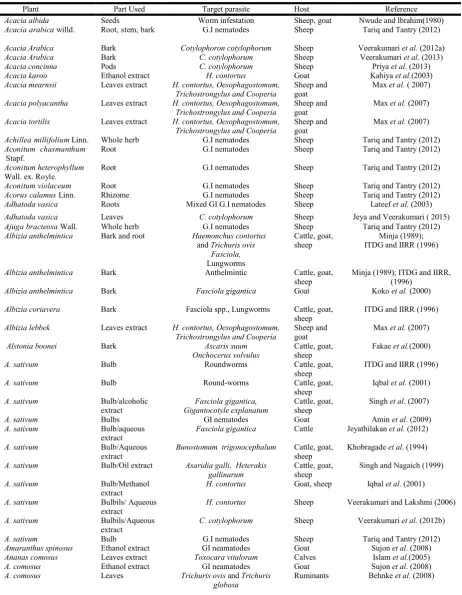
Table 1. List of plants with anthelmintic activity
Plant Part Used Target parasite Host Reference
Acacia albida Seeds Worm infestation Sheep, goat Nwude and lbrahim(1980)
Acacia arabica willd. Root, stem, bark G.I nematodes Sheep Tariq and Tantry (2012)
Acacia Arabica Bark Cotylophoron cotylophorum Sheep Veerakumari et al. (2012a)
Acacia Arabica Bark C. cotylophorum Sheep Veerakumari et al. (2013)
Acacia concinna Pods C. cotylophorum Sheep Priya et al. (2013)
Acacia karoo Ethanol extract H. contortus Goat Kahiya et al.(2003)
Acacia mearnsii Leaves extract H. contortus, Oesophagostomum,
Trichostrongylus and Cooperia
Sheep and goat
Max et al. ( 2007)
Acacia polyacantha Leaves extract H. contortus, Oesophagostomum,
Trichostrongylus and Cooperia
Sheep and goat
Max et al. (2007)
Acacia tortilis Leaves extract H. contortus, Oesophagostomum,
Trichostrongylus and Cooperia
Sheep and goat
Max et al. (2007)
Achillea millifolium Linn. Whole herb G.I nematodes Sheep Tariq and Tantry (2012)
Aconitum chasmanthum
Stapf.
Root G.I nematodes Sheep Tariq and Tantry (2012)
Aconitum heterophyllum
Wall. ex. Royle.
Root G.I nematodes Sheep Tariq and Tantry (2012)
Aconitum violaceum Root G.I nematodes Sheep Tariq and Tantry (2012)
Acorus calamus Linn. Rhizome G.I nematodes Sheep Tariq and Tantry (2012)
Adhatoda vasica Roots Mixed GI G.I nematodes Sheep Lateef et al. (2003)
Adhatoda vasica Leaves C. cotylophorum Sheep Jeya and Veerakumari ( 2015)
Ajuga bracteosa Wall. Whole herb G.I nematodes Sheep Tariq and Tantry (2012)
Albizia anthelmintica Bark and root
Haemonchuscontortus and Trichuris ovis
Fasciola,
Lungworms
Cattle, goat, sheep
Minja (1989); ITDG and IIRR (1996)
Albizia anthelmintica Bark Anthelmintic Cattle, goat,
sheep
Minja (1989); ITDG and IIRR, (1996)
Albizia anthelmintica Bark Fasciola gigantica Goat Koko et al. (2000)
Albizia coriavera Bark Fasciola spp., Lungworms Cattle, goat,
sheep
ITDG and IIRR (1996)
Albizia lebbek Leaves extract H. contortus, Oesophagostomum,
Trichostrongylus and Cooperia
Sheep and goat
Max et al. (2007)
Alstoniaboonei Bark Ascarissuum
Onchocerusvolvulus
Cattle, goat, sheep
Fakae et al.(2000)
A. sativum Bulb Roundworms Cattle, goat,
sheep
ITDG and IIRR (1996)
A. sativum Bulb Round-worms Cattle, goat,
sheep
Iqbal et al. (2001)
A. sativum Bulb/alcoholic
extract
Fasciola gigantica, Gigantocotyle explanatum
Cattle, goat, sheep
Singh et al. (2007)
A. sativum Bulbs GI nematodes Goat Amin et al. (2009)
A. sativum Bulb/aqueous
extract
Fasciola gigantica Cattle Jeyathilakan et al. (2012)
A. sativum Bulb/Aqueous
extract
Bunostomum trigonocephalum Cattle, goat,
sheep
Khobragade et al. (1994)
A. sativum Bulb/Oil extract Asaridia galli, Heterakis
gallinarum
Cattle, goat, sheep
Singh and Nagaich (1999)
A. sativum Bulb/Methanol
extract
H. contortus Goat, sheep Iqbal et al. (2001)
A. sativum Bulbils/ Aqueous
extract
H. contortus Sheep Veerakumari and Lakshmi (2006)
A. sativum Bulbils/Aqueous
extract
C. cotylophorum Sheep Veerakumari et al. (2012b)
A. sativum Bulb G.I nematodes Sheep Tariq and Tantry (2012)
Amaranthus spinosus Ethanol extract GI neamatodes Goat Sujon et al. (2008)
Ananas comosus Leaves extract Toxocara vituloram Calves Islam et al.(2005)
A. comosus Ethanol extract GI neamatodes Goat Sujon et al. (2008)
A. comosus Leaves Trichuris ovis and Trichuris
globosa
Ruminants Behnke et al. (2008)
A. comosus Leaves GI nematodes Goat Amin et al. (2009)
Andrographis paniculata Leaves/Aqueous
extract
H. contortus Sheep and
goat
Singh et al. (2011)
Areca catechu Nut Taenicidal Cattle, goat,
dog
Roepke (1996)
Areca caetcheu Nut, Ethanol
extract
C. cotylophorum sheep Manoj Dhanraj and Veerakumari (2015 a)
Artemesia absinthium Root
powder/aqueous extract
G.I nematodes Sheep Tariq et al. (2009)
A. maritime Whole herb Neoascaris vitulorum Buffalo,
calves
Akhtar et al. (1982);
Farnsworth et al. (1985);
Sherif et al. (1987)
A. maritime Whole herb G.I nematodes Sheep Tariq and Tantry (2012)
A. absinthium - G.I nematodes Sheep Tariq and Tantry (2012)
A. brevifolia Crude methonolic
and aqueous extract of whole plant
H. contortus Sheep Iqbal et al. (2004)
A. herbaalba Powdered shoots H. contortus Sheep and
goat
Idris et al. (1982)
A. maritime Whole herb Neoascaris vitulorum Buffalo,
calves
Akhtar et al. (1982);
Farnsworth et al. (1985);
Sherif et al. (1987)
A. maritime Root powder H. contortus Sheep and
goat
Jangde et al. (2001)
Artemisia mesatlantica Flavonoids
and sesquiterpene lactones
Anthelmintic Sheep and
goat
Holeman et al. (1991)
Asparagus filicinus Buch. Root G.I nematodes Sheep Tariq and Tantry (2012)
Azadirachta indica Fruit seed and oil G.I nematodes
(Trichostongylids)
Small ruminants
Mostofa et al. (1996)
A. indica Leaves/methanol
extract
H. contortus Goat Arora et al. (2010)
A. indica Cake and
Leaves
Anthelmintic Small
ruminants
Gowda (1997);
Mostofa et al.(1996)
A. indica Leaves/Ethanol
extract
Trichuris globulosa Sarwal et al.(2000)
A. indica Leaves extract H. contortus, Oesophagostomum,
Trichostrongylus and Cooperia
Sheep and goat
Max et al. (2007)
A. indica Bark/Alcoholic
extract
H. contortus Sheep Swarnakar et al. (2008a)
A. indica Leaves/aqueous
extract
H. contortus Sheep and
goat
Singh et al. (2008)
A. indica Metanol extract Fasciola gigantica Livestock Kushwaha et al.(2004)
A. indica Ethanol extract C. cotylophorum Sheep Veerakumari and Priya (2006)
A. indica Leaves GI nematodes Goat Amin et al. (2009)
Balanites aegyptiaca Fasciola gigantica Goat Koko et al. (2000)
Bauhinia tomentosa Leaves/Aqueous
and ethanol extracts
H. contortus Sheep and
goat
Vihan et al. (2007)
Bauhinia variegate Leaves/Methanol
extract
H. contortus Sheep and
goat
Bharadwaj et al. (2010)
Boswellia dalzelii Bark Anthelmintic Sheep, goat Nwude and Ibrahim (1980)
Brassica nigra Linn. Seed G.I nematodes Sheep Tariq and Tantry (2012)
Butea frondosa Seeds Ascaridia galli In vitro Lal et al.(1976)
B. frondosa Seed/ether extract Ascaridia galli Sharma and Sisodia (1976)
B. frondosa Seeds/Palasonin Ascaris lumbicoides Sheep Rao et al. (1977)
B. frondosa Seeds/Isolated a
purified/Palasonin
Ascaridia galli Livestock Kumar et al. (1983)
B. frondosa Seeds/Solution in
ammonia (Palasonin)
H. contortus Sheep Sathianesan et al. (1984)
B. frondosa Seeds/Ether and
Alcoholic extracts
Ascaridia galli Livestock Shilaskar and Parashar (1989)
B. frondosa Seeds/Aqueousext
ract (Palasonin)
H. contortus Sheep Jangde et al. (2001)
B. frondosa Seeds/Aqueous,
alcohol, ether and chloroform
H. contortus Sheep Swarnkar et al. (2008c)
B. frondosa Seeds/Chloroform
extract
H. contortus Sheep Vihan et al. (2007)
B. frondosa Seeds/Palasonin Ascaris lumbicoides Sheep Parker and Palmer ( l991)
B. monosperma Seeds Anthelmintic, GI G.I nematodes
Sheep and others
Kalesaraj and Kurup(1968); Chandra and Sabir(1978);
Lal et al.(1978);
Prashanth et al. (2001)
Iqbal et al. (2006)
B. monosperma Seeds Paramphistomum cervi Goat Chopra et al.(1991)
Caesalpinia crista Seed powder Fasciola gigantica Buffalo Kailani et al. (1995)
Caesalpina crista Seeds Toxocara vitulorum
Ascaridia galli
Buffalo, calves, chicken
Akhtar et al. (1985);
Javed et al. (1994)
Calliandra portoricensis Roots,
leaves, flowers
Toxocaracanis, Gastrointestinal G.I nematodes,
H. contortus
Dog, Sheep Adewunmi and Akubue
(1981); Jain et al.(1996);
A1-Qarawi et al. (2001);
Iqbal et al.(2005)
Calotropis procera Latex Gastrointestinal nematodes,
H.contortus
Sheep Iqbal et al. (2005)
Calatropis gigantean Leaves/Extract
(Methanol)
H. contortus Sheep and
goat
Yadav et al. (2010)
Cannabis sativa Linn. Leaf G.I nematodes Sheep Tariq and Tantry (2012)
Capillipedium foetidum Oil, grass Taenia
solium and Ascaris lumbricoides
In vitro Siddiqui and Garg (1990)
Carica papaya Seeds/Alcoholic
extract
Ascaridia galli Small
ruminants
Lal et al. (1976)
C. papaya Seeds/Aqueous
extract
A.galli and Heterakis gallinae Small ruminants
Singh and Nagaich (1999)
C. papaya Leaves Trichuris ovis and Trichuris
globosa
Ruminants Behnke et al. (2008)
C. papaya Seeds GI nematodes Goat Amin et al. (2009)
C. papaya Leaves GI nematodes Goat Amin et al. (2009)
Carissa edulis Root Roundworms Cattle, goat,
sheep
ITDG and IIRR (1996)
Casia tora Seeds/Alcohol and
aqueous extracts
Ascaridia galli Small
ruminants
Deore et al. (2009)
Cassia spectalis Roots Round-worms Cattle, goat, ITDG and IIRR (1996)
Chenopodium album Leaves G.I nematodes Sheep Akhtar et al. (1999)
Chenopodium album Seeds/Methanol
extract
H. contortus Sheep Yadav et al. (2010)
Chenopodium ambrosoides
Linn.
Whole herb G.I nematodes Sheep Tariq and Tantry (2012)
Chrysophyllum cainito Stem H. contortus Cattle Fernandez (1991)
Chrysothamnus viscidiflorus Methanol extract H. contortus Goat, sheep Acharya et al. (2014)
Cissampelos mucromata Root Helminths Goat, sheep Minja (1989)
Cimum basilicum Leaves GI nematodes Goat Amin et al. (2009)
Citrus aurantifolia Leaves GI nematodes Goat Amin et al. (2009)
Corchorus spp. Ethanol extract GI nematodes Goat Sujon et al. (2008)
Corchorus capsularis Leaves GI nematodes Goat Amin et al. (2009)
Croton macrostachys Leaves Anthelmintic Minja (1989)
Curcuma longa Rhizome GI nematodes Goat Amin et al. (2009)
Cucurbita Mexicana Methanol extract H. contortus Sheep and
goat
Iqbal et al. (2001)
Cucurbita sp. Methanol extract G.I nematodes Sheep Tariq and Tantry (2012)
Cuscuta reflexa Whole plant GI nematodes Goat Amin et al. (2009)
Cyathocline lyrata Essential oil Tape-worms, hookworms In vitro Shrivastava (1979)
Cymbopogon flexuosus Leaves/Essential Oil Strongyles Goat Sahoo and Tripathy (2007)
Cynodon dactylon Ethanol extract G.I nematodes Goat, sheep Sujon et al. (2008)
Datura quercifolia Fruit Ascaridia galli In vitro Kaushik et al.,1981
Datura stramonium Linn. Seeds G.I nematodes Sheep Tariq and Tantry (2012)
Daucus carrota Linn. Roots G.I nematodes Sheep Tariq and Tantry (2012)
Delphinium denodatum Wall. Seeds G.I nematodes Sheep Tariq and Tantry (2012)
Diospyros mespilliformis Bark Anthelmintic Sheep, goat Minja (1989)
Diospyros scabra Seeds Fasciola Cattle, goat,
sheep
ITDG and IIRR (1996)
Dodonea viscosa Leaves Intestinal worms Cattle Sharma and Singh (1989)
Embelia kilimandschiraca Root Helminthosis Cattle Minja (1989)
Embelia ribes Seeds/Aqueous
extract
H. contortus Sheep and
goat
Swarankar et al. (2009)
E. ribes Aqueous extract H. contortus Goat Arora et al. (2010)
E. ribes Seed/Aqueous and
Alcoholic extracts
Paramphistomum cervi Goat, sheep Chopra et al.(1991)
E. ribes Seed/Aqueous and
Alcoholic extracts
H. contortus Sheep Swarnkar et al. (2009)
Ericameria nauseosa Methanol extract H. contortus Goat, sheep Acharya et al. (2014)
Erythrina senegalensis Bark Fasciola spp. Ruminants Nwude and Ibrahim (1980)
Eugeniu spp. Ethanol extract GI nematodes Goat Sujon et al. (2008)
Ferula asafetida Extract Ascaridia galli and Heterakis
gallinae
Livestock Nagaich and Singh (2001)
Ferula costata Crude methanol and aqueous extract
H. contortus Sheep Kakar et al. (2013)
Ficus religiosa Leaves/Methanol
extract
H. contortus Goat, sheep Iqbal et al. (2001)
Ficus spp Leaves Trichuris ovis and Trichuris
globosa
Ruminants Behnke et al. (2008)
Flemingia vestita Tuber/Extract
(genistein)
Ascaris suum Small
ruminants
Yadav et al. (1992)
Flemingia macrophylla Leaves H. contortus Sheep Nyguyen et al. (2005)
Fritillaria royeli Hook. Bulb G.I nematodes Sheep Tariq and Tantry (2012)
Fumaria parviflora Plant
Powder
Tricho strongylus,
Haemonchus, Trichuris, Fasciola
spp.
Sheep, buffalo
Akhtar and Javed, (1985);
Kailani et al. (1995)
Gardenia gummifera Round worm Goats Jangde and Bansod (2004)
Geranium viscosissimum Methanol extract H. contortus Goat, sheep Acharya et al. (2014)
Gliricidia sepium Leaves extract H. contortus, Oesophagostomum,
Trichostrongylus and Cooperia
Sheep and goat
Max et al. (2007)
Gmelina arborea Leaves GI nematodes Goat Amin et al. (2009)
Hagenia abyssainicia Fruit Round-worms Cattle,
goat, sheep
ITDG and IIRR, 1996
Holarrhena antidysenterica Leaves GI nematodes Goat Amin et al. (2009)
Hyoscyamus niger Seeds Mixed nematode
Infection
In vivo Akhtar and Ahmad, 1990
Inula racemesa Hook. Root G.I nematodes Sheep Tariq and Tantry (2012)
lstonia scholaris Leaves GI nematodes Goat Amin et al. (2009)
Juglans regia Linn. Bark and Leaf G.I nematodes Sheep Tariq and Tantry (2012)
Juniperus macropoda Boiss. Leaf G.I nematodes Sheep Tariq and Tantry (2012)
Juniperus communis Linn. Fruit G.I nematodes Sheep Tariq and Tantry (2012)
Khaya senegalensis Bark H. contortus
Trichostrongylus Sp.
Oesophagostomum Sp.
Strongyloides Sp. Trichuris Sp.
Sheep Ademola et al.(2004)
Lagen siceraria Seeds Cestodes, moniezia,
avitelina spp.
Sheep Akhtar and Riffat, 1987
Lansium domesticum Seeds Ascaridia galli
Ascaris suum H. contortus
Goat Fernandez (1991)
Lantana trifolia Fruit Fasciola spp., lungworms Cattle, goat,
sheep
ITDG and IIRR, 1996
Lawsonia inermis Leaves Fasciola spp. Sheep, goat Nwude and Ibrahim, 1980
Lawsonia inermis Leaves Setaria digitata - Banu et al.(1992)
Leucas aspera Leaves GI nematodes Goat Amin et al. (2009)
Leucena leucocephala and
Leucena diversifolia
Leaves Mixed GI infection Small
ruminants
Semenye, 1990; Adejumo and Ademosun, 1991).
Leucaena leucocephala Seeds Ascaridia galli
Ascaris suum H. contortus
Chicken Pig, Goat
Fernandez (1991)
Lespedeza cuneata fresh forage or hay H. contortus Sheep (Min et al., 2004; Lange et al.,
2006; and Shaik et al., 2006)
Liatris punctate Methanol extract H. contortus Goat, sheep Acharya et al. (2014)
L. corniculatus Methanol extract H. contortus Goat, sheep Acharya et al. (2014)
Lotus pedunculatus Teladorsagia circumcincta Sheep Niezen et al.(1998)
Luvunga scandena Ethanol extract H. contortus Sujon et al. (2008)
Mallotus philippinensis Leaves/Chloroform
extract
H. contortus Sheep and
goat
Vihan et al. (2007)
M. philippinensis Fruit Moniezia and
Avitellina
Beetal Goat Akhtar and Ahmad (1992)
M. philippinensi
Momordica charantias
Essential oil Fasciola gigantica Sheep and
goat
Kushwaha et al.(2004)
Mangifera indica Seeds Ascaridia galli Chicken Fernandez (1991)
Magnifera indica Ethanol extract G.I nematodes Goat Sujon et al. (2008)
Manihot esculenta Leaves H. contortus Sheep Nyguyen et al. (2005)
Matricaria chammomila Linn. Aerial parts G.I nematodes Sheep Tariq and Tantry (2012)
Melia azedarach Fruit (Powdered) G.I. nematodes Goat Akhtar and Riffat (1984)
M. azederach Fruit Ascaridia galli
Haemonchus, Trichostrongylus, Trichuris, Chabertia spp.
Goat Akhtar and Riffat (1985);
M. azedarach Seed/Alcoholic
extract
H. contortus Goat Misri et al. (2002)
M. azedarach Bark GI nematodes Goat Amin et al. (2009)
M. azedarach Leaves GI nematodes Goat Amin et al. (2009)
Melilotus alba Methanol extract H. contortus Goat, sheep Acharya et al. (2014)
Melilotus officinalis Methanol extract H. contortus Goat, sheep Acharya et al. (2014)
Mentha sylvestris Linn. Whole herb G.I nematodes Sheep Tariq and Tantry (2012)
Mimisa isp Leaves H. contortus Sheep Nyguyen et al., 2005
Mimosa pudica Stem H. contortus Sheep and
goat
Fernandez (1991)
M. pudica Leaves H. contortus Sheep Nyguyen et al. (2005)
Momordica charantia Ethanol extract GI nematodes Goat Sujon et al. (2008)
M. charantia Leaves GI nematodes Goat Amin et al. (2009)
M. charantia Stem Ascaris suum
Ascaridia galli H. contortus
Pig, Chicken, Goat
Fernandez (1991);
Farnsworth et al. (1985)
Moringa oleifera Seeds Ascaridia galli
Ascaris suum H. contortus
Chicken, Pig, Goat
Fernandez (1991)
Morus alba Leaves extract H. contortus, Oesophagostomum,
Trichostrongylus and Cooperia
Sheep and goat
Max et al., 2007
Morus alba Linn. Bark and Leaf Nematodes Sheep Tariq and Tantry (2012)
Mixture of Azadirachta indica Butea frondosa Nigella sativa Piper longum
Ethanol extract H. contortus
Paramphistomum cervi Oesophagostomum
Cow claves Raje et al.(2003)
Myrisine africana Linn. Whole plant Nematodes Sheep Tariq and Tantry (2012)
Myrsine africana Leaf Roundworms Cattle, goat,
sheep,
ITDG and IIRR (1996)
Nauclealatifolia Roots Ascarissuum
Onchocerusvolvulus
In vitro Fakae et al.(2000)
Nelumbo nucifera Gaertn. Whole plant Nematodes Sheep Tariq and Tantry (2012)
Nepeta cataria Linn. Leaf/whole plants Nematodes Sheep Tariq and Tantry (2012)
Nicotiana tabacum Dried leaves/
Decoction
H. contortus Sheep and
goat
Raje and Jangde (2003)
Nicotiana tobacum Dried l eaves/
Aqueous and methanol extracts
H. contortus Sheep and
goat
Iqbal et al. (2006)
Nicotiana tobacum Ethanol extract GI nematodes Goat Sujon et al. (2008)
N. tabacum Leaves GI nematodes Goat Amin et al. (2009)
Nigella sativa Seed powder F. gigantica Buffalo Kailani et al. (1995)
Nymphea alba Linn. Whole plant Nematodes Sheep Tariq and Tantry (2012)
Ocimum basilicum Linn. Seeds Nematodes Sheep Tariq and Tantry (2012)
O. gratissimum Leaves Ascarissuum
Onchocerusvolvulus
In vitro Fakae et al.(2000)
O. sanctum Leaves H. contortus Sheep and
goat
Garg (1997)
O. sanctum Leaves Setaria digitata Livestock Banu et al.(1992)
Onobrychis viciifolia Hay GI infections Goats Paolini et al. (2004, 2005).
Peganum harmala Seeds Mixed GI infection,
cestode infection
Goats Akhtar and Ahmed (1991)
P. harmala Seeds Nematodes Sheep Tariq and Tantry (2012)
P. harmala Seeds Mixed gastrointestinal Cestode
infection
Goat Sheep
Akhtar and Ahmad (1991); Akhtar and Riffat (1986)
Perideridia gairdneri Methanol extract H. contortus Goat, sheep Acharya et al. (2014)
Persea americana Leaves extract H. contortus, Oesophagostomum,
Trichostrongylus and Cooperia
Sheep and goat
Max et al. (2007)
Pinus wallichiana Needles Nematodes Sheep Tariq and Tantry (2012)
Piper betle Leaves/Essential oil Ascaridia galli Shilaskar and Parashar
(1989)
P. betle Ethanol extract GI nematodes Goat Sujon et al. (2008)
P. betle Leaves GI nematodes Goat Amin et al. (2009)
Piliostigmathonningii
Ocimumgratissimum
Nauclealatifolia
Alstoniaboonei
Bark, leaves, Roots and bark extract
Ascarissuum
Onchocerusvolvulus
Ruminants Fakae et al.(2000)
Platanus orientalis Bark, Seed Nematodes Sheep Tariq and Tantry (2012)
Pongamia glabra Seeds/Ether extract H. contortus Sheep and
goat
Arora et al. (2010)
Populus alba Linn. Bark Nematodes Sheep Tariq and Tantry (2012)
Populus nigra Linn. Bark Nematodes Sheep Tariq and Tantry (2012)
Prosopis cineraria Bark H. contortus Sheep and
goat
Swarnker et al., 2008(b)
P. cineraria Bark, etanol extract C. cotylophorum Sheep Manigandan and Veerakumari (2015)
Prunella vulgaris Root and stem bark Nematodes Sheep Tariq and Tantry (2012)
Psidium guajava Leaves H. contortus Sheep Nyguyen et al. ( 2005)
P. guajava Leaves extract H. contortus, Oesophagostomum,
Trichostrongylus and Cooperia
Sheep and goat
Max et al. ( 2007)
Punica granatum Leaves GI nematodes Goat Amin et al. (2009)
P. granatum Rind C. cotylophorum Sheep Veerakumari et al. (2012 b)
P. granatum Linn. Flowers and leaves G.I nematodes Sheep Tariq and Tantry (2012)
Quisqualis indica Seeds H. contortus Goat Xiao and Lin (1986)
Quisqualis indica Stem Ascaris suum
Ascaridia galli H. contortus
Pig, Chicken, Goat
Fernandez (1991);
Farnsworth et al. (1985)
Raphanus sativus Root Nematodes Sheep Tariq and Tantry (2012)
Rapanea melanoploeos Seeds Roundworms Cattle, goat,
sheep
ITDG and IIRR (1996)
Rhamnus principides Leaves Anthelmintic Cattle, goat,
sheep
Minja (1989)
Rhus vulgaris Root Roundworms Cattle, goat,
sheep,
ITDG and IIRR (1996)
Rhus vulgaris Roots Round-worms Cattle, goats,
sheep
ITDG and IIRR (1996)
Rhus aromatic Methanol extract H. contortus Goat, sheep Acharya et al. (2014)
Roltleria tinctoria Paramphistomum cervi Sheep and
goat
Chopra et al.(1991)
Salvia plebeja Leaves GI nematodes Goat Amin et al. (2009)
Salix alba Linn. Bark Nematodes Sheep Tariq and Tantry (2012)
Sanguinaria canadensis Methanol extract H. contortus Goat, sheep Acharya et al. (2014)
Senecio lyratiparitus Leaves Anthelmintic Goat, sheep Minja (1989)
Schinopsis sp Bark extract H. contortus Goat and
sheep
Paolini et al. (2004)
Skimmia laureola Essential oil from
root, stem and leaves
H.contortus Sheep Mehmood et al. (2011)
Solanum nodiflorum Fruit Worm infestation Sheep and
goat
Nwude and Ibrahim (1980)
Spigelia anthelmia Aerial parts H. contortus Sheep and
goat
Assis et al.(2003)
Stephaniaglabra Ethanol extract Fasciolopsis buski
Raillietina echinobothrida
Livestock Tandon et al. (2004)
Syzygium aromaticum Bud C. cotylophorum Sheep Manoj Dhanraj and Veerakumari
(2014;2015 a, b)
Tagetes patula Flowers/Methanol
extract
H. contortus Sheep and
goat
Bhardwaj et al. (2010)
T.patula Flowers/Methanol
extract
H. contortus Sheep and
goat
Singh et al.(2002)
Tamarindus indica Leaves extract H. contortus, Oesophagostomum,
Trichostrongylus and Cooperia
Sheep and goat
Max et al. (2007)
T. indica Root Roundworms Cattle, goat,
sheep,
ITDG and IIRR (1996)
Terminalia arjuna Bark/Crude
methanolic extract
H. contortus Sheep Bachaya et al. (2009)
Terminalia chebula Dry fruits Cotylophoron cotylophorum Sheep Lokesh and Veerakumari(2015)
Thuja sinensis Leaves/Ethanol
extract
H. contortus Sheep and
goat
Vihan et al. (2007)
Tiinospora rumphii Stem H. contortus Goat Fernandez (1991)
Trachispermum ammi Seeds/Extract with
various solvents (Ethanol, methanol)
Setaria cervi
Sheep
Rizvi et al. (2012)
Trachyspermum ammi Seed/Extract H. contortus Sheep Lateef et al. (2006)
Trichilia emetic Bark Fasciola spp. lungworms Cattle ,
goats,sheep
ITDG and IIRR (1996)
However, concentrations of potentially active substances used
in vitro do not always correspond to in vivo bioavailability.
Hence, further in vivo study is required to enlighten the
therapeutic potential of plant extracts in treating helminth
infection. The in vivo assay such as faecal egg count reduction
test is suitable for the evaluation of all types of anthelmintics
(Verma et al., 2006). Further, in vivo observations on the
haematobiochemical profile can offer more insights into the safety and protective efficacy of the plant extracts.
Many of the in vitro investigations on anthelmintic activity of
plants, their oils, or extracts have been based on their toxic
effects on the earthworm, Pheritima posthuma (Gaind and
Budhiraja, 1967; Kokate and Varma, 1971; Dixit and Varma,
1975; Banerjee and Nigam, 1978; Girgune et al., 1978; 1979;
Garg and Kasera 1982a, b; Nanda et al., 1987; Siddiqui and
Garg, 1990; Garg and Siddiqui, 1992). However anthelmintic potential of plants should not be assessed based on their efficacy against earthworm. The anatomy and physiology of earthworm, which is an annelid and terrestrial in habitat differ from helminth parasites. Helminths are endo-parasites protect themselves by the production of anti-enzymes and derive energy through anaerobic metabolism. The plants which are effective against earthworm may not have anthelmintic efficacy. Even among the helminth parasites, the plants which are effective against trematodes are not effective against nematodes or cestodes. Hence using earthworm as a model for testing anthelmintic efficacy is inappropriate. Larval and adult Nematodes, cestodes and trematodes are used for the evaluation of anthelmintic activity of different plant material
by various researchers (Aktar et al., 2000; Veerakumari and
Priya, 2006; Veerakumari and Lakshmi, 2006).
The most common effect of anthelmintic drugs against worm infections is paralysis of the parasite musculature either by inhibiting the neuromuscular transmission or enzymes involved in energy production; however, certain other drugs damage the tegument allowing partial digestion or rejection by the host immune system (Manger, 1991). The pharmacologic basis of the treatment for helminth infection generally involves interference with the integrity of parasite cells, neuromuscular coordination, energy metabolism or protective mechanisms against host immunity, which lead to starvation, paralysis, and expulsion or digestion of the parasite. A full understanding of the way in which drugs achieve their action helps to identify susceptible parasite systems and show the properties of drugs necessary to attack them.
Usage of plant anthelmintics to combat gastrointestinal helminths of small ruminants is well documented by several
parasitologists (Hammond et al., 1997; Schillhorn van Veen,
1997; Akhtar et al., 2000; Tagboto and Towson, 2001; Githori
et al., 2006; Piyush et al., 2013; Pathak and Chhabra, 2014). Aqueous and various solvent extracts viz. hexane, chloroform, ethylacetate, alcoholic extracts, pastes, essential oils, extracted from leaves, stem, fruits, flowers and roots or whole plants
were used to test their anthelmintic efficacy in vitro or in vivo.
Plants with anthelmintic activity are shown in Table 1.
An anthelmintic drug which could cause adverse changes to a parasite but not the host is said to be potential anthelmintics drug. Anthelmintic drugs impair the vital activities of the parasite and consequently result in the death of the parasites. The most common effect of anthelmintic drug is paralysis of parasite musculature either by inhibiting neuro-muscular transmission or enzymes involved in energy production (Manger, 1991: Veerakumari and Munuswamy, 2000). Drugs may also damage the tegument allowing partial digestion or rejection by host immune system. Anthelmintic drugs may induce pathological changes in various organ systems of the parasites affecting the vital physiological functions viz. excretion, osmoregulation and reproduction (Veerakumari and Munuswamy, 1999; Veerakumari and Paranthaman, 2004).
Mode of action of Phytoconstituents
Whole plant consumption has shown good anthelmintic effects against GI parasites of sheep. This could be either due to direct toxic effects on the parasites or it can be indirect due to changes in the gut environment that favour low fecundity and worm expulsion. The mechanisms whereby the consumption of certain plants and plant extracts can affect parasite viability,
motility and fecundity both in vitro and in vivo are largely
unknown. For some plants it has been suggested that the consumption could be associated with an enhanced immune response of host towards the parasites as a result of nutrient supplementation and thus improve nutrition (Athanasiadou and Kyriazakis, 2004). Curative property of the medicinal plants is attributed to the various chemical substances of different composition that arise as secondary metabolites and get localized in one or more parts of the plant. These complex phytochemicals could play a vital role in minimizing the
development of drug resistance among parasites. A number of
research works have elucidated the anthelmintic effect of tannin rich plants against GI helminth parasites (Athanasiadou,
Trichosanthesmultiloba Fasciolopsis buski
R. echinobothrida
Livestock Tandon et al. ( 2004)
Trigonella foenum-graecum
Seeds Gastrothylax crumenifer Buffaloes Swarnakar et al. (2014)
Urtica dioica Linn. Leaf Nematodes Sheep Tariq and Tantry (2012)
Uvaria hookeri Root-bark H. contortus Sheep and
goat
Padmaja et al. (1993)
Vernonia amygdalina Stem, bark H. contortus In vitro Alawa et al. (2003)
V. anthelmintica Seeds/Ether and
alcoholic extracts
Ascaridia galli Livestock Shilaskar and Parashar (1989)
Vitex negundo Leaves GI nematodes Goat Amin et al. (2009)
Xanthium flexuosus Leaves/Fresh Juice H. contortus Sheep and
goat
Sharma et al. (2003)
Xanthium strumarium H. contortus Sheep and
goat
Sharma et al.(2003)
Zingiberus officinale Rhizome/
Methanol extract
H. contortus Sheep and
goat
Iqbal et al. (2001)
et al., 2001; Paolini et al., 2003; Hoste et al., 2006; Alonso
Díaz et al., 2008; Calderón-Quintal et al., 2010;
Martínez-Ortíz-de-Montellano et al., 2010). Apart from condensed
tannins, catechins, flavonoids, steroids (Oliveira et al.,2009)
and polyphenols (Lorimer et al., 1996) as well as bio-active
enzymes such as cysteine proteinase and secondary
metabolites such as alkaloids, and glycosides (Piyush Jain et
al., 2013) possess anthelmintic property. Phytoconstituents,
may act by inhibition of tubulin polymerization and blocking
glucose uptake (Jain et al., 2011). Any damage to the
mucopolysaccharide membrance of parasites will expose the outer layer restricting their movment which finally may cause
paralysis and ultimately death of parasite (Chandrashekhar et
al., 2008). The anthelmintic effects of tannins may be
attributed to its capacity to bind free protein available for larval nutrition and thus reducing the nutrient availability resulting in larval starvation or decrease in gastrointestinal
metabolism directly through inhibition of oxidative
phosphorylation causing larval death (Scalbert., 1991;
Athanasiadau et al., 2001).
Conclusion
Discovery of new therapeutic substances of natural origin, with possibly least toxicity to animals will protect the animals from chemical inputs. The natural compounds derived from plants are more stable as these are mostly plant secondary metabolites synthesized over a long synthetic ones and therefore are a source of low molecular weight structures active against a wide range of target agents and this diversity can preclude the occurrence of resistance. The progress in the livestock sector will in turn result in more balanced development of rural economy and improvement in economic status of poor people associated with this sector.
A combinatorial approach would help us to formulate new anthelmintic phytomedicine to combat parasitic infections in livestock. Intensive effort on isolation, combined formulation and validation of the efficacy of these plant based anthelmintics and appropriate toxicological screening should be undertaken before the release of commercially viable product for use in livestock industry. Future research in this area seems promising, as there remain a lot of plants to be tested for their anthelmintic potential.
Acknowledgements
My heartfelt thanks to Dr. P, Priya, Dr. K. Navaneethalakshmi, Dr. R. Ashwini, Dr. K. Lalhmingchhuanmawii, Mr. K. Manoj Dhanraj, Mr. R. Lokesh, Mrs K. Jeya and Mr. Sathishkumar, Research scholars, Unit of Parasitology, Department of Zoology, Pachaiyappa’s college, Chennai-30.
REFERENCES
Acharya, J., Michael B. Hildreth and Neil Reese, R., 2014. In
vitro screening of forty medicinal plant extracts from the United States Northern Great Plains for anthelmintic
activity against Haemonchus contortus. Veterinary
Parasitology.201: 1–2, 75–81.
Adejumo, J. O. and Ademosun, A. A. 1991. Utilization of leucena as supplement for growing dwarf sheep and goats
in the humid zone of West Africa. Small Rumin. Res.
5:75-82.
Ademola, I.O., Fagbemi, B.O. and Idowu, S.O. 2004.
Evaluation of the anthelmintic activity of Khaya
senegalensis extract against gastrointestinal nematodes of
sheep: in vitro and in vivo studies. Vet. Parasitol. 122,
151–164.
Adewunmi, C.O. and Akubue, P.I. 1981. Preliminary studies on the anthelmintic properties of the aqueous extract of
Calliandra portoricensis (Jacq.) Benth. Bull Anim Health Prod Afr 29:171-175.
Akhtar M S and Riffat S. 1984. Efficacy of Melia azedarach
Linn. (Bakain) and morantel against naturally acquired
gastrointestinal nematodes in goats. Pakistan Veterinary
Journal 4: 176–79.
Akhtar M.S, Javed, I. Hayat, C. S. and Shah, B. H. 1985.
Efficacy and safety of Caesalpinia crista Linn. seeds and
its extracts in water and methanol against natural
Neoascarisvitulorum infection in buffalo calves. Pakistan Vet. J., 5, 1985, 192–196
Akhtar, M. S, Chattha, M.I. and Chaudhry, A.H. 1982. Comparative efficacy of santonin and piperazine against
Neoascaris vitulorum in buffalo calves. J. Vet. Pharmacol. Ther., 5: 71-76.
Akhtar, M. S., Z. Iqbal, M. N. Khan and M. Lateef, 2000. Anthelmintic Activity of Medicinal Plants with Particular Reference to Their Use in Animals in the Indo-Pakistan
Subcontinent. Small Ruminant Research, 38,( 2), 99-107.
Akhtar, M.S. and Ahmad, I. 1990. Anthelmintic and
Phytochemistryical studies on Hyoscyamus niger Linn.
(Ajwain Khurasani) seeds and Morringa oleifera, Lam
(Sohanjna) roots. J. Pharm. Punjab Univ. Lahore, Pakistan,
3:75–81
Akhtar, M.S. and Ahmad, I. 1991. Evaluation of antinematodal
efficacy of tetrahydroharmine in goats. Vet. Arhiv., 6:
307-311.
Akhtar, M.S. and Ahmad, I. 1992. Comparative efficacy of
Mallotus phillippinensis fruit (Kamala) or Nilzan® drug
against gastrointestinal cestodes in Beetal goats. Small
Rumin. Res., 8: 121–128.
Akhtar, M.S. and S. Riffat, 1985. Evaluation of Melia azedarach Linn. seeds (Bakain) and piperazine against Ascaridia galli infection in chickens. Pakistan Vet. J., 5: 34-37.
Akhtar, M.S. and S. Riffat, 1986. A field trial of Paganum
harmala Linn. seeds (Harmal) against natural cestodal
infection in Betel goats. J. Pharm. Univ. Kar., Pakistan, 4:
79-84.
Akhtar, M.S. and S. Riffat, 1987. Evaluation of anticestodal
activity of Lagenaria siceraria (Kaddoo) seeds in sheep.
Pakistan Vet. J., 7: 139–141.
Akhtar, M.S., Z. Iqbal and M.N. Khan, 1999. Evaluation of
anthelmintic activity Chenopodium album (Bathu) against
nematodes in sheep. Int. J. Agri. Biol., 1: 121–124.
Al. Qarawy, A. A., Mahmoud O M, Sobaih, Haroun E M and Adam S E. 2001. A preliminary study on the anthelmintic
activity of Calotropis procera latext against Haemonchus
contortus infection in Najdi sheep. Veterinary Research
Communications 25: 61–70.
Alawa, C. B. I., Adamu, A. M., Gefu J O, Ajanusi OJ , Abdu F
A, Chiezcy N P, Alawa J N and Bowman D D. 2003. In
vitro screening of two Nigerian medicinal plants (Vernonia amygolalina and Annona senegalensis) for anthelmintic
Alonso-Díaz, M. A., Torres-Acosta, J. F., Sandoval-Castro, C. A., Capetillo-Leal, C., Brunet, S. and Hoste, H., 2008. Effects of four tropical tanniniferous plant extracts on the inhibition of larval migration and the exsheathment process
of Trichostrongylus colubriformis infective stage.
Veterinary Parasitology., 153(1-2): 187-192
Amin, M. R., Mostofa, M., Hoque, M. E. and Sayed M A.
2009. In vitro anthelmintic efficacy of some indigenous
medicinal plants against gastrointestinal nematodes of
cattle. Journal of Bangladesh Agricultural University 7:
57–61.
Arora, N., Kumar, A., Vihan, V. S. and Sharma, S. D. 2010.
Efficacy of indigenous plants against Haemonchus
contortus infection in goats. Indian Veterinary Journal 87: 869–71.
Asis, L. M., Bevilaqua, C. M. L. Morais, S.M. Vieira, L.S. Costa, C. I. C. and Sousza, A.L. 2003. Ovicidal and
larvicidal activity in vitro of Spigelia anthemia Linn.
Extracts on H. contortus. Vet. Parasitol., 117(1-2): 43-49.
Athanasiadou, S., Kyriazakis, I., Jackson, F. and Coop, R. L. 2001. Direct Anthelmintic effects of condensed tannins
towards different Gastrointestinal Nematodes of sheep: In
vitro and in vivo studies. Veterinary Parasitology., 99(3): 205-219.
Bachaya, H.A., Iqbal, Z., Khan, M.N., Jabbar, A., Gilani, A.H.
and Uddin, I. 2009. In vitro and in vivo anthelmintic
activity of Terminalia arjuna bark. International Journal
of Agricultural Biology, 11: 273–78.
Banerjee, A. and Nigam, S.S. 1978. In vitro anthelmintic activity of the essential oils derived from the various species of the genus Curcuma L. Sci. Cult. 44, 503-504. Banu, M. J., Nellaiappon, K. and Dhandayuthapni, S. 1992.
Mitochondrial malate dehydrogenase and malic enzyme of
filarial worm Setaria digitata, some properties and effects
of drugs and herbal extracts, J. Med. Sci. boil., 45
(3)137-50
Behnke, J.M., Buttle, D.J., Stepek, G., Lowe, A. and Duce, I.R. 2008. Developing novel anthelmintics from plant
cysteine proteinases. Parasit Vectors, 1:29.
Bhardwaj, P., Varshneya, C. and Mittra, S. 2010. Anthelmintic
efficacy of Bauhinia variegata and Tagetes patula against
Haemonchus contortus. Indian Veterinary Journal, 87:
1204–06.
Calderón-Quintal, J. A., Torres-Acosta, J. F. J., Sandoval-Castro, C. A., Alonso-Díaz, M. A., Hoste, H. and Aguilar-Caballero, A. 2010. Adaptation of Haemonchus contortus
to condensed tannins: can it be possible? Archives of
Medical Veterinary., 42: 165-171.
Chandra, S. and M. Sabir, 1978. Modified method for isolation of Palasonin-the anthelmintic principle of Butea frondosa
seeds. Indian J. Pharm. Sci., 97-98.
Chandrashekhar, C. H., Latha, K. P., Vagdevi, H. M. and Vaidya, V. P. 2008. Anthelmintic activity of the crude
extracts of Ficus racemosa. International Journal of Green
Pharmacy., 2(2): 100-103.
Chopra, A. K., Sharma, M. K. and Upadhyaya, V. P. 1991. Effect of ayurvedic anthelmintics on phosphatase activity
of Paramphistomum cervi. Indian Journal of
Helminthology 43: 65–69.
Deore, S. L., Khadabadi, S. S., Kamdi, K. S., Ingle, U. P., Kawalkar, N. G., Sawarkar, P. S., Patil, U. A. and Vyas,
A.J. 2009. In vitro anthelmintic activity of Casia tora.
International Journal of Chemical Technology Research,
1: 177–79.
Dixit, V.K. and Varma, K.C., 1975. Anthelmintic properties of essential oils from rhizomes of Hedychium coronarium
Koenig and Hedychium spicatum Koenig. Indian J.
Pharm., 37, 143-144
Fakae, B. B., Campbell, A. M., Barrett, J., Scott, I. M., Teesdale-Spittle, P. H., Liebau, E. and Brophy, P. M. 2000. Inhibition of glutathione S-transferases (GSTs) from parasitic nematodes by extracts from traditional Nigerian medicinal plants. Phytotherapy Research 14, 630-634 Farnsworth, N, R., Akerele, O. and Bingel, A. S. 1985. “Me-
dicinal Plants in Therapy,” Bulletin of the World Health
Organisation, Vol. 63, No. 6, pp. 965-981.
Fernandez, T.J. 1991, Local plants having anthelmintic activity, Asean J. Sci. Technol. Develop, 8, 115–19. Gaind, K.N. and Budhiraja, R.D. 1967. “Antibacterial and
anthelmintics activity of Withania coagulans dunal”,
Indian J. Pharm., Vol.29, 185.
Garg, L.C. and Atal, C.K. 1963. Anthelmintic activity of
Calotropain and Bromelain. Indian J. Pharm., 25, 422
Garg, S.C. 1997. Anthelmintic activity of some medicinal
plants, Hamdard Medicus, 40( 3), 18-21.
Garg, S.C. and Kasera, H.L. 1982a. Anthelmintic activity of
Callistemon viminalis. Fitoterapia LIII (5-6), 179-181. Garg, S.C. and Kasera, H.L. 1982b. In vitro anthelmintic
activity of the essential of Anacardium occidentale. Indian
Perfumer 26, 239-240.
Garg, S.C. and Siddiqui, N. 1992. Anthelmintic activity of
Vernonia teres L. and Clerodendrum phlomidis. J. Res. Edu. Indian Med. 11, 1-3.
Girgune, J.B., Jain, N.K. and Garg, B.D. 1978. Anthelmintic
activity of some essential oils. Indian Perfumer., 22,
296-297.
Girgune, J.B., Jain, N.K. and Garg, B.D. 1979. Antimicrobial
and anthelmintic activity of essential oil from Gardenia
lucida Roxb. Indian Perfumer XXIII (3-4), 213±215. Githiori, J. B., Athanasiadou, S. and Thamsborg, S. M. 2006.
Use of Plants in Novel Approaches for Control of Gastrointestinal Helminths in Livestock with Emphasis on
Small Ruminants, Veterinary Parasitology, 139,( 4),
308-320.
Gowda, S.K. 1997. Biological effects of neem (Azadirachta
indica) derivatives in animals. In: Ethnoveterinary
medicine: alternatives for livestock development. Vol. 2.
Abst. Proc. Int. Conf. Puna, India, Nov., 16, 1997
Guarrera, P. M.1999. Traditional antihelmintic, antiparasitic
and repellent uses of plants in Central Italy. J.
Ethnopharm., 68 (1-3): 183-192.
Hammond, J. A., Fielding, D. and Bishop, S. C. 1997. Prospects for plant anthelmintics in tropical veterinary
medicine. Vet. Res. Commun., 21(3): 213-228.
Holeman, M., Ilidrissi, A. and Berrada, M. 1991. Flavonoids
and sesquiterpene lactones of Artemisia mesatlantica.
Planta Med., 57: 198–199.
Hoste, H., Jackson, F., Athanasiadou, S., Thamsborg, S. M. and Hoskin, S. O. 2006. The effects of tannin-rich plants
on parasitic nematodes in ruminants. Trends in
Parasitology, 22(6): 253-261.
Idris Um El, A.A., Adam, S. E. I. and Tartour, G. 1982. The
anthelmintic efficacy of Ar temesia herba-alba against
Haemonchus contortus infection in goats. National
Gilani, A. H. 2006. In vivo Anthelmintic Activity of Ginger against Gastrointestinal Nematodes of Sheep,
Journal of Ethnopharmacology, Vol. 106, No. 2, , pp. 285-287.
Iqbal, Z., Lateef, M., Ashraf, M. and Jabbar, A. 2004.
Anthelmintic activity of Artemisia brevifolia in sheep.
Journal ofEthnopharmacology 93: 265–68.
Iqbal, Z., M. Lateef, A. Jabbar, G. Muhammad and M.N.
Khan, 2005. Anthelmintic activity of Calotropis procera
(Ait.) Ait. F. flowers in sheep. J. Ethnopharmacol., 102:
256-261.
Iqbal, Z., Nadeen, Q. K., Khan, M. N., Akhtar, M. S. and
Waraich, F.N. 2001. In vitro anthelmintic activity of
Allium sativum, Zingiber officinale, Cucurbita Mexicana and Ficus religosa. International Journal of Agricultural Biology, 3: 454–57.
Islam, N., Awal, M.A., Islam, M.S., Sobhan, M.A. and Rahman, M.M. 2005. Efficacy of levamisole and triclabendazole against gastro-intestinal nematodes and
trematodes in crossbred cows. Indian Journal of Veterinary
Medicine 25: 24 – 27.
ITDG, IIRR, 1996. Technol. Devel. Group and Internat. Inst. of Rural Reconst, Kenya.
Jain, D., Maheshwari, D. and Somani, R., 2011. Journal of
Advances in Drug Research. 1(2): 965-967.
Jain, S.C., Sharma, R., Jain R. and Sharma, R.A. 1996.
Antimicrobial activity of Calotropis procera. Fitoterapia,
67: 275–277
Jangde, C. R. and Bansod, K. V. 2004. Efficacy of Gardenia
gummifera in roundworm infection in goats. Indian
Veterinary Journal, 81(3): 344
Jangde, C. R., Maske, D. K., Shrikhande, G. B., Sirothia, A. R.
and Sirothia, K. A. 2001. In vitro anthelmintic activity of
Artemesia maritima and Butea frondosa against
Haemonchus contortus in bullock. Indian Veterinary
Journal, 78: 295–97.
Javed, I., Akhtar, M.S. Rahman, Z.U. Khaliq, T. and Ahmad, M. 1994. Comparative anthelmintic efficacy and safety of
Caesalpinia crista seed and piperazine adipate in chickens
with artificially induced Ascaridia galli infection. Acta Vet.
Hungarica, 42, 103–109
Jeya and Veerakumari, L, 2015. In vitro effect of Adhatoda
vasica on the motility and AchE of Cotylophoron
cotylophorum. Int.J.Sci. Res., 4(6). 1550-1561.
Jeyathilakan, N., Murali, K., Anandaraj, A. and Abdul Basith,
S. 2012. In vitro evaluation of anthelmintic property of
ethno-veterinary plant extracts against the liver fluke
Fasciola gigantica. Journal of Parasitic Diseases, 36: 26– 30.
Kahiya, C., Mukaratirwa, S. and Thamsborg, S. M. 2003.
Effects of Acacia nilotica and Acacia karoo Diets on
Haemonchus contortus Infection in Goats, Veterinary
Parasitology, Vol. 115, No. 3, pp. 265-274.
Kailani, S. U. R., Akhtar, M. S. and Ashraf, M. 1995. Anti-fasciolic efficacy of indigenous plant drugs; kalongi,
shahterah and karanjawa in buffalo. Pakistan Journal of
Pharmaceutical Science, 8: 17–27.
Kakar, S.A., Tareen, R. B. Sandhu, Z. U .D., Kakar, M. A., Kakar, S. U. R., Iqbal, Z. and Jabeen, H. 2013. In vitro and
in vivo anthelmintic activity of Ferula costata (kor.)
against gastrointestinal nematodes of sheep. Pakistan
Journal of Botany, 45: 263–68.
Kalesaraj, R. and Kurup, P.A. 1968. Anthelmintic activity,
toxicity and other pharmacological properties of palasonin,
the active principle of Butea frondosa seeds and its
piperazine salt, Indian J. Med. Res., 56, 1818.
Kaushik, R.K., Katiyar, J.C. and Sen, A.B. 1981. A new in
vitro screening technique for anthelmintic activity using
Ascaridia galli as a test parasite. Indian J. Anim. Sci., 51: 869–872
Khobragade, V. R., Jangde, C. R. and Maske, D. K. 1994. In
vitro anthelmintic trial of extract of Allium sativum Linn.
against Bunostomum trigonocephalum in goats. Journal of
Veterinary Parasitology, 8: 97–98.
Kokate, C.K. and Varma, K.C. 1971. Anthelmintic activity of
some essential oils. Indian J. Hospital Pharm., 8, 150-151.
Koko, W.S., Galal, M. and Khalid, H.S. 2000. Fasciolicidal
efficacy of Albizia anthelmintica and Balanites aegyptiaca
compared with albendazole. J. Ethnopharmacol. 71, 247–
252
Kumar N.G. Raghunandanan and Sathianesan V. 1983.
Larvicidal property of Butea frondosa on Ascaridia galli.
Kerala Journal of Veterinary Science 14: 158–60.
Kushwaha, D. S., Kumar, D., Tripathi, H. C. and Tandan, S. K. 2004. Effect of some indigenous medicinal plants on
Fasciola gigantica in vitro. Indian Journal of Animal Sciences 74: 143–
Lal, J, S. Chandra and M. Sabir, 1978. Modified method for
isolation of Palasonin-the anthelmintic principle of Butea
frondosa seeds. Indian J. Pharmacol. Sci., 4: 97-98
Lal, J., Chandra, S., Raviprasad, V. and Sabir, M. 1976. In
vitro anthelmintic action of some medicinal plants on
Ascaridia galli worms. Indian Journal of Physiology and
Pharmacology, 20:64–68.
Lange, K. C., Olcott, D. D. Miller, J. E. Mosjidis, J. A. Terrill, T. H. Burke, J. M. and Kearney, M. T. 2006. Effect of
Sericea lespedeza (Lespedeza cuneata) fed as hay, on natural and experimental Haemonchus contortus infections
in lambs. Veterinary Parasitology. 141, p. 273-278.
Lateef, M., Iqbal, Z. Khan, M.N. Akhtar, M.S. and Jabbar, A.
2003. Anthelmintic activity of Adhatoda vesica roots. Int.
J. Agri. Biol., 5: 86–90
Lateef, M., Iqbal, Z., Akhtar, M. S., Jabbar, A., Khan, M. S. and Gilani, A.H. 2006. Preliminary screening of
Trachyspermum ammi (L.) seeds for anthelmintic activity
in sheep. Tropical Animal Health and Production, 38:
491–96.
Lokesh, R. and Veerakumari, L. 2015. Effect of ethanol
extract of T. chebula on the motility and AchE of
Cotylophoron cotylophorum. International journal of pharmaeceutical sciences and research, Vol. 6(9): 3975-3800.
Lorimer, D. S., Perry, B. N., Foster, M. L. and Burgess, E. 1996. A Nematode Larval Motility Inhibition Assay for
Screening Plant Extracts and Natural Products. Journal of
Agriculture Food Chemistry., 44(9): 2842-2845.
Manger, B.R. 1991. Anthelmintics veterinary Applied Pharmacology and Therapeutics (Brander, G.C.Pugh., D.M. Bywater, R.J. and Jenkins, W.L. Eds.) ELBS/ bailliere, Tindall, pp.513548.
Manigandan and Veerakumari, L, 2015. In vitro studies on the effect of Procopis cineraria on the motility and AchE of
Cotylophoron cotylophorum. International Journal Of
Pharmaceutical Sciences And Drug Research, 7 (3) 259-262.