Translated and revised from Yingxiao Kexue Xuebao 营销科学学报 (Journal of Marketing Science), 2007, 3(2): 1–19
HE Jiaxun ()
Center on Branding Science, School of Business, East China Normal University, Shanghai 200241, China
E-mail: [email protected]
RESEARCH ARTICLE
HE Jiaxun
Transference or severance: An exploratory study
on brand relationship quality of China’s
time-honored brands based on
intergenerational influence
© Higher Education Press and Springer-Verlag 2008
Abstract Using an indigenous model of Chinese brand relationship quality (CBRQ), the author analyzes the transfer phenomenon of the time-honored brand equity between parents and children from the perspective of combining intergenerational influence and brand equity. Results show that the time-honored brand equity from parents basically has no way to pass on to their children besides trust. Moreover, the positive relationships between parents and the time-honored brands are even destroyed to some extent. Implications related to the revitalization of the time-honored brands are also discussed.
Keywords China’s time-honored brand, brand relationship quality, intergenerational influence, brand equity
摘要 研究从老字号的基本特征出发,选择代际影响和品牌资产相结合的视角,借
助本土化的中国消费者-品牌关系质量(CBRQ)模型,考察老字号品牌资产在上
辈和下辈之间的传承现象。结果表明,除了信任之外,来自上辈的老字号资产基本 无法传承给下辈。更有甚者,上辈受下辈的反向影响破坏了上辈与老字号的积极品 牌关系。这个结果对老字号品牌复兴具有重要的管理指导意义。
关键词 中华老字号,品牌关系质量,代际影响,品牌资产
1
Introduction
For many years, issues of China’s time-honored brand have attracted continuous attention from both the academic and business circles. The related researches mainly focused on discussing the various factors leading to the decline of time-honored brand, including the vicissitudes of history and environment (Wang, 2005; Wei, 2006), the poor management and lack of innovation (Leng, 2004; Wang, 2005; He and Peng, 2005). However, there has not been any study focusing on the consumer behavior, which is fundamental and extraordinarily important for studying time-honored brand from the perspective of brand equity source.
According to The Cognizance Criterion of Time-honored Brand (Trial) issued by the Ministry of Commerce of the People’s Republic of China in 2006, China’s time-honored brand refers to “the brands which own the time-honored products, techniques or services, can be passed down by generations, have obvious traditional cultural backgrounds and profound cultural details, have gained wide social identity, and have formed good reputation.” Traditionally, the time-honored brand achieves its reputation by word of mouth (Leng, 2004; Wang, 2005). Therefore, we can hold the proposition that intergenerational influence (IGI) of family consumption is an important tie which makes the time-honored brand survive.
Using the Chinese brand relationship quality (CBRQ) (He, 2006a, 2006b) model indigenous to China, this paper intends to investigate the characteristics of the time-honored brand equity sources based on the IGI from the dual perspectives of IGI and brand equity—What are the differences of relationship toward time-honored brand between parents and children? Have the positive brand relationships between parents and the time-honored brands been effectively passed on to their children or severed? The answers to the related questions are applied to reveal the decline of the time-honored brands from a new perspective and thus put forward the basic management guides for the revival of them. Meanwhile, they can also offer evidence and beneficial inspiration from the Chinese market to the study of the long-term brand management theory.
2
Theoretical backgrounds
2.1 Chinese brand relationship quality
social relationship, the fundamental significance of brands reflects the inter-influences of individuals and their ways to view the society, which mean that if we use the indigenous measurement tools to evaluate the brand equity under the Chinese cultural backgrounds, better evaluation effects may ensue. The Chinese Brand Relationship Quality (CBRQ) scale is a brand equity measurement tool based on the perspective of consumer relationships (He, 2006a, 2006b), and has proven to possess better predictive abilities by related studies (He, 2006c).
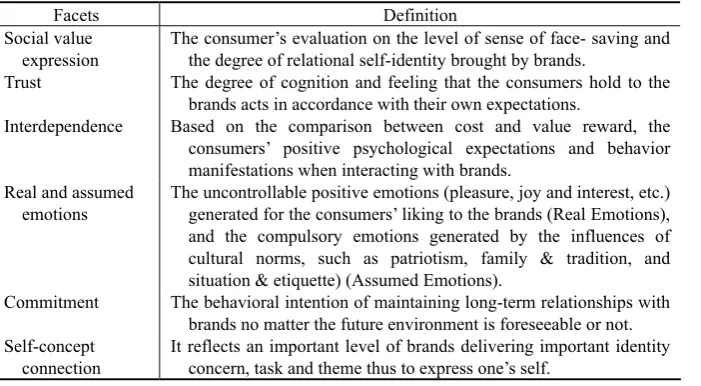
The CBRQ scale is composed of six facets—social value expression, trust, interdependence, real and assumed emotions, commitment and self-concept connection (Table 1). Compared with the BRQ model (Fournier, 1994, 1998), which has drawn attention worldwide, CBRQ has two special aspects—social value expression and real and assumed emotions. It not only reveals the special respect of consumer and brands under the Chinese social and cultural backgrounds but also reflects the cross cultural differences on brand equity evaluation. These two aspects are built on the basis of the theory of indigenous social psychology, which is applies to the situation of consumer and brand relationship under the metaphor “brand-as-relationship partner” (He, 2006a).
Table 1 Six facets of Chinese brand relationship quality (CBRQ) scale
Facets Definition Social value
expression
The consumer’s evaluation on the level of sense of face- saving and the degree of relational self-identity brought by brands.
Trust The degree of cognition and feeling that the consumers hold to the brands acts in accordance with their own expectations.
Interdependence Based on the comparison between cost and value reward, the consumers’ positive psychological expectations and behavior manifestations when interacting with brands.
Real and assumed emotions
The uncontrollable positive emotions (pleasure, joy and interest, etc.) generated for the consumers’ liking to the brands (Real Emotions), and the compulsory emotions generated by the influences of cultural norms, such as patriotism, family & tradition, and situation & etiquette) (Assumed Emotions).
Commitment The behavioral intention of maintaining long-term relationships with brands no matter the future environment is foreseeable or not. Self-concept
connection
It reflects an important level of brands delivering important identity concern, task and theme thus to express one’s self.
Source:He(2006a, 2006b).
face-saving” refers to the consumer’s perception degree of the social status, social praise and impact that is symbolically endowed by the brand, which brings to the consumer some pleasant and proud emotions, such as feelings of proud, grand, outstanding and respected, etc. Second, different from the conception of the pure “ego” in western culture, the self of traditional Chinese is “the relational self”, which means “the harmony and unity of individual self and social self” (Ho, 1991). Therefore, usually they will make different reflections of “self” according to the different relationships between individuals and the people they interacted (Huang, 2006). For this reason, how an individual can express the “self” in accordance with the social norms becomes an interesting and essential issue (Yang, 1991). Thus, serving as a symbol of social exchange, brand could become a tool to identify the relational characteristics of an individual and to approve his social identity. This is just like the viewpoint advanced by Tse (1996): In China, brands are more regarded by the consumers to keep distance from the outer group and at the same time to maintain the similarity of the internal group. “The relational self” and “sense of face-saving” mutually come from the essence of Chinese Confucianism named “social orientation”, and turn into the real connotation of the symbolism of brands in the Chinese culture.
With regard to real and assumed emotions, Yang (2001a) points out that Chinese culture attaches great importance to “Ganqing” (affection), reflected in any interpersonal contacts, in which people will always give their counterparts the basic “Renqing” (favor). This “Renqing” has an intensive sense of obligation and compulsion. Thereby she puts forward the dual construct of “assumed emotions” (the compulsory and normative emotions, which are also called “Renqing”) and “real emotions” (the real and spontaneous emotions, which are also called “affection”) to categorize the interpersonal relationships and explain the emotional world of the Chinese people (Yang, 2001b). To some extent, this construct has been tested by an empirical study. According to the findings of Lau et al. (2005), the general emotional components in the Chinese interpersonal relationships contain some obligations. In the situation of consumer-brand relationship, this paper does verify the existence and melting of the two emotional components (they belong to the same facet), which is essentially different from the facet of “love and passion” in Fournier (1994, 1998) model (He, 2006a).
connotation of facets of CBRQ instead? This is one of the basic research purposes of this paper.
2.2 Intergenerational influences and intergenerational brand equity
In the early 1970s, IGI study was introduced into the field of consumer behavior (consumer socialization), and it was defined as the within family transmission of market-related skills, attitudes, preferences, values and behaviors (Heckler, Childers and Arunachalam, 1989; Childers and Rao, 1992; Shah and Mittal, 1997). Woodson, Childer and Winn (1976) first extended IGI to the field of brands and verified the manifestation of the IGI affecting brand preferences and brand loyalty. Heckler, Childers and Arunachalam (1989) found that there is a transfer of brand preferences in intergenerational influences; Olsen (1993, 1995) showed that if there are full of affection and respect within a family, it is more likely that the parents and children have the similarity of brands loyalty; Moore-Shay and Lutz (1988) discovered that when it comes to the products with higher brands visibility, mothers and daughters have evident consensus on their brands preferences and loyalty—they both incline to trust the brands with higher awareness. Viswanathan, Childers and Moore (2000) revealed that highly effective communication and intense consumption experiences within the family can make the parents and children have higher consensus on brand preferences. From the perspective of traditional significance, the shaping of time-honored brand mainly depends on the experience of family use; thus, IGI is a basic perspective to analyze the consumption behaviors of time-honored brands.
Moore, Wilkie and Lutz (2002) first studied intergenerational influences in combination of brand equity, and put forward the construct of IG brand equity, proposing that referring to the conception of customer-based brand equity (Keller, 1993), IGI is actually one of the important sources of brand equity. Their research showed that IGI can generate great and durable influences on a series of daily commodities with some certain brands with the exception of others. It falls into four categories. The first category is the brands with high-IG brand equity, which are evidently influenced by families, to which the mothers and daughters preference match scores are higher than the category average. The second category is the IG brand silo effect. In some categories, there are several brands having high preference match scores, which indicate the existence of the IG brand silo effect on these markets—vast loyal families are continuously prefer some certain brands, which are comparatively independent. The third category is the brands with IG potential. These brands exemplify reasonable IG brand equity but could not be categorized into the second category for various reasons. The last category is the brands with low or no evidence of IG impacts. For the above four categories, which one should China’s time-honored brand belong to? Or maybe it belongs to none of them. Can IGI become the basic source of its brand equity? Specifically, with the help of CBRQ model (He, 2006a, 2006b), this paper is intended to make some exploratory investigation about the following questions: which kinds of brand relationship quality of time-honored brand tend to be transmitted? and which are not easily transferred but even accelerate the severance of brand relationship quality for the negative influence?
3
Methodology
3.1 Research design and sample
Most previous exploratory studies used qualitative methods to study the consumer-brand relationship, which mainly contains in-depth interviews (Fournier, 1994), participant observation (Coulter, Price and Feick, 2003), scenario completion (Eckhardt and Houston, 2001), etc. This paper adopts the method of focus group interviewing, an usual qualitative method (Malhotra, 2002) with an outstanding advantage of expressing a more comprehensive and profound view on some subject by using group dynamics to inspire the group member to “share and compare” their respective experiences (McDaniel and Gates, 2000).
influencee’s standpoint, we should focus on asking respondents to assess their response to their parents’ behavior on their consumer decisions. Choosing the perspective of the influencee, this paper studied the impacts and interactions between parents and children. As the social transformation in China took place after the reform and opening-up, the author chose the young generations, Shanghai permanent residents born in the 1970s and 1980s as interviewing participants. The interviewees were divided into four groups: males born in the 1970s (No. FG1, being on the job, aged from 27 to 36, average age: 32.75, total number: 8), females born in the 1970s (No. FG2, on the job, aged from 28 to 36, average age: 31.70, total number: 10), and two groups of females born in the 1980s (No. FG3, on the job, aged from 21 to 24, average age: 22.50, total number: 6 and No. FG4, students aged from 21 to 25, average age: 23.25, total number: 12). Totally, there were 36 interviewees with the marital status of 13 married and 23 unmarried. Among them, 10 (27.8%) were junior college students, 15 (41.7%) undergraduate students and 11 (30.6%) graduate students.
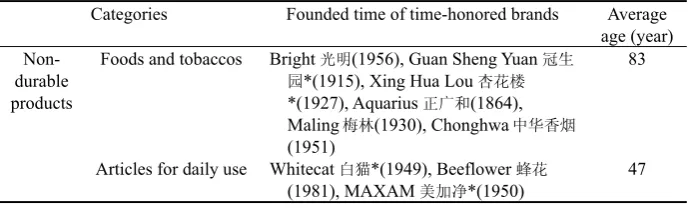
Due to the historical reasons, companies with China’s time-honored brand have apparent regional features. Some researches were extended according to regions, which mainly focused on Beijing (e.g. Developing Beijing Time-honored Brand Project Group, 2004), Shanghai (e.g. Wei, 2006), Guangzhou (e.g. Cai and Chen, 2004), etc. This paper focused on Shanghai and the time-honored brands were chosen from the selected results of “Shanghai Time-honored Trademarks Rebuilding Brilliance Promoting Activity” held by Shanghai Trademark Association and Shanghai Famous Brands Cognizance Committee. In order to conduct deep discussion, the interviewer had first confirmed by means of pre-investigation whether the interviewees were quite familiar with the brands. At last, 22 brands covering seven industries lines of the three main classes—non durable products, durable products and services were chosen. Among the time-honored brands, 8 were the first China’s time-honored brands designated by Ministry of Commerce of the People’s Republic of China. The average age of the samples of time-honored brands was 87 years (Table 2).
Table 2 The basic situations of the interviewed time-honored brands
Categories Founded time of time-honored brands Average age (year) Foods and tobaccos Bright光明(1956), Guan Sheng Yuan冠生
园*(1915), Xing Hua Lou杏花楼
*(1927), Aquarius正广和(1864), Maling梅林(1930), Chonghwa中华香烟
(1951)
83 Non-
durable products
Articles for daily use Whitecat白猫*(1949), Beeflower蜂花
(1981), MAXAM美加净*(1950)
(Continued) Categories Founded time of time-honored brands Average
age (year) Garment Threegun三枪(1936),Hengyuanxiang
恒源祥*(1927), Spring Bambooo春竹
(1979)
60
Household appliances & bikes
Seagull海鸥(1964), Wahson华生(1916), Forever永久(1951)
63 Durable
products
Ornaments Lao Fengxiang老凤祥*(1848), Laomiao老 庙*(1896)
135 Accommodation JinJiang锦江(1935), Lake Pavilion湖心亭
(1855), Lu Bo Lang绿波廊(1979)
84 Services
Glasses services Wu Liang Cai吴良材(1719), Maochang茂 昌*(1923)
186
Note: The brands with asterisk are the first China time-honored brands designated by Ministry of Commerce of China (2006).
3.2 Interview procedures
The focus group interviews were conducted by the author with three research assistants taking care of the spots. Before the formal interviews started, the host had introduced the purposes of the interview, made clear the basic rules the interviewees should observe, and then let them make self-introductions and finally given them the indicating lists of time-honored brands to define the discussion scope. The questions discussed were divided into three main parts. First, the interviewees were asked to talk about their attitudes and experience concerning time-honored brands. Second, according to the interviewees’ experience, they talked about their parents’ attitudes and behaviors concerning time-honored brands. Third, they talked about the intergenerational influences in time-honored brands consumption. To avoid abstract description, all of these three parts were required to answer with the specific examples of the time-honored brands in the indicating list. During the process of interviewees’ answering questions, the host added more questions according to specific circumstances, encouraging the interviewees to talk out their deep feelings further. Every group of interview lasted 120 to 150 minutes. All the contents talked during the interview were recorded on the spot and later converted to the form of text by the research assistants, which totally had 62 000 words (in Chinese). The whole FG interviewing project was conducted during May and June of 2006, and it contained four stages.
3.3 Data analysis and interpretation
sample contained males born in the 1970s (FG1) and females born in the 1980s (FG3, on the job); the second sample consisted of females born in the 1970s (FG2) and females born in the 1980s (FG4, students). Firstly, based on the understanding and guidance of the general theoretical framework, the two research assistants respectively encoded the data and identified the themes of the first sample, of which the matching rate was 85%. After all the members discussing the existing differences, the consistency rate came up to 95%. As to the statements that could not be agreed, they were considered as ambiguities and were eliminated from the texts. All of the themes were placed in the six facets of the CBRQ, and no definite themes were found belong to the other new facet. Second, the conductor encoded the second sample according to the confirmed six facets of CBRQ, and then repeated the work of the first step, lastly found very similar results. Finally, all statements gained from the previous two steps were combined together. The data got by dealing with the initial texts were applied to this study. The author interpreted, sorted and compiled the statements related to every facet and finally confirmed the manifestations of brand relationship quality in intergenerational influences.
3.4 Results
Of all the statements data in the six facets of CBRQ, the related contents could de divided into two main parts. The first part was the fundamental interpretations of the six facets of CBRQ from the perspective of time-honored brands. No matter the related statements coming from the parents or the children, they provide rich evidences for indigenous CBRQ model. The second part answered the question that whether the brand relationship quality of the time-honored brands is transferred concerning the aspects of intergenerational influences. Related statements and analysis also showed that except for the facet of “trust”, other facets were hardly passed on to the next generation. The following texts will explain the two main parts in detail.
4
The brand relationship quality of time-honored brands:
Interpretation of the basic facets
connotations of the two special facts of CBRQ—social value expression and real and assumed emotions (He, 2006a, 2006b).
4.1 Facet one: Trust
With good trustworthiness, the connotation of time-honored brand contains reputation, honesty, safety, relief, reliability, etc., in which honesty is the most important part of time-honored brand equity. According to the norms of the traditional Chinese Confucianism, “trust” means honesty. Under the cultural backgrounds of China, “honesty” is primary and unconditional while “trust” is derived and conditional (Yang and Peng, 1999). The interviewee Ms. Cui’s attitude towards “Guan Sheng Yuan” Honey indicates that “honesty” is more important than trust.
There are now many fake honeys in the marketplaces, but “Guan Sheng Yuan” Honey has a good reputation and reliability, so people tend to choose it. My family members have been choosing “Guan Sheng Yuan” Honey for many years, in fear of the fake ones…. I will buy this brand’s honey, not only because I think its price is reasonable, but also because its quality is trustworthy. That is to say that just because of the special situations of the honey markets, I mainly consider that it can not be fake (Ms. Cui, 28, FG2).
Under many circumstances, the trust of the consumers towards the time-honored brands is the result of the recognition of the brands’ “old” history. Many interviewees, such as Ms. Fo, has deep feelings about their parents’ trust towards time-honored brands. This is the reflection of filial piety in the customer-brands (products) relationship within the vast backgrounds of the Chinese filial piety culture. The connotation of “old” here contains qualifications, liability and prestige; therefore, it is more likely to be trusted. However, when it comes to the younger generation, the foundation of trust coming from the cultural values respecting the old and taking care of the young has become to shake and collapse. For example, Ms. Luo does not value the “old” quality of the brand but has definite requirements for brands’ reality (technical contents) instead.
My father extremely trusts time-honored things…. He comparatively trusts the time-honored brands more when it comes to the large products like household appliances, especially for the color TV sets and refrigerators. (Ms. Fo, 24, FG4)
couldn’t be able to sustain. The fact is that the technical contents of the time-honored brands are too few…. I think if you want to keep the time-honored brands take up some position in heart of the younger generation, their technical contents must be improved, or it may be time-honored for my mother but not for me. (Ms. Luo, 23, FG3)
Ms. Zhuang said that, for her mother, China’s time-honored brands are just like “the insiders” while the foreign brands were like “outsiders”. As her parents have more reliable experience in “the insiders”, she can trust them more. the famous sociologist Weber has depicted two kinds of trust in Weber (1951): universalistic trust and particularistic trust. Mostly, the Chinese way of trust belongs to the latter—trust “the insiders” not “the outsiders”.
If one day my mother recommends me some brands, I will think that it must be the colleagues of her, such as some good female friends discussed like “I have been using something of some brands recently and it is really good” or it maybe someone of her colleagues is the seller of the products of (some brands such as) Amway. My first reaction is that someone is promoting products to her, and my intuition is that she may be cheated. I just feel that if my mom recommends some time-honored brands to me, it might come from her own experience, but if she recommends some foreign brands to me, I will begin to worry that she is cheated. I’m just inclined to have such feelings. (Ms. Zhuang, 21, FG4)
4.2 Facet two: Interdependence
Interdependence is generated when one of the two related parties make some valuable reward to the other. Reward subtracts cost is the comprehensive net profit or loss, i.e. outcome (Brehm et al., 2005). If the consumers’ sense of satisfaction brought by the long-term use of time-honored brands is greater than the uncertain cost may be brought by using new brands, interdependence will emerge between the consumer and the time-honored brands. The interviewee Ms. Qiu “grew up with drinking Bright milk”, and the reward of such an experience is apparently huge, and it is much greater than the psychological cost of brands transferring under many circumstances.
host, “Haven’t you tried others?”) I have tried yogurt of other brands such as “Danone”, but for the milk, I will surely choose “Bright”. (Ms. Qiu, 24, FG3)
According to the interdependence theory (Brehm et al., 2005) of socio-psychology, based on past experience, everyone holds a value level that he/she should get from the interaction with brand relationship, i.e. comparison level (CL). After comparing the results with CL, he/she will get satisfactory or dissatisfactory evaluations of the brands. As the parents are influenced by the past have-not material conditions, their CL is lower than their children’s. Thereby, for the same time-honored brand, the parents are inclined to get higher degree of satisfaction than children. Besides, comparison level for alternatives (CLalt) greatly influences the degree of consumer-brand interdependence. CLalt refers to the outcome of getting rid of the current relationship and beginning to use other better brands. When a better substitution (Danone yogurt for example) appears, the degree of the interdependence will decrease. According to the interdependence theory, if the consumer considers CL, CLalt and the outcome at the same time, three different types of relationships will be generated. From the case of Ms. Wang’s father’s buying glasses, we could see that the outcome’s quality is higher than CL and CLalt (here means the possible result of using “Paris Miki”), so his relationship with “Wu Liang Cai” is “happy and stable”. Making further analysis of Ms. Wang’s statement, we can find that here CL is higher than CLalt, so his attitude toward “Wu Liang Cai”is more reliant rather than merely satisfied. If CLalt is higher than CL, then the consumer will be more satisfied with it rather than dependent on it.
In my family, only my father prefers time-honored brands… he just thinks that the quality of the time-honored brand is better. Regardless of prices, he believes that the more expensive one is better. For example, he thinks the brands like “Wu Liang Cai” and “Chonghwa” are better than others. However, once I told him about glasses of “Paris Miki”, he said, “well, the foreign products have the same quality, but the prices are too high, so it’s not worthwhile! …. He thinks that though glasses of “Wu Liang Cai” are a bit expensive, the quality is much better than other brands like “Paris Miki” (Ms. Wang, 22, FG3).
4.3 Facet three: Commitment
1998). This kind of commitment also shows powerful marketing advantages: resisting competition, reducing marketing cost, and minimizing the results of products quality crisis. The interviewee Mr. Zhang’s experiences with “Bright” milk offered us some evidences. Owing to the trust towards “Bright”, his mother eliminated her doubts of the products quality event, and continued to buy its products.
My parents have special affection on “Bright” milk. I remembered that once she (his mother) bought some fresh milk with the marked date of the very day. But actually when I opened it, I found the milk in it was bad. I said why the milk went bad as we just bought it. I told her that I doubted about the quality of it. For the first few days, she also thought the quality was bad and stopped buying it. But a few days later, she continued to buy this product again. When I asked her why she still bought this brand’s milk as it had quality problem, she answered, “Maybe it’s just a rare case, I think the whole quality is trustworthy.” (Mr. Zhang, 36, FG1)
Influenced by the past-time orientation and continuity in Chinese cultural values, traditional elder consumers have stronger inclination of brand loyalty (Yau, 1994). From the general perspective, the commitment degree of the children is not as strong as their parents. As for the young generation, they have tried more brands. This is related to the current environment of brand competition and reflects the fast increase of the consumers’ brand experience in the market of economy reform (Coulter, Price and Feick, 2003). However, if the family members live together, the intergenerational influences coming from the family will easily compete with the brands trials of the younger generation. In the case of the interviewee Mr. Zhang, the former defeats the latter, and thus commitment is passed on.
4.4 Facet four: Self-concept connection
In the perceptional experience of the young generation, time-honored brands are deeply engraved with the impression of “used by parents” or “suitable for parents”, i.e. in the mind of the younger generation, the images of time-honored brands are more consistent with the self-images of parents. The interviewees Ms. Zhu and Ms. Lu separately spoke out that “Shanghai Hyposensitization toothpaste” was “what people like my mother use” and “Lao Fengxiang” and “Laomiao” were “suitable for the generation of my parents”. Actually, the “Self-Concept” here merely represented for the overall image of one generation. It is the general generational difference resulting from the influences of social environments other than the self image based on specifically segmented groups.
If my parents want to buy toothpaste, they will surely buy “Shanghai Hyposensitization toothpaste”. When I come home and use it, I could not tell it is good or bad, and also I do not have any uncomfortable feelings. But if I buy toothpaste, I am sure I will not buy this brand, though I don’t know the reason. (Host: What do you think are the differences between “Shanghai Hyposensitization Toothpaste” and “Crest” toothpaste?) If it comes to use, I think there is no difference, but if it is for me to choose, I just won’t buy “Shanghai Hyposensitization Toothpaste” because of the feeling that it is the preferable brand of people like my mother’s age. As to our young people, we just like the brands such as “Crest” and “Colgate”. (Ms. Zhu, 23, FG4)
For “Lao Fengxiang” and “Laomiao”, how should I say? They are the domestic gold jewelry brands, and for such a long time that their styles have not changed a lot. I feel that they are just suitable for the generation of my parents. It seems that the renewal of patterns of them is not as good as “Chow Sang Sang”, etc.… Other brands have a larger variety of designs. The time-honored brands mainly deal with gold while others have a variety of products like colored gold, K gold, etc. (Ms. Lu, 24, FG2)
4.5 Facet five: Social value expression
face-saving” needs the references to the group’s common identity which comes from the size and degree of “public opinion” controlling “sense of face-saving”. After the interviewee came to Shanghai—the origin place of this brand, the regional differences have gone and accordingly the “sense of face-saving” has also disappeared.
Before 2004, I had been living in Wuhan. I can say that the reaction to the time-honored brands of Shanghai in Wuhan can represent for the status of Shanghai products in other cities of China. In the 1990s or even in the early 21st century, some products of Shanghai, including “Threegun” took up much of the Wuhan market. At that time, I also thought that “Threegun” underwear was considered as the thing that had much “brand” when talked about. What’s more, I thought its quality was excellent…. I had Chosen “Threegun” underwear because of its good quality, but after I came to Shanghai, I found that the Shanghai natives did not wear this brand any more. Now I also have such feelings as “Threegun” underwear is not as good as before, and its designs are not good—they are out of fashion. I think it is not good anymore. (Mrs. Li, 36, FG2)
From the above mentioned, we can draw that social value expression is the acquired symbolic meaning based on social psychological activities. For Ms. Li, “Threegun” underwear was just the same as before, but what really changed were the social groups she belongs to, so the symbolic meaning of “Threegun” underwear changes consequently. In addition, the specific “sense of face-saving” brought by time-honored brands is not based on good products or services; therefore, it does reflect the additional value brought by brand names. Let us cite Mr. Zhang’s attitudes towards “Lu Bo Lang” of Shanghai as another example.
Under cultural environments of China, another connotation of social value expression is the “relational self-connection”. In Chinese traditional social orientation culture, “relational self-connection” essentially demonstrates the individuals’ attitudes of expressing themselves by choosing to use the suitable brands due to their different interactive objects. This is important to the motivations for gift-giving and socialized consumption. Coming from the nature of relationship with the counterpart, it influences individual’s choice for brands. When contact with other people, the interviewee Mr. Mao smokes “Chonghwa” while Ms. Yuan’s parents chose “Lao Fengxiang” and “Laomiao” as presents for people of their same generation. But personally, they might not smoke “Chonghwa” cigarette or bought jewelry of “Lao Fengxiang” and “Laomiao”. This demonstrates that some time-honored brands have evident “relational self-connection”. Just the same with “sense of face-saving”, their premise is the group identity degree of time-honored brand, which thus brings the symbolic value for the consumers in the process of social intercourse.
For example, every place, every province or city has high-priced cigarette, such as the one of 50 Yuan RMB each pack, which is almost the same grade or price with “Chonghwa” cigarette, but from all over the country, the celebrity rating of Chonghwa is that no matter where you go, when you take out some Chonghwa cigarette others will surely know it is “Chonghwa” by saying, “Oh, it’s “Chonghwa cigarette.” Thus, it may be a historical deposit other than a thing formed in one or two days… That is my feeling, for it is impossible for you to just meet people of one district and there are people of other places. It is clearly that you all know what I mean. (Mr. Mao, 34, FG1)
They (the interviewee’s parents) just buy some golden decoration of “Lao Fengxiang” and “Laomiao” Jewelry as presents for others, such as a relative’s new-born baby. If they want to buy some for themselves, they won’t buy the ones of these two brands…. Maybe they think that the person who receives the presents is the similar age with them, so it is a face-saving present as these two brands are known to all. (Mrs. Yuan, 31, FG2)
western culture of individualism, the power distance indexes in China are much higher, i.e. people accept the truth that power is of vertical ordering and uneven distribution (Wong and Leung, 2001). Thus, the use of brands is embodied with the function of expressing differences of inter-group or similarities of internal group. People associate the grades of brands with the social classes of the consumers while trying to keep the correspondence of the two, and improve their social self-evaluation by using high-grade brands. The facts presented by Ms. Zhi typically manifest the social norms that in Chinese culture, the brands-consumption grade needs to be identical with the individual’s identity and status, thereby the individuals in the relational context (here refers to the upper and lower ranks within a unit) could well reflect the self-concept connection of using brands (Ho, 1998).
I have observed that in the place I’m working, ordinarily the cadres rank higher than deputy director smoke “Chonghwa” while the cadres rank lower than director and other common cadres generally smoke “Double Happiness”. (Host: What do you think are the differences between them?) How to say, well, I think the first one is that it is a symbol of social status. The brands they smoke are used to show their identity and also show that they have the financial ability to consume such brands. The second one is that maybe the common cadres can afford “Chonghwa” cigarette as well, but they do not want to be too eye-catching. (Mrs. Zhi, 35, FG2)
4.6 Facet six: Real and assumed emotions
Consumers’ affections to time-honored brands are composed of the real emotions and the assumed emotions. These two components can mix together or separate with each other. Under the high relationship quality of mixing, in the relationship types like the family type proposed by Yang (1993), the emotion was “beloved emotion” other than the “liking emotion” between non-acquaintances or the “emotion to cater to another’s pleasure” among strangers. In the interview, Ms. Zhuang expressed her yearning of some past life and fine emotions and this “beloved emotion” was naturally transferred to the time-honored brand “Xing Hua Lou” (moon cake). We generally define this kind of special emotional connection as “nostalgia” (He and Li, 2006), which is usually related to IGI.
(Ms. Zhuang, 21, FG4)
Another interviewee Ms. Jiang connected time-honored brands with the Chinese traditions, and took it for granted that they would certainly develop further. Meanwhile, she definitely felt the closeness contained in “Xing Hua Lou” and even used the metaphor “relative” to describe it. This kind of emotion has strong representativeness for China’s time-honored brands.
The specialty of “Xing Hua Lou” is that it is connected with the traditional festival of China. As long as China has this festival, “Xing Hua Lou” will surely exist…. Besides, except for tradition, I feel that it is more stressed on kinship than other brands…. The feeling of affinity and kinship is more intense, and it is just like the warm feelings between relatives. (Ms. Jiang, 22, FG4)
Based on her closeness with brands, Ms. Dai listed time-honored brands first. Analogous to the “differential order-pattern” (Fei, 1985), this way of evaluation and information processing introduce the correspondent strategic principles with the relationship types. According to the study of Yang (2001) and Yang (2001c), “the assumed emotions” can independently reflect the “differential order-pattern”, which means that the more intimate insiders have higher assumed emotions while the more strange outsiders have lower assumed emotions. From the above mentioned, that the consumer puts time-honored brands in the first place does prove that she has intense assumed emotions on them. The statements such as “other’s recognition” and “I’m patriotic” mentioned by Ms. Dai directly express the compulsory emotions generated by the influences of social cultural norms.
It’s individual interest. If it is left for me to make a choice order among new brands, old brands and foreign brands, sometimes I may list time-honored brands first. But I am sure that new brands will be listed last because I’m not inclined to accept new brands. (Host: Why do you list time-honored brands first? Do you have some special feelings on it?) It is not because I have some speical feelings on a certain brand, maybe it is because … well, it has held the recognition of the public for many years, so I also approve them. What’s more, I think I am a patriotic person. (Ms. Dai, 23, FG4)
4.7 Brief conclusions
interactions with time-honored brands tend to be in harmony. However, if the consumers are the more modern younger generation, their interactions will possibly be unharmonious. This is typically reflected in self-concept connection.
From the above interviews and related explanations we can see that the interaction between consumer and brand has some similarities with the interpersonal relationship in Chinese culture, which is extremely evident in self-concept connection and real and assumed emotions. The consumers choose the suitable products to reflect themselves according to different relation objects, which show that they have the basic motivation of differentiating brands statuses according to grade differences. This is similar to people’s paying attention to social classes in high power distance culture. At the same time, the consumer also differentiates the closeness between time-honored brands and other brands on the basis of the “differential order-pattern”in interpersonal relationships and further decides to adopt which interacting rules. These results at least tell us that by using the metaphor of interpersonal relationships (Fournier, 1994), the essence of relationism of the Chinese Confucianism can be used to analyze the relationships between consumers and time-honored brands. This is beneficial to the construction of Chinese indigenous brand theory.
brand relationship. If the time-honored brands still interact with consumers in the
way it used to, the low assessment of brand attitude is surely reasonable.
5
Intergenerational brand relationship quality differences:
Transferred or severed brand equity
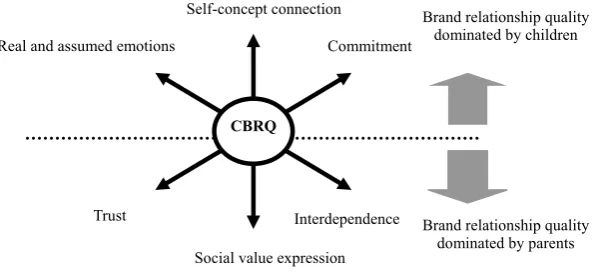
In this part, we will emphasize the research of intergenerational brand equity, i.e. whether the brand relationship equity can generate the transferring function of brand equity by IGI. By this study we can observe that some brand relationship qualities are dominated by parents, which means that in intergenerational relationship, parents have more influences on children. Such kind of brand relationship qualities is still the important brand equity components of time-honored brands, and they can be easily transferred, but there is also possibility of being severed. Contrarily, others are dominated by children, i.e. in intergenerational relationship, children have more influences on their parents, because of which, the brand equity of these time-honored brands is being washed away, the transfer of them from parents is severed and also they are faster declining with the counter-influence of the children (see Fig. 1).
Brand relationship quality dominated by parents Real and assumed emotions Commitment
Trust Interdependence Self-concept connection
CBRQ
Brand relationship quality dominated by children
Social value expression
Fig. 1 CBRQ of time-honored brand based on IGI
5.1 Brand relationship quality dominated by parents: Transferred or severed brand equity
5.1.1 Trust
is more important than the reliability based on ability in the cognitive components of trust of the Chinese time-honored brands. Besides, trust is also originated from the culture of respecting the old which is similar with parents and children. This is a significant reason for its liability of being transferred. According to the statements of Ms. Qiu and Ms. Liu, some perceptions of time-honored brands like honesty and safety are well inherited by them. If the consumers pay attention to “the ratio of quality to price” (Ms. Qiu said “so they should be with good quality and low prices”) or the products with low involvement (Ms. Liu’s “it was very cheap”), then “trust” may directly lead to their choice of purchase.
As to gold jewelry, my parents only trust “Laomiao” and “Lao Fengxiang”, for they think that these brands are reliable and they won’t be cheated, so they must buy these products…. I had intended to buy a ring of platinum gold. But after going to “Chow Tai Fook”, I found that things there are really expensive, really! … Influenced by my mother, I now also buy “Laomiao” jewelry instead. I think it’s nice because the price of “Laomiao” is comparatively low. You know, the price of jewelry varies a lot, so we should purchase with good quality and low prices. (Ms. Qiu, 24, FG3)
In the cognition of the young generation, parents have some reliable consumption knowledge for the traditional Chinese brands while they have little experience in consuming foreign brands. Therefore, in IGI, the children continue to back up their parents’ trust towards time-honored brands, which strengthens the trust relationship with time-honored brands. Both the above-mentioned statements of Ms. Zhuang and the following statements of Ms. Liu provided some evidences for this. It can be believed that trust is the most active brand equity as well as the component of brand relationship quality which is influenced by the intergenerational positive mutual impacts.
fooled. (Ms. Liu, 22, FG3)
Traditional values have been split among the young generation. Some still keep many traditional values thus have more similarities in cognition with their parents and make the transference of the trust mechanism based on “respecting the old” possible while others keep pace with the times by choosing new life styles, being motivated by trying new diversified products, thus the trust based on “respecting the old” relationship is severed. Here, the following two examples of Ms. Zhi and Ms. Yuan formed a strong comparison.
For “Bright” milk, I don’t like it much but I still accept it passively (Host: What do you mean by saying “accept it passively”?) because I am a little traditional… After all, it is a time-honored brand of Shanghai, so I mainly trust its effects of brand name. (Mrs. Zhi, 35, FG2)
Before I got married, I had been using some time-honored brands for my parents had been using them too. But after I got married, my husband and I totally changed the brands and we no longer used time-honored brands for no reasons. Without any comparisons, we just did not want to use those brands and inclined to switch them for new ones. After the switch we found the new brands are pretty good. (Mrs. Yuan, 31, FG2)
5.1.2 Social value expression
In the pre-statements of this paper, we explained the two sub-facets of social value expression: “sense of face-saving” and “the relational self”. As to the parents, time-honored brands have positive social value expression evaluation. Under cetain circumstances, this equity of some time-honored brands is still active. But in general, the social value expression of time-honored brands basically cannot be inherited by the younger generation. This was shown by Ms. Yuan’s statements that because of the low “grade” of “Xing Hua Lou”, using it in the activities in public relations with foreign companies would make people feel lack of “face-saving”.
Though the brand “Beeflower”hair conditioner cited by Ms. Luo is a personal appliance, once it is used in public, social assessments will become an important problem, thus the existence of “relational self” is tested. This is the reason why she was against her conscience to have poured the “pretty good” “Beeflower” which could not be recognized by her colleagues into the bottle of “Lux”.
In fact, “Beeflower” hair conditioner is not bad, isn’t it? There is a bathroom in my working place, but I have never taken”Beeflower” there. Instead, I poured it into the bottle of “Lux” and then …. After all, it only costs five Yuan. I’m kind of against my conscience for its quality is really good. However, I dare not say that I am using “Beeflower” when having a bath in the afternoon. (Ms. Luo, 23, FG3)
As the parents and children have experienced different social backgrounds, their values are different, which makes the two generations set up different periodical standards for the assessment of brand’s symbolic connotation and then accordingly hinders the transference of brand’s social value expression. Nevertheless, the social value expression of some high-priced products or services like “Chonghwa” and “Lu Bo Lang” may be transferred for the association of these brands is not other connotations but the symbol of high grade brought by high price.
5.1.3 Interdependence
From the statements of Mr. Mao we can infer that his parents are highly dependent on “Bright”. As they live together and the purchases are mainly processed by his parents, they have a direct influence on the children (including the grandchildren). However, once the children have a chance to choose brands, they will switch brands according to their own will. If we judge that the independence on time-honored brands of parents has evolved into a habitual consumption due to their habitual use, it is obvious that this kind of habitual consumption will never be formed among the young generation.
Similarly, Ms. Zhuang’s father also has a strong dependence on “Shanghai Hyposensitization Toothpaste” and this maybe because he had formed a habitual dependence on the special taste of the toothpaste of this brand owing to his long-term use of it. The following example is the one that he urged the whole family to “hoard” toothpastes of this brand in a sales promotion. For him, the results of balancing the reward (the taste he likes) and the cost (bargain) held positive value. But the interviewee was not influenced by her family. She didn’t like this brand and also had her own choice (Crest), though she still backed up her father’s habit of brand choice.
My father likes “Shanghai Hyposensitization Toothpaste” very much. Once we went to a supermarket like Lotus, there was a promotion in which the toothpaste of this brand was only 1.9 Yuan each. As it was stated in the advertisement that each person could only buy two, so I told my mother that we could buy four. But my father insisted on buying six for it was really a bargain…. He just likes the taste of it. I think its taste is very sharp, yes, very sharp. After brushing the teeth, I felt my mouth was spicy rather than cool. If I go to the supermarket on my own, I would prefer to buy “Crest”. (Ms. Zhuang, 21, FG4)
As was stated above, the major reason why the interdependence of time-honored brands can not be transferred is that the CL and CLalt of the two generations vary greatly due to their different life experiences. Generally speaking, the CL of parents is much lower than their children’s. So, under the same circumstance, they are inclined to get higher satisfaction. Similarly, the CLalt of the parents is also much lower than their children’s, so they are more dependent on time-honored brands.
5.2 Brand relationship quality dominated by children: The severed brand equity and the counter-negative influence
5.2.1 Commitment
way of depending on the socialization of family is greatly challenged by the mass media which is weakening the IGI.
At first, every family member including my parents-in-law drank “Bright”. But later, we changed to drink “Mengniu” while they still drank “Bright”. Then after a longer time, they also switched to drink “Mengniu”. Why? Whenever my daughter went to their home, she would ask them why the still drank “Bright” and told them that she would not drink that brand any more. She told them that the cows of “Mengniu” Group were growing in the great prairie and they could produce more milk but the cows in Shanghai were raised with forage, so she persuaded them not to buy “Bright” again by saying that she wouldn’t drink milk of that brand. My mother-in-law thought that it was reasonable that she also began to drink “Mengniu”. Therefore, all of my family members are now drinking “Mengniu”. (Mr. Qian, 35, FG1)
The parents’ brand commitment to time-honored brands is also negatively influenced by their children’s consumption knowledge. If the children have more specialized knowledge of some certain brands, the parents will be counter-influenced by them (Shah and Mittal, 1997). Under the impact of her father, Ms. Zhuang had been solely using “Seagull” camera for eight years. However, this loyal relationship was finally ceased with the growing up of Ms. Zhuang. Moreover, she even counter influenced her father and managed to change his attitudes to “Seagull”.
5.2.2 Real and assumed emotions
During the family interaction between parents and children, the parents still show their assumed emotions towards time-honored brands to their children. Mr. Nie’s mother-in-law’s recommending time-honored brands to him and Ms. Ding’s mother’s repellence to the foreign brands recommended by her are good examples. However, due to its unattractive appearance (Mr. Nie said had a “feeling of old”) and quality (Ms. Ding’s “uncomfortable”), time-honored brand is apt to lack the attraction to the younger generation and will finally lead to the severance in consumption.
I remember that when I got married, I needed to by a ring. My mother-in-law recommended me have a look at “Lao Fengxiang”, but on hearing that, I felt a feeling of old and thought that the styles of it would not be in fashion. So we did not go there but directly went to “TSL”. After inquiring the price, we found it really expensive, but we still bought it. Though we knew that for the same product it charged more than “Lao Fengxiang”, we still chose that brand. (Mr. Nie, 35, FG1)
“Shanghai Hyposensitization Toothpaste” is still used in my family but not by me for I hate this taste. Both my parents and grandparents are using this brand and “Chonghwa” toothpaste. But I still could not accept that taste which made me uncomfortable. Later, there were new products like “Crest” was promoted. I would like to buy brands such as “Crest and “Colgate”. I think that what attract me are the tastes they have, so whenever they present new flavors like green tea I will go to buy it. I think their tastes are good…. Anyway, my parents are still using “Shanghai Hyposensitization Toothpaste”. When I advised my mother to use “Crest”, she said it was not as good as “Shanghai Hyposensitization Toothpaste”. (Ms. Ding, 23, FG4)
5.2.3 Self-concept connection
there had been a distance between the time-honored brand image and the self identity of the young generation.
If I choose a sweater on my own, I may not choose “Spring Bamboo” because I think the styles of its sweaters are very common and the colors are not good either. But…. when our companies organize employees to bought sweaters in bulk, they always chose this brand. So when we ordered the sizes, we generally ordered the ones that are suitable for the elder people—our parent’s sizes. We got the sweaters for parents and we ourselves will not wear the brand, for its styles are not suitable for the young. (Mrs. Zhi, 35, FG2)
The “self-concept connection” of time-honored brands can not be passed on to the next generation. At the same time, we should pay attention that this kind of “self-concept connection” has generated a differentiation in the elder generation. A considerable portion of aged consumers are still keeping more traditional life styles and values while parts of them have accepted more modern values. They adore youth, and compared with their peers, they have younger psychological perceptual age and are more apt to be counter influenced by their children. Impacted by her, Ms. Yuan’s mother began to drift apart from “Lao Fengxiang” and “Laomiao Jewelry”. Similarly, conducted by Ms. Luo, her mother changed from the loyal customer of “MAXAM” to that of “OLAY”.
For my mother’s last birthday, my father intended to buy her a necklace and we didn’t go to “Lao Fengxiang” or “Laomiao”…. Choosing a present for my mum, we should also consider the patterns, but the two brands are too outdated and their main products are only golden ones. My mother now does not want to wear gold either, and she would like to wear “diamond” like I do. (Mrs. Yuan, 31, FG2)
The cosmetics like “MAXAM” and its pearl-tremella cream used by my mother are very greasy, so when I got my first salary, I clearly knew what I should buy her—a bottle of “OLAY” Intensive Restoration Treatment. After using it, her freckles were really lessened. I did not know whether it had high content of lead, but her face looked younger. Then, with time passing, she would also buy this brand for herself… and began to use cream of “OLAY”.… (Ms. Luo, 23, FG3)
5.3 Conclusions
severance, and the counter influences from the children to the parents, etc. Comparatively, trust, social value expression and interdependence are the sources of brand equity led by the elder generation. In other words, for these kinds of brand equity, the elder generation functions and influences the younger generation. Commitment, real and assumed emotions and self-conception connection are the sources of brand equity led by the younger generation, who functions most and counter influences the elder generation. Therefore, compared with the former ones the latter ones are harder to be transferred or have more obvious severance. Together with the relationship between brand consumption stages and brand relationship equity (He, 2006b), the three brand quality relationships led by the elder generation reflect the common attitudes in the primary stage of brands consumption while the other three ones led by the younger generation manifest the requirements in the advanced stage of brands consumption.
Further more, whether the time-honored brand is transferred or severed and whether the influence pattern between parents influence children is positive or negative, these questions are influenced by many factors such as the categories of time-honored brands, the variations of knowledge and values between the two generations, family communication and interaction, and so on.
First, the influence of category difference is fundamental. “Guan Sheng Yuan” honey and “Bright” milk are the leading brands in their respective categories. They have less competitors and their brand relationship is easily transferred. This result is similar to one of Moore, Wilkie, and Lutz (2002)’s quantitative studies: if there is no leading product in one category and the children do not use this product, the matching rate of preference will be evidently lowered. What is more, the perceptual risk of product can also influence the transfer of brand relationship. If there is greater perception of financial risks (e.g., Ms. Qiu, 24, FG3) and physical risks (e.g. Ms. Cui, 28, FG2), the brand trust is easier to be transferred. On the contrary, if there is a greater perception of social risks (e.g. Mrs. Yuan, 31, FG2; Ms. Luo, 23, FG3), the social value expression of brand is harder to be transferred.
The result was similar to that of Shah and Mittal (1997) who argued that if the elder generations had more specialized knowledge and if the two generations had more similar lifestyles, IGI would be stronger. Moreover, the frequency of family communication and interaction also affects IGI. For example, Mr. Qian (35, FG1)’s family paid frequent visits to his parents-in-law, which finally changed the brands choice of the latter.
In addition, another exploratory finding of this paper is that compared with the original product categories, the time-honored brand equity can hardly be transferred to the new extended ones when comes to new product categories. “Bright” milk and yogurt (e.g., Mr. Mao, 34, FG1; Ms. Qiu, 24, FG3) and “Lao Fengxiang” and “Laomiao” gold and diamond jewelry (e.g. Mrs. Yuan, 31, FG2) and “Seagull” camera and digital camera (e.g., Ms. Zhuang, 21, FG4) are good examples. Time-honored brands have no transference influence of brand equity for new categories, and this also reflects the weakness in new products of the time-honored brand equity.
6
Conclusions, academic and managerial implications
From a special perspective, this paper firstly adopts an exploratory method to study the IGI in consumer behavior and reveals the phenomenon of intergenerational brands equity transference with time-honored brands as study objects in Shanghai, China. Results show that most of the positive brand relationships between the elder generation and time-honored brands can hardly be passed on to the next generation; meanwhile, the negative word of mouth on time-honored brands from the younger generation undermines the positive brand relationships existing between the elder generation and the brands. This proves that explaining the decline of time-honored brands from consumers’ perspective and using family consumption factors are effective. Preliminary study results of this paper positively contribute to the extension of theories about the sources of brand equity and the instruction of revitalizing time-honored brands in management.
the trust brought by long-term use and the nostalgia to warm family life, which enables the brands to possess special image and equity. This paper has drawn a similar conclusion, i.e. the trust towards time-honored brands of the elder generation can be easily passed on to the younger generation, which manifests as the basic sources of intergenerational brands equity. However, viewing from the other facets, the brand equity of time-honored brands can not be transferred from the elder generation to the younger one, which means that for the contemporary younger generation, time-honored brands do not possess brand equity that has high intergenerational influences. This finding verifies such a proposition to some degree: the reflection of IGI on time-honored brands attitudes is weakened between generations (He, 2007). As a result, it becomes more and more important for the time-honored brands to seek for other modern marketing approaches in addition to family influences.
This paper shows that one of the reasons for the weakening of time-honored brands’ intergenerational equity is the customer value difference of the two generations. China’s society and economy has developed rapidly after the reform and opening-up, which resulted in diversified consumption concepts. The differences in consumption concepts of different generations are evident and greater than those of the westerners (Lu et al., 2005). The traditional concepts coming from the elder generation and the new concepts coming from the more extensive peers, media and other socialized ways interacts with each other. Apparently, in the competition of these two counter strengths, the impact of the latter is greater and has weakened and reduced the strength of IGI in consumer behaviors. Particularly, when most time-honored brands have get used to offering positioning to the elder consumer targets in the traditional way while neglecting the consumption demands of the new generation, the effects of intergenerational become more fragile. Therefore, in order to bring the rejuvenation of China’s time-honored brands, we must consider more about the lifestyles and values of the new generation segmentation and actively promote products innovation and rebuilding of the brand meaning.
shopping, and they have great purchase potentials (McEwen et al., 2006). If the time-honored brands are not able to hold this new strength, they will gradually withdraw from the future market. This paper shows that the younger generation of the new century generally does not acknowledge the symbolic value of time-honored brands. Fixing eyes upon the current and future market, the revival of time-honored brands needs to find a joint point between maintaining traditional Chinese cultural details and absorbing fresh modern values. This may be a trying orientation of activating brand equity of trust and making it produce positive behavior results.
From the preliminary result of this paper, time-honored brands have the feature of high trust which is their special brand equity advantage. However, it has not become an active factor directly promoting the new generation to form brand loyalty (commitment) on it. Thus, the essence of time-honored brand identity urgently needs reconstruction and improvement. Faced with the new market competition and the new generation’s consumption demands, time-honored brands must develop new techniques, introduce new products and extend their brands. But due to historical reasons, the product lines of time-honored brands are narrow with mostly of them dealing with a single product or services (Wang, 2005). Accordingly, the brand association of them is connected with a particular product category and has high instance dominance, which limits the extension to new product category of the time-honored brand equity.
As a result, time-honored brands are in urgent requirements to transfer the basis of association advantages: transfer from special products association to value-benefit association and thus can make leverage of brand equity in a wider product range. The above problems cannot be solved in a short time, but they are the basic approaches for the revival of time-honored brands and the basic considerations they must take into account when making the right strategic planning of brand revitalization.
7
Limitations and further research
investigation scope to enhance the validation of the results. Second, this work adopted the method of focus group interviewing, but if adopting the multi-stages phenomenlolgical interview (He, 2006d), combined with the interviewees’ backgrounds, the study can have further interpretations with more insights into the related phenomenon. In addition, if the researcher can make investigation on the matching of parents and children, it is possible to completely and objectively collect the intergenerational influences and interaction information. Moreover, future studies should apply quantitative methods to test the transference degree of the intergenerational brand equity for different consumer segments, products categories and time-honored brands. In this way, their differences on brands attitudes could be clearly observed and the results drawn from it would be more general and reliable. We are looking forward to more attention paid to this subject from the academia.
Acknowledgements The work is supported by the National Natural Science Foundation of China (No.70772107). The author extends his sincere appreciation to the anonymous JMS reviewers for their constructive suggestions.
References
Brehm S S, Miller R S, Perlman D (2005). Intimate Relationship (the third edition). Translated by Guo Hui, Xiao Bin. Beijing: People Post Publishing House, 143–148 (in Chinese) Brown S, Kozinet R V, Sherry J F Jr (2003). Teaching old brands new tricks: Retro branding
and the revival of brand meaning. Journal of Marketing, 67(July): 19–33
Cai Guotian, Chen Zhongnuan (2004). A discussion on difficulties and development of “Guangzhou time-honored brand” in the new times. Yunnan Geography and Environment Study, (1): 47–51 (in Chinese)
Childers T L, Rao A R (1992). The influence of familial and peer-based reference groups on consumer decisions. Journal of Consumer Research, 19(2): 198–211
Coulter R A, Price L L, Feick L (2003). Rethinking the origins of involvement and brand commitment: Insights from postsocialist central Europe. Journal of Consumer Research, 30(September): 151–169
Developing Beijing Time-honored Brand Project Group (2004). The current developing status and strategies of Beijing time-honored brand. Journal of Beijing Executive College, (3): 40–44 (in Chinese)
Eckhardt G M, Houston M J (2001). Cultural paradoxes reflected in brand meaning: McDonalds’s in Shanghai, China. Journal of International Marketing, 10(2): 68–82
Fei Xiaotong (1985). Native China. Beijing: Life, Study and New Knowledge SanLian Bookstore (in Chinese)
Fournier S (1994). A consumer-brand relationship framework for strategic brand management. unpublished doctoral dissertation, University of Florida
Fournier S (1998). Consumers and their brands: Developing relationship theory in consumer research. Journal of Consumer Research, 24(March): 343–373
late imperial China, in Rutz H, Orlove B. The Social Economy of Consumption: Monographs in Economic Anthropology, University Press of America, 253–279
He Aizhong, Peng XingLü (2005). Key to rejuvenation of old established firm: The dynamic unification of innovation ability and control ability. Business Economics and Administration, (7): 24–28 (in Chinese)
Heckler S E, Childers T L, Arunachalam R (1989). Intergenerational influences in adult buying behaviors: An examination of moderating factors. Advances in Consumer Research, 16: 276–284
He Jiaxun (2006a). Brand relationship quality: The establishment and validation of an indigenous model in China. Journal of East China Normal University (Philosophy and Social Science), 38(3): 100–106 (in Chinese)
He Jiaxun (2006b). An indigenous study on high-order factors model of brand relationship quality and its applications. Journal of Marketing Science, 2(3): 97–107 (in Chinese) He Jiaxun (2006c). The differences of brand equity between local companies and foreign
companies: A positive study based on CBRQ scale. China Industrial and Economy, (8): 109–116 (in Chinese)
He Jiaxun (2006d). Consumer research: The methodology of existential-phenomenology and its application. Advances in Psychological Science, 14(5): 729–736 (in Chinese)
He Jiaxun (2007). Review on intergenerational influence and brand equity transference in consumer behavior. Foreign Economy and Management, 29(5): 47–53 (in Chinese) He Jiaxun, Li Yao (2006). An elementary study on principles and decision-making strategy of
brand rejuvenation—A concurrent discussion on the revitalization of China’s time-honored brands. Journal of Beijing Technology and Business University (Social Science), 21(6): 50–55 (in Chinese)
Ho D Y F (1998). Interpersonal relationships and relationship dominance: An analysis based on methodological relationalism. Asian Journal of Social Psychology, (1): 1–16
Ho D Y F, Chen Shujuan, Zhao Zhiyu (1991). Relationship orientation: Seek for answers to China social psychology methodology, in Yang K S and Hwang K K. Chinese Psychology and Behavior. Taibei: Gui Guan Books Stock Ltd., 49–66 (in Chinese)
Hwang K K (2006). Confucius Relationism. Beijing: Beijing University Press (in Chinese) Keller K L (1993). Conceptualizing, measuring, and managing customer-based brand equity.
Journal of Marketing, 57(January): 1–22
Keller K L (1999). Managing brands for long run: Brand reinforcement and brand revitalization strategies. California Management Review, 41(3): 102–124
Lau Kahing, Au Wingtung, Lü Xiaowei, Jiang Yi (2005). The conceptualization of Chinese Guanxi of Hong Kong university students by using multi-dimensional scaling: An empiracal approach. Acta Psychologica Sinica, 37(1): 122–125 (in Chinese)
Leng Zhiming (2004). Research on the reasons and countermeasures for the lagging development of China’s traditional brand. Journal of Beijing Technology and Business University (Social Science), 19(1): 55–57 (in Chinese)
Lu Taihong et al. (2005). Reports of Chinese Consumer Behavior. Beijing: China Social Science Press (in Chinese)
Malhotra N K (2002). Marketing Research: Application Orientation (the third edition). Translated by Tu Ping etc. Beijing: Electronic Industry Press, 2002: 106 (in Chinese) McDaniel C Jr, Gates R (2000). Contemporary Marketing Research (the fourth edition).
Translated by Fan Xiucheng, etc. Beijing: Mechanics Industry Press, 2000: 74 (in Chinese) McEwen W, Fang X, Zhang C, et al. (2006). Inside the mind of the Chinese consumer. Harvard