R E S E A R C H A R T I C L E
Open Access
Learning design as a vehicle for developing
TPACK in blended teacher training on
technology enhanced learning
Kyparisia Papanikolaou
1*, Katerina Makri
1and Petros Roussos
2* Correspondence: [email protected]
1School of Pedagogical and
Technological Education, Athens 141 21 Heraklion, Greece Full list of author information is available at the end of the article
Abstract
This paper presents a framework for constructivist pre-service teacher training in Technology Enhanced Learning, adopting a view of teachers as designers of innovative content, working individually and/or collaboratively, discussing and interacting with the instructor, technology and their peers. In such a context, a challenging issue is the content and structure of appropriate activities for cultivating various types of synthetic knowledge combining technology, pedagogy and content through asynchronous collaboration. In this paper, we elaborate on the social orchestration of a training course around collaborative design activities and on the emerging challenges from two successive cycles of implementation. We highlight the elements used to expand and augment online interaction, drawn from two known approaches in teacher training and online learning, the TPACK (Technological, Pedagogical and Content Knowledge) framework and the CoI (Community of Inquiry) model. We specifically examine a) the impact of synthetic design activities to the development of pre-service teachers’ synthetic knowledge (of Technology, Pedagogy and Content) and b) the relationships among specific elements of TPACK and CoI. Findings drawn from the examination of pre-service teachers’perspectives through two structured questionnaires reveal important potential of synthetic activities for teachers’TPACK development and highlight specific connections among elements of the TPACK and CoI frameworks.
Keywords:Teacher training, Technology enhanced learning, Technological pedagogical content knowledge, Learning design, Community of Inquiry
Introduction
Technology Enhanced Learning (TEL) design by teachers is an inherently challenging task (Mor & Winters, 2008) addressing realistic workplace needs whilst simultaneously revealing several complex design preoccupations. Ruthven (2007) identifies key structur-ing features in TEL integration, requirstructur-ing from teachers to shape their craft knowledge accordingly: working environment, resource system, activity format, curriculum script and time economy. Digital media integration, thus, goes beyond traditional lesson plan-ning, or even instructional design models. An overview of these traditional models brings to surface a common underlying schema: objectives - selection of appropriate content, materials and method - implementation - outcomes. The focus on application of generalizable results and measurement is obvious (Pinar, 2014). Designing for TEL though, demands “thinking out of the box” with regards to emerging learning
environments shaped by digital media, as the latter integrate new kinds of learning activ-ities, new ways of digital expression, new social orchestration patterns and spatial arrange-ments (Kynigos, 2003, our emphasis).
The above challenges are expressed in the field of TEL teacher education as a growing concern on the inadequacy of teacher preparation programs treating technological, peda-gogical and content knowledge in isolation (Angeli & Valanides, 2009). Technological knowledge -in the sense of ICT literacy or basic computing skills-, seems to be the pri-mary focus of the prevailing paradigm in teacher preparation programs (Angeli & Vala-nides, 2005). The main point of criticism on this rationale lies on the fact that it does not suffice to equip teachers with adequate knowledge to naturally synthesize their technology skills with teaching methods and their knowledge of their subject matter (Angeli & Vala-nides, 2005; Jang, 2008; Koehler, Mishra, & Yahya, 2007; Wilson, 2003). As Ruthven (2009) suggests: “Understanding the challenges of incorporating new technologies into classroom practice calls for the development of naturalistic perspectives that situate their adoption and use within the everyday work of teaching”(Ruthven, 2009:131).
In this line of thought, several approaches have emerged in the field, legitimizing de-sign as a valued professional activity in the teaching profession and calling for a reposi-tioning of teachers from conveyors of knowledge to designers of learning (Mor, Warburton, & Winters, 2012). Some of these are:“design thinking in pedagogy”(Luka, 2014),“learning by design”(Kalantzis & Cope, 2012) and“universal design for learning” (Meyer, Rose, & Gordon, 2014). Alongside these approaches evolves the strong trad-ition of“learning design”envisaging teaching as a design science (Laurillard, 2012; Bee-tham & Sharpe, 2013; Mor & Winters, 2008) and the “teachers as designers” view of Mishra and Koehler (2006), introducing the synthetic teacher knowledge of technology, pedagogy and content, widely known as Technological, Pedagogical and Content Knowledge (TPACK).
In line with the aforementioned approaches highlighting the role of trainee-teachers as active designers of lessons, related literature also includes several models, tools and frameworks focusing on (a) the organisation of the design process and/or (b) building a sense of community by cultivating the social dimension of a course on learning design.
problems (Angeli & Valanides, 2009). It emphasizes on the situated nature of teachers’ thinking and the critical role of teachers’ understanding of their students and context (i.e., affordances of technology, content, pedagogical strategies, setting) in their instruc-tional decisions. This approach is more well-suited to the needs of experienced teachers having shaped their own practices. Pre-service teachers are a special target group that poses a set of different challenges that need further exploration.
Building a sense of community. As regards the social dimension of teacher training, a proposal is to evolve a community of practice in which pre-service teachers collabora-tively work on generating applicable Online Science Coursewares (OSCs) with peers and instructors. In this framework, interaction takes place face to face in classroom set-tings (Chien et al., 2012). Moving online, in search of ways of shifting teaching practice to a culture of sharing learning ideas, Conole and Culver (2010) created and maintained Cloudworks, a social networking site for learning design, based on the notion of“social objects”, which are learning designs understandable and shareable by teachers online, using a Web 2.0 philosophy. Also, the Learning Designer environment (Laurillard et al., 2013) supports lecturers and teachers in capturing their pedagogical ideas, testing them out, revisiting them, allowing them to build on others’ ideas, and share them with the community. The Integrated Learning Design Environment (ILDE) (Hernández-Leo, Asensio-Pérez, Derntl, Prieto, & Chacón, 2014; Asensio-Pérez et al., 2017) provides support to communities of educational designers (such as teachers and professional in-structional designers) in the process of co-creating and sharing learning designs. Lastly, PeerLAND (Papanikolaou, Gouli, Makri, Sofos, & Tzelepi, 2016a) is a web-based envir-onment that supports the development and peer evaluation of learning designs on the basis of TPACK. Users are supported to act as reviewers and participate in peer-evaluation tasks of scenarios authored by specific user-authors. The above approaches either include f2f collaboration or provide a technological solution mainly allowing sharing of designs, peer review of complete learning designs, and collaborative con-struction of designs based on specific pedagogical perspectives. However, the way these approaches and tools can be incorporated in teacher training to support the develop-ment of common understanding on learning design issues among pre-service teachers lacking teaching experience, remains a challenging issue.
elaborate on the way this synergy actually took place, in our empirical research spanning two cycles, the first informing and guiding the next. The two research questions we ar-ticulate relate to the activities and curricular decisions we made in each cycle and focus on a) the effects of synthetic design activities (individual/collaborative, online/f2f) on syn-thetic types of teacher knowledge and b) the relationship among specific elements of CoI and TPACK. Our findings reveal particular aspects of this synergy and point to areas needing further elaboration.
Synthesizing two frameworks on a teacher training course on TEL design Summarizing the problematique of the introductory section, a TEL design course “for beginners” should aim at synthesizing different areas of teacher knowledge (Mishra & Koehler, 2006) and at integrating meaningful ways to engage pre-service teachers with design tasks in a natural way (Angeli & Valanides, 2009). In particular, the pedagogical engineering underlying a course design framework for pre-service teachers needs to target complex, synthetic fields of knowledge following the TPACK framework (Mishra & Koehler, 2006), such as Technological, Pedagogical Knowledge (TPK), Technological Content Knowledge (TCK) and TPACK instead of focusing on simpler, separate con-stituents (such as Technological Knowledge, Pedagogical Knowledge and Content Knowledge). To this end, constant interaction between teachers’understanding of tech-nologies and pedagogical content knowledge is a prerequisite. But how can these pur-suits be translated in meaningful activities which lead to new experiences for pre-service teachers in an authentic and interactive blended learning context?
As a contribution to this line of research, we propose a framework for constructivist pre-service teacher training on TEL, based on a synthesis of TPACK and CoI frame-works. Whilst both models are widely recognized as influential, there is scarce evidence on how a synergy between the two could promote research and practice in the field of online and blended learning. More specifically, the TPACK framework has been widely used in online and blended learning settings (Clark-Wilson, Robutti, & Sinclair, 2014), so its use would also be expected in teacher education. This is hardly the case, as dom-inant eLearning and blended learning designs still remain teacher or content-centered (Tømte, Ann-Britt Enochsson, & U., & Kårstein, A., 2015). Recent research calls for a more robust theoretical grounding of the framework (Angeli & Valanides, 2009; Arch-ambault & Barnett, 2010; Jimoyiannis, 2010; Tzavara & Komis, 2015). In particular, a sound theoretical grounding guiding practical uses of TPACK is an emerging need, due to the following reasons: TPACK still doesn’t address evaluation in a consistent way (Chai, Koh & Tsai, 2013; Koehler, Rosenberg, Greenhalgh, Zellner, & Mishra, 2014; Schmidt et al., 2009), it has not been directly related to specific disciplinary areas (Jimoyiannis, 2010; Tzavara & Komis, 2015; Voogt, Erstad, Dede, & Mishra, 2013) and finally, proposed research pursuits call for the implementation of the framework in a larger scale in higher education (and other) settings (Rienties, Brouwer, & Lygo-Baker, 2013; Niess, 2011).
proceed to common understanding and joint construction of meaning. Research on this problem highlights important aspects in the design of online interaction: the nature of the triggering event or problem under question (Luebeck & Bice, 2005), the design of appro-priate tasks (Murphy, 2004), the use of approappro-priate techniques by the moderator for or-ganizing –but not eliciting- discussion and finally, the focus on group dynamics (Pawan, Paulus, Yalcin, & Chang, 2003). A function with added value for the evolution of the CoI model would be that of a framework for predicting and evaluating the construction of knowledge in online and blended learning settings (Shea & Bidjerano, 2012).
Synergies between TPACK and CoI have begun to take shape in related litera-ture, they are, however, still nascent and premalitera-ture, either drawing separate elements from the two frameworks in design models (Hokanson, Clinton, & Tracey, 2015; Bath & Bourke, 2011), or attempting to propose a synthesis not yet fully articulated (Otrel-Cass, 2015).
In this paper we present a synthetic framework combining elements of TPACK and CoI, having been gradually shaped throughout a 5-year iterative process of empirical test-ing with different audiences of pre-service teachers in blended learntest-ing setttest-ings (Papani-kolaou & Gouli, 2013; Papani(Papani-kolaou, Gouli & Makri, 2014; Kounenou, Roussos, & Yotsidi, 2014; Makri, Papanikolaou, Tsakiri, & Karkanis, 2014). The framework is guided by three principles: (a) interaction with state-of-the-art, accessible and teacher-friendly technology such as Web 2.0 tools and dedicated learning design environments, stimulat-ing pre-service teachers’reflection on their own pedagogical perspective in course design and experimentation with new ones (Papanikolaou et al., 2016b), (b) active involvement in TEL design aiming to cultivate synthetic knowledge of TPACK, and (c) collaboration with peers to design TEL artefacts through successive cycles of practical inquiry. These cycles are organized around specific design challenges triggering reflection on the princi-ples underlying the matching of appropriate pedagogical and technological tools.
The theoretical grounding of this work builds upon the cognitive dimension of the CoI model (Garrison et al., 2010; Garrison, 2011), as a basis for the design of a progression of synthetic knowledge of TPACK. This is the cross section of TPACK with CoI. TPACK provides a blueprint for designing activities (collaborative design tasks) to cultivate appropriate synthetic types of knowledge, whilst CoI func-tions as a mechanism for organising teacher-trainees’ interaction around design goals that incrementally lead them to develop their cognitive presence and jointly construct meaning.
This framework was tested in two successive cycles that provided adequate experience to evaluate and optimize the intersection of TPACK with CoI and the way both could support the design of a pre-service teacher training course with a collaborative design-centered per-spective. In both cycles, pre-service teachers worked individually and in groups based on their personality traits (based on the five-factor personality model) and other psychological variables, such as self-efficacy, anxiety and attitudes (Kounenou et al., 2014).
Cycle 1 represents our first attempt to map individual and collaborative activities and tasks to specific types of knowledge from TPACK.
Cycle 2 represents our pursuit to synthesize TPACK and CoI, through augmenting the synthetic view in tasks and activities, and aligning these to specific types of TPACK elements and related online presences.
1. What is the effect of synthetic design activities (individual/collaborative, f2f/on-line) both on simpler and more synthetic types of knowledge?
2. What relationships can be drawn among TPACK and CoI elements?
Cycle 1: Separating technology from pedagogy and content
During Cycle 1, at an early stage pre-service teachers worked individually on activities fo-cusing separately on either technology or pedagogy. Then participants were organized in groups, in order to collaboratively design and author an educational scenario.
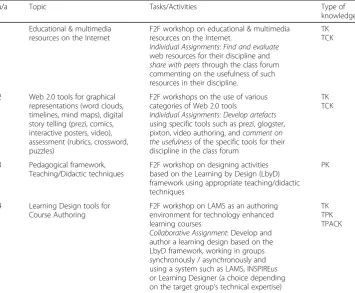
Aiming at increasing the intensity of interaction among group members in educa-tional scenario design, the following collaboration script was adopted, prescribing the envisaged phases, roles and activities (Dillenbourg & Hong, 2008) (see Table 1):
1. Initially pre-service teachers worked individually with various Web 2.0 technolo-gies and web resources in order to cultivate their Technological Knowledge (TK). Then they were asked to (a) reflect on the added value of these technolo-gies for their particular discipline in order to cultivate their Technological Con-tent Knowledge (TCK) (see Table 1, Rows 1 & 2) and (b) elaborate on a pedagogical framework for designing learning activities aiming at cultivating their Pedagogical Knowledge (PK) (see Table 1, Row 3),
These activities started in class during F2F workshops and continued online.
Table 1Curriculum organized around activities cultivating solid types of knowledge, starting from
TK, PK and incrementally combining them in TCK, TPK and TPACK
a/a Topic Tasks/Activities Type of
knowledge
1 Educational & multimedia resources on the Internet
F2F workshop on educational & multimedia resources on the Internet.
Individual Assignments:Find and evaluate
web resources for their discipline and
share with peersthrough the class forum commenting on the usefulness of such resources in their discipline.
TK TCK
2 Web 2.0 tools for graphical representations (word clouds, timelines, mind maps), digital story telling (prezi, comics, interactive posters, video), assessment (rubrics, crossword, puzzles)
F2F workshops on the use of various categories of Web 2.0 tools
Individual Assignments:Develop artefacts
using specific tools such as prezi, glogster, pixton, video authoring, andcomment on the usefulnessof the specific tools for their discipline in the class forum
TK TCK
3 Pedagogical framework, Teaching/Didactic techniques
F2F workshop on designing activities based on the Learning by Design (LbyD) framework using appropriate teaching/didactic techniques
PK
4 Learning Design tools for Course Authoring
F2F workshop on LAMS as an authoring environment for technology enhanced learning courses
Collaborative Assignment: Develop and author a learning design based on the LbyD framework, working in groups synchronously / asynchronously and using a system such as LAMS, INSPIREus
or Learning Designer (a choice depending on the target group's technical expertise)
2. Then, pre-service teachers were familiarised with learning design environments such as Learning Designer, INSPIREus, LAMS, which are content free but they have a strong pedagogical orientation addressing their Technological Pedagogical Know-ledge (TPK). Later on, they worked in groups of three (3) that were formulated on the basis of specific psychological characteristics, with these environments in order to collaboratively design a course and author appropriate content aiming at cultivat-ing their TPACK i.e. synthesizcultivat-ing Technological with Pedagogical knowledge in order to teach particular Content (see Table1, Row 4).
Students worked in groups in class and online.
Cycle 1 revealed two main issues guiding the design of Cycle 2: the first issue was a difficulty in maintaining participation and communication flow in asynchronous discus-sions; this was attributed to (a) the blended character of the course and the fact that most issues were resolved in f-2-f seminars and (b) pre-service teachers’ inexperience with asynchronous collaboration. The second issue had to do with the lack of achieving a gradual progress, starting from activities targeting simpler knowledge areas (such as TK, TCK or PK) and coming to more complex ones (such as TPK and TPACK) needed for scenario design. Pre-service teachers faced serious difficulties in synthesizing TP, TCK and PK while designing a course during the last phase of the TEL course.
Cycle 2: Learning design tasks that promote the synthesis of technology, pedagogy and content
The issues acknowledged during the first cycle of the implementation led to significant changes in the course curriculum at the second cycle. The core idea guiding the second cycle was to put emphasis on activities that cultivate synthetic types of knowledge such as TPK, TCK and TPACK, almost from the beginning of the course. This was realized by functionally integrating CoI in the course format and deploying TPACK through cy-cles of practical inquiry on various collaborative learning design tasks. This is in ac-cordance with the view of TPACK as a holistic and transformative form of knowledge suggesting that growth in just one of the three knowledge bases, i.e., technology, con-tent, and pedagogy, does not readily bring about progress or growth in TPACK as a whole (Angeli & Valanides, 2009).
In particular, emphasis was put on the gradual collaborative development of a technology-enhanced course (learning design) throughout the course. Pre-service teachers’collaboration was organized in successive stages around three specific design challenges. Each challenge initiated cycles of practical inquiry which would gradually lead to the integration of separate elements into a more integrative course structure, cultivating various synthetic types of knowledge. To this end, several triggering events were proposed leading to cycles of the practical inquiry process. This process comprises of four stages (Garrison et al., 2001): (a) an initiation phase, which is considered a trig-gering event, (b) an exploration phase, characterized by brainstorming, questioning, and exchange of information, (c) an integration phase, characterized by constructing meaning and (d) a final phase, characterized by the resolution of the problem created by the triggering event.
In summary, pre-service teachers working in groups of three had to address three particular design challenges, seriatim (see Table 2):
1st design challenge: initially they had to discuss and decide on the roles they would undertake (choosing among “the teacher”, “the researcher” and “the computer scien-tist”), the target group, the topic of the course they would develop (interdisciplinary in the case of mixed-discipline groups), taking in mind areas and subjects suggested by the Greek national curriculum (1st triggering event).
2nd design challenge: then they were assigned to design a learning activity for the se-lected topic, focusing on a specific knowledge process involving Web 2.0 tools and web-based resources (2nd triggering event). In particular, they had to (a) define learning objectives, (b) select appropriate Web 2.0 tools to integrate in the learning activity, (b) develop digital learning objects with the Web 2.0 tools, (c) connect the objects with a knowledge process using the New Learning–Learning by Design framework (Kalant-zis & Cope, 2012) framework, matching with their learning objectives.
3rd design challenge: Finally, the design of a course as a sequence of learning activ-ities and the authoring of appropriate content was the 3rd triggering eventthey had to address. During this process, trainees used dedicated learning design authoring environments (such as Learning Designer, and INSPIREusor LAMS) to develop appro-priate content and reflect on their artefacts. The final deliverable was a technology-enhanced course which included discrete learning activities of various types, as suggested by Laurillard (2012): read-watch-listen (assimilation), discussion, collabor-ation, investigcollabor-ation, practice and production. These activities should integrate web re-sources and objects developed with Web 2.0 tools, aiming at various knowledge processes using the New Learning – Learning by Design framework (Kalantzis & Cope, 2012). Each activity should be also pedagogically documented with appropri-ate teaching techniques, suggested tools and resources, types of interaction and participants’ roles.
Empirical research Methodology
The study was performed in the context of one semester TEL courses for two subsequent academic years where the blended learning scenarios of Cycles 1 and 2 were implemented. The first year, a pilot study was performed with pre-service Civil Engineering Educators of the Higher School of Pedagogical and Technological Education (ASPETE) (Cycle 1). The
Table 2Curriculum organized around design challenges cultivating synthetic types of knowledge
and prioritizing specific types of online presences
a/a Topic Tasks/activities Type of
Knowledge CoI Presence
1 Introduction to the Moodle VLE. Learning design for technology enhanced lessons: pedagogical & technological challenges
F2F workshopon the use of Moodle Creation of individual profiles. Introduction to learning design: structure of learning scenarios of various disciplines
Online: forum discussion: individually commenting on learning design examples TK PCK TPACK Teaching Social Cognitive
2 1st design challenge: Selecting
the theme of the learning design and orchestrating group roles
F2F workshop: Web search on theme-related resources following the Greek curriculum
Online: Small group forum discussion aiming at role allocation and a first draft of their learning design Peer and instructor feedback on first drafts
TPK PCK
Cognitive Social
3 Educational & multimedia resources on the Internet. Editing multimedia resources and integrating them in the learning design
F2F workshop: Web search on educational & multimedia resources on the Internet to be used in the learning design project
F2F workshopon multimedia editing (picture, sound and video) for the learning design project
TK TCK
Teaching
4 2nd design challenge:
Development of an activity (using the LbD framework) integrating the use of one or more Web 2.0 tools and web resources
F2F workshopon designing activities based on the LbyD framework using appropriate teaching techniques
F2F workshopon designing Web 2.0 objects for the learning design project
Online: Small group forum discussion aiming at the collaborative development of an artifact using Web 2.0 tools (such as prezi, glogster, pixton, video authoring) using the LbyD framework
PK TCK TPACK Teaching Cognitive Social
5 3rd design challenge:
Development of a learning design as a set of activities using the LbD framework and integrating the use of several Web 2.0 tools and web resources
Online:
Authoring and development of a full learning design using a dedicated learning design tool (Learning Designer, INSPIREusor LAMs)
TPK TPACK
Cognitive Social Teaching
6 Reflecting on learning designs Online: inter-group peer evaluation of learning designs
TPACK Cognitive Social
7 Final presentation F2F workshop: presentations of final learning designs by groups
second year the main study (Cycle 2) was performed with three categories of 207 pre-service teachers: (a) students of a 1-year postgraduate certificate in education of ASPETE and postgraduate students of the department of Informatics and Telecommunications of the University of Athens, (b) undergraduate students of the department of Civil Engineer-ing Educators of ASPETE, (c) undergraduate students of the department of Informatics of the Technological Educational Institute of Central Greece.
In this paper, we consider the three groups as one, since they belong to the broad category of pre-service teachers, coming, however, from different disciplinary areas. Furthermore, the scores of the three groups for the study variables (TPACK and CoI) were tested for heterogeneity and mean differences; none of them was found to be significant. Thus, the data we use in this research, for the first re-search question, come from the last group and for the second rere-search question, come from all the three groups since the framework we propose as well as the scope of this empirical research doesn’t focus on tools and didactic approaches of any specific discipline or degree, but rather exploits the complementary expertise, skills and preferences of pre-service teachers.
All the courses used Moodle for class administration, content delivery, and commu-nication/collaboration, beyond the regular f-2-f meetings/workshops. In this study asynchronous discussions are valuable resources for assessing the learning and design process. Moreover, through the second cycle of the course, the trainees completed two questionnaires (a) the TPACK instrument measuring pre-service teachers’ self-assessment of the seven knowledge domains included within TPACK (Schmidt et al., 2009) and (b) the CoI questionnaire, an instrument assessing students’perceptions on the development of the teaching, social and cognitive presences (Arbaugh et al., 2008).
Data analysis & results
In this section we provide initial evidence for the effectiveness of the activities employed based on the pre-service teachers’perspective. To this end, we analyzed their answers to the TPACK and CoI questionnaires collected during the 2013–2014 aca-demic year (when cycle 2 took place) to assess their perceptions about the type of knowledge they developed (Research Question 1) as well as their collaborative experi-ence and then we examined the relationships among TPACK and CoI elements (Re-search Question 2).
What is the effect of synthetic design activities (individual/collaborative, f2f/on-line) both on simpler and more synthetic types of knowledge?
Additionally, effect sizes were computed for all mean differences using Cohen’s d measure (Cohen, 1988) to demonstrate the magnitude of each difference. Effect size was large for the Technological Knowledge (d = .94), moderate for most other differences, and small for Pedagogical Content Knowledge and Content Knowledge (.41 and .43 respectively).
What relationships can be drawn among TPACK and CoI elements?
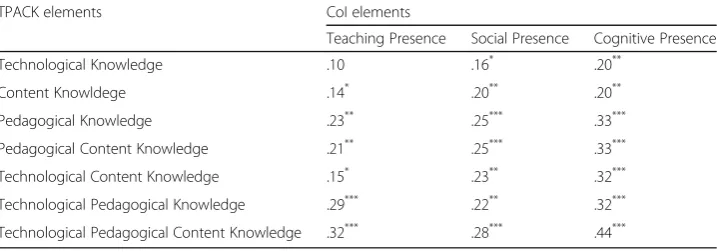
In order to assess the efficiency of the organic integration of TPACK and CoI models, we examined potential relationships of the types of knowledge that the three groups of pre-servive teachers developed with the CoI presences (Teaching, Social, Cognitive). Pearson’s correlation coefficients between the TPACK and CoI elements are presented in Table 4.
Almost all coefficients were statistically significant, but it should be noted that statis-tical significance mainly depends on the sample size (N = 207). Coefficients were mostly small (15 of them were under .30) and only the Cognitive Presence element of CoI exhibited five coefficients with the TPACK elements larger than .30, i.e. Pedagogical Knowledge, Pedagogical Content Knowledge, Technological Content Knowledge, Technological Pedagogical Knowledge, Technological Pedagogical Content Knowledge.
Correlation coefficients under .30, even when they are statistically significant, are too low to be considered. However, Cognitive Presence has low to moderate coefficients with the TPACK elements. Therefore, it can be argued that Cognitive Presence and TPACK have moderate linear relationships between each other.
Table 3Descriptive and inferential statistics for TPACK mean differences before and after the
training course of (N= 98) ASPETE undergraduates
Pre-Post Mean Dif. s.d. t-test
Technological Knowledge −.47 .5 t(97) =−8.68,p< .001, d = .94 Content Knowledge −.23 .6 t(96) =−4.12,p< .001, d = .43 Pedagogical Knowledge −.25 .6 t(96) =−4.27,p< .001, d = .50 Pedagogical Content Knowledge −.20 .7 t(96) =−2.95, p-.004, d = .41
Technological Content Knowledge −.41 1.1 t(96) =−3.87,p< .001, d = .51 Technological Pedagogical Knowledge −.31 .6 t(96) =−5.29,p< .001, d = .67
TPACK −.26 .6 t(96) =−4.43,p< .001, d = .54
Table 4Pearson’s correlation coefficients between TPACK and CoI elements (N= 217)
TPACK elements CoI elements
Teaching Presence Social Presence Cognitive Presence
Technological Knowledge .10 .16* .20**
Content Knowldege .14* .20** .20**
Pedagogical Knowledge .23** .25*** .33***
Pedagogical Content Knowledge .21** .25*** .33***
Technological Content Knowledge .15* .23** .32***
Technological Pedagogical Knowledge .29*** .22** .32***
Technological Pedagogical Content Knowledge .32*** .28*** .44***
*
p< .05;**
p< .01;***
Conclusions and future plans
As regards the effect of design activities, it is interesting to point out that synthetic, in-tellectually provocative design activities seem to address, to a great degree, Techno-logical and Pedagogical Knowledge as well as synthetic types of knowledge including technology (TCK, TPK, TPACK), a finding which confirms the need for viewing teacher digital literacy in an integrative way (Angeli & Valanides, 2005; Jang, 2008; Koehler et al., 2007; Wilson, 2003, Ruthven, 2009). On the other hand, Pedagogical Content Knowledge and Content Knowledge are less affected, a finding pointing a) to the need to address audiences with no perceived gaps in these two types of knowledge and b) to the potential of this design for in-service teacher training, as in-service teachers are an audience in constant interaction with PCK and CK through their everyday teaching practice. The most important finding however is the one confirming the increase of synthetic types of knowledge (TCK, TPK and TPACK), as it aligns both with the stated aims of this research and with expressed concerns in the field (Chien et al., 2012).
As regards the relationships among TPACK and CoI elements, the statistically signifi-cant difference of coefficients, despite being relatively small, reveals the connection be-tween TPACK and Cognitive Presence as well as the potential for further refining the CoI elements of Teaching and Social presence. Cognitive presence, which was at the centre of the engineering of design challenges exhibited a greater degree of association with TPACK, a finding in line with the need for integration of the two frameworks a) for fur-ther elaborating TPACK in different settings and with different audiences (Niess, 2011) and b) for using the CoI model as a tool for predicting and evaluating the joint construc-tion of meaning in online learning settings (Shea & Bidjerano, 2012).
The process of expanding and transforming the existing curriculum revealed a num-ber of issues. The augmented degree of online engagement achieved during the 2nd cycle created the need for constant and sustained moderation, a need not so evident during the 1st cycle. Thus, blended learning including a significant element of online interaction is evidently more demanding, as it calls for the collaboration of the content expert (the course instructor) with an online learning expert (who can also be a f2f in-structor, or at least have knowledge of the target group).
Challenging future goals are to compare the pre-service teachers’ perceptions with the evaluation of the group product as a more objective measure, as well as to trace the development of their knowledge through their contributions to the forum, using also qualitative measures to detect critical episodes in their interaction and the effect of these on both TPACK and Cognitive presence. Finally, qualitative content analysis of participants’contributions in terms of the type of knowledge they represent, in relation to the stage of cognitive presence they develop could further elaborate the relationship between CoI and TPACK.
Acknowledgments
The research“Design, Implementation and Evaluation of Blended Learning Scenarios in a Teacher Training Context Accommodating their Individual Psychological Characteristics (BleSTePsy)”is implemented through the Operational Program“Education and Lifelong Learning”and is co-financed by the European Commission (European Social Fund) and Greek national funds.
Authors’contributions
Competing interests
The authors declare that they have no competing interests.
Publisher’s Note
Springer Nature remains neutral with regard to jurisdictional claims in published maps and institutional affiliations.
Author details
1
School of Pedagogical and Technological Education, Athens 141 21 Heraklion, Greece.2Department of Psychology, School of Philosophy, National and Kapodistrian University of Athens, University Campus, 15784 Athens, Greece.
Received: 20 December 2016 Accepted: 3 August 2017
References
Angeli C., & Valanides N. (2005). Preservice elementary teachers as information and communication technology designers: an instructional systems design model based on an expanded view of pedagogical content knowledge.
Journal of Computer Assisted Learning,21, 292–302. Blackwell Publishing Ltd.
Angeli C., & Valanides N. (2009). Epistemological and methodological issues for the conceptualization, development, and assessment of ICTeTPCK: advances in technological pedagogical content knowledge (TPCK).Computers & Education,52(1), 154–168.
Arbaugh J. B., Cleveland-Innes M., Diaz S. R., Garrison D. R., Ice P., Richardson J. C., & Swan K. P. (2008). Developing a community of inquiry instrument: Testing a measure of the community of inquiry framework using a multi-institutional sample.Internet and Higher Education,11, 133–136.
Archambault L. M., & Barnett J. H. (2010). Revisiting technological pedagogical content knowledge: Exploring the TPACK framework.Computers & Education,55(4), 1656–1662.
Asensio-Pérez J. I., Dimitriadis Y., Pozzi F., Hernández-Leo D., Prieto L. P., Persico D., & Villagrá-Sobrino S. L. (2017). Towards teaching as design: exploring the interplay between full-lifecycle learning design tooling and teacher professional development.Computers & Education,114(November 2017), 92–116 https://doi.org/10.1016/j. compedu.2017.06.011.
Bath, D. & Bourke, J. (2011). The blending of blended learning: An experiential approach to academic staff development. ASCILITE 2011 Proceedings, Hobart, Tasmania, Australia, 4–7/12/2011, pp. 123–138.
Beetham H., & Sharpe R. (2013).Rethinking pedagogy for a digital age: Designing for 21st century learning(). Oxon: Routledge. Brindley, J. E., Walti, Ch. & Blaschke, L. M. (2009). Creating effective collaborative learning groups in an online
environment. International Review of Research in Open and Distributed Learning (IRRODL), 10, 3. Retrieved from: http://www.irrodl.org/index.php/irrodl/article/view/675/1271 14/12/2016.
Chai C. S., Koh J. H. L., & Tsai C. C. (2013). A Review of Technological Pedagogical Content Knowledge.Educational Technology & Society,16(2), 31–51.
Chien Y. T., Chang C. Y., Yeh T. K., & Chang K. E. (2012). Engaging pre-service science teachers to act as active designers of technology integration: A MAGDAIRE framework.Teaching and Teacher Education,28(4), 578–588.
Clark-Wilson A., Robutti O., & Sinclair N. (2014).The mathematics teacher in the digital era: an international perspective on technology focused professional development(vol. 2). Dordrecht: Springer.
Cohen J. (1988).Statistical power analysis for the behavioral sciences. Hillsdale: Erlbaum.
Conole G., & Culver J. (2010). The design of cloudworks: applying social networking practice to foster the exchange of learning and teaching ideas and designs.Computers & Education,54(3), 679–692.
Dillenbourg P., & Hong F. (2008). The mechanics of CSCL macro scripts.Computer-Supported Collaborative Learning,3, 5–23. Garrison D. R. (2011).E-learning in the 21st century: A framework for research and practice(). Taylor & Francis. Garrison D. R., Anderson T., & Archer W. (2001). Critical thinking, cognitive presence, and computer conferencing in
distance education.American Journal of Distance Education,15(1), 7–23.
Garrison D. R., Anderson T., & Archer W. (2010). The first decade of the community of inquiry framework: A retrospective.The Internet and Higher Education,13(1–2), 5–9.
Hernández-Leo D., Asensio-Pérez J. I., Derntl M., Prieto L. P., & Chacón J. (2014). ILDE: Community environment for conceptualizing, authoring and deploying learning activities. InProceedings of the 9th European conference on technology enhanced learning (EC-TEL 2014)(pp. 490–493) https://doi.org/10.1007/978-3-319-11200-8_48.
Hokanson B., Clinton G., & Tracey M. (Eds.) (2015).The Design of Learning Experience: the future of educational technology. New York: Springer-Verlag.
Jang S. J. (2008). The effects of integrating technology, observation and writing into a teacher education method course.Computers & Education,50, 853–865.
Jimoyiannis A. (2010). Designing and implementing an integrated technological pedagogical science knowledge framework for science teachers professional development.Computers & Education,55(3), 1259–1269. Kalantzis M., & Cope B. (2012).New learning: elements of a science of education(Second ed.). Cambridge: Cambridge
University Press.
Koehler M. J., Mishra P., & Yahya K. (2007). Tracing the development of teacher knowledge in a design seminar: Integrating content, pedagogy, and technology.Computers & Education,49, 740–762.
Koehler M. J., Rosenberg J., Greenhalgh S., Zellner A., & Mishra P. (2014).Can portfolio-based assessments demonstrate teachers’TPACK? Part of the symposium: Artifacts demonstrating teachers’technology integration competencies,
Presented at the Society for Information Technology & teacher education international conference 2014. Jacksonville. Kounenou K., Roussos P., & Yotsidi V. (2014). Teacher training in technology based on their psychological characteristics:
Kynigos C. (2003).Teacher education and the teaching profession, in learning and teaching in the communication society, theme 1–Teacher training and the role of teaching in the communication society, CD-ESR-GT2 (2003) 1, Council of Europe(pp. 35–59).
Laurillard D. (2012).Teaching as a design science: Building pedagogical patterns for learning and technology(). New York and London: Routledge.
Laurillard D., Charlton P., Craft B., Dimakopoulos D., Ljubojevic D., Magoulas G., Masterman E., Pujadas R., Whitley E. A., & Whittlestone K. (2013). A constructionist learning environment for teachers to model learning designs.Journal of Computer Assisted Learning,29(1), 15–30.
Luebeck J. L., & Bice L. R. (2005). Online discussion as a mechanism of conceptual change among mathematics and science teachers.Journal of Distance Education,20(2), 21–39.
Luka, I. (2014). Design Thinking in Pedagogy. Journal of Education Culture and Society, 2, 63–74. Retrieved from: http://nowadays.home.pl/JECS/data/documents/JECS=202014=20=282=29=2063.74.pdf (7/12/2016) doi:10.15503/jecs20142.63.74.
Makri K., Papanikolaou K., Tsakiri A., & Karkanis S. (2014). Blending the Community of Inquiry Framework with learning by design: towards a synthesis for blended learning in teacher training.The Electronic Journal of e-Learning,12(2), 183–194. Meyer A., Rose D. H., & Gordon D. (2014).Universal design for learning: theory and practice(). Wakefield: CAST
Professional Publishing.
Mishra P., & Koehler M. J. (2006). Technological pedagogical content knowledge: A framework for integrating technology in teacher knowledge.Teachers College Record,108(6), 1017–1054.
Mor Y., & Mogilevsky O. (2013). The learning design studio: collaborative design inquiry as teachers’professional development.Research in Learning Technology,21, 22054.
Mor Y., & Winters N. (2008). Participatory design in open education: a workshop model for developing a pattern language.Journal of Interactive MediaSpecial Issue. Available at: https://www-jime.open.ac.uk/articles/10.5334/2008-13/. Mor, Y., Warburton, S. & Winters, N. (2012). Participatory pattern workshops: a methodology for open learning design
inquiry, Research in Learning Technology 20. DOI: 10.3402/rlt.v20i0.19197.
Murphy E. (2004). Recognizing and promoting collaboration in an online asynchronous discussion.British Journal of Educational Technology,35(4), 421–431.
Niess M. L. (2011). Investigating TPACK: Knowledge growth in teaching with technology.Journal of Educational Computing Research,44(3), 299–317.
Otrel-Cass K. (2015). Theorizing technological pedagogical content knowledge to support networked inquiry learning in science : Looking back and moving forward. In C. Angeli, & N. Valanides (Eds.),Technological pedagogical content knowledge: Exploring, developing, and assessing TPCK(vol. IV, pp. 193–207). New York: Springer Publishing Company. Papanikolaou K., & Gouli E. (2013). Challenging pre-service teachers’on collaborative authoring of learning designs in a blended
learning context. In12th European conference on e-learning (ECEL 2013), 30–31 October(). France: Sophia Antipolis. Papanikolaou, K., Gouli, E., Makri, K., (2014). Designing pre-service teacher training based on a combination of TPACK
and Communities of Inquiry.Procedia–Social and Behavioral Sciences, 116, 3437–3442.
Papanikolaou, K., Gouli, E., Makri, K., Sofos, I., Tzelepi, M. (2016a). A peer evaluation tool of learning designs, In M. Sharples, K. Verbert, T. Klobucar: European conference on technology enhanced learning (EC-TEL) 2016, LNCS 9891, 193–206. DOI: 10.1007/978-3-319-45153-4_15.
Papanikolaou K. A., Makri K., Magoulas G. D., Chinou D., Georgalas A., & Roussos P. (2016b). Synthesizing technological and pedagogical knowledge in learning design: a case study in teacher training on technology enhanced learning.
International Journal of Digital Literacy and Digital Competence,7(1), 19–32 IGI Publishing.
Pawan F., Paulus T. M., Yalcin S., & Chang C. (2003). Online learning: patterns of engagement and interaction among in-service teachers.Language Learning & Technology,7(3), 119–140.
Pinar W. F. (Ed.) (2014).International handbook of curriculum research(2nd ed., ). Mahwah: Lawrence Erlbaum Associates. Rienties B., Brouwer N., & Lygo-Baker S. (2013). The effects of online professional development on higher education
teachers' beliefs and intentions towards learning facilitation and technology.Teaching and Teacher Education,29, 122e131.
Ruthven, K. (2007). Teacher, technologies and the structure of schooling. In D. Pitta–Pantazi & G. Philippou, Proceedings of the fifth congress of the European Society for Research in mathematics education, Larnaca (pp 52– 67), ISBN - 978-9963-671-25-0.
Ruthven, K. (2009). Towards a Naturalistic Conceptualisation of Technology Integration in Classroom Practice: the example of school mathematics. Éducation et didactique [Online], 3, 1 (Mars 2009), Retrieved from: http://educationdidactique.revues.org/434; DOI : 10.4000/educationdidactique.434.
Schmidt D. A., Baran E., Thompson A. D., Mishra P., Koehler M. J., & Shin T. S. (2009). Technological pedagogical content knowledge (TPACK): the development and validation of an assessment instrument for Preservice teachers.Journal of Research on Technology in Education,42, 123–149.
Shea P., & Bidjerano T. (2012). Learning presence as a moderator in the community of inquiry model.Computers and Education,59, 316–326.
Tømte, K., Ann-Britt Enochsson, A., B., Buskqvist, U. & Kårstein, A. (2015). Educating online student teachers to master professional digital competence: the TPACK-framework goes online. Computers & Education, 84, 26–35, ISSN 0360– 1315, https://doi.org/10.1016/j.compedu.2015.01.005.
Tzavara A., & Komis V. (2015). Design and implementation of educational scenarios with the integration of TDCK: a case study at a department of early childhood education. In C. Angeli, & N. Valanides (Eds.),Technological pedagogical content knowledge: Exploring, developing, and assessing TPCK. New York: Springer.
Voogt J., Erstad O., Dede C., & Mishra P. (2013). Challenges to learning and schooling in the digital networked world of the 21st century.Journal of Computer Assisted Learning,29, 403–413.