1. Introduction
In this paper, we deal with a Quadratic Programming problem. The classical Quadratic Programming problem is the problem of finding the minimum or maximum values of a quadratic function under constraints that are represented by linear inequality or equations. It’s a mathematical modeling technique designed to optimize the usage of limited recourses. It led to a number of interesting applications and the development of numerous useful results [9, 10]. In 2000, Beck and Teboulle considered nonconvex quadratic optimization problems with binary constraints and established a necessary global optimality condition for it [2]. They also presented an approach, which uses elementary arguments based on convex duality. In 2007, Jeyakumar et al. examined how global optimality of non-convex constrained optimization problems is related to Lagrange multiplier conditions [11]. In addition, they established Lagrange multiplier conditions for global optimality of general quadratic minimization problems with quadratic constraints. Xia obtained new sufficient optimality conditions for the nonconvex quadratic optimization problems with binary constraints by exploring local optimality conditions in 2009 [21]. In 2010, Glover et al. described a Diversification-Driven Tabu Search algorithm for solving unconstrained binary quadratic problems [8]. Also, Yang and Ruan presented a canonical duality theory for solving quadratic minimization problems subjected to either box or integer constraints [6]. In 2012, Sun et al. investigated the duality gap between the binary quadratic optimization problem and its semidefinite programming relaxation [17]. Frasch et al. addressed the
Corresponding author
Email: [email protected] DOI: 10.22105/jarie.2018.111797.1028
A Solution Approach for Solving Fully Fuzzy Quadratic
Programming Problems
Nemat Allah Taghi-Nezhad 1, Fatemeh Taleshian 2
1Department of Mathematics, Faculty of Basic Sciences, Gonbad Kavous University, Gonbad, Iran. 2Department of Mathematics, Shahrood University of Technology, Shahrood, Iran.
A B S T R A C T P A P E R I N F O
Quadratic Programming has been widely applied to solve real-world problems. This paper describes a solution method for solving a special class of fuzzy quadratic programming problemswith fuzziness in relations. Then the method is generalized to a more general fuzzy quadratic programming problem, where the cost coefficients, the matrix of the quadratic form, constraints coefficients, and the right-hand sides are all fuzzy numbers. Finally, some examples are taken to the utility of our proposed method.
Chronicle:
Received: 05 October 2017 Accepted:27 February 2018
Keywords: Fuzzy Number. Quadric Programming. Membership Function. Fuzzy Arithmetic. Fuzzy Constraint.
Journal of Applied Research on Industrial
Engineering
ubiquitous case in 2015 where the quadratic programming problems are strictly convex. The authors proposed a dual Newton strategy that exploits the block-bandedness similarly to an interior-point method [5]. Quadratic programming problem is mostly used in real problems. So the ambiguity and uncertainty are mostly presented in such optimization problems. Hence, the applicable tool fuzzy set theory is used to model these uncertainties in mathematical form. Fuzzy mathematical programming problems were quite studied in the specialized literature [3, 4, 12, 19, 20]. Also. fuzzy quadratic programming problem became interests of many researchers, and many studies were happened in this field. Abbasi Molai studied the quadratic programming problem with fuzzy relation inequality constraints in 2012 [16]. In 2014, Kochenberger et al. studied the unconstrained binary quadratic programming problem [13]. At this year, Gill and Wong studied active-set method for a generic quadratic programming problem with both equality and inequality constraints [7]. Also, Abbasi Molai studied the minimization problem of a quadratic objective function with the max-product fuzzy relation inequality constraints [15]. They use some properties of 𝑛 × 𝑛 real symmetric indefinite matrices, Cholesky’s decomposition, and the least square technique to solve this problem. In 2017, Takapoui et al. proposed a fast optimization algorithm for approximately minimizing convex quadratic functions over the intersection of affine and separable constraints [18].
This paper is organized in six sections. In the next section, quadratic programming problem is defined. In Section 3, some necessary notations and definitions of fuzzy set theory and fuzzy arithmetic are given. In Section 4, fuzzy quadratic programming problem is defined in the first subsection, the solution method of solving this fuzzy quadratic programming problem is focused in the second subsection, and in the third subsection, we extend this idea for generalizing fuzzy quadratic programming problem. In Section 5, some numerical examples are presented to illustrate how to apply the contribution of this paper for solving such quadratic programming problems. Finally, we conclude in Section 6.
2. Quadratic Programming
The most typical quadratic programming problem is defined as follows [1]:
Min 𝑍 = ∑ 𝑐𝑗𝑥𝑗 𝑛
𝑗=1
+1
2∑ ∑ 𝑞𝑖𝑗𝑥𝑖𝑥𝑗
𝑛
𝑗=1 𝑛
𝑖=1
𝑠. 𝑡. {∑ 𝑎𝑖𝑗𝑥𝑗≤ 𝑏𝑖
𝑛
𝑗=1
, 𝑖 ∈ 𝑁𝑚
𝑥𝑗≥ 0
,
(1)
where 𝑐 =(𝑐1, 𝑐2, … , 𝑐𝑛) and 𝑏𝑇 = (𝑏1, 𝑏2, … , 𝑏𝑚) are called cost vector and right-hand side vector. 𝑥 =
(𝑥1, 𝑥2, … , 𝑥𝑛)𝑇 is a vector of variables. Also, 𝐴 =[𝑎𝑖𝑗]𝑚×𝑛, 𝑖 ∈ 𝑁𝑚 and 𝑗 ∈ 𝑁𝑛, is called a constraint matrix and 𝑄 = [𝑞𝑖𝑗]𝑚×𝑛 is called the matrix of quadratic form where 𝑖 ∈ 𝑁𝑛 and 𝑗 ∈ 𝑁𝑛. Using this notation, the problem can be modeled in matrix form as follows:
Min 𝑍 = 𝑐𝑥 +1 2𝑥
𝑇𝑄𝑥
𝑠. 𝑡. {𝐴𝑥 ≤ 𝑏 𝑥 ≥ 0 .
(2)
In this paper, the matrix 𝑄 =[𝑞𝑖𝑗]
values used would be based on a prediction of future conditions, which inevitably involves some degree of uncertainty.
3. Fuzzy Numbers and Fuzzy Arithmetic
In this section some necessary definitions of fuzzy set theory which is taken from [9] are taken.
Definition 3.1: Let 𝑹 be the real line, then a fuzzy set 𝐴̃ in 𝑹 is defined to be a set of ordered pairs 𝐴̃ = {(𝑥, 𝜇𝐴̃(𝑥))|𝑥 ∈ 𝑹}, where 𝜇𝐴̃(𝑥) is called the membership function for the fuzzy set. The membership function maps each element of 𝑹 to a membership value between 0 and 1.
Definition 3.2: The support of a fuzzy set 𝐴̃, is defined as fallow: 𝑠𝑢𝑝𝑝(𝐴̃) = {𝑥 ∈ 𝑹|𝜇𝐴̃(𝑥) > 0} .
Definition 3.3: The core of a fuzzy set is the set of all points 𝑥 in 𝑹 witch 𝜇𝐴̃(𝑥) = 1.
Definition 3.4: A fuzzy set 𝐴̃ is called normal if its core is nonempty. In other words, there is at least one point 𝑥𝜖𝑹 with 𝜇𝐴̃(𝑥) = 1.
Definition 3.5: The 𝛼–cut or 𝛼–level set of a fuzzy set is a crisp set defined as follows: 𝐴𝛼= {𝑥 ∈ 𝑹|𝜇𝐴̃(𝑥) > 𝛼}.
Definition 3.6: A fuzzy set 𝐴̃ on 𝑹 is convex, if for any 𝑥, 𝑦𝜖𝑹and 𝜆 ∈ [0,1], we have
𝜇𝐴(𝜆𝑥 + (1 − 𝜆)𝑦) ≥ 𝑚𝑖𝑛{𝜇𝐴̃(𝑥), 𝜇𝐴̃(𝑦)} .
Definition 3.7: A fuzzy number 𝐴̃ is a fuzzy set on the real line that satisfies the condition of normality and convexity.
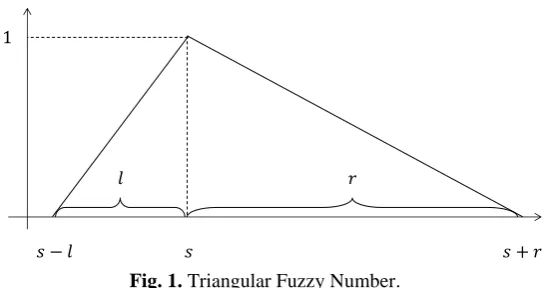
Definition 3.8: A fuzzy number 𝐴̃ on 𝑹is said to be triangular fuzzy number, if there exist real numbers and 𝑙, 𝑟 ≥ 0 such that
𝐴̃(𝑥) = {
𝑥
𝑙+
𝑙−𝑠
𝑙 , 𝑥 ∈ [𝑠 − 𝑙, 𝑠] −𝑥
𝑟 +
𝑠+𝑟
𝑟 , 𝑥 ∈ [𝑠, 𝑠 + 𝑟]
0, 𝑜. 𝑤. .
We denote a triangular fuzzy number 𝐴̃ by three real numbers 𝑠, 𝑙 and 𝑟 as = 〈𝑠, 𝑙, 𝑟〉 whose meaning are defined in Fig. 1.We also denote the set of all triangular fuzzy numbers with F(R).
Fig. 1. Triangular Fuzzy Number.
Definition 3.9: Let 𝑎̃ = 〈𝑠𝑎, 𝑙𝑎, 𝑟𝑎〉 and𝑏̃ = 〈𝑠𝑏, 𝑙𝑏, 𝑟𝑏〉 be two triangular numbers and 𝑥𝜖𝑹. Summation and multiplication of fuzzy numbers are defined as [22]:
𝑥𝑎̃ = {〈𝑥𝑠〈𝑥𝑠𝑎, 𝑥𝑙𝑎, 𝑥𝑟𝑎〉, 𝑥 ≥ 0
𝑎, −𝑥𝑟𝑎, −𝑥𝑙𝑎〉, 𝑥 < 0
𝑎̃ + 𝑏̃ = 〈𝑠𝑎+ 𝑠𝑏, 𝑙𝑎+ 𝑙𝑏, 𝑟𝑎+ 𝑟𝑏〉
𝑎̃ − 𝑏̃ = 〈𝑠𝑎− 𝑠𝑏, 𝑙𝑎− 𝑟𝑏, 𝑟𝑎− 𝑙𝑏〉
𝑎̃ ≤ 𝑏̃ if and only if 𝑠𝑎≤ 𝑠𝑏, 𝑠𝑎− 𝑙𝑎≤ 𝑠𝑏− 𝑙𝑏, 𝑠𝑎+ 𝑟𝑎≤ 𝑠𝑏+ 𝑟𝑏
Definition 3.10: We let 0̃ = (0,0,0) as a zero triangular fuzzy number.
Remark 3.1: 𝑎̃ ≥ 0̃ if and only if 𝑠𝑎≥ 0 , 𝑠𝑎− 𝑙𝑎≥ 0, 𝑠𝑎+ 𝑟𝑎 ≥ 0.
Remark 3.2: 𝑎̃ ≤ 𝑏̃ if and only if −𝑎̃ ≥ −𝑏̃.
4. Fuzzy Quadratic Programming
Consider the conventional quadratic programming problem (1). If some or all of the parameters were fuzzy numbers, the problem turns into the fuzzy quadratic programming problem. The most general type of this programming problem is formulated as follows:
Min 𝑍 = ∑ 𝐶̃𝑗𝑋̃𝑗 𝑛
𝑗=1
+1
2∑ ∑ 𝑄̃𝑖𝑗𝑋̃𝑖𝑋̃𝑗
𝑛
𝑗=1 𝑛
𝑖=1
𝑠. 𝑡. {∑ 𝐴̃𝑖𝑗𝑋̃𝑗
𝑛
𝑗=1
≤ 𝐵̃𝑖, 𝑖 ∈ 𝑁𝑚,
𝑋̃ ≥ 0
(3)
where 𝐴̃𝑖𝑗, 𝐵̃𝑖, 𝐶̃𝑗 and 𝑄̃𝑖𝑗 are fuzzy numbers, and 𝑋̃𝑗 are variables whose states are fuzzy numbers
(𝑖 ∈ 𝑁𝑚, 𝑗 ∈ 𝑁𝑛). The operations of addition and multiplication are operations of fuzzy arithmetic. Here instead of discussing this general type, we consider two special cases of fuzzy quadratic programming problem as follows:
1.The quadratic programming problem that only the right-hand side parameters and constraint coefficient are triangular fuzzy numbers.
𝑠 − 𝑙 𝑠 𝑠 + 𝑟
𝑙 𝑟
Min 𝑍 = ∑ 𝑐𝑗𝑥𝑗 𝑛
𝑗=1
+1
2∑ ∑ 𝑞𝑖𝑗𝑥𝑖𝑥𝑗
𝑛
𝑗=1 𝑛
𝑖=1
𝑠. 𝑡. {∑ 𝐴̃𝑖𝑗𝑥𝑗
𝑛
𝑗=1
≤ 𝐵̃𝑖, 𝑖 ∈ 𝑁𝑚.
𝑥 ≥ 0
(4)
2.A more general fuzzy quadratic programming problem in which the cost coefficient, the matrix of the quadratic form, constraint coefficient, and right-hand side parameters are all triangular fuzzy numbers.
Min 𝑍 = ∑ 𝐶̃𝑗𝑥𝑗 𝑛
𝑗=1
+1
2∑ ∑ 𝑄̃𝑖𝑗𝑥𝑖𝑥𝑗
𝑛
𝑗=1 𝑛
𝑖=1
𝑠. 𝑡. {∑ 𝐴̃𝑖𝑗𝑥𝑗 𝑛
𝑗=1
≤ 𝐵̃𝑖, 𝑖 ∈ 𝑁𝑚.
𝑥 ≥ 0
(5)
In the following, a solving method for model (4) is represented. In addition, this method is extended to a more general fuzzy quadratic problem (5).
4.1. Quadratic Programming with Fuzziness in Relations
Consider the quadratic programming problem (4.2). Let 𝐴̃𝑖𝑗= 〈𝑎𝑖𝑗, 𝑙𝑖𝑗, 𝑟𝑖𝑗〉 and 𝐵̃𝑖 = 〈𝑏𝑖, 𝑢𝑖, 𝑣𝑖〉 be
triangular fuzzy numbers. According to Definition 3.8, the fuzzy quadratic programming (4.2) is rewritten as follows:
Min 𝑍 = ∑ 𝑐𝑗𝑥𝑗 𝑛
𝑗=1
+1
2∑ ∑ 𝑞𝑖𝑗𝑥𝑖𝑥𝑗
𝑛
𝑗=1 𝑛
𝑖=1
𝑠. 𝑡. {∑〈𝑎𝑖𝑗, 𝑙𝑖𝑗, 𝑟𝑖𝑗〉𝑥𝑗
𝑛
𝑗=1
≤ 〈𝑏𝑖, 𝑢𝑖, 𝑣𝑖〉, 𝑖 ∈ 𝑁𝑚.
𝑥𝑗≥ 0, 𝑗 ∈ 𝑁𝑛
(6)
Using the operations of fuzzy numbers, any fuzzy constraint ∑𝑗=1𝑛 〈𝑎𝑖𝑗, 𝑙𝑖𝑗, 𝑟𝑖𝑗〉𝑥𝑗 ≤ 〈𝑏𝑖, 𝑢𝑖, 𝑣𝑖〉, 𝑖 ∈ 𝑁𝑚 can be transformed to the three crisp constraint as follows:
{
∑ 𝑎𝑖𝑗𝑥𝑗 𝑛
𝑗=1
≤ 𝑏𝑖
∑(𝑎𝑖𝑗− 𝑙𝑖𝑗) 𝑛
𝑗=1
𝑥𝑗≤ 𝑏𝑖− 𝑢𝑖
∑(𝑎𝑖𝑗+ 𝑟𝑖𝑗) 𝑛
𝑗=1
𝑥𝑗≤ 𝑏𝑖+ 𝑣𝑖, 𝑖 ∈ 𝑁𝑚
min 𝑧 = ∑ 𝑐𝑗𝑥𝑗 𝑛
𝑗=1
+1
2∑ ∑ 𝑞𝑖𝑗𝑥𝑖𝑥𝑗
𝑛
𝑗=1 𝑛
𝑖=1
𝑠. 𝑡.
{
∑ 𝑎𝑖𝑗𝑥𝑗 𝑛
𝑗=1
≤ 𝑏𝑖, 𝑖 ∈ 𝑁𝑚
∑(𝑎𝑖𝑗− 𝑙𝑖𝑗) 𝑛
𝑗=1
𝑥𝑗≤ 𝑏𝑖− 𝑢𝑖, 𝑖 ∈ 𝑁𝑚
∑(𝑎𝑖𝑗+ 𝑟𝑖𝑗) 𝑛
𝑗=1
𝑥𝑗≤ 𝑏𝑖+ 𝑣𝑖, 𝑖 ∈ 𝑁𝑚
𝑥𝑗≥ 0, 𝑗 ∈ 𝑁𝑛
.
(7)
As it is clear, all numbers are involved in resent programming problem are real numbers. Hence, this classical quadratic programming problem can be easily solved using existing methods.
4.2. Fully Fuzzy Quadratic programming problem
In this section, we generalize above method to a more general fuzzy quadratic programming problem in which the cost coefficient, the matrix of quadratic form, constraint coefficient, and right-hand side parameters are all triangular fuzzy numbers.
Min 𝑍 = ∑ 𝐶̃𝑗𝑥𝑗 𝑛
𝑗=1
+1
2∑ ∑ 𝑄̃𝑖𝑗𝑥𝑖𝑥𝑗
𝑛
𝑗=1 𝑛
𝑖=1
𝑠. 𝑡. {∑ 𝐴̃𝑖𝑗𝑥𝑗
𝑛
𝑗=1
≤ 𝐵̃𝑖, 𝑖 ∈ 𝑁𝑚.
𝑥 ≥ 0
(8)
As it mentioned before, any triangular fuzzy number 𝐴̃ can be represented as 𝐴̃ = 〈𝑠, 𝑙, 𝑟〉 where 𝑠, 𝑙 and
𝑟 are three real numbers. Using this representation, Problem (8) can then be rewritten as follows:
Min 𝑍 = ∑〈𝑐𝑗, 𝑝𝑗, 𝑡𝑗〉𝑥𝑗 𝑛
𝑗=1
+1
2∑ ∑〈𝑞𝑖𝑗, 𝑠𝑖𝑗, 𝑤𝑖𝑗〉𝑥𝑖𝑥𝑗
𝑛
𝑗=1 𝑛
𝑖=1
𝑠. 𝑡. {∑〈𝑎𝑖𝑗, 𝑙𝑖𝑗, 𝑟𝑖𝑗〉𝑥𝑗
𝑛
𝑗=1
≤ 〈𝑏𝑖, 𝑢𝑖, 𝑣𝑖〉, 𝑖 ∈ 𝑁𝑚,
𝑥𝑗≥ 0, 𝑖 ∈ 𝑁𝑚
(9)
where for all 𝑖 ∈ 𝑁𝑚 and 𝑗 ∈ 𝑁𝑛, 𝑄̃𝑖𝑗 = 〈𝑞𝑖𝑗, 𝑠𝑖𝑗, 𝑤𝑖𝑗〉, 𝐴̃𝑖𝑗 = 〈𝑎𝑖𝑗, 𝑙𝑖𝑗, 𝑟𝑖𝑗〉, 𝐶̃𝑗= 〈𝑐𝑗, 𝑝𝑗, 𝑡𝑗〉 and 𝐵̃𝑖= 〈𝑏𝑖, 𝑢𝑖, 𝑣𝑖〉 are all triangular fuzzy numbers. Summation and multiplication are operations on fuzzy numbers, and
Min 𝑍 = ∑〈𝑐𝑗, 𝑝𝑗, 𝑡𝑗〉𝑥𝑗 𝑛
𝑗=1
+1
2∑ ∑〈𝑞𝑖𝑗, 𝑠𝑖𝑗, 𝑤𝑖𝑗〉𝑥𝑖𝑥𝑗
𝑛
𝑗=1 𝑛
𝑖=1
𝑠. 𝑡.
{
∑ 𝑎𝑖𝑗𝑥𝑗 𝑛
𝑗=1
≤ 𝑏𝑖, 𝑖 ∈ 𝑁𝑚,
∑(𝑎𝑖𝑗− 𝑙𝑖𝑗)𝑥𝑗 𝑛
𝑗=1
≤ (𝑏𝑖− 𝑢𝑖), 𝑖 ∈ 𝑁𝑚
∑(𝑎𝑖𝑗+ 𝑟𝑖𝑗)𝑥𝑗 𝑛
𝑗=1
≤ (𝑏𝑖+ 𝑣𝑖), 𝑖 ∈ 𝑁𝑚
𝑥 ≥ 0
(10)
In the above optimization problem since the coefficients of the objective function are still fuzzy numbers, the optimal solution and so the derived objective value are fuzzy numbers as well. Without loss of generality, let 𝜇𝐶̃𝑗 and 𝜇𝑄̃𝑖𝑗, denote the membership function of 𝐶̃𝑗 and 𝑄̃𝑖𝑗, respectively:
𝜇𝐶̃𝑗 = {(𝐶𝑗, 𝜇𝐶̃𝑗(𝐶𝑗)) |𝐶𝑗∈ 𝑆(𝐶̃𝑗)}
μ𝑄̃ij= {(𝑞𝑖𝑗, μ𝑄̃ij(𝑞𝑖𝑗))| 𝑞𝑖𝑗∈ 𝑆(𝑄̃𝑖𝑗)} ,
where 𝑆(𝐶̃𝑗) and 𝑆(𝑄̃𝑖𝑗) are support sets of 𝐶̃𝑗 and 𝑄̃𝑖𝑗, respectively. In this paper, we are interested in
deriving the membership function of the objective value 𝑧̃. Since 𝑧̃ is a fuzzy number rather than a crisp number, we apply Zadeh’s extension principle to transform the problem into a family of conventional quadratic programs to solve. Based on the extension principle, the membership function 𝜇𝑧̃, can be defined as:
sup
𝑎,𝑏,𝑐
𝑀𝑖𝑛 {μ𝑄̃ij, 𝜇𝐶̃𝑗, ∀𝑖, 𝑗|𝑧 = 𝑍(𝑎, 𝑏, 𝑐, 𝑞)}, (11)
where 𝑍(𝑎, 𝑏, 𝑐, 𝑞) is the function of the conventional quadratic program that is defined in Model (1). Intuitively, to find the membership function 𝜇𝑧̃, it is sufficient to find the right shape function and the left shape function of 𝜇𝑧̃, which is equivalent to find the upper bound of the objective value 𝑧𝛼𝑢 and the lower bound of the objective 𝑧𝛼𝑙 at specific 𝛼 level. Since 𝑧𝛼𝑢 is the maximum of 𝑍(𝑎, 𝑏, 𝑐) and 𝑧𝛼𝑙 is the minimum of 𝑍(𝑎, 𝑏, 𝑐), they can be expressed as:
𝑍𝛼𝑢= 𝑀𝑎𝑥 {𝑍(𝑎, 𝑏, 𝑐, 𝑞) |(𝑄̃𝑖𝑗)𝛼 𝑙
≤ 𝑞𝑖𝑗 ≤ (𝑄̃𝑖𝑗)𝛼 𝑢
, (𝐶̃𝑗)𝛼 𝑙
≤ 𝑐𝑗 ≤ (𝐶̃𝑗)𝛼 𝑢
,
∀𝑖, 𝑗 } (12)
𝑍𝛼𝑙 = 𝑀𝑖𝑛 {𝑍(𝑎, 𝑏, 𝑐, 𝑞) |(𝑄̃𝑖𝑗)𝛼 𝑙
≤ 𝑞𝑖𝑗≤ (𝑄̃𝑖𝑗)𝛼 𝑢
, (𝐶̃𝑗)𝛼 𝑙
≤ 𝑐𝑗≤ (𝐶̃𝑗)𝛼 𝑢
,
∀𝑖, 𝑗 }. (13)
Clearly, different values of 𝑞𝑖𝑗 and 𝑐𝑗 produce different objective values. To find the interval of the objective value at specific 𝛼 value, it is sufficient to find the upper bound and lower bound of the objective values of (4.7). From (4.9), the values of 𝑞𝑖𝑗 and 𝑐𝑗, that attain the largest value for 𝑧𝛼𝑢, can be
Max 𝑍𝛼𝑢= (𝑄̃𝑖𝑗)𝛼 𝑙 ≤ 𝑞𝑖𝑗 ≤ (𝑄̃𝑖𝑗)𝛼 𝑢 (𝐶̃𝑗)𝛼 𝑙 ≤ 𝑐𝑗≤ (𝐶̃𝑗)𝛼 𝑢 ∀𝑖, 𝑗
Min 𝑍 = ∑ 𝑐𝑗𝑥𝑗 𝑛
𝑗=1
+1
2∑ ∑ 𝑞𝑖𝑗𝑥𝑖𝑥𝑗
𝑛 𝑗=1 𝑛 𝑖=1 𝑠. 𝑡. { ∑ 𝑎𝑖𝑗𝑥𝑗 𝑛 𝑗=1 ≤ 𝑏𝑖, 𝑖 ∈ 𝑁𝑚 ∑(𝑎𝑖𝑗− 𝑙𝑖𝑗)𝑥𝑗 𝑛 𝑗=1 ≤ (𝑏𝑖− 𝑢𝑖), 𝑖 ∈ 𝑁𝑚 ∑(𝑎𝑖𝑗+ 𝑟𝑖𝑗)𝑥𝑗 𝑛 𝑗=1 ≤ (𝑏𝑖+ 𝑣𝑖), 𝑖 ∈ 𝑁𝑚
𝑥 ≥ 0
(14)
The objective value 𝑧𝛼𝑢, is the upper bound of the objective values for model (10). By the same token,
to find the values of 𝑞𝑖𝑗 and 𝑐𝑗 that produce the smallest objective value 𝑧𝛼𝑙, a two-level mathematical program is formulated by replacing the outer-level program of Model (14) from ‘‘𝑀𝑖𝑛’’ to ‘‘𝑀𝑎𝑥’’:
Min 𝑍𝛼𝑙 = (𝑄̃𝑖𝑗)𝛼 𝑙 ≤ 𝑞𝑖𝑗 ≤ (𝑄̃𝑖𝑗)𝛼 𝑢 (𝐶̃𝑗)𝛼 𝑙 ≤ 𝑐𝑗≤ (𝐶̃𝑗)𝛼 𝑢 ∀𝑖, 𝑗
Min 𝑍 = ∑ 𝑐𝑗𝑥𝑗 𝑛
𝑗=1
+1
2∑ ∑ 𝑞𝑖𝑗𝑥𝑖𝑥𝑗
𝑛 𝑗=1 𝑛 𝑖=1 𝑠. 𝑡. { ∑ 𝑎𝑖𝑗𝑥𝑗 𝑛 𝑗=1 ≤ 𝑏𝑖, 𝑖 ∈ 𝑁𝑚 ∑(𝑎𝑖𝑗− 𝑙𝑖𝑗)𝑥𝑗 𝑛 𝑗=1 ≤ (𝑏𝑖− 𝑢𝑖), 𝑖 ∈ 𝑁𝑚 ∑(𝑎𝑖𝑗+ 𝑟𝑖𝑗)𝑥𝑗 𝑛 𝑗=1 ≤ (𝑏𝑖+ 𝑣𝑖), 𝑖 ∈ 𝑁𝑚
𝑥 ≥ 0
(15)
Clearly, for any 𝑥𝑖, 𝑥𝑗≥ 0 we have:
(𝑄̃𝑖𝑗)𝛼 𝑙 𝑥𝑖𝑥𝑗≤ 𝑞𝑖𝑗𝑥𝑖𝑥𝑗≤ (𝑄̃𝑖𝑗)𝛼 𝑢 𝑥𝑖𝑥𝑗 (𝐶̃𝑗)𝛼 𝑙 𝑥𝑗 ≤ 𝑐𝑗𝑥𝑗≤ (𝐶̃𝑗)𝛼 𝑢 𝑥𝑗.
In other words, we have:
∑(𝐶̃𝑗)𝛼 𝑙 𝑥𝑗 𝑛 𝑗=1 +1
2∑ ∑(𝑄̃𝑖𝑗)𝛼 𝑙 𝑥𝑖𝑥𝑗 𝑛 𝑗=1 𝑛 𝑖=1 ≤ ∑ 𝑐𝑗𝑥𝑗 𝑛 𝑗=1 +1
2∑ ∑ 𝑞𝑖𝑗𝑥𝑖𝑥𝑗
𝑛 𝑗=1 𝑛 𝑖=1 ≤ ∑(𝐶̃𝑗)𝛼 𝑢 𝑥𝑗 𝑛 𝑗=1 +1
2∑ ∑(𝑄̃𝑖𝑗)𝛼 𝑢 𝑥𝑖𝑥𝑗 𝑛 𝑗=1 𝑛 𝑖=1
To derive the maximum objective value in (14), the parameters 𝑞𝑖𝑗 and 𝑐𝑗 must set to their upper bounds
(𝑄̃𝑖𝑗)𝛼 𝑢
and (𝐶̃𝑗)𝛼 𝑢
. Simultaneously, to search for the minimum objective value in (15), we need to set all
𝑞𝑖𝑗 and 𝑐𝑗 to their lower bounds (𝑄̃𝑖𝑗)𝛼 𝑙
and (𝐶̃𝑗)𝛼 𝑙
𝑍𝛼𝑢= Min 𝑍 = ∑(𝐶̃𝑗)𝛼 𝑢
𝑥𝑗 𝑛
𝑗=1
+1
2∑ ∑(𝑄̃𝑖𝑗)𝛼 𝑢
𝑥𝑖𝑥𝑗 𝑛
𝑗=1 𝑛
𝑖=1
𝑠. 𝑡.
{
∑ 𝑎𝑖𝑗𝑥𝑗 𝑛
𝑗=1
≤ 𝑏𝑖, 𝑖 ∈ 𝑁𝑚
∑(𝑎𝑖𝑗− 𝑙𝑖𝑗)𝑥𝑗 𝑛
𝑗=1
≤ (𝑏𝑖− 𝑢𝑖), 𝑖 ∈ 𝑁𝑚
∑(𝑎𝑖𝑗+ 𝑟𝑖𝑗)𝑥𝑗 𝑛
𝑗=1
≤ (𝑏𝑖+ 𝑣𝑖), 𝑖 ∈ 𝑁𝑚
𝑥 ≥ 0,
(16)
𝑍𝛼𝑙 = Min 𝑍 = ∑(𝐶̃𝑗)𝛼 𝑙
𝑥𝑗 𝑛
𝑗=1
+1
2∑ ∑(𝑄̃𝑖𝑗)𝛼 𝑙
𝑥𝑖𝑥𝑗 𝑛
𝑗=1 𝑛
𝑖=1
𝑠. 𝑡.
{
∑ 𝑎𝑖𝑗𝑥𝑗 𝑛
𝑗=1
≤ 𝑏𝑖, 𝑖 ∈ 𝑁𝑚
∑(𝑎𝑖𝑗− 𝑙𝑖𝑗)𝑥𝑗 𝑛
𝑗=1
≤ (𝑏𝑖− 𝑢𝑖), 𝑖 ∈ 𝑁𝑚
∑(𝑎𝑖𝑗+ 𝑟𝑖𝑗)𝑥𝑗 𝑛
𝑗=1
≤ (𝑏𝑖+ 𝑣𝑖), 𝑖 ∈ 𝑁𝑚
𝑥 ≥ 0,
. (17)
These are pairs of one-level mathematical programs that clearly express the bounds of the objective values at a specific 𝛼 value. In these conventional quadratic programming problems, the objective functions are convex functions and constraints are linear. Therefore, the derived objective values are global optimum solutions. The optimal solutions 𝑍𝛼𝑙 and 𝑍𝛼𝑢 are the lower bound and the upper bound of the objective values of the fuzzy quadratic programming problems, respectively. 𝑍𝛼𝑙 and 𝑍𝛼𝑢 together constitute the interval [𝑍𝛼𝑙 , 𝑍𝛼𝑢] that the objective values of the fuzzy quadratic program lie. In the next section, by using two numerical examples we illustrate the utility of this paper.
5. Numerical Examples
In this section, the applicability of our proposed method is demonstrated by solving two numerical examples.
Example 1: Inthefollowing, a quadratic programming problem is considered in which the constraint coefficient and the right-hand sides parameters are triangular fuzzy parameters:
𝑀𝑖𝑛 𝑍 = 2𝑥1+ 𝑥2+ 2𝑥12+ 𝑥1𝑥2+ 2𝑥22
𝑠. 𝑡. {
〈6,2,1.5〉𝑥1+ 〈8,2.5,1〉𝑥2≤ 〈5,1,0.5〉
〈5,1,1〉𝑥1+ 〈2,0.5,1〉𝑥2≤ 〈7,2,1.5〉
𝑥1, 𝑥2≥ 0
(18)
𝑀𝑖𝑛 𝑍 = 2𝑥1+ 𝑥2+ 2𝑥12+ 𝑥1𝑥2+ 2𝑥22
𝑠. 𝑡.
{
6𝑥1+ 8𝑥2≤ 5
5𝑥1+ 2𝑥2≤ 7
4𝑥1+ 5.5𝑥2≤ 4
7.5𝑥1+ 9𝑥2≤ 5.5
4𝑥1+ 1.5𝑥2≤ 5
6𝑥1+ 3𝑥2≤ 8.5
𝑥1, 𝑥2≥ 0
(19)
where parameter values are all known constant. Thus, this model is a conventional quadratic programming problem. By solving this problem with SQP algorithm, the global optimum solution is obtained as:
𝑥1= 0, 𝑥2= 0.
The value of the objective function is also achieved 𝑍∗= 0.
Example 2: Now suppose a quadratic programming problem with fuzzy objective function and fuzzy constraints as follows:
Min 𝑍̃ = 〈−5,1,1〉𝑥1+ 〈1.5,0.5,0.5〉𝑥2+
1
2(〈6,2,2〉𝑥1
2+ 〈−4,2,2〉𝑥
1𝑥2+ 〈4,2,2〉𝑥22)
𝑠. 𝑡. {
1𝑥1+ 〈1,0.5,0.5〉𝑥2≤ 〈2,1,1〉
〈2,1,1〉𝑥1+ 〈−1,1,0.5〉𝑥2≤ 〈4,1,1〉
𝑥1, 𝑥2≥ 0
(20)
According to Models (16) and (17), the upper and lower bounds of 𝑍̃ at possibility level 𝛼 can be solved as:
𝑍𝛼𝑢= Min (−4 − 𝛼)𝑥1+ (2 −
𝛼
2) 𝑥2+ (4 − 𝛼)𝑥1
2+ (−𝛼 − 1)𝑥 1𝑥2
+(3 − 𝛼)𝑥22
𝑠. 𝑡.
{
𝑥1+ 𝑥2≤ 2
𝑥1+ 0.5𝑥2≤ 1
𝑥1+ 1.5𝑥2≤ 3
2𝑥1− 𝑥2≤ 4
𝑥1− 2𝑥2≤ 3
3𝑥1− 0.5𝑥2≤ 5
𝑥1, 𝑥2≥ 0
(21)
𝑍𝛼𝑙 = min (𝛼 − 6)𝑥1+ (1 +
𝛼
2) 𝑥2+ (2 + 𝛼)𝑥1
2+ (𝛼 − 3)𝑥 1𝑥2
+(1 + 𝛼)𝑥22
𝑠. 𝑡.
{
𝑥1+ 𝑥2≤ 2
𝑥1+ 0.5𝑥2≤ 1
𝑥1+ 1.5𝑥2≤ 3
2𝑥1− 𝑥2≤ 4
𝑥1− 2𝑥2≤ 3
3𝑥1− 0.5𝑥2≤ 5
𝑥1, 𝑥2≥ 0
(22)
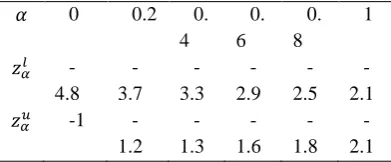
Table 1. Lists the α-cuts of the objective value.
Thus, the optimal objective value is equivalent to:
Fig. 2. Optimal objective value.
6. Conclusion
Quadratic programming problem is an important field in operation research and is mostly used to optimizing real words problems. In this paper, we considered a special class of quadratic programming problem with fuzziness in constraints coefficients. In addition, we considered all fuzzy numbers in triangular form. Then, we presented a new method using fuzzy operations to solve the mentioned problem. Finally, by combining our idea with Liu’s method, we extended our method for solving a more general quadratic programming problem with fuzziness in both constraints and objective function coefficients. We tried to extend this method to situations where parameters are trapezoidal or LR fuzzy numbers. Also, we hope to extend our presented method for problems with fuzzy parameters and fuzzy variables.
Reference
[1] Bazaraa, M. S., Sherali, H. D., & Shetty, C. M. (2013). Nonlinear programming: theory and algorithms. John Wiley & Sons.
[2] Beck, A., & Teboulle, M. (2000). Global Optimality conditions for quadratic optimization problems with binary constraints. SIAM journal on optimization, 11(1), 179-188.
[3] Das, S. K., & Mandal, T. (2017). A new model for solving fuzzy linear fractional programming problem with ranking function. Journal of applied research on industrial engineering, 4(2), 89-96.
[4] Ebrahimnejad, A., & LUIS, J. (2018). Fuzzy Sets-Based Methods and Techniques for Modern Analytics. Springer International Publisher.
[5] Frasch, J. V., Sager, S., & Diehl, M. (2015). A parallel quadratic programming method for dynamic optimization problems. Mathematical programming computation, 7(3), 289-329.
[6] Gao, D. Y., & Ruan, N. (2010). Solutions to quadratic minimization problems with box and integer constraints. Journal of global optimization, 47(3), 463-484.
𝛼 0 0.2 0.
4
0. 6
0. 8
1
𝑧𝛼𝑙
-4.8 -3.7
-3.3
-2.9
-2.5
-2.1
𝑧𝛼𝑢 -1
-1.2 -1.3
-1.6
-1.8
[7] Gill, P. E., & Wong, E. (2015). Methods for convex and general quadratic programming. Mathematical programming computation, 7(1), 71-112.
[8] Glover, F., Lü, Z., & Hao, J. K. (2010). Diversification-driven tabu search for unconstrained binary quadratic problems. 4OR, 8(3), 239-253.
[9] Goodarzi, F. K., Taghinezhad, N. A., & Nasseri, S. H. (2014). A new fuzzy approach to solve a novel model of open shop scheduling problem. University politehnica of bucharest scientific bulletin-series a-applied mathematics and physics, 76(3), 199-210.
[10] Hock, W., & Schittkowski, K. (1980). Test examples for nonlinear programming codes. Journal of optimization theory and applications, 30(1), 127-129.
[11] Jeyakumar, V., Rubinov, A. M., & Wu, Z. Y. (2007). Non-convex quadratic minimization problems with quadratic constraints: global optimality conditions. Mathematical programming, 110(3), 521-541.
[12] Kao, C., & Liu, S. T. (2000). Fuzzy efficiency measures in data envelopment analysis. Fuzzy sets and systems, 113(3), 427-437.
[13] Kochenberger, G., Hao, J. K., Glover, F., Lewis, M., Lü, Z., Wang, H., & Wang, Y. (2014). The unconstrained binary quadratic programming problem: a survey. Journal of combinatorial optimization, 28(1), 58-81.
[14] Maros, I., & Mészáros, C. (1999). A repository of convex quadratic programming problems. Optimization methods and software, 11(1-4), 671-681.
[15] Molai, A. A. (2014). A new algorithm for resolution of the quadratic programming problem with fuzzy relation inequality constraints. Computers & industrial engineering, 72, 306-314.
[16] Molai, A. A. (2012). The quadratic programming problem with fuzzy relation inequality constraints. Computers & industrial engineering, 62(1), 256-263.
[17] Sun, X. L., Liu, C. L., Li, D., & Gao, J. J. (2012). On duality gap in binary quadratic programming. Journal of global optimization, 53(2), 255-269.
[18] Takapoui, R., Moehle, N., Boyd, S., & Bemporad, A. (2017). A simple effective heuristic for embedded mixed-integer quadratic programming. International journal of control, 1-11.
[19] Taleshian, F., & Fathali, J. (2016). A Mathematical Model for Fuzzy-Median Problem with Fuzzy Weights and Variables. Advances in operations research. http://dx.doi.org/10.1155/2016/7590492
[20] Taleshian, F., Fathali, J. & Taghi-Nezhad, N. A. (in press). Fuzzy majority algorithms for the 1-median and 2-median problems on a fuzzy tree. Fuzzy Information and Engineering.
[21] Xia, Y. (2009). New optimality conditions for quadratic optimization problems with binary constraints. Optimization letters, 3(2), 253-263.