Optimization of CNC Turning Cutting
Parameter for Geometrical Dimensional
Accuracy with Surface roughness on the
non-ferrous Material Applying Taguchi Technique
Santosh Kumar Patod
#1, Dr. Suman Sharma
#21#Research Scholar, Mechanical Engineering, SIRT Indore, India 2#Professor and Head, Mechanical Engineering, SIRT Indore, India
Abstract — In a manufacturing industry, machining
process is to shape the metal parts by removing unwanted material by means of tool. During the machining process of any part given quality specifications such as surface quality, dimensional accuracy with minimum production cost or machining time are to be considered. To obtain the final surface quality and dimensional tolerance. Surface quality produced by the machining processes is one of the crucial factors to determine the functional performance and correspondent fatigue life time of the parts. The project will present the results of surface characterization of the part produced by high speed CNC turning with optimum combinations of input parameters cutting speed(rpm), feed rate, depth of cut, material removal rate, adequate coolant flood, tool geometry, work piece clamping, material composition, chip formations. And the corresponding output size precision, circularity, taper, concentricity and better surface finish. A series machining tests were conducted on the non-ferrous materials specimen the significance of influence of machining parameters in the study and Taguchi approach (orthogonal array) was adapted for the experiments This research report reveals the relationship between cutting parameters and surface roughness is studied to determine the effect of different parameters on the machined surface quality as well as dimensional confirmations.
Keywords — CNC, Non-Ferrous, Dimensional
Accuracy, Surface Roughness, Turning, Cutting Parameter, Taguchi.
I. INTRODUCTION
The extent of quality of the procured item (or product) influences the degree of satisfaction of the consumers during the usage of the procured goods. Therefore, every manufacturing or production unit should concern about the quality of the product. Apart from the quality, there exists another criterion, called productivity which is directly related to the profit level and also goodwill of the organization. Metal based industry is focused to increase productivity and
quality of the machined parts. For this purpose, all aspects of every process need to be monitored. In this way we can maximize the efficiency in the manufacturing process. In this study, the effect of machining parameters on the various surface roughness characteristics; Ra, Rq and Rz in the turning of different non-ferrous materials with R0.4 insert was experimentally investigated. Optimal machining parameters were determined using multi-objective Taguchi Technique and a confirmation experiment was conducted to test the success of the optimization. Process parameters considered for this research are feed, speed and depth of cut and lathe tailstock centre support were examined with the help of design of experiments to obtain better surface finish and minimize run out error (geometrical dimensional accuracy). Experiments were conducted based on Taguchi method L27 orthogonal array and analysed with lower the better concept. This investigation shows the important and dominant factor which influences the responses of the turning operation.
A. CNC Turning
meticulously exact components are produced, and can also be reproduced.
B. Dimensional Accuracy
The geometrical dimensional accuracies (GD&T) focused on functional assembly. This ensures a uniform method of manufacture and an assured problem free functional fitment. The use of linear tolerances when dimensioning the part can control the size of a product. It is however possible for limits of size to be maintained while the shape of a part or feature deviates significantly from the intended form. To control this deviation, a method of specifying the acceptable tolerance of form is required and this is done using geometric dimensioning and tolerance symbols. These enable the designer to specify on the drawing, the geometry or shape of a component and they provide a precise definition of what constitutes a functionally good part. Some of GD&T characteristics are as follows
Straightness- is the condition where an element of a surface or an axis is a straight line.
Circularity- Each circular element of the surface must lie within a tolerance zone defined by two concentric circles separated by the specified tolerance value. All points on the surface must lie within the limits of size and the circularity limit.
Circular Run out-The tolerance zone for any individual circular element is equal to the total allowable movement of a dial indicator fixed in a position normal to the true geometric shape of the feature surface when the part is rotated 360 degrees about the datum axis.
C. Surface Roughness
Surface roughness often shortened to roughness, is a component of surface texture. It is quantified by the deviations in the direction of the normal vector of a real surface from its ideal form. If these deviations are large, the surface is rough; if they are small, the surface is smooth. Surface structure plays a key role in governing contact mechanics, that is to say the mechanical behavior exhibited at an interface between two solid objects as they approach each other and transition from conditions of non-contact to full contact.
The Theoretical finished surface roughness (h) is
given by the formula-
h (µm): Finished Surface Roughness
f (mm/ rev): Feed per Revolution
RE (mm): Insert Corner Radius (Nose Radii)
Theoretical roughness depends exclusively on tools geometry and applied process of machining whereas a real roughness appears as the result of theoretical roughness though with bigger or lesser occasional roughness provoked by the many factors. The surface roughness is influenced by the most important factors such as: cutting parameters, tool geometry, build-up edge, process time, work piece and tool material, tool wear, machine condition appliance of cutting fluids (coolants and lubricants).
Surface quality (finish/roughness) is one of the essential quality control parameter to ensure that functional surfaces of manufactured parts conform to specified standards. Surface finish of parts can significantly affect their friction, wear, fatigue, corrosion, tightness of contact joints, positioning accuracy, etc. In many engineering applications surface finish is closely allied to function, particularly when the surface of interest is having relative motion with another surface.
D. Non-Ferrous Materials
The Non-ferrous materials can be defined as the material that does not contain iron in an appreciable amount. Non-ferrous metals include Aluminum, Copper, lead, zinc and tin, as well as precious metals like gold and silver. Their main advantage over ferrous materials is their malleability. Lastly they are non-magnetic, which is important for many electronic and wiring applications.
In this study there are three non-ferrous metals and alloy adopted for cutting parameters optimization; these are Aluminium, Copper and Brass alloy.
E. Optimization Software
Here for obtaining the optimal values of cutting parameters we applied the Minitab 17 stastical data optimization software, the brief information about the software are described below. Minitab is a software product that helps you to analyze the data. This is designed essentially for the Six Sigma professionals. It provides a simple, effective way to input the statistical data, manipulate that data, identify trends and patterns, and then extrapolate answers to the current issues. This is most widely used software for the business of all sizes - small, medium and large. Minitab provides a quick, effective solution for the level of analysis required in most of the Six Sigma projects.
II. LITRATURE REVIEW
Following is a list of researchers who has worked in area of optimization of cutting parameters of turning operation to achieve better surface quality.
LB Abhang [2012] Study on a reliable surface roughness model for steel turning was developed using RSM and incorporated cutting speed, feed rate, depth of cut, and the tool nose radius. The study was optimized by the LINGO-solver approach, which is a global optimization technique. This has resulted in a fairly useful method of obtaining process parameters in order to the required surface quality. The optimal parameter combination of the turning process corresponded to cutting speed of 189 miters/minute, a feed attain rate of 0.06 mm/revolution, a depth of cut of 0.2 mm, and a tool nose radius of 1.2 mm.
Upinder Kumar Yadav et al. [2012] In this study used Medium Carbon steel AISI 1045 and investigated the effect of machining parameters on surface roughness. They used L27 orthogonal array for performing experiments and ANOVA and Taguchi method for analyzed data result. They investigate three levels of machining parameter and experiments were done on STALLION -100 HS CNC lathe. They conclude that feed rate is the most significant factor affecting surface roughness followed by depth of cut. They also conclude that cutting speed is the least significant factor affecting surface roughness.
N. Zeelan Basha et al. [2013] They have investigated effect of process parameters (spindle speed, Feed rate and depth of cut) in turning operation. They used Aluminum 6061 material and coated carbide as a tool for performing experiments. They developed Mathematical model using regression technique of Box-Behnken of Response surface methodology (RSM) in design expert 8.0 software and optimization carried out by using genetic algorithm in Matlab 8.0. They used genetic algorithm and determine optimal solution of different cutting conditions.
M. Naga Phani Sastry and K. Devaki Devi [2011] This paper explains an optimal setting of turning parameters (Cutting speed, Feed and Depth of Cut) which results in an optimal value of Surface Roughness and maximum Metal Removal Rate while machining Aluminium bar with HSS tool. A mathematical technique has been used to generate model with Response Surface Methodology.
P.Warhade et al.[2013] This paper investigated the effect of cutting parameters namely, cutting speed, depth of cut and feed rate on minimize required machining time and maximizing metal removal rate during machining of Aluminium Alloy 6063 using VBM0.2 tool. Experiments were conducted based on the established Taguchi’s technique L27 orthogonal
array and minitab-16 statistical software is used to generate the array.
Ravi Patel et al. [2016] This study was based on optimizing the turning process under different machining parameters by Taguchi method to improve the surface roughness (quality) of the product due to this decreases the machining time, increases the production rate and decreasing the product manufacturing cost. Taguchi optimization methodology is applied to optimize cutting parameters in turning of mild steel with carbide tool under dry cutting condition. The Centre Lathe machine was used for experiments based on the Taguchi design of experiments (DOE) with orthogonal L9 array. The orthogonal array, signal to noise ratio (S/N) and Taguchi method were employed to find minimum surface roughness. From the Experimental result of Taguchi method it is found that Depth of cut is most significant, spindle speed is significant and feed rate is least significant factor effecting surface roughness.
N. Rajesh et al. [2017] In this paper, turning experiments are conducted on Al6061 work material using HSS tool with and without coolant at different cutting parameter values and Cutting Temperature, Surface Roughness are recorded for each experiment. Regression models for Cutting Temperature and Surface Roughness are developed to analyse the effects of cutting parameters (Speed, Feed and Depth of Cut) on Machining responses. The developed Regression Equations are solved by using Genetic Algorithm to obtain optimal values for cutting parameters.
Puneet Bansal and Lokesh Upadhyay [2016] This paper implies now a day’s demand of light materials is increasing continuously and MMC of aluminum playing a vital role to fulfill these demands due to their light weight, high strength and appreciable hardness etc. This study deals with the manufacturing of Aluminum based MMC of Alumina. Three samples were manufactured by sand casting with 2%, 4% and 6% of alumina by weight and mechanical properties like tensile Strength and Hardness were tested. Investigation reveals that mechanical properties enhanced in appreciable fashion as compared to pure aluminum. Turning on MMCs were carried out using uncoated carbide tool and understand the behavior of the turning parameters of composite materials under various operating conditions.
quality of product at affordable cost. Industries look for high productivity and better surface finish in machining operations which depends on process parameters. In this article the process parameters such as feed rate, cutting speed and depth of cut are selected to optimize the material removal rate in turning of Al-6061.The analysis is carried out using signal to noise ratio for predicting optimum process parameters.
N. Satheesh Kumar et al. [2012]This paper investigates the effect of process parameters in turning of Carbon Alloy Steels in a CNC lathe. The parameters namely the spindle speed and feed rate are varied to study their effect on surface roughness. The experiments are conducted using one factor at a time approach. The five different carbon alloy steels used for turning are SAE8620, EN8, EN19, EN24 and EN47. The study reveals that the surface roughness is directly influenced by the spindle speed and feed rate. It is observed that the surface roughness increases with increased feed rate and is higher at lower speeds and vice versa for all feed rates.
Gaurav Mishra et al, [2017] Inconel 718 plays very important role in the field of high temperature and high pressure applications but due to difficult machining of this alloy, machining analysis is quite being necessary before fabrication. In this paper, machining analysis of Inconel718 is performed with the help of three process parameters namely, cutting speed, feed rate, and depth of cut along with PVD(physical vapour deposition) coated carbide insert in turning operation. The machining characteristics Cutting force, Feed force, and Material removal rate (MRR) are optimized by the using of Taguchi method.
Vijay Kurkute and Sandeep T Chavan [2018] In the present investigation response surface methodology (RSM) is used to fit the quadratic model for surface roughness and microhardness of roller burnishing process on Aluminium alloy 63400 Grade. The desirability function technique is utilized to optimize the responses. Central composite design (CCD) technique is used to prepare the experiment matrix. Single roller carbide burnishing tool is employed for preparing experiment samples. The individual and interaction of effect each controllable parameter is analysed using analysis of variance (ANOVA) and quadratic regression analysis is performed to compute the correlation coefficient. It is observed that for surface roughness, feed and for micro hardness, force and number of tool passes is the most significant parameter. To find the optimum value for both the responses, desirability function approach is used.
Barzani MM et al. [2015] In this study it was found that the change of flake-like eutectic silicon into the refined lamellar structure increased surface roughness and decreased machinability of Al–12Si–2Cu cast alloy. However, formation of Bi compound which acts as lubricant during turning can be more likely a reason to obtain the best surface roughness and lowest main cutting force value compared to the base and Sb containing work pieces Although there are available data on how the copper addition influence the mechanical properties of Al-Si-Mg aluminum alloys and the influence of this chemical element in other aluminum alloys machineability, more research and knowledge is needed about how this copper addition and consequently modification caused on microstructure and material properties can influence the behaviour of Al-Si-Mg aluminum alloys during machining. Thus, the main objective of this paper is to study the influence of copper (Cu) in machining of aluminum alloy 6351. The machinability will be evaluated from measurements of drilling torque and drilling thrust force in cutting tool and surface roughness of the machined surface.
Ashok Kumar Sahoo et al. , [2012] This study have used grey relational analysis to perform multi-objective optimization of surface roughness and MRR in turning of AA 1040 steel and determined that cutting speed is the most influencing parameter affecting combined grey relational grade followed by depth of cut and feed rate.
A.J.Makadia and J.I.Nanavati [2013] Design of experiments has been used to study the effects of machining parameters such as cutting speed, feed and tool nose radius on the surface roughness of Aluminium. A mathematical prediction model of the surface roughness has been developed in terms of the above parameters. The effect of these parameters on the surface roughness has been investigated by using response surface methodology (RSM). The developed prediction equation shows that the feed is the most important factor that influences the surface roughness. The surface roughness was found to increase with increase in the feed and it decreased with increase in the nose radius and cutting speed. Response surface contours were constructed for determining the optimum conditions for a required surface roughness. Response surface optimization shows that the optimal combination of machining parameters is (280 m/min, 0.1mm/rev, 0.93 mm) for cutting velocity, feed rate and nose radius respectively. In addition, a good agreement between the predicted and measured surface roughness with 95% confidence interval within range.
parameters like spindle speed (rpm), feed (mm/rev) and depth of cut (mm) are taken into consideration.
III. RESEARCH PROBLEM
Roughing or preturning operations are performed to open up the existing size of outer diameter to within large tolerances and usually to prepare for finishing, which makes the external diameter to within tolerance and surface finish limits. Achieving a desired level of dimensional accuracy for CNC turning parts requires practical knowledge and skill to properly set up this type of operation with the given specifications and conditions. A manufacturing engineer or CNC machine setup technician is often expected to utilize floor persons experience and published shop guidelines and the handbooks for determining the proper machining parameters to achieve a specified level of dimensional accuracy as well as surface finish. This must be done in a timely manner to avoid production delays, effectively to avoid defects, and the produced parts monitored for quality. Therefore, in this situation, it is prudent for the engineer or technician to use past experience to select parameters which will likely yield a surface roughness below that of the specified level, and perhaps make some parameter adjustments as time allows or quality control requires. The objective is to optimize the process parameters viz. Cutting Speed, feed rate Spindle Speed to achieve the closer dimensional accuracy of the pre or rough turned specimen diameter. Also to see the influencing contribution of each process parameter for achieving the same. After finalizing the optimized process parameters it is imperative to establish the redundant manufacturing system, so that to improve the process capability.
IV. OBJECTIVES
The main objective in the Taguchi method is to design robust systems that are reliable under uncontrollable conditions. The method aims to adjust the design parameters (known as the control factors) to their optimal levels, such that the system response is robust – that is, insensitive to noise factors, which are hard or impossible to control. The aims in this study are attention on
(1) To see the influencing contribution of each process parameter over the surface quality.
(2) To reduce the variations in dimensional geometry and achieve improvement in surface roughness along with better dimension conformance in CNC turning operation
.
V. EXPERIMENTAL DATA COLLECTION
To conduct experiment some of the initial preparation required for the setup.
A. Planning Of Experiments
-
1)Specimen
Work piece of non ferrous materials (Aluminium, Brass and Copper) round bar of diameter 25-30 mm with 100 mm in length.
2) Turning tool- Single cutting point , SVJBL 2525 M08 WIDAX Make with Insert 0.4mm corner radius, VBMT 160404 (ISO)/332 (ANSI) TN2000 R0.4 WIDIA Make.
3) Turning sketch (2 D) for specimen to turn via tool path made by a customised CNC Programme. 4) The experiment conducted on Doosan Model Puma 300L CNC Turn centre which is equipped with Fanuc TB 21i series CNC Controller, Hydraulic Programmable Tailstock and Quill , 12″ 3 Jaw Hydraulic Chuck, Turbo Chip Conveyor and 12 pocket indexable turret.
Figure1 A PUMA 300 CNC Lathe Machine
Figure2 Turning tool and Insert
Figure4 Turned Copper Specimen
B. Experimental Procedure-
The following step has been followed for carrying out the experiments:
1) Firmly clamp the work piece in the three jaw chuck of CNC Lathe.
2) The Speed, Feed & Depth of Cut required for turning operation were first decided.
3)
Call the CNC program written for performing desired machining operation.4
)
Edit the program for necessary depth of cut, Cutting Speed and feed rate mentioned in the L9 Orthogonal Array (OA).5) After that the Orthogonal Array was formed with the help of MINITAB 17 Software.
6)According to that Orthogonal Array, nine Turning Operations were carried out for each type of material (Aluminium, Copper and Brass) specimen by repeat the program.
7) The minimum numbers of experiments were carried out calculated as
[(L-1) F]+1= [(3-1)3]+1=7 approximate 9 where L is no of Level for each factor and F is Factors 9 experiments were conducted instead of 33=27 experiments. As per the experimental design determined by applying Taguchi approach through this method, parameters affecting experiments can be investigated as controlling and non controlling (noise factors).
8) The Surface Roughness testing was carried out for all the specimens.
9)Then all the values of Surface roughness were put down in MINITAB software & Analysed as the TAGUCHI design.
10) After getting the graph, the optimum Solution was drawn.
Figure5 Surface Roughness testing arrangement for turned specimen
C. Analyse Taguchi Design Through Minitab 17
Figure6 Selection of Taguchi Method in Minitab
Figure7 Assigning Parameters Values Surface
Roughness Tester
Test Report Generated
Specimen of Non Ferrous Materials Stylus
Figure8 S/N Ratio graph for Aluminium Specimen
Figure9 S/N R Graph for Brass Specimen
Figure10 S/N R Graph for Copper Specimen
D. The Geometrical Dimensional Accuracies Checking and Conformance
–
The dimensional accuracies i.e. size precision in machining is very tedious because the cutting
parameter depth of cut given during turning operation to achieve accurate control size not physible in actual material removal due to machine backlash error (play),rigidity, spindle vibrations, between centres alignment. Axis squareness, tool/job clamping conditions (over hang or too shorten) so that to set the parameter for critical size confirmation.
The confirmation of circularity by measuring the machined diameter throughout the length of turned work piece by micrometer readings finding very closed. As shown in figure 11.
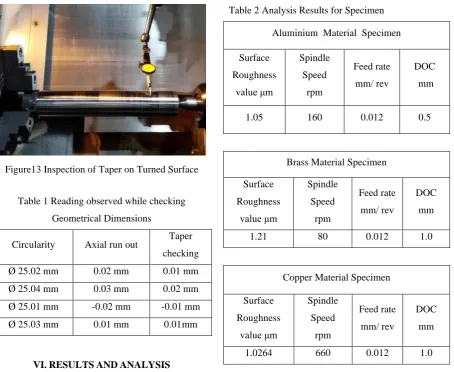
To confirm the absence of taper on external diameter by travelling the lever dial pointer along with length and found very slight variation in dial readings with respect to work piece length. As shown in figure13 The confirmation of axial run out and total run out by mounting work piece in between centers arrangement as shown in figure12. By rotate the job manually and applying dial pressure and inspect the dial pointer movement observed very little variations around the diameter in each segment of length.
The above descriptions and shown figures are implies the fulfilment of geometrical dimensional conformance. In advance inspection techniques the geometrical dimensions checked with CMM (Co-ordinate Measuring Machine).
Figure11Circularity/ Roundness Checking
Figure13 Inspection of Taper on Turned Surface
Table 1 Reading observed while checking
Geometrical Dimensions
Circularity Axial run out Taper checking
Ø 25.02 mm 0.02 mm 0.01 mm
Ø 25.04 mm 0.03 mm 0.02 mm
Ø 25.01 mm -0.02 mm -0.01 mm
Ø 25.03 mm 0.01 mm 0.01mm
VI. RESULTS AND ANALYSIS
The main aim of our project is to optimize the Surface roughness of the turning process. In this work L9 array was used to carry out the experiments. The response, Cutting speed, Feed and depth of cut were measured by varying the machining parameters and the corresponding values are shown in tables. MINITAB version 17 software is used. The mean roughness of the nine tests for Aluminium obtained by the Taguchi method is Ra=1.97 μm. The test with the least roughness is the sixth with the value of Ra = 1.05 μm
The mean roughness of the nine tests for Brass obtained by the Taguchi method is Ra=3.11μm. The test with the least roughness is the ninth with the value of Ra=1.21 μm
The mean roughness of the nine tests for Copper obtained by the Taguchi method is Ra=2.0794μm.The test with the least roughness is the ninth with the value of Ra=1.0264 μm
Optimized Cutting Parameters and Surface Roughness achieved on different specimen, during the test are tabulated.
Table 2 Analysis Results for Specimen
Aluminium Material Specimen
Surface
Roughness
value μm
Spindle
Speed
rpm
Feed rate
mm/ rev
DOC
mm
1.05 160 0.012 0.5
Brass Material Specimen
Surface
Roughness
value μm
Spindle
Speed
rpm
Feed rate
mm/ rev
DOC
mm
1.21 80 0.012 1.0
Copper Material Specimen
Surface
Roughness
value μm
Spindle
Speed
rpm
Feed rate
mm/ rev
DOC
mm
1.0264 660 0.012 1.0
Table 3 Geometrical dimensional Accuracy
inspections Results
Circularity
(Reading of
external
micrometers over
diameter)
Axial run out
(Deflection of
dial indicator’s
pointer)
Taper
checking
(Total
deflection of
pointer)
30 µm 50 µm 30 µm
A. Graphical Analysis
0 0.5 1 1.5 2 2.5
0 200 400 600 800
Su rf ac e ro u gh n es s µ m R a
Spindle speed RPM
Aluminium Specimen
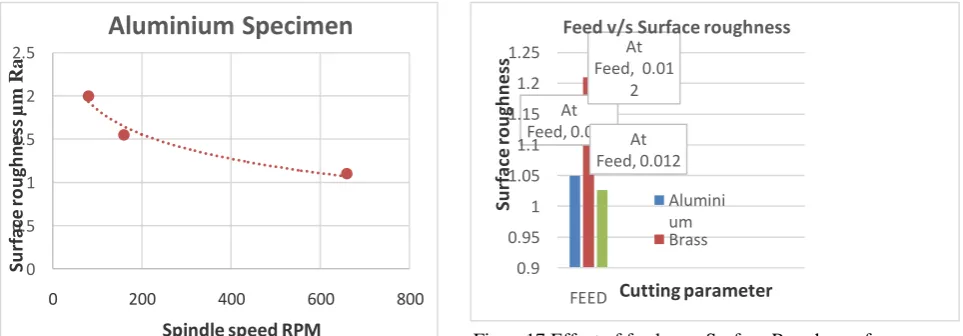
Figure14 Influence of spindle speed to surface roughness over Aluminium specimen
0 1 2 3 4
0 0.05 0.1 0.15
Su rf ac e ro u gh n es s µ m R a
Feed rate mm/rev
Copper specimen
Figure15 Influence of feed rate to surface roughness over Copper specimen
The minimum surface roughness (µm Ra) in different materials at the different cutting parameters spindle speed feed rate (mm/rev) and depth of cut (mm), respectively shown in graphs
.
At S pe ed, 1 6 0 R P M At Speed, 1 60 RPM At Speed , 160 RPM 0 0.5 1 1.5 2 2.5 3 3.5 SPEED Su rfa ce ro u gh n es s Cutting parameter Speed v/s Surface roughness Aluminium Brass Copper
Figure 16 Effect of speed over Surface Roughness for all materials
At Feed, 0.012
At Feed, 0.01
2 At Feed, 0.012 0.9 0.95 1 1.05 1.1 1.15 1.2 1.25 FEED Su rf ac e ro u gh n es s Cutting parameter
Feed v/s Surface roughness
Alumini um Brass
Figure17 Effect of feed over Surface Roughness for all materials
At Doc, 1.0
At Doc, 1.5
At Doc, 0.5
0 0.2 0.4 0.6 0.8 1 1.2 1.4 Su rf ac e r ou gh n e ss Cutting parameter
Depth of Cut v/s Surface roughness
Aluminium Brass Copper
Figure18 Effect of depth of cut over Surface Roughness for all materialss.
B. Statistical Analysis
The Signal/Noise(S/N) ratio calculation of surface roughness: The S/N ratio can be used to measure the deviation of the performance characteristics from the desired values.
In this the observe value of surface roughness is transform in S/N ratio values to find out the optimum combination of parameters for response variable. In surface roughness “smaller is better” is objective characteristic, since the minimization of the quality characteristic is interested. The Signal/Noise( S/N) ratios are calculated using the below mentioned formula (smaller the better type criteria).
S/N Ratio(η) = -10x Log10{ ∑ (Y2/n)}………….(1) Where Y- is the observed data at i th trial
n- is the number of trials
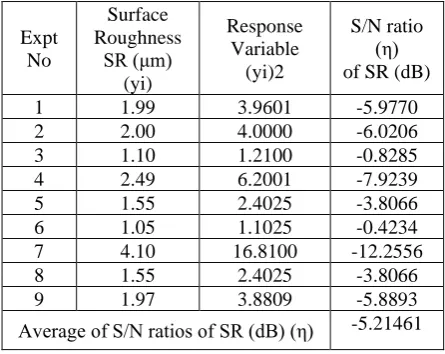
For example the S/N ratio is calculated for first experiment is as follows: η1 = -10 log10 [(1/1) (1.99)2]
η1 = -5.977 for second experiment η2 = -10 log10 [(1/1) (2.00)2]
η2 = -6.0206
η9 = -10 log10 [(1/1) (1.97)2] η9 = -5.8893
Delta (∆) = ηmax - ηmin………(2)
Similarly all the S/N ratios are determined and tabulated (fromη1,η2……..uptoη9.) These values of S/N ratio and averages will then further be analyzed to detect the most responsible factor and the percentage contribution of each factor on the surface roughness (response variable).
Table 4 S/N ratio calculation of SR for Aluminum
Expt No
Surface Roughness
SR (μm) (yi)
Response Variable
(yi)2
S/N ratio (η) of SR (dB)
1 1.99 3.9601 -5.9770
2 2.00 4.0000 -6.0206
3 1.10 1.2100 -0.8285
4 2.49 6.2001 -7.9239
5 1.55 2.4025 -3.8066
6 1.05 1.1025 -0.4234
7 4.10 16.8100 -12.2556
8 1.55 2.4025 -3.8066
9 1.97 3.8809 -5.8893
Average of S/N ratios of SR (dB) (η) -5.21461
Table 5 Response table of S/N Ratio for Surface Roughness for Al
Level Spindle speed (A)
Feed (B)
Depth of Cut (C)
1 -4.275 -2.380 -3.402
2 -4.051 -4.545 -6.611
3 -7.317 -8.719 -5.630
Delta 3.266 0.339 3.209
Rank 2 1 3
From Table, it is show that the value of delta for each parameter A, B, and C are 3.266, 0.339 and 3.209 for surface roughness. From delta value of each parameter it is conclude that for surface roughness the most effective parameter is feed followed by spindle speed, and then depth of cut. From the above table optimal parameters for turning operation are A2 B1 C3.
The combination of factors and levels which give maximum S/N ratios give the optimum cutting parameters. That means A2, B1,and C3 combination gives the optimum cutting parameter which minimizes the surface roughness.
VII. CONCLUSION AND SCOPE FOR FUTURE WORK
It is found out that turning is affected by various factors but due to the difficulty to optimise all the parameters speed, feed and depth of cut is mainly optimised for various characteristics. As producing high quality product at low cost in less time is mostly desirable in today’s world optimisation of cutting parameters for minimum surface roughness and maximum material removal rate is very important. This study concludes optimized process parameters such that cutting speed, feed and depth of cut in CNC turning operation of non-ferrous
materials (Al, Cu & Brass) for getting better surface finish and geometrical dimensional conformance. In this experimental study spindle speed, feed rate and depth of cut taken as Control ( input) parameters and the surface roughness was treated as response parameter.
The better combination of levels and factors (cutting parameters) – for Aluminium A2 B1 C3 for Brass A3 B1 C2 and for Copper specimen A1 B2 C3.
This study concludes that roughness increases with the feed rate and decreases with the cutting velocity. The best roughness was attained at the lower feed rate and the maximum cutting speed whereas depth of cut has negligible influence.
By keeping speed and feed same the Copper and Aluminium gives better surface finish than the brass.
Future Scope: This study is based on dry machining of non- ferrous materials. An Adequate (fluid) coolant, water soluble cutting oil or Kerosene or Minimum Quantity Lubricant (MQL) can be used in machining for better control on heat generation and cutting forces which will provide better results in terms of tool life, power consumption as well as material removal rate.
REFERENCES
In this study we adopt following recommendations and reference books and articles from Journal, to fulfil the objective.
[1] L B Abhang [2012]“Optimal Machining Parameters for Achieving the Desired Surface Roughness in Turning of Steel”.(2012) (TJER,Vol. 9).
[3] N .Zeelan Basha, G.Mahesh and N.Muthuprakash [2013] “Optimization of CNC Turning Process Parameters on Aluminium 6061 Using Genetic Algorithm” International Journal of Science and Modern Engineering, Volume-1, Issue-9, pp. 43-46, August 2013.
[4] M.Naga Phani Sastry and K.Devaki Devi [2011] “Optimizing of Performance Measures in CNC Turning using Design of Experiments (RSM).” Science Insights: An International journal, 2011;1(1):1-5.
[5] P.Warhade, Sonam K.Bhilare and Shirley R.Gaikwad [2013]“Modeling and Analysis of Machining Process using Response surface methodology”.International Journal of Engineering and Development Volume 2, December- 2013.
[6] Ravi Patel, Ankit Kumar, and Jitendra Kumar Verma [2016] “Analysis and Optimization of Surface Roughness in Turning Operation of Mild Steelusing Taguchi Method” International Journal of Engineering Trends and Technology (IJETT) – Volume 34 Number 7- April 2016. [7] N. Rajesh. M.Yohan, P.Venkataramaiah,and M.Vani
pallavi 2017“Optimization of Cutting Parameters for Minimization of Cutting Temperature and Surface Roughness in Turning of Al6061 Alloy”
[8] Puneet Bansal and Lokesh Upadhyay 2016“Effect of Turning Parameters on Tool Wear, Surface Roughness and Metal Removal Rate of Alumina Reinforced Aluminum Composite”3rd International Conference on Innovations in Automation and Mechatronics Engineering, ICIAME 2016.
[9] Rajendra B and Deepak D 2015 “Optimization of Process Parameters for Increasing Material Removal Rate for Turning Al6061 Using S/N ratio’’International Conference on Emerging Trends in Engineering, Science and Technology (ICETEST- 2015)
[10] N. Satheesh Kumar,Ajay Shetty, Ashay Shetty, Ananth K, and Harsha Shetty,[2012]“Effect of spindle speed and feed
rate on surface roughness of Carbon Steels in CNC turning” International Conference on Modeling, Optimization and Computing (ICMOC 2012).
[11] Gaurav Mishra, Arpit Srivastava, A. S. Verma, Ramendra Singh Niranjan [2017]“Optimization of Cutting Force, Feed Force and Material Removal Rate (MRR) in Turning of Inconel 718”International Journal of Science and Research (IJSR)ISSN (Online): 2319-7064 Index Copernicus Value (2016): 79.57 | Impact Factor (2017): 7.296.
[12] Vijay Kurkute and Sandeep T Chavan [2018]“Modeling and Optimization of surface roughness and micro hardness for roller burnishing process using response surface methodology for Aluminum 63400 alloy” 2nd International Conference on Materials Manufacturing and Design Engineering (2018) 542–547.
[13] Barzani MM, Sarhan AA, Farahany S, Ramesh S and Maher I. [2015]”Investigating the machinability of Al–Si– Cu cast alloy containing bismuth and antimony using coated carbide insert” Measurement2015; 62: 170-178. [14] Ashok Kumar Sahoo, Achyuta Nanda Baral, Arun Kumar
Rout, B.C. Routra,[2012]”Multi-objective optimization and predictive modeling of surface roughness and material removal rate in turning using Grey Relational and Regression Analysis” Procedia Engineering, 38 (2012) 1606-1627.
[15] A.J.Makadia, J.I.Nanavati [2013] “Optimizing Surface Finish in Turning Operation by Factorial Design of Experiments” International Conference on Advanced Engineering Optimization through Intelligent Techniques (AEOTIT), July 01-03, 2013’