521
INTERNATIONAL JOURNAL OF PHARMACEUTICAL, CHEMICAL AND BIOLOGICAL SCIENCES
Available online at
www.ijpcbs.com
DEVELOPMENT AND CHACTERIZATION OF SITE SPECIFIC SUSTAINED
RELEASE MICROSPHERES FOR INTESTINAL INFECTION
DS. Goswami
*and S. Kashyap
SD College of Pharmacy, Barnala, Punjab, India.
INTRODUCTION
Controlled drug delivery systems are those in which the drug is released in a pre-determined pattern over a fixed period of time. The primary objectives of sustained drug delivery are to ensure safety and enhancement of efficacy of drug with improved patient compliance1. Mucoadhesive drug delivery system are those which prolong the residence time of the dosage form at the site of application or absorption and to facilitate intimate contact of the dosage form with the underlying absorption surface to improve and enhance the bioavailability of drug2. Colonic drug delivery has gained increased importance in the colonic diseases to treat the colonic infections. A colon specific drug delivery system should prevent drug release in the stomach and small intestine and
affect an abrupt onset of drug release upon entry in to the colon3. Hydrocortisone belongs to the class of corticosteroids. It is naturally occurring glucocorticosteriods. These are well absorbed by oral route. For the delivery of drug molecule the drug may be coated with the polymeric material so that they are degraded by the colonic enzymes and deliver the drug to the colonic site. They have the anti-inflammatory property so used to treat the intestinal infection which is caused by an overactive immune system, resulting in ulcers and inflammation along the lining of rectum and colon. So oral Hydrocortisone is prescribed to treat more severe symptoms of colitis4. The objective of my present work was to developed and characterized site specific sustained release microspheres for intestinal infection.
Research Article
ABSTRACT
The present work was to develop and characterized site specific sustained release microspheres for intestinal infection. Hydrocortisone have the anti-inflammatory property so used to treat the intestinal infection which is caused by an overactive immune system, resulting in ulcers and inflammation along the lining of rectum and colon. So oral Hydrocortisone is prescribed to treat more severe symptoms of colitis. Coating was done with the colon specific polymer eudragit S100 and sodium alginate used as a matrix polimer and HPMC K4M and gellan gum was used as mucoadhesive polymers. Hydrocortisone mucoadhesive microspheres were prepared by orifice ionic gelation method. The prepared formulations were characterized for various physicochemical parameters such as particle size, percentage yield, drug entrapment efficiency, loose surface crystal study, surface accumulation study, % moisture loss, swelling poperties, wash off test and in vitro drug release of mucoadhesive microsphere at different pH up to 12 hrs. The drug entrapment efficiency of all formulations was reported as high profile ranges 80-97.44% and the surface pH in the ranges between 6.80 -7.02. The swelling index in the range 51.11-88.12%. It was found that the F1 shows the best cumulative drug release up to 12 hrs of the period. Hence it was concluded that the polymer possess substantial release with good mucoadhesion properties could be used for sustained drug delivery.
522
MATERIAL AND METHODS
Hydrocortisone was obtained from the Balaji Drugs. Hydroxy propyl methyl cellulose (HPMC K4M), gellan gum was supplied by Central Drug House (P) Ltd. New Delhi and Bargon Berges, Bombay. Sodium alginate was obtained from Qualikems fine chemicals Pvt. Ltd New Delhi, Eudragit S 100 was obtained from the Balaji Drugs. Calcium chloride, magnesium stearate, light liquid paraffin, span 80 was obtained from Central Drug House (P) Ltd. New Delhi. All other chemicals were of analytical grade.
Preformulation studies of drug Organoleptic properties
Hydrocortisones were tested for organoleptic properties such as appearance, colour, odour, taste.
Melting point determination5
Melting point of the drug was determined by taking a small amount of drug in a capillary tube closed at one end and it was placed in melting point apparatus and the temperature at which the drug melts was noted. Average of triplicate readings was taken.
Solubility
The solubility was carried out as per IP.6
Flow properties7 Angle of repose
The angle of repose of drug powder was determined by the funnel method. The accurately weight powder blend were taken in the funnel. The height of the funnel was adjusted in such a way the tip of the funnel just touched the apex of the powder blend. The powder blend was allowed to flow through the funnel freely on to the surface. The diameter of the powder cone was measured and angle of repose was calculated using the following equation.
tan θ = h/r θ= tan-1 h/r
Where, h and r are the height and radius of the powder cone.
Bulk density and tapped density
Both Bulk density (BD) and tapped density (TD) was determined. A quantity of 2 gm of drug powder from each formula, previously shaken to break any agglomerates formed, was introduced in to 10 ml measuring cylinder. After that the initial volume was noted and the cylinder was
allowed to fall under its own weight on to a hard surface from the height of 2.5 cm at second intervals. Tapping was continued until no further change in volume was noted. BD and TD were calculated using the following equations.
BD = Weight of the powder blend/Untapped volume of the packing
TD = Weight of the powder blend/Tapped volume of the packing
Compressibility index
The Compressibility Index of the powder blend was determined by Carr’s compressibility index. The formula for Carr’s index is as below:
Carr’s index (%) = [(TD‐BD) x100]/TD
Hausner’s ratio
The Hausner’s ratio is a number that is correlated to the flowability of a powder or granular material. The ratio of tapped density to bulk density of the powders is called the Hausner's ratio. It is calculated by the following equation.
H = ρT / ρB
Where ρT = tapped density, ρB = bulk density.
Assay8
Weigh accurately about 0.1 gm dissolve in sufficient ethanol to produce 100 ml. Dilute 2 ml of this solution to 100 ml with ethanol and mix. Measure the absorbance of the resulting solution at the maximum at 241 nm. Calculate the content of hydrocortisone at 241 nm.
523
Table 1: Formulations of mucoadhesive microspheres
Formulation code Drug (mg) Sodium alginate (mg) HPMC K4M
(mg)
Gellan gum (mg)
F1 30 100 100 ---
F2 30 100 200 ---
F3 30 100 300 ---
F4 30 100 400 ---
F5 30 100 --- 100
F6 30 100 --- 200
F7 30 100 --- 300
F8 30 100 --- 400
Evaluation of mucoadhesive microsphere Flow properties5
Bulk density
The bulk density of microsphere was obtained by dividing the weight of sample in grams by the final volume in cm3 of the sample contained in the cylinder. It was calculated by using equation given below
Df = M / Vp
Where Df is bulk density, M is weight of samples in grams and Vp is final volumes of formulation in cm3.
Tap density
The tapped density of microsphere was obtained by dividing the weight of sample in grams by the final tapped volume in cm3 of the sample contained in the cylinder. It was calculated by using equation given below:
Do = M / Vp
Where Do is bulk density, M is weight of samples in grams and Vp is final tapped volumes of granules in cm3.
Carr’s index
The percentage compressibility of microspheres was calculated according to equation given below:
% Compressibility = Do – Df x 100 Do
Where Df is bulk density and Do is Tapped density.
Hausner’s ratio
The Hausner’s ratio of a microsphere was calculated according to equation given below:
Hausner’s ratio = Do / Df
Where Do is Tapped density and Df is bulk density.
Angle of repose
The Angle of repose i.e. Flow property of the microspheres, which measures the resistance to particle flow, was calculated as
Tan θ = h / r θ = tan-1 h / r
Where h / r are height of the microspheres heap that is formed after making the microspheres flow from the glass funnel and r is the radius.
Percentage yield10
The yield was calculated using the equation
Yield of microspheres (%) = Weight of the microspheres (mg) X 100 [Drug (mg) + Polymer (mg)]
Particle size11
The size and shape of the microspheres were evaluated using optical microscopy. The particle sizes of 50 microspheres were determined randomly using equation below
Xg = 10 X [(ni X log Xi) / N]
Where Xg is geometric mean diameter, ni is no of particles in the range, Xi is the midpoint of range, and N is total no of particles analyzed.
Drug content3
The weighed amount of drug loaded mucoadhesive microsphere was kept in 100 ml phosphate buffer pH 6.8 for 12 hrs with continuous stirring. The samples were filtered and were analyzed at 241nm by using UV spectrophotometer.
Drug Entrapment efficiency (DEE %)12
Entrapment efficiency of the microspheres was calculated using the formula
524
Loose surface crystal study13
Loose surface crystal study was performed to observe the excess drug present on the surface of microspheres. From each batch 11 mg of mucoadhesive microspheres were shaken in 100 ml of phosphate buffer, pH 6.8 for 5 mins and then filtered through Watt man filter paper 41.The amount of drug in the filtrate was determined spectrophotometrically at 241nm and calculated as percent of total drug content. This estimates the surface entrapment of the drug by the microspheres.
Surface accumulation study14
This study was conducted to estimate the amount of drug present on the surface of microspheres which may show immediate release in the dissolution media.100 mg of mucoadhesive
microsphere were suspended in 100 ml of phosphate buffer pH 6.8 simulating the dissolution media. The samples were shaken vigorously for 15 mins in a mechanical shaker. The amount of drug leached out from the surface was analyzed spectrophotometrically at 241 nm. Percentage of drug released with respect to entrapped drug in the sample was recorded.
Percentage of moisture loss15
The Hydrocortisone loaded mucoadhesive microspheres of different polymers were evaluated for percentage of moisture loss. The microspheres weighed initially and kept in desiccators containing calcium chloride at 37°C for 24 hrs. The final weight was noted when no further change in weight of sample.
Surface pH16
The surface pH of the formulation was determined in order to investigate their possible side effects in vivo. An acidic or alkaline formulation will cause irritation of the mucosal membrane and hence this is an important parameter in developing a mucoadhesive dosage form. A combined glass electrode was used for determination of surface pH. The formulations were first allowed to swell by keeping them in contact with 5 ml distilled water pH 6.5±0.5 for 2 hrs in 10 ml beakers. Then pH was noted by bringing the electrode near the surface of the formulation and allowing equilibrating for 1 min.
Swelling properties9
The dynamic swelling property of mucoadhesive microsphere in the dissolution medium was determined. Mucoadhesive microsphere of known weight were placed in dissolution solution i.e pH 6.8 phosphate buffer for 6 hrs and the swollen microcapsules were collected by a centrifuge and the wet weight of the swollen mucoadhesive microsphere was determined by first blotting the particles with filter paper to remove absorbed water on surface and then weighing immediately on an electronic balance. The percentage of swelling of mucoadhesive microsphere in the dissolution media was then calculated by using equation,
Sw = [(Wt-Wo)/Wo] ×100
Sw = percentage of swelling of mucoadhesive microsphere.
Wt = weight of the mucoadhesive microsphere at time t.
Wash off test17
The mucoadhesive properties of the mucoadhesive microspheres were evaluated by in vitro wash off test. A 1-cm by 1-cm piece of sheep stomach mucosa was tied onto a glass slide (3-inch by 1-(3-inch) using thread. Mucoadhesive microspheres were spread (50 Particles) onto the wet, rinsed, tissue specimen and the prepared slide was hung on to one of the groves of a USP tablet disintegrating test apparatus. The disintegrating test apparatus was operated such that the tissue specimen was given regular up and down movements in a beaker containing the phosphate buffer pH 6.8. At the end of 30 mins 1 hr, and at hourly intervals up to 8 hrs, the number of mucoadhesive microspheres still adhering onto the tissue was counted.
Coating of mucoadhesive microsphere18
200 mg of eudragit was dissolved in 5 mL of ethanol and acetone (1:4). After addition of 40 mg of microsphere and 20 mg of aluminium stearates, the mixture was dropped into 20 mL of liquid paraffin and stirred at 600 rpm at room temperature. After complete evaporation of
525
acetone and ethanol, the microspheres formed were collected, washed with n-hexane and dried under vacuum at room temperature for 24 hrs.Flow properties5 Bulk density
The bulk density of microsphere was obtained by dividing the weight of sample in grams by the final volume in cm3 of the sample contained in the cylinder. It was calculated by using equation given below:
Df = M / Vp
Where Df is bulk density, M is weight of samples in grams and Vp is final volumes of granules in cm3.
Tap density
The tapped density of microsphere was obtained by dividing the weight of sample in grams by the final tapped volume in cm3 of the sample contained in the cylinder. It was calculated by using equation given below:
Do = M / Vp
Where Do is bulk density, M is weight of samples in grams and Vp is final tapped volumes of granules in cm3.
Carr’s index
The percentage compressibility of microspheres was calculated according to equation given below:
% Compressibility = (Do – Df) x 10/Do
Where Df is bulk density and Do is Tapped density.
Hausner’s ratio
The Hausner’s ratio of a microsphere was calculated according to equation given below:
Hausner’s ratio = Do / Df
Where Do is Tapped density and Df is bulk density.
Angle of repose
The Angle of repose i.e. Flow property of the microspheres, which measures the resistance to particle flow, was calculated as
Tan θ = 2H / D
Where 2H/D is the surface area of the free standing height of the microspheres heap that is formed after making the microspheres flow from the glass funnel.
Particle size11
The size and shape of the microspheres were evaluated using optical microscopy. The particle sizes of 50 microspheres were determined randomly using 14.44 μm as calibration factor. The average particle size of microspheres can be given by the following formula:
Average Size= Σ nd / Σ n
Where, n is the number of microspheres and d is the size of microsphere
In vitro drug release studies19
The in vitro drug release studies of hydrocortisone was carried out using USP dissolution apparatus type 2 (Paddle type) at 50 rpm at 37±0.50ºC using 0.1(N) HCl for 2 hr, phosphate buffer (pH 4.5) for 1 hr, phosphate buffer (pH 7.4) for next 2 hrs and then in the phosphate buffer (pH 6.8) for next 7 hrs. 5 ml of dissolution medium was withdrawn to maintain sink condition and the medium was replaced with equal quantity of fresh dissolution medium. The sample withdrawn was suitably filtered, diluted and drug content was analyzed spectrophotometer at 241 nm.
RESULTS AND DISCUSSION
526
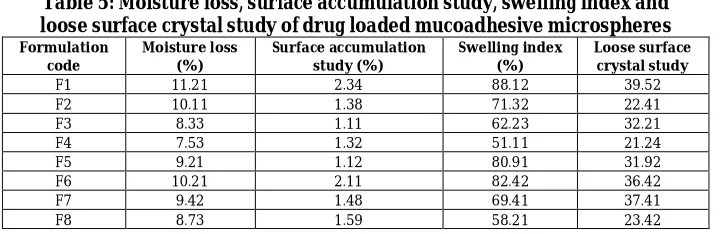
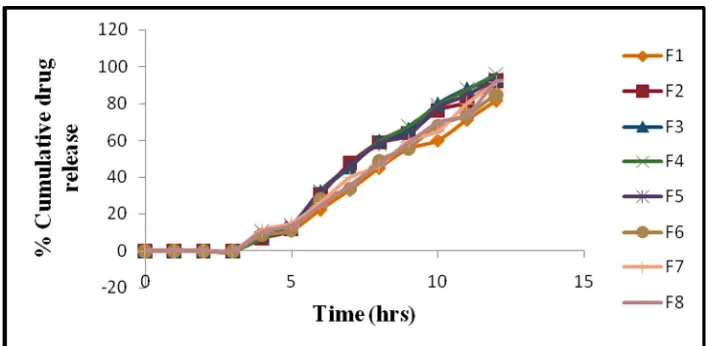
accumulation study (%), swelling index (%) and loose surface crystal study as shown in (Table 4). The % moisture loss in the range 7.53-11.21% due to the involvement of water and hydrophilic property of the mucoadhesive polymers. The surface accumulation study was an important parameter giving an indication of the amount of drug on the surface of the microsphere without proper entrapment. The range was between 1.11-2.34%. The swelling index in the range 51.11-88.12% with less polymer ratio more swelling. The loose surface crystal studies lend a hand to estimate the excess amount of drug attached on the surface of microspheres after a successful entrapment in the range of 21.24-39.52. The mucoadhesive property of the microspheres was evaluated by in vitro adhesion testing method called in vitro wash off test. The numbers of microspheres adhering to the tissue was calculated after 1 hr and hourly up to 8 hrs (Table5). After determination it was found that F1 have more adhering property then the other formulations. In F1 more particles are adhere on the membrane for a long period. So it showed good mucoadhesive property. After coating the micromeritic studies was found to be good in (Table 6). The particle size was also within the range 8.48- 15.20 µm. The in vitro release profile of coated microspheres in release medium of pH (1.2) revealed the absence of drug release for the 2 hrs. The release studies conducted in phosphate buffer where the pH was gradually increased 4.5 then again it showed no release. However as the pH of the release medium was raised beyond 7.4 then the prepared formulation showed around 6-12% of drug release in a period 2 hrs and after that at pH 6.8 the drug release study was carried out and the result was found in the range 81-95.92% up to 12 hrs. The total drug release for F1 was 81% and F6 was 84% (Figure 1).
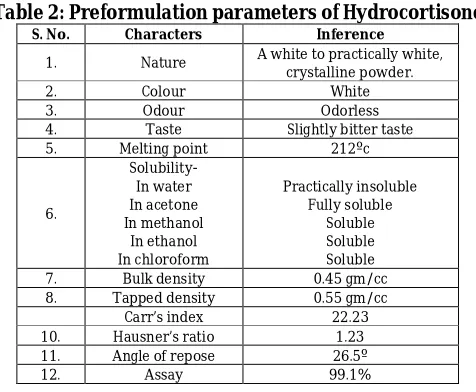
Table 2: Preformulation parameters of Hydrocortisone
S. No. Characters Inference
1. Nature A white to practically white,
crystalline powder.
2. Colour White
3. Odour Odorless
4. Taste Slightly bitter taste
5. Melting point 212ºc
6.
Solubility- In water In acetone In methanol
In ethanol In chloroform
Practically insoluble Fully soluble
Soluble Soluble Soluble
7. Bulk density 0.45 gm/cc
8. Tapped density 0.55 gm/cc
Carr’s index 22.23
10. Hausner’s ratio 1.23
11. Angle of repose 26.5º
12. Assay 99.1%
Table 3: Flow properties of mucoadhesive microspheres before coating Formulation code Bulk density
(gm/cc)
Tap density
(gm/cc) Carr’s index Hausner’s ratio Angle of repose(θ)
F1 0.42 0.52 19.23 1.23 25.44º
F2 0.46 0.56 17.85 1.24 30.23º
F3 0.45 0.51 11.76 1.13 29.33º
F4 0.47 0.58 18.96 1.23 27.31º
F5 0.44 0.55 21.24 1.24 26.11º
F6 0.42 0.52 19.23 1.23 25.44º
F7 0.43 0.54 20.37 1.25 26.51º
527
Table 4: Particle size, % yield, drug content, % drug entrapment efficiency, surface pH of drug loaded mucoadhesive microspheres
Formulation code
Particle size
(µm) yield (%)
Drug content (mg)
Drug entrapment
efficiency (%) Surface pH
F1 14.26 97.12 29.2 97.44 7.02
F2 8.008 86.96 26.8 89.34 6.80
F3 12.49 83.48 25 83.34 7.01
F4 7.28 90.02 24 80 6.69
F5 10.24 87.27 22.63 87.34 6.82
F6 11.21 90.34 27.2 94.34 6.98
F7 12.40 79.15 26.6 88.67 6.81
F8 12.17 82.61 26.2 91.34 6.92
Table 5: Moisture loss, surface accumulation study, swelling index and loose surface crystal study of drug loaded mucoadhesive microspheres Formulation
code
Moisture loss (%)
Surface accumulation study (%)
Swelling index (%)
Loose surface crystal study
F1 11.21 2.34 88.12 39.52
F2 10.11 1.38 71.32 22.41
F3 8.33 1.11 62.23 32.21
F4 7.53 1.32 51.11 21.24
F5 9.21 1.12 80.91 31.92
F6 10.21 2.11 82.42 36.42
F7 9.42 1.48 69.41 37.41
F8 8.73 1.59 58.21 23.42
Table 6: Results of in vitro wash off tests to affects mucoadhesive properties of the microsphere Formulation
code After 1hr After 2hr After 3hr After 4hr After 5hr After 6hr After 7hr After 8hr
F1 45 41 35 34 33 22 31 25
F2 40 38 34 29 24 23 22 21
F3 41 36 30 25 21 19 18 17
F4 40 35 34 33 32 29 27 21
F5 48 35 28 26 25 24 21 19
F6 46 35 28 26 25 24 21 20
F7 40 35 23 20 18 16 14 12
F8 44 40 39 36 28 24 23 22
Table 7: Flow properties and particle size of mucoadhesive microspheres after coating Formulation
code
Bulk density (gm/cc)
Tap density
(gm/cc) Carr’s index Hausner’s ratio
Angle of repose(θ)
Particle size (µm)
F1 0.42 0.50 16 1.19 27.11º 15.20
F2 0.43 0.51 15.68 1.18 29.14 º 10.01
F3 0.45 0.52 13.46 1.15 28.13º 12.42
F4 0.43 0.49 12.24 1.13 26.56º 8.48
F5 0.43 0.51 15.68 1.18 27.12 º 11.22
F6 0.45 0.52 13.46 1.15 26.12º 13.43
F7 0.43 0.49 12.24 1.13 28º 12.43
F8 0.48 0.53 15.38 1.12 27º 12.19
528
Fig. 1: In vitro drug release profile of formulation F1-F8
CONCLUSION
In conclusion, the formulation F1 containing drug polymer ratio 1:1:1 was found to be the best mucoadhesive microsphere formulation regarding all the properties evaluated in order to achieve objective of this study. Because of the hydrophobic nature of eudragit S 100 F1 formulation shows the release for 12 hrs and it will extended up to 24 hrs. The results of the study give a rational guideline for formulating a sustained release mucoadhesive microsphere of Hydrocortisone for effective therapy of colonic infection.
REFERENCES
1.
Mandel V, Gowda V and Ghosh A. Formulation and optimization of sustained release matrix tablet of metformin. The Pharmaceutical Society of Japan, 2007; 127(8): 81-90.2.
Ahmed MG, Kumar SBP and Kiran GBK. Formulation and evaluation of gastric mucoadhesive drug delivery systems of captopril. J Curr Pharm Res. 2010; 2(1): 26-32.3.
Mishra MK, Shikhri M and Sharma R. Optimization, formulation development and characterization of eudragit RS 100 loaded microsponges and subsequent colonic delivery. Int J Drug Discovery Herbal Res. 2011; 1(1): 8-13.4.
Tripathi KD, Corticosteriods, In: Essentials of medical pharmacology. Jaypee brothers, New Delhi. 2008; 6th Edn: , pp 275-287.5.
Bhople A, Chandewar A and Sheiakh. Formulation and development of mucoadhesive microcapsule for delivery of clarithromycin and omeprazole used against helicobacter pylori infection. Asian J Pharmacy and Life Sci. 2012; 2(1) :27-48.6.
Indian Pharmacopoeia, Vol. I, Ministry of health and family welfare, 2007; 151.7.
Patel SR, Patel PR and Vora CN.Formulation, process parameters optimization and evaluation of delayed release tablets of rabeprazole sodium. Int J Pharmacy and Pharm Sci. 2010; 2(3) :144-156.
8.
Indian Pharmacopoeia, Vol. II, Ministry of health and family welfare, 2007; 568.9.
Shanker NB, Kumar NU and BalakrishnaPK. Formulation design, preparation and in vitro evaluation of mucoadhesive microcapsule employing control release polymers to enhance gastro retention for oral delivery of famotidine. Int J Pharm Sci Tech. 2009; 2(1): 22-29.