ISSN: 2334-2943 (Print) 2334-2951 (Online) Copyright © The Author(s). 2014. All Rights Reserved. Published by American Research Institute for Policy Development
Prime Generating Algorithms through Nonprimality of Even
Numbers (Except 2) and by Skipping Even Divisors (Except 2)
Neeraj Anant Pande1
Abstract
There have been consistent systematic efforts of refining the prime generating sieves. Number 2 enjoys the unique status of being the first and the only even prime. The fact that no even number other than 2 is prime number along with the one that no prime number except 2 has even divisors leads to further improvement of prime generating algorithms of each respective sieve. Three new sieves are presented and exhaustively compared with earlier respective nine.
Keywords: Algorithm, Sieve, Prime Number
Mathematics Subject Classification 2010: 11Y11, 11Y16, 65Y04, 65Y20, 68Q25
1. Introduction
In the hunt for better (consecutive) prime generating algorithms, popularly known as sieves, various techniques have evolved gradually as has been reported in [4], [5] and [6]. Each of these three papers analyzes three algorithms with improving approach. A comparative statement of run-time requirements and number of steps taken for each of these is quite self-explanatory about the efficiency achieved. Total nine sieves appearing in these three works show a continuous graph of superior performance. Continuing on the same path further, in the present work, the approaches of [5] and [6] have been combined illustrating even better results.
Every number has some specialty of its own. Number 2, in addition to other aspects, is special in prime number study due to a main reason that it is the only even prime - so all even numbers greater than 2 are non-prime, i.e., composite. Consequently, since any prime except 2 is not even, it cannot have even divisors. These two properties of 2 and even numbers have been harnessed to develop better prime generating algorithms.
2. Sieves Subtype 1 Improved
It would be better to renumber the Sieves 1, 2 and 3 of [4] as Sieves 1.1.1, 1.1.2 and 1.1.3, respectively, in coherence with the numbering later adopted in [5] and [6].
The common approach of rightly named dumb simplest Sieve 1 [4], Sieve 1.2.1 [5] and Sieve 2.1.1 [6], is the property of integers that no positive integer can have a divisor greater than itself. In fact, in primality tests for a positive integer k, as one is interested in only the divisors of k other than 1 and k itself, this common approach searches for possible divisors of k in the range 2 to k − 1. On failure, k is declared as prime; while success leads to conclusion that k is non-prime or composite.
Sieve 1.1.1 [4] adopts plain way of testing all numbers from 2 to k − 1 for
divisibility and hence is most non-efficient. It being so fundamentally simple, we just mention it instead of supplying it explicitly.
Sieve 1.2.1 in [5] reads :
Take an integer n larger than 1
For all values of k from 2 to n and only odd values after 2
For values of integer d from 2 to k−1 If d divides k perfectly,
Stop checking as k is not prime Else
Continue checking
If checks do not stop for any value of d till k−1, k is prime
Take an integer n larger than 1 2 is prime
For all values of k from 3 to n
For values of integer d from 2 to k−1 and only odd values after 2 If d divides k perfectly,
Stop checking as k is not prime Else
Continue checking
If checks do not stop for any value of d till k−1, k is prime
The combination of both of these approaches with a little modification leads to following outcome which we name as Sieve 2.2.1 :
Take an integer n larger than 1 2 is prime
For all values of k from 3 to n and only odd values after 2
For values of integer d from 3 to k−1 and only odd values after 2 If d divides k perfectly,
Stop checking as k is not prime Else
Continue checking
If checks do not stop for any value of d till k−1, k is prime
While devising this improved version through combination, the values of the numbers to be tested as divisors (designated as d in the sieve) have started with 3 instead of 2. As 2 is already declared to be prime and only the odd numbers after 2 are being taken on primality test, test of divisibility by 2 becomes altogether redundant and hence 2 is skipped as candidate for possible divisor.
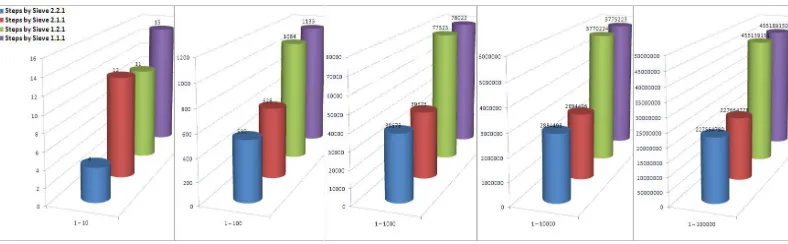
To have a comparative idea of quantum of improvement, the three algorithms were implemented and run on an electronic computer for the ranges each of 1 – 10, 1 – 100, 1 – 1000, 1 – 10000 and 1 – 100000 and reduction in the number of steps was as in Table 1. All these computations have been rigorously performed by using electronic computer and Java programming Language is employed for implementing the algorithms. In this and further data tables, number range is restricted to 100000 as Sieves 1.1.1, 1.1.2 and 1.1.3 take excess time for higher values and it is impracticable to go for higher ranges even by using fast electronic computers.
Table 1 : Number of Steps Taken by Sieves of Subtype 1
Sr. No.
Range Steps Taken by Sieve 1.1.1
Steps Taken by Sieve 1.2.1
Steps Taken by Sieve 2.1.1
Steps Taken by Sieve 2.2.1
1 1 – 10 15 11 12 4
2 1 – 100 1133 1084 628 530
3 1 – 1000 78022 77523 39676 38678
4 1 – 10000 5775223 5770224 2894496 2884498
5 1 – 100000 455189150 455139151 227664778 227564780
Figure 1: Depicts This Data Graphically
Figure 1 : Number of Steps Taken by Sieves of Subtype 1
Table 2 : Step Difference of Sieve 2.2.1 with earlier Sieves of Subtype 1
Sr. No.
Range Steps Lesser than Sieve 1.1.1
Steps Lesser than Sieve 1.2.1
Steps Lesser than Sieve 2.1.1
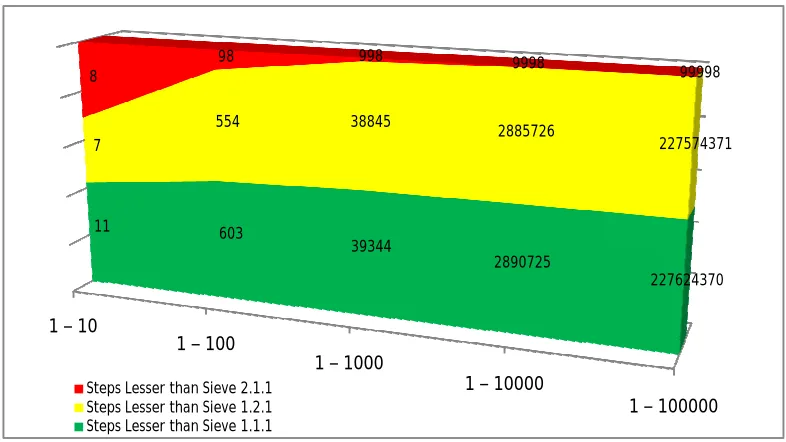
1 1 – 10 11 7 8
2 1 – 100 603 554 98
3 1 – 1000 39344 38845 998
4 1 – 10000 2890725 2885726 9998
5 1 – 100000 227624370 227574371 99998
The graphical comparison of reduced step of Sieve 2.2.1 is as follows.
Figure 2 : Step Difference of Sieve 2.2.1 with earlier Sieves of Subtype 1
3. Sieves Subtype 2 Improved
All the sieves subtype 1’s occurring in [4], [5] and [6] have been improved in the respective works by corresponding subtypes 2’s, labeled as Sieves 1.1.2, 1.2.2, 2.1.2. The refining step in determining the primality of a positive integer k is to test only the positive integers from 2 to k/2 for divisibility to reduce the efforts almost to half. The principle behind it being very simple that k cannot have an integral divisor greater than k/2.
1 – 10
1 – 100
1 – 1000
1 – 10000
1 – 100000
11 603
39344
2890725
227624370 7
554 38845
2885726
227574371 8
98 998 9998
99998
All those sieve subtype 2’s when refined with the method of present work yield Sieve 2.2.2 :
Take an integer n larger than 1 2 is prime
For all values of k from 3 to n and only odd values after 2
For values of integer d from 3 to k/2 and only odd values after 2 If d divides k perfectly,
Stop checking as k is not prime Else
Continue checking
If checks do not stop for any value of d till k/2, k is prime
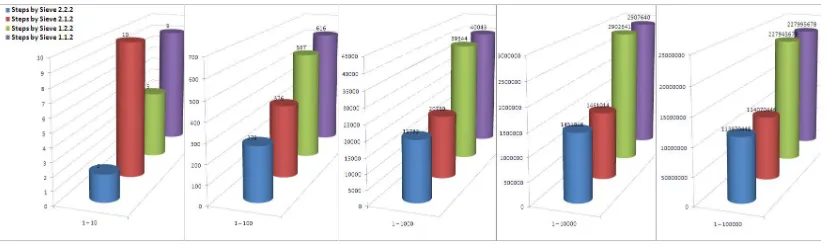
Steps requirement in determining primality in first few ranges is again seen to be reduced significantly.
Table 3 : Number of Steps Taken by Sieves of Subtype 2
Sr. No.
Range Steps Taken by Sieve 1.1.2
Steps Taken by Sieve 1.2.2
Steps Taken by Sieve 2.1.2
Steps Taken by Sieve 2.2.2
1 1 – 10 9 5 10 2
2 1 – 100 616 567 376 278
3 1 – 1000 40043 39544 20730 19732
4 1 – 10000 2907640 2902641 1461014 1451016
5 1 – 100000 227995678 227945679 114070446 113970448
These figures compare graphically as follows.
Figure 3 : Number of Steps Taken by Sieves of Subtype 2
Table 4 : Step Difference of Sieve 2.2.2 with earlier Sieves of Subtype 2
Sr. No.
Range Steps Lesser than Sieve 1.1.2
Steps Lesser than Sieve 1.2.2
Steps Lesser than Sieve 2.1.2
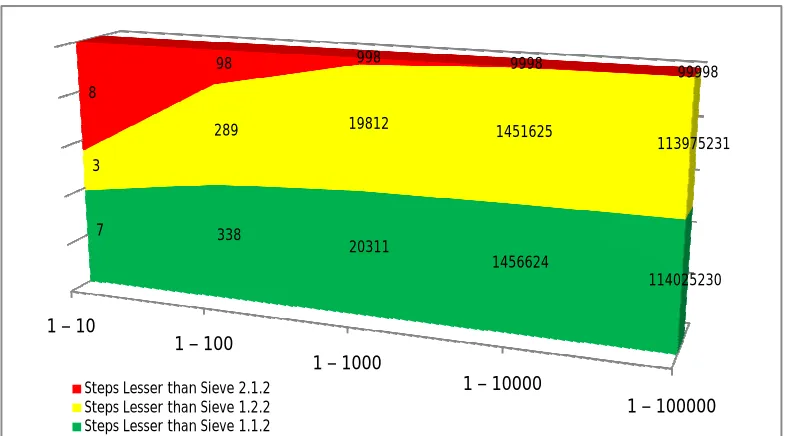
1 1 – 10 7 3 8
2 1 – 100 338 289 98
3 1 – 1000 20311 19812 998
4 1 – 10000 1456624 1451625 9998
5 1 – 100000 114025230 113975231 99998
Figure 4 illustrates the steps improvement of Sieve 2.2.2.
Figure 4 : Step Difference of Sieve 2.2.2 with earlier Sieves of Subtype 2
4. Sieves Subtype 3 Improved
In each of the referred earlier works, the ultimate improvement of succession of sieve subtypes has been subtype 3. That makes the way of formulating the superior Sieve 2.2.3 of present work clear.
1 – 10
1 – 100
1 – 1000
1 – 10000
1 – 100000
7 338
20311
1456624
114025230 3
289 19812 1451625
113975231 8
98 998 9998 99998
As in other subtypes 3 designated as 1.1.3 in [4], 1.2.3 in [5] and 2.1.3 in [6], here also, the advantage can be taken of the fact that for every positive integer k; for
every divisor of k greater than k, there is a divisor of k less than k. This pairing effect allows to look for positive divisors of k in the further reduced range of 2 to
k. If there is a divisor of k in this range, obviously k is not prime; and if there is no
divisor of k in this range, then k is prime, for there cannot be any divisor in the remaining higher range also as it would then lack its partner in our range. The result is Sieve 2.2.3 :
Take an integer n larger than 1 2 is prime
For all values of k from 3 to n and only odd values after 2
For values of integer d from 3 to k and only odd values after 2 If d divides k perfectly,
Stop checking as k is not prime Else
Continue checking
If checks do not stop for any value of d till k, k is prime
With comparatively less efforts, the statistics of steps requirement of improved subtypes 3’s is available.
Table 5 : Number of Steps Taken by Sieves of Subtype 3
Sr. No.
Range Steps Taken by Sieve 1.1.3
Steps Taken by Sieve 1.2.3
Steps Taken by Sieve 2.1.3
Steps Taken by Sieve 2.2.3
1 1 – 10 8 4 9 1
2 1 – 100 236 187 185 87
3 1 – 1000 5288 4789 3349 2351
4 1 – 10000 117527 112528 65956 55958
This data is illustrated in the following figure.
Figure 5 : Number of Steps Taken by Sieves of Subtype 3
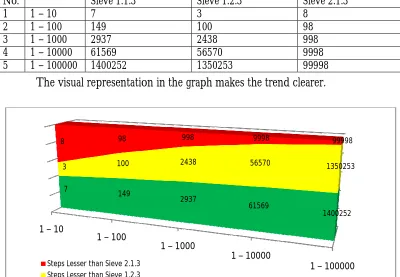
The step reduction obtained from Sieve 2.2.3 gives maximum efficiency.
Table 6 : Step Difference of Sieve 2.2.3 with earlier Sieves of Subtype 3
Sr. No.
Range Steps Lesser than Sieve 1.1.3
Steps Lesser than Sieve 1.2.3
Steps Lesser than Sieve 2.1.3
1 1 – 10 7 3 8
2 1 – 100 149 100 98
3 1 – 1000 2937 2438 998
4 1 – 10000 61569 56570 9998
5 1 – 100000 1400252 1350253 99998
The visual representation in the graph makes the trend clearer.
Figure 6 : Step Difference of Sieve 2.2.3 with earlier Sieves of Subtype 3
1 – 10
1 – 100
1 – 1000
1 – 10000
1 – 100000
7
149
2937
61569
1400252
3 100 2438 56570 1350253
8 98 998 9998 99998
The three new versions of the sieves presented here, viz., Sieves 2.2.1, 2.2.2 and 2.2.3, are quite promising. No doubt, they are inspired by the earlier work, in particular, a just combination of different better approaches in [5] and [6], which stand on the foundation of [4]. It is equally interesting to note that few best known traditional algorithms also find their roots in these.
Acknowledgements
The author expresses his grateful to the Java (7 Update 25) Programming Language Development Team and the NetBeans IDE 7.3.1 Development Team, whose software have been freely used in implementing the algorithms developed and tested during this work.
The author is also thankful to the University Grants Commission (U.G.C.), New Delhi of the Government of India for funding this research work under a Research Project (F.No. 47-748/13(WRO)).
References
Burton David M. (2007). Elementary Number Theory. Tata McGraw-Hill Education.
Knuth Donald E. (1968). The Art of Computer Programming, Volume 1: Fundamental Algorithms. Addison-Wesley, Reading, MA.
Niven Evan, Zuckerman Herbert S., Montgomery Huge L. (2008). An Introduction to the Theory of Numbers. John Wiley & Sons Inc., U.K.
Pande Neeraj Anant. (2013a). Evolution of Algorithms: A Case Study of Three Prime Generating Sieves, Journal of Science and Arts. 13-3(24): 267-276.
Pande Neeraj Anant. (2013b). Algorithms of Three Prime Generating Sieves Improvised Through Nonprimality of Even Numbers (Except 2). International Journal of Emerging Technologies in Computational and Applied Sciences. 6(4): 274 – 279. Pande Neeraj Anant. (2013c). Algorithms of Three Prime Generating Sieves Improvised by
Skipping Even Divisors (Except 2). American International Journal of Research in Formal, Applied and Natural Sciences. 4(1): 22 – 27.