INTERNATIONAL JOURNAL OF PHARMACEUTICAL, CHEMICAL AND BIOLOGICAL SCIENCES
Available online at
www.ijpcbs.com
DEVELOPMENT AND VALIDATION OF RP-HPLC METHOD FOR
SIMULTANEOUS ESTIMATION OF EPERISONE HYDROCHLORIDE
AND DICLOFENAC SODIUM IN BULK AND PHARMACEUTICAL
DOSAGE FORM
D. Kamble Neelam
1*, S. Mahajan Supriya
1, S. Pradhan Nitin
2, S. Prabhune Swarup
2and S. Reddy Sajjalavarlakshmi
21
C. U. Shah College of Pharmacy, Sir Vitthaldas Vidyavihar, Juhu Road, Santacruz (W), Mumbai-400
049, Maharashtra India.
2
Analytical Method Development Laboratory of Wanbury Research and Development Centre,
Turbhe, Navi Mumbai-400 705, India.
INTRODUCTION
The combination of eperisone hydrochloride (EPE) and diclofenac sodium (DIC), available in sustained release capsule dosage form, is used in the treatment of acute musculoskeletal spasm
associated with low back pain1. The combination
of these two drugs in the ratio of (EPE) 150: (DIC) 100 is approved by Central Drugs Standard Control Organization (CDSCO) in India in the year 2012.
Eperisone hydrochloride is chemically 1-(4- ethylphenyl)-2-methyl-3-piperidin-1-yl-propan-1-one (Fig. 1) and is a well known antispasmodic drug2. It has a relatively low incidence of central
depression when compared with other
antispasmodic drugs, which makes it widely useful for the therapeutic treatment of spastic patients to relieve skeletal muscle stiffness and
back pain3. It is useful in diabetical angiopathy and
Raynaud’s syndrome4. Eperisone hydrochloride is
official in Japanese Pharmacopoeia only5in which
non-aqueous titrimetry is reported for its
estimation. Many methods like HPLC6, HPLC - MS7,
GC - MS8 and electrospray ionization method9 are
reported for the estimation of eperisone hydrochloride.
Diclofenac sodium is phenylacetic acid derivative and chemically it is 2-(2, 6 dichlorophenylamino)
Research Article
ABSTRACT
A simple, selective, precise and accurate Reverse Phase High Pressure Liquid Chromatographic (RP-HPLC) method was developed and validated for the simultaneous estimation of eperisone hydrochloride and diclofenac sodium in marketed sustained release (SR) capsules. The method was validated for accuracy, specificity, linearity and robustness as per the ICH guidelines. The results of the developed method were found to be reproducible and within official limits of USP. Isocratic elution at a flow rate of 1.0 mL per min was employed on symmetry C18 column at temperature of 10
o
C. The method was successfully applied to estimate eperisone hydrochloride and diclofenac sodium in marketed SR capsules since there was no interference from the excipients.
benzeneacetic acid sodium salt10 (Fig. 2). It is a
non-steroidal anti-inflammatory drug (NSAID) that exhibits anti-inflammatory, analgesic and antipyretic activities in both animals and
human beings11. Diclofenac sodium is used for
the relief of signs and symptoms of osteoarthritis, rheumatoid arthritis and ankylosing spondylitis. It is often used to treat
chronic pain associated with cancer12. Diclofenac
sodium is official in Indian Pharmacopoeia13,
British Pharmacopoeia14, and United S t a t e s
Pharmacopoeia15. Many methods like UV-Visible
spectroscopy16, HPLC17, HPTLC18, atomic
absorption spectroscopy (AAS)19 and capillary
electrophoresis19 are reported for the estimation
of d iclofenac s o d i u m i n single as well as in combined dosage forms.
The present article deals with the development of RP-HPLC method for the estimation of eperisone hydrochloride and diclofenac sodium from the marketed sustained release (SR) capsules.
MATERIALS AND METHODS Reagents and chemicals
Ammonium acetate (GR grade), glacial a ce t i c acid ( GR grade) and distilled water (HPLC grade) were used for preparing the buffer solution. Acetonitrile, used as a mobile phase along with the buffer, was of HPLC grade. Methanol was also of HPLC grade. All the reagents were provided b y Wanbury R & D Centre Pvt. Ltd., Turbhe, Navi
Mumbai. Pure s amp le o f e p e ri s o n e
hydrochloride w as obtained as a gift sample from Sharon Bio-Medicine Ltd., Vashi, Navi Mumbai, and pure diclofenac sodium was provided by Pharmaceutical Products of India Ltd., Turbhe, Navi Mumbai.
Preparation of mobile phase
A freshly prepared mixture of ammonium
a c e t a t e b u ff e r (pH=6.0 adjusted with glacial acetic acid) and acetonitrile (50:50 v/v) was
used as the mobile p h a s e . Buffer solution was
prepared b y dissolving 3.9 g o f ammonium acetate i n 900 mL of w a t e r and by adjusting its pH to 6.0 ± 0 .0 5 using g la c ia l a ce t i c a ci d . T h e volume was then adjusted to 1000 mL with water. Mobile phase was filtered through a 0.45
μ membrane filter and sonicated before use.
HPL C oper ating c onditions
All chromatograp hic ex periments were performed in the isocratic mode. Th e h igh
pressure liquid chromatograph from
Waters - 2487, equipped with dual wavelength
absorbance detector, was used for the estimation of diclofenac sodium and eperisone hydrochloride from the marketed sustained release capsules.
One more high p ressu re liquid
ch ro mato graph from Prominence, equipped with UV/VIS detector, was also used for the optimization studies. For both the systems, the
reverse phase C18 column (150 x 4.6 mm, 5 µ)
from Waters was used. The flow rate was maintained at 1.0 mL/min and the eluates were monitored at 256 nm. The sample was injected using a 20 µL fixed loop and the total run time was 10 min.
Preparation of solutions for assay
Standard solution: A mixture of 150 mg of
eperisone hydrochloride (AR Grade) and 100 mg of diclofenac sodium (AR Grade) was transferred into 100 mL volumetric flask. The mixture was dissolved in 60 mL of methanol by sonication and the volume was made up to the mark with the same (concentration of EPE: 1500 ppm and DIC: 1000 ppm). Five mL of this standard stock solution was diluted to 50 mL with mobile phase (concentration of EPE 150 ppm and DIC 100 ppm).
Sample solution (Marketed SR capsules) The capsule claim of each marketed SR capsule
was 340 mg. The content of twenty capsules was transferred to a mortar, crushed and mixed intimately. The powder equivalent to the average weight (340 mg) of contents of one capsule was transferred to a 100 mL volumetric flask. To this powder 60 mL of methanol was added and the mixture was sonicated for 45 min in ice cold water and dissolved in methanol to make up the volume to the mark. This solution was centrifuged at 3500 rpm for 5 min. Five mL of this supernatant solution was diluted to 50 mL with mobile phase.
O p t i m i z a t io n o f HPL C me t h od
V a rio u s mo b i le p h a se s w e re u s ed in order to find the optimum conditions for the separation of eperisone hydrochloride and diclofenac sodium from each other. It was found
that mobile phase containing ammonium acetate
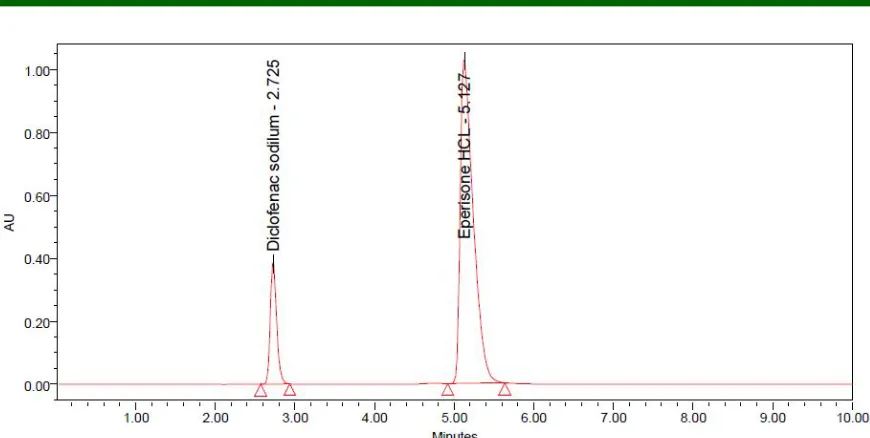
for diclofenac sodium (Fig. 3).
VALIDATION OF THE METHOD20-24
The ICH guidelines were followed for validation of developed analytical method. The method was validated for the following parameters.
Linearity
Linearity was demonstrated from 50 % to 150 % of standard concentration (EPE 150 µg/mL and DIC 100 µg/mL) using minimum five calibration levels (50, 80, 100, 120 and 150 %) for eperisone hydrochloride and diclofenac sodium, which gave an assurance of analytical method with respect to linearity.
Precision
The precision of the method was studied and determined by r e p e a t a b i l i t y study and by determining, interday and intraday precision. Repeatability studies were performed by analysis of three different concentrations like 50 %, 100 % and 150 % of the drug for six times on the same day. Intraday precision studies were carried out by analyzing sample solutions at different time intervals on the same day. The interday precision studies were determined by injecting the sample solutions on different days.
Accuracy
To confirm the accuracy of the proposed method, recovery studies were carried out by adding a known amount of the standard solution of a pure drug (eperisone hydrochloride and diclofenac sodium) to a pre-analyzed sample solution. These studies were carried out at 50 %, 100 % and 150 % levels. The per cent recoveries of EPE and DIC at each level and each replicate were determined. The mean per cent recovery (n=3) of both the drugs and the relative standard deviation (RSD) were calculated.
Robustness of method
To evaluate the robustness of the developed RP-HPLC method, minute variations in the optimized method parameters were done. For this purpose, the effect of change in pH of the mobile phase, change in wavelength and flow rate on the retention time, theoretical plates, area under the curve and per cent content of eperisone
hydrochloride and diclofenac sodium was
studied. The solution having mixture of eperisone hydrochloride (100 %) and diclofenac sodium (100 %) was injected into the sample injector of RP-HPLC system thrice under the varied
conditions.
Ruggedness of method
Solution containing mixture of eperisone
hydrochloride (100 %) and diclofenac sodium (100 %) was prepared and analyzed by two different analysts using the same operational and environmental conditions. From the area under the curve, the amount of both the drugs was calculated.
R E S U L T S A N D D I S C U S S I O N
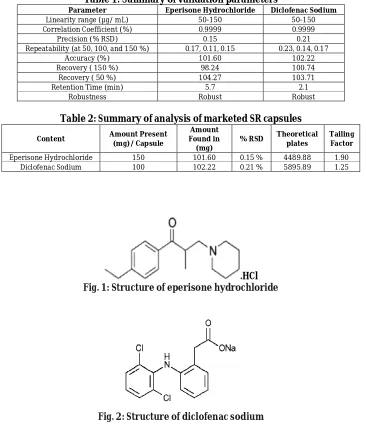
T h e r e s u l t s o f v a l i d a t i o n studies on simultaneous estimation method developed for eperisone hydrochloride and diclofenac sodium by RP - HPLC are summarized in Table 1.
By using the mobile phase of acetonitrile and
buffer (50: 50), two drugs, eperisone
hydrochloride and diclofenac sodium, could be resolved clearly from each other. The retention time for eperisone hydrochloride and diclofenac sodium was 5.1 and 2.7 min, respectively, (Fig. 3).
Linearity
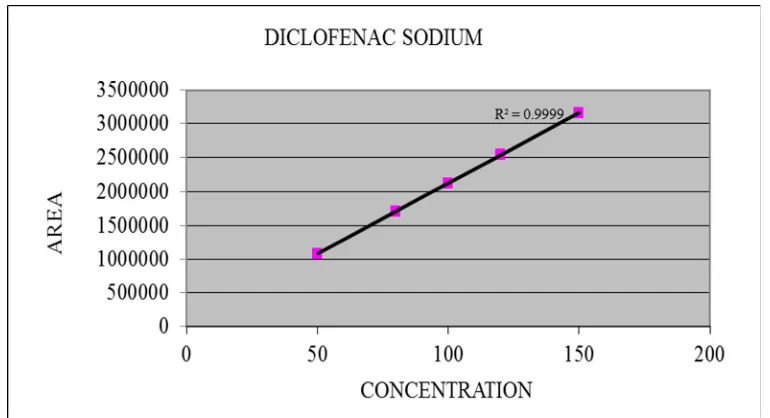
The drug response was linear for eperisone
hydrochloride (r2 = 0.9999) and for diclofenac
sodium (r2 = 0.9999) over the concentration range
of 50-150 μg/mL (Figures 4 and 5, respectively).
Precision
The developed method was found to be precise as the RSD value for intra-day and interday precision studies was < 2 %, which is in the limit as per the recommendations of ICH guidelines.
Analysis of marketed SR capsule
Experimental results for the amount of eperisone hydrochloride and diclofenac sodium in marketed SR capsules, were in good agreement with their label claims. This suggested that there was no interference from any of the excipients, which are normally present in marketed SR capsules. The replicate analysis (n=6) of eperisone hydrochloride and diclofenac sodium by the proposed method showed that the content of eperisone hydrochloride and diclofenac sodium in the SR capsules was 101.60 % and 102.22 %, respectively the results are summarized in table 2. The retention time of diclofenac sodium and eperisone hydrochloride was found to be 2.7 min and 5.1 min, respectively, and hence, the analysis was very fast (Fig. 3).
CONCLUSION
simultaneous estimation of eperisone hydrochloride and diclofenac sodium from their mixture in the marketed sustained release capsules is simple, rapid, selective, accurate, precise, linear, rugged and robust. Hence, i t can be adopted efficiently and easily for routine quality control (QC) a n a ly s is with a ccu ra c y an d reproducibility of the results.
ACKNOWLEDGEMENT
The authors are thankful to Wanbury R & D Centre, Turbhe, Navi Mumbai, India, for providing chemicals an d th e facility to ca rry o ut HPLC stu d ies fo r o ur re search work . The authors are also thankful to Sharon Bio-Medicine Ltd. Vashi, Navi Mumbai, an d Ph arma ceu tica l P rod u ct s o f Ind ia Ltd ., Tu rbh e, Nav i Mu mba i, fo r p rov id ing gift
sa mp le o f eperisone hydrochloride and
diclofenac sodium for the research purpose.
Table 1: Summary of validation parameters
Parameter Eperisone Hydrochloride Diclofenac Sodium
Linearity range (µg/ mL) 50-150 50-150
Correlation Coefficient (%) 0.9999 0.9999
Precision (% RSD) 0.15 0.21
Repeatability (at 50, 100, and 150 %) 0.17, 0.11, 0.15 0.23, 0.14, 0.17
Accuracy (%) 101.60 102.22
Recovery ( 150 %) 98.24 100.74
Recovery ( 50 %) 104.27 103.71
Retention Time (min) 5.7 2.1
Robustness Robust Robust
Table 2: Summary of analysis of marketed SR capsules
Content Amount Present
(mg)/ Capsule
Amount Found in (mg)
% RSD Theoretical plates
Tailing Factor
Eperisone Hydrochloride 150 101.60 0.15 % 4489.88 1.90
Diclofenac Sodium 100 102.22 0.21 % 5895.89 1.25
.HCl Fig. 1: Structure of eperisone hydrochloride
Fig. 3: Chromatogram of a mixture of diclofenac sodium and eperisone hydrochloride
Fig. 5: Calibration curve for diclofenac sodium
REF EREN CES
1. Roelofs PD, Deyo RA and Koes BW.
Non-steroidal anti-inflammatory drugs for low back pain: an updated Cochrane review. 2008;33:1766-1774.
2. Malanga GA and N a d l e r S F . N o n
steoideal anti- inflammatory
t r e a t m e n t o f muscle spasm. Medical, c l i n i c a l procedures and practices. 1999;74:1135- 1148.
3. Cabitza P and Randellu P. Safety and
efficacy of eperisone in patients with low back pain a double blind randomized study. Europe. Review for Medical and Pharmacological Sciences. 2008;12:229-235.
4. Inoue S, Bian K, Okamura T, Okunishi H
and Toda N. Mechanisms of action of eperisone on isolated dog saphenous arteries and veins. Japan. Journal of Pharmacology. 1989;50(3):271-282.
5. The Ministry of Health, Labour and
Welfare. Japanese Pharmacopeia.
Prefectural office in Japan. 15th Edn. 618, 2006.
6. Fu CM, Li B and Guo RC. Determination
of eperisone hydrochloride tablets by high performance liquid chromatography. Chin. Journal on Medicinally Active Plant. 18: 57–59, 2001.
7. Shi A and Li K. Determination of
eperisone hydrochloride tablets by High Performance Liquid Chromatography and mass spectrometry. Chin Journal on
Pharmaceutical Analysis. 2002;22:45–47.
8. Takamatsu T, Yamazaki K and Kayano M.
Determination of eperisone in human plasma by gas chromatography- mass spectrometry. Journal of Chromatograph Sciences. 1992;584:261-266.
9. Ding L, Wei X and Zhang Y. Rapid and
sensitive liquid chromatography-
electrospray ionization-mass
spectrometry method for the applications of eperisone in patients with low back pain. Journal on Chromatograph Sciences. 2004;42:254-258.
10. Brogden RN, Heel RC, Pakes GE, Speight
TM and Avery GS. Diclofenac sodium, a review of its pharmacological properties and therapeutic use in rheumatic diseases and pain of varying origin. Journal on Chromatograph. 1980;20(1):24-48.
11. Tripathi KD. Analgesics and
anti-inflammatory drugs. Essentials of Medical Pharmacology. 5th Edn. Jaypee Brothers, Medical Publishers, New Delhi, India. 2004;196-199.
12. Laurence LB and Lozo JS. Analgesics,
antipyretic and anti-inflammatory
agents. Goodman & Gilman’s the
Pharmacological basis of therapeutics, 11th. Edn. Medical Publishing, Division, New York. 2006;671-675.
13. Government of India. Ministry of health
and family welfare. Indian
Pharmacopoeia. The Controller of
14. Great Britain: The department of Health.
Medicinal and healthcare products
regulatory agency. British
Pharmacopoeia. The stationary office, 2009;1:1893.
15. The United States Pharmacopoeia
Convention. Food and drug
administration. The United States
Pharmacopoeia, National Formulary 27.
Asian Edn, Rockville. 2009;2:2124-
2125.
16. Bhati S, Padaliya H, Padhiyar P,
Munjapara A and Pancholi SS.
Development and validation of UV
spectrophotometric method for
estimation of eperisone hydrochloride and diclofenac sodium in bulk and
Pharmaceutical formulation by
absorption ratio method. Inventi Rapid: Pharm Analysis & Quality Assurance, 2013. Article, visited on: (2013 Mar 17) http://www.inventia.in/Article/ppaqa/6 85/13.aspx.
17. Heda A, Gadale D, Kathirya J and Puranik
P. Development and validation of HPLC method for determination of diclofenac sodium and rabeprazole sodium in tablet formulation. Journal of chemistry. 2010;7: 386-390.
18. Dhaneshwar SR and Bhusari VK.
Validated HPTLC method for
simultaneous quantitation of diclofenac sodium and misoprostol in bulk drug and
formulation. Asian Journal of
Pharmaceutical and Biological Sciences. 2011;1:15-21.
19. Wei X, Ding L and Gao J. Rapid and
sensitive chromatography, atomic
absorption spectroscopy and capillary
e le c t ro p h o re s is method for the
determination of d iclo fenac sodium in human plasma: method and clinical applications. Journal on Chromatograph. 2004;39:309–311.
20. ICH Q2R1. Validation on Analytical
Procedures: Methodology.International
Conference on Harmonization, Guidelines for industry. Switzerland: IFPMA, 1996;1-8.
21. ICH Q2R1. Validation on Analytical
Procedures: Methodology.International
Conference on Harmonization, Guidelines
for industry. Switzerland: IFPMA,
2004;198-99.
22. ICH, Q2 (R1) Validation of Analytical
Procedures, Test and Methodology,
International Conference on
Harmonization, Geneva: IFPMA, 2005.
23. ICH, Q2A Validation of Analytical
Procedures, Consensus Guidelines, and ICH Harmonized Tripartite Guidelines, 1994.
24. ICH, Q2B Validation of Analytical
Procedures, Methodology, Consensus