http://www.sciencepublishinggroup.com/j/aff doi: 10.11648/j.aff.20170601.12
ISSN:2328-563X (Print); ISSN:2328-5648 (Online)
Indigenous Knowledge and Factors Related to Practices of
Forest Conservation Among Forest Dependent
Communities in the Tocha District Southern Ethiopia
Biniam Tesfaye
1, *, Bahilu Bezabih
21
Department of General Forestry, Mizan Tepi University College of Agriculture and Natural Resource, Mizan Tepi, Ethiopia 2Department of Natural Resources Management, Jimma University College of Agriculture and Veterinary Medicine, Jimma, Ethiopia
Email address:
[email protected] (B. Tesfaye) *Corresponding author
To cite this article:
Biniam Tesfaye, Bahilu Bezabih. Indigenous Knowledge and Factors Related to Practices of Forest Conservation Among Forest Dependent Communities in the Tocha District Southern Ethiopia. Agriculture, Forestry and Fisheries. Vol. 6, No. 1, 2017, pp. 6-19.
doi: 10.11648/j.aff.20170601.12
Received: October 18, 2016; Accepted: December 7, 2016; Published: January 18, 2017
Abstract:
The study was conducted to assess and explain indigenous knowledge and factors related to practice of forest conservation among forest dependent community in the three kebeles in Dawuro Zone, Tocha District. The communities involved were Malla and Manja. In light of this, both primary data and secondary data were used. Primary data was obtained through structured questionnaire, key informant information and focus group discussion while secondary data was obtained from published and unpublished materials, books, journals and project reports. A total of 162 sample respondents were identified using simple random sampling technique. According to the binary logit analysis age, religion, extension service and education were one of socio-economic factors found to be significantly related to the practice of forest conservation while sex, marital status, family size, ethnicity, occupation and residence to forest were not significantly related. The communities’ awareness about the general function of the forest was identified as indirect benefits like having high tendency to bring rain, maintaining soil fertility, protecting from extreme sun light and protecting the soil from erosion and direct benefits like getting non timber forest products (NTFP) and timber and other forest associated products are the well known contribution of forest. Even though, these two well contribution forests are known the communities understanding on indirect benefit is higher than direct benefits of forest. The forest communities are more associated with the forest and they have different conservation methods in their area due to their indigenous knowledge. This indigenous knowledge of community related towards the practice of conservation was for the purpose of traditional belief, medicinal value, for the extraction of honey and coffee shade and others. Though forest is conserved and protected by the communities, forest being deforested and reduced in coverage. Hence, forests were being depleted intentionally or unintentionally in the study area. This is due to expansion of agricultural land, population growth, logging of timber, high demand of charcoal, fuel wood and so on. Because of these pressures there is high level of deforestation in the area. Generally, for the protection and utilization of forest in sustainable manner it is recommended that traditional ecological culture should be done wisely.Keywords:
Awareness, Binary Logit, Indigenous Knowledge, Model, Practice, Perception1. Introduction
People value forest biodiversity in different ways: spiritually, economically, aesthetically, culturally, and scientifically. Its values also differ on international, national, and local levels. The conservation of forest biodiversity is important and directly relevant to local residents, for whom
better than the state [3].
People who live in or near forests have a deep understanding of natural resource management [29]. The ecological importance of such local knowledge has been widely acknowledged [23]. It has made significant contribution to the maintenance of the earth’s most fragile ecosystems, through habitual, sustainable resource use practices and culture-based respect for nature. Exploitation of biological resource is a major source of income and livelihood support in developing countries. Biodiversity contributes to food security, health (nutritious food and medicine), ecosystem resilience, social wellbeing (religion and ceremonies), and freedom of choices [31]. Therefore, biodiversity and human well-being are strongly linked with each other. Forests are the storehouses for different products and biodiversity among the biological resources [42].
In Ethiopia the large majority of people’s lives are closely linked to natural resource, particularly forests. However, the absence of appropriate forest use and benefit sharing mechanisms are resulted in a situation where by forest dependents are forced to over utilize forest resource to the extent of irreversible destruction. For instance, Ethiopia loses about 141,000 hectares of natural forest each year due to firewood collection, conversion to farm land, overgrazing and uses of forest products for building material [15]. Similarly, in the study district, there are communities that live within or adjacent to forest areas and whom livelihood depend on nearby forest resource. The large number of forest dependent Manja and little other Malla communities were living inside and around to the forest area of the study area. Among this Manja community is one of the pioneer forest dwellers and who earn their daily consumption by cutting down forest trees for firewood and selling them. It is known that the forest is more directly linked to their survival than that of other communities. Likewise, increasing human settlement around forest patches have been significantly aggravating forest resources in Dawuro Zone especially in lowland areas. Doddi district is among the lowland area in the Tocha district in Dawuro zone. The forest cover in the Doddi district has been declining in terms of coverage and quality due to main threat is clearance of forest land for agricultural expansion, settlement, charcoal making, fuel wood gathering, logging timbers. In general, indigenous conservation practices play a critical role in forest biodiversity management especially outside protected areas. Traditionally, customary law enabled people to develop indigenous management systems that acted as controls in the exploitation of natural resources. However, there is no known literature evidence on the traditional conservation practices of forest biodiversity among the local people of the study area. Therefore this study was aimed to investigate to the role of indigenous knowledge in the practice of forest conservation and management among local forest dependent
communities and to examine its relationship with local people’s perception of the decline of forest around Tocha district of Dawuro Zone in Southern Ethiopia. The study primarily emphasizes on Manja and other community inhabited for a long time.
2. Materials and Method
2.1. Description of the Study Area
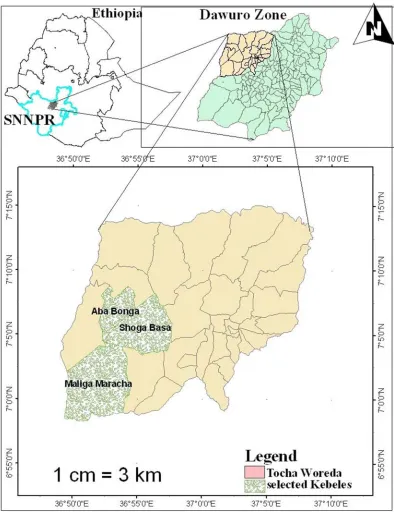
Figure 1. Map of the study area.
2.2. Data Sources
The primary and secondary data were the two major categories of information sources widely used in this study. These included results of the current household socioeconomic surveys, focus group discussions, key informant and in-depth interviews. Similarly, unpublished sources on environment and forest resources were also explored carefully and patiently.
2.2.1. Key Informant Selection
Here snow-ball sampling method used for accessing informants through contact information that was provided by
other informants to select individuals who have lived in the area for a long time, active and knowledgeable of their localities were selected. Accordingly, six key informants were selected from three kebele namely Aba Bonga, Shoga Basa and Maliga Maracha (Figure 1).
2.2.2. Focus Group Selection
2.2.3. Household Survey
The quantitative data for the study was collected through a structured questionnaire administered by face to face interview with the household head. A total of 162 respondents were interviewed during household survey.
2.3. Sample Size Determination
A simple random sample (SRS) was used for creating a sample from a population. Each sample was made of individuals drawn from a larger population (represented by the variable N), completely at random. As a result individuals have an equal chance of being selected. This study adopted the sample size rule that N ≥ 50 + 8 m, where N is the minimum required number of households and m is explanatory variables [18] to limit the size of sampled households for the interview. The explanatory variables in this study were ten. So that the minimum sample size is N ≥ 50 +8 x 10 ≥ 130. For this study a total sample of 162 individuals was selected and interviewed.
There were thirty four rural kebeles in Tocha district. Among these, three kebeles were purposely selected for this study. Six villages were selected from each kebeles. Household listing were undertaken in two major categories namely rich (no), and poor (high) forest dependent community based their land size respectively. In all these households, population listing with filtering variable age was conducted by the data collectors. It was later served as a sample frame for the study.
= + 1 1 + 2 2 + − − − + (1)
2.4. Method of Data Analysis
In this study, explanatory data analysis is used to explain the relationship between level of people's participation and its determining factors related people’s participation of forest conservation practice, and looking for the causal effects of these determinants on participation of people. This relationship was studied using frequencies and percentiles for descriptive and also for econometric procedures. Quantitative data was analyzed using statistical package for social sciences (SPSS 20) and Microsoft Excel 2007.
2.4.1. Econometric Model
Several studies indicate, econometric models have the power to generate essential information on causal relationships between household characteristics and their participation strategies of forest management (conservation) practices and in this study, the Binary Logistic Regression model (BLR) was employed to determine the effect of socio economic correlates (determinants) that influence decision to use participation of practice.
2.4.2. Binary Logit Model Specification
The Binary Logistic Regression model (BLR) model was used to determine forest users’ decision to practice or not to practice forest conservation. The standard form of the logit model is given as [19]: The logistic formulas are stated in
terms of the probability that Y = 1, which is referred to as the probability that Y is 0 is 1 - qit.
This logistic regression model was employed since this technique is the most appropriate tool of analyzing the degree of strength of the relationship between dependent variables and independent variables when dependent variable is dichotomous taking value between 1 (one) and 0 (zero), where 1(one) for those who practice forest conservation (forest dependent) and 0 (zero) for those who do not practice forest conservation (non dependent) respectively. The logistic regression function for predicted variables can generally be given as to answer the question of factors that relate to the indigenous knowledge and practice of forest management and conservation, since the logit model is computationally easier to use a meaningful interpretation [20].
= = (2)
Where, Pi is the probability of practicing the forest conservation system for the ith community and it ranges from 0-1. P is the observed response of the ith community (i.e., the binary variable, P =1 for conservation, P = 0 for a non conservation) and Zi is a function of m explanatory variables (Xi) which is expressed as:
= + 1 1 + 2 2 + − − − + (3)
Where X1, X2… Xn = Predictor variables o - is the intercept
1, 2, --- n are the logit parameters (slopes) of the equation in the model. The coefficients show how the log-odds in favor of knowledge and practice change as the value of predictor variables change. The value of Pi (the probability of having knowledge and practice) ranges between 0 and 1 and it is also non-linearly related to the predictor variables.
If Pi is the probability of occurrence of an event, then (1 - Pi), the probability of non occurrence event will be [15]
1 − = (4)
Then, Pi/ (1-Pi) are simply the odds ratio in favor of occurrence of the event - the ratio of probability of occurrence of an event to the probability of non-occurrence of an event, will be specified as;
= = (5)
And
= = + ∑ (6)
Zi - is a function of m- explanatory variables (Xi) which is also expressed by taking natural log in both sides of Eq. (4);
! " = [ + ∑ ] = (7)
= + ∑ + % (8)
2.4.3. Definition of Variables and Working Hypotheses
Different variables were expected to relate the practice of the forest conservation system in the study area. The variables hypothesized to relate the practice of forest conservation system were tested whether they would be statistically significant or not. Accordingly, the major variables expected to have relation on the practice of forest conservation system are defined and explained below:
2.4.4. The Dependent Variable of the Model (Practice of Forest Conservation)
The independent variables that were hypothesized to relate the practice of community towards the forest were the combined effects of various factors such as: household characteristics, socioeconomic characteristics and demographic characteristics in which the communities operate. Based on the review of literature and past research finding 10 potential explanatory variables were considered in this study and examined for their relation in practicing system. The variables are:
Age: Peoples having a longer forest conservation experience are in a better position to know about the potential benefits of practicing forest conservation than peoples with shorter practicing experience. Knowledge of practicing forest Conservation increases as one goes from the young to old age [36]. Hence, thus, age was positively associated with practice of forest conservation system.
Extension: The extension service of the community was positively and significantly related with the forest conservation. Communities taking extension service of the forest conservation have high tendency to scale up the important trainings from the government regarding to their forest utilization for sustainable development [14].
Education: The education level of the community was positively and significantly related with the forest conservation. Educated communities have more vital role than an uneducated communities for forest conservation activities for the sake of sustainable development of the forest sector and the natural environment [16].
Sex of the Household Head (gender): There was a variation in practice of forest conservation regarding to being male/female. Female-headed households have less access to land and extension than male headed household [19]. Hence, it was expected that the male headed households were better practice of forest conservation system.
Religion: The religion of forest dependent community is positively and significantly related with the forest conservation. It was indicated that forest dependent communities that have traditional religion have good indigenous knowledge and positive outlook to the forest conservation in the area [17], [11], [30].
Type of occupation: the type of activities in the study areas were agriculture related and forestry activities. So that it is obvious that their perception towards the environment vary accordingly. Off-farm activity produces additional income and means of survival. Hence, a farmer who has off-farm
activity will be reluctant to work on the forestry activities [5]. Thus, off-farm activity was expected to negatively influence forestry activities.
Marital status: Communities’ involvement in natural resource management is needed from each society for its sustainable development. As each community member had his/her own role regarding to the practice of natural resource conservation. Unmarried person compared to the married to the married ones have limited knowledge of environmental conservation because when people get married they involve in communities than the single.
Ethnicity: Diversity of ethnic groups has its own contribution towards the management and conservation of forest and their environment based on its ethnicity. The conservation/management of forest may differ from community to community based on its background of the ethnicity which associated with traditional beliefs of the forest community. Hence, from the two ethnic groups of Manja and Mala, the majority of manja has a strong relationship with the practice of forest conservation.
Size of land: The adequate size of land holding is the basic requirement for the practice of forest conservation. It is thus hypothesized that the larger the farm size the farmer has the better opportunity to practice conservation of forest and not forced to destruct the forest. But that of having a piece small farm land are forced to deforest and deplete the natural environment.
Distance/residence to the forest:
The longer the distance from the forest peoples will be discouraged to practice forest conservation than those live near to the forest. Therefore, the distance between the respondent’s residence and the nearest the forest place (measured in kilo meters) was negatively correlated with the practice of forest conservation.
Household size: as the number of community increases the demand of natural resource also increases especially those depend on forest. This increasing of the population influences the nature of environment by deforesting the forest environment for different purposes [35]. Hence, thus, households with large household size have high pressure for the occurrence of deforestation.
Multicollinearity test
Multicollinearity is a high degree of correlation among several independent variables. It commonly occurs when a large number of independent variables are incorporated in a regression model that may measure the same phenomena [21]. Multicollinearity refers to a situation where it becomes difficult to disentangle the separate effects of independent variables on the dependent variable because of strong relationships among them [13]. The existence of this situation in this study was tested using the methods of variance inflation factor and contingency coefficients.
Variance Inflation Factor (VIF)
in the limit, it can be infinite. The larger the value of VIF, the more troublesome or collinear is the variable Xi. As a rule of thumb, if the VIF of a variable exceeds 10 (this will happen if Ri2 exceeds 0.90), that variable is said to be highly collinear [20]. The values of VIF for continuous variables were found to be small. To avoid serious problem of multicolinearity, it is quite essential to omit the variable with value 5 and more from the log it analysis. Based on the VIF result, the data have no serious problem of multi-co linearity. Similarly, value of contingency coefficient ranges between 0 and 1, and value of variable with contingency coefficient below 0.75 shows weak correlation and value above it indicates strong association of variables. Accordingly, the results of the computation reveal that there was no serious problem of association among discrete explanatory variables. Hence, all the 11 explanatory variables were entered into logistic analysis.
Contingency coefficient for discrete variables
Contingency coefficient analysis was carried out to check for the strength of relationship among discrete variables. The contingency coefficient is a symmetric measure which indicates the strength and significance of the relation between the row and column variables of a cross tabulation. The value ranges between zero and one, with zero indicating no association between the row and column variables and values close to one indicating a high degree of association between the variables. The decision criterion is that variables with a contingency coefficient closer to one would be avoided from further consideration in the binary analysis.
3. Result and Discussion
3.1. Traditional Conservation Method and Communities’ Involvement
In the study area there was a long history of protecting and managing forests. Though dominant numbers of manja and some other malla communities have a traditional system of conserving forest in their localities and the smallest proportion of the communities were not participated in the practice of forest conservation in the same area (Figure 1). This interruption was due to some members of the community ignored the traditional belief which associated with the practice of forest conservation.
Figure 2. The number of participants and non participants in conservation
activity.
Well known certain tree species such as tikurinchet (Prunus africana), weira (Olea capensis), zigba (Podocarpus falcatus) were conserved dominantly by manja communities and small proportion of malla communities to undertake worshiping ceremonies under the trees. These selected tree species and others were forbidden to cut and to collect for firewood purposes by traditional believers in the specified sites of the forest area. According to other finding by [10] many trees growing in the vicinity of a sacred place is impossible to consider all of them as “sacred” merely because of their specific location. Out of 162 respondent, 139 (85.8%) were participated to practice conservation, while 23 (14.2%) were not participated to conserve (Figure 2).
There are specific forest site indicated for ceremonial and sacrifice which is respected and even worshiped called “Eqa or Yarsho Sa’a” in local language. In accordance with other studies [1] in south western Ethiopia Kafa has a number of traditionally respected and even worshiped places as a result of which unnecessary meddling with them are socially disapprove. Traditional religious beliefs and the livelihood of highly dependent on natural resources, leads to a core of known traditional ecological culture, that the inhabitant respect for nature and cherish life [39].
In the study area traditional management of sacred sites was to maintain their separateness or sanctity by controlling access to the community. This was achieved largely through the strength of spiritual beliefs and norms. According to group discussion, if the violation did occur among them, purposely or not, intervention by spiritual leaders would be required to ward off harm to the trespasser. There were also certain old trees and unusual landforms such as caves also have ritual importance. An important thing that occurred in the area was cutting of trees and other activities that could potentially cause damage to the forest and a sacred spot was strictly forbidden by the selected elders. This might include collecting or removing dead logs or twigs or any other forest material. One kept to the traditional paths and avoided wandering freely in the forest trampling vegetation, disturbing secret sites and grazing livestock in the forest was strictly forbidden in the study area of traditional believers’.
system by the traditional believers was better than that of other conservation systems. But that of the remaining conservation were less than that of the traditional ones due to their conserving and management system is seasonal and they also may have option to sustain their life.
Figure 3. Communities use tree parts in for traditional medicines.
The responses from key participants and focus group interviewee described various conservation practices done either purposefully or by virtue of traditional consideration emanating from the social norms. These practices have been put in two categories for discussion purposes. The traditional conservation mentioned by the key respondents in traditional believers was cutting of certain tree species was forbidden. This included rules regulating the controlled burning of forests, seasonal harvesting of fruit trees and wild vegetable.
Conservation practices among the key participants were reported to be declining for various reasons. For example, elderly people felt sad that “a long time ago, some tree species could not be used for firewood but now a days, literally any tree can be used due to population increase with limited trees around. The other problem threatening our local knowledge of conservation was declining in conservation practices may have an effect on the conservation perceptions among the key participants especially the young. According to the study by [37], in regions of Debre Libanos, Ethiopia, that young people are flock to the urban centers in search of employment and education and thus that the traditional knowledge of plants is concentrated in the few experts in the region. In the community studied, it has been reported by informants that in recent decades, many young people have migrated to urban centers in other states in search of employment. This trend is worrisome because such actions may affect the transfer of local medical practices between generations.
3.2. Indigenous Knowledge on Utilization of Forest Trees
The rural community of the study area is rich in different indigenous tree species as having relative value-use. The key participants were asked to list vegetation species that they know are extracted from forests in order of preference of use in each category. It was assumed in this study that people knew species according to their view on use value. Therefore, knowledge of species can be used to determine the use value attached to vegetation. These resources are extracted from the “Wora” a local term referred to forests. Accordingly to the
key participants, forests mean a natural wilderness mainly composed of trees and other biodiversity. The key participants were asked to list forest tree species that they knew are extracted from forests. Therefore, participants were further asked in order of preference of use in each category. It was assumed in this study that people answered species according to their view on use-value and individual experiences. Therefore, knowledge of species of people can be used to determine the use-value attached to forest tree species.
The interviews were based on informal small talks with individuals and groups including filling of open ended questionnaires was conducted for traditional knowledge of medicinal trees. The native people of the study area use medicinal tree species for various therapeutic purposes in their day to day life for primary healthcare. The respondents were various sexes and age groups from 15 to 55 and above years. It was found that the young generation had less information than the old generation about medicinal trees. According to the report by [4] the relationship between age and the number of plants cited for medical use was observed that older people has more experience and contact with the resources. The greater knowledge of older people, as observed in this study, may be related to the degree of opportunity that they have had to learn about medicinal plants and their healing uses. Another relevant explanation may be related to the fact that these people are more susceptible to illness than young people, which again opens up a space for them to have closer contact with the world of medicinal plants in the region where they live.
All parts of the tree such as bark, leaves, root, seeds and stems are utilized by local community. The common use of root 35.67%, followed by bark 23%, stems 21%, leaves 15.33% and seeds 5%. The well known tree species are used to treat Diarrhea, abdominal pain, injured body, liver infection, tanning leather, hemorrhoids, fish poison and diseased animals. More commonly used trees are Prunus africana, Syzygium guineense, Croton macrostachyus, Antiaris toxicaria, Podocarpus falcatus, Acacia lahai, Millettia ferruginea and Acacia albidaetc. Because these trees commonly occur in the study area reveals that the local people are rich in indigenous knowledge of trees and treat many diseases. According to the report by [25] that up to 80% of the world’s population (mostly developing countries) rely on traditional medicine for primary health care.
biomedical practices.
3.3. Utilization of Forest Tree for Honey Extraction
Schefflera abyssinica, Croton macrostachyus, Vernonia sp. are preferred by bees and protected by the local people for the benefits derived from these species in bee keeping. Albiza gummifera, Aningeria adolfi-friedrichi, prunus africana, Milletia ferrugnea, podocarpus falcatus, Croton macrostachyus, Ekebergia capensisetc,are preferred to keep bee hives on their long branches and are protected. According to the group and key informant discussion very long and branched trees of selected ones are forbidden to cut and dump waste materials of human. According to the traditional belief system it may dehydrate and wilt instead of being used to keep bee hive besides to other expected multipurpose for the environment and especial forest dependent community.
3.4. Utilization of Forest for Coffee Plantation and Others
According to the respondents the most preferred tree species as coffee shade trees are Albiza gummifera, Acacia abyssinica and Miletia ferugnia, because of the size of their leaves and their crown that obstruct direct rain splash and ice, and allow light and rain water to reach the coffee plant without causing damage to the plant and the soil. They also have small leaves that can easily pass through coffee tree branches without causing damage to fruits and flowers when they are shedding. From the well known coffee shade trees Albiza gummifera is more preferred tree species because of its reverse phonology, i.e., shedding leaves during the rainy season and growing during the dry period when coffee plants need shade. Tree species explained in the above is strictly forbidden to cut by all the communities those living inside and around the forest unless diseased and broken by the storm. Another protected site of the study area was for the cash crops like Aframomum corrorima and “timiz” (Piper Capense) are obtained from the forest as wild and the local
people know that these products exist only when the forest is kept intact. There is also protection of springs called "aduwa" used for cattle’s drinking- these springs are salty and highly preferred by cattle. According to the group discussion the study area this means that the local communities know that if these forests are removed these important sources of water will also get dry.
3.5. Perception of Local Community towards Major Causes of Deforestation
The declining of forest cover in the study area was an increasing demand for expansion of agricultural land, fuel wood, grazing and timber logging etc. The report agree with [24] whom stated that, forest cover of Ethiopia has suffered severe deforestation and degradation through heavy exploitation resulting from an increasing demand for agricultural expansion, fuel wood and grazing.
Communities in the study area living around the forest use forest land for grazing and expansion of agricultural land due to the problem of piece of farm land causes somewhat them to deforest. According the study [22] deforestation is driven mainly by conversion of forests in to agricultural land, both for subsistence agriculture and livelihood activities based on over utilization of the forest without consideration in to managing and conserving properly.
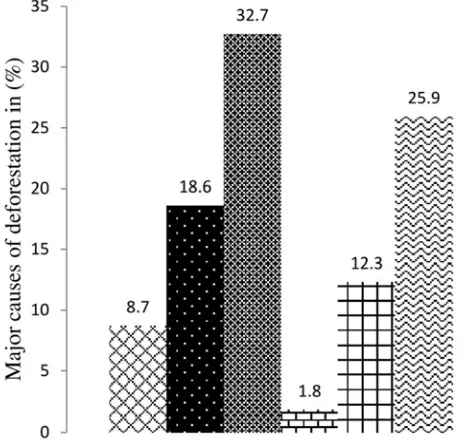
According to local community, the major causes of deforestation in the study area agricultural expansions, over extraction of forest for fuel wood, timber logging, livestock grazing, slash and burning agriculture and encroachment by settlement and others (Figure 4). Similar to the study of [43], reported loss of biodiversity of tropical forests is mainly due to degradation and destruction of forest habitat by anthropogenic activities is now recognized as a global problem. The figure above shows agricultural land expansion was serious than the rest of extraction, selective logging, settlement and grazing and slash burning agriculture.
3.6. Agricultural Expansion
According to the study area that agricultural expansion was a dominant for the cause of ecological disturbance and climate change. Expansion of agriculture often required the clearing of forests; the carbon stored in the wood eventually ended up in the atmosphere as part of carbon dioxide, a greenhouse gas [27]. Based on discussion with group and key-informants agriculture was mentioned as a major player of livelihood for most rural households in the study area like; maize, bean were some of cereals important to generate income for local communities of the study area.
Forest was being cleared due to scarcity of farm land especially those living around and a little bit far away from the forest. The same is true in the study like [12]. Climate change in the humid tropics is mainly due to clearance of natural forest for agriculture; while in mountain and dry regions a substantial portion of the deforestation may be caused by the need to fell trees for fuel wood and fodder.
Among perennial crops, Enset is the most important one in the study area as a staple food.
Extensive agricultural activities plus demand for firewood due to population increase are the major causes for deforestation. During discussion with group discussion and key-informants due to the increasing demand for annual crop especially teff and maize, cultivation of Enset has been losing the attention of farmers. The informants also added that since income generation for the communities mainly from agricultural products, due to this they are focusing on expansion of agricultural activities rather than being employed of others. One of the key-informants said that the reason why expansion of agriculture is due to immediate solution rather long term that means, products being obtained from agriculture takes short period of time and also it is possible to generate income in short period of time than forests which takes long period.
3.7. Land Shortage
Table 1. Land scarcity depending on the size.
Land size (ha) Frequency Percent
Below 1 64 39.5
Above 1 98 60.5
Total 162 100.0
Source: Own Field survey, 2014
Key-informants have mentioned that the dominant farming system in the study area was mixed farming that means, both crops farming and rearing of livestock. Moreover, according to the data based on the responses of the survey, family size was one of the major factors that affect land holding size and agricultural expansion of the farm households. From the sample respondents, the average family size was six. According to land administration desk in agricultural office (2008) report, the average size of land holding for the sample households in the year 2008/9, was varies from 0.3-3.5 ha. Therefore, one can possible to say from the field survey, that
those have hold small land with large family size of the study area was likely to be involved in wood selling from the local forests to subsidize their income. Information gathered through semi-structured interview revealed that most of poor household’s especially poor women did not have lands. According to the information in further discussions, those have hold small piece of land and those totally do not have land were often involved in cutting trees for firewood, timber and clearing the forest for cultivation as income generation, while some others used the forest land for grazing. Therefore, one can possible to say from the field survey, that those have hold small land with large family size of the study area was likely to be involved in wood selling from the local forests to subsidize their income. Information gathered through semi-structured interview revealed that most of poor household’s especially poor women did not have lands. According to the information in further discussions, those have hold small piece of land and those totally do not have land were often involved in cutting trees for firewood, timber and clearing the forest for cultivation as income generation, while some others used the forest land for grazing.
3.8. Population Growth
As population growth in the study area increased demand for more agricultural land, timber production, fuel wood consumption and other unwise uses for occurrence of deforestation, at this time the tree cover was reduced, the stock of trees diminishes as the forest resource was overly exploited rather than being managed on a sustainable basis. According to the report of the study [40] and [2] Population growth coupled with unwise use of resources in several countries is blamed for deforestation and land degradation.
The local leaders also perceived that over exploitation of forests resource in the study area led to fuel wood scarcity. During discussion with key-informants and group discussion, before two decades in the study the progressive destruction of trees and shrubs due to growing demands for fuel wood, wood products for construction, agricultural expansion, sets the pace for accelerated soil erosion and deterioration of the productive capacity for food and energy supply, these were some of the challenges being happened due to high growth of population. According to the report of the study [9] the sharp increase of the population density in Ethiopia pressure on landscape and natural forest is extremely high.
the country in 1950s. Hence, size of farm land is insufficient to produce enough food to sustain the life of family.
3.9. Forest Encroachment by Settlement
As human population is constantly increasing in number, the limited forestland is unable to meet their needs for agricultural land and other demands. To meet their demands, local people sometimes clear the forests for their residents and agriculture. Their settlements have destroyed the animals’ migratory routes and wild animals consequently appear less frequently.
As the informants said that in the study area settlements were serious problem which cause deforestation. Many people whom came from different areas being settled either formally or informally, resulting depleting of forests and other natural resources. This is due to flooding occurred in 7 rural kebeles about 1000 peoples evacuated from their land since 2011/2. According to this by the help of regional government thedistrict was forced to shift these peoples from the low land to where there is free land near the forest. According to the report [31], some of the projects for example the resettlement project in metekel, were implemented without a proper feasibility study.
These peoples were able to destruct the forest near them for house construction, timber logging, and expanding agricultural land. As information obtained from the kebele leaders dweller of settlements were vulnerable to the external environmental crisis (floods, landslide, and windstorm) from man-made disasters.
Timber logging
Forest has numerous benefits for people for those lead
themselves by obtaining products from the forest. The uncontrolled and illegal use of specific forest tree species became endanger due to unwise use by the loggers which forced the forest being deforested. Similar to the studies logging creates particularly cleared areas, which become accessible by logging roads, and agriculture, preventing the forest from growing back [41].
In the study area one of these problems was timber logging and wood for home construction in rural and urban areas. Similar to the studies that logging and wood for construction is a direct driver of deforestation most important in Southeast Asia and Ethiopia [34] and [28]. As the informants said our forests were more destructed by those who work in timber logging activity became so many next to agricultural expansion and fuel wood needs. According key-informant discussion this timber loggers were very interested due to it was very costs and selling for the merchants and for the neighboring district and zones increased from time to time who were illegal users and out of control of the government. In accordance to the report of wondo genet forest deforestation [6], the major protagonists of illegal cutting and logging of trees are reported to come from outside the forest areas: lumber hunters, commercial wood processors and people in need wood for construction.
3.10. Perception of Local Community Towards Major Consequences of Deforestation
According to local community, the major cause’s deforestation in the study area agricultural expansions, urbanization, fuel wood energy consumptions, and other services.
Figure 5. Major consequences of deforstation.
In the figure above due to ecological disturbance and deforestation dominantly brought erosion, loss of biodiversity and increasing of hotness respectively. According to the key informants, deforestation also results in
3.11. Determinants of Forest Conservation Practice
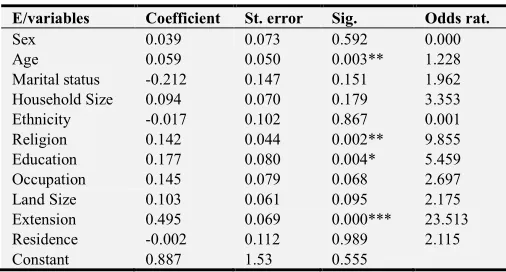
Table 2. Logistic regression result.
E/variables Coefficient St. error Sig. Odds rat.
Sex 0.039 0.073 0.592 0.000
Age 0.059 0.050 0.003** 1.228
Marital status -0.212 0.147 0.151 1.962
Household Size 0.094 0.070 0.179 3.353
Ethnicity -0.017 0.102 0.867 0.001
Religion 0.142 0.044 0.002** 9.855
Education 0.177 0.080 0.004* 5.459
Occupation 0.145 0.079 0.068 2.697
Land Size 0.103 0.061 0.095 2.175
Extension 0.495 0.069 0.000*** 23.513
Residence -0.002 0.112 0.989 2.115
Constant 0.887 1.53 0.555
Note: ***, ** and * shows in the table above how much the variables are related with practice of forest conservation and their degree of association with the communities very strong and strong respectively.
In fact there are different factors that associated with differences in household characters, livelihood characters and institutional factors that jointly determine the way in which an individual household whether decides to conserve the forest or not. In this study eleven explanatory variables such as age, sex, educational level, family size, religion, ethnicity, occupation, extension service, residence, marital status and ethnicity were hypothesized as they contribute to the forest dependent communities for conservation activities. Of this five variables includes religion, education, age and access to extension service were analyzed as statistically significant.
Religion of the respondents: As hypothesized/ not the religion of the whole community is positively and significantly related with the forest conservation at <0.01 probability level. Furthermore, the parametric estimation of 0.142 indicates that the religion, traditional religion is positively related with the forest conservation. This implies that the forest dependent communities that have traditional religion have good indigenous knowledge and positive outlook to the forest conservation in the area. This is in line with the studies conducted by [17], [11] and [30] they showed that indigenous knowledge in forest conservation and management tries to elucidate the property regimes or social strategies associated with the use of resources that it hardly addresses the social or religious logic and ethics that underlines indigenous cognition and interpretation of nature and culture. This is due to the fact that scientific approach to knowledge is by its nature and through our culture segregated in to well defined very autonomous and sometimes even unrelated field [30].
Age of the respondents: As hypothesized the age of the community is positively and significantly related with the forest conservation at <0.01 probability level. Furthermore, the parametric estimation of 0.059 indicates that the age is positively related with the forest conservation. This indicates that the older have trends of conserving and managing the forest well than the young do. This is in line with the study conducted by [36] knowledge of forest Conservation increases as one goes from the young to old. Extension
service of the respondents: As hypothesized the extension service of the community is positively and significantly related with the forest conservation at <0.01 probability level. Furthermore, the parametric estimation of 0.0495 indicates that the extension service is more positively related with the forest conservation. Communities taking extension service of the forest conservation have high tendency to scale up the important lessons and trainings from the government regarding to their forest utilization for sustainable development than those missing the extension service of forest conservation besides to their indigenous knowledge of conservation. This is in line with the study conducted by [14] showed that the higher the frequency of extension contact the more likely a farmer will receive valuable information about the adoption of new techniques for environment management.
Education level of the respondents: As hypothesized the education level of the community is positively and significantly related with the forest conservation at <0.01 probability level. Furthermore, the parametric estimation of 0.177 indicates that the education level is more positively related in addition to their indigenous knowledge of forest conservation. Though indigenous knowledge is very important for the forest communities and government and non government organization of forest sectors, educated communities have more vital role than an uneducated communities for forest conservation activities for the sake of sustainable development of the forest sector and the natural environment. This is in line with the study conducted by [16] an uneducated people were observed to have low knowledge in establishing the link between conservation and development and have also little understanding about the linkage between right to resource and conservation responsibility than educated ones. Finally the rest other variables such as Sex, marital status, household size, ethnicity, occupation and residence from the forest were found to be statistically insignificant.
4. Conclusion and Recommendation
4.1. Conclusion
the same area because some members of the community pay no attention to the traditional belief which associated with the practice of forest conservation in the past years. Due to this some tree species and certain sacred places of the forest area became endanger. One of the most examining and important factors that related towards the practice of forest conservation of the study indicated from both demographic and socio-economic factors that positively related for the practice of forest conservation were traditional religion, age which indicates that the older have trends of conserving and managing the forest well than the young do. Communities taking extension service of the forest conservation have high tendency to scale up the important lessons and trainings from the government regarding to their forest utilization for sustainable development than those missing the extension service of forest conservation besides to their indigenous knowledge of conservation. Educated communities have more vital role than an uneducated communities for forest conservation activities for the sake of sustainable development of forest.
The community of the study area was rich in different indigenous tree species as having relative value-use. It was assumed in this study that people knew species according to their view on use value. This indigenous knowledge of the community based on different tree species which are extracted from the ‘wora’ a local name referred to forests. These extracted well known tree species and others commonly occur in the study area reveals that the local people were rich in indigenous knowledge of these trees and treat many diseases. The forest dependent communities were also well awarded of forest trees to keep bee hives on their long branches and protect them from cutting and destructing. There were also protected tree species for the shade of coffee plantation which was strictly forbidden to cut by all the communities those living inside and around the forest unless diseased and broken by the storm. The communities in the study area perceived that forests were being depleted intentionally or unintentionally. That forest depleted intentionally because of lack of alternatives for income generation for the communities’ livelihood, to ensure their way of life. In other way forests were being exploited inadvertently because of lack of awareness creation for the local communities concerning protection of forests and other natural resources.
The major causes of deforestation in the study area were agricultural expansion, land scarcity, population growth, forest encroachment by settlement and timber logging. Due to increasing demand of forest products exploitation was high. The main consequences of deforestation in the study area were erosion, loss of biodiversity and climate change is well known.
4.2. Recommendation
This study suggests that local people should establish distinct system of knowledge, innovation and practices relating to the uses and management of forest and natural resources in order to maintain the biodiversity of the their
environment. Collaborating of local (indigenous) knowledge and peoples’ participation is fundamental for sustainable forest conservation. Therefore, it is now a major challenge of time that must be paid proper attention to protection of the rights of local peoples and their knowledge about the environment. Evaluating of traditional ecological culture should be done wisely. The traditional community leaders have to be empowered and the administrative settings of the kebele administration integrated with them. Sorting out the traditional ecological knowledge of the forest community systematical Protection, utilization and development of the precious traditional ecological knowledge must be enhanced. To control and stop deforestation forest resources should be managed by the stakeholders in order to ensure environmental sustainability. Promoting environmental education and awareness is needed. The local community should have a habit of planting various trees species on sustainable way. Natural resources including forests should be considered in its utilization and management by governments and communities.
References
[1] Abatte, Y., 2005. Community Values and Natural Resource Management: (The case of indigenous and settler communities in Kefa with particular reference to forest resources)(Doctoral dissertation, AAU).
[2] Adugnaw Birhanu 2014 Environmental degradation and management in Ethiopian highlands International Journal of Environmental Protection and Policy 2014; 2(1): 24-34 Published on line February 28, 2014 (http://www. Science publishing group. Com/j/ijepp) doi: 10.11648/j.ijepp.20140201.14 Federal Democratic Republic of Ethiopia, Ministry of Agriculture, Addis Ababa.
[3] Agrawal, A. and Gibon, C. (1999). Enchantment and disenchantment: The role of community in natural resource conservation. World Development, 27: 629-49.
[4] Almeida ALS 2008. Reproductive Biology of Spondias Tuberosa Arruda, Anacardiaceae, under different management conditions in a caatinga area of Pernambuco. Degrees, Graduate Program in Botany, Federal Rural University of Pernambuco.
[5] Ashenafi B., 2011. Economic Implications of Climate Change in Ethiopia: A Computable General Equilibrium Analysis. A Thesis Submitted to the School of Graduate Studies of Addis Ababa University in Partial Fulfillment of the Requirements for the Degree of Master of Science in Economics (Resource and Environmental Economics stream).
[6] Bekele, T., Kassa, K., Mengistu, T., Debele, M. and Melka, Y., 2013. Working with communities to address deforestation in the Wondo Genet Catchment Area, Ethiopia: Lessons learnt from a participatory action research. Research Journal of Agriculture and Environmental Management, 2(12), pp. 448-456.
[8] Central Statistical Authority and ORS Macro International (2005) Ethopian Demographic and Health Survey, Addis Ababa. [9] CIA, 2002: The world fact book Ethiopia downloaded at http://www.odci gov/cia/publications/fact book/goes/et.html. [10] Dafni, Amots 2006: On the Typology and the Worship Status
of Sacred Trees with a Special Reference to the Middle East.
Journal of Ethnobiology and Ethnomedicine,Vol. 2.
[11] Descola, P. (1994). In the Society of Nature: A Native Ecology in Amazonia. University of Cambridge Press, Cambridge. Translation of: Descola, P. (1986). La Nature Domestique. Plon, Paris.
[12] Egziabher, T. B. G., 1996. Potential of the African Environment for the Intensification of Agricultural Production. AFRICA CAN FEED ITSELF, p.47.
[13] Endrias, G. 2003. Adoption of Improved Sweet Potato Varieties in Boloso Sore Woreda, Southern Ethiopia. MSc thesis. Alemaya University, Ethiopia. EnvironmentalQuality, 40(3):784-790.
[14] Endrias Geta, LegesseDadi and TeresseAdugna (2005). Adoption and Intensity Use of Improve Sweet Potato Varieties in Boloso Sore Woreda, Southern Ethiopia. Ethiopia Journal of Development Research V.27:25-55.
[15] FAO (Food and Agriculture Organization of the United Nations). (2008). Deforestation continues at an alarming rate. FAO, retrieved 18 February, 2008 from http://www.fao.org/newsroom/en/news/2005/1000127/index, Html.
[16] Flintan, F. (2003) Women, Gender and ICDPs in South and South East Asia: Lessons Learnt andExperiences Shared. ‘Engendering’ Eden, Volume III. London: IIED.
[17] Godelier, M. (1984). Idea and Material (Ideal and Material.). Fayard, Paris
[18] Green S. B. 1991. How Many Subjects DoesIt Take To Do A Regression Analysis? Multivariate Behavioral Research, 26 (3):499-510.
[19] Greene, W. H. (2008). Econometric Analysis, 6th Edition, Upper Saddle River, New Jersey, PrenticeHall, New York University.
[20] Gujarati D. N. 2004. Basic Econometrics. Fourth edition. New York. TheMcGraw−HillCompanies.
[21] Jeeshim and KUCC625. 2002. Multicollinearity in Regression Models. This document is accessed online at: http://php.indiana.edu/~kucc625
[22] Julie, Lethi (2013). The Enviromentality of Forest Conservation: Faculty of Theology University of Copehagen. The Case of REDD+ in Tanzania.
[23] Kumar, S. (2002): does ‘participation’ in common pool resource management help the poor? a social cost–benefit analysis of joint forest management in Jharkhand, India. World Development 30, 763–782.
[24] Lisanework, N. &Mesfi n, T. 1989. An ecological study of the vegetation of the Harena forest, Bale. Sinet: Ethiopian Journal of Science, 12(1): 63-63.
[25] Mander M, Le Breton G (2006). Overview of the medicinal plants industry in southern Africa. In: Diederichs, N (ed).
Commercializing medicinal plants in southern African guide.
Sun press South Africa, pp. 3-8.
[26] Marsha B. Quinlan and Robert J. Quinlan 2007: Modernization and Medicinal Plant Knowledge in a Caribbean Horticultural Village, Department of Anthropology, Washington State University.
[27] Max Planck research (2010): Climate protection through forestation.
[28] Mekete Belachew (1996): The Science of Geography and its Relationship with Environment and Population Studies.– In BekureWoldesemait and Kashi N. Singh (eds.): Proceedings of the First Annual Conference of the Association of Ethiopian Geographers on Population, Sustainable Resources and Development in Ethiopia, AddisAbaba, June 6 and 7, 1996. [29] Michael A. and Ian T. 1996. Assessing the potential of forest
product activities to contribute to rural incomes in Africa. [30] Michon, G., de Foresta, H., Levang, P. and Kusworo (2000).
The DamarAgro forests of Krui, Indonesia: Justice for Forest Farmers. In: Zerner, C. (ed.). People, Plants and Justice. The Politics of Conservation. Chapter 7, pp. 180-205. Cambridge University Press, New York.
[31] Millennium Ecosystem Assessment. Ecosystems and Human Well-Being: Biodiversity Synthesis. Washington D.C.: World Resources Institute, 2005.
http://www.millenniumassessment.org/documents/document.3 54.aspx.pdf.
[32] Pankhurst Alula. (1999) ‘Caste’ in Africa: The Evidence form South-Western Ethiopia Reconsidered. Africa 69 (4), 485-509. [33] Paine RT, Tegner MJ, and Johnson EA. 1998. Compounded pertur-bations yield ecological surprises. Ecosystems 1: 535–45. [34] Rudel, T. K., R. Defries, G. P. Asner, and W. F. Laurance. 2009. Changing drivers of deforestation and new opportunities for conservation. Conservation Biology.
[35] Tegbar Achameleh. (2007) Demographic and Socio-economic factors affecting rural Women Perception of Deforestation in Amhar: The Case of Zhege Peninsula Region, (Unpublished Thesis), Adiss Ababa University, AddisAbaba.
[36] Temesgen Workayehu. (2007). Demographic and Socio-economic Determinants of Knowledge, Attitude and Practice towards Forest Conservation wondogenet, Ababa Sidama Zone SNNPR, (Unpublished Thesis),Adiss Ababa University, Addis
[37] Teklehaymanot T, Giday M, Medhin G, Mekonnen Y 2007. Knowledge and use of medicinal plants by people around DebreLibanos monastery in Ethiopia. J Ethnophamacol 111. [38] UNEP (United Nations Environment Programme). 1983.
Ecology and Environment: What Do We Know About Desertification? Desertification Control.
[39] UNESCO (MAB) (2008). Young scientist award program for the year- The relationship between the biodiversity conservation and the traditional beliefs of the native people in Dalai Lake Biosphere Reserve, Liu Bingwan College of Wild Life Resources, North east Forestry University Harbin, China. [40] UNRISD (1994). Environmental degradation and social
[41] USC (2011): The union of concerned scientists, the leading science-based-nonprofit working for a healthy environment and a safer world.
[42] Wagle, R. 2009 Effects of management and disturbance gradients on a bird fauna in Chitwan National Park and its
Buffer zone CBM, Swedish biodiversity centre, SLU, Uppsala University.