ISSN: 2231 – 5381
http://www.ijettjournal.org
Page 14
Analysis of Various Features of Hand
Gestures using Leap Motion Controller for
Indian Sign Language Interpretation
Archana Ghotkar#1, Pujashree Vidap*2 Pune Institute of Computer Technology, Pune, India
Abstract
Hand gesture recognition for sign language interpretation is an active research currently going on. As a computer vision application, varieties of sensors/cameras with notable features are available for capturing live gesture. In this paper, real time hand gesture recognition has been done with Leap motion sensor. The main objective of this research is to do analysis of various derived (hand) features provided by leap motion with different classifier and select notable features with tested classifier for the further study. Indian sign language (ISL) dataset of alphabets and numbers are considered for performance analysis. Here, total 68 features for both hands (34 for each hand) are derived and tested with nearest neighbourhood, Logistic regression, Support Vector Machine (SVM) and nearest mean classifier. The fusion vector of 68 features are created and tested with different classifier to check the performance. Result shows that, SVM classifier giving better result of 96.19% for ISL alphabets and 100 % for ISL numbers with fusion vector. The detailed analysis shows that selection of hand orientation features instead of distance features are also a good choice for hand gesture recognition.
Keywords —Indian Sign Language, 3D Leap Motion sensor, Pattern recognition, k-nearest neighbor, Logistic regression, Support vector machine, Nearest mean classifier.
I. INTRODUCTION
Indian Sign language (ISL) interpretation as a HCI application is a one of the noble, challenging and demanding application to help deaf community. Sign language (SL) varies from state accordingly to the spoken languages and is known by its country’s name such as American Sign Language (ASL) , British Sign Language (BSL), Indian sign language (ISL) and so on [1,2,5]. Due to technology advances in HCI and computer vision field, Deaf people can bring in the main stream of the society with computer interpreter instead of human interpreter [2]. In sign language, hand plays very important role for symbolic communication. Now days researchers find vision based approach is more suitable than data glove based approach due to its
natural interface. Survey shows that, as compared to other sign language interpretation work, ISL work started late in India due to unavailability of standardized ISL [3, 4].
Despite substantial research in last 15-20 years, “Hand Gesture Recognition (HGR)” continues to be challenge. HGR with complete natural interface without any constraints in real-time is still quite demanding. With the development of sensor technology in the field of vision based gesture recognition, now researchers are more options for cameras.
This paper focuses on the use of Leap motion controller for Indian sign language interpretation. Initially, subset of ISL such as alphabets and numbers are considered for experimentation. Various features are derived with the help of sensory data and used for classification purpose. Various classifiers such as nearest neighbourhood, Logistic regression with PCA, SVM as well as nearest mean classifier are used for analysis purpose.
The organization of the paper is given below: Section 2 gives literature survey related hand gesture recognition using 3D cameras such as Kinect, Leap motion sensors. Section 3 presents dataset used for the proposed work. Methodology and detail algorithm is presented in section 4. Section 5 gives the experimentation results and its analysis. Conclusion and future work is presented in section 6 followed by references.
II. LITERATURESURVEY
There are various 2D and 3D web cameras are available in the market for computer vision applications. There is a lot of work has been done on 2D web cameras with image processing algorithms. Due to challenges of vision based approach for capturing and processing hand gesture signs with normal 2D web cameras now researchers are focusing the 3D cameras such as Microsoft Kinect sensors [6] and Leap motion controller [8]. These advance sensor based controller devices help researchers to provide depth information and removes the hurdles of the challenges of real time capturing the data [2].
ISSN: 2231 – 5381
http://www.ijettjournal.org
Page 15
used to deal with dynamic hand gesture recognitionproblem [6].
Lionel et al. worked on 20 Italian gestures with Microsoft Kinect sensor. They achieved 91.7% accuracy using convolution neural network and GPU acceleration [7].
Leigh et al. [8] have given a study of leap motion controller with its advantages, drawbacks and challenges for the implementation of Australian sign language (Auslan).
Deepali Niglot and Milnd Kulkarni worked on Indian sign language numbers (10 signs for numbers) recognition using leap motion controller. They have used ANN and achieved 100% accuracy on 200 sample data set. The same authors in other paper tried to work on American Sign Language (only alphabets) using Leap Motion controller and achieved 96.15% accuracy using multi-level perceptron neural network with black propagation [9,10].
Rajesh B. Mapari and Govind Kharat worked on multiple sign language recognition using leap motion sensor and neural networks. They have considered 33 ISL signs with 3300 data samples. From each sample they have derived feature vector of 97 elements from positional values, distance values and angle values. For ISL recognition system they have achieved 97.34% accuracy with GFF NN (Generalized Feed Forward neural network) [11].
Makiko Funasaka et al. proposed the finger spelling recognition system consists of 24 alphabets using Leap motion controller and decision tree for ASL. They have experimented with 16 conditions that based on properties of hand and fingers for conditional branches. The experimentation done with genetic algorithm and obtained quasi-optimal solution with 82.71 % accuracy [12].
Midarto Dwi, Wibowo et al. worked on Indonesian sign language recognition with Leap motion Controller. They have used Naïve Bayesian classification algorithm for 24 letters and achieved 95% accuracy [13].
M. Mohandes et al. have measured the performance of Multilayer perception neural network with Naïve Bayes classifier for Arabic sign language consists of 28 letters. The proposed system have achieved 98% accuracy for Naïve Bayes and 99% accuracy for MLP NN[14].
Ching-Hua Chuan et al. worked on American Sign Language recognition using leap motion controller. They found that leap motion sensor device is much more affordable than Cyberglove and Kinect sensor. They have achieved 79.28% accuracy for SVM and 72.78 % using k-NN on ASL 26 alphabet on derived features of sensors [15].
Methodology of interpretation varies from camera to camera with its own advantages and limitation. There is a need to work on finding suitable vision based solution for camera selection, feature selection and classifier selection for better improvement and real time performance.
III.DATASET
In this paper, Indian sign language alphabets and numbers are considered for testing the algorithm [16]. Currently scope is limited to static signs for testing the performance of leap motion controller. In our earlier work, we have tested normal web camera [17] for static signs which include alphabets and numbers and Kinect sensor [6] for dynamic signs which includes word dataset. Currently total 620 samples are considered for training. For numbers 100 samples (10 for each number) and for alphabets 520 samples (20 for each alphabet) are considered.
IV.METHODOLOGYANDALGORITHM
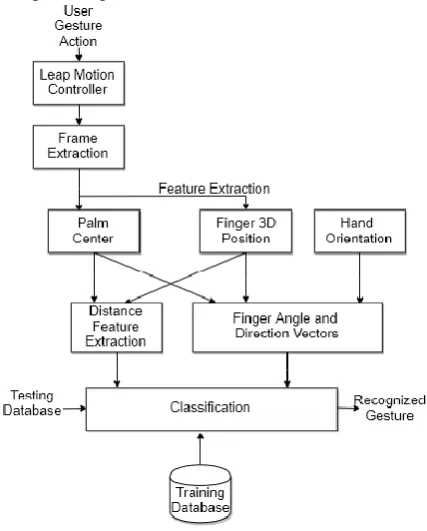
The system attempts to detect hand gestures by leap motion controller. Figure 1 shows proposed system architecture for gesture recognition. Sensory features are extracted from data generated by leap motion controller. The extracted features consist of palm centre, fingers 3D positions and hand orientation. The leap motion controller transforms raw sensor data into useful information which helps to recognize the gestures. The leap motion controller gives the results in series of frames which contains hand tracking data. Once the hand posture is given to the system, key frame get extracted (Frame extraction). From this extracted frame the system calculates palm centre of both hands, 3D position of joints of each fingers which is used to calculate total 24 derived distance features. It also extracts hand and finger orientation data (10 features) to calculate hand and finger direction vectors. These all extracted data given to classifier to recognize unknown gesture using training data.
ISSN: 2231 – 5381
http://www.ijettjournal.org
Page 16
A. Feature Extraction
It is an important step in any kind of object recognition system. Here, we have tried to take advantage of 3D leap motion controller camera. Following are the features considered for recognition purpose.
1) Distances features: Distance between palm center and finger joints for every finger (20 distance features) are considered along with tip finger position distance (4 distance features) for a hand. Figure 2 shows distance features considered for recognition system.
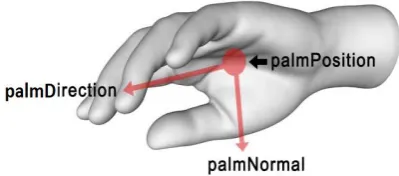
2) Hand orientation features: Finger direction vectors and angles are considered. Figure 3 and 4 shows hand orientation features which are considered for recognition system.
Some of the features which we get directly from API are not suitable for this application. Therefore, we needed to derive more meaningful features from the data which directly obtained from the API.
Table I summarizes the features used as the attributes for different classification algorithms. These features we calculated for each hand. Total 24 distance features and 10 hand orientation features formed fusion vector which consists of 34 features derived for one hand.
Table I: Summarization of Sensory and derived features
Data Extracted from
Sensory features
Derived features Total Number
Palm Grab strength
Grab strength Float in [0,1]
01
Palm Normal vector
Angle between palm normal vector and direction vector
01
Hand Normal Direction Vector
Roll angle of palm
Pitch angle of palm
Yaw angle of palm
03
Fingers Bone joint coordinat ors (w.r.t. Palm center coordinat ors C= (Xpm, Ypm, Zpm ))
Distance of bone joint from palm center
20
Finger tip distance 04
Finger direction vector
Angle between finger direction and normal vector
05
Fig. 3: Hand direction and normal vectors from palm center as hand orientation features
Fig 2: Distance features using centre of palm and finger joints positions
Fig 4: Finger tip position and direction as hand oriented features [18].
ISSN: 2231 – 5381
http://www.ijettjournal.org
Page 17
Following are algorithms implemented in proposedsystem for training and recognition of ISL gesture Algorithm 1 describes detail steps for training the gestures using leap motion controller where as Algorithm 2 describes the gesture recognition module
.
Algorithm 1: Indian sign language gestures training using leap motion sensor
1. Procedure GestureTraining(Controller C)
1: Frame f=getFrame(C)
// Get most recent frame from leap motion controller
2: Hand h[2]=getHands(f) // Get hands from selected frame f
3: For each h in h[]
Ch (Xh,Yh,Zh) =getPalmCenterPosition(h) Gb=getGrabStrength(h)
//Get Normal vector
Vector normal = getPalmNormal(h) //Get Direction vector
Vector direction = getHandDirection(h) //Calculate hand orientation features
HO1=angleBetween(normal,direction) HO2=getPalmPitch(direction) HO3=getPalmRoll(normal) HO4=getPalmYaw(direction) For each finger fi where i=1 to 5 // for each finger of hand For each joint j where j=1 to 4 // for 4 bone joints
Bij(Xij,Yij,Zij)=getFingerBoneCordi nator();
Distanceij=CalculateDistance(Ch,B ij)
End for
// Get finger direction vector Vector Fd =getFingerDirection(fi) HOk=angleBetween(normal,Fd) k=k+1
End for End for
4: TrainingSymbol ts= TraningSymbol(HO, Distance) 5: addSymbolToDatabase(ts)
6: End Procedure
Algorithm 2: Procedure for recognition of ISL using leap
Motion sensor
1. Procedure IndianSignLangRecognition (Controller C)
1.: TestSymbol ts=GetTestSymbol(C) 2: For every Single Symbol ss from Database
compareWith= ss.getHandDistances(); trainingho=
ss.getHandOrientationAngles(); distScore=CalculateDistanceScore(ts, comapreWith)
HOScore=calculateHOScore(ts,training ho)
End for
3: Predicatedgesture = CalculateMinScore (distScore, HOScore);
4: End procedure
V. RESULTANDANALYSIS
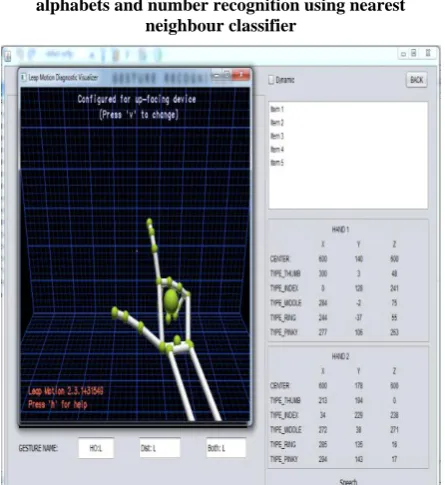
Figure 6 shows snapshot of system for Gesture Viewer window where we get derived features data. Figure 8 and 9 shows recognition window for ISL signs.
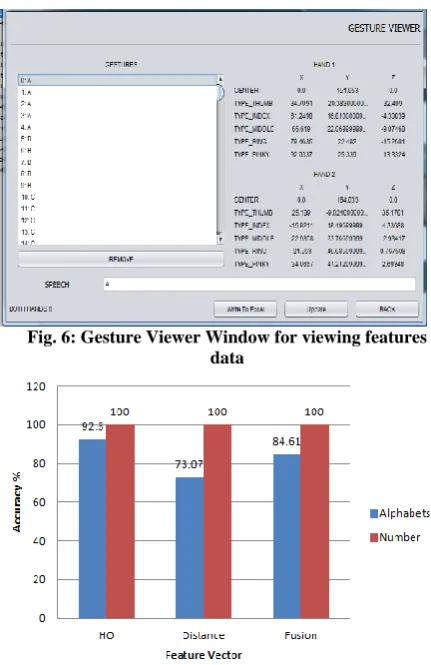
As per the state of the art and our knowledge, very less work has been done on Indian sign language with leap motion controller. There is no significant statistics are available to compare the proposed work with the state of the art work. So, here we tried to do analysis of sensory features and self- driven features with different classifier. Figure 10 shows that analysis of fusion vector with different classifier and here; SVM is given best result than NN, NMC and Logistic regression with PCA. Figure 7 shows the analysis of different features and fusion vector with nearest neighbourhood classifier and it shows that Hand orientation(HO) features are quite sufficient for hand gesture recognition using leap motion controller. Fusion vector is also equally performing but HO is quite sufficient for recognition purpose.
Fig. 6: Gesture Viewer Window for viewing features data
ISSN: 2231 – 5381
http://www.ijettjournal.org
Page 18
alphabets and number recognition using nearestneighbour classifier
Fig. 8: ISL recognition window for symbol consists of two hand
Fig 9: ISL recognition window for symbol consists of one hand
Fig 10: Result analysis for ISL alphabets and number recognition with fusion vector using
different classifier
VI.CONCLUSIONANDFUTUREWORK
The purpose of this paper is to study, test and analysis the performance of the Leap motion controller with sensory features and derived features. As hand gesture recognition with computer vision based approach is a very challenging task for sign language interpretation, efficient sensor camera can play very important role to reduce the task of pre-processing and result improvement. In our earlier work we have tested 2D web camera, Microsoft Kinect Sensors but all the cameras are having their own limitation. So we have tried to work on Leap motion controller as this camera gives more minute features of hand. Though it is giving more sensible and noticeable features of hand, which can help to improve the hand gesture recognition result but the camera is very sensitive for background noise and not easy to give gesture with stability.
Microsoft kinect sensor gives depth information of whole body (non-manual gestures) and Leap motion controller gives depth information of hand (manual gestures) so, in our further work we wanted to use combination of Microsoft kinect sensor and leap motion controller for gesture recognition of whole ISL sign language.
REFERENCES
[1]. Gajanan K. Kharate and Archana S. Ghotkar, “Vision based
Multi-Feature Hand Gesture Recognition for Indian Sign Language Manual Signs”, International Journal on Smart sensing and intelligent systems, Vol.9 (1), March 2016, pp.124-147.
[2]. Archana S. Ghotkar and Gajanan K. Kharate, “Dynamic Hand
Gesture Recognition and Novel Sentence Interpretation Algorithm for Indian sign language Using Microsoft Kinect Sensor”, Journal of Pattern Recognition Research, Volume 10, No.1, August 2015, pp. 24-38.
[3]. U. Zeshan, M. Vasishta, M. Sethna, “Implementation of
Indian Sign Language in Educational Setting,” Asia pacific Disability Rehabilitation Journal,Vo.16, No.1, pp.16-39, 2005.
[4]. Archana S. Ghotkar, Gajanan K. Kharate, “Study of Vision
based Hand Gesture Recognition Using Indian Sign Language” , International Journal on Smart Sensing and Intelligent System, Volume. 7, No.1, March 2014. pp. 96-115.
[5]. C. Vogler, D. Metaxas, “A Framework for Recognizing the
Simultaneous Aspects of American Sign Language,” Computer Vision and Image Understanding, pp. 358-384, 2001
[6]. Archana Ghotkar, Pujashree Vidap and Kshitish Deo,
“Dynamic Hand Gesture Recognition using Hidden Markov Model by Microsoft Kinect Sensor”, International Journal of Computer Application, Vol. 150(5), PP. 5-9, Sept. 2016
[7]. Lionel Pigou, Sander Dieleman, Pieter-Jan Kindermans, and
Benjamin Schrauwen “Sign Language Recognition Using Convolutional Neural Networks”. Springer International Publishing Switzerland 2015. pp 572-578.
[8]. Leigh Ellen Potter, Jake Araullo, Lewis Carter, “The Leap Motion controller: A view on sign language”. Proceedings of the 25th Australian Computer-Human Interaction Conference: Augmentation, Application, Innovation, Collaboration. pp 175-178
[9]. D. Naglot, M. Kulkarni. “ANN based Indian Sign Language
ISSN: 2231 – 5381
http://www.ijettjournal.org
Page 19
International Conference on Inventive Computation
Technologies (ICICT), Vol 3 ,August-2016
[10]. D. Naglot, M. Kulkarni, “Real Time Sign Language Recognition using the Leap Motion Controller”, International Conference on Inventive Computation Technologies (ICICT), Vol 3, August-2016
[11]. Rajesh B. Mapari, Govind Kharat, “Analysis of Multiple Sign Language Recognition Using Leap Motion Sensor”, International Journal of Research in Advent Technology (IJRAT), March 2017.
[12]. Makiko Funasaka, Yu Ishikawa, Masami Takata, and Kazuki Joe, “Sign Language Recognition using Leap Motion Controller” International conference on Parallel/Distributed Processing Tech/ Appls PDPTA'15.
[13]. Midarto Dwi Wibowo, Ingrid Nurtanio ,Amil Ahmad Ilham, “Indonesian sign language recognition using leap motion controller”. 11th International Conference on Information & Communication Technology and System (ICTS), 2017. [14]. M. Mohandes, S. Aliyu and M. Derich, “Arabic Sign
Language Recognition using the Leap Motion Controller”, IEEE 23rd International Symposium on Industrial Electronics (ISIE) 2014. pp 960-965.
[15]. Ching-Hua Chuan, Eric Regina, Caroline Guardino. “American Sign Language Recognition Using Leap Motion Sensor”, 13th International Conference on Machine Learning and Applications. pp541-544
[16]. Archana S. Ghotkar, Gajanan K. Kharate, “Study of Vision based Hand Gesture Recognition Using Indian Sign Language,” International Journal on Smart Sensing and Intelligent System, Volume. 7, No.1, March 2014. pp. 96-115.
[17]. Archana S. Ghotkar, Gajanan K. Kharate, “Vision based Real time Hand Gesture Recognition Techniques for HCI,” International Journal of computer Application, Volume. 70, No. 16, Foundation of Computer Science, New York, USA, 2013, pp.1-6