Study The Impact Of Cell Capacity And
Application Type On Wimax Network Performance
Dr. Elmabruk M Laias, Moahammed Alnass
Department of Computer, Omar Al-mukhtar University
Faculty of Information Technology, Azzaytuna University, Tarhuna,
Libya [email protected]
Abstract: This paper aims to introduce WiMAX technology. In addition study the effect of the size of the network on the performance of the network in terms of the number of stations and the area covering using most famous and powerful applications We also explained about this technology, its advantages and uses, and compared it to other broadband technologies which currently used in the world. We also explained the general architecture of the WiMAX network. The study of the network through eight scenarios using HTTP and VoIP applications, the performance has been studied for some parameters such as throughput, delay, and load Using the OPNET v14.5 simulator.
KEY WORDS: WiMax planning; OPNET
1-
Introduction
The need in large-scale for access to data and information is becoming increasingly common In all sectors and at all levels with the best speed and quality available, networks Communications in particular the Internet become the easiest and broadest way to achieve this. Resulting this increase the demand for the availability of advanced communications networks and able to cope with those increased needs providing high-speed services in all regions and wide accessibility. In these days, there are ways to connect to the Internet, access and exchange data. In case of broadband access, the service can be obtained In more than one way depending on DSL circuits or Wi-Fi technology, and there the method of communication using 3G cellular networks or so-called third generation as exists (FTTH, FTTB) method We provide high quality services. Apart from broadband access, there is a dial-up or ISDN method. Which It is still used sometimes when other means of communication are not available depending on the connection Service provider via ordinary telephone lines. But these roads continue to suffer from some deficiencies in the Several areas in terms of the need to increase to high speeds and provide service in all regions Even remote and remote ones (such as agricultural areas, mountainous fields and gas cover that are usually in Remote areas of inhabited territory). If we have a dial-up or even ISDN connection, the service offers low quality Where the maximum data exchange rate theoretically over the network is 56Kbit / s in the case of dial-up Up to 128Kbit / s in the case of ISDN, a speed does not meet the requirements. In broad access DSL service, we find the service to be of fairly acceptable quality but expensive to use ,also not available in all areas and needs to be provided for cable infrastructure and connections Requires a lot of effort and cost, especially for remote areas. If we adopt the option of wireless connection Wi-Fi, We note that the places where this service is limited in addition to the access points the transmission cannot cover large areas. We have a way of communicating about 3G services3G over GSM networks, offering good quality but expensive service is not available in all areas. FTTH and FTTB are very
expensive and require infrastructure of optical fiber reaching the last point and it is difficult to provide this service in the regions Remote and geographically difficult. Therefore, because of this weakness of some of these techniques, there is a need for technology connects most of the pros of previous ways to provide wide access Range to high-speed, high-speed, long distance and at an affordable cost. This is what promises to provide WiMAX technology as one of the 4G generation technologies for 4G communications, means "interoperability around the world for the World Wide Interoperability for Microwave Access Of the latest wireless technologies that comply with the IEEE 802.16 standard To deliver broadband services up to the last mile at high speeds of more than 75 Mbit / s and for wide areas we may reach a radius of 50 Km per cell under appropriate conditions [1]. It can be considered an alternative to DSL technology at greater speeds and without the need for wires and connections, better than Wi-Fi and 3G in terms of service availability at higher speeds and distances, further away in all surrounding environments, they are also less costly and effortless than optical fibers ,there are problems of infrastructure and the difficulty of drilling and delivery, especially in remote areas and nature Geographically difficult.
2-
Wireless Metropolitan Area Networks
Overview
with better flexibility while maintaining the data rate and
transmission range. IEEE 802.16a also supports mesh deployment, which can extend the network coverage and increase the overall throughput. IEEE 802.16b: This extension increases the spectrum to the 5 and 6 GHz frequency bands, which provides QoS guarantee to ensure priority transmission for real-time applications and to differentiate service classes for different traffic types. IEEE 802.16c: As the Work Group’s initial interest, IEEE 802.16c defines a 10 to 66 GHz system profile that standardizes more details of the technology. These high frequency bands have more available bandwidth, but the signals cannot diffract the obstacles and require line of sight deployment. IEEE 802.16d: Approved in June 2004, IEEE 802.16d upgrades the 802.16a standard. This extension aims to improve performance for 802.16 especially in the uplink traffic. IEEE 802.16e: This technology standardizes networking between fixed base stations (BSs) and mobile base stations (MSs), rather than just between base stations and fixed recipients. IEEE 802.16e enables the high-speed signal handoffs necessary for communications with users moving in vehicles. It promises to support mobility up to speeds of 70-80mi/h. The subscriber stations (SSs) could be personal communication devices such as mobile phones and laptops. We only concentrate on wimax network performance of three major QoS parameters (Throughput ,Delay ,Load) in the fixed network architecture. In the following sections, an overview on IEEE 802.16 PHY subsystems is provided as well as network simulation and result analyses .
2.1- PHY Technology in IEEE 802.16
IEEE 802.16 is a universal standard comprehending various types of network architecture. IEEE 802.16 defines two different network topologies each with a specific MAC protocol: the point to multipoint (PMP) mode and mesh mode. The mesh mode is optional in IEEE 802.16e, where data can be routed directly between two SSs. In the PMP mode, a central BS is capable of handling multiple independent SSs simultaneously. It does not need to coordinate with other stations. Nowadays, most WiMAX systems are equipped with the PMP mode where traffic only occurs between a BS and its SSs [4] Figure (1).
Figure(1) Fixed PMP architecture network
2.2 Broadband Wireless Access Background
Several frequency bands for the initial 802.16 products have been identified. In IEEE 802.16a-2001, the frequency is addressed from 10 to 66 GHZ, which is available all over the world. Due to higher frequency, Line-of-Sight (LOS) propagation is a necessity. For a residential application, roof tops may be too low for a clear sight line to a BS. We must consider the multipath propagation affection. Recently, more interest is in the 2-11GHz projector. Design of the 2-11 GHz PHY is driven by the need for non-LOS (NLOS) operations. The standard defines three different air interfaces that can be used to provide reliable end-to-end link:
I. SCa: A single-carrier modulated air interface. II. OFDM: A 256-carrier orthogonal-frequency
division multiplexing (OFDM). Multiple access of different SSs is time-division multiple access (TDMA)-based.
III. OFDMA: A 2048-carrier OFDM scheme. But a subset of the carriers can be assigned to an individual user. eIO Id o dd rIefIr Ii tI
seceOgc Iepp .
Table[1] summarizes the nomenclature for the various air interface specifications in standard.
eerc [1]eOdIOee doep Iefs epceeed
Figure. 2 (a) OFDM/TDMA Figure. 2 (b) OFDMA
3- Simulation and Results
In this study we simulated a WiMAX network and tested a number of performance determinants and quality of service QoS, using one of the appropriate simulation tools. The simulation of eight scenarios was performed using the HTTP and VoIP applications, in Medium and large WiMAX networks to test and approach some performance determinants and QoS For network such as throughput, a transmission delay, load. Where In the first four scenarios, these parameters are tested and compared using the HTTP application. In the next four years, the same parameters are tested and compared to the network using an application VoIP, depending on the number of base stations and subscriber stations in each scenario. As we mentioned earlier to perform this simulation we have used one of the important tools in this area, a program (OPNET Modeler v14.5 (Optimized Network Engineering Tool, which is considered the most powerful Software used in the modeling and simulation of real general behavior of wired and wireless networks. .The first scenario includes 4 base stations, each with 10 subscriber stations. In the second scenario, we multiplied the number of stations connected to each Base station to become our 4 base stations linking each of the 20 Subscribers stations. In the third scenario, the number of base stations was doubled to 8 Base stations connected by 10 joint stations. As in the third scenario also increased the number of stations of subscribers over another period to become our 8 base stations linking each Of which 30 are shared.
3.1 Test and compare settings with an HTTP application:
We tested and evaluated each of the three parameters (Delay - Throughput – Load) in the network During different scenarios. Each scenario consists of a number of base stations BS, Subscriber’s stationsISS, and HTTP server, and a set of connections between Subscribers stations, base stations and server, as well as configuration files necessary for the management and organization of network work. Simulation has been run for each scenario for ten minutes and the following results obtained:
1- Throughput Using HTTP :
In Figure (3) the throughput simulation result observed in the case of HTTP implementation ,in the first scenario the throughput reached about 5Mbps, In the second scenario, the number of subscriber stations increased by double to 80 stations instead of 40 stations and the use of 4 base stations, the throughput has returned almost twice as much comparing with the first scenario. also when we
increased the number of base stations in the Third scenario to double to 8 base stations instead of 4 stations and 80 subscriber stations, throughput did not differ significantly from the second scenario in which we used 4 base stations. We also noted that when we increased the number of subscriber stations to 240 stations linked With 8 base stations, throughput has increased significantly by two and a half times Comparing with third Scenario.
Figure (3) Throughput for the four scenarios using HTTP
2- Delay Using HTTP:
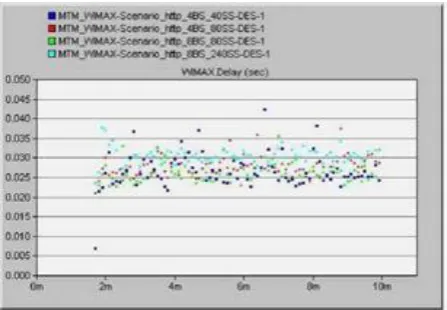
Figure (4) shows the results of the simulation for comparison of time delay in each of the four scenarios, the simulation result on the Delay, in the second scenario was achieved Delay time greater than the first scenario when number of subscriber stations increased to 80 stations 4 base stations has been kept. While the third scenario achieved a lower time delay than the first and 2nd scenarios when we increased the number of base stations to 8 stations with 80 Subscriber stations.,the largest time delay in the third scenario was achieved with 8 base stations and 240 Subscriber stations .
Figure (4) Delay for the four scenarios using HTTP
3- Load Using HTTP:
increased the number of base stations in the third scenario
by double To become 8 base stations and 80 subscriber stations, the load is no different from the second scenario the load also increased dramatically in the third scenario when we increased the number of subscriber stations to 240 stations.
Figure (5) Load for the four scenarios using HTTP
3.2 Test and compare results with an VOIP application:
1- Throughput Using VOIP:
Figure (6) shows the result and comparing Throughput in each of the scenarios.The simulation result in the case of a VoIP application, showed that Throughput in the first scenario was about 15Mbps in the case of 4 base stations and 40 subscriber stations, in the third scenario we doubled the number of subscriber stations to 80 Instead of 40 stations and keep use of 4 base stations, scenario has returned closer result to the Scand scenario. We noticed that when we increased the number of base stations In the third scenario by double to 8 base stations instead of 4 stations and 80 subscriber station, the Throughput did not differ from the second scenario we used 4 Base stations. We also noticed that when we increased the number of subscriber stations to 240 station connected to 8 base stations the Throughput significantly increased by two times almost half of the third scenario up to more than 90Mbps.
Figure (6) Throughput for the four scenarios using VOIP
2- Delay Using VOIP:
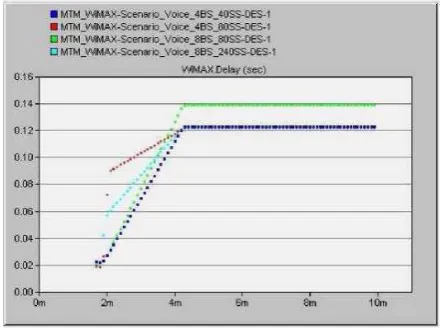
The simulation result in Figure(7) of the time Delay in the case of using the VoIP application, showed that the first, second and fourth scenarios achieved a very close time delay in most Simulation phases, while the third scenario achieved a longer time delay than the remaining three scenarios when we increased the number of base stations to 8 stations with 80 subscriber stations
Figure (7) Delay for the four scenarios using PIOV
3- Load Using VOIP:
We observed from the simulation result on the load Figure(8) ,in the case of the VoIP application the load increased in the second scenario by approximately twice comparing with the first scenario and that happened when we increased the number of subscriber stations to 80 stations instead of 40 stations and 4 base stations. Also when we increased the number of base stations in the third scenario by 8 base stations and 80 subscriber stations, load was not very different from the second scenario in which we used 4 base stations. In the other hand Load increased heavily in the fourth scenario when we increased the number of subscriber stations to become 240 stations with 8 base stations.
Figure (8) Load for the four scenarios using VOIP
different ratios between the two applications for each
scenario, we will compare Here are the results of each of the three parameters in the fourth scenario with each of two applications HTTP and VoIP, where this scenario consists of 8 base stations and 240 subscriber stations, where Each station is connected to 30 subscriber stations.
1- Throughput Using HTTP & VOIP
In Figure(9) the simulation Throughput result in the fourth scenario showed the two applications using the same conditions and specifications for base stations and subscriber stations, the Throughput in the case of HTTP application was about 25Mbps, while much more than that with VoIP application It reached more than 90Mbps
Figure (9) Throughput for the fourth scenario using both
HTTP,VOIP
2- Delay Using HTTP & VOIP:
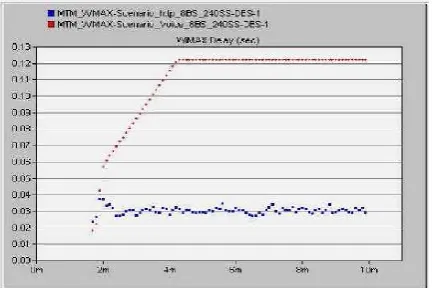
For both applications, the Delay in the case of HTTP application is lower than VoIP application under the same conditions and specifications for base stations and subscriber stations as shown in Figure(10).
Figure (10) Delay for the four scenarios using
HTTP,VOIP
3- Load Using HTTP & VOIP :
The load in the case of the HTTP was less than the case when VoIP based on the same Conditions and specifications for base stations and subscriber stations. As is shown in Figure(11)
Figure (11) Load for the four scenarios using
HTTP,VOIP
Recommandtion
in the case of launching a WiMAX network in any country , start with a law scale network includes a small area or city, so that the service runs for a period of time During this period this network performance monitored to identifies most of the difficulties And technical problems that can overwhelm the network or services in order to expend Coverage of other areas, cities.
Bibliography
[1]. Jos´eLuiz,FrauendorfN,MehtaT.KeyFactorsforIE EE802.16e2.5GHzWiMaxDeployentsforFixedAc cessServiceApplications,WCA’s Global Development Committee (GDC), S˜aoPaulo - Brazil & Reston -- USA, Jan 2008.
[2]. Steven J.Vaughan-Nichols, “Achieving Wireless Broadand with WiMAX” IEEECommunication Magazine, vol. 37, issue 6, Jun. 2004, pp.10-13.
[3]. Abichar, Z, Yanlin Peng, Chang, J.M, “The Emergence of Wireless Broadband”, IT Professional, vol. 8, issue 4, pp. 44-48, Jul.-Aug. 2006.
[4]. C. Eklund, “IEEE standard 802.16: A Technical Overview of the Wireless MAN Air Interface for Broadband Wireless Access,” IEEE Communication Magazine, vol. 40, no
.
6, pp. 98– 107, Jun. 2002.[5]. A.Ghosh, David R.Wolter, Jeffrey G. Andrews and Runhua Chen, “BroadbandWireless Access with WiMAX/802.16: Current Performance Benchmarks and FuturePotential,” IEEE Communication Magazine, pp129-136, Feb. 2005.
[6]. Andrews, j. D., Ghosh, A., & Muhamed, R. (2007, February). Fundamentals of WiMAX: understanding broadband wireless networking. Prentice Hall. USA.
[8]. Bai, Ling. (2007, May). Analysis of the Market
for WiMAX Services. Master Thesis,Technology University of Denmark, Denmark.
[9]. Banerji, S., Chowdhury, R. S. (2013, May). Wi-Fi & WiMAX: A Comparative Study.Indian Journal of Engineering. Vol.2-Issue. 5, pp. 5.