Innovation,
Learning,
and Synergy
Between
Entrepreneurs
and Venture
Capitalists
93
Innovation, Learning, and Synergy
Between Entrepreneurs and Venture
Capitalists
Ron Berger*
Department of Marketing and Strategy
The Jerusalem Academic Center – Lander Institute
Jerusalem, Israel
(tel: +972 54 2290025)
(fax: +972-3-7554930)
(
[email protected])Moti Zviling
Natanya Academic Center, Israel
Natanya, Israel
[email protected]
Abstract
Uncertainty and complexity are fundamental to innovation and decision making, especially in global high technology industries. Entrepreneurs interact with venture capitalists through the entrepreneurs’ communication and learning about the potential of new business venture. We believe that uncertainty and complexity are fundamental to the process of innovation through the synergy between entrepreneurs and venture capitalists. The purpose of this conceptual paper is to provide a conceptual synthesis on a complexity system approach to the innovation relationship between entrepreneurs and venture capitalists.
Keywords – Learning, Synergy, Venture Capital, Innovation, Entrepreneurship
Introduction
Technology and innovation can be determined by the interaction between business
entrepreneurs and inancial venture capitalists. Entrepreneurs interact with venture
capitalists through the entrepreneurs’ communication and learning about the potential of the new business venture. In this paper, we analyse innovation and the relationship between entrepreneurs and venture capitalists through a complex systems based integrated synergy model. The emergent behavior of complex systems in the context of globalization and the commercialisation of the global internet, are so rich and varied that any attempt to identify
it by reductionist means - mechanistic, linear thinking, is dificult. By contrast, complex
systems theory suggests that in a complex environment one should seek to identify patterns and principles, the iteration of which generates the richness of outcomes. In the same
International Journal of Synergy and Research
Vol. 2, No. 2, 2013 p. 91–106
Pobrane z czasopisma International Journal of Synergy and Research http://ijsr.journals.umcs.pl Data: 08/09/2020 10:12:11
IJSR
2, 2
vein, Drazin and Sandelands (1992) suggested that rules which govern individual action
and interaction “constitute a deep structure that generates relationships among actors
and produces macro-order” (p.235). Therefore, in applying the principles of complexity theory to represent complex environments, one should develop reasoning for isolating the rules or principles which drive their dynamics (Berger and Herstein, 2012). In this conceptual article, we combine traditional aspects of market competition with the role of social structure (Granovetter 1985) to analyze the relationship between venture capitalists
and the inancial community and their interaction with business entrepreneurs. This paper
is thus an attempt to analyse the innovation process, by entrepreneur’s communications to
venture capitalists for inancial funding decisions.
The importance of analysing innovations in organizations and businesses in the
complex, context of institutions and society has been illustrated in depth in the ield of
business, institutions and societyas it has become a crucial area of social science and management research. Models of corporate social performance (Choi et al, 2011; Carroll,
1979; Wood, 1991a, 1991b), focusing on the internal aspects of the irm; social control
of business (Berger et al, 2011; Jones, 1995) focusing on the external environment of the
irm; stakeholder models (Berger et al, 2013; Donaldson and Preston, 1995; Freeman, 1984; Hill and Jones, 1992), focusing on the various actors that constrain and inluence the irm’s behavior and performance. We believe that a complex systems approach
allows a broader and richer approach to the various processes that drive innovations. In this conceptual article, we try and integrate the nature of innovation in the context of complex systems, with an application to the relationship between entrepreneurs and venture capitalists. Venture capitalists in making funding decisions combine not only economic and market criteria, but also social and institutional criteria in their valuation of international corporations and new business ideas. The valuation of entrepreneurship and the efforts of entrepreneurs will depend on institutional factors under complex systems. The purpose of this conceptual paper is to provide a preliminary conceptual framework of this idea, and to contribute to the literature on the nature of innovation in business and society in the 21st century.
Venture Capitalists and Entrepreneurs as Complex
Entities
The basic notion of complexity theory is that complex adaptive systems are far from being in equilibrium and conditions are poised at the edge of chaos. In these circumstances they are capable of very complex information storage and manipulation (Achrol, 1991; Coleman, 1990; Day, 1994). The edge of chaos is a state between order and disorder,
between a condition of constrained or ixed interconnections and completely loose or
random ones. In that condition, complex adaptive systems are capable of tackling, by self-organization, the complex optimization problems generated by the endless evolution of their environments. Self-organization is not a property of the constituent elements of the
system as such, but stems from “their interrelation and organization,…the operation of
building blocks acting in concert, in parallel, combining to form new blocks at a higher level” (Baker 1995, p.107). Thus, complex adaptive systems possess properties such as
Innovation,
Learning,
and Synergy
Between
Entrepreneurs
and Venture
Capitalists
95
adaptivity, lexibility, resilience, intelligence, self-renewing and learning capabilities,
attributed to their self-organizing potential (Teece et al, 1990; Sedej and Justinek, 2013; Preston and Sapienza, 1990).
Complexity as applied to organization studies borrows the elements of nonlinearity and far from equilibrium conditions from the Pregogine School. Organizations must be open to information and resources from the environment. Controlled environmental
and internal noise, such as new relections and outside perspectives, challenge existing
equilibrium and push towards new, emergent states. This is done by self-organization and organizations must be able to contain it within some boundaries because otherwise they run the risk of disintegration (Anderson and Narus, 1990; Bucklin and Sengupta, 1993; D`Aveni, 1996).
It is a nonlinear complex adaptive process which gives rise to complicated and evolving market formations where economic, social and psychological factors as well as random events intertwine and transfer information via multiple links (Arndt, 1979; Dickson, 1992). Complex systems exhibit nonlinear, aperiodic, emergent behavior where direct causal links disappear and long-term predictions become impossible (Dwyer and Walker, 1981; Eisenhardt, 1989). Studies have mathematically demonstrated the nonlinearity of these interactions (Day and Wensley, 1988). As a result, there can be no direct link between intention, decision, and outcome; rather we can talk of multiplicity of causes and co-evolving outcomes (Lippman and Rumelt, 1982).
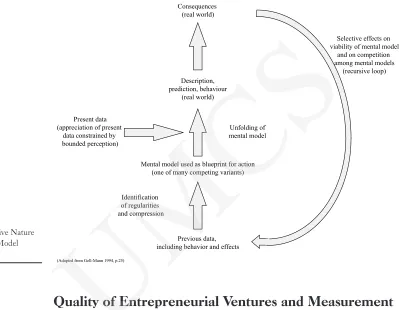
The relationship between venture capitalists and business entrepreneurs suggests an open organization, one which constantly fosters relationships with its environment and receives information which continuously pushes the organization towards new equilibrium states. Present data combine with the mental model of the organization and lead to actions, whose outcome is fed back as noise or disturbance to shake the organization from its equilibrium. Noise about the state of technology, the behaviour of business entrepreneurs, global economic health, is distributed inside the organizations of venture capitalists, and self-referential expectations formation (Sinkula, 1994) make sure that venture capitalists develop different mental models (Mills and Margulies, 1980), interpret different things differently. Individuals formulate their behavior according to their cognition, what their neighbors do and what the collective purpose dictates (Norek, 2012). In other words, actions and their consequences recursively alter individual behaviors which, in turn, alter the patterns of links and relationships inside and outside the organization, allowing for a new macro-order to emerge. This is shown
in the igure below.
Our framework, being an application of complexity, seeks precisely to provide a framework for facilitating the process of choice of attractors, in the context of market and social interactions between venture capitalists and business entrepreneurs and add an element of predictability to analysis of complex systems. Understanding a phenomenon adds up to constructing a suitable metaphor or schema and, based on the
schema, generating a detailed but suficiently abstract description of the phenomenon
to override the limitations posed by the schema. In the same vein, we have constructed a schema which is capable of generating descriptions and meanings in the complex environment of venture capitalists and business entrepreneurs.
Pobrane z czasopisma International Journal of Synergy and Research http://ijsr.journals.umcs.pl Data: 08/09/2020 10:12:11
IJSR
2, 2
Selective effects on viability of mental model
and on competition among mental models
(recursive loop)
Previous data, including behavior and effects Identification
of regularities and compression Present data
(appreciation of present data constrained by bounded perception)
Unfolding of mental model Description,
prediction, behaviour (real world) Consequences
(real world)
Mental model used as blueprint for action (one of many competing variants)
(Adapted from Gell-Mann 1994, p.25)
Quality of Entrepreneurial Ventures and Measurement
The technology bubble of the late 1990’s and early 21st century helped to illustrate
the dificulties for the venture capitalists and inancial community in analysing and
measuring the quality of new technologies managed by business entrepreneurs. As analysed in works such as Reeves and Bednar (1994); Dean and Bowen (1994); Bitner
(1990); Bolton and Drew (1991); Spencer (1994); Waldman (1994), the research deining quality and its linkage to outcomes such as market share, costs, proits in manufacturing industries has led to conlicting results. The concept of quality, which has been reviewed in Reeves and Bednar (1994) has been deined in many ways, including conformance to speciications (Levitt, 1972); itness for use (Juran, 1988); meeting customers’
expectations (Parasuraman et al, 1985). The issue of quality intangibility and even the
deinition of quality itself (Reeves and Bednar, 1994; Zeithaml, Parasuraman et al, 1990;
Curry, 1985; Brown et al, 1993) have become increasingly complex, as many of the world’s major industries have shifted to services and knowledge based industries. Can the quality of an entrepreneur’s new venture be easily measured by venture capitalists?
What is fundamental to our analysis is the role of measurement costs (Williamson, 1985; North, 1990). The concept of stakeholder theory raises measurement problems, because of the diversity of stakeholder interests; this is especially true in service and knowledge based industries, because of the inherent intangibility of product and service quality in these industries (Spender and Grant, 1996; Hosmer, 1995). We believe that when
Figure 1:
The Recursive Nature of Mental Model Formation
Innovation,
Learning,
and Synergy
Between
Entrepreneurs
and Venture
Capitalists
97
such measurement problems exist, irms and clients tend to further depend on market signals and “external cues” and the evaluation made by other organizations in the market, which serve as external cues of certiication and measurement. This becomes an issue for even the narrower, economic based deinitions of market competition and success.
An ideal way of classifying products for our current purposes is found in the work of Jacobson (1992) developed a typology which distinguishes between search and experience goods. The quality of search goods can be ascertained before purchase, common examples being transport services or cheap clothing. The quality of experience goods, however, can be learnt only after use, good examples being holidays and restaurants meals. Darby and Karni (1973) developed this typology by identifying a third category, for which they coined the term credence goods; Nayaar (1990) and Nayyar and Kazanjian (1993) have also analyzed the importance of such information
asymmetries, and economies of scope, but from the angle of irm diversiication.
Credence goods are goods whose quality is rarely learned, even after purchase and use. Examples of such credence goods are numerous and include the worth of a transfer of title on a property, the impact of the services of a particular graphic artist or copywriter in an advertising campaign or the quality of care received on hospitalisation for a
non-speciic medical problem. In our opinion, the quality and value of an entrepreneur’s new
business, especially in new technologies, is similar to a credence (Darby and Karni, 1973) good for a substantial period of time.
The research on stakeholder theory also shows that in a complex systems environment
including the inancial community, venture capitalists, government regulation, global
trends in technology, measurement is a complex process (Swanson, 1995; Jones, 1995). Our key research question then is what additional factors help to determine an
entrepreneur’s irm’s quality, position in the market when quality certainty is no longer
guaranteed. In this sense, if market signals (Anderson et al, 1994; Heil and Robertson, 1991) help to overcome uncertainty in general, an important issue is which signals and
complex processes, inluence the venture capitalists and the investment community?
Signals, Invisible Assets
The diversity of stakeholder interests (Jones, 1995; Donaldson and Preston, 1995;
Freeman, 1984; Hill and Jones, 1992) creates dificulties for venture capitalists and the inancial community, in the measurement and in determining a business entrepreneur’s
performance. With the existence of measurement costs (Norek, 2013; North, 1990), external intermediaries can also play a potential role in certifying the content and value of the business entrepreneur’s products or services. Under such uncertainty, the evaluation
of a business entrepreneur’s products and services is also inluenced by external organizations, which help to certify and measure the quality and content of a irm’s
products or services. This idea overlaps with recent works such as Podolny (1993); Camic (1992); Haunschild (1994); Carter and Manaster (1990), which have recently further developed the earlier works of White (1970); Sorensen (1983); Bonacich (1987);
Simmel (1950); Dutton and Jackson (1987), to show that a irm’s position in the social structure can in turn affect not only rewards, but can reduce the irm’s ability to interact
Pobrane z czasopisma International Journal of Synergy and Research http://ijsr.journals.umcs.pl Data: 08/09/2020 10:12:11
IJSR
2, 2
with irms with different social status. We believe that this basic idea of interdependence
can be taken further.
For a new entrepreneur’s new venture, where the quality and content of the product or service being exchanged is uncertain, external cues like intermediaries help to
measure and certify a irm and its quality in the market place for its stakeholders. Such external cues help to identify a irm’s, “invisible” assets. Itami and Roehl (1987) have also noted that traditional research has tended to deine assets too narrowly, focusing
on the tangible assets, such as plant and equipment. They note that invisible assets such as accumulated consumer information, brand name reputation, management skill,
corporate cultures are just as important to the success of the irm. But the existence or
possession of such invisible assets can be more easily communicated to the other party, if the backgrounds of the two parties are shared. Such shared backgrounds allow each
party to ind the points of salience, or focal points (Berger and Herstein, 2012), creating
a more bilateral relationship as in relationship marketing, rather than an anonymous, multilateral market exchange.
We believe that information concerning such invisible assets can be revealed in a slightly different way than for tangible assets, to competitors and the market. If the
invisible assets are rare, and imperfectly imitable, then this will provide the irm with
a sustained advantage over competitors. In turn, the ability to reveal such information
and possession of invisible assets provides the irm with a competitive advantage that
cannot be easily imitated. The importance of providing information indirectly to the market through market signals has been analyzed in great detail in Spence (1973); Robertson et al, (1995); Choi et al (2011); Heil and Robertson (1991); Moore (1992).
Proposition 1: The importance of shared background in sending and receiving signals leads to a separation of insiders and outsiders in such signal based communication, for example between business entrepreneurs and the
venture capital community.
Milgrom and Roberts (1992) provide a more general deinition of signals:
“...signals demonstrate to others the actor’s intentions or abilities or some other characteristic about which the actor has private, unveriiable information.”
(Milgrom & Roberts, 1992)
An example of a signal would be a irm’s willingness to provide a money back guarantee for its product, to signal to consumers the irm’s commitment and conidence
in the product. One of the problems with signals is that they can be, manipulated by the
irm, in order to provide what could be deceptive information about its invisible assets. For example, there is no guarantee that a irm’s willingness to provide money back
guarantees will actually ensure good value and a high quality product for the consumer. A distinction now needs to be made between signals and, indices. A positive signal for one stakeholder, such as consumers may send the wrong signals to another stakeholder, such as alliance partners. Our key issue is whether certain signals can send an undeniably
effective message to all stakeholders. “Indices”, as deined by Jervis (1985) are:
Innovation,
Learning,
and Synergy
Between
Entrepreneurs
and Venture
Capitalists
99
“....statements or actions that carry some inherent evidence that the image projected is correct because they are believed to be inextricably linked to the actor’s capabilities or intentions.”
Indices, unlike signals, cannot be as easily manipulated and are always true. Examples include private messages the perceiver overhears or intercepts. In some sense, an indice is a type of signal that cannot be manipulated, and is truthful in its information content. Our point is that if we make a distinction between signals and indices, such
factors as a irm’s history, or past success may play a role in the information conveyed by a irm. Kreps and Spence (1984) have in their work already noted the importance
of history in the role of competition within industries. The ability to use indices, also depends on a particular, or rare experience, in that there is a linkage to some aspects of
past success of the irm, an experience, which other competitors cannot easily imitate.
As discussed by Stern and Reve (1980), Shostack (1970), and NG et al (2012), the
various symbols, beliefs and values that are part of a irm’s culture will relect the unique early history of the irm. Part of a irm’s history of course can be success in the industry, such as leading to the establishment of a satisied client base.
We believe that because indices are always truthful signals, only certain types of
irms would have an incentive to use indices. Indices are more credible than signals, on the other hand, because not all irms want to convey information about their history,
especially if it included various failures.
Proposition 2:Indices may be more widely used by successful entrepreneurial irms, because indices are more credible than signals, and entrepreneurial irms would like to convey their past successes with as much credibility as possible.
As mentioned before, a business entrepreneur, providing a irm’s year when it was
established, implying the age, or information about the number of branches and stores, implying the size of the client base are indices, rather than signals. But because they are indices, they provide much more certain information to venture capitalists and
the inancial community than signals, or claims about the quality of a entrepreneur’s irm’s product, quality, because such signals can be more easily manipulated. In a world where venture capitalist often experience a proliferation of irms’ signals and where it is dificult to distinguish between truths and bluffs, indices provide a highly credible way for an entrepreneur’s irm to convey information. Organisations
have different past histories. Indices, unlike signals, may allow organisations who have been successful in the past, or in other areas, to convey information credibly
to customers. In turn, a irm with such positive invisible assets, or indices has an
incentive to make it known to the market or to the industry. Such indices can be seen as more truthful by the stakeholders in the market, especially venture capitalists and the investment community.
Perceptions of customers are greatly inluenced by factors that can prove irm success, present robustness of the irm’s resources. In this sense, indices are especially
important as invisible assets, because they can provide truthful information, knowledge
about a irm’s capabilities, and past successes. At the same time, such indices, as irm
Pobrane z czasopisma International Journal of Synergy and Research http://ijsr.journals.umcs.pl Data: 08/09/2020 10:12:11
IJSR
2, 2
history, age, and its client base are dificult to imitate for competitors. In this sense,
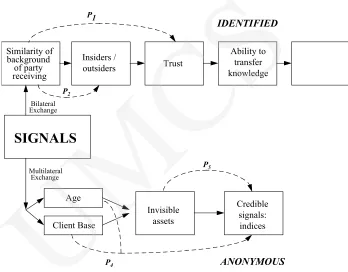
indices are an invisible and non-imitable asset. The relationship between market signals
and truthful, institutional indices is shown in the igure below.
SIGNALS
Similarity of background of party receiving
Insiders /
outsiders Trust
Ability to transfer knowledge
IDENTIFIED
Bilateral Exchange
Age
Client Base
Invisible assets
Credible signals: indices
ANONYMOUS
Multilateral Exchange
P
2
P1
P4
P
5
Market versus Institutional Value
Global technology industries require complex interactions between the inancial
institutions and the business entrepreneurs. External intermediaries can also play a potential role in certifying the content and value of an actor’s products or services.
We believe that a irm’s or actor’s identity in the market place for knowledge based
industries is determined by four drivers of identity, which help to certify the quality, value and content of the actor’s products or services. This idea overlaps with recent works such as Podolny (1993), Camic (1992), Haunschild (1994) which have recently further developed the earlier works of White (1970), Bonacich (1987), Dutton and Jackson (1987), Simmel (1950) to show that an actor’s position in the social structure can not only affect rewards but can reduce his ability to interact with actors of different social status. We believe that this basic idea of interdependence can be taken further. With assets such as science, technology and knowledge, where the value and content of the product or service being exchanged are uncertain, external cues like intermediaries help to identity and certify an actor, and its products or services’ value and quality in the
market place. This is shown in the igure below.
Figure 2:
Signals, Invisible Assets and Indices
Innovation,
Learning,
and Synergy
Between
Entrepreneurs
and Venture
Capitalists
101
Fig. 3. Development process model adapted from Ulrich and Eppinger (2008) and Menke (1
R&D sector,
Planning
Concept development
System level design
Detailed design
Testing and
refinement
Production ramp-up
Feasibility
Evaluating the project according to the strategic plans, cost of the project, and its predicted revenue, and the innovative level of the project (Menke, 1991)
R&D actual process
(design) phase
Prototype phase
The modified quality assurance
models recommended for R&D
sector such as TQM
The special quality assurance approaches for creating the prototype and the quality definition of the prototype is included in the design phase of the product
Implementation phase
Quality requirements are defined during the design phase that should be organized and regulated for the mass production (according to Total Quality Management Requirements)
Development Process Model
Quality assurance various phases
Thus, a duality exists in the complex interaction between the clarity of market
forces, and the socially complex nature of institutions. The igure above is just an illustration of this duality, the need to integrate in complex systems, “both” the market
and institutional forces determining the relationship between business entrepreneurs
and venture capitalists and the inancial community. We listed potential indices, such
as client based, external intermediaries to illustrate the principle, rather than to claim
that such indices are generic or ixed for all industries. We believe that integrating
both market signals and institutional indices provides a more comprehensive picture of the complexities surrounding commercialisation of global technology, business entrepreneurs and the venture capitalist community.
Stakeholders, Signals, Indices
It is well known that external stakeholders play an important role in the success of
companies. Dwyer and Schurr (1987) has shown how dificult it is for excellent companies to maintain their success over even several years; part of the dificulty of
maintaining success is the need to respond to internal as well as external stakeholders. External commentary such as favorable commentaries in business publications create awareness, which can be used by companies in their marketing strategy (Cronin and Taylor, 1992; Anderson et al, 1994). Although the increasingly turbulent and uncertain
Figure 3:
Venture Capitalists and Entrepreneurs - Institutional Criteria
Pobrane z czasopisma International Journal of Synergy and Research http://ijsr.journals.umcs.pl Data: 08/09/2020 10:12:11
IJSR
2, 2
environment has increased the importance of such external factors, the existing literature has not conceptually framed how such factors can be analyzed. We believe that the earlier distinction between signals and indices help to clarify their roles. We believe there are several major indices (Jervis, 1985) or external measurement drivers,
of relevance to stakeholders, for any irm in industries where quality is intangible. This
will vary according to the industry and the various stakeholders for that industry. For example, based on existing empirical research on science and technology industries, we can create a list of such potential indices for entrepreneurs in technology
industries. Firstly, a irm’s client base is a driver of quality; the position or status (Podolny,
1993; Frank and Cook, 1995) of the particular clients, can in turn help to elevate a new,
entrepreneurial irm’s ranking and quality. Secondly, the ability and reputation for being
innovative, such as developing new products, a dynamic corporate culture, are another
type of index in the market place (Haunschild, 1994), affecting quality. Thirdly, a irm’s
networks, whether they be with collaborators, or with competitors can also be an index
of quality in the market place, especially legitimizing a new technology irm. Fourthly, outside external sources of information, such as Standard and Poor indices in inancial
markets; consumer reports written by private organizations; business magazines and commentaries all help to serve as an index of quality.
Proposition 3: An entrepreneurial irm’s value to stakeholders in industries where quality is intangible, such as technology, is affected by market signals as well as institutional indices. Indices could include the list of clients; reputation for successful innovation; network of partners or competitors; evaluation by external intermediaries.
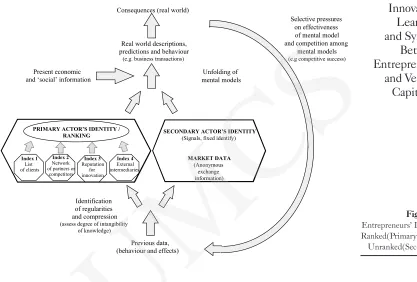
The indices, or truthful signals certify the entrepreneurial irm’s quality and status, providing an, “indirect” measurement to stakeholders. These complex processes create a ranking of the business entrepreneurs by the venture capitalists and the inancial community. This is shown in the igure below.
As we discussed earlier in this article, the deinition of quality has varied, among conformance to speciications (Levitt, 1972); itness for use (Juran, 1988); meeting
customers’ expectations (Parasuraman et al., 1985; Parasuraman et al, 1993). Our
existing analysis is that when there is quality intangibility, the various existing deinitions
of quality may still apply, but whether they meet the criteria of quality and success is
also affected by these external indices of measurement. A irm’s overall and continued
success in its market, or in its industry, needs to take into account these external factors;
stakeholder theories, which measure the performance of irms and their responsiveness
to external constituencies such as customers, government, society (Jones, 1995) also need to incorporate the role played by these external indices.
Our framework also helps further illustrate the behavioral research of Burt (1992), Feld (1981) and Granovetter (1985), on the importance of relationships within the
social structure and how it inluences competition. Stakeholders of the entrepreneurial irm need to evaluate not only the competitiveness of the irm in the market, but also the entrepreneurial irm’s position in the social structure, and its relations with the
four external indices of quality measurement; the abstract economics based model of
Innovation,
Learning,
and Synergy
Between
Entrepreneurs
and Venture
Capitalists
103
anonymous exchange and competition is only a beginning. Research in stakeholder theories helps to bring together these two major frameworks in management research. The intangibility of quality in services and knowledge based industries, illustrates the
importance of external cues, or indices in further identifying irms and determining their
quality for stakeholders.
Conclusions and Discussion
Technology entrepreneurs interact with venture capitalists through complex communications about the entrepreneurs’ new business venture. The purpose of this conceptual paper was to analyse the complex systems that drive the market and institutional relationship between business entrepreneurial learning towards the
venture capitalist and investment community. Entrepreneurs by deinitions are free of the constraints of society and institutions by being, “entrepreneurial”. However, inancial investors such as venture capitalists are very much part of institutions and
society. We provided a preliminary framework for understanding the direct and indirect measurement of value that takes place in interactions between entrepreneurs and
inancial investors such as venture capitalists. Signals (Spence, 1973) were contrasted with, “indices” (Jervis, 1985) to illustrate the potential mismatch between entrepreneurs who are relatively free of institutional constraints, and inancial investors who are very
much part of the institutional community.
Selective pressures on effectiveness of mental model and competition among
mental models
(e.g competitive success)
Previous data, (behaviour and effects) Identification
of regularities and compression
(assess degree of intangibility of knowledge)
Present economic
and ‘social’ information mental modelsUnfolding of Real world descriptions,
predictions and behaviour
(e.g. business transactions)
Consequences (real world)
SECONDARY ACTOR’S IDENTITY (Signals, fixed identify)
MARKET DATA (Anonymous
exchange information) PRIMARY ACTOR’S IDENTITY /
RANKING
Index 2
Network of partners or
competitors
Index 1
List of clients
Index 3
Reputation for innovation
Index 4
External intermediaries
Figure 4:
Entrepreneurs’ Identity: Ranked(Primary) versus
Unranked(Secondary)
Pobrane z czasopisma International Journal of Synergy and Research http://ijsr.journals.umcs.pl Data: 08/09/2020 10:12:11
IJSR
2, 2
Business entrepreneurs are known as exceptional learners – but whether they are exceptional learners towards the investment community is questionable. We analyzed
the relationship among the entrepreneur’s irm, stakeholders and external measurement
through the concept of market signals (Blau, 1975; Spence, 1973; Heil and Robertson, 1991) and indices (Jervis, 1985). These external, institutional indices for such credence goods industries (Darby and Karni, 1973) such as high technology include: list of clients; reputation for successful innovation; networks of partners or competitors; evaluation by external intermediaries. Entrepreneurs compete in the market against other entrepreneurs; however, they also maintain long term relations with these indices, or external drivers of measurement that help to overcome quality intangibility. We provided a preliminary framework for integrating such complex processes between business entrepreneurs and the venture capitalist and investment community.
Further research is warranted on the following issues. Firstly, there is a need to analyse in more depth the way quality and value can be measured for a new business entrepreneur’s products and services. The shift of many of the world’s mature economies towards increased technology and knowledge entrepreneurship will make such research issues increasingly important. Secondly, there is a need to further research the dynamics of the relationship between market and social structure when stakeholders in the
inancial community such as venture capitalists, and pension funds, drive the success of entrepreneurial irms. The potential importance of stakeholder concepts require further research on integrating the role of signals, the measurement of entrepreneurial irms,
and how to improve the accuracy of valuations towards innovation and entrepreneurial
irms in the 21st century.
References
Achrol, Ravi. (1991), “Evolution of the Marketing Organisation: New Forms for Turbulent
Environments,” Journal of Marketing, Vol. 55, pp. 77-93.
Anderson, J., M. Rungtusanatham., and R. Schroeder. (1994), “A Theory of Quality Management
underlying the Deming Management Method”, Academy of Management Review, Vol. 19, pp. 472-509.
Anderson, J. and J. Narus. (1990), “A Model of Distributor Firm and Manufacturer Firm Working
Partnerships”, Journal of Marketing, Vol. 54, pp. 42-58.
Arndt, J. (1979), “Toward a Concept of Domesticated Markets”, Journal of Marketing, Vol. 43, pp. 69-75.
Berger, R; C.J. Choi; R. Herstein. (2013), “Cina’s Social Market Economy: The Leverage of
Economic Growth”. International Journal of Asian Business and Information Management, Vol. 14 No. 1, pp. 21-30.
Berger, R. and R. Herstein. (2012), “The Limits of Guanxi From The Perspective of The Israeli
Diamond Industry”, Journal of Chinese Economic and Foreign Trade Studies, Vol. 5 No. 1, pp. 29-41.
Berger, Ron; C. J. Choi; J.B. Kim. (2011), “Responsible Leadership From Multinational
Enterprises in Bottom of The Pyramid Countries: The Knowledge of Local Managers”, Journal of Business Ethics, Vol. 101, pp. 553-561.
Bitner, M. (1990), “Evaluating Service Encounters: the Effects of Physical Surroundings and
Employee Responses”, Journal of Marketing, Vol. 54, pp. 69-82.
Innovation,
Learning,
and Synergy
Between
Entrepreneurs
and Venture
Capitalists
105
Blau, P. (1975), Approaches to the Study of Social Structure. New York: Free Press.
Bonacich, P. (1987), “Power and Centrality: a Family of Measures”, American Journal of Sociology, Vol. 92, pp. 1170-1183.
Bolton, R. and J. Drew. (1991), “A Longitudinal Analysis of the Impact of Service Changes on
Customer Attitudes”, Journal of Marketing, Vol. 55, pp. 1-9.
Brown, T., G. Churchill and J. Peter. (1993), “Improving the Measurement of Service Quality”,
Journal of Retailing, Vol. 69, pp. 127-139.
Bucklin, L. and S. Sengupta. (1993). “Organizing Successful Co-Marketing Alliances”, Journal of Marketing, Vol. 57, pp. 32-46.
Burt, R. (1992), Structural Holes. Cambridge: Harvard University Press.
Camic, C. (1992), “Reputation and Predecessor Selection: Parsons and the Institutionalists”,
American Sociological Review, Vol. 57, pp. 421-445.
Carroll, A.B. (1979), “A Three Dimensional Conceptual Model of Corporate Performance“,
Academy of Management Review, Vol. 4, pp. 497-505.
Carter, R. and S. Manaster. (1990), “Initial Public Offerings and Underwriter Reputation”, Journal of Finance, Vol. 45, pp. 1045-1068.
Choi, C. J; R. Berger; J.B. Kim. (2010), “Capitalism’s Global Financial Crisis: The Role of the
State”, The Social Science Journal, Vol. 47, pp. 829-835.
Coleman, J. (1990), Foundations of Social Theory. Cambridge: Belknap Press of Harvard University Press.
Cronin, J. and S. Taylor. (1992), “Measuring Service Quality: a Re-examination and Extension”,
Journal of Marketing, Vol. 56, pp. 55-68.
Curry, D. (1985), “Measuring Price and Quality Competition”, Journal of Marketing, Vol. 49, pp. 106-117.
D’Aveni, R. (1996), “A Multiple-Constituency, Status-Based Approach to Interorganizational
Mobility of Faculty and Input-Output Competition among Top Business Schools”,
Organization Science, Vol. 7, pp. 166-189.
Darby, M. and E. Karni. (1973), “Free Competition and the Optimal Amount of Fraud”, Journal of Law and Economics, Vol. 16, pp. 67-88.
Day, G. and R. Wensley. (1988), “Assessing Advantage: a Framework for Diagnosing Competitive
Superiority”, Journal of Marketing, Vol. 52, pp. 1-20.
Day, George. (1994), “The Capabilities of Market-driven Organisation”, Journal of Marketing, Vol. 58, pp. 37-52.
Dean, J. and D. Bowen. (1994), “Management Theory and Total Quality: Improving Research
and Practice through Theory Development”, Academy of Management Review, Vol. 19, pp. 392-418.
Dickson, P. (1992), “Toward a General Theory of Competitive Rationality”, Journal of Marketing, Vol. 56, pp. 69-83.
Donaldson, T. and L. Preston. (1995), “The Stakeholder Theory of the Corporation: Concepts,
Evidence and Implications”, Academy of Management Review, Vol. 20, pp. 65-91.
Dutton, J.E. and Jackson, S. (1987), “Categorizing Strategic Issues: Links to Organizational
Action”, Academy of Management Review, Vol. 12, pp. 76-90.
Dwyer, R., P. Schurr, S. Oh. (1987), “Developing Buyer-Seller Relationships”, Journal of Marketing, Vol. 51, pp. 11-27.
Dwyer, R. and O. Walker. (1981), “Bargaining in an Asymmetrical Power Structure”, Journal of Marketing, Vol. 45, pp. 104-115.
Eisenhardt, K. (1989), “Agency Theory: an Assessment and Review”, Academy of Management Review, Vol. 14, pp. 57-74.
Feld, S. (1981), “The Focused Organization of Social Ties”, American Journal of Sociology, Vol. 86, pp. 1015-1034.
Pobrane z czasopisma International Journal of Synergy and Research http://ijsr.journals.umcs.pl Data: 08/09/2020 10:12:11
IJSR
2, 2
Frank, R. and P. Cook. (1995), The Winner-Take-All Society. New York: Free Press. Freeman, R. (1984), Strategic Management: a Stakeholder Approach. Boston: Pitman Press.
Granovetter, M. (1985), “Economic Action and Social Structure: the Problem of Embeddedness”,
American Journal of Sociology, Vol. 91, pp. 481-510.
Haunschild, P. (1994), “How much is that Company worth? Interorganizational Relationships,
Uncertainty and Acquisition Premiums”, Administrative Science Quarterly, Vol. 39, pp. 391-411.
Heil, O. and T. Robertson. (1991), “Toward a Theory of Competitve Market Siganling: a Research
Agenda”, Strategic Management Journal, Vol. 12, pp. 403-418.
Hill, C. and T. Jones. (1992), “Stakeholder-Agency Theory”, Journal of Management Studies, Vol. 29, pp. 131-154.
Hosmer, L. (1995), “Trust: the Connecting link between Organizational Theory and Philosophical
Ethics,” Academy of Management Review, Vol. 20, pp. 379-403.
Itami, H. with T. Roehl. (1987), Mobilizing Invisible Assets. Cambridge, MA.: Harvard University Press.
Jacobson, R. (1992), “The Austrian School of Strategy”, Academy of Management Review, Vol. 17, pp. 782-807.
Jervis, R. (1985), The Logic of Images in International Relations. Princeton: Princeton University Press.
Jones, T. (1995), “Instrumental Stakeholder Theory: a Synthesis of Ethics and Economics”,
Academy of Management Review, Vol. 20, pp. 404-437. Juran, P. (1988), A History of the Jews. New York: Harper and Row.
Kreps, D. and Spence, M. (1984), “Modeling the Role of History in Industrial Organization”,
In G. Feiwel (Ed.), Contemporary Issues in Modern Microeconomics. London: Macmillan.
Levitt, T. (1972), “Production-line Approach to Service”, Harvard Business Review, Vol. 50, pp. 41-52.
Lippman, S. and Rumelt, R. (1982), “Uncertain Imitability: an Analysis of Interirm Differences in Eficiency under Competition,” Bell Journal of Economics, Vol. 13, pp. 418-438. Milgrom, P. and Roberts, J. (1992), Economics, Organization and Management. New Jersey:
Prentice-Hall International.
Mills, P. and N. Margulies. (1980), “Toward a Core Typology of Service Organizations,” Academy of Management Review, Vol. 5, pp. 255-265.
Moore, M. (1992), “Signals and Choices in a Competitive Interaction: the Role of Moves and
Messages,” Management Science, Vol. 4, pp. 483-500.
Nayyar, P. (1990), “Information Asymmetries: A Source of Competitive Advantage for Diversiied
Service Firms”, Strategic Management Journal, Vol. 11, pp. 513-519.
Nayyar, P. and Kazanjian, R. (1993), “Organizing to Attain Potential Beneits from Information Asymmetries and Economies of Scope in Related Diversiied Firms,” Academy of Management Review, Vol. 18, pp. 735-759.
NG, Y-K; L. Voon-Hsien; A. Tun-Lee; and P-L, Gan. (2012), “The Relationship Between
Knowledge Management Practices and Technology Innovation: A Conceptual Framework”,
International Journal of Management, Knowledge, and Learning, Vol. 1 No. 2, pp. 71-89.
Norek, T. (2012), “Knowledge Management in the Innovation Potential of Enterprises: A Case
Study of Practical Solutions”, International Journal of Management, Knowledge, and Learning, International Conference, pp73-85.
Norek, T. (2013), “The Knowledge Management for Innovation Processes for SME Sector
Companies”, International Journal of Management, Knowledge, and Learning, Vol. 2 No. 1, pp. 83-89.
North, D. (1990), Institutions, Institutional Change and Economic Performance. Cambridge: Cambridge University Press.
Innovation,
Learning,
and Synergy
Between
Entrepreneurs
and Venture
Capitalists
107
Parasuraman, A., L. Berry and V. Zeithaml. (1993), “More on Improving Service Quality
Measurement”, Journal of Retailing, Vol. 69, pp. 140-147.
Parasuraman, A., V. Zeithaml, and L. Berry. (1985), “A Conceptual Model of Service Quality and
its Implications for Future Research”, Journal of Marketing, Vol. 4, pp. 41-50.
Podolny, J. (1993), “A Status-Based Model of Market Competition,” American Journal of Sociology, Vol. 98, pp. 829-872.
Preston, L. and H. Sapienza. (1990), “Stakeholder Management and Corporate Performance,”
Journal of Behavioral Economics, Vol. 19, pp. 361-375.
Reeves, C. and D. Bednar. (1994), “Deining Quality: Alternatives and Implications,” Academy of Management Review, Vol. 19, pp. 419-445.
Sedej, T. and G. Justinek. (2012), “Global Economic and inancial Crisis – A Threat For Innovative
SMEs”, International Journal of Management, Knowledge, and Learning, International Conference, pp87-95.
Shostack, G. (1977), “Breaking Free from Product Marketing,” Journal of Marketing, Vol. 41, pp. 73-80.
Simmel, G. (1950), “Superordination and Subordination,” in K. Wolf translation, The Sociology of Georg Simmel. Illinois: Free Press.
Sinkula, James. (1994), “Market Information Processing and Organisational Learning,” Journal of Marketing, Vol. 58, pp. 35-45.
Sorensen, A. (1983), “Processes of Allocation to Open and Closed Positions in Social Structure.
Zeitschrift fuer Soziologie, Vol. 12, pp. 203-224.
Spence, M. (1973), Market Signalling. Cambridge: Harvard University Press.
Spender, J.C. and R. Grant. (1996), “Knowledge and the Firm: Overview”, Strategic Management Journal, Vol. 17, pp. 5-9.
Stern, L. and T. Reve. (1980), “Distribution Channels as Political Economies: a Framework for
Comparative Analysis”, Journal of Marketing, Vol. 44, pp. 52-64.
Swanson, D. (1995), “Addressing a Theoretical Problem by Reorienting the Corporate Social
Performance Model”, Academy of Management Review, Vol. 20, pp. 43-64.
Teece, D.J., Pisano, G., and Shuen, A. (1990), “Firm Capabilities, Resources, and the Concept of
Strategy”, Working Paper, University of California at Berkeley.
Waldman, D. (1994), “The Contributions of Total Quality Management to a Theory of Work
Performance,” Academy of Management Review, Vol. 19, pp. 510-536.
White, H. (1970), Chains of Opportunity: System models of mobility in organizations. Cambridge: Harvard University Press.
Williamson, O.E. (1985), The Economics Institutions of Capitalism. New York: Free Press.
Wood, D.J. (1991a), “Corporate Social Performance Revisited”, Academy of Management Review, Vol. 16, pp. 691-718.
Wood, D.J. (1991b), “Social Issues in Management: Theory and Research in Corporate Social
Performance”, Journal of Management, Vol. 17, pp. 383-406.
Zeithaml, V. A. Parasuraman, L. Berry. (1990), Delivering quality service. New York: Free Press.
Biographical Notes
Ron Berger is the Head of Marketing at The Lander Institute, Jerusalem, Israel. His
research area is international marketing, cultural industries, and knowledge management. He has published in The Journal of Business Ethics, Service Journal of Business and Industrial Marketing, International Journal of Technology Management and others.
Pobrane z czasopisma International Journal of Synergy and Research http://ijsr.journals.umcs.pl Data: 08/09/2020 10:12:11
IJSR
2, 2
Moti Zviling is a senior lecture in Marketing at the Netanya Academic College, Israel.
He served as the Head of the Information Systems Program at Ruppin Academic Center, Emek-Hefer. He is the CTO of mentis, a young company that deals with decision support systems in marketing and technology.