1. Introduction
Linear Programming (LP) is one of the most versatile, powerful, and useful techniques for making managerial decisions. Linear programming technique may be used for solving broad range of problems arising in business, government, industry, hospitals, libraries, etc. Whenever we want to allocate the available limited resources for various competing activities for achieving our desired objective, the technique helps us is linear programming. As a decision making tool, it has demonstrated its value in various field such as production, finance, marketing, research and development, and personal management. In conventional LP problems, it is assumed that the data have precise values. This means that the elements are crisp numbers, inequality is defined in the crisp sense, and objective function is a strict imperative. However, the observed values of the data in real-life problems are often imprecise because of incomplete or non-obtainable information. In such situations, fuzzy sets theory is an idea approach to handle imprecise in LP by generalizing the notion of membership in a set and this leads to the concept of fuzzy LP problems. Fuzzy Linear Programming (FLP) problems allow working with imprecise data and constraints, leading to more realistic models. They have often been used for solving a wide variety of problems in sciences and engineering. Fuzzy mathematical programming has been researched by a number of authors. One of the earliest works on fuzzy mathematics programming
Corresponding author
E-mail address: [email protected] DOI: 10.22105/jarie.2019.183391.1090
A New Approach to Solve Fully Fuzzy Linear Programming
Problem
Seyed Hadi Nasseri, Faranak Mahmoudi
Department of mathematics, University of Mazandaran, Babolsar, Iran.
A B S T R A C T P A P E R I N F O
Today, human decisions are more than ever based on information. But most of this information is not definitive, and in this situation, logical decision making is very difficult based on this uncertainty. Different methods are used to represent this uncertainty, including the fuzzy numbers. The fuzzy linear programming problem is one of the interesting concepts to be addressed in fuzzy optimization. Fully Fuzzy Linear Programming Problems (FFLP) are issues in which all parameters of the coefficients of the variables in the target functions, the coefficients of the variables in the constraints, the right-hand side of the constraints, and the decision variables in them are fuzzy. In this paper, we show that Definition 2.6 which is used by Ezzati et al. [1], failed to compare any arbitrary triangular fuzzy numbers. We demonstrate that their presented method is not well in general, thus the proposed method finds the fuzzy optimal solution of fully fuzzy linear programming problems by Ezzati et al. [1]. Then a new approach is proposed for solving this FFLP problem. An example is also presented to demonstrate the new method.
Chronicle:
Received: 27 March 2019 Revised: 24 May 2019
Accepted:27 June 2019
Keywords: Fully Fuzzy Linear Programming.
Triangular Fuzzy Numbers. Ranking Function. Fuzzy Number.
Journal of Applied Research on Industrial
Engineering
problems was presented by Tanaka et al. [2] based on the fuzzy decision framework of Bellman and Zadeh [3]. Since Tanaka et al. [2] have been a number of fuzzy LP models, in the literature, the fuzzy LP has been classified into different categories, depending on how imprecise parameters are modeled by subjective preference-based membership functions or possibility distributions. Numerous researchers have studied various properties of FLP problems and proposed different approaches for solving them. Because of existing different assumptions and sources of fuzziness in the parameters, the definition of FLP problem is not unique. Bector and Chandra [4] have classified FLP problems into four following Categories:
Type I. LP problems with fuzzy inequalities and crisp objective function.
Type II. LP problems with crisp inequalities and fuzzy objective function.
Type III. LP problems with fuzzy inequalities and fuzzy objective function.
Type IV. LP problems with fuzzy parameters.
The FLP problems involving fuzzy numbers for the decision variables, the coefficients of the decision variables in the objective function, the coefficients of the decision variables in the constraints and the right-hand-side of the constraints, is called Fully Fuzzy Linear Programming (FFLP) problems. Lotfi et al. [5] considered the FFLP problems where all the parameters and variables were triangular fuzzy numbers. Kumar et al. [6] using arithmetic operations and definition of fuzzy equality, first converted each fuzzy equality constraint into several crisp constraints and then optimized the rank of fuzzy objective function over the obtained crisp feasible space. In contrast to most existing approaches which provide crisp solution, their method gives fuzzy optimal solution but also not preserve the form of non-negative fuzzy optimal solution and optimal objective function, then Najafi and Edalatpanah [7] noticed that Kumar et al. [6] method was missing one condition to guarantee the non-negativity of the fuzzy solution. Fully Fuzzy Linear Programming problem in which all the parameters and variables are considered as fuzzy numbers is an attractive topic for researchers Lotfi et al. [5], Kumar et al. [6], and Ezzati et al. [1]. Kumar et al. [6] proposed a new method to solve FFLP problem where all the constraints are equality.
In method [5], the parameters of fully fuzzy linear programming problem have been approximated to the nearest symmetric triangular fuzzy numbers. Then a fuzzy optimal approximation solution has been achieved by solving a Multi-Objective Linear Programming (MOLP) problem. In method [6], the linear ranking function has been used to convert the fuzzy objective function to crisp objective function. Bhardwaj and Kumar [8] shown that the fully fuzzy programming problems with inequality constraints cannot be transformed into fully fuzzy linear programming problems with equality constraints. And hence, the algorithm, proposed by Ezzati et al. [1] for solving fully fuzzy linear programming problems with equality constraints, cannot be used for finding the fuzzy optimal solution of fully fuzzy linear programming problems with inequality constraints.
The rest of this paper is organized as follows: In Section 2, we review the basic definitions and results of fuzzy sets and some related topics. Section 3 gives the definition for comparing fuzzy numbers and then, we propose numerical example. Furthermore, we introduce a new method for solving FFLP problem in Section 3. In Section 4, an application of the method is described in FLP problems and finally the conclusions are discussed in Section 5.
2. Preliminaries
In this section, we begin with some basic definitions, arithmetic operations of fuzzy numbers, and an existing ranking approach for comparing fuzzy numbers will be used in the rest of this paper.
Definition 1. Let ℝ denotes a universal set. Then, a fuzzy subset 𝐴̃ of ℝ is defined by its membership function 𝜇𝐴̃: ℝ → [0,1], which assigns a real number 𝜇𝐴̃(𝑥) in the interval [0,1],
To each element 𝑥 ∈ ℝ, where the value of 𝜇𝐴̃(𝑥) at 𝑥 shows that grade of membership of 𝑥 in 𝐴̃.
A fuzzy subset 𝐴̃ can be characterized as a set of ordered pairs of element 𝑥 and grade 𝜇𝐴̃(ℝ) and is often written 𝐴̃ = {(𝑥, 𝜇𝐴̃(𝑥)), 𝑥 ∈ ℝ }; the class of fuzzy sets on 𝑅 is denoted by 𝑇𝐹(ℝ).
Definition 2. The 𝛼-cut or 𝛼-level set of a fuzzy set is a crisp set defined by 𝐴𝛼 = {𝑥 ∈ ℝ|𝜇𝐴̃(𝑥) > 𝛼}.
Definition 3. A fuzzy set 𝐴 on ℝ is convex, if for any 𝑥, 𝑦 ∈ ℝ and 𝜆 ∈ [0,1], we have 𝜇𝐴̃(𝜆𝑥 + (1 − 𝜆)𝑦) ≥ 𝑚𝑖𝑛{𝜇𝐴̃(𝑥), 𝜇𝐴̃(𝑦)}.
Definition 4. A fuzzy number 𝐴̃ = (𝑥1, 𝑦1, 𝑧1) = (𝑥1𝑙, 𝑦1𝑐, 𝑧1𝑢) is said to be a triangular fuzzy number if its membership function is given as follows:
𝜇𝐴̃(𝑥) =
{ 𝑥 − 𝑥1
𝑦1− 𝑥1, 𝑥1≤ 𝑥 ≤ 𝑦1, 𝑥 − 𝑧1
𝑦1− 𝑧1, 𝑦1≤ 𝑥 ≤ 𝑧1, 0, 𝑂. 𝑊.
(1)
Definition 5. A triangular fuzzy number 𝐴̃ = (𝑥1, 𝑦1, 𝑧1) is said to be a non- negative triangular fuzzy number, if and only if 𝑥1≥ 0. The set of all these triangular fuzzy numbers is denoted by 𝑇𝐹(ℝ)+. Definition 6. An effective approach for ordering the elements of ℱ(ℝ) is to define a ranking function ℛ: ℱ(ℝ) → 𝑅 which maps each fuzzy number into the real line, where a natural order exists [9].
We define orders on
ℱ(ℝ)by
𝐴̃ ≥ℛ𝐵̃ 𝑖𝑓 𝑎𝑛𝑑 𝑜𝑛𝑙𝑦 𝑖𝑓 ℛ(𝐴̃) ≥ ℛ(𝐵̃), 𝐴̃ >ℛ𝐵̃ 𝑖𝑓 𝑎𝑛𝑑 𝑜𝑛𝑙𝑦 𝑖𝑓 ℛ(𝐴̃)>
ℛ(𝐵̃),
𝐴̃ =ℛ𝐵̃ 𝑖𝑓 𝑎𝑛𝑑 𝑜𝑛𝑙𝑦 𝑖𝑓 ℛ(𝐴̃)=
ℛ(𝐵̃),
where 𝐴̃ 𝑎𝑛𝑑 𝐵̃ are in ℱ(ℝ).
Remark 1. As well as given in [9], we use ranking function for triangular fuzzy number 𝐴̃=(𝑥1, 𝑦1, 𝑧1) as follows:
ℛ(𝐴̃) =1
4(𝑥1+ 2𝑦1+ 𝑧1) . (2) Definition 7. Two triangular fuzzy numbers 𝐴̃ = (𝑥1, 𝑦1, 𝑧1) and 𝐵̃ = (𝑥2, 𝑦2, 𝑧2) are said to be equal, 𝐴̃ = 𝐵̃ if and only if 𝑥1= 𝑥2 , 𝑦1= 𝑦2 and 𝑧1= 𝑧2.
Definition 8. Let 𝐴̃ = (𝑥1, 𝑦1, 𝑧1) and 𝐵̃ = (𝑥2, 𝑦2, 𝑧2) be two triangular fuzzy numbers. Then, arithmetic operation on these fuzzy numbers can be defined as follows:
Addition:𝐴̃⨁𝐵̃ = (𝑥1, 𝑦1, 𝑧1) + (𝑥2, 𝑦2, 𝑧2) = (𝑥1+𝑥2, 𝑦1+𝑦2, 𝑧1+𝑧2),
Subtraction: 𝐴̃ ⊝ 𝐵̃ = (𝑥1, 𝑦1, 𝑧1) − (𝑥2, 𝑦2, 𝑧2) = (𝑥1− 𝑥2, 𝑦1− 𝑦2, 𝑧1− 𝑧2),
−𝐴̃ = −(𝑥1, 𝑦1, 𝑧1) = (−𝑧1, −𝑦1, −𝑥1),
Multiplication: if 𝐵̃ be a non- negative triangular fuzzy number then:
𝐴̃ ⊗ 𝐵̃ = {
(𝑥1𝑥2, 𝑦1𝑦2, 𝑧1𝑧2), 𝑥1≥ 0, (𝑥1𝑧2, 𝑦1𝑦2, 𝑧1𝑧2), 𝑥1< 0 , 𝑧1≥ 0, (𝑥1𝑧2, 𝑦1𝑦2, 𝑧1𝑥2), 𝑧1< 0.
Definition 9. The FLP problem is said to be an FFLP problem if all the parameters and variables are considered as fuzzy numbers. In recent years, some researchers such as [5, 8] were interested in the FFLP problems, and some solution methods have been obtained to the fully fuzzy systems and the FFLP problems [10, 11, 12]. These problems can be divided in two categories: (1) problems with inequality constraints; (2) problems with equality constraints. Let an FFLP problem be as follows:
𝑚𝑎𝑥(𝑚𝑖𝑛) ∑ 𝐶̃𝑗𝑇 𝑛
𝑗=1
⨂𝑥̃𝑗 (3)
𝑠. 𝑡. {∑ 𝐴̃𝑖𝑗 𝑛
𝑗=1 ⨂𝑥̃𝑗≤ (=, ≥)𝑏̃𝑖, 𝑖 = 1,2, . . . , 𝑚, 𝑥̃𝑗 𝑖𝑠 𝑛𝑜𝑛 − 𝑛𝑒𝑔𝑎𝑡𝑖𝑣𝑒 𝑓𝑢𝑧𝑦 𝑢𝑚𝑏𝑒𝑟
where 𝐶̃𝑗𝑇= [𝑐̃𝑗𝑇]1×𝑛, 𝑏̃𝑖= [𝑏̃𝑖]𝑚×1, 𝐴̃𝑖𝑗= [𝐴̃𝑖𝑗]𝑚×𝑛and 𝑥̃𝑗= [𝑥̃𝑗]1×𝑛. Let us assume that all fuzzy numbers are triangular. Thus 𝐶̃𝑗𝑇, 𝑏̃𝑖, 𝐴̃𝑖𝑗 and 𝑥̃𝑗, are represented as 𝐶̃𝑗𝑇= (𝐶𝑗𝑙, 𝐶𝑗𝑐, 𝐶𝑗𝑢)
𝑇
, 𝑏̃𝑖= (𝑏𝑖𝑙, 𝑏𝑖𝑐, 𝑏𝑖𝑢), 𝐴̃𝑖𝑗=
(𝐴𝑖𝑗𝑙 , 𝐴𝑖𝑗𝑐, 𝐴𝑢𝑖𝑗) and 𝑥̃𝑗= (𝑥𝑗𝑙, 𝑥𝑗𝑐, 𝑥𝑗𝑢), respectively. Now by substituting these triangular fuzzy numbers in problem (3), the FFLP problem (3) may be written as:
𝑚𝑎𝑥(𝑚𝑖𝑛) ∑(𝐶𝑗𝑙, 𝐶𝑗𝑐, 𝐶𝑗𝑢) 𝑇 𝑛
𝑗=1
⨂(𝑥𝑗𝑙, 𝑥𝑗𝑐, 𝑥𝑗𝑢) (4)
𝑠. 𝑡. {∑ (𝐴𝑖𝑗 𝑙 , 𝐴
𝑖𝑗 𝑐, 𝐴
𝑖𝑗 𝑢) 𝑛
𝑗=1 ⨂(𝑥𝑗
𝑙, 𝑥
𝑗𝑐, 𝑥𝑗𝑢) ≤ (=, ≥)(𝑏𝑖𝑙, 𝑏𝑖𝑐, 𝑏𝑖𝑢), 𝑖 = 1,2, . . . , 𝑚,
(𝑥𝑗𝑙, 𝑥𝑗𝑐, 𝑥𝑗𝑢) 𝑖𝑠 𝑛𝑜𝑛 − 𝑛𝑒𝑔𝑎𝑡𝑖𝑣𝑒 𝑓𝑢𝑧𝑦 𝑢𝑚𝑏𝑒𝑟
3. Proposed Method to Solve FFLP Problem
example that this method is not efficient to solve a fully fuzzy programming problems with inequality constraints. According to Definition 6, the optimal solution of problem, obtained from Ezzati's method, is not a feasible fuzzy solution of the original problem.
Ezzati et al. [1] in Definition 6 of, proposed a method for comparing any arbitrary fuzzy numbers that by use of yager's ranking function in definition 6 and Remark 1, and solving the following counterexamples showed that their definition for all fuzzy numbers will not be right.
For the continuing of the discussion, we mention the ranking definition which is defined by Ezzati et al. [1] and then we can explicitly say this method of evaluation may produce inaccurate results, as shown in Fig. 1 and the current discussion.
Ezzati et al. [1] in Definition 6 expressed that if 𝐴̃ = (𝑥1, 𝑦1, 𝑧1) and 𝐵̃ = (𝑥2, 𝑦2, 𝑧2) be two triangular fuzzy numbers then say that 𝐴̃ ≺ 𝐵̃, if and only if:
𝑦1 < 𝑦2 or
𝑦1 = 𝑦2 and (𝑧1− 𝑥1) > (𝑧2− 𝑥2) or
𝑦1 = 𝑦2 and (𝑧1− 𝑥1) = (𝑧2− 𝑥2) and (𝑥1+ 𝑧1) < (𝑥2+ 𝑧2).
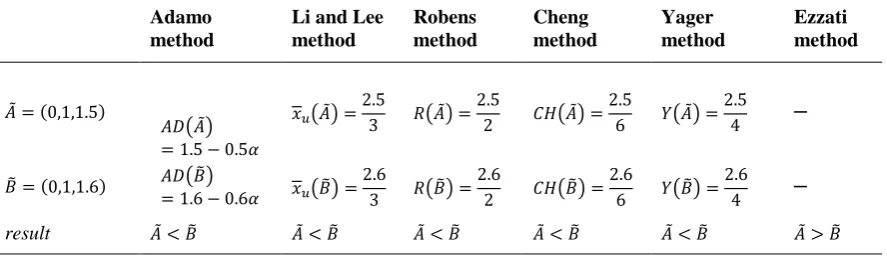
Counterexample. Consider two triangular fuzzy numbers 𝐴̃ = (0,1,1.5) and 𝐵̃ = (0,1,1.6) then according to Ezzati's definition in this example we have that 1=1, 1.6> 1.5 then 𝐵̃ < 𝐴̃ while due to the Definition 5 of this paper (Yagre's ranking function), ℛ(𝐴̃) =14(0 + 2 + 1.5) = 1.125 and ℛ(𝐵̃) = 1
4(0 + 2 + 1.6) = 1.115 since ℛ(𝐴̃) < ℛ(𝐵̃) then 𝐴̃ < 𝐵̃.
Fig. 1. Showing two triangular fuzzy numbers 𝐴̃ = (0,1,1.5) and 𝐵̃ = (0,1,1.6).
Also, according to the available methods for comparing two triangular fuzzy numbers, the comparative table shows the ranking methods of two triangular fuzzy numbers and then results that 𝐴̃ < 𝐵̃.
Select Yager's ranking method is arbitrary from this table.
1 1.5 1.6
1
𝐴̃
Table 1. Ranking methods of two triangular fuzzy numbers. Ezzati method Yager method Cheng method Robens method Li and Lee
method Adamo
method
─
𝑌(𝐴̃) =2.5
4
𝐶𝐻(𝐴̃) =2.5
6
𝑅(𝐴̃) =2.5
2
𝑥𝑢(𝐴̃) =2.53
𝐴𝐷(𝐴̃) = 1.5 − 0.5𝛼 𝐴̃ = (0,1,1.5)
─
𝑌(𝐵̃) =2.6
4
𝐶𝐻(𝐵̃) =2.6
6
𝑅(𝐵̃) =2.6
2
𝑥𝑢(𝐵̃) =2.63
𝐴𝐷(𝐵̃) = 1.6 − 0.6𝛼 𝐵̃ = (0,1,1.6)
𝐴̃ > 𝐵̃ 𝐴̃ < 𝐵̃
𝐴̃ < 𝐵̃ 𝐴̃ < 𝐵̃
𝐴̃ < 𝐵̃ 𝐴̃ < 𝐵̃
result
Ezzati et al. [1] represented an algorithm to solve each fully fuzzy problem based on a comparing method. We have shown that their comparing method and definition is not be true for all fuzzy numbers and by disproving Ezzati's method. In this way, we convert the objective function into crisp objectives as follows.
Consider the following FFLP problem (5),
𝑚𝑎𝑥 ∑(𝐶𝑗𝑙, 𝐶𝑗𝑐, 𝐶𝑗𝑢) 𝑇 𝑛
𝑗=1
⨂(𝑥𝑗𝑙, 𝑥𝑗𝑐, 𝑥𝑗𝑢) (5)
𝑠. 𝑡. { ∑ (𝐴𝑖𝑗 𝑙 , 𝐴 𝑖𝑗 𝑐, 𝐴 𝑖𝑗 𝑢) 𝑛
𝑗=1 ⨂(𝑥𝑗
𝑙, 𝑥
𝑗𝑐, 𝑥𝑗𝑢) ≤ (𝑏𝑖𝑙, 𝑏𝑖𝑐, 𝑏𝑖𝑢), 𝑖 = 1,2, . . . , 𝑚,
(𝑥𝑗𝑙, 𝑥𝑗𝑐, 𝑥𝑗𝑢) 𝑖𝑠 𝑛𝑜𝑛 − 𝑛𝑒𝑔𝑎𝑡𝑖𝑣𝑒 𝑓𝑢𝑧𝑦 𝑢𝑚𝑏𝑒𝑟
Assuming (𝐴𝑖𝑗𝑙 , 𝐴𝑖𝑗𝑐, 𝐴𝑖𝑗𝑢)⨂(𝑥𝑗𝑙, 𝑥𝑗𝑐, 𝑥𝑗𝑢) = (𝑚𝑖𝑗𝑙, 𝑚𝑖𝑗𝑐, 𝑚𝑖𝑗𝑢)
the FFLP problem may be written as follows:
𝑚𝑎𝑥 ∑(𝐶𝑗𝑙, 𝐶𝑗𝑐, 𝐶𝑗𝑢) 𝑇 𝑛
𝑗=1
⨂(𝑥𝑗𝑙, 𝑥𝑗𝑐, 𝑥𝑗𝑢) (6)
𝑠. 𝑡. { ∑ (𝑚𝑖𝑗 𝑙, 𝑚 𝑖𝑗 𝑐, 𝑚 𝑖𝑗 𝑢) 𝑛
𝑗=1 ≤ (𝑏𝑖
𝑙, 𝑏
𝑖𝑐, 𝑏𝑖𝑢), 𝑖 = 1,2, . . . , 𝑚,
(𝑥𝑗𝑙, 𝑥𝑗𝑐, 𝑥𝑗𝑢) 𝑖𝑠 𝑛𝑜𝑛 − 𝑛𝑒𝑔𝑎𝑡𝑖𝑣𝑒 𝑓𝑢𝑧𝑦 𝑢𝑚𝑏𝑒𝑟
Using arithmetic operations defined in Definitions 6 and 8, the fully fuzzy linear programming problem (6), is converted into the following problem:
𝑚𝑎𝑥 ℛ (∑(𝐶𝑗𝑙, 𝐶𝑗𝑐, 𝐶𝑗𝑢) 𝑇 𝑛
𝑗=1
⨂(𝑥𝑗𝑙, 𝑥𝑗𝑐, 𝑥𝑗𝑢)) (7)
𝑠. 𝑡.
{
∑ 𝑚𝑖𝑗𝑙 𝑛
𝑗=1 ≤ 𝑏𝑖
𝑙, 𝑖 = 1,2, . . . , 𝑚,
∑ 𝑚𝑖𝑗𝑐 𝑛
𝑗=1 ≤ 𝑏𝑖
𝑐, 𝑖 = 1,2, . . . , 𝑚,
∑ 𝑚𝑖𝑗𝑢 𝑛
𝑗=1 ≤ 𝑏𝑖
𝑢, 𝑖 = 1,2, . . . , 𝑚,
Using ranking function given in Remark 1 for the objective function, the FLP problem (7) can be rewritten as follows:
𝑚𝑎𝑥 1
4(∑ 𝐶𝑗𝑙𝑥𝑗𝑙 𝑛
𝑗=1
+ 2 ∑ 𝐶𝑗𝑐𝑥𝑗𝑐 𝑛
𝑗=1
+ ∑ 𝐶𝑗𝑢𝑥𝑗𝑢 𝑛
𝑗=1
) (8)
𝑠. 𝑡.
{
∑ 𝑚𝑖𝑗𝑙 𝑛
𝑗=1 ≤ 𝑏𝑖
𝑙, 𝑖 = 1,2, . . . , 𝑚,
∑ 𝑚𝑖𝑗𝑐 𝑛
𝑗=1 ≤ 𝑏𝑖
𝑐, 𝑖 = 1,2, . . . , 𝑚,
∑ 𝑚𝑖𝑗𝑢 𝑛
𝑗=1 ≤ 𝑏𝑖
𝑢, 𝑖 = 1,2, . . . , 𝑚,
𝑥𝑗𝑐− 𝑥𝑗𝑙≥ 0, 𝑥𝑗𝑢− 𝑥𝑗𝑐≥ 0, 𝑥𝑗𝑙≥ 0.
Now, we find the optimal solution 𝑥𝑗𝑙, 𝑥𝑗𝑐 and 𝑥𝑗𝑢 by solving the problem (8), and by putting the value of 𝑥𝑗𝑙, 𝑥𝑗𝑐 and 𝑥𝑗𝑢 in 𝑥̃𝑗= (𝑥𝑗𝑙, 𝑥𝑗𝑐, 𝑥𝑗𝑢) obtain the fuzzy optimal solution, then by substitute 𝑥̃𝑗 in ∑𝑛𝑗=1𝐶̃𝑗𝑇⨂𝑥̃𝑗 find the optimal value of problem (5).
3. Numerical Discussion
In this section, we are going to explore the solving process which is introduced in the last section for the extended model by an illustrative example.
Example 1. Consider the FFLP problem and solve it by the proposed method as follows:
𝑚𝑎𝑥 (10,15,17)⨂𝑥̃1⨁(10,16,20)⨂𝑥̃2⨁(10,14,17)⨂𝑥̃3⨁(10,12,14)⨂𝑥̃4 (9) 𝑠. 𝑡. (8,10,13)⨂𝑥̃1⨁(10,11,13)⨂𝑥̃2⨁(9,12,13)⨂𝑥̃3⨁(11,15,17)⨂𝑥̃4
= (271.75,411.75,573.75)
(11,14,16)⨂𝑥̃1⨁(14,18,19)⨂𝑥̃2⨁(14,17,20)⨂𝑥̃3⨁(13,14,18)⨂𝑥̃4= (385.5,539.5,759.5).
where 𝑥̃𝑗, 𝑗 = 1,2,3,4, is non-negative fuzzy number.
Now, let us consider 𝑥̃𝑗 = (𝑥𝑗𝑙, 𝑥𝑗𝑐, 𝑥𝑗𝑢). Then the FFLP problem (9), is rewritten as follows:
𝑚𝑎𝑥 (10,15,17)⨂(𝑥1𝑙, 𝑥1𝑐, 𝑥1𝑢)⨁(10,16,20)⨂(𝑥2𝑙, 𝑥2𝑐, 𝑥2𝑢)⨁(10,14,17)⨂(𝑥3𝑙, 𝑥3𝑐, 𝑥3𝑢) (10)
⨁(10,12,14)⨂(𝑥4𝑙, 𝑥4𝑐, 𝑥4𝑢)
𝑠. 𝑡. (8,10,13)⨂(𝑥1𝑙, 𝑥1𝑐, 𝑥1𝑢)⨁(10,11,13)⨂(𝑥2𝑙, 𝑥2𝑐, 𝑥2𝑢)⨁(9,12,13)⨂(𝑥3𝑙, 𝑥3𝑐, 𝑥3𝑢)
⨁(11,15,17)⨂(𝑥4𝑙, 𝑥4𝑐, 𝑥4𝑢) = (271.75,411.75,573.75)
⨁(13,14,18)⨂(𝑥4𝑙, 𝑥4𝑐, 𝑥4𝑢) = (385.5,539.5,759.5).
𝑥̃𝑗, 𝑗 = 1,2,3,4, is non-negative fuzzy number.
By use of ranking function that is mentioned in Definition 4, the FFLP problem (10), is written as follows:
𝑚𝑎𝑥 ℛ ((10,15,17)⨂(𝑥1𝑙, 𝑥1𝑐, 𝑥1𝑢)⨁(10,16,20)⨂(𝑥2𝑙, 𝑥2𝑐, 𝑥2𝑢)⨁(10,14,17)⨂(𝑥3𝑙, 𝑥3𝑐, 𝑥3𝑢)⨁
(10,12,14)⨂(𝑥4𝑙, 𝑥4𝑐, 𝑥4𝑢) ) (11) 𝑠. 𝑡. (8,10,13)⨂(𝑥1𝑙, 𝑥1𝑐, 𝑥1𝑢)⨁(10,11,13)⨂(𝑥2𝑙, 𝑥2𝑐, 𝑥2𝑢)⨁(9,12,13)⨂(𝑥3𝑙, 𝑥3𝑐, 𝑥3𝑢)
⨁(11,15,17)⨂(𝑥4𝑙, 𝑥4𝑐, 𝑥4𝑢) = (271.75,411.75,573.75)
(11,14,16)⨂(𝑥1𝑙, 𝑥1𝑐, 𝑥1𝑢)⨁(14,18,19)⨂(𝑥2𝑙, 𝑥2𝑐, 𝑥2𝑢)⨁(14,17,20)⨂(𝑥3𝑙, 𝑥3𝑐, 𝑥3𝑢)
⨁(13,14,18)⨂(𝑥4𝑙, 𝑥4𝑐, 𝑥4𝑢) = (385.5,539.5,759.5).
𝑥̃𝑗, 𝑗 = 1,2,3,4, is non-negative fuzzy number.
Then, whit regard to problem (11) and the fuzzy arithmetic which is defined in Section 2, the problem (11) is rewrote as follows:
𝑚𝑎𝑥1
4((10𝑥1𝑙+ 10𝑥2𝑙+ 10𝑥3𝑙+ 10𝑥4𝑙) + (30𝑥1𝑐+ 32𝑥2𝑐+ 28𝑥3𝑐+ 24𝑥4𝑐) + (17𝑥1𝑢+ 20𝑥2𝑢+ 17𝑥3𝑢+ 14𝑥4𝑢))
(12)
𝑠. 𝑡. 8𝑥1𝑙+ 10𝑥2𝑙+ 9𝑥3𝑙+ 11𝑥4𝑙 = 271.75
10𝑥1𝑐+ 11𝑥2𝑐+ 12𝑥3𝑐+ 15𝑥4𝑐= 411.75
13𝑥1𝑢+ 13𝑥2𝑢+ 13𝑥3𝑢+ 17𝑥4𝑢= 573.75
11𝑥1𝑙+ 14𝑥2𝑙+ 14𝑥3𝑙+ 13𝑥4𝑙 = 385.5
14𝑥1𝑐+ 18𝑥2𝑐+ 17𝑥3𝑐+ 14𝑥4𝑐= 539.5
16𝑥1𝑢+ 19𝑥2𝑢+ 20𝑥3𝑢+ 18𝑥4𝑢= 759.5
𝑥1𝑙, 𝑥1𝑐, 𝑥1𝑢, 𝑥2𝑙, 𝑥2𝑐, 𝑥2𝑢, 𝑥3𝑙, 𝑥3𝑐, 𝑥3𝑢, 𝑥4𝑙, 𝑥4𝑐, 𝑥4𝑢≥ 0.
The optimal solution of above mentioned linear programming problem is achieved as follows:
𝑋̃∗=
{
Now, the optimal value of objective function can be obtained. Therefore, the optimal value of problem may be written as follows:
𝐶̃𝑇𝑥̃∗= ((𝐶𝑇𝑥∗)𝑙, (𝐶𝑇𝑥∗)𝐶, (𝐶𝑇𝑥∗)𝑢) = (∑ (𝐶 𝑗𝑥𝑗∗)
𝑙 4
𝑗=1 , ∑ (𝐶𝑗𝑥𝑗∗)
𝐶 4
𝑗=1 , ∑ (𝐶𝑗𝑥𝑗∗)
𝑢 4
𝑗=1 ) = (330,558.3,803.55)
,
Now, using Ezzati's method, the optimal solution and optimal value of objective function are given as follows:
𝑋̃∗=
{
𝑥̃1∗= ((𝑥1∗)𝑙, (𝑥1∗)𝐶, (𝑥1∗)𝑢) = (17.27, 17.27, 17.27), 𝑥̃2∗= ((𝑥2∗)𝑙, (𝑥2∗)𝐶, (𝑥2∗)𝑢) = (2.16, 2.16, 2.16), 𝑥̃3∗= ((𝑥3∗)𝑙, (𝑥3∗)𝐶, (𝑥3∗)𝑢) = (4.64, 9.97, 16.36), 𝑥̃4∗= ((𝑥4∗)𝑙, (𝑥4∗)𝐶, (𝑥4∗)𝑢) = (6.36, 6.36, 6.36),
and putting the fuzzy optimal solution in the objective function of the problem gives
(𝐶̃𝑇𝑥̃∗)
𝐸𝑧𝑧𝑎𝑡𝑖′𝑠 𝑚𝑒𝑡ℎ𝑜𝑑= (∑ (𝐶𝑗𝑥𝑗∗)
𝑙 4
𝑗=1 , ∑ (𝐶𝑗𝑥𝑗
∗)𝐶 4
𝑗=1 , ∑ (𝐶𝑗𝑥𝑗
∗)𝑢 4
𝑗=1 ) = (304.58, 509.79, 704.37).
By comparing the results of proposed method in this paper with Ezzati’s method [1], we can conclude that our result is more reliable, since:
(304.58, 509.79, 704.37) = (𝐶̃𝑇𝑥̃∗)
𝐸𝑧𝑧𝑎𝑡𝑖′𝑠 𝑚𝑒𝑡ℎ𝑜𝑑< (𝐶̃𝑇𝑥̃∗)𝑝𝑟𝑜𝑝𝑜𝑠𝑒𝑑 𝑚𝑒𝑡ℎ𝑜𝑑= (330,558.3,803.55),
Example 2. Consider the following FFLP problem. Ezzati et al. [1] solved this problem, Bhardwaj, B., & Kumar [8] showed that this problem was not feasible with Ezati's proposed method.
We are now solving this problem by our proposed method and show that the problem will be solved and has feasible solution.
𝑚𝑎𝑥 ( (5,7,8)𝑥̃11+ (3,5,6)𝑥̃12+ (4,8,9)𝑥̃13+ (3,5,7)𝑥̃21+ (4,7,8)𝑥̃22+ (8,9,10)𝑥̃23
+(7,10,11)𝑥̃31+ (6,8,10)𝑥̃32+ (4,7,8)𝑥̃33+ (4,6,8)𝑥̃41+ (3,5,7)𝑥̃42+ (7,9,11)𝑥̃43) (13)
s.t. ∑4𝑖=1∑3𝑗=1𝑥̃𝑖𝑗 = (25,30,40),
∑ 𝑥̃1𝑗 3
𝑗=1 ≥ (2,3,5), ∑ 𝑥̃2𝑗 3
𝑗=1 ≥ (4,5,6),
∑3𝑗=1𝑥̃3𝑗≥ (5,8,9) , ∑3𝑗=1𝑥̃4𝑗≥ (7,8,14),
𝑥̃11≤ (4,6,7), 𝑥̃12≤ (3,5,6), 𝑥̃13≤ (8,9,10),
𝑥̃21≤ (5,7,8), 𝑥̃22≤ (8,10,11), 𝑥̃23≤ (3,4,5),
𝑥̃31 ≤ (4,5,7), 𝑥̃32≤ (2,3,6), 𝑥̃33≤ (4,7,9),
𝑥̃41≤ (4,6,7), 𝑥̃42≤ (4,5,9), 𝑥̃43≤ (2,5,4),
By use of our proposed method the above problem is rewrote as follow:
𝑚𝑎𝑥1
4((5𝑥11𝑙 + 3𝑥12𝑙 + 4𝑥13𝑙 + 3𝑥21𝑙 + 4𝑥22𝑙 + 8𝑥23𝑙 + 7𝑥31𝑙 + 6𝑥32𝑙 + 4𝑥33𝑙 + 4𝑥41𝑙 + 3𝑥42𝑙 + 7𝑥43𝑙 ) + 2(7𝑥11𝑐 + 5𝑥12𝑐 + 8𝑥13𝑐 + 5𝑥21𝑐 + 7𝑥22𝑐 + 9𝑥23𝑐 + 10𝑥31𝑐 + 8𝑥32𝑐 + 7𝑥33𝑐 + 6𝑥41𝑐 + 5𝑥42𝑐 + 9𝑥43𝑐 )
+ (8𝑥11𝑢 + 6𝑥12𝑢 + 9𝑥13𝑢 + 7𝑥21𝑢 + 8𝑥22𝑢 + 10𝑥23𝑢 + 11𝑥31𝑢 + 10𝑥32𝑢 + 8𝑥33𝑢 + 8𝑥41𝑢 + 7𝑥42𝑢 + 11𝑥43𝑢))
𝑠. 𝑡. 𝑥11𝑙 + 𝑥12𝑙 + 𝑥13𝑙 + 𝑥21𝑙 + 𝑥22𝑙 + 𝑥23𝑙 + 𝑥31𝑙 + 𝑥32𝑙 + 𝑥33𝑙 + 𝑥41𝑙 + 𝑥42𝑙 + 𝑥43𝑙 = 25,
𝑥11𝑐 + 𝑥12𝑐 + 𝑥13𝑐 + 𝑥21𝑐 + 𝑥22𝑐 + 𝑥23𝑐 + 𝑥31𝑐 + 𝑥32𝑐 + 𝑥33𝑐 + 𝑥41𝑐 + 𝑥42𝑐 + 𝑥43𝑐 = 30, 𝑥11𝑢 + 𝑥12𝑢 + 𝑥13𝑢 + 𝑥21𝑢 + 𝑥22𝑢 + 𝑥23𝑢 + 𝑥31𝑢 + 𝑥32𝑢 + 𝑥33𝑢 + 𝑥41𝑢 + 𝑥42𝑢 + 𝑥43𝑢 = 40,
𝑥11𝑙 + 𝑥12𝑙 + 𝑥13𝑙 ≥ 2, 𝑥11𝑐 + 𝑥12𝑐 + 𝑥13𝑐 ≥ 3, 𝑥11𝑢 + 𝑥12𝑢 + 𝑥13𝑢 ≥ 5, 𝑥21𝑙 + 𝑥22𝑙 + 𝑥23𝑙 ≥ 4, 𝑥21𝑐 + 𝑥22𝑐 + 𝑥23𝑐 ≥ 5, 𝑥21𝑢 + 𝑥22𝑢 + 𝑥23𝑢 ≥ 8, 𝑥31𝑙 + 𝑥32𝑙 + 𝑥33𝑙 ≥ 5, 𝑥31𝑐 + 𝑥32𝑐 + 𝑥33𝑐 ≥ 8, 𝑥31𝑢 + 𝑥32𝑢 + 𝑥33𝑢 ≥ 9, 𝑥41𝑙 + 𝑥42𝑙 + 𝑥43𝑙 ≥ 7, 𝑥41𝑐 + 𝑥42𝑐 + 𝑥43𝑐 ≥ 8, 𝑥41𝑢 + 𝑥42𝑢 + 𝑥43𝑢 ≥ 14, 𝑥11𝑙 ≤ 4, 𝑥12𝑙 ≤ 3, 𝑥13𝑙 ≤ 8, 𝑥11𝑐 ≤ 6, 𝑥12𝑐 ≤ 5, 𝑥13𝑐 ≤ 9, 𝑥11𝑢 ≤ 7, 𝑥12𝑢 ≤ 6, 𝑥13𝑢 ≤ 10,
𝑥21𝑙 ≤ 5, 𝑥22𝑙 ≤ 8, 𝑥23𝑙 ≤ 3, 𝑥21𝑐 ≤ 7, 𝑥22𝑐 ≤ 10, 𝑥23𝑐 ≤ 4, 𝑥21𝑢 ≤ 8, 𝑥22𝑢 ≤ 11, 𝑥23𝑢 ≤ 5, 𝑥31𝑙 ≤ 4, 𝑥32𝑙 ≤ 2, 𝑥33𝑙 ≤ 4, 𝑥31𝑐 ≤ 5, 𝑥32𝑐 ≤ 3, 𝑥33𝑐 ≤ 7, 𝑥31𝑢 ≤ 7, 𝑥32𝑢 ≤ 6, 𝑥33𝑢 ≤ 9, 𝑥41𝑙 ≤ 4, 𝑥42𝑙 ≤ 4, 𝑥43𝑙 ≤ 2, 𝑥41𝑐 ≤ 6, 𝑥42𝑐 ≤ 5, 𝑥43𝑐 ≤ 4, 𝑥41𝑢 ≤ 7, 𝑥42𝑢 ≤ 9, 𝑥43𝑢 ≤ 5,
where 𝑥̃𝑖𝑗, 𝑖 = 1,2,3,4, 𝑗 = 1,2,3, is non-negative fuzzy number.
By solving above mentioned problem and by use of Lingo 17.0 software, we have:
𝑋̃∗=
{
and putting the fuzzy optimal solution, in the objective function of the problem and comparing the
results of proposed method in this paper with Ezzati’s method [1], we can conclude that our result ismore reliable, since:
(133, 245,362) = (𝐶̃𝑇𝑥̃∗)
𝐸𝑧𝑧𝑎𝑡𝑖′𝑠 𝑚𝑒𝑡ℎ𝑜𝑑 < (𝐶̃𝑇𝑥̃∗)𝑝𝑟𝑜𝑝𝑜𝑠𝑒𝑑 𝑚𝑒𝑡ℎ𝑜𝑑 = (137,267,419).
5. Conclusions
In this paper, we studied one of the new comparing definition and then also considered a solving method in [1] for solving fully fuzzy linear programming problems. We showed that this method is not correct generally. Furthermore, a new method was provided in this paper. Bhardwaj and Kumar [8] concluded that finding a feasible solution of the problem is not based on Definition 6 and thus becomes a matter of infeasible problem. We showed that this definition does not apply to all arbitrary fuzzy numbers and thus, there is a discussion as a result of Kumar's. By the proposed approach, the problem in solving the fully fuzzy linear model with inequality constraints was resolved .On the other hand, by proving that the definition expressed by Ezzati is not available for any arbitrary fuzzy numbers, then its extension to all numbers, and then to use it in all-fuzzy problems with equal and inequal constraints, and convert those to certain issues are not useful.
Acknowledgment
The authors would like to appreciate from the anonymous referees who offered their valuable
comments to improve the earlier version of this study.
References
[1] Ezzati, R., Khorram, E., & Enayati, R. (2015). A new algorithm to solve fully fuzzy linear programming problems using the MOLP problem. Applied mathematical modelling, 39(12), 3183-3193.
[2] Tanaka, H., Okuda, T., & Asai, K. (1974). On fuzzy mathematical programming. Jornal of cybern. 3(4), 37–46.
[3] Bellman, R. E., & Zadeh, L. A. (1970). Decision-making in a fuzzy environment. Management science, 17(4), B-141.
[4] Bector, C. R., & Chandra, S. (2005). Fuzzy mathematical programming and fuzzy matrix games (Vol. 169). Berlin: Springer.
[5] Lotfi, F. H., Allahviranloo, T., Jondabeh, M. A., & Alizadeh, L. (2009). Solving a full fuzzy linear programming using lexicography method and fuzzy approximate solution. Applied mathematical modelling, 33(7), 3151-3156.
[6] Kumar, A., Kaur, J., & Singh, P. (2011). A new method for solving fully fuzzy linear programming problems. Applied mathematical modelling, 35(2), 817-823.
[7] Najafi, H. S., & Edalatpanah, S. A. (2013). A note on “A new method for solving fully fuzzy linear programming problems”. Applied mathematical modelling, 37(14-15), 7865-7867.
[8] Bhardwaj, B., & Kumar, A. (2015). A note on “A new algorithm to solve fully fuzzy linear programming problems using the MOLP problem”. Applied mathematical modelling, 39(19), 5982-5985.