
Publicly Accessible Penn Dissertations
2017
Diverging Paths: Three Essays On The Transitions
Of Working-Class Young People In South Korea
Hyejeong Jo
University of Pennsylvania, [email protected]
Follow this and additional works at:
https://repository.upenn.edu/edissertations
Part of the
Asian Studies Commons
,
Education Commons
, and the
Sociology Commons
This paper is posted at ScholarlyCommons.https://repository.upenn.edu/edissertations/3038
Recommended Citation
Jo, Hyejeong, "Diverging Paths: Three Essays On The Transitions Of Working-Class Young People In South Korea" (2017).Publicly Accessible Penn Dissertations. 3038.
Abstract
Despite the egalitarian ideal of “college-for-all,” research shows that working-class young people remain disadvantaged in the transition to college and work. However, while some experience upward mobility, most go to work. Yet, scholars have paid scant attention to these variant pathways to adulthood within the working-class young individuals. Particularly, they have not fully recognized varying roles that teachers play in the transition of working-class students to college and work. Moreover, working-class young people’s
understanding of the transition to adulthood has been discussed only insufficiently in the literature. Therefore, this dissertation, consist of three independent but complementary essays, investigates various transitional experiences of the working-class young people. The results draw on a one-year of ethnography in a South Korean high school as well as the broader community which serves young individuals from working-class homes. The first article of the dissertation shows how teachers, as “mobility sponsors,” selectively help working-class students to go to college. Whereas teachers provide sponsorship for the college admissions of those working-class students with academic excellence, they take a “laissez-faire” approach for ordinary working-class students without helping them directly. The second article illustrates how teachers stigmatize working-class students who seek to become working-class workers. Teachers stereotype working-class work and criticize vocational aspirations. I also find that work-bound students report that teachers’ negative comments create emotional distress for them. The third article explores young workers’ subjective understanding of their status in the college-for-all society focusing particularly on gender differences. The study finds that female workers are pessimistic about their status because they believe that their lack of college education might adversely affect their transition to adult roles. On the other hand, male workers are optimistic as they believe that their future compulsory military service will help them to become a respectable male adult. Overall, the dissertation discusses the social implications of the college-for-all society by showing various struggles of working-class young people. It also calls for policy efforts to provide institutional support for their diverging pathways to adulthood.
Degree Type
Dissertation
Degree Name
Doctor of Philosophy (PhD)
Graduate Group
Sociology
First Advisor
Annette Lareau
Keywords
DIVERGING PATHS: THREE ESSAYS ON THE TRANSITIONS OF WORKING-CLASS YOUNG PEOPLE IN SOUTH KOREA
Hyejeong Jo
A DISSERTATION
in
Sociology
Presented to the Faculties of the University of Pennsylvania
in
Partial Fulfillment of the Requirements for the
Degree of Doctor of Philosophy
2017
Supervisor of Dissertation
_________________________
Annette Lareau
Professor of Sociology and Stanley I. Sheerr Term Professor of the Social Science
Graduate Group Chairperson
_________________________
David Grazian
Associate Professor of Sociology
Dissertation Committee
Hyunjoon Park, Korean Foundation Professor of Sociology
Emily Hannum, Professor of Sociology and Education
DIVERGING PATHS: THREE ESSAYS ON THE TRANSITIONS OF WORKING-CLASS YOUNG PEOPLE IN SOUTH KOREA
COPYRIGHT
2017
Hyejeong Jo
This work is licensed under the Creative Commons Attribution- NonCommercial-ShareAlike 3.0 License
To view a copy of this license, visit
DEDICATION
ACKNOWLEDGMENT
My graduate career was deeply engraved by support, encouragement, and love of many people that I have
met at Penn and in Philadelphia. First, it was my great privilege to have caring committee members for the
dissertation project. I am very grateful to Annette Lareau for her advice and mentorship. She is not only a
thoughtful advisor but also a patient mentor who has sincerely cared for my intellectual growth. Her
academic and personal paths have never failed to inspire me. I also thank Hyunjoon Park who has provided
bottomless support for my graduate study since we first met in Seoul in the summer of 2010. Over seven
years at Penn, he has showered me with support and encouragement to nurture my scholarship. Emily
Hannum and Hae Yeon Choo have believed in my potential as a sociology researcher even when I doubted
about myself as well as provided insightful academic advice. I am humbled by the support and guidance of
my entire committee, which enabled me to complete my dissertation journey.
While developing my dissertation, I have also been much benefited from my colleagues at Penn, including
Yi-lin Chiang, Sherelle Ferguson, Nora Gross, Rita Harvey, Sarah Spell, Aliya Rao, Peter Harvey and
Calvin Zimmermann. They read earlier drafts of the dissertation and offered thoughtful comments.
Moreover, I am deeply thankful for students and teachers at Glory High School and many young workers in
Harbortown, South Korea, who accepted me in their lives and shared their experiences for this study. Their
generosity taught me that an ethnographer is always in debt to those people who are willing to welcome a
stranger who wants to learn about the rhythm of their lives. This dissertation has been supported by the
Benjamin Franklin Fellowship at the School of Arts and Science, the Otto and Gertrude K. Pollak
fellowship in the Department of Sociology, and the Y. H. Park Fellowship in Korean Studies at the
University of Pennsylvania. Of course, the responsibility for any errors in the dissertation are solely my
own, not any institutions or individuals mentioned here.
I would like to acknowledge many people who have supported me during my graduate career. Having their
Kyong Shin, Ning Hsieh, Elisa Landaverde, Radha Modi, Rozina Ali, and Sarah Spell for the friendship
and beer that we have shared for many years. Junhow Wei, Aliya Rao, Rachel Ellis, and Yi-lin Chiang also
added warmth and laughs to my life in McNeil. Outside Penn, many people have helped me, especially for
the past nine months while I was learning to juggle my dual roles as a graduate student and a new mom of a
baby girl, including Jin and Tony Shih, Sooji Kuk, Sunah Byun, Yunah Chang, Christina and Jason Oh,
Jisun Kim Choe, and Helena Ji. New Hope Community Church members also supplied me with abundant
love, fellowship, and authentic Korean food. I am grateful to my parents, Gee-chang Jo and Young-soon
Jin, and my little sisters, Hanwool and Ara Jo, who have been always there for me. My biggest thanks go to
my dear daughter, Ahwool and my loving husband, Sunggywun Gim, whose love brightens up every
ABSTRACT
DIVERGING PATHS: THREE ESSAYS ON THE TRANSITIONS OF WORKING-CLASS YOUNG PEOPLE IN SOUTH KOREA
Hyejeong Jo
Annette Lareau
Despite the egalitarian ideal of “college-for-all,” research shows that working-class young people remain
disadvantaged in the transition to college and work. However, while some experience upward mobility,
most go to work. Yet, scholars have paid scant attention to these variant pathways to adulthood within the
working-class young individuals. Particularly, they have not fully recognized varying roles that teachers
play in the transition of working-class students to college and work. Moreover, working-class young
people’s understanding of the transition to adulthood has been discussed only insufficiently in the literature.
Therefore, this dissertation, consist of three independent but complementary essays, investigates various
transitional experiences of the working-class young people. The results draw on a one-year of ethnography
in a South Korean high school as well as the broader community which serves young individuals from
working-class homes. The first article of the dissertation shows how teachers, as “mobility sponsors,”
selectively help working-class students to go to college. Whereas teachers provide sponsorship for the
college admissions of those working-class students with academic excellence, they take a “laissez-faire”
approach for ordinary working-class students without helping them directly. The second article illustrates
how teachers stigmatize working-class students who seek to become working-class workers. Teachers
stereotype working-class work and criticize vocational aspirations. I also find that work-bound students
report that teachers’ negative comments create emotional distress for them. The third article explores young
workers’ subjective understanding of their status in the college-for-all society focusing particularly on
believe that their lack of college education might adversely affect their transition to adult roles. On the
other hand, male workers are optimistic as they believe that their future compulsory military service will
help them to become a respectable male adult. Overall, the dissertation discusses the social implications of
the college-for-all society by showing various struggles of working-class young people. It also calls for
TABLE OF CONTENTS
ACKNOWLEDGMENT IV
ABSTRACT VI
CHAPTER 1. TEACHERS AS A MOBILITY SPONSOR: HOW TEACHERS SELECTIVELY
FACILITATE WORKING-CLASS STUDENTS’ COLLEGE ACCESS IN SOUTH KOREA 1
THEORETICAL FRAMEWORK: TEACHERS AS MOBILITY SPONSORS 3
SOUTH KOREAN EDUCATION AS A CONTEST MOBILITY SYSTEM 6
METHOD AND DATA 9
FINDINGS 15
DISCUSSION 40
CHAPTER 2. THE HIDDEN COSTS OF THE COLLEGE-FOR-ALL SOCIETY: THE STIGMATIZED DREAMS OF WORK-BOUND STUDENTS IN A SOUTH KOREAN HIGH
SCHOOL 50
LITERATURE REVIEW 52
WORK-BOUND YOUTH IN SOUTH KOREA 55
METHOD AND DATA 57
FINDINGS 61
DISCUSSION 78
CHAPTER 3. GENDERED NARRATIVES OF TRANSITION TO ADULTHOOD AMONG
YOUNG WORKERS IN SOUTH KOREA 90
THE PRECARIOUS JOURNEY TO ADULTHOOD 92
GENDERED NARRATIVES OF WORK-BOUND YOUTH 95
METHOD AND DATA 97
“IT JUST HAPPENED”: DRIFTING TO PRECARIOUS WORK 99
“A LIFE WITHOUT A FUTURE: THE PERPETUATING TRANSITION OF FEMALE
“UNTIL THE MILITARY STARTS”: THE PROGESSIVE TRANSITION OF MALE
INFORMANTS 113
LIST OF TABLES
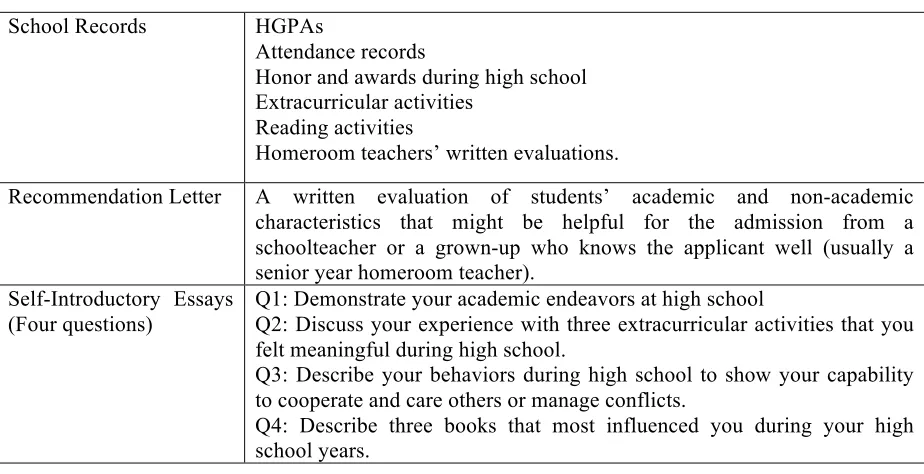
Table 1.1. An Example of the Application Material Requirement for an Early Admission Program
(Seoul National University, 2015) 44
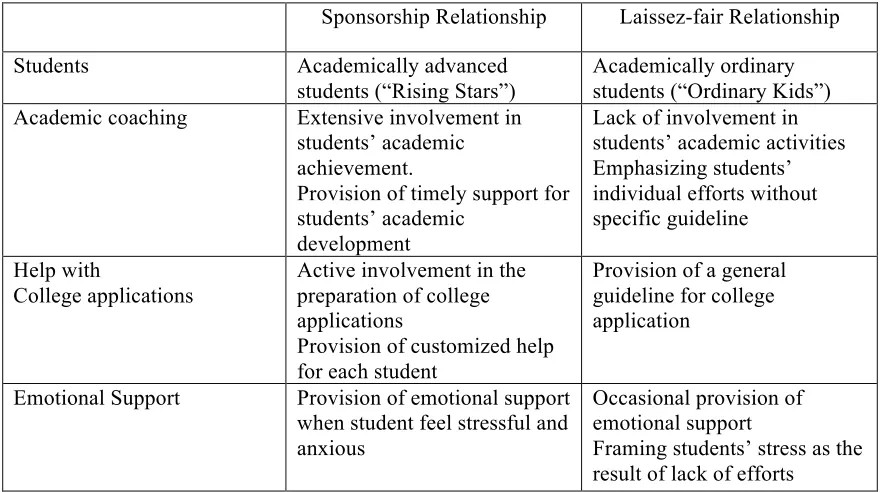
Table 1.2. Summary of Sponsorship relationship and laissez-fair relationship 45
Table 2.1. Information of Eight Focal Students 84
Table 2.2. Characteristics of the Interview Participants 85
Table 3.1. Respondent Characteristics 122
CHAPTER 1
Teachers as a Mobility Sponsor: How Teachers Selectively Facilitate
Working-Class Students’ College Access in South Korea
The power of parents’ social background has been well documented cross-culturally, especially
with regards to shaping students’ experiences with educational institutions, as well as their
academic outcomes (Lucas 2017; Lareau 2011; Weis, Cipollone, and Jenkins 2014). Much of the
research has focused on the powerful ways that parents transmit class advantages to their children
in the educational realm. Studies have found that middle-class parents transmit cultural capital to
their children, allowing them to navigate and negotiate with educational institutions better than
their working-class peers (Bourdieu and Passeron 1990; Lareau 2011; Calarco 2014). They also
more actively intervene in children’s schooling (Lareau 1987; McNeal 1999; Reay 1998) and in
their academic activities to facilitate their educational success (Sui-Chu and Willms 1996; Park,
Byun, and Kim 2011; Abelmann and Park 2004).
Nevertheless, in sociological studies of education, the role of educators has been studied
insufficiently, and when it is studied, the work has yielded contradictory results. Some have
suggested that there are patterns of bias on the part of educators who selectively reward, assist,
and punish children from different backgrounds, according to class (Calarco, 2011; Bowles &
Gintis, 1976; Bourdieu & Passeron, 1990), race and ethnicity (Downey and Pribesh 2004; Morris
2005; Linnehan, Weer, and Stonely 2011), and gender (Duffy, Warren, and Walsh 2001; Jones
and Wheatley 1990; Paechter 2002). Others, however, have shown that educators operate in
literature on “college for all” highlights the ways that educators and counselors push students into
higher education in a uniform fashion, regardless of their backgrounds or academic orientation
(Rosenbaum 2001; Rosenbaum, Miller, and Krei 1996). Moreover, researchers have argued that
educators provide various educational benefits to disadvantaged students (Jack 2016; Gonzalez
2015; Horvat and Davis 2011). Overall, our understanding of the role of educators in students’
educational experiences remains unclear.
Still, there are signs in the literature that teachers do engage with students in unequal,
rather than uniform, ways. They invest energy, time, and effort in some students more than others
(Holland 2015; Hao and Pong 2008). While there is ample evidence of class bias in the
interactions between students and teachers, there also exists variability in working-class students’
experiences with teachers, and this has not received sufficient academic attention (Jack, 2016).
Indeed, understanding this variance in the experiences of working-class students is important
because there is a clear pattern of upward mobility. While many working-class students encounter
barriers to educational improvement (Goyette, 2008; Weis, Cipollone, & Jenkins, 2014; Lareau,
2011), a growing number of them do proceed to tertiary institutions, including elite universities
(Byun & Park, 2017; Lee & Kramer, 2013; Jack, 2016; Hurst & Warnock, 2015; Hurst, 2010;
Mullen, 2010). In this mobility process, educators can play a crucial role. Teachers offer
extensive institutional support, assisting in their students’ academic achievement (Stanton-Salazar
2011). They also directly support the upward mobility of some working-class students (Gonzales,
2016). However, their sponsorship for selected working-class students, which might not apply
for all working-class students, has not sufficiently explored.
Derived from Turner’s (1960) theory of social mobility, this study analyzes the ways in
which teachers play the role of a “mobility sponsor” in certain working-class students’
educational mobility. Turner conceptualized two different types of folk norms associated with
understanding normative mobility regimes, only a few studies have empirically examined his
theoretical model in recent decades (Lareau 2015). Particularly, little research has investigated the
diverging ways in which working-class students experience educational mobility within each of
these two mobility systems. In addition, the role that the dynamics within the school plays in the
mobility process has not drawn sufficient academic attention.
Drawing on a one-year ethnographic study conducted at an academic high school in
South Korea, in this research, I show how teachers play the role of a mobility sponsor by
selectively supporting students in their journeys through the highly competitive educational
system. I demonstrate that teachers provide support for only a small number of working-class
students at the top of the academic hierarchy. Through this sponsorship relationship, educators
effectively facilitate certain working-class students’ academic achievement, offer extensive help
with college applications, and provide emotional support. Conversely, teachers form a laissez fair
relationship with most other working-class students, often neglecting their educational needs and
criticizing their lack of effort and preparation. These teachers emphasize contest mobility norms
that highlight personal achievement. The resulting lack of support leaves many students
perplexed and frustrated. By portraying these diverging patterns of teacher sponsorship, this
study seeks to contribute to our sociological understanding of the nature of educational mobility
and class inequality in education.
THEORETICAL FRAMEWORK: TEACHERS AS MOBILITY
SPONSORS
Turner (1960) describes two contrasting normative ideas about educational mobility systems—
contest mobility and sponsored mobility—to account for structural differences in the American
the prize in an open contest and is taken by the aspirants’ own efforts” (586). Under the contest
regime, all are encouraged to participate in, and believed to be capable of winning, a mass
competition for elite status. Rather than relationships with existing elite groups, individual efforts
and achievement are emphasized. In contrast, “under sponsored mobility, elite recruits are chosen
by the established elites or their agents, and elite status is givenbased on some criterion of
supposed merit and cannot be taken by any amount of effort or strategy” (586). In this system, it
is the elites themselves (or their agents) who select and educate a small number of students for
future elite status; this selection occurs in the earliest stages of the educational system. In other
words, the sponsors judge an individual’s ability and exclusively support some students over
others; therefore, an individual’s relationship with the sponsors is crucial in securing elite status.
Despite the importance of his theoretical contribution to the mobility research, there have
been only a few attempts to empirically examine or theoretically revisit his theory in recent
decades. Particularly, as Lareau (2015) has pointed out, Turner’s research is unclear with regards
to how sponsorship works for working-class students’ mobility. Turner discussed the sponsorship
offered by educators, describing it as a major feature of the sponsored mobility regime. Yet
sponsorship can also matter in contest mobility systems, and this possibility has been
under-scrutinized. Whereas contest mobility emphasizes individual achievement in the competition for
elite status, students may still need extensive support until they finish the competition. As many
studies of middle-class youth transitioning to college have shown, students receive significant
support such as academic guidance, mentorship, and emotional care from non-parental adults
(i.e., teachers, guidance counselors, coaches, etc.) as well as their parents (Lareau, 2011; Weis,
Cipollone, & Jenkins, 2014; Stevens, 2009). This sponsorship gives them a class advantage.
Sponsorship can be of particular importance to working-class students who seek
educational mobility. Support from adults outside the family can offer crucial assistance to those
1067) conceptualized the role of teachers as “institutional agents” who “acts to directly transmit,
or negotiate the transmission of, highly valued resources (e.g., high school course requirements
for admission to 4-year universities).” He explains that educators serve disadvanted students by
providing social capital and “institutional resources that function to ensure children and
adolescents become effective participants within institutional spheres” (1078). Stanton-Salazar’s
theoretical argument reonates in empirial research on the relationship between disadvantaged
students and their educators. For example, in his study of undocumented youth transitioning to
adulthood, Gonzales (2016: 79) documented how “a nudge in the right direction from an
influential teacher” could help undocumented students from less affuluent families transition to
college, rather than leave school. His study shows that supportive educators cultivate their
students’ educational aspirations, improve their college preparations, and develop their sense of
beloinging in school, all of which “set them on distinct pathways toward college-going from
school” (77). In addititon, Jack’s (2016) study reports that disdavanted students, and specifically
black students from low-income families, benefit from attending resourceful elite secondary
schools. Simliar to their peers from middle-class backgrounds, privileged poor who experience a
nurturing educational atmosphere at prestigeious secondary institutions “enter college at ease
with the expected style of engaging faculty and … navigating institutional practices,” which
facilitates a smooth landing in an elite college (13).
Clearly, educators play a role as what I call mobility sponsors: They faciliate
disadvntaged students’ educational mobiliy by showering them with educational, social, and
cultural resources. However, the machenism of the sponsorship from educators, which enables to
understand the nature of working-class youth’s mobility experience, has not been sufficiently
examined. Little research has explored how sponsorship from educators is distributed across
working-class students within the same school, and how receiving or being denied such
sponsorship to all students in an equal manner is virtually impossible (Corwin et al., 2004;
O’Conner, 2000). Educators are given a limited amount of resources (i.e., time, physcial and
emotional energy, etc.), and hence their resources are dilluted when they must distribute them
across large numbers of students. Therefore, sponsorship from educators inevitably becomes a
zero-sum game. When some students acquire resources from teachers, other students in the same
school are likely denied the opportunity to utilize that same capital. This means that some
working-class students are left unsupported, while others receive sufficient assistance from their
educators. Noverthless, this selective nature of sponsopship from teachers has not yet to be
studied with scrutiny.
SOUTH KOREAN EDUCATION AS A CONTEST MOBILITY SYSTEM
The concept of a contest mobility system states that paths to elite status should be available to all
in an open contest (Turner, 1960). Therefore, providing fair opportunities for competition for
better social status is crucial. South Korean education arguably follows the contest mobility
system paradigm. It seeks to guarantee students a fair competition for social mobility, regardless
of their social origins. For example, through the High School Equalization Policy, the government
has attempted to reduce between-school disparities by limiting both school choice and student
selection; this is to prevent academically advanced students from becoming concentrated in a few
prestigious high schools. In addition, standardized educational curricula are adopted nationwide,
and educational practices providing different educational experiences for students within a single
school (i.e., tracking and ability grouping) are prohibited.
In Korea, the competition for elite status is organized around college admissions, where
there is a rigid stratification of higher education institutions. Four-year colleges are usually
are two-year colleges (Park, 2008). Among four-year universities, several institutions in the Seoul
metropolitan area and a fewer number of national universities in other major cities are considered
top-tier institutions. Graduating from these schools means better access to economic
opportunities, social privilege, and exclusive social networks. Therefore, to many parents and
children, especially in the middle class, securing a seat in one of these top schools is the most
important educational goal (Abelmann, Park, & Choi 2012). This induces intense educational
competition among high school students. While simply going to a college has become easier due
to the rapid expansion of higher education in Korea, getting into select schools has remained
difficult for many.
Korean education has recently diversified the ways in which it selects students.
Admission is now based on an evaluation of multiple qualifications. Consequently, the college
admissions process has become more complex since the early 2000s. Before that time, applicants
were evaluated based on a single criterion: their academic performance measured by their scores
on the College Scholastic Ability Test (CSAT) and HGPA.1 After the early 2000s, things
changed. The government forced colleges to diversify their admissions programs to reduce this
heavy reliance on test scores and allow for the consideration of diverse aspects of talent. Now
universities select students via two major admissions programs: early admission (soo-si),where
many aspects of the application portfolios are considered, including the HGPA, and late
admission (jung-si), where students’ performance on the CSAT is crucial.
1 Institutions selected their new, incoming students in January and February, before matriculation
For early admissions, during which approximately 60% of the incoming freshmen are
selected, students are required to demonstrate diverse qualifications.2 For example, to apply for
Seoul National University (SNU), one of the top schools in Korea, applicants must qualify in
many ways. In 2015, Seoul National University asked applicants to submit several different types
of information for the first round of the student selection process (see Table 1.1). Applicants were
required to submit their school records, including HGPA, other records indicating their academic
and non-academic activities, and a recommendation letter. Finally, applicants were asked to
submit four “self-introductory essays” demonstrating their educational experience, academic
aspirations, and plans.3 After screening the applicants based on their school records and essays,
SNU chose their future freshmen from in-person interviews. For these interviews, the school
asked the students certain questions to gauge their academic fit with the major to which they’d
applied, as well as assess their academic attitude and overall personality. Whereas each school
can customize their evaluation tools, selective schools usually adopt an evaluation process similar
to SNU’s.
In this complex competition for college admission, students are required to demonstrate
various academic and non-academic qualities. In addition, since many institutions ask students to
2 In 2015, 65.1% of all freshmen students beginning college were chosen through early
admissions; the other 34.9% were through regular admissions (Korean Council for University Education, 2015). The government has incentivized colleges to expand their early admissions programs, so these programs are expected to continue to grow.
3 The essay consists of four questions, as determined by the Ministry of Education. The Ministry
of Education decides the first three questions. These questions do not change every year. They ask students to describe their academic endeavors, extracurricular activities in school, and learning of social virtues through school activities (e.g., cooperation, sharing, caring, and conflict management). Each institution adds the fourth question to their application materials. For
prove that they have regularly engaged in diverse activities, students must strategically develop
their portfolios from their first year of high school. This means that compared to past cohorts
whose admissions were determined by standardized test scores, recent cohorts of Korean high
school students have been forced to navigate a complex admissions system and carefully plan and
participate in diverse activities. They now need cultural knowledge about the educational system;
thus, sponsorship from adults – both parents and educators – is more important than ever, making
the mobility experience of Korean working-class high school students an interesting case when
examining sponsorship in a contest mobility system.
METHOD AND DATA
Research Site
For this study, I spent one academic year (March 2014 to February 2015) at a co-ed academic
high school in a southern city in South Korea; in this research, I pseudonymously refer to this
institution as Glory High School (or Glory). Glory is located on the outskirts of an industrial town
called Harbortown. In the 1970s, Glory was a vocational institution that served local needs by
primarily graduating industrial workers. In the 1980s, Glory became an academic institution
designed to prepare students for university. Due to its early history as a vocational high school,
Glory has had a longstanding local reputation as a low-performing school.
Thus, Glory High School has had to fight an uphill battle to attract academically
advanced students. Because the number of recent graduates admitted to elite universities often
shapes a high school’s local reputation, high schools in Harbortown and adjacent cities engage in
intense competition for students with the academic potential to be admitted to prestigious
universities. Since it occupies a lower rung on Harbortown’s academic hierarchy, Glory has
and less often go on to selective four-year universities; unfortunately, this serves to reinforce their
negative reputation.4
Despite its less favorable academic performance, Glory’s educational mission is to
prepare pupils for a university education. Like other academic high schools in Harbortown, the
daily schedule at Glory is primarily organized around college preparation. Students spend 14
hours a day, from 7:30am to 9:30pm, Monday through Friday, at school. On Saturdays, when
schools do not have regular classes, senior students are mandated to come to school to study or
prepare college application materials. The major curricula address subjects chosen for college
preparation. Club activities, which are less relevant to college preparation, are unofficially
prohibited for senior students. Also, students’ attire is strictly controlled and monitored by
teachers who believe that paying excessive attention to fashion distracts students from their
studies. Currently, Glory seems to have achieved their aim, at least in a quantitative sense. Recent
statistics show that more than 96% of graduates proceeded to college in 2014. They sent more
than 90% of their graduates to college, including four-year universities and two-year junior
colleges, in the last ten years. As of 2014, 52% of Glory High School graduates proceeded to
two-year junior colleges, mostly in Harbortown or adjacent cities, and 44% went to four-two-year
universities, including a few that are highly selective.
Students at Glory are from diverse socioeconomic backgrounds; students in Harbortown
can apply for high school regardless of their residential district. However, the school is known to
draw more students from low-income families, as compared to other schools in the area. Given
the negative association of students’ SES and academic performance in Korea (Kim and Kim
2013), many of the teachers with whom I spoke pointed out that there is usually more
working-class students than middle-working-class students at Glory. For example, the head teacher said during our
4 For instance, Glory High School’s results from the National Scholastic Achievement Test in
interview, “There is a vicious cycle between our low academic performance and students’ family
backgrounds. Wealthy parents would not send children to us unless they want their children to
have an advantage in the educational competitions within school. They would choose other, better
schools in the downtown.”5 Despite restricted access to students’ family backgrounds for legal
reasons, I can confirm that Glory has a substantial number of students from low-income families.
For example, 15.3% of the senior students I observed were eligible for any type of government
support for low-income households (those who made less than 20% above minimum wage). In
addition, 30% had their registration fees waived (approximately $90) for the three-week CSAT
preparation summer program because teachers determined that these students could not afford to
pay.6
Data Collection and Analysis
I gathered data using an ethnographic research method, including school observations and
in-depth interviews with senior students, teachers, and administrators. I concentrated on senior
students over a single academic year, since I sought richness rather than breadth in the data; I felt
that this would best enable me to understand the rhythm of the daily experiences of students and
teachers alike (for other examples of this method, see Willis, 1981; MacLeod, 1987; and Pascoe
2011).
For observations, I visited schools at least four times weekly during a single academic
year, with each observation lasting approximately eight hours, on average. I had access to six
senior classrooms, senior teachers’ offices, other facilities (e.g., special study rooms, the library,
5 Teachers repeatedly mentioned to me that Glory High School draws more students from less
affluent families than other academic high schools in Harbortown. For example, one male English
teacher said, “You should know that our kids are different. They are not only academically poor
but financially poor. We have a higher proportion of poor students than any other school in the city. Many are from less wealthy neighborhoods. Their parents are often poorly educated, too.”
6 The fees were waived for those students whose households were eligible for government
gym, and cafeteria) in Glory. Following senior students and their homeroom teachers, I primarily
observed interactions between students and teachers during the self-study hours (four to six hours
on weekdays and eight hours on Saturdays), lunch and dinner hours, and breaks. During
observations, I tried to capture various interactions between teachers and students regarding
students’ transition after high school. I used ethnographic notes to document my observations and
later expanded these into field notes.
My role at Glory was primarily that of an outside observer, but both teachers and students
accepted me easily and found me to be a useful resource in different ways. Many teachers said
openly that they believed I could be a good influence on their senior students. I believe that my
status in the international academic hierarchy, a PhD candidate at a well-known American
institution, helped me to earn their trust. Since they believed I could be a good academic role
model for their students, they were very receptive to my research. Teachers also asked me to get
involved in certain academic activities.7 However, I strived to minimize my influence on
students’ academic achievement or their college admissions process. When teachers (and less
often, students) actively asked for my help with exam preparation or college admissions, I gently
reminded them that I could not provide extensive support. When I inevitably provided teachers or
students with some academic assistance (e.g., providing students with general advice for college
application materials or exam prep for social studies), I tried not to interfere with the students’
overall educational experiences.
At the same time, the students saw me as a friendly ear with whom they could talk about
their problems without being judged; they knew that I was neither their “real” teacher nor a
classmate. Also, I believe that my personal history, growing up and attending school in
7 For example, at the request of teachers, I worked as an unpaid teaching assistant for Mr.
Harrison, who was teaching senior English and was having a hard time because of the language barrier. My role in this class was minimal. I translated or helped teachers facilitate class
Harbortown, allowed me to build a rapport with these students in a short amount of time. When I
first entered the field, I found the students to be excited to share their experiences with me,
though we were practically strangers. Within a couple of weeks, they began confiding in me
about several issues, such as college, future careers, friendships, courtship and sexuality, and
family conflicts, and touched upon aspects that they would not openly discuss with their teachers
or classmates. In addition, the students often invited me to their classrooms for observation. Many
students enjoyed my observations because they felt that they were receiving an unusual amount of
attention from a grownup. Since social rewards and recognition are tied to academic achievement
in Korea, many students found it pleasing to have an adult interested in them irrespective of their
academic standing. Indeed, one male student said to me at the end of my research, “I enjoyed
having you around. No one cares about us who are not good at studying, but you care about us,
right?” Overall, due to my dual role, I was easily accepted. More importantly, this acceptance
allowed them to behave freely in front of me, which was crucial for my acquiring vivid firsthand
observational data about their interactions in the school.
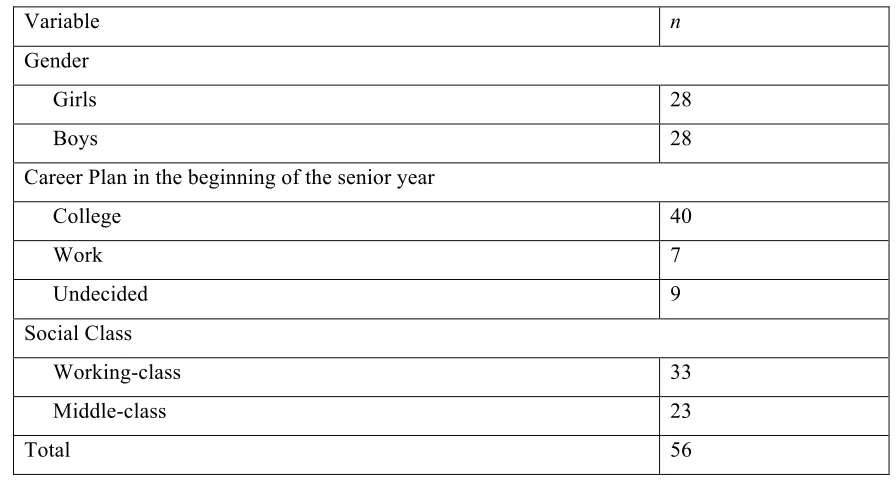
In addition to observations, I conducted in-depth interviews with 33 students from
working-class families and 10 teachers. The interview questions for the students generally
addressed their educational experiences, career plans, academic aspirations, and perceptions of
their interactions with teachers. With the teachers, I asked about their career experiences,
opinions about the college admissions system, and their perceptions of students. All interviews
lasted approximately 50 minutes to 2 hours. Because I used self-study hours or lunch periods for
these interviews, they were sometimes interrupted when the break was over. In these cases, I
asked the interviewees to meet with me again to complete the interviews. All interviews were
conducted in Korean and audiotaped with the interviewee’s consent. I later transcribed and
Because I am interested in the role of teachers in working-class students’ academic
transition, I limited the scope of my analysis to students from working-class backgrounds. From
the field notes, I selected only the information related to the experiences of students from
working-class families. To measure these students’ family backgrounds, parental education was
used as a proxy; I also used other class information as secondary data. I was not granted access to
any school-level information regarding parents’ socioeconomic statuses, for legal reasons.
Students provided me with certain information about their parents’ education – especially with
regards to whether their parents had attended college – in a confident manner, as compared with
other information related to their family backgrounds (e.g., parental income, homeownership, and
parents’ occupations). Students were much more inconsistent when they described their financial
situation or parents’ occupational history. I selected students with parents who had high school
educations or less, and further limited the sample to students whose parents had working-class
occupations. For example, I excluded students who told me that their parents were business
owners or held managerial positions, even though the parents had high school educations or less.
To evaluate the field notes and interview transcriptions, I conducted an ongoing process
of data analysis during the fieldwork, regularly reviewing field notes and interview transcripts,
and writing analytical memos (Emerson, Fretz, & Shaw 1995). After finishing this one year of
fieldwork, I revisited the materials to identify inductively any emerging themes, discuss
connections to the existing research, and raise additional questions. Particularly, I sought to
capture emerging themes regarding college choice and the application process. I also paid close
attention to incidents from the field notes in which teachers and students communicated about
going to college. I focused on categories related to interactions regarding attending college and
college applications, and teachers’ differing treatment of certain groups of students. While
conducting this analysis, diverging experiences emerged between high performers (who consisted
would be eligible to apply for competitive four-year colleges), and low performers considered
more suitable for local junior colleges. I further developed this analysis to clarify comparisons of
these two groups and identify disconfirming evidence.
FINDINGS
Academic Hierarchy in Glory High School
Students in the senior student building seemed almost indistinguishable from one another in their
grey school uniforms. They had carefully adorned themselves in similar fashion, guided by both
the latest teen trends and official school regulations restricting “immoderate clothes and
accessories that are not suitable for their status as high school students.” For instance, many boys
intentionally left a few buttons of their shirts open at the top so they could indirectly brag about
the brands of t-shirt (e.g., Nike, Adidas, and New Balance) that they were wearing underneath
their school uniforms. In addition, most had the same trendy mop-top hairstyle, helmet-like with
straight bangs neatly clipped just above their eyebrows. Girls usually let their slightly-dyed brown
hair that they had carefully ironed fall upon their shoulders. They also wore what they called
“transparent makeup,” which included only powder and pink lip gloss for an even skin tone and
“natural” look. This helped keep teachers from easily noticing their makeup, the wearing of
which violated school rules. Their similar look made it difficult to discern the hierarchical
structure of their peer groups.
It was another criterion, one to which scholars have paid scant attention, that largely
shaped the students’ status at school: their academic standing narrowly measured by their average
test scores (i.e., average HGPA). It did not take long for me to learn that the social world of
senior students at Glory was hierarchically stratified by their academic performance; this helped
the first few weeks, teachers and students repeatedly instructed me on this invisible yet powerful
social stratification mechanism.
For example, on my third day in the field, Ji-soo, a female student who was said to be a
“good student” and who showed a high level of academic performance, walked me through the
social world in which she lived every day. She harshly evaluated her school’s status in the local
academic hierarchy:
Glory High School is just a dump. We are all trash. These kids are not interested in studying at all. No one. Thus, it is very fun to hang out with friends at school. They are not lame. Yet they are all a dump, too. Any smart kids would never apply for this school. We came here because we were not very good at middle school. It is obvious that no one in this school would do well at other academic schools.
Ji-soo explained that whereas the school’s academic reputation was less favorable,
student’s status in the school was shaped by their academic standing. She clarified that their
relative academic performance in school still divided the senior students into different social
groups. In a cynical tone, she continued:
There are kids who study well. Teachers usually love them, but these kids are
sometimes annoying because they think that they are smarter. They will live better lives than anyone from Glory … because they will make it to good colleges … The rest of the students are nothing. They are so far from being smart but still want to go to college. They are usually nice and fun, but they just do not study hard. Teachers do not care about them much, either.
In her vision, her school was rigidly stratified based on students’ academic performance.
Many teachers and students at Glory confirmed Ji-soo’s categorization on several different
occasions. Despite the various terms they used to describe the school’s hierarchical structure, my
fieldwork uncovered two major student groups: a smaller number of academically excellent
students at the top of the hierarchy whom teachers and students alike had labelled “rising stars,”
and most of the other students who did not demonstrate academic excellence and were understood
The rising stars were at the top of the academic hierarchy at Glory. These students were
better academic performers than their classmates, and hoped to enter selective four-year colleges.
Two or three of the 25 students in each class were rising stars. The most prominent were six
top-performing students chosen to be in a “special class.”8 At the beginning of every academic year,
Glory selected the top six students from each cohort to be in a special class. The special class was
a sort of elite unit within the school; they were exclusively supported because they were the most
academically advanced. Once the students were chosen to be in the special class, they received
diverse educational advantages such as customized tutoring, individual mentoring from teachers
and guidance counsellors, and access to a special study area. To be selected for the special class,
only a single criterion was applied: students’ HGPAs from the previous year. Mr. Choi, the head
teacher of the senior class, explained, “anyone can be in the special class if they show the highest
performance. We invest in those students with the most potential.”
Their status within the school was symbolically illustrated by the special study room.
This room was on the top floor of the building and was assigned exclusively to six rising stars. It
was more spacious than any other room in the building, and isolated from the other areas. Other
students were not allowed to enter. These six special students could enjoy a tranquil study space
8 Any use of ability grouping in schools is prohibited by all sixteen metropolitan and provincial
all by themselves. The special study room was also equipped with facilities that the other students
could not expect in regular classrooms. Each student had a spacious brown carrel with a
bookshelf and cabinet, and a green adjustable office chair to protect his or her back when
studying for long hours. In addition, these special students shared three personal computers so
they could search for college admissions information or take private online college prep classes.
These features were in stark contrast to those of the regular classrooms, where students spent
fourteen hours a day on weekdays. These classrooms were filled with more than two dozen small,
open-front desks, standardized school chairs, and small lockers. After regular classes ended
around 3:30 pm, the special class students would climb the stairs leading to the study room,
removing themselves from their crowded classrooms where their peers spent the rest of the school
day. This secluded8 space symbolized their distinctive location in the social hierarchy and the
social benefits of their status.
It is important to note that this special class is different from the honors or AP classes of
American high schools. The special class students at Glory had the same curriculum as their
classmates. Glory did not use a within-school tracking system like other high schools in Korea.
All students received the same education during regular school hours. The special class took
place only after school, in the evening and on Saturday self-study hours. This was not a part of
the regular curriculum, but a special curriculum designed to help the most talented students make
a successful transition to selective universities. Therefore, becoming a member of the special
class meant that that they had a social status that was distinguishable from the rest of their
classmates, that they deserved more attention and a specialized education from the school.
Conversely, most of the students described themselves as “ordinary kids.” Teachers often
referred to them as “kids,” without a specific nickname like “rising stars.” Students sometimes
called themselves “nothing,” as Ji-soo described harshly. The ordinary kids were not as
high school “shine.” They existed as a marginalized majority at Glory High School. Hyun-min, a
stout boy with an outgoing and courteous demeanor, summarized their status as having “no
presence.” Comparing the rising stars to the ordinary kids, Hyun-min said bitterly:
The rising stars are the main characters in the play. We are just supporting actors ... Honestly speaking, to this school, they must be more important. That is why they got the special treatment. We are of no use … Ordinary students who are just doing fine academically have no presence at school. No one pays attention to us unless we make trouble.
Overall, the academic hierarchy was responsible for shaping even students’ more
mundane experiences at school. It drew clear social boundaries between students, even defining
their physical location in the school. However, as I will show below, this stratification did not just
have symbolic importance. It also defined how the school distributed its institutional resources,
serving as a pipeline through which teachers provided institutional support to the benefit of some
and the detriment of others. In the following sections, I will outline two different relationship
regimes that teachers forged with these two groups of students: the rising stars and the ordinary
kids. By comparing their experiences, I will illustrate a teacher’s role as a mobility sponsor who
selectively supports working-class students’ transition to college.
Sponsorship Relationship between Teachers and Rising Stars
As Stanton-Salazar (2011) argued, the teachers at Glory High School served as institutional
agents, providing valuable educational resources to disadvantaged students. Yet they only offered
their support to a small number of rising stars who already had strong academic records and the
potential to be accepted by prestigious universities. These teachers formed a distinct relationship
with these rising stars, which I have termed sponsorship. In this type of relationship, the teachers
were mobility sponsors; they showered rising stars with academic and personal resources that
directly led to their securing seats in prestigious universities, such as academic coaching, help
Academic coaching. As mobility sponsors, the teachers at Glory High School served as
academic coaches to the rising stars. They meticulously monitored these students’ academic
endeavors and performances to make sure their academic records would stay strong enough that
they could apply for selective universities. To maintain their academic standing, students were
required to make a steady and sustained academic effort. Teachers checked in daily on the rising
stars; this was primary to the routines of the class teachers in the senior building. They visited the
rising stars in their classrooms, the special study room, and even in the cafeteria during
lunchtime, to connect with them and make sure they were fully committed to their studies.
For example, throughout the senior year, Ms. Han tried to make sure that Ga-hee, a rising
star in her class, studied hard enough to retain her academically elite status. Ga-hee complained
about Ms. Han’s “endless nagging,” but they retained a cooperative and favorable relationship
throughout Ga-hee’s senior year. Ms. Han carefully checked in on Ga-hee’s progress and actively
intervened in her activities if Ga-hee’s academic endeavors were less than satisfactory. Ms. Han’s
hands-on coaching was only for Ga-hee and one other rising star in her class. She rarely paid this
close attention to ordinary students, only checking in on them occasionally. One of her coaching
techniques was “keeping Ga-hee separated from other kids.” Like other senior teachers, Ms. Han
believed that students could be a substantial distraction for rising stars. In addition, she thought
that her rising star needed some distance from her friends because of “Ga-hee’s nosy
personality.” Ms. Han once complained to me about Ga-hee, saying “That girl gets easily
distracted. She is interested in other people’s business too much. You can’t be focused on
studying when you are nosy. Those students need some discipline.”
One evening in April, Ms. Han removed Ga-hee from her classroom and sent her back to
the self-study room. Ms. Han had entered her classroom during a self-study hour and found
hee busily chatting about the Sewol ferry disaster that had occurred five days prior. Because
However, Ga-hee’s presence in the room immediately caught Ms. Han’s attention. Ms. Han,
annoyed, asked Ga-hee in a high-pitched voice, “What are you doing here now, young lady?” She
did not say a word to the two students who had been chatting with Ga-hee, nor did she pay
attention to the students who were conversing with one another or sleeping at their desks. Her
eyes were fixed on Ga-hee’s back. Embarrassed at her teacher’s outburst, Ga-hee made excuses in
an awkward but cheerful manner. “I was about to go back. I was here to pick up my workbooks.”
She pointed at the workbooks in her arms, hoping they might prove her innocence to Ms. Han.
However, Ms. Han was persistent. She continued to yell at Ga-hee: “Go back to the
upstairs right now!” The upstairs meant the special study room. Her voice was loud enough to be
heard by everyone in the class, including myself. At that time, I was on the opposite side of the
classroom to where Ms. Han and Ga-hee stood. Her scolding continued. “Are you insane or what?
The midterm is around the corner. You must know that every exam matters for you from now on
because there will be no more chances for you to make your academic records look better! It’s
time to focus on studying, so go back to the upstairs!”
Ga-hee quickly complied with her teacher’s order. “I got it! I got it! I am leaving now.”
She hurried to leave the room, putting a smile on her face. It seemed that Ms. Han’s scolding did
not hurt her feelings. After she left, Ms. Han gave a cursory glance at her class from the door.
When she left, she shouted sharply at the air, “Wake up! Did you come to school to take a nap?”
However, she did not specify to whom she was talking. She did not give any specific guidance to
the ordinary kids or remind them of the importance of the midterm exam. Ms. Han’s endeavors
were only to make sure Ga-hee’s commitment to studying continued until she got in to one of the
most prestigious private universities in Seoul.
Along with their careful monitoring of rising stars’ day-to-day academic activities, the
teachers kept close track of their academic records and actively intervened when necessary. I
exam, and practice CSAT exams the students took every month). Through this communication,
teachers informed students of their current academic standing. They provided timely advice to
help rising stars maintain or improve their academic performance and make a successful
transition to college.
For example, Sang-min, a male rising star who was in the special class with Ga-hee, did
not do well on the mid-term math test in the first semester of his senior year. The son of factory
workers, Sang-min had secured his position as a rising star during his first year at Glory High
School. However, in the first semester of his senior year, his math results removed him from the
top 4% of the senior cohort. Being in the top 4% meant receiving Grade Level 1 out of nine
levels. High school grades in Korea are always on a curve. Therefore, he had to be in the top 4%
to maintain the highest level in math. It was especially important for Sang-min to maintain Grade
Level 1 in math and science because the bioengineering major at the elite colleges to which he
was applying would consider these grades to be more important than those in other subjects.
Sang-min’s unsatisfactory test results shocked Mr. Lee, his class teacher. Mr. Lee
expressed worry about Sang-min, whereas he did not show any concern about the performances
of his other 24 other students.9 He was anxious that “Sang-min’s academic spirit had been
dampened for some reason,” and that “the midterm result would negatively affect Sang-min’s
early admission applications in the fall.” To help Sang-min restore his academic standing, Mr.
Lee scolded Sang-min and reminded him that he needed to work harder to get admitted to a good
college:
Mr. Lee is furiously yelling at Sang-min in the teachers’ office. Sang-min quietly listens to Mr. Lee with his head lowered and hands around his belly. “Are you insane? Are you a crazy person? How could you get … Grade Level 2 on the math test?” Mr. Lee fumes. A short silence fills the air as Sang-min keeps quiet. Mr. Lee lets out a short sigh, and then tells his disheartened student in a gentler tone, “Let’s do better, okay?
You have done well so far. You can’t ruin everything in your senior year.”Sang-min
9 I did not observe any occasions where Mr. Lee had individual discussions about the midterm
does not answer right away, and Mr. Lee hurries to fill the silence. “You understand?” Sang-min finally utters two words in a faint voice: “Yes, Teacher.”
As Mr. Lee intended, the conversation was “a wake-up call” for Sang-min. It helped him
to realize that he needed to work harder to achieve his goal. After the meeting, Sang-min studied
harder and recovered his math grade in the next exam. He was appreciative of Mr. Lee’s
attention. In a feeble yet determined voice, Sang-min told me that he “totally understood why Mr.
Lee got upset.” To Sang-min, Mr. Lee’s scolding was “a token of affection.” Sitting on the
stairway leading to the top floor, Sang-min echoed Mr. Lee’s point about his academic attitude:
As he said, I might have been crazy or something. I might have been overly confident about my math skill. I was naïve enough to simply assume that I would get a good result this time too. However, it turned out that I was so wrong. I decided to try harder from now on. I have a final exam and another mid-term before the application, so I still have a chance to make it up.
Involvement in college applications. Teachers were also actively involved in rising stars’
college preparation and applications, another aspect of their sponsorship relationship. Because
most rising stars were applying for early admission to university programs, they had to
demonstrate both academic and non-academic qualifications. To be competitive for selective
universities, rising stars began preparing from their first year of high school. They already knew
the majors they would pursue. Based on those majors, they built cohesive resumes to demonstrate
their consistent academic interest. Ideally, they also had a record of extracurricular as well as
academic activities.
This complex process of college admissions is especially challenging for students from
working-class homes. Because their parents could not provide sufficient guidance for college
applications, working-class students at Glory High School found it difficult to prepare in advance.
For example, Ho-jin, the youngest son of a fisherman father and homemaker mother, was a rising
transition; yet Ho-jin felt that they could not help him sufficiently because “they don’t know …
about college applications.” Ho-jin said:
They always keep saying ‘you should go to a good school.’ But when I was about to apply for colleges, they just said ‘we trust you. You can do it by yourself.’ They didn’t know what to tell me, so I took care of the applications without letting them know about specific details.
Instead of parental involvement, Ho-jin received support from his teachers at school.
From the beginning of his high school years, his teachers helped him to effectively prepare for the
admissions process. For example, they assisted him with building a resume that would be suitable
for applications to teachers’ colleges. Ho-jin particularly referenced Mr. Roh as one of the most
helpful in his admissions preparations. Mr. Roh, who used to be the head teacher when Ho-jin
was in his first-year, directly advised Ho-jin and other rising stars, helping them to make
long-term plans and consistent resumes based on their goals. In addition, he encouraged rising stars to
participate in extracurricular activities that might be helpful in the admissions process.
Mr. Roh provided customized help to Ho-jin by getting actively involved in Ho-jin’s
long-term preparations. Particularly, he advised Ho-jin to participate in volunteer work. Because
Ho-jin wanted to go to a teachers’ college, demonstrating his commitment to his community and
caring for others would be helpful in the admissions process. It would testify to his non-academic
qualities important for future teachers, such as integrity and altruism. Mr. Roh helped Ho-jin
found a student volunteer group at Glory High School; Ho-jin also began working as a volunteer
tutor at a local community center. Mr. Roh contacted the center, run by an acquaintance, and
requested that they accept his student as a tutor and mentor. Thanks to Mr. Roh’s efforts to
arrange volunteer work for Ho-jin and other rising stars whose goal was to attend teachers’
colleges, Ho-jin could work at the center for three years, leading the volunteer group as a
co-founder and president. Ho-jin enthusiastically explained the role Mr. Roh played in his success:
record of volunteer work for three years. He explained to me that professors who would review my applications wanted to see how committed I was to my community. He told me to do … volunteer work, which is related to teaching, for a long time, because no one would believe my intention to do … volunteer work if I worked only for a few months.
Ho-jin was grateful for Mr. Roh’s guidance and involvement in his early life at Glory
High School. Ho-jin recognized that his sponsorship relationship with his teacher was crucial to
achieving his educational goals. He told me in a serious manner:
Without Mr. Roh, I wouldn’t get accepted. I had no idea how to prepare for admissions. I realized that good academic records were only a basic requirement for college
admissions only after I began my applications. There are many students who have good records but eventually fail because they don’t have good resumes. They simply don’t know who professors consider to be … good candidates. I think that I was very lucky to have Mr. Roh.
Another common way that teachers became involved was directly helping rising stars
prepare their admissions materials. For instance, teachers actively helped them to write
self-introduction essays. These essays are a crucial part of the admissions process. However, both
rising stars and ordinary kids felt burdened with writing them. While students generally learned
how to write essays for college applications during regular classes, many students felt stress about
the essay, including Sang-min, a rising star who severely struggled in this area. He did not have a
first draft of his essay one week before his first application deadline in September.
His struggling alarmed Mr. Choi, the head teacher of the senior class. On one Thursday in
September, Mr. Choi quietly roamed the special study room, something he did every day. I ran
into him whenever I was sitting in the study room. Checking in with the rising stars was a part of
his routine. One by one, he asked them about the status of their applications. When he asked
Sang-min about his essay, Sang-min hesitantly mumbled, “I am still writing. It is hard. You know
that I am not a good writer.” Mr. Choi’s face hardened immediately. In an unusually low voice,
Mr. Choi asked Sang-min seriously, “So, are you saying that you haven’t finished your essay
finished his or her essay either. Mr. Choi frowned and put his hands behind his back. He
nervously bit his lip and shook his head. “Is this a joke? Your deadline is in a week, and you
haven’t written anything?” Letting out a sigh, he continued, “I think that I can’t have you guys
handle … the applications by yourselves.” He implied that the teachers should become more
actively involved in the students’ applications.
After that moment, Sang-min became a “priority target” who drew intense focus from all
the teachers. It became a collective effort among the teachers to help Sang-min. Mr. Choi
informed Mr. Lee, his class teacher, of Sang-min’s issue and asked him to step in. Mr. Lee
immediately met with Sang-min to discuss the problem with the essay and arrange a meeting with
a Korean teacher, Mr. Ki. Agreeing to help his colleague’s rising star, Mr. Ki met with Sang-min
every night for almost an hour until Sang-min submitted his applications. Sang-min said,
fidgeting with his fingers, “He almost rewrote what I had written.” Being shy, he handed me a
hardcopy of his essay. It was filled with Mr. Ki’s copyediting marks in red, which showed his
conscientious efforts to help Sang-min. Thanks to his teachers’ timely and considerable
intervention, Sang-min submitted his applications on time and got in to one of the schools to
which he’d applied.
Emotional support. The sponsorship relationship between teachers and rising stars also
involved teachers’ emotional support. For example, Ga-hee constantly complained about how
nervous she was while preparing her submission to her dream school, Yonsei. Her desks were
decorated with the school’s name, logo, and even pictures of the campus. She was obsessed with
that school, and the submission process gave her much stress. Though she had completed the
materials a few days before the deadline, she could not send them because of her anxiety. “I just
can’t do it because I am so nervous. What if I don’t get it?” As the deadline approached, Ga-hee
![Methyl (2S) 2 [2 (5 fluoro 2,4 dioxo 1,2,3,4 tetrahydropyrimidin 1 yl)acetamido]propionate monohydrate](data:image/gif;base64,R0lGODlhAQABAIAAAP///wAAACH5BAEAAAAALAAAAAABAAEAAAICRAEAOw==)