1 | P a g e
LIGHT WEIGHT CONCRETE USING COCONUT
SHELLS
Kulkarni Parag Pramod
1, Prashant Ganpat Chavan
2,Pagar Chetan Bhaskar
31
Department of Civil Engineering Guru Gobind Singh polytechnic Nasik (India)
2
Department of Civil Engineering Guru Gobind Singh polytechnic Nasik (India)
3
Department of Civil Engineering Guru Gobind Singh polytechnic Nasik (India)
ABSTRACT
The high cost of conventional building materials is a major factor affecting housing delivery in world. This has
necessitated research into alternative materials of construction. The paper aims at analyzing flexural and
compressive strength characteristic coconut shells of concrete produced using crushed, granular coconut shells as
substitutes for conventional coarse aggregate with partial replacement using M30 grade concrete. Beams are casted
and tested and their physical and mechanical properties are determined. The main objective is to encourage the use
of these seemingly waste products as construction materials in low cost housing. It is expected to serve the purpose
of encouraging housing developers in investing these materials in house construction.
Key Words Civil Engineering; Construction Materials; Compressive Strength Coconut Shells;
Concrete , Environment; Sustainability.
I INTRODUCTION
There were many experimental work conducted to improve the properties of the concrete by putting new materials,
whether it is natural materials or recycle materials or synthetic materials in the concrete mix. The additional material
can be replacing the aggregate, cement or just as additive and one form of the additive is natural material. A large
amount of agricultural waste was disposed in most of tropical countries especially in Asia for countries like
Thailand, Philippine and Malaysia. If the waste cannot be disposed efficiently it will lead to social and
environmental problem. The high cost of conventional building materials is a major factor affecting housing
delivery in India. This has necessitated research into alternative materials of construction. There is an increasing
interest in what happens to products at the end of their useful lives, so natural materials have an advantage in that
they can biodegrade or be burnt in a carbon-neutral manner. Natural material like coconut shell and palm kernel
shell are not commonly used in the construction industry but still are often dumped as agricultural wastes. However,
2 | P a g e
countries, various proposals focusing on cutting down conventional building material costs have been put forward.One of the suggestions in the forefront has been the sourcing, development and use of alternative, non-conventional
local construction materials including the possibility of using some agricultural wastes and residues as construction
materials. As the natural fibers are agriculture waste, manufacturing natural product is, therefore, an economic and
interesting option. Coconuts show a wide diversity in size, weight, shape and color, depending on genetic variety
and maturity of the nut at harvest (Ohler, 1999). Adeyemi, 1998 investigated, for one mix ratio (1:2:4) the suitability
of coconut shell as substitute for either fine or coarse aggregate in concrete production. (Olanipekun et al., 2006)
Investigated the comparative cost analysis and strength characteristic coconut shells of concrete produced using
crushed, granular coconut shell as substitutes for conventional coarse aggregate. It was concluded that the coconut
shell were suitable as low strength-giving lightweight aggregate when used to replace common coarse aggregate in
concrete production.
II LITERATURE REVIEW
2.1 Basri H.B. and Khedari
Normal concrete contains four components, cement, crushed stone, river sand and water. The crushed stone and
sand are the components that are usually replaced with lightweight aggregates. Lightweight concrete is typically
made by incorporating natural or synthetic lightweight aggregates or by entraining air into a concrete mixture. Some
of the lightweight aggregates used for lightweight concrete productions are pumice, perlite, expanded clay or
vermiculite, coal slag, sintered fly ash, rice husk, straw, sawdust, cork granules, wheat husk, oil palm shell, and
coconut shell. (Basri.H.B et al., 1999, Khedari et al., 2000).
2.2 Asokan Pappu
Presently in India, about 960 million tonnes of solid wastes are being generated annually as by-products during
industrial, mining, municipal, agricultural and other processes. Of this 350 million tonnes are organic wastes from
agricultural sources; 290 million tonnes are inorganic waste of industrial and mining sectors. However, it is reported
that about 600 MT of wastes have been generated in India from agricultural sources alone (Asokan Pappu (2007).
The new and alternative building construction materials developed using agro-industrial wastes have ample scope
for introducing new building components that will reduce to an extent the costs of building materials. The high cost
of conventional building materials is a major factor affecting housing delivery in India. In developing countries
where abundant agricultural and industrial wastes are discharged, these wastes can be used as potential material or
replacement material in the construction industry.
One such alternative is coconut shell (CS), which is a form of agricultural solid waste. It is one of the most
3 | P a g e
potential to use in areas where crushed stones are costly. Statistical data of coconut production shows that, India isproducing nearly 27% of total world production and the annual production of coconut is reported to be more than 12
million tons. Only few studies have been reported on use of coconut shells as aggregate in concrete This paper
discussed the physical properties of crushed coconut shell aggregate and the compressive strength of the concrete
made with coconut shell coarse aggregate.
Fig.1 Uncrushed coconut shells Fig.2 Crushed coconut shells
III EXPERIMENTAL PROGRAMME
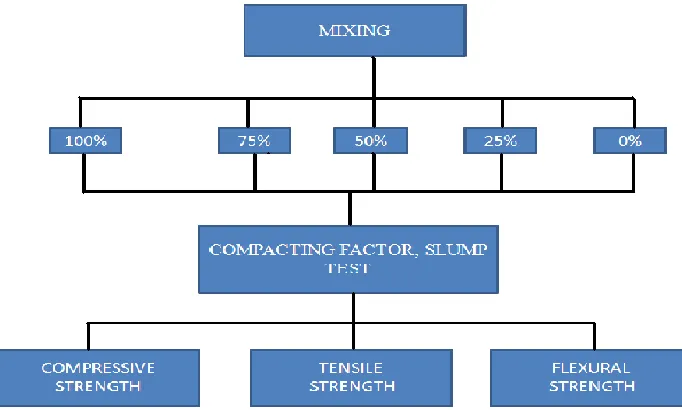
The target of the experimental program was to determine the contribution of natural material aggregate type to the
development of the strength behavior of the conventional concrete. The experimental program comprises the
following:
a. To investigate the best mix proportion of the combination of coconut shell as coarse aggregate in concrete.
b. To investigate the feasibility of the combination of coconut shell as coarse aggregate and in concrete by
determining its flexural, compressive strength, tensile strength.
c. To investigate the effect of the combination of coconut shell as coarse aggregate in concrete content and length to
4 | P a g e
Fig.3 Experimental program conducted
IV MATERIALS AND MIX PROPORTIONS
All raw materials used in this investigation were locally obtained. These includes Pozzolana Portland cement
confirming to Indian standard code IS 8112-1995, river sand as fine aggregate and crushed coconut shell as coarse
aggregate. The potable water was used for mixing and curing. After crushed the coconut shells, they were sieved and
the aggregates passing 12.5mm sieve size was used for this investigation (Fig.1 and Fig.2). The physical and
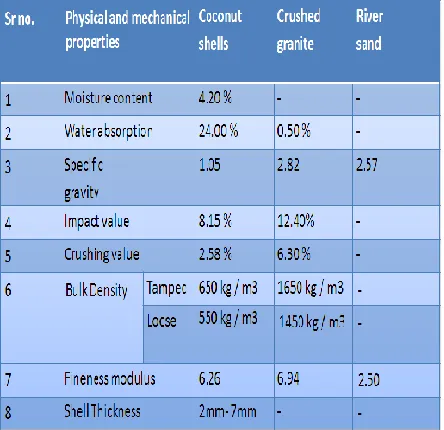
mechanical properties of the river sand, coconut shells aggregate and granite aggregates are shown in Table 1.
The normal design procedures for ordinary conventional concretes are not applicable to the mix design of
lightweight aggregate concrete for two reasons:
-The water content of the cement paste in the fresh lightweight aggregate concrete mix is reduced progressively
through absorption by the aggregate and therefore the water-cement ratio will also decrease, and
-The compressive strength of lightweight aggregate concrete is not only influenced by the strength of the mortar but
also by the aggregate used.
Hence, it is recommended to go for trial mixes for designing lightweight concrete mix. For lightweight concrete, the
cement is recommended in the range of 285–510 kg/m3. The concrete mix proportion obtained from the trials is
1:1.83:2.63. The mix proportion consists of 480 kg/m3 cement with the water / cement ratio of 0.5 All the
ingredients of the mix were weighed and mixed in concrete mixture machine. Steel moulds were used for casting
specimens Sides of the moulds and bottom of all the moulds were properly oiled for easy demoulding. The concrete
5 | P a g e
Table 1. Physical properties of different materials
V SPECIMEN PREPARATION AND TESTING
For each mix, workability (in terms of slump) of the fresh concrete was measured. For each mix, nine 100-mm size
cubes were cast to determine the compressive strength at the age of 3, 7, and 28 days. Mixing was performed in a
drum type mixer (capacity 50 kg) in the laboratory with an ambient temperature of 28±5ºC and the mixing time was
adjusted for each mix type to obtain a uniform and homogenous concrete. All specimens were cast in two layers and
compacted on a vibrating table until air bubbles appearing on the surface stopped.
Immediately after casting, the specimens were covered with plastic sheet, left in the mould for one day and then
removed from the moulds. After that, they were cured in water at 23 ± 2 ºC until they were tested. The compressive
strength was determined by crushing three 100 mm cubes in accordance with BS 1881: Part 116: and averages of the
three values were obtained. Table 2 presents the results of compressive strength at 3 days,7 days and 28-day of
concrete made with coconut shell aggregate.
VI RESULTS AND DISCUSSION
The average moisture content and water absorption of the crushed coconut shell was found to be 4.20 % and 24.00
% respectively. Since the coconut shells are basically wood based and organic material and therefore moisture
retaining capacity would be more compared with the crushed stone aggregates. Due to the high water absorption of
6 | P a g e
(SSD) condition during mixing to prevent absorption of mixing water. The specific gravity under SSD condition ofCS and crushed granite was found to be 1.05 and 2.82 respectively. The specific gravity for normal weight aggregate
used in concrete ranges from 2.30 to 2.90. The aggregate impact value gives relative measure of the resistance of an
aggregate to sudden impact or shock. The aggregate impact value should not be more than 45 % by weight for
aggregate used in concrete From Table 1, it can be observed that the aggregate impact value (AIV) and aggregate
crushing value (ACV) of CS aggregates are much lower compared to the crushed stone aggregates. The slump
obtained for the trial mix was 55 mm, which has showed that CS concrete has a medium degree of workability. The
28-day compressive strength of the concrete using coconut shell aggregate was found to be 29.3 N/mm2 (Table 2)
under full water curing. The compressive strength of concrete using coconut shell coarse aggregate was more than
27.2 N/ mm2, which is a requirement for structural lightweight concrete.
Mix type
Compressive strength,
N/mm2
3-day
7-day
14-days
28-day
CS
concrete
11.3
17.8
22.6
29.3
Table 2. Test result of coconut shell concrete
7 | P a g e
Graph 2. Tensile Test result of coconut shell concrete
Graph 3. Flexural Test result of coconut shell concrete
VII CONCLUSIONS
This paper presents the effective way of utilizing crushed coconut shell aggregate in concrete. Presently, coconut
shell is available at a low price in most of the tropical countries. Also the concrete obtained using coconut shell
aggregates satisfy the minimum requirements of lightweight concrete. Hence it is possible to made lightweight
concrete making use of coconut shells as an aggregate in concrete. Based on the investigation, the following
conclusions were made.
i) The average moisture content and water absorption of the crushed coconut shell were found to be 4.20 %
and 24.00 % respectively. The CS aggregates have higher water absorption because of higher porosity in its’ shell
structure.
ii) The aggregate impact value and aggregate crushing value of CS aggregates were much lower compared to
the crushed stone aggregate, which indicates that these aggregates have good absorbance to shock.
iii) The specific gravity under SSD condition of CS and crushed granite was found to be 1.05 and 2.82
8 | P a g e
iv) The 28-day compressive strength of the concrete using coconut shell aggregate was found to be 29.3N/mm2 under full water curing and it satisfies the requirement for structural lightweight concrete. It should,
however, further investigations are required before it can be used as a building material.
REFERENCES
[1] Basri H.B. et al (1999), “Concrete using waste oil palm shells as aggregate”, International Journal of Cement
and Concrete research, pp 619-622.
[2] E.A Olanipekun, K.O.Oluola,et al 2006. “A comparative study of concrete properties using coconut shell and
palm kernel shell as coarse aggregates”,Building & environment 41, pp.297-301.
[3] K.Gunasekaran, P.S.Kumar et al 2008,” Proceedings of International Conference on Advances in Concrete and
Construction, ICACC-2008”, 2008, Hyderabad, India pp 450-459
[4] Asokan Pappu (2007), “Solid wastes generation in India and their recycling potential in building materials”,