ISSN Online: 2329-3292 ISSN Print: 2329-3284
The Impact of Characteristics of B2C Retailer on
Purchasing Intention—Based on TAM Model
Qinchang Zhu, Ming Lei
College of Business Management, South China University of Technology, Guangzhou, China
Abstract
The rapid development of Internet makes B2C E-commerce more and more popular. This paper is based on TAM model and related consumer behavior theory, structur-ing the hypothesis model of consumer intention. Then we used SPSS 19.0 and Amos 21.0 to analyze data, and to explore the relationship between the characteristics of online retail and consumer perception, and relationship between consumer percep-tion and consumer intenpercep-tion. The results suggest that: 1) credit degree negatively in-fluences perceived risks; 2) information quality has a significant positive impact on perceived usefulness and perceived ease of use, and a significant negative impact on perceived risk; 3) service quality has a significant positive impact on perceived use-fulness and perceived ease of use, and the impact on the perceived risk is not signifi-cant; 4) perceived usefulness and perceived ease of use positively influence purchas-ing intention, perceived risks negatively influence purchaspurchas-ing intention. The conclu-sion of this study may be useful for online retailer to make valid marketing strategies.
Keywords
Online Retailing, Perceived Usefulness (PU), Perceived Ease of Use (PEOU), Perceived Risks, Consumer Intention
1. Introduction
The number of Chinese internet users and online shopping user has been increasing rapidly. According to the 38th Statistical Report on Internet Development in China re-leased by China Internet Network Information Center (CNNIC) in Beijing [1], as of June 2016, the number of Chinese netizens has reached 710 million, with an increase rate of 3.1%. The scale of mobile phone users has reached 656 million at the same time. Online shopping users have reached 448 million, increase 34.48 million with an in-creasing rate of 8.3% comparing to which by the end of 2015. “2015 Annual Chinese How to cite this paper: Zhu, Q.C. and Lei,
M. (2016) The Impact of Characteristics of B2C Retailer on Purchasing Intention— Based on TAM Model. Open Journal of Busi- ness and Management, 4, 784-798. http://dx.doi.org/10.4236/ojbm.2016.44076
Received: September 6, 2016 Accepted: October 28, 2016 Published: October 31, 2016
Copyright © 2016 by authors and Scientific Research Publishing Inc. This work is licensed under the Creative Commons Attribution International License (CC BY 4.0).
e-commerce market data monitoring report” shows that China’s online retail market transaction scale has reached 3.8285 trillion yuan until 2015, with an increasing rate of 35.7%.
Responding to the daily rising consumer demanding, B2C shopping network like JD, Tianmao, and Weipinhui etc. has gain a great growth. Along with rapid development of various network business models, online shopping has widely infiltrated into all fields of society. As the network environment and law and regulations get better day by day, the scale of online shopping will keep growing. However, to gain and keep more cus-tomers, B2C retailers are still facing a series of problems like information quality, ser-vice quality, trust and logistics.
Gaining and keeping customers is the key of success of B2C retailer. In consumer behavior research, intention is an important tool of behavior prediction. Planned Beha-vior Theory noted that behaBeha-vior is caused by both behaBeha-vioral intention and perceived behavioral control. Consumer purchase intention refers to the tendency of buying something. Behavioral intention is an extremely important predictor of behavior. Therefore, it is important to analyze and interpret the formation mechanism of pur-chase intention. B2C business is going gangbusters in online retailing market. “One- stop service” provided by this kind of retailers acquires more consumer recognition. This paper studies consumer intention basing on TAM, which is useful to help us to know more about how to implement marketing in the B2C field from customers’ perspectives.
2. Variable Definition and Related Discussion
2.1. Consumer Intention
Whether consumers will ultimately buy the selected products depends largely on their purchase intention. Therefore, one should know about consumers’ intention first if he/she plans to predict purchase behavior. Intention refers to the subjective probability of doing something. Purchase Intention refers to the possibility of buying a product or service by a consumer, and it is a subjective psychological feeling. Mullet (1985) consi-dered that consumers’ attitudes towards a product or brand, coupled with the role of external factors, constitutes consumer’s purchase intention [2]. Purchase intention can be viewed as the tendency to buy something and as an important indicator of predict-ing purchase behaviors. Dodds (1991) defined purchase intention as the probability to buy something, and it was composed by the attitude towards a product or a brand and something external factors [3]. Grewal et al. (1997) pointed out that purchase intention is the possibility of buying a certain product [4].
Blackwell (2001) thought that the willingness to buy means what consumers think they want to buy. Schiffima and Kanuk (2000) pointed out that purchase intention is used to measure the possibility of buying a particular product.
2.2. TAM
Theory of Reasonable Action-TRA is a model using to test and explain the behaviors of human being. Davis (1986) constructed Technology Acceptance Model (TAM) on the basis of TRA [5][6]. The main goal of TAM is to make a tool to predict the adoption of information system. TAM proposed that the behavior of using information system is caused by behavior intention, and intention is caused by both users’ attitude towards using system and perceived usefulness of information system. Attitude reflects individ-ual’s good or bad feeling of using system, which is determined by both perceived use-fulness (PU) and perceived ease of use (PEOU) Perceived useuse-fulness (PU) is affected by both perceived convenience and external factors. Perceived usefulness (PU) refers to individual’s feeling about the extent of improving performance by using certain appli-cation system. Perceived convenience refers to individual’s expectation of the ease extent of using system. The more useful and convenient of using a technique, the more positive of people’s attitude and intention towards them and the more possible to adopt them.
Davis et al. put forward advanced TAM. This model divides into two stages, includ-ing prior model and later model. They omitted attitude variables in this advanced mod-el. Behavior intention is affected by both perceived usefulness and perceived ease of use when consumers adopt the technology for the first time, and affected only by perceived usefulness. Perceived ease of use has indirect effect on behavior intention through af-fecting perceived usefulness. That is to say, perceived ease of use has great impact on initial technique adopter but small to old users.
In the aspect of B2C shopping, perceived ease of use and perceived usefulness affects both shopping attitude and behavior of consumers. For example, interface design, the procedure of placing an order, and payment method, as well as protection to consum-ers’ private information have direct influence on consumconsum-ers’ online shopping intention and behavior. Many scholar adopted TAM to study online shopping.
2.3. Perceived Risk
In terms of the dimension of perceived risks, Woodside (1968) believes that per-ceived risks can be divided into three aspects: social, functional and economic. Jacoby and Kaplan (1974) divided consumer perceived risk into five aspects: financial risk, functional risk, physical risk, social psychological risk and social risk [11]. Stone and Gronhaug (1993) pointed out that the financial, functional, physical, psychological, so-cial and time risks have 88.8% interpreting ability of the overall perceived risk [12]. So far, most of the network perceived risks researches used these six dimensions. Miyazaki et al. (2002) studied the impact of perceived risk such as privacy risk and security risk on consumer’s online shopping behavior [13]. Dong Dahai et al. (2005) used factor analysis and other statistical techniques to draw the following four dimensions of per-ceived risks: the core services risks from network retailers, following risks of online shopping, privacy risks and fake risks [14].
Based on previous research, this study defines perceived risks as the subjective ex-pectations of the various consequences brought by shopping on B2C websites.
2.4. Retailer Literature Review
1) Service Quality of Network RetailerIn 2000, Parasuraman et al. defined the quality of electronic services as the extent of how a website can enable customers to efficiently browse, query, and shopping, and how they can distribute products and services conveniently. Zeithaml, Parasuraman, and Malhotra (2002) first proposed the concept of website service quality (E-Service Quality) and defined it as the extent to which a website facilitates efficient and effective shopping, purchasing, and delivery [15]. Santos (2003) defined the quality of electronic services as the overall evaluation and judgment of the extent of excellence of E-service provided by network shopping market [16]. Parasuraman (2005) did an in-depth study of the quality of electronic services and defined it as the extent to which how website facilitates efficient and effective shopping, procurement and delivery [17].
trust, and can further predict customer loyalty. Guo Zhiqing (2014) put forward that service quality of retailer network could be divided into necessary quality, expected quality, attractive quality, and pointed out that Internet retailers could develop and grow in fierce competition only if they keep necessary quality, enhance expected quali-ty, and increase attractive quality [19].
Based on the above research results, this study considers the reliability, convenience, security and other aspects of the service quality of the network retailers.
2) Credit Degree of Retailer
Many scholars have confirmed that the reputation of online retailers will affect the consumer’s trust on the network behavior (McKnight & Chervan, 1998; Jarvenpaa, Tractinsky & Vitale, 2000; Koufaris & Hampton-Sosa, 2004) [20]. Consumers’ percep-tion of the reputapercep-tion of online retailers can be divided into two categories: cognitive appraisals and emotional tendency. The brand and scale of enterprises may affect cog-nitive appraisals of consumers. And the main factors affecting emotional tendency of consumers are fine reputation and WOM. Weigelt and Camerer (1988) thought that the reputation is a set of characteristics of the company, originating from the past be-havior of the enterprise [21]. Wartick (1992) Reputation is individual’s feeling about to what extent can organization response meet stakeholders’ need. Herbig and Milewicz (1993) believe that the reputation is a whole cognitive judgment of the past behavior of the enterprise [22]. Fombrun (1996 and 2000) believes that corporate reputation is ex-pressed by the emotional reaction to the enterprise from the consumers, investors, em-ployers and the public [23]. Retailer reputation can be an important risk-reducing me-chanism in such environments. Assuming that all else is equal, consumers are more likely to buy from an online retailer with better online reputation (Kotha et al., 2001) [24].
We define reputation of online retailer as the degree of consumers’ good or bad feel-ing of online retailer in this paper.
3) Information Quality of Retailer
3. Research and Assumptions
3.1. Research Model
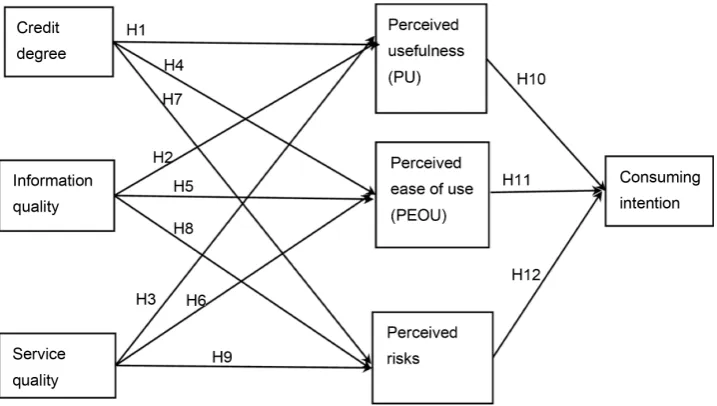
In the previous literature reviews, TAM has been used by many scholars to study the influence factors of consumer behavior in electronic commerce, and some scholars made some improvements of the TAM in the light of the actual needs of the research. Therefore, this study also takes the TAM as the basic framework. We carry on certain modifications and supplements of this model with the actual situation of network con-sumption, and put forward the following model. As shown in the following picture, the independent variables are the three major characteristics of online retailers: credibility, information quality and service quality; the middle variables are three consumer per-ception: perceived usefulness (PU); perceived ease of use (PEOU) and perceived risks; the dependent variables is consuming intention. The relationship between various va-riables of the model is shown with the arrow in Figure 1.
3.2. Research Hypothesis
1) Characteristics of Online Retailers and Perceived Usefulness
[image:6.595.195.554.474.677.2]According to the definition of perceived usefulness by Davis (1989), we define per- ceived usefulness as the degree of consumers’ belief of how online shopping will im-prove the efficiency of shopping or save cost [5]. The most prominent advantage of network retailing is its convenience and speed. You can get your favorite products with only some clicks. However, due to the overloading online information, it is difficult to distinguish information that can provide a basis for their decision making. People need to spend a lot of time to collect information before making shopping decisions. Retail-ers’ reputation will affect the consumer’s perception of the product information. Mu-dambi and Schuff (2010) used the theory of information economics to analyze online
Figure 1. The influencing factors model of network consumption intention under B2C
product reviews, and thought that the depth of reviews can improve the diagnostic power of information [27]. When consumers have a positive or negative attitude to some products, but still not decide to buy or give up them, high quality WOM can help consumers classify them. Therefore, consumers can improve the efficiency of purchas-ing and reduce transaction time and energy cost. Huang and Tsang (2011) analyzed the factors that arouse the ripple effect of WOM from the perspective of e-WOM commu-nication, and pointed out the main factor is perceived quality of information, which has a significant positive correlation with information reception [28]. In ELM model, Petty and Cacioppo (1993) put forward that information quality is an important factor to de-termine the persuasive power [29]. Saeed et al. (2003) also considers that service quality has impact on perceived usefulness [30].
In conclusion, we put forward the following hypothesis:
(H1): Credit degree of online retailers is positively associated with the perceived use-fulness of consumers.
(H2): Information quality of online retailers is positively associated with the per-ceived usefulness of consumers.
(H3): Service quality of online retailers is positively associated with the perceived usefulness of consumers.
2) Characteristics of Online Retailers and Perceived Ease of Use (PEOU)
Perceived ease of use is defined as the ease degree to which consumers believe the use of this technology (Davis, 1989) [5]. It can be defined as the ease degree with which the consumer considers the operation in the transaction process under network transac-tions in the B2C environment. Online retailers must ensure consumers to get desired information conveniently and fast, on the premise of providing useful information. Moreover, they need to provide consulting services in a smooth and quick way. From the daily shopping experience, we can know that high quality information and high quality service contribute greatly to convenient and fast online shopping, and also help consumers solve their problems. Therefore, the perceived ease of use of online shop-ping is higher. At the same time, retailers with high credit degree can enhance the sense of trust of consumers. Consumers with higher perceived ease of use are more likely to buy.
In conclusion, we put forward the following hypothesis:
(H4): Credit degree of online retailers is positively associated with perceived ease of use of consumers.
(H5): Information quality of online retailers is positively associated with perceived ease of use of consumers.
(H6): Service quality of online retailers is positively associated with perceived ease of use of consumers.
3) Characteristics of Online Retailers and Perceived Risks
sumer shopping intention [32]. Ganeson and Shankar (1994) found that the retailer’s reputation is very important in the study of the factors influencing the perceived risks of the retailers. Consumers generally believe that a reputable online retailer can reduce the negative impact caused by the high risk levels contained in the network. The higher service quality the retailers provide, the more likely that consumers feel that the retailer can reduce perceived risks. Many empirical studies suggest that there is a negative cor-relation between service quality and customer perceived risk.
In conclusion, we put forward the following hypothesis:
(H7): Credit degree of online retailers is negatively associated with perceived risk of consumers.
(H8): Information quality of online retailers is negatively associated with perceived risk of consumers.
(H9): Service quality of online retailers is negatively associated with perceived risk of consumers.
4) Perceptions of Consumers and Purchasing Intention
Research shows that if the users feel that they just need relatively little cognitive ef-fort in the process of interacting with the technology, they will be more likely to inte-ract with the technology. Davis put forward that perceived usefulness is the predictors of using behavior when he proposed TAM. Many subsequent studies have found that users’ acceptance of information technology is largely driven by perceived usefulness (Davis et al. 1989; Adams et al., 1992; Szajna, 1996; Venkatesh & Davis, 2000) [5][33]. Studies have proved that perceived usefulness is an important factor to predict the ac-ceptance of e-commerce model, and it has significant influence on the attitude, inten-tion and behavior about using e-commerce (Gefen & Straub, 2000; Feathennan & Pav-lou, 2003) [32][34]. In the study of online shopping intention, Thompson (2003) found that perceived risk will lead to consumers’ negative assessment on the transaction. The more positive the overall assessment of the transaction is, the greater the willingness of online shopping is. Sandra (2003) believed that perceived risk had direct negative ef-fects on the purchase attitude and purchase intention. Nadia (2004) qualitatively stu-died the relationship between perceived risks and trust level by E-mail interviews. The perceived risks will reduce the level of trust, and also obscure benefits of network shop-ping reduces the consumer’s income. Finally, it lowers consumers’ interests.
In conclusion, we put forward the following hypothesis:
(H10): Perceived usefulness of consumers is positively associated with purchase in-tention.
(H11): Perceived ease of use of consumers is positively associated with purchase in-tention.
(H12): Perceived risks are negatively associated with purchase intention.
4. Method and Results
4.1. Research Design and Sample Description
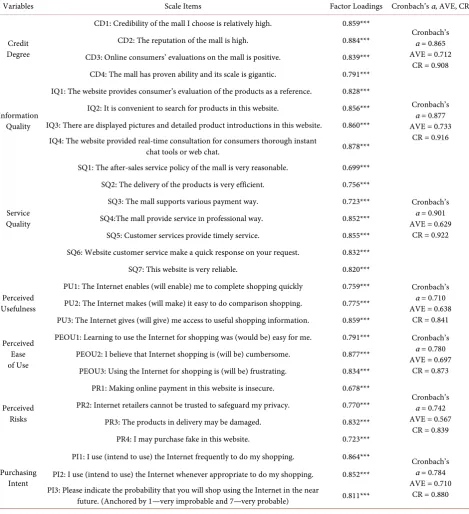
tions about Internet shopping. The questionnaire includes two parts. The first part is about basic information, such as gender, grade, education background and so on. The second part investigates 7 factors of the model with a total of 28 items. We created the scale by referring to the related measurement of variables in this study, and then ad-justing it to this study. The scales are composed of 4 items of credit degree referring to the scale of (LeBlanc and Nguyen, 2001) [35]; 4 items of information quality referring to (Chae M., Kim J., et al. 2005); 7 items of service quality referring to Zeithaml (2000) and Parasuramanl (2005); 3 items of perceived usefulness referring to L.R. Vijayasara-thy (2004); 3 items of perceived ease of use referring to L.R. VijayasaraVijayasara-thy (2004); 4 items of perceived risks referring to Jacoby and Kaplan (1974) [11]; 3 items of purchas-ing intention referrpurchas-ing to L.R. Vijayasarathy (2004) [36]. Consumers were investigated by filling out Likert seven-point scale (Please indicate the extent to which you agree with each of the following statements by using the following scale: 1 = strongly disag-ree, 2 = disagdisag-ree, 3 = slightly disagdisag-ree, 4 = neutral, 5 = slightly agdisag-ree, 6 = agdisag-ree, 7 = strongly agree).
This study is based on the TAM, and examines the influence of retailer characteris-tics on the purchasing intention of consumers. Participants were mostly adults working or residing in Zhujiang New Town, a CBD with a population of about 300,000. Ques-tionnaire release time was from July 1, 2016 to July 22, 2016. We collected 322 ques-tionnaires, and we finally acquired 275 after deleting the invalid quesques-tionnaires, the va-lid rate of questionnaires is 85.4%. In recovered samples, men accounted for 59%; women accounted for 41%. Those whose age between 21 to 25 years old and 26 to 30 years old accounted for 37.9% and 37.4% separately. The population of those who searches the Internet 3 - 5 hours every day is 73, accounting for 26.7%; 5 hours and above 106 people, accounting for 38.5%. It suggested that the investigated group has relatively high network familiarity. The population of those who have shopped over ten times last year accounts for 84.1%, and who spent more than 2000 online shopping in the past year accounted for 69.7%.
4.2. Reliability and Validity Test
Reliability refers to consistency, stability and reliability of the test results, that is, the ex-tent to which the consistency of the results if we do repeated test. Scholars commonly use Cronbach’s α to test reliability, internal consistency. Generally, we think that the reliabili-ty is high if Cronbach’s α value is higher than 0.7. As shown in Table 1, The Cronbach’s α value of all variables are above 0.7, which shows that the scale has good reliability.
Table 1. Reliability and validity of all variables.
Variables Scale Items Factor Loadings Cronbach’s α, AVE, CR
Credit Degree
CD1: Credibility of the mall I choose is relatively high. 0.859***
Cronbach’s α = 0.865 AVE = 0.712
CR = 0.908 CD2: The reputation of the mall is high. 0.884***
CD3: Online consumers’ evaluations on the mall is positive. 0.839*** CD4: The mall has proven ability and its scale is gigantic. 0.791***
Information Quality
IQ1: The website provides consumer’s evaluation of the products as a reference. 0.828***
Cronbach’s α = 0.877 AVE = 0.733
CR = 0.916 IQ2: It is convenient to search for products in this website. 0.856***
IQ3: There are displayed pictures and detailed product introductions in this website. 0.860*** IQ4: The website provided real-time consultation for consumers thorough instant
chat tools or web chat. 0.878***
Service Quality
SQ1: The after-sales service policy of the mall is very reasonable. 0.699***
Cronbach’s α = 0.901 AVE = 0.629
CR = 0.922 SQ2: The delivery of the products is very efficient. 0.756***
SQ3: The mall supports various payment way. 0.723*** SQ4:The mall provide service in professional way. 0.852*** SQ5: Customer services provide timely service. 0.855*** SQ6: Website customer service make a quick response on your request. 0.832*** SQ7: This website is very reliable. 0.820***
Perceived Usefulness
PU1: The Internet enables (will enable) me to complete shopping quickly 0.759*** Cronbach’s α = 0.710 AVE = 0.638
CR = 0.841 PU2: The Internet makes (will make) it easy to do comparison shopping. 0.775***
PU3: The Internet gives (will give) me access to useful shopping information. 0.859***
Perceived Ease of Use
PEOU1: Learning to use the Internet for shopping was (would be) easy for me. 0.791*** Cronbach’s α = 0.780 AVE = 0.697
CR = 0.873 PEOU2: I believe that Internet shopping is (will be) cumbersome. 0.877***
PEOU3: Using the Internet for shopping is (will be) frustrating. 0.834***
Perceived Risks
PR1: Making online payment in this website is insecure. 0.678***
Cronbach’s α = 0.742 AVE = 0.567
CR = 0.839 PR2: Internet retailers cannot be trusted to safeguard my privacy. 0.770***
PR3: The products in delivery may be damaged. 0.832*** PR4: I may purchase fake in this website. 0.723***
Purchasing Intent
PI1: I use (intend to use) the Internet frequently to do my shopping. 0.864*** Cronbach’s α = 0.784 AVE = 0.710
CR = 0.880 PI2: I use (intend to use) the Internet whenever appropriate to do my shopping. 0.852***
PI3: Please indicate the probability that you will shop using the Internet in the near
future. (Anchored by 1—very improbable and 7—very probable) 0.811*** Note: ***means p < 0.001.
4.3. Structure Model and Path Test
We used Amos 21.0 to analyze 3.3 structure model and relationship between variables in this study. In this model, absolute fitness index are as follows: χ2 = 637.675, df = 335,
GFI (0.813) > 0.80, CFI (0.896) > 0.80, RMR (0.063) < 0.08, RMSEA (0.068) < 0.08, all of which are acceptable. Reduced fitness index includes PNFI (0.714) and PCFI (0.794), both of which are above 0.5 and are acceptable. IFI (0.897), RFI (0.802) and NFI (0.815) are above 0.80. χ2/df (1.904) < 3. These data indicate that the structural model of this
study has good fitness.
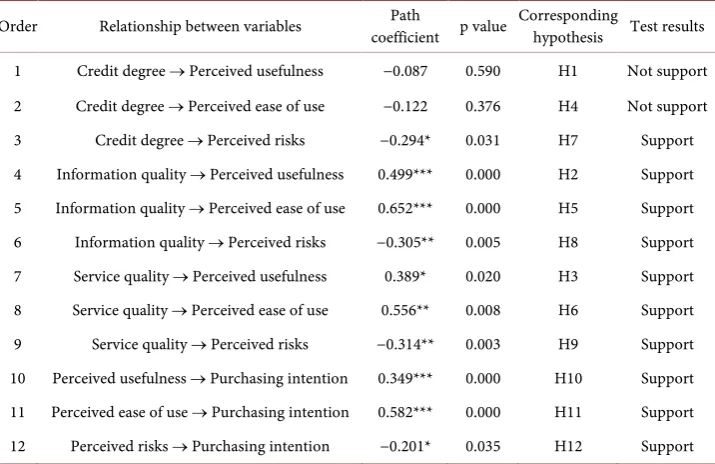
[image:11.595.192.554.260.404.2]As the path coefficient and the significance of hypothesis test shown in Table 3, we can know that all hypotheses except H1, H4 are proved: 1) credit degree negatively influence
Table 2. Correlation coefficient table matrix between variables.
Variables 1) Perceive usefulness 2) Perceived ease of use 3) Perceived risks 4) Credit degree 5) Information quality 6) Service quality 7) Purchasing intention
1 0.799
2 −0.216** 0.835
3 0.565** −0.288** 0.753
4 0.415** 0.498** −0.319** 0.844
5 0.461** 0.616** −0.391** 0.704** 0.856
6 0.356** 0.416** −0.218** 0.562** 0.506** 0.793
7 0.525** 0.596** −0.307** 0.444** 0.595** 0.417** 0.843 Note: *represents p < 0.05; **represents p < 0.01; ***represents p < 0.001; the values of the diagonal are the square root of the AVE.
Table 3. Path coefficients and hypothesis verification of theoretical model.
Order Relationship between variables coefficient p value Path Corresponding hypothesis Test results
[image:11.595.194.552.461.693.2]perceived risks (p < 0.05); 2) information quality has a significant positive impact on perceived usefulness (p < 0.001) and perceived ease of use (p < 0.001), and a significant negative impact on perceived risk (p = 0.005 < 0.05); 3) service quality has a significant positive impact on perceived usefulness (p < 0.05) and perceived ease of use (p < 0.01), and the impact on the perceived risk is not significant (p < 0.01); 4) perceived useful-ness (p < 0.001) and perceived ease of use (p < 0.001) positively influence purchasing intention, perceived risks (p < 0.05) negatively influence purchasing intention.
5. Discussion and Conclusion
Basing on TAM, we construct the model of how characteristics of online retailers im-pact on customer purchasing intention. The results show that the information quality and service quality have positive effect on perceived usefulness and perceived ease of use, that is, the higher the quality of information supplied by retailers is, or the higher perceived service quality is, the more usefulness and ease of use consumer perceive. The credit, information quality, and service quality are all negatively impact on perceived risk, that is, the higher the credibility of the retailer, the higher the quality of informa-tion provided and the higher the quality service, the lower the risk consumers feel. Cre-dit degree has no significant influence on perceived usefulness and perceived ease of use. Generally speaking, credit degree of online retailers may have impact on consumer choices. However, through the analysis of model data, we found this effect is not re-flected in the improvement of purchasing performance. A high credit degree of the network retailers can only mean that their business activities are more formal, and they provide guaranteed products, but does not mean that there is a price advantage or the purchasing efficiency is higher. Furthermore, the evaluation of online consumers on the products may affect the initial impression on online retailers, but consumers do not necessarily be familiar with the shopping website by other consumers’ evaluation. Per-ceived ease of use is mainly affected by skill level of computer use and the experience of network shopping. Perceived usefulness and perceived ease of use positively influence on consumer purchasing intention, but perceived risks negatively influence purchasing intention, that is, the more the provided efficiency and convenience are, the higher the purchase intention is. When perceived risks are lower, the purchase intention is relative higher.
Today, online shopping is increasingly popular and consumers can buy almost every- thing on the Internet. Improving the credit degree, information quality and service quality of enterprises can effectively improve the consumers’ purchasing efficiency and convenience, and reduce consumers’ perceived risk. High perceived ease of use and perceived usefulness is the key to improve the online shopping intention. This paper has practical significance for the construction of a retailing shopping site.
Firstly, online retailers should focus on the information display of products. They need to make corresponding display scheme according to different kinds of products. They also need to make efforts to lay consumer’s doubts. For those giant retailers, they can also try to use innovative display method or purchase innovative and efficient shopping assisted technology. For example, consumers buying the clothing on the In-ternet worry most about whether clothes fit, so if there is an excellent solution for this problem, they can easily develop the online clothing market.
Secondly, online retailers should provide good service quality in the whole shopping process. They need to train their employees to be professional so consumers can have a wonderful experience whether in pre-consulting or during the searching or checkout. There is no significant price difference between different online retailers in the compet-itive online shopping market. Therefore, online retailers need to differentiate their ser-vice if they want to develop and grow.
Limitations to this study are in the areas of sampling and external factors. Firstly, the participants of this study are mainly B2C online shoppers. We do not include other on-line shopping way. Therefore, whether the conclusions can be extended to other net-work shopping way, such as C2C, has yet to be further studied. Secondly, we only con-sider three antecedents of consumer perception, namely the retailer’s credit degree, in-formation quality, service quality, but not include external factors. In fact, other exter-nal factors such as the popularity of online shopping, novelty, etc. may also affect con-sumer perception, and these external factors can be taken into account in future stu-dies.
Acknowledgements
The authors would like to thank the Editor and anonymous referees for their helpful comments and suggestion.
References
[1] CNNIC (2016) 38th China Internet Development Statistics Report. China Internet Network Information Center.
http://www.cnnic.cn/hlwfzyj/hlwxzbg/hlwtjbg/201608/t20160803_54392.htm
[2] Mullet, G.M. and Karson, M.J. (1985) Analysis of Purchase Intent Scales Weighted by Probability of Actual Purchase. Journal of Marketing Research, 22, 93-96.
http://dx.doi.org/10.2307/3151555
[3] Dodds, W.B. (1991) In Search of Value: How Price and Store Name Information Influence Buyers’ Product Perceptions. Journal of Services Marketing, 5, 27-36.
[4] Kavanoor, S., Grewal, D. and Blodgett, J. (1997) Ads Promoting OTC Medications: The Ef-fect of Ad Format and Credibility on Beliefs, Attitudes, and Purchase Intentions. Journal of Business Research, 40, 219-227. http://dx.doi.org/10.1016/S0148-2963(96)00238-X
[5] Davis, F.D. (1989) Perceived Usefulness, Perceived Ease of Use, and User Acceptance of Information Technology. MIS Quarterly, 13, 319-340. http://dx.doi.org/10.2307/249008
[6] Venkatesh, V. and Davis, F.D. (2000) A Theoretical Extension of the Technology Accep-tance Model: Four Longitudinal Field Studies. Management Science, 46, 186-204.
http://dx.doi.org/10.1287/mnsc.46.2.186.11926
[7] Bauer, R.A. (1967) Consumer Behavior as Risk Taking. In: Cox, D.F., Ed., Risk Taking & Information Handling in Consumer Behavior, Graduate School of Business Administra-tion, Harvard University, Boston, 23-33
[8] Cox, D.F. (1967) Risk Taking and Information Handling in Consume Behavior. 6, No. 1. [9] Cunningham, S.M. (1967) The Major Dimensions of Perceived Risk. In: Cox, D.F., Ed., Risk
Taking and Information Handling in Consumer Behavior, Harvard University Press, Bos-ton, MA.
[10] Forsythe, S.M. and Shi, B. (2003) Consumer Patronage and Risk Perceptions in Internet Shopping. Journal of Business Research, 56, 867-875.
http://dx.doi.org/10.1016/S0148-2963(01)00273-9
[11] Kaplan, L.B., Szybillo, G.J. and Jacoby, J. (1974) Components of Perceived Risk in Product Purchase: A Cross-Validation. Journal of Applied Psychology, 59, 287-291.
http://dx.doi.org/10.1037/h0036657
[12] Stone, R. and Gronhaug, K. (1993) Perceived Risk: Further Considerations for the Market-ing Discipline. European Journal of Marketing, 27, 39-50.
http://dx.doi.org/10.1108/03090569310026637
[13] Miyazaki, A.D. and Krishnamurthy, S. (2002) Internet Seals of Approval: Effects on Online Privacy Policies and Consumer Perceptions. Journal of Consumer Affairs, 36, 28-49.
http://dx.doi.org/10.1111/j.1745-6606.2002.tb00419.x
[14] Dong, D.H., et al. (2005) Study on the Structure of Perceived Risk of Consumers’ Online Shopping. Chinese Journal of Management, 2, 55-60.
http://glxb.hust.edu.cn/CN/article/showZhaiYao.do?id=9266
[15] Zeithaml, V.A., Parasuraman, A. and Malhotra, A. (2002) Service Quality Delivery through Web Sites: A Critical Review of Extant Knowledge. Journal of the Academy of Marketing Science, 30, 362-375. http://dx.doi.org/10.1177/009207002236911
[16] Santos, J. (2003) E-Service Quality: A Model of Virtual Service Quality Dimensions. Man-aging Service Quality, 13, 233-246. http://dx.doi.org/10.1108/09604520310476490
[17] Parasuraman, A., Zeithaml, V.A. and Malhotra, A. (2005) E-S-Qual: A Multiple-Item Scale for Assessing Electronic Service Quality. Journal of Service Research, 7, 213-233.
http://dx.doi.org/10.1177/1094670504271156
[18] Zhao, W.H. and Xiong, X.M. (2015) Measurement and Management of Online Retail Ser-vice Quality—Based on Chinese Context. Business Review, 27, 120-130.
http://www.glplzz.com/CN/abstract/abstract382.shtml
[19] Guo, Z.Q. (2014) Evaluation of Service Quality of Online Retailers Based on KANO Model. Business Economy, No. 18, 38-40.
[20] Hampton-Sosa, W. and Koufaris, M. (2005) The Effect of Web Site Perceptions on Initial Trust in the Owner Company. International Journal of Electronic Commerce, 10, 55-81. [21] Weigelt, K. and Camerer, C. (1988) Reputation and Corporate Strategy: A Review of Recent
http://dx.doi.org/10.1002/smj.4250090505
[22] Herbig, P. and Milewicz, J. (1993) The Relationship of Reputation and Credibility to Brand Success. Journal of Consumer Marketing, 10, 18-24.
http://dx.doi.org/10.1108/EUM0000000002601
[23] Fombrun, C.J. (1996) Reputation: Realizing Value from the Corporate Image. Harvard Business School Press, Harvard.
[24] Kotha, S., Rajgopal, S. and Rindova, V. (2001) Reputation Building and Performance: An Empirical Analysis of the Top-50 Pure Internet Firms. European Management Journal, 19, 571-586. http://dx.doi.org/10.1016/S0263-2373(01)00083-4
[25] Delone, W.H. and Mclean, E.R. (1992) Information Systems Success: The Quest for the Dependent Variable. Information Systems Research, 3, 60-95.
http://dx.doi.org/10.1287/isre.3.1.60
[26] Delone, W.H. and Mclean, E.R. (2003) The Delone and Mclean Model of Information Sys-tem Success: A Ten-Year Update. Journal of Management Information Systems, 19, 9-30. [27] Mudambi, S.M. and Schuff, D. (2010) What Makes a Helpful Online Review? A Study of
Customer Reviews on Amazon. Com. MIS Quarterly, 34, 185-200.
[28] Huang, M., Cai, F., Tsang, A.S.L. and Zhou, N. (2011) Making Your Online Voice Loud: The Critical Role of WOM Information. European Journal of Marketing, 45, 1277-1297.
http://dx.doi.org/10.1108/03090561111137714
[29] Petty, R.E., Wegener, D.T., Fabrigar, L.R., Priester, J.R. and Cacioppo, J.T. (1993) Concep-tual and Methodological Issues in the Elaboration Likelihood Model of Persuasion: A Reply to the Michigan State Critics. Communication Theory, 3, 336-342.
http://dx.doi.org/10.1111/j.1468-2885.1993.tb00078.x
[30] Choudhary, A.I., Saeed, S., Humayon, A.A. and Humyon, A.A. (2015) Service Quality Fac-tors Affecting Adoption of Internet Banking In Pakistan.International Journal of Econom-ics, Commerce and Management, 3, 1-10.
[31] Mitchell, V. (1999) Consumer Perceived Risk: Conceptualisations and Models. European Journal of Marketing, 33, 163-195. http://dx.doi.org/10.1108/03090569910249229
[32] Featherman, M.S. and Pavlou, P.A. (2003) Predicting E-Services Adoption: A Perceived Risk Facets Perspective. International Journal of Human-Computer Studies, 59, 451-474.
http://dx.doi.org/10.1016/S1071-5819(03)00111-3
[33] Szajna, B. (1996) Empirical Evaluation of the Revised Technology Acceptance Model. Man-agement Science, 42, 85-92. http://dx.doi.org/10.1287/mnsc.42.1.85
[34] Gefen, D., Straub, D. and Boudreau, M. (2000) Structural Equation Modeling and Regres-sion: Guidelines for Research Practice. Communications of the Association of Information Systems, 4, Article 7.
[35] Nguyen, N. and Leblanc, G. (2001) Corporate Image and Corporate Reputation in Cus-tomers’ Retention Decisions in Services. Journal of Retailing & Consumer Services, 8, 227- 236. http://dx.doi.org/10.1016/S0969-6989(00)00029-1
Submit or recommend next manuscript to SCIRP and we will provide best service for you:
Accepting pre-submission inquiries through Email, Facebook, LinkedIn, Twitter, etc. A wide selection of journals (inclusive of 9 subjects, more than 200 journals)
Providing 24-hour high-quality service User-friendly online submission system Fair and swift peer-review system
Efficient typesetting and proofreading procedure
Display of the result of downloads and visits, as well as the number of cited articles Maximum dissemination of your research work
Submit your manuscript at: http://papersubmission.scirp.org/