University of Pennsylvania
ScholarlyCommons
Publicly Accessible Penn Dissertations
1-1-2013
Optimizing Adaptive Marketing Experiments with
the Multi-Armed Bandit
Eric Michael Schwartz
University of Pennsylvania, [email protected]
Follow this and additional works at:http://repository.upenn.edu/edissertations
Part of theAdvertising and Promotion Management Commons, and theMarketing Commons
This paper is posted at ScholarlyCommons.http://repository.upenn.edu/edissertations/694
Recommended Citation
Schwartz, Eric Michael, "Optimizing Adaptive Marketing Experiments with the Multi-Armed Bandit" (2013).Publicly Accessible Penn Dissertations. 694.
Optimizing Adaptive Marketing Experiments with the Multi-Armed
Bandit
Abstract
Sequential decision making is central to a range of marketing problems. Both firms and consumers aim to maximize their objectives over time, yet they remain uncertain about the best course of action. So they allocate resources to both explore to reduce uncertainty (learning) and exploit their current information for immediate reward (earning). This explore/exploit tradeoff is best captured by the multi-armed bandit, the conceptual and methodological backbone of this dissertation. We focus on this class of marketing problems and aim to make the following substantive and methodological contributions. Our substantive contribution is that we solve an important and practical marketing problem with challenges that exceed those handled by existing multi-armed bandit methods: sequentially allocating resources for online advertising to acquire customers. Online advertisers serve millions of ad impressions to learn which ads work best on which websites. However, recognizing that ad effectiveness differs by website in unobserved ways creates a methodological challenge. Our methodological contribution is that we propose a novel bandit policy that simultaneously handles attributes of ads and how their importance differs across websites (heterogeneity) to generate recommended allocations of ad impressions. We not only test this in simulation, but we also run a live field experiment with a large retail bank to improve customer acquisition rates, lowering the firm's cost per acquisition. Serving ads across websites is just one of a broader class of problems. Broadening our scope to that class, we aim to contribute a body of empirical results to better understand how key managerial issues in marketing experiments affect the performance of bandit methods. As firms become more sophisticated in their ability to test and adapt quickly, managers and researchers should understand the empirical realities of the problems and policies, such as, under what conditions do certain methods perform better than other methods. We run a numerical experiment motivated by common managerial issues to learn about these contingencies of bandit methods. Finally, while the literature spans disparate fields of research, we hope to organize the various streams of work to better guide future research using multi-armed bandit methods to solve marketing problems.
Degree Type Dissertation
Degree Name
Doctor of Philosophy (PhD)
Graduate Group Marketing
First Advisor Eric T. Bradlow
Subject Categories
OPTIMIZING ADAPTIVE MARKETING EXPERIMENTS WITH THE
MULTI-ARMED BANDIT
Eric M. Schwartz
A DISSERTATION
in
Marketing
For the Graduate Group in Managerial Science and Applied Economics
Presented to the Faculties of the University of Pennsylvania
in
Partial Fulfillment of the Requirements for the
Degree of Doctor of Philosophy
2013
Supervisor of Dissertation Co-Supervisor of Dissertation
Eric T. Bradlow Peter S. Fader
Professor of Marketing, Statistics and Education Professor of Marketing
Graduate Group Chairperson
Eric T. Bradlow
Professor of Marketing, Statistics and Education
Dissertation Committee
OPTIMIZING ADAPTIVE MARKETING EXPERIMENTS WITH THE
MULTI-ARMED BANDIT
c
COPYRIGHT
2013
Eric M. Schwartz
This work is licensed under the
Creative Commons Attribution
NonCommercial-ShareAlike 3.0
License
To view a copy of this license, visit
ACKNOWLEDGEMENTS
I have many people and organizations to thank for making this dissertation possible. I list
them here.
• Every teacher and professor I have ever had in class for the past 9 years at Penn and
13 years before that at Herricks.
• Every coffee shop in Philadelphia.
• The group formerly-known-as ING Direct digital marketing team and the Traffic
Buyer team.
• The Jay H. Baker Retailing Initiative.
• The Wharton Risk Management and Decision Processes Center.
• The Wharton Customer Analytics Initiative.
• The Wharton Marketing Department staff and the Wharton Marketing PhD students.
• My extended academic family.
• My committee, Raghu Iyengar and Chrisophe Van den Bulte.
• My advisors, Pete Fader and Eric Bradlow.
• My closest friends.
• My family, Mom and Dad, Barry, Marla, and Blake.
ABSTRACT
OPTIMIZING ADAPTIVE MARKETING EXPERIMENTS WITH THE
MULTI-ARMED BANDIT
Eric M. Schwartz
Eric T. Bradlow and Peter S. Fader
Sequential decision making is central to a range of marketing problems. Both firms and
consumers aim to maximize their objectives over time, yet they remain uncertain about the
best course of action. So they allocate resources to explore, to reduce uncertainty
(learn-ing), and also to exploit their current information for immediate reward (earning). This
explore/exploit tradeoff is best captured by the multi-armed bandit, the conceptual and
methodological backbone of this dissertation. We focus on this class of marketing
prob-lems and aim to make the following substantive and methodological contributions. Our
substantive contribution is that we solve an important and practical marketing problem with
challenges that exceed those handled by existing multi-armed bandit methods: sequentially
allocating resources for online advertising to acquire customers. Online advertisers serve
millions of ad impressions to learn which ads work best on which websites. However,
recognizing that ad effectiveness differs by website in unobserved ways creates a
method-ological challenge. Our methodmethod-ological contribution is that we propose a novel bandit
pol-icy that simultaneously handles attributes of ads and how their importance differs across
only test this in simulation, but we also run a live field experiment with a large retail bank
to improve customer acquisition rates, lowering the firm’s cost per acquisition. Serving
ads across websites is just one of a broader class of problems. Broadening our scope to
that class, we aim to contribute a body of empirical results to better understand how key
managerial issues in marketing experiments affect the performance of bandit methods. As
firms become more sophisticated in their ability to test and adapt quickly, managers and
researchers should understand the empirical realities of the problems and policies, such as,
under what conditions certain methods perform better than other methods. We run a
numer-ical experiment motivated by common managerial issues to learn about these contingencies
of bandit methods. Finally, while the literature spans disparate fields of research, we hope
to organize the various streams of work to better guide future research using multi-armed
Table of Contents
Acknowledgements iii
Abstract iv
List of Tables x
List of Figures xi
1 Introduction 1
2 Improving Customer Acquisition through Adaptive Online Display
Adver-tising Experiments 7
2.1 Introduction . . . 7
2.2 Online Display Advertising and Bandit Problems . . . 11
2.3 Formalizing Online Display Advertising as a Multi-armed Bandit Problem . 14 2.3.1 MAB Problem Component: Learning . . . 15
2.3.2 MAB Problem Component: Attribute Structure . . . 15
2.3.3 MAB Problem Component: Hierarchical Structure . . . 16
2.3.5 MAB Optimization Problem . . . 18
2.4 MAB Policies . . . 22
2.4.1 Randomized Probability Matching with a Generalized Linear Mixed Model . . . 22
2.4.2 RPM-LC: Latent-Class GLM with RPM . . . 32
2.4.3 RPM-GLM: Homogeneous GLM with RPM . . . 34
2.4.4 RPM-Binomial . . . 36
2.4.5 Test-Rollout Policy . . . 37
2.4.6 Greedy Policy . . . 38
2.4.7 Epsilon-Greedy Policy . . . 39
2.5 Field Experiment . . . 42
2.5.1 Design and Implementation . . . 42
2.5.2 Field Experiment Results . . . 45
2.5.3 A Closer Look at the RPM-GLMM Policy . . . 50
2.6 Policy Simulations Based on Field Experiment Data . . . 60
2.6.1 Performing Policy Simulations . . . 61
2.6.2 Replicating the Field Experiment . . . 63
2.6.3 Benchmark MAB Policies . . . 64
2.7 General Discussion . . . 72
3 Managerial Issues in Implementing Attribute-Based Batched Bandit
3.1 Introduction . . . 76
3.2 Illustration of a Marketing Experiment . . . 80
3.3 Existing Evidence . . . 84
3.4 Managerial Issues Involved in Bandit Problems . . . 88
3.5 Formalizing the Attribute-Based Batched MAB Problem . . . 90
3.6 Design of Numerical Experiment . . . 93
3.6.1 Fractional Factorial Designs and Bandit Policies . . . 98
3.7 Empirical Results . . . 100
3.7.1 Reference Case . . . 102
3.7.2 Batch Size and Time . . . 103
3.7.3 Initial Period Length . . . 105
3.7.4 Distribution of True Means . . . 107
3.7.5 Incidence Rate . . . 108
3.7.6 Design Matrix with Intermediate Complexity . . . 111
3.7.7 Simple Experimental Designs . . . 115
3.8 General Discussion . . . 115
4 Conclusion 122 4.1 Hierarchical Models, RPM, Optimizing Batch Size, and Expected Value of Information . . . 123
4.2 Bandit Problems Throughout the Customer Life Cycle . . . 125
4.4 Consumer Learning Models: Econometric Perspective and Dynamic
Dis-crete Choice Models . . . 127
List of Tables
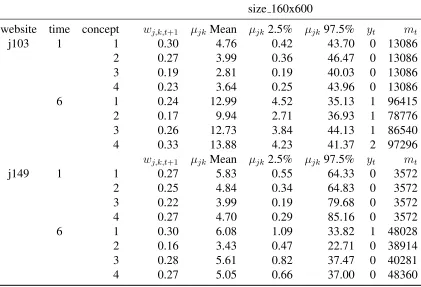
2.1 Values from Figure 2.7 for ad size 160x600 . . . 54
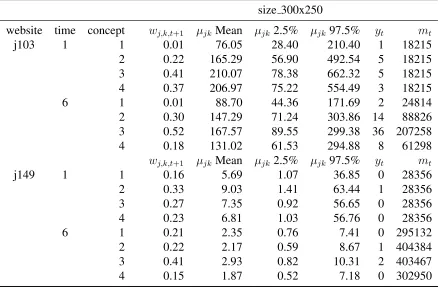
2.2 Values from Figure 2.7 for ad size 300x250 . . . 56
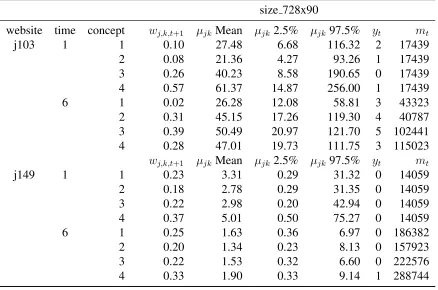
2.3 Values from Figure 2.7 for ad size 728x90 . . . 57
2.4 Summary of rewards for MAB policies using RPM . . . 68
2.5 Quantiles of rewards for MAB policies using RPM . . . 68
2.6 Summary of rewards for test-rollout policies varying test period length. . . . 68
2.7 Summary of reward for test-rollout and epsilon-greedy policies . . . 70
2.8 Quantiles of reward of simple epsilon-greedy and test-rollout policies. . . . 70
3.1 Design of numerical experiment . . . 97
3.2 Results from 2x3x4x5 design . . . 105
3.3 Results from 2x2x2x2 design . . . 112
3.4 Results from 3x3 design and 10 independent actions . . . 116
List of Figures
2.1 Display advertisements used in field experiment . . . 43
2.2 Results observed in field experiment . . . 46
2.3 Variability around field experiment results . . . 49
2.4 Effects of ad size and ad concept . . . 51
2.5 Conversion rate beliefs (probability scale) . . . 52
2.6 Conversion rate beliefs (log-odds scale) . . . 53
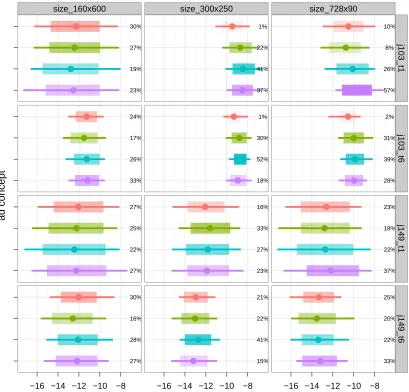
2.7 Heterogeneity in conversion rates across websites and learning over time . . 55
2.8 Boxplots of reward distributions for a wide range of MAB policies . . . 66
2.9 Reward distributions from RPM-based policies . . . 67
2.10 Densities of reward for test-rollout policies . . . 69
Chapter 1
Introduction
Sequential decision making problems appear across marketing domains. These
problems can look quite different on the surface. For example, firms repeatedly
reallo-cate budgets across ads to acquire customers. Similarly, consumers make repeat purchases
in a product category while learning about product quality to maximize utility. Despite the
superficial differences, these problems center on a dynamic tradeoff between exploration
and exploitation. This tradeoff is best captured by the multi-armed bandit framework.
The multi-armed bandit problem (MAB) is a classic sequential sampling problem
(Robbins 1952; Thompson 1933). It captures the essence of exploration/exploitation
ten-sions in problems ranging from clinical trials and manufacturing to oil drilling and
adver-tising, and it is covered in texts in statistics, operations, economics, and computer science
(Berry and Fristedt 1985; Gittins et al. 2011; Sutton and Barto 1998). In the MAB
alternatives (e.g., slot machines, a.k.a. one-armed bandits) to maximize the expected sum
of rewards earned from actions over time. But the actions’ expected rewards are unknown,
and the decision maker can only learn which actions are better than others by repeatedly
selecting different actions and observing the corresponding rewards. While some
learn-ing is necessary, it is not the end goal; instead, learnlearn-ing is a means to an end, maximizlearn-ing
reward. Therefore, a solution to the MAB problem must balance the tension between
explo-ration and exploitation: learning in order to improve future rewards and earning immediate
rewards based on the current state of information. This explore-exploit tension is
funda-mental to the marketing domains highlighted here and the broader class of problems they
represent.
We argue that there is a need for a closer focus on, and integration of, research
related to multi-armed bandit problems in marketing. The primary reason we focus on this
issue is the proliferation of marketing experiments. Marketers are increasingly running live
experiments as part of routine operations (e.g., A/B and multivariate tests). These tests
are becoming easier to conduct because simple random assignment of treatments of digital
content is straightforward (e.g., randomly deliver different versions of websites, emails, or
online ads). While firms may be adaptive, using what they learn from tests to determine
their next steps, they do this in an ad hoc way. Instead, a principled approach centers on
the MAB problem. MAB methods provide tools for firms to conduct those experiments
as profitably as possible, achieving higher levels of earning during the experiment, and
Each chapter of this dissertation addresses a different conceptual, methodological,
or substantive aspect of multi-armed bandit problems in marketing. In Chapter 2,
“Improv-ing Customer Acquisition through Adaptive Online Display Advertis“Improv-ing Experiments,” we
focus on one particular managerial problem, frame it as a bandit problem that does not have
an existing solution framework, propose such a solution (i.e., a policy), and implement it
with a firm in a real-time field experiment. In particular, an online advertiser serves its
online display ads across many websites to acquire customers. We frame this as a
compli-cated bandit problem with many components: attributes (i.e., ads are described by size and
concept attributes), batching (i.e., we cannot allocate ad impressions one-by-one, so we
use decision rules to allocate groups of millions of impressions for each time period), and,
most importantly, hierarchical structure (i.e., the firm delivers the ads on many websites, so
there is a within-website bandit problem but the impact of those same ads may differ across
websites). These three components (attributes, batching, and hierarchical structure) are not
addressed by a single existing bandit method. We fill that gap as we propose a novel MAB
method: a policy comprised of a hierarchical model (continuous unobserved heterogeneity
of ad attribute effects across websites) and a randomized probability allocation rule (within
websites across ads). This is our methodological contribution. We formally define both the
hierarchical model and the allocation rule of randomized probability matching, sometimes
referred to as Thompson Sampling (Thompson 1933).
While many versions of MAB problems and their associated methods are addressed
structure with unobserved heterogeneity – the same ads perform differently on different
websites, so each website may have a different “winning” ad that maximizes customer
acquisition rates. However, existing methods have not accommodated this key component.
In addition to proposing a MAB policy for this problem, we implement this policy live with
a large online retail bank over two months and improve the firm’s customer acquisition
rates. Further, we document the value of accounting for these differences in the domain
of customer acquisition through online display ads. We are able to quantify this value by
comparing the performance of our proposed MAB policy to a variety of benchmark MAB
policies, with different combinations of model components and allocation rules. These
policies are relevant to a broader class of interactive marketing problems, which includes
ad serving but also a variety of other adaptive experiments, as addressed in Chapter 3.
In Chapter 3, “Managerial Issues in Implementing Attribute-Based Batched Bandit
Experiments,” we focus on understanding the operational and implementation challenges
of bandit policies for adaptive experiments in marketing. As firms are testing digital content
more frequently and more comfortably, bandit algorithms are becoming popular.
Unfortu-nately, these methods’ empirical performance for the common business settings in which
they are used is not well understood. Among the managerial issues surrounding adaptive
experiments in marketing, we select a subset of these issues to be the dimensions in our
analysis. These dimensions fall into two categories: (i) the sample size of decisions (e.g.,
How many total observations? How many decisions are made? How many observations per
actions (e.g., How many attributes describe the actions? What is that attribute structure?
How different are the true mean rewards of the actions anticipated to be?).
In summary, how sensitive are MAB policies to these abovementioned managerial
issues in adaptive experiments? This chapter answers that question with a numerical
ex-periment. We investigate how well-known main effects (bandit methods’ performances)
change under different moderating conditions (bandit problems’ components). Those
con-tingences are business issues that any manager implementing an adaptive content
experi-ment has to handle. In such adaptive and sequential experiexperi-ments, the manager confronts an
exploration/exploitation tradeoff for allocating resources to different treatments. Therefore,
this commonly-used adaptive marketing experiment is best framed by the attribute-based
and batched MAB problem. As a result, we consider that particular MAB problem and
examine how well (or poorly) a range of MAB policies perform in that problem setting.
Finally in the concluding chapter, we summarize the contribution of the two main
chapters, discuss limitations, and consider four promising avenues of research. One is to
combine recent methodological advances in flexible adaptive allocation rules (e.g.,
ran-domized probability matching) with improvements in batched adaptive sampling stopping
rules in operations research (e.g., knowledge gradient approach) (Powell 2011). Another
avenue of integrating distinct research streams is to bring customer lifetime value into a
MAB framework. This is desirable since firms want to “earn and learn” for long term profit
instead of immediate reward, but it also raises methodological challenges never addressed
a single one). Two other avenues of research include incorporating MAB policies into
learning models in consumer psychology and into empirical econometric dynamic discrete
choice models. In total, we hope that the concluding chapter places the particular
prob-lems and methods that are covered into a broader context and describes promising areas of
Chapter 2
Improving Customer Acquisition
through Adaptive Online Display
Advertising Experiments
2.1
Introduction
Business experiments such as A/B/C or multivariate tests are becoming increasingly
popular (Anderson and Simester 2011; Davenport 2009; Donahoe 2011; Wind 2007). As
a result, interactive marketing firms can be continuously “testing and learning” in their
market environments. But as this practice becomes part of regular business operations,
such sequential testing has to be done profitably – to be “earning while learning.” One
display ad executions in a single campaign across dozens of websites in order to acquire
customers. As the campaign progresses, the advertisers adapt to intermediate results and
allocate more impressions to the better performing ads on each website. But how should
they decide what percentage of impressions to allocate to each ad?
We focus on solving this problem, but it is not unique to online advertisers; it
be-longs to a much broader class of sequential allocation problems that marketers have faced
for years across countless domains. Many other activities – sending emails or direct mail
catalogs, providing customer service, designing websites – can be framed as sequential and
adaptive experiments. All of these problems are structured around this question: which
tar-geted marketing action should we take, when should we take them, with which customers
should we test them, and in which contexts should we test them?
This class of problems can be framed as a multi-armed bandit (MAB) problem. The
MAB problem (defined formally later) is a classic adaptive experimentation optimization
problem. Some challenges of the associated business problems have motivated the
devel-opment of various MAB methods. However, the existing methods do not fully address
the richness of the online advertising problem or many of the aforementioned marketing
problems. That is, the methods for solving the basic MAB problem and even some
gener-alizations fall short of addressing common managerial issues.
The purpose of this chapter is to shrink that gap. We aim to make two contributions,
one substantive and one methodological: substantively, we aim to improve the practice of
to address a more general MAB problem, representative of a class of interactive
market-ing problems. We achieve both contributions by implementmarket-ing our proposed MAB policy
in real-time, in a large-scale adaptive field experiment in collaboration with ING Direct
(since acquired by CapitalOne), a large retail bank focusing on direct marketing. The field
experiment generated data over two months in 2012, including more than 700 million ad
impressions delivered across 59 different websites, and 12 unique banner ads, described by
three ad sizes and four creative ad concepts. Further, using the data collected, we ran
coun-terfactual policy simulations to understand how benchmark MAB methods would perform
in this setting.
From a substantive perspective, we solve the problem facing firms buying online
display advertising designed to acquire customers. How can you maximize customer
ac-quisition rates by testing many ads on many websites while learning which ad works best
on which website? The key substantive insights include quantifying the value of
account-ing for attributes describaccount-ing different ads and unobserved differences (across websites) in
viewers’ responsiveness to those ad attributes. We glean these insights by using each
web-site (more specifically, each media placement) as the unit of analysis in a heterogeneous
model of acquisition from ad impressions.
From a methodological perspective, we establish and propose a method for a
ver-sion of the MAB that is new to the literature: a hierarchical, attribute-based, and batched
MAB policy. This extension of MAB methods is motivated by the advertising problem.
struc-ture, and batched decisions makes this a novel bandit problem. However, the unique
com-ponent is unobserved heterogeneity (i.e., hierarchical structure). While recent work has
in-corporated attributes into actions and batched decisions (Chapelle and Li 2011; Dani et al.
2008; Rusmevichientong and Tsitsiklis 2010; Scott 2010), no prior work has considered a
MAB with action attributes and unobserved heterogeneity.
We propose an approach to solve that problem. The approach is based on the
prin-ciple known as randomized probability matching, but we extend existing methods to
ac-count for unobserved heterogeneity in the attribute-based multi-armed bandit problem with
batched decision making. Beyond showing the proposed approach is conceptually different
from prior work (Agarwal et al. 2008; Bertsimas and Mersereau 2007; Hauser et al. 2009),
we also show via numerical experiments that it empirically outperforms existing methods
in this setting (Chapelle and Li 2011; Scott 2010).
Since the component that extends existing attribute-based batched MAB methods
is hierarchical modeling, we illustrate how including unobserved heterogeneity in ad
effec-tiveness across websites improves bandit method performance. In addition, we illustrate
how it leads to substantively different recommended allocations of resources.
The rest of the chapter is structured as follows. Section 2.2 surveys the landscape
of the substantive problem, online display advertising and media buying, from industry
and research perspectives. In Section 2.3, we translate the advertiser’s problem into MAB
language, formally defining the MAB and our approach to solving it with all components
we describe how existing methods would only solve simpler versions of the advertising
problem. In doing so, we trace the history of relevant bandit research and introduce the
benchmark methods that we use in the empirical sections. In Section 2.5, we turn to the
empirical context. We provide institutional and implementation details about the ING
Di-rect field experiment and then discuss the observed results. In Section 2.6, we consider
what would have happened if we had used other MAB methods in the field experiment.
These counterfactual policy simulations reveal which aspects of the novel method account
for the improved performance. Finally, in Section 2.7, we conclude with a general
discus-sion of issues at the intersection of MAB methods, online display advertising, and real-time
optimization of business experiments.
2.2
Online Display Advertising and Bandit Problems
We build on two main areas of the literature: online advertising and multi-armed
bandit problems. Despite the common concerns about the (presumed) ineffectiveness of
display ads, advertisers still use them extensively for the purpose of acquiring new
cus-tomers. In 2012, combining display, search, and video, U.S. digital advertising spending
was $37 billion (eMarketer 2012b). Out of that total, display advertising accounted for
40%. Display advertising’s share of U.S. digital advertising spending is growing and
ex-pected to be greater than sponsored search’s share by 2016 (eMarketer 2012b). Further,
while display advertising can be used just to build brand awareness through impressions,
acquisition). Indeed, direct-response campaigns were the most common purpose of display
advertising campaigns and accounted for 54% of display advertising budgets in the U.S.
and for 67% in the U.K. in 2011 (eMarketer 2012a).
Research in this area has focused on the impact of exposure to ads on purchases
(Manchanda et al. 2006) or on other customer activities like search behavior (Reiley et al.
2011). There is also much evidence, in both the academic literature and industry reports,
that suggests clicks do not indicate more effective advertising (Manchanda et al. 2006). For
a discussion of the complex landscape between a display advertiser and a customer viewing
the ad in a web browser, see Gupta and Davies-Gavin (2012).
In contrast to that previous work (Manchanda et al. 2006; Reiley et al. 2011), we
focus on a different aspect of online display advertising: optimizing allocation of resources
over time across many ad creatives and websites by sequentially learning about ad
per-formance. As advertisers try to maximize their return on investment in purchasing online
media, their challenge is to determine which ads to serve and on which websites (i.e.,
con-textual advertising) to deliver them. But how should firms allocate their ad impressions so
that they can simultaneously learn how to grow profits in the future and improve profits
while learning now?
This challenge relates to other work at the intersection of online advertising or
on-line content optimization and bandit problems (Agarwal et al. 2008; Scott 2010). Like
those studies, we downplay what the firm is actually learning (Is one color better than
challenge of “how to learn profitably,” since this is goal of the MAB problem. So we do
not give a global answer to the question, “What kinds of advertisements are most effective
at acquiring customers?” But we do address the practical concern: how should we learn
the answer to that question as profitably as possible? In our particular setting, we solve the
problem of how to allocate previously purchased impressions (i.e., the firm has bought a
certain number of impressions for each website). But the general approach can be extended
to the problem of where to buy media and other sequential resource allocations common to
interactive marketing problems.
The bandit literature is large and spans many fields, so our aim is not a complete
review like that by Gittins et al. (2011). But as we noted earlier, currently existing MAB
methodologies do not adequately address all of the ad problem’s key components.
There-fore, a new MAB method is needed to address those challenges.
In particular, the setting of online display advertising presents three challenges. (1)
While advertisers often try dozens of different ads, those ads are typically interrelated,
varying by such attributes as creative design, message, and size/format. Thus, observing
one ad’s performance can suggest how similar ads will perform. (2) The way those
at-tributes affect the ad’s performance depends on the context, such as the website on which it
appears. (3) As is common in media buying, the advertiser’s key decision is what
percent-age of the next batch of already purchased impressions should be allocated to each ad (i.e.,
the weights that the publisher uses to rotate the ads). Our MAB method overcomes these
2.3
Formalizing Online Display Advertising as a
Multi-armed Bandit Problem
We translate the advertiser’s problem into MAB language, formally defining the
MAB and our approach to solving it with all components of the problem included. To
con-trast this problem with existing versions of the MAB problem, we describe how existing
MAB methods would only solve simpler versions of the advertising problem. In doing so,
we trace the history of relevant work in the literature. Later we cover the basic bandit
prob-lem (Robbins 1952; Thompson 1933) and the Gittins index, the exactly optimal solution
of this particular Markov decision problem (MDP) satisfying the Bellman equation
(Bell-man 1957; Gittins 1979). Then we cover the more complicated and already well-studied
versions of the problem involving attributes and batching.
Here, we define the MAB problem in this advertising context. The firm has ads
k = 1, . . . , Keach with a different unknown conversion rateµk, that is stationary over time.
The firm serves ads in order to maximize the expected total number of customers acquired
(conversions) by serving impressions. Let impressions be denoted bym and conversions
byy. Then to describe the random variable for number of conversions from adk through
periods1, . . . , t, we can sayYkt∼ binomial(mkt, µk). In general, we can sayYkt∼ f(µk)
2.3.1
MAB Problem Component: Learning
If the ads’ conversion rates µk were known, then the optimal policy would be to
select the best ad, k∗ = argmaxkµk. However, we are uncertain about the values of
µ1, . . . , µK. We form beliefs about their values, and make decisions given those beliefs.
The desire to maximize cumulative value over time while facing uncertainty creates value
for learning. That is, we select an action for one of two reasons: either our current beliefs
suggest it is the best ad, on average, or our current beliefs suggest is not the best ad, on
average, but there is some chance that it actually is. While the first reason is purely for
earning, the second reason is important because of learning with the hope of earning. We
can reduce uncertainty, gaining information for the next decision period, so that we can
more accurately identify the best ad, acquiring more customers. This is what we mean by
earning while learning, often called the tension between exploitation and exploration. This
is the central tension of every MAB problem.
2.3.2
MAB Problem Component: Attribute Structure
The ad conversion rates are not only unknown, but they may be correlated since
they are functions of unknown common parameters denoted by,θ, and a common attribute
structure, a K ×d matrixX, where the kth row corresponds to actionk. Hence we use
the notation, µk(θ). For instance, θ may include a parameter vector β, the coefficients
representing the importance of different ad attributes, denoted by the covariate vectorxk,
When it comes to specifying a MAB policy for a problem with attributes, we assume
that the impact of the attributes on the mean reward is described by a common generalized
linear model (GLM),µk(θ) = h−1(x0kβ). We lethbe the link function (e.g., logit, probit,
log, identity) that relates the linear predictor to the actual mean reward of the action. The
presence ofxkis a feature of the problem, but the GLM is not itself a feature of the problem;
rather the model alludes to the MAB methods to be discussed.
2.3.3
MAB Problem Component: Hierarchical Structure
In decision periodt = 1, . . . , T of the MAB problem, the firm has the opportunity
to make allocations of allKads on each ofj = 1, . . . , J different websites. This is what we
mean when we say that the problem has a hierarchical structure (i.e., ads within websites).
The implication of this hierarchical structure is that each website may differ from one
another. Broadly speaking, one ad may not be the best ad for all websites; instead, the best
ad for one website may not be the best for another. This difference comes in the form of
different conversion rates for the same set of K ads. In the presence of action attributes,
this means that the importance of ad attributes differs across websites, so each website has
its own set of attribute importance weights,βj.
On the other hand, this hierarchical structure suggests that all websites are coming
from the same broader population. Intuitively, we can think of each website as just a
different slice of the population of all Internet traffic. This translates to saying βj is a
of the MAB problem (hierarchical structure) and components of the MAB method (e.g.,
hierarchical model with unobserved heterogeneity). While this distinction is obvious in
standard data analysis and model selection, it is not made as clearly in the bandit literature.
2.3.4
MAB Problem Component: Batching
For each decision period and website, the firm has a budget of Mjt = Pkmjkt
impressions. In the problem we address, this budget constraint is taken as given and
ex-ogenous due to previously arranged media contracts, but the firm is free to decide what
proportion of those impressions will be allocated to each ad. This proportion iswjkt, where
P
kwjkt = 1. This is what makes the problem batched (i.e., many impressions to allocate
at once).
To clarify notation over different units, we denote M = (M1, . . . ,MT) to be a
schedule of impressions per website per period, where each Mt = (M1t, . . . , MJ t). We
control a schedule of weights expressed asw= (w1, . . . ,wT), where for each period,wt=
(w1t, . . . ,wJ t)and each website,wjt = (wj1t, . . . , wjKt). Equivalently, we determine the
number of impressions for each ad on each website per period since the following holds,
mjt = (mj1t, . . . , mjKt)∼multinomial(Mjt;wj1t, . . . , wjKt). Note that in practiceMjt is
so large that the resulting values of eachmjkt is approximately equal to its average value,
2.3.5
MAB Optimization Problem
More generally, letK, X, J, T andMbe given and exogenous. We define a MAB
policy, π to be a decision rule for sequentially settingwt+1 each period based on all that
is known and observed through periods1, . . . , t. That is,π maps information onto
alloca-tion of resources across acalloca-tions. We select a policy, π, that corresponds to an allocation
schedule,w, to maximize the cumulative sum of expected rewards, as follows,
max
w Ef
" T X t=1 J X j=1 K X k=1 Yjkt # subject to K X k=1
wjkt = 1,∀j, t. (2.3.1)
Note thatEf[Yjkt] =wjktMjtµjk(θ).
Equation 2.3.1 lays out the undiscounted finite-time optimization problem, but we
can also write the discounted infinite-time problem as follows: assume a geometric discount
rate0< γ <1, letT =∞, and maximize the expected value of the summations ofγtYjkt.
However, we will continue on with the undiscounted finite-time optimization problem,
except where otherwise mentioned, without loss of generality in understandingπ.
Ordinarily at this point in framing a dynamic optimization problem, one expects to
see a Bellman equation and a corresponding value function. However, the current problem
suffers from an extreme case of the curse of dimensionality (Powell 2011), and the current
problem does not correspond to an exact value function satisfying the Bellman equation.
Nevertheless, we illustrate the basic MAB problem, which does have a corresponding value
However, we show this only to illustrate how much simpler the basic MAB problem is
compared to our advertising allocation problem of interest in this chapter.
The basic MAB problem is quite restrictive in contrast to the problem that we
ad-dress. To understand how restrictive it is, we have to suppose there are no ad attributes
X and just one single website J = 1, and each batch contains only one observation,
Mt = 1. In this basic MAB problem, we select from independent and uncorrelated
ac-tions, k = 1, . . . , K, with Ef[Ykt] = µk, for each k. The objective is to maximize the
expected infinite discounted sum of rewards. Therefore,
max
k∈1,...,K
Z
µ1
· · · Z
µK
Ef
( ∞ X
t=1 γtYkt
)
p(µ1). . . dp(µK)dµ1. . . dµK (2.3.2)
because the joint priorp(θ) = p(µ1). . . p(µK)is separable into the priorsp(µk)for allk,
and0< γ <1is a discount factor.
To demonstrate a simple and the canonical example of Equation 2.3.2 with standard
priors, considerf(Y|µk) =Bernoulli (µk), and prior,p(µk) =beta(a0, b0), for allk. Then
Bayes updates are made sequentially after each Bernoulli trial. If there is a success, the
re-ward isykt= 1, otherwiseykt= 0. So after periodt, the beta distribution shape parameters
areakt = ak0 +Ptτ=1ykτ and bkt = bk0 +Ptτ=1(mkτ −ykτ), incorporating the number
of successes and trials for each arm k. Then the information gain (state transition) occurs
the likelihood of a successful trial based on current beliefs,
Pr(Ykt = 1|akt, bkt) = Ep(µk)(µ|akt, bkt) = akt
akt+bkt
. (2.3.3)
The reward distribution and the transitions are intricately linked because this is a
“learn-ing by do“learn-ing” MDP. State transitions occur only when we take an action and observe a
Bernoulli reward. As a result, the state space is described simply by pairs of non-negative
integers.
Each action corresponds to its own MDP. Each is its own “one-and-a-half-armed”
bandit problem. The “one” arm is the action of continuing to play the arm and learn about
it. The “half” arm can be interpreted as “retiring” to receive an annuity or exploiting a
known stream of rewards. The key insight is that each of these can be solved as an optimal
stopping problem (i.e., when to stop exploration and begin exploitation). This optimization
problem can be described by a Bellman equation, and the value function satisfying it is,
V(akt, bkt, γ) = max
Gkt
1−γ, (2.3.4)
[1 +γV(akt+ 1, bkt, γ)]
akt
akt+bkt
+ [0 +γV(akt, bkt+ 1, γ)]
bkt
akt+bkt
= max
Gkt
1−γ, akt
akt+bkt
+γ
V(akt+ 1, bkt, γ)
akt
akt+bkt
+V(akt, bkt+ 1, γ)
bkt
akt+bkt
.
BernoulliK-armed bandit problem, that value ofGktis the Gittins index (dynamic
alloca-tion index). This is demonstrated in the original derivaalloca-tion (Gittins 1979) and reviewed in
various applications, e.g., Hauser et al. (2009). The term,Gkt/(1−γ), can be interpreted as
the present value of the discounted infinite sum of future rewards from an action while
tak-ing into account the value of reductak-ing uncertainty. It is the exact solution to a quintessential
learning problem. There are tables showing the values of the Gittins index for different
val-ues of beta distribution shape parameters and discount factors, as well as parameter valval-ues
for other distributions in the exponential family and easy-to-compute closed-form
approx-imations of the Gittins index (Chick and Frazier 2012; Brezzi and Lai 2002; Gittins et al.
2011).
The work of Gittins is seminal because it solved a classic sequential decision
mak-ing problem that attracted a great deal of attention (Berry 1972; Bradt et al. 1956; Robbins
1952; Wahrenberger et al. 1977) and was previously thought to be intractable (Berry and
Fristedt 1985; Gittins et al. 2011; Whittle 1980). The Gittins index itself has attracted many
alternative proofs (Tsitsiklis 1986, 1994).
While the Gittins index has been applied in marketing and management science
(Hauser et al. 2009; Bertsimas and Mersereau 2007), these same applications note that
computing the Gittins index cannot be done in closed-form and that the index only solves
a narrow set of problems with restrictive assumptions. We echo those sentiments and
reit-erate that the Gittins index is inappropriate for the ad allocation problem of interest in this
performance of different policies. In theoretical research and some simulation studies,
per-formance of any MAB method is compared to a hypothetical policy known to be optimal,
which is called the oracle policy.
Let π∗ denote this ideal policy that can be followed if we had full knowledge
of θ, hence also full knowledge of µjk(θ). A priori, the oracle policy knows k∗j =
argmaxkµjk(θ), for each j (i.e., the truly best ad for each website). Therefore, for each
j, the policy sets wjkt = 1 fork∗j, and wjkt = 0for all other k (i.e., only allocates
im-pressions to the truly best ad). Therefore, on average, the oracle policy earns a reward of
µjk∗j(θ)Mjtfor each period on websitej. We return to the oracle policy later in a discussion
of evaluating MAB policies.
2.4
MAB Policies
2.4.1
Randomized Probability Matching with a Generalized Linear
Mixed Model
Now that we have described the advertising allocation problem as a hierarchical,
attribute-based, batched MAB problem, we can focus on our MAB solution approach. We
can call this a solution, but it is a methodology, or more precisely, a policy which manages
a bandit problem. The term “solution” connotes an exactly optimal policy, but no such
policy exists for the problem that we address or, as mentioned, most MAB problems. In
(Gittins 1979).
We now describe our proposed bandit policy. The policy is a combination of a
model and an allocation rule: a logistic regression model with varying parameters across
websites (also known as hierarchical, multilevel, partially pooled, or heterogeneous model)
and randomized probability matching (RPM). The principle of RPM is simply stated: the
current proportion of resources allocated to a particular action should equal the current
probability that the action is optimal (Thompson 1933). We discuss other applications of
RPM and related literature later, but first we describe the model of display ad conversions
accounting for ad attributes and unobserved heterogeneity across websites.
Let the data at each timet be fully described by the cumulative number of
conver-sions per ad,yjkt, out of impressions,mjkt, delivered cumulatively per ad for each of the
J websites (contexts) andK ads (actions). The design matrixX = (x01, . . . , x0K)is of size
K ×d. Then we can summarize our hierarchical logistic regression with covariates and
varying slopes,
yjkt ∼binomial(µjk|mjkt)
µjk = 1/[1 + exp(−x0kβj)]
βj ∼MVNormal( ¯β,Σ)
θ= ({βj}J1,β,¯ Σ)
where{βj}J1 = {beta1, . . . , βJ}, and the hyperpriors p( ¯β)and p(Σ)are set to be slightly
informative conjugate multivariate normal and inverse-Wishart distributions, respectively.
We note that in the optimization problems (Equations 2.3.1 and 2.3.2), we letyktdenote the
number of conversions per ad per period. To simplify notation, in subsequent descriptions
of the models and allocation rules, we let yjkt denote the cumulative sum of conversions
through periods 1, . . . , t for ad k on website j. Then we denote all of conversions and
impressions we have observed through timetas, {yt,mt} = {yjk1, mjk1, . . . , yjkt, mjkt :
j = 1, . . . , J;k = 1, . . . , K}. To include the attribute design matrix, we denote all data
throughtas,Dt={X,yt,mt}.
Suppose that we have obtained the joint posterior distributionp(β1, . . . , βJ,β,¯ Σ|Dt)
via MCMC sampling (or approximate Bayesian methods, as we discuss later). Then the
posterior beliefs of βj can be characterized byp(βj|β,¯ Σ, Dt), which in general, does not
have a closed-form expression. Using the updated beliefs of the coefficient vector, βj,
and the design matrix, X, we easily obtain the joint predictive distribution of
conver-sion rates (expected rewards), µj(θ) = µj1(θ), . . . , µjK(θ). Then this website-specific
K-dimensional vectorµj has the following posterior distribution,
p(µj|Dt)∝p(βj|β,¯ Σ, Dt)p( ¯β,Σ|β1, . . . , βJ) (2.4.2)
This distribution encodes the uncertainty for parameters at both the website-specific
and population levels. Although we express the mean reward of each action, it is important
any context, j, the reward distributions of the actions are correlated through the common
set of attributes X and common context-specific parameter βj. This is essential because
the uncertainty around the expected rewardsµjk(θ)are transformations of the uncertainty
around the parametersβj, the context-specific attribute coefficients.
In the preceding paragraphs we have covered the hierarchical logistic regression
model, or more generally, the generalized linear mixed model (GLMM). This is one piece
of the proposed MAB policy. The other is the allocation rule: randomized probability
matching (RPM). Hence, we refer to the proposed MAB policy as RPM-GLMM. The RPM
allocation rule works with the GLMM as follows. In order to translate the predictive
distri-bution ofβjinto action allocations probabilities in each context,wjt, we apply the principle
of RPM. This requires computing the probability that an action is optimal for any context
and assigning that probability to be the allocation weight. Once we obtain the distribution
p(µj|Dt), we can just carry through our subscriptj and then follow the RPM / Thompson
Sampling literature (Chapelle and Li 2011; Granmo 2010; May et al. 2011; Scott 2010).
For any context, j, we let the optimal action’s mean be µj∗ = max{µj1, . . . , µjK} (e.g.,
highest true conversion rate for that website). Then we can define the set of allocation
probabilities,wjt, as,
wjkt =Pr(µjk =µj∗|Dt) (2.4.3)
wjkt =
Z
µj
1{µjk =µj∗|µj}p(µj|Dt)dµj (2.4.4)
conver-sion rate for websitej.
The key to computing this probability is conditioning on our beliefs about the vector
µj for all J contexts. Again, we note that by capturing all uncertainty in our current
be-liefs about the conversion rates, we are balancing exploration and exploitation in the MAB
problem, which we explain further below.
We also note that these allocations are based on a partially pooled model. While
our notation shows separatewjt andµj for eachj, recall that they are computed from the
parametersβj, which are partially pooled. This means that websites with little data (or more
within website variability) are shrunk towards the population mean parameter vector β¯,
representing ad attribute importance, on average, across all websites. This is the case for all
hierarchical models with unobserved parameter heterogeneity (Gelman et al. 2004; Gelman
and Hill 2007). We are sharing information across websites. We are not obtaining the
distribution ofβjseparately for each website; instead, we leverage data from all websites to
obtain each website’s parameters. Given those parameters, we use the observed attributes
X to determine the predictive distribution of the ad conversion rates, p(µj|Dt). For this
particular model, the integral above can be rewritten as,
wjkt =
Z
Σ Z
¯
β
Z
β1,...,βJ
1nβjxk = max
k βjxk|βj, X
o
p(βj|β,¯ Σ, X,yt,mt)p( ¯β,Σ|β1, . . . , βJ)dβ1. . . dβJdβd¯ Σ (2.4.5)
as a direct function of the joint distribution of the means,µj(θ).
It is natural to compute allocation probabilities by sampling from the predictive
distribution p(µj|Dt). We can simulate G independent draws of βj. Each β
(g)
j can be
combined with theK ×ddesign matrix to form µ(jg) = h−1(X0β(g)
j ). Again, conditional
on thegth draw of theK predicted conversion rates, the optimal action is to select the ad
with the largest predicted conversion rates,µ(jg∗) = max{µj(g1), . . . , µ(jKg)}.
AcrossGdraws, we approximatewjkt by computing the fraction of times each ad
kis predicted to have the highest conversion rate.
wjkt ≈wˆjkt =
1
G
G
X
g=1
1nµ(jkg) =µ(jg∗)|µ(jg)o (2.4.6)
Across all K ads, based on the weights, wˆjkt, computed from the data through
periods1, . . . , t, andMj,t+1, the total number of pre-determined impressions to be delivered
across allKads on websitejin periodt+ 1, the allocation is aK-dimensional multinomial
random variable:
(m1,j,t+1, . . . , mK,j,t+1)∼multinomial(Mj,t+1; ˆwj1t, . . . ,wˆjKt), (2.4.7)
so the expected allocation is( ˆwj1tMj,t+1, . . . ,wˆjKtMj,t+1).
As a result, we have the allocations of our ad impressions for each ad within each
website for the next period, hence solving the optimization problem of interest. We reiterate
RPM is a heuristic. While it is not guaranteed to maximize total expected reward optimally,
in the absence of an exact solution, we demonstrate that this heuristic (policy) is a good one.
Later we can show this numerically: in simulations based on our field experiment, we will
show it achieves higher average reward than a set of benchmark policies.
First, we briefly illustrate some of the analytical results from the literature that
demonstrate the good performance of RPM as a bandit policy. The key to analyzing bandit
policy performance is to quantity how far off a policy is from an optimum, even though
no realistic policy could achieve that optimum. However, we suppose it is achieved by the
hypothetical oracle policy, as mentioned earlier. The oracle policy,π∗, always allocates all
resources to the truly optimal arm in every context. Both theoretical and numerical analyses
define “loss” to be the difference in total reward accumulated between any policy,π, and
the oracle polic,yπ∗. A common measure is “regret,” which is the expected value of that
loss. Since expectation is linear, the regret of policyπ throughT periods is expressed as
the sum of per period expected loss,
Regret(π, T) =
T X t=1 J X j=1
Mjt µj∗(θ)−
K
X
k
wjktµjk(θ)
!
, (2.4.8)
where each wjkt is determined byπ, the policy being evaluated. This implicitly defines
a linear loss function (i.e., opportunity cost). Finite-time regret is the most common
for-mal criterion for evaluating bandit policies in the reinforcement learning community (Auer
2002; Lai 1987). It has theoretical appeal, and is considered a frequentist quantity.
(Agrawal and Goyal 2012; Kaufmann et al. 2012).
We also note that ifwjkt is the current allocation probability thenwˆjkt denotes the
current estimate from the sample. It can be estimated in a variety of ways from the data. If
the problem is simple enough (e.g., the previously described two-armed Bernoulli bandit,
assuming beta distributions for beliefs) this can be computed exactly since there is a
closed-form expression for the inequality of two beta random variables (Thompson 1933). Such
random inequalities and order statistics have been studied for simple bandit problems like
Bernoulli bandits (Berry 1972). For more general cases, it is appropriate to compute the
allocation probabilities using quadrature or sampling. If the model estimation is the result
of MCMC samples, from a stationary distribution, then wˆjk → wjk as G → ∞ by the
ergodic theorem since we have a stationary Markov chain (Scott 2010). But the sampling
method to obtain a stationary distribution need not be MCMC. Any method of obtaining
draws from a posterior distribution or its approximation (e.g., Laplace approximation) still
works well in the RPM procedure (Chapelle and Li 2011).
While RPM is a heuristic, it does in fact trade off exploration and exploitation
and provides a good performing MAB policy. This may be surprising for those expecting
optimality guarantees, but RPM does not explicitly optimize any objective function. In fact,
only one bandit policy explicitly and exactly optimizes an objective function, the Gittins
index, but it is the solution for only the basic bandit problem.
It may even be surprising that a RPM policy strikes a balance between the dynamic
numer-ically good performance. However, recall that the dynamics in the MAB are purely due
to learning. Given the joint distribution of predicted means for all actions, the uncertainty
about which action is the optimal action can be characterized by computing the posterior
probability that an action has the highest expected reward.
We can characterize RPM as drawing appropriate quantities from a posterior
pre-dictive distribution in the presence of remaining uncertainty. So, consider the case when
there was no uncertainty remaining and we had perfect knowledge of all expected rewards
µj for allJ. If we knew all conversion ratesµj1, . . . , µjK in a context,j, then we would
simply only play the winner, the one with the highest posterior mean of expected reward.
Therefore, our allocation acrossK actions should bewjk = 0 for allkexcept that ofµj∗,
where wj∗ = 1. This would be optimal no matter how close the second largest
conver-sion rate is since we know with certainty that µj∗ is maximal. Of course, we are facing
uncertainty inµj. Any practical problem may contain a great deal of uncertainty. In order
to obtain each allocation probability, wˆjk, we need to integrate over the that uncertainty
encoded by the predictive distributionp(µj1, . . . , µjK|Dt).
Recent theoretical analysis supports the preceding intuition (Agrawal and Goyal
2012). Although the existing proofs are obtained for the basic MAB (without attributes,
batching, or hierarchy), they show that the regret for RPM applied to solve the K-armed
above by,
Regret(π, T) =
K
X
k=2 1 ∆2
k
!2
logT, (2.4.9)
up to a function of constants, where ∆k = µ1 −µk and µ1 = µ∗ = max{µ1, . . . , µK}.
Without loss of generality, we can assume the first arm is the unique optimal arm. These
performance bounds are considered theoretical evidence that RPM is asymptotically
opti-mal since cumulative regret grows at the slow rate oflogT. Other analyses aim to do the
same for an attribute-based RPM policy (May et al. 2011).
Theoretical analysis of randomized probability matching is limited but an active
area of research (Agrawal and Goyal 2012; Granmo 2010; Kaufmann et al. 2012; May
et al. 2011). The key calculations in the proofs in Agrawal and Goyal (2012) are based
on random inequalities (e.g., probability that one arm’s expected reward is greater than
another arm’s expected reward). The optimal expected reward would be achieved by only
playing the optimal arm, receivingµ1, in expectation. Then the analysis focuses on the
ex-pected number of times the optimal arm is played compared to how many times other arms
are played, which is common in similar proofs of finite-time regret bounds (Auer 2002).
According to RPM, the expected number of times that the optimal arm is played is a
func-tion of the probability that current beliefs suggest that the optimal arm’s expected reward
is indeed the maximum, Pr(µ1 > max{µ2, . . . , µK}|Dt). The key analytical techniques
in Kaufmann et al. (2012) build on these ideas in Agrawal and Goyal (2012) to prove the
One benefit of RPM is that it is compatible with any model. RPM is an allocation
heuristic that can be layered on top of a model. Given a model’s predictive distribution of
the arm’s expected rewards, it is straightforward to compute the probability of each arm
having the highest expected reward. This means that we can examine a range of model
specifications, just as we would ordinarily do in analyzing a dataset, and we can still apply
the RPM allocation rule to those policies. We now discuss the results from a variety of
bandit algorithms all using RPM but with different models, decreasing in complexity. In
particular, we consider RPM for different versions of a binomial model.
With the proposed policy, RPM-GLMM, now fully discussed, in the remainder of
Section 2.4, we review a series of benchmark MAB policies. Each one lacks one or more
components present in the proposed policy. We follow the following roadmap: we begin
with a different form of unobserved heterogeneity (e.g., latent-class logistic regression),
next remove unobserved heterogeneity (e.g., homogeneous logistic regression), and then
re-move action attributes (e.g., action-specific binomial models). After these binomial-based
models, we discuss policies with simpler allocation rules (e.g., different than RPM).
2.4.2
RPM-LC: Latent-Class GLM with RPM
While the GLMM model exhibits partial pooling through a single continuous
(mul-tivariate normal) distribution for parameter heterogeneity, an alternative form of
hetero-geneity is latent classes. In the latent-class model that we employ empirically, we assume
two-segment model, the distribution of heterogeneity for each parameter consists of two point
masses. The locations and relative size are estimated. While we could implement a model
with any number of classes, we only use the two-segment model in our empirical analysis
to follow in order to show the performance of this type of policy (e.g., latent-class GLM
with RPM) in comparison to the other policies.
The desirable features of the latent-class model in an RPM policy are its
interpre-tation and its implemeninterpre-tation. The standard interpreinterpre-tations of latent-class models nicely
reflect the online display advertising context. Each website is really an unknown mixture
of different types of visitors. Each type (latent class) may respond to ads differently. We
allow types to correspond to different allocations of impressions across ads. We cannot
distinguish between these two typical interpretations: a website’s visitors come from a
mixture of latent segments versus a website belongs to one of those latent segments yet
we are uncertain about which one it belongs to. The interpretation of discrete unobserved
heterogeneity is natural, and implementing it also fits naturally into the bandit framework
using RPM. In a data-augmentation framework, within each posterior draw, every website
is stochastically assigned to a latent class. Given the class membership, we know which
allocation rule to apply. Then, following RPM, we assign impressions for that website in
proportion to the allocation weights. As a result, the whole posterior contains a distribution
of latent-class membership labels for each website as well as an allocation rule reflecting
both forms of uncertainty, i.e., which ad is the best if we knew the class membership and
2.4.3
RPM-GLM: Homogeneous GLM with RPM
We refer to a logistic regression with homogeneity as a homogeneous or a pooled
regression model. In this model, we remove unobserved heterogeneity entirely. In terms of
the ad allocation problem, if there were no differences across websites, then we would
as-sume an ad’s performance rate is the same regardless of the placement. In a pooled
regres-sion, however, we still account for the attribute structure of ads (e.g., sizes and concepts).
Using an attribute-based approach, or linear combination of attributes, was first brought
into the bandit literature using an upper confidence bound (UCB) algorithm (Ginebra and
Clayton 1995). The literature first showed a linear bandit with normally distributed reward
(Dani et al. 2008; Rusmevichientong and Tsitsiklis 2010) and then a version allowing for a
generalized linear model in the UCB algorithm (Filippi et al. 2010).
While we could elaborate on these so-called linear UCB algorithms, we simply
point out that the structure of these MAB policies is straightforward although the exact
constants that yield good empirical performance are problem-dependent. The UCB-GLM
algorithm values each action as the sum of the predicted mean and an exploration bonus,
where the exploration bonus is a proportional to the standard error of that predicted mean.
In this manner, it is similar in spirit to an upper quantile of the predictive distribution of the
action’s mean reward. However, the functional form of that exploration bonus, involving
the standard error of the mean, depends on constants and, in some cases, tuning parameters
that must be set a priori by the experimenter (Filippi et al. 2010). For these reasons, we do
The same homogeneous regression model has been combined with an RPM
allo-cation policy (Granmo 2010). Scott (2010) illustrates this innovation and emphasizes this
marriage of classical (frequentist) experimental design and Bayesian data analysis. More
broadly, the link stems from the following. A regression model aims to explain variation
across many observations using a smaller number of parameters. This leads to benefits
from a bandit problem perspective. Given the attribute structure, instead of initially
test-ing all actions, you only need to initialize with a subset of actions – specifically a set that
spans the space of covariates. Then the regression allows you to predict the effectiveness of
actions never taken. This is analogous to the marketing insight that an attribute-based
ap-proach (like conjoint) is useful in projecting sales for new SKUs before they are launched
(Fader and Hardie 1996). In other words, information is shared across similar ads based on
the attribute structure. Again for a bandit algorithm, this is desirable because observations
do not need to be wasted to learn how precisely inferior an action is if it is already believed
to be sufficiently far from the best action.
The regression model and RPM frameworks blend nicely. For any generalized
linear model, it is easy to obtain a distribution of parameters. Although the underlying
assumptions differ between frequentist and Bayesian modeling approaches, one can still
obtain a distribution of model parameters. As a result, one can quantify the uncertainty
around the linear prediction (mean conditional on attributes). The joint distribution of the
actions’ linear predictors is the input for RPM. With each draw from that joint distribution,
monotonic inverse-link function is applied). Again, the allocation rule is merely the
pro-portion of draws each action is the winner. Compared to a heterogeneous regression (either
continuous or discrete mixture), this homogeneous regression averages across website
dif-ferences. It provides a single allocation rule for all websites.
2.4.4
RPM-Binomial
We can also use a RPM policy without a binomial regression by ignoring the
at-tribute structure, and we refer to this a binomial RPM policy. If we remove the atat-tribute
structure from the regression, then we are left with a MAB problem with independent
ac-tions. That means learning about one action does not provide any information about any
others. In classical experimental design language, we can consider this a flat experiment
with a one-factor design (as if it were analyzed in a one-way ANOVA) or in online
experi-ments industry language, this is an A/B/n test. To obtain allocations with RPM, we model
the data with a simple binomial distribution and characterize our changing beliefs about
the mean response (probability of success in a Bernoulli trial) with a beta distribution. The
whole RPM algorithm becomes as simple as counting successes and failures, drawing from
a beta distribution, and identifying which action has a maximum value for each draw. This
policy algorithm is considered the canonical version of RPM because the most common
(batched) bandit problem corresponds exactly to its assumptions. Because of the
corre-spondence to the A/B/n test, this independent-action version of RPM has been introduced
2.4.5
Test-Rollout Policy
The “test-rollout” policy is the simplest adaptive policy that we examine. This
pol-icy captures the intuitive practice of using a randomized control test with balanced design,
and then a rollout period allocating all impressions to the treatment that performed best in
the test periods. Formally, for allk, setwjkt = 1/K during periodst = 1, . . . , Ttest. Then
using all data, we run a pooled logistic regression obtaining point estimate, βˆ. We then
identify the ad with the highest predicted conversion rate, k∗ = argmaxkh−1( ˆβxk). We
note that it is only necessary to compute each action’s linear predictorβxˆ k since the logit
and other GLM link functions are monotonic. Given the identity of the best performing
ad,k∗, we allocate impressions only to that ad for the remaining time periods. That is, for
allj and for remaining periods t = Ttest+ 1, . . . , T, setwjk∗t = 1and for all otherk, set
wjkt = 0.
This policy is intuitive and simple. It addresses the explore/exploit tension with
two phases: explore then exploit. But how long should you test before deciding on the
winner? This question is an optimal stopping problem, and it is exactly the optimization
problem which the Gittins Index solves. However, that solution only holds under the basic
bandit assumptions, and our problem violates most of those assumptions (due to attributes,
heterogeneity, and batching).
The test-rollout policy is a winner-take-all policy. A winner-take-all policy ignores
the fact that there are many observations in the batch, and allocates all observations to the