R E S E A R C H
Open Access
Using ontologies to study cell transitions
Georg Fuellen
1*†, Ludger Jansen
2,6†, Ulf Leser
3and Andreas Kurtz
4,5Abstract
Background:Understanding, modelling and influencing the transition between different states of cells, be it reprogramming of somatic cells to pluripotency or trans-differentiation between cells, is a hot topic in current biomedical and cell-biological research. Nevertheless, the large body of published knowledge in this area is underused, as most results are only represented in natural language, impeding their finding, comparison,
aggregation, and usage. Scientific understanding of the complex molecular mechanisms underlying cell transitions could be improved by making essential pieces of knowledge available in a formal (and thus computable) manner. Results:We describe the outline of two ontologies for cell phenotypes and for cellular mechanisms which together enable the representation of data curated from the literature or obtained by bioinformatics analyses and thus for building a knowledge base on mechanisms involved in cellular reprogramming. In particular, we discuss how
comprehensive ontologies of cell phenotypes and of changes in mechanisms can be designed using the entity-quality (EQ) model.
Conclusions:We show that the principles for building cellular ontologies published in this work allow deeper insights into the relations between the continuants (cell phenotypes) and the occurrents (cell mechanism changes) involved in cellular reprogramming, although implementation remains for future work. Further, our design principles lead to ontologies that allow the meaningful application of similarity searches in the spaces of cell phenotypes and of mechanisms, and, especially, of changes of mechanisms during cellular transitions.
Background
The (artificial) induction of cell transitions has recently attracted a lot of attention. A cell phenotype (or cell type) can be defined by the cell’s repertoire of molecules and structural components at a certain time, together with the specific morphology and function they bring with them. A cell transition is a change in a cell that re-sults in a new phenotype. For example, the phenotype of epithelial cells is distinct from the phenotype of fibro-blasts. Programming of cells is the induction of a cell phenotype transition, e.g. from fibroblast to epithelial cell. Reprogramming is the artificially induced transition of a cell to a cell phenotype, which it (or its predecessor) had in the past. Potency can be defined as the dispos-ition of a cell to transdispos-ition into another cell phenotype; pluripotency is the ability of a cell to transition naturally into any of the cell phenotypes of an organism (where a transition is natural if it is not triggered by a technical
intervention). Since Takahashi and Yamanaka described cell reprogramming of fibroblasts back to pluripotency (also known as generation of iPS, induced pluripotent stem cells) [1], hundreds of papers have dissected the re-programming process and the cellular disposition of pluripotency at an ever-increasing resolution, reviewed in, e.g., [2] and [3]. This corpus is currently underused as there is no formal representation of the reported findings.
Several ontologies already exist in the domain of cell biology, such as the well-known Gene Ontology (GO) [4] and the cell type ontology (CL; cf. [5,6]). Bard et al. [5] proposed formal definitions for CL classes, referring to properties of cells such as expressed proteins, acti-vated biological processes, or phenotypic characteristics. Further cell-related knowledge projects include the Vir-tual Physiological Human project (http://www.vph-noe.eu/) that attempts to provide interoperability between differ-ent databases and tools related to human physiology and gene expression; the associated software Phenomeblast (code.google.com/p/phenomeblast) is an ontology-based tool for aligning and comparing phenotypes across species. * Correspondence:[email protected]
†Equal contributors 1
Institute for Biostatistics and Informatics in Medicine and Ageing Research, Rostock Medical School, Ernst-Heydemann-Str. 8, 18057 Rostock, Germany Full list of author information is available at the end of the article
However, many efforts in formal modelling of biological phenomena of organisms focus on anatomical features and only rarely address the cell level (cf. [7-10] and [11]). What is missing is a comprehensive tool to represent and to compare cellular phenotypes and their dynamics.
Results and discussion
Cell phenotypes and cell mechanisms
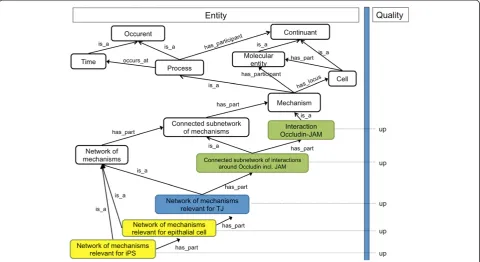
We distinguish between two types of processes going on in a cell: microscale mechanisms and macroscale changes thereof. Microscale mechanisms are the interactions be-tween molecules going on in a cell at a certain time, while a macroscale change is the transition from one set of microscale mechanisms going on at one point of time to another such set at a later time. In order to transfer ontology-based annotation and search strategies from phenotypes at the anatomical level [12] to the domain of cell phenotypes and mechanism changes, we need to be able to formally describe both (a) cell phenotypes and (b) mechanism changes. Phenotypes are usually de-scribed by means of the entity-quality syntax (EQ) using the Phenotypic Quality Ontology PATO for anatomic phenotypes [13,14]. To apply the EQ syntax to the cell level, we outlined two ontologies, an ontology of cell parts (Figure 1) and an ontology of microscale mechanisms
(Figure 2) to be used in combination with a small set of standardized modifiers (as‘qualities’).
Most of the classes that are needed for the ontology of cell parts can be found in CELDA, the ontology developed by the CellFinder project (http://cellfinder.org/about/ ontology/) [15], that itself integrates ontologies like the Cell Ontology (CL), the Cell Line Ontology (CLO), the Foundational Model of Anatomy (FMA), the Gene Ontol-ogy (GO) and Mouse Anatomy. Additional classes can be taken from the Cellular Phenotype Ontology [16] (CPO). For the ontology of cell mechanisms, we can re-use (portions of ) the Interaction Network Ontology (http:// bioportal.bioontology.org/ontologies/1515) and the GO subontology for biological processes (http://www.gene ontology.org). The current GO (Biological Process), how-ever, does not capture the hierarchical relationships de-scribed in Figure 2, connecting molecular events such as the interaction of Occludin and JAM to ultrastructural events such as the formation of a tight junction. Here, we need to explicitly encode the interconnections of molecu-lar events and ultrastructural events. The ontology of cell parts (Figure 1) is designed to handle exactly the same challenge, on the level of the continuants. While the focus of the CPO is on phenotypeabnormalities, we can still re-use it to provide distinct morphological and associated
physiological phenotypes of cells and their components. Again, the hierarchical interconnections between the mo-lecular entities and cellular parts (components, anatomical structures, cell types) need to be explicitly established, for example, between Occludin in tight junctions to the anat-omy of specific cell types.
To describe cell phenotypes and transitions, we refer to entities belonging to distinct ontological top-level cat-egories [17]:
(1)Independent continuants: Cells and their organelles as well as molecules are three-dimensional entities; they are present with all their spatial parts at every time of their existence.
(2)Dependent continuants: Any property of a cell or a molecule, be it a quality or a disposition, also exists as a whole at every time of its existence. However, any such property is ontologically dependent on its particular bearer: It cannot exist without it.
(3)Occurrents: Interactions, inhibitions, stimulations as well as transitions are temporally extended processes. They have temporal parts that occur at different times; hence they do not exist as a whole at any single point of time.
We can, for example, describe the state of a cell at a certain time by enumerating all of its parts and contents (independent continuants), or by enumerating all of its properties (dependent continuants), or by enumerating all the events going on at this time (occurrents), which could then be connected with parts and contents of the cell as their participants, e.g. with organelles or mole-cules. All of these categories are needed to integrate the data available: Cellular data describe continuants (like cellular components and dispositions) as well as occur-rents, namely the molecular interactions (microscale mechanisms) going on in a cell at a certain time. While these continuants are covered by the phenotype ontol-ogy scheme, the interactions (microscale mechanisms) are covered by the mechanism ontology. Cell transition data describe occurrents, namely macroscale changes of microscale mechanisms. Within the EQ framework, we can describe such macroscale changes of microscale mechanisms by pairing terms for microscale mechanisms (as‘entities’) with specific change modifiers (as‘qualities’). In Figure 2 we illustrate this with one possible annotation pattern for a cell transition. In this annotation pattern, the entity term‘Interaction Occludin-JAM’from the mechan-ism ontology is used as a subject term in combination Figure 2Outline of an ontology of cell mechanisms and its use to describe cell transitions.The figure shows a structure by which
with the qualifier‘up’in order to express that in a certain time step the interaction between Occludin and JAM has been upregulated.
In our framework, a pluripotent cell can then be char-acterized by its expression data (about genes, proteins etc.), from which relevant microscale mechanisms can be inferred. A cell transition from one cell phenotype into another (e.g., of a fibroblast into a pluripotent cell) can be described by comparing the expression data of both cell phenotypes, which capture macroscale changes in microscale mechanisms. Such expression data include the start-up of the interactions between genes/proteins relevant for the induction of pluripotency. Such a start-up may happen because the cell starts to produce more in-stances of the molecule types participating in this type of interaction. In our framework, a pluripotent cell realizes dispositions for mechanisms relevant for pluripotency that may be described by a network of interactions. Further, a cell transition from fibroblast to pluripotent cell realizes dispositions for changes in mechanisms. After transition, the cell is characterized by the microscale mechanisms relevant for the pluripotent phenotype.
The use of the ontologies within the EQ framework
Our ontologies are designed to be used together with specific modifiers within the EQ framework. As shown on the right-hand side of Figure 1, the ontology of cell phenotypes can be used to collect annotations for cell phenotypes such as fibroblast, epithelial cell and pluripo-tent stem cell. We can set up annotation profiles of cells, consisting of sets of EQ pairs that describe them. For
example, the profile of epithelial cells includes the infor-mation that the genes/proteins Occludin, the Junctional adhesion molecule (JAM), Claudin as well as tight junc-tions (TJs) are‘present’, and cell membranes are ‘joined’. For this purpose, we can use a number of standardized modifiers like ‘present’,‘absent,’ ‘up’, ‘moderately up’, and ‘down’, which can be integrated within an ontology like PATO [13]. The quality terms used in a particular annota-tion profile are derived from the data being annotated, describing, e.g., a specific set of epithelial cells in a specific culture medium.
The ontology of cell mechanisms, on the other hand, is designed to be used together with modifiers like ‘up’ and ‘down’in order to yield descriptions for macroscale changes of the microscale mechanisms going on within a cell (‘up’for start-up;‘down’for shutdown). The right-hand side of Figure 2 features, e.g., the specific changes (‘up’for start-up) of the microscale mechanisms relevant for TJs, which are the macroscale changes associated with TJ formation. Within the framework of the EQ syn-tax, qualities help to describe these changes of the mi-croscale mechanisms. The example hierarchy in Figure 2 reflects our example of the epithelial-mesenchymal transition (EMT) and its reversal (MET, observed during reprogram-ming). Within an EQ-framework, an MET can be coded using ‘network of mechanisms relevant for epithelial cell’ as the entity term and‘up’as the quality modifier; the‘
net-work of mechanisms relevant for mesenchymal cell’goes
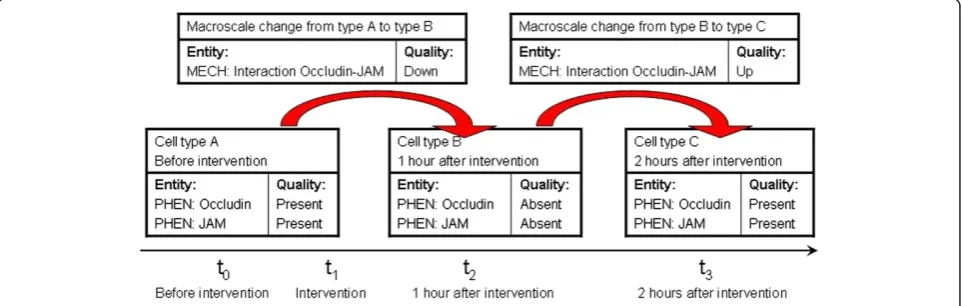
‘down’simultaneously. Figure 3 shows how the ontology of phenotypes and the ontology of mechanisms can be combined in order to represent temporal dynamics.
Annotation propagation
Both ontologies allow for annotation propagation. In [12], annotations for anatomical entities are propagated up a hierarchy ofis_a and part_ofrelations, such that a parent receives all the annotations of its children. The rationale for this is the following. Every finger is part of a hand; hence any information about a finger is also information about some hand. Hence, whatever is expli-citly annotated with “finger” is, implicitly, also about some hand. Annotation propagation makes these impli-cit annotations expliimpli-cit via automated reasoning. In our domain, however, universalpart_ofrelations are rare: As opposed to anatomical entities, molecules (like Occludin) and organelles are not usually restricted to one specific part of a cell or a specific cell, and process parts can be-long to different process wholes. As a consequence of this, the mereological hierarchy cannot be used in the same way as in [12] for cell phenotypes and mechanism changes. As there is an implicit universal quantification over all instances of the first class in an assertion in an ontology description language like the Web Ontology
Language (OWL) [18], we have to use has_partinstead
of part_of. In our example, a molecular entity like Occludin can belong to a range of cellular structures and phenotypes, while a certain cellular structure or phenotype has to possess certain molecular entities. Put in general terms, a cellular structure necessitates its es-sential molecular parts. That is, the whole determines the parts, and for this reason we need to use the has_part relation. The has_partrelation is also appro-priate for occurrents like cell mechanisms. This is be-cause any initial temporal part of an event can happen without the event being completed. For example, not every S-phase needs to be part of a mitosis: the cell cycle can be disrupted, e.g. by the destruction of the cell that is about to divide, resulting in an S-phase that is not followed by a cell division at all. In contrast to this, every mitosis has an S-phase as one of its temporal
parts. Again, we need to employ thehas_parthierarchy,
from whole processes to their necessary parts (e.g., from Network_of_mechanisms_relevant_for_TJto theInteraction_ Occludin_JAM). When employing annotation propagation, therefore, as a rule, a whole process will have ahigher in-formation content than its necessary parts.
Similarity searches
The ontologies outlined above enable similarity searches across cell phenotypes and mechanism changes in ana-logy to [12]. In particular, we wish to estimate the simi-larity of cell types and of cell transitions across time. In this setting, macroscale changes are processes happening from one state at a certain time to another state at a later time. What we call microscale mechanisms are activities around a certain time, i.e. activities that we suppose to
happen at some (maybe small) interval around that time. Microscale mechanisms are typically described as undir-ected activities (interactions), while macroscale changes are of necessity directed to a certain end state. The EQ-syntax is used to build up annotation profiles for the cell types under scrutiny. If appropriate, they will be time-stamped in order to mark how much time has elapsed after a certain intervention (e.g.,“two days after interven-tion X”). If a macroscale change is the transition from cell type A to cell type B, it can‘inherit’the timestamps from the annotation profiles of A and B as its start and end time, respectively (see also Figure 3).
Similarity searches may then compare, e.g., EMT/MET and reprogramming data. In simplified terms, an MET (mesenchymal-epithelial transition) [19] consists in, first, the formation of adherens junctions (AJs) and, second, the formation of tight junctions (TJs). We represent the MET as the start-up of the microscale mechanisms rele-vant for an epithelial cell, which has as one of its parts TJ formation that is, in turn, represented as the start-up of the mechanisms relevant for a TJ. This is the inverse of an EMT (epithelial-mesenchymal transition, which hap-pens in development, metastasis and fibrosis). ExprEssence and related tools ([20-23]) can be employed for generating annotations about mechanism changes relevant for a certain transition by means of high-throughput data analysis, and the more mechanisms are annotated, the better we can estimate how similar biological processes are. Ultimately, any set of cell transitions can be com-pared (using data coded in EQ syntax) with respect to the underlying mechanisms, demonstrating the power of our approach. Our ontology design principles thus enable a kind of BLAST search in the space of annotations (for mechanisms), with similar goals such as highlighting relationships (between mechanisms, based on basic mechanisms as building blocks), and eventually estimating their evolutionary history.
The support for similarity search that we envision is illustrated in Figure 4. From left to right, three possible annotation profiles are shown that could be derived from data on MET processes. For the sake of simplicity, the qualities considered are restricted to‘up’and‘down’, mark-ing upregulation of a mechanism (derived from high-throughput data or literature curation) by a black tick mark. Further assertions are then derived by automatic annotation propagation: Our ontology of cell mechanisms enables to infer (by subsumption reasoning, following the idea of [12]) the magenta tick marks. Our example sug-gests that similarity estimates after ontology-based reason-ing are better and more reliable than without reasonreason-ing.
Clustering of cell phenotypes
repertoire constitutes a change in phenotype), we can construct more coarse-grained cell types by clustering of cell phenotypes based on similarity, considering the pres-ence or abspres-ence of morphological or (ultra-)structural components and of molecular entities. In addition, we can also cluster the macroscale changes that transition cells from one phenotype to another. A cluster of cells shares aspects of components and microscale mechanisms. Gen-erally speaking, similar phenotypes correspond to similar cells, and similar mechanism changes correspond to simi-lar cell transitions (cf. Figure 5). Thus, boundaries between clusters of cells that are‘next neighbours’(e.g. pluripotent embryonic stem cells and epiblast stem cells) as well as be-tween cells on opposite ends of a developmental spectrum
(e.g. mesenchymal cells and epithelial cells) can be de-fined by clustering based on expert annotations and on bioinformatics analyses of experimental data. Clustering of mechanism changes (that is, of macroscale changes in microscale mechanisms) will in turn generate clusters of similar mechanism changes with a large distance be-tween the clusters. The cause for this large distance then is the existence of strongly dissimilar cells.
We suggest that the improvement in similarity estimates afforded by our ontologies (see Figure 4) enables the plausible clustering of both cell phenotypes and cellular mechanisms. Then it should become possible to cluster cell phenotype and mechanism data sufficiently well to de-rive the clusters exemplified in Figure 5.
Conclusion
We outlined how to design ontologies that enable to (1) formally represent cell phenotypes and mechanism changes behind cell transitions such as (re-)programming, and to (2) develop algorithms exploiting this framework, includ-ing clusterinclud-ing and searchinclud-ing for similar cell phenotypes and mechanism changes. Both ontologies support manual curation of publication data, annotation propagation and information content measurement, as well as the inclusion of results from high-throughput data analysis.
Our use of EQ-syntax allows the systematic encoding of annotation profiles of cell phenotypes and mechanism changes. The terms for both types of entities are organized in hierarchies ranging from molecular to (ultra)structural to morphological entities. Annotation profiles can then be obtained using (1) data curation from publications or by (2) high-throughput data analysis. In ontological terms, Figure 4Example of an ontology-supported similarity search.Three possible annotation profiles derived from data on MET processes are exemplified, from left to right. Black tickmarks label mechanisms upregulated according to the data, and magenta tickmarks are inferred. After reasoning, more plausible similarity estimates become possible.
bioinformatics tools such as ExprEssence can be used as an instrument for deriving mechanistic information from high-throughput data, turning information about con-tinuants into information about occurrents by differen-tial analysis. The starting point for expert curation, possibly supported by text mining, must be a set of care-fully selected papers.
Given a rich annotated knowledge base, existing ap-proaches for ontology-based similarity measurements [12] can be applied to the domains of cell phenotypes and cel-lular mechanism changes. This would yield two important functionalities: It allows clustering of cell phenotypes (and of mechanism changes) by similarity, providing important information for an operational definition of cell pheno-types, and it allows similarity search in the spaces of mechanism changes and of cell phenotypes.
To further refine and populate the ontologies, we cur-rently explore the option to work together with collabo-rators in the DFG SPP 1356 (http://www.spp1356.de) on pluripotency and cellular reprogramming, and similar initiatives, and we are looking for further collaborations. The size of the final artifacts is obviously a function of time and efforts invested in their development. While the number of relevant entities is limited for cell anat-omy and cell types (several thousands), it is very large and virtually unlimited for molecular entities.
To evaluate our approach, we intent to compare simi-larity search results based on high-throughput data ana-lysis only to results based on employing the ontologies integrating high-throughput data, (ultra)structural data and morphological data, and further to compare both sets of results with the expectations of domain experts. We expect that in particular the relationships between molecular events (which may be derived from filtering high-throughput data) and ultrastructural events (cu-rated from the literature) yield improvements for simi-larity searches (see Figure 4). To avoid a garbage-in, garbage-out scenario, the application domain must be strictly limited, e.g. to data describing reprogramming and EMT experiments, so that the input data can all be validated by domain experts. Ultimately we envision a community-based crowd-sourcing approach.
Competing interests
The authors declare that they have no competing interests.
Authors’contributions
Starting from research by GF, LJ and GF developed the ontologies, while AK and UL provided domain knowledge. LJ wrote the first version of this paper, drawing on a larger unpublished manuscript by the authors. All authors read and approved the manuscript.
Acknowledgements
DFG support to AK and UL (AK 851/3-1, LE 1428/4-1), GF (FU 583/2-1, FU 583/2-2) and LJ (JA 1904/2-1) is gratefully acknowledged.
Author details
1
Institute for Biostatistics and Informatics in Medicine and Ageing Research, Rostock Medical School, Ernst-Heydemann-Str. 8, 18057 Rostock, Germany.
2
Institute of Philosophy, University of Rostock, 18051 Rostock, Germany.
3Humboldt Universität zu Berlin, Unter den Linden 6, 10099 Berlin, Germany. 4
Charite Berlin, BCRT, Augustenburger Platz 1, 13353 Berlin, Germany.
5College of Veterinary Medicine and Research Institute for Veterinary Science,
Seoul National University, Seoul, Republic of Korea.6Department of Philosophy, University of Münster, Domplatz 6, 48143 Münster, Germany.
Received: 21 January 2013 Accepted: 19 August 2013 Published: 8 October 2013
References
1. Takahashi K, Yamanaka S:Induction of pluripotent stem cells from mouse embryonic and adult fibroblast cultures by defined factors.Cell2006,
126:663–676.
2. Ho R, Chronis C, Plath K:Mechanistic insights into reprogramming to induced pluripotency.J Cell Physiol2011,226:868–878.
3. Jaenisch R, Young R:Stem cells, the molecular circuitry of pluripotency and nuclear reprogramming.Cell2008,132:567–582.
4. Ashburner M, Ball CA, Blake JA, Botstein D, Butler H, Cherry JM, Davis AP, Dolinski K, Dwight SS, Eppig JT,et al:Gene ontology: tool for the unification of biology. The Gene Ontology Consortium.Nat Genet2000,
25:25–29.
5. Bard J, Rhee SY, Ashburner M:An ontology for cell types.Genome Biol 2005,6:R21.
6. Meehan TF, Masci AM, Abdulla A, Cowell LG, Blake JA, Mungall CJ, Diehl AD:
Logical development of the cell ontology.BMC Bioinforma2011,12:6. 7. Gunsalus KC, Yueh WC, MacMenamin P, Piano F:RNAiDB and PhenoBlast:
web tools for genome-wide phenotypic mapping projects.Nucleic Acids Res2004,32:D406–D410.
8. Hoehndorf R, Oellrich A, Dumontier M, Kelso J, Rebholz-Schuhmann D, Herre H:Relations as patterns: bridging the gap between OBO and OWL.
BMC Bioinforma2010,11:441.
9. Hoehndorf R, Oellrich A, Rebholz-Schuhmann D:Interoperability between phenotype and anatomy ontologies.Bioinformatics2010,26:3112–3118. 10. Hoehndorf R, Schofield PN, Gkoutos GV:PhenomeNET: a whole-phenome
approach to disease gene discovery.Nucleic Acids Res2011,39:e119. 11. Hoehndorf R, Dumontier M, Oellrich A, Rebholz-Schuhmann D, Schofield
PN, Gkoutos GV:Interoperability between biomedical ontologies through relation expansion, upper-level ontologies and automatic reasoning.
PLoS One2011,6:e22006.
12. Washington NL, Haendel MA, Mungall CJ, Ashburner M, Westerfield M, Lewis SE:Linking human diseases to animal models using ontology-based phenotype annotation.PLoS Biol2009,7:e1000247.
13. Gkoutos GV, Green EC, Mallon AM, Hancock JM, Davidson D:Using ontologies to describe mouse phenotypes.Genome Biol2005,6:R8. 14. Mungall CJ, Gkoutos GV, Smith CL, Haendel MA, Lewis SE, Ashburner M:
Integrating phenotype ontologies across multiple species.Genome Biol 2010,11:R2.
15. Seltmann S, Stachelscheid H, Damaschun A, Jansen L, Lekschas F, Fontaine JF, Nguyen-Dobinsky TN, Leser U, Kurtz A:CELDA-an ontology for the comprehensive representation of cells in complex systems.BMC Bioinforma 2013,14:228.
16. Hoehndorf R, Harris MA, Herre H, Rustici G, Gkoutos GV:Semantic integration of physiology phenotypes with an application to the Cellular Phenotype Ontology.Bioinformatics2012,28:1783–1789.
17. Jansen L:Categories: the top level ontology.InApplied ontology.Edited by Munn K, Smith B. Ontos: Frankfurt; 2008:173–196.
18. OWL 2 Web Ontology Language Document Overview (Second Edition).http:// www.w3.org/TR/owl2-overview/.
19. Thiery JP, Sleeman JP:Complex networks orchestrate epithelial-mesenchymal transitions.Nat Rev Mol Cell Biol2006,7:131–142.
20. Ideker T, Ozier O, Schwikowski B, Siegel AF:Discovering regulatory and signalling circuits in molecular interaction networks.Bioinformatics2002,
18(Suppl 1):S233–S240.
21. Guo Z, Wang L, Li Y, Gong X, Yao C, Ma W, Wang D, Zhu J, Zhang M, Yang D,et al:Edge-based scoring and searching method for identifying condition-responsive protein-protein interaction sub-network.
22. Warsow G, Greber B, Falk SS, Harder C, Siatkowski M, Schordan S, Som A, Endlich N, Scholer H, Repsilber D,et al:ExprEssence–revealing the essence of differential experimental data in the context of an interaction/regulation net-work.BMC Syst Biol2010,4:164.
23. Kim Y, Kim TK, Yoo J, You S, Lee I, Carlson G, Hood L, Choi S, Hwang D:
Principal network analysis: identification of subnetworks representing major dynamics using gene expression data.Bioinformatics2011,
27:391–398.
24. Bhattacharya S, Zhang Q, Andersen ME:A deterministic map of Waddington's epigenetic landscape for cell fate specification.BMC Syst Biol2011,5:85. 25. Huang S:The molecular and mathematical basis of Waddington's epigenetic
landscape: a framework for post-Darwinian biology?Bioessays2012,
34(2):149–157.
doi:10.1186/2041-1480-4-25
Cite this article as:Fuellenet al.:Using ontologies to study cell transitions.Journal of Biomedical Semantics20134:25.
Submit your next manuscript to BioMed Central and take full advantage of:
• Convenient online submission
• Thorough peer review
• No space constraints or color figure charges
• Immediate publication on acceptance
• Inclusion in PubMed, CAS, Scopus and Google Scholar
• Research which is freely available for redistribution