178
Hydrodynamics And Heat Transfer Characteristics
Of Draft Tube Spouted Bed Roasting Of
Groundnuts (Arachis Hypogeae)
V.D. Nagaraju, B.S. Sridhar
Abstract: The hydrodynamic characteristics of flow regime were studied employing different draft tubes during the spouted bed roasting of groundnuts and the dimensionless parameters were employed for predicting the flow regime. The estimated Reynolds's number (Re) under the turbulent convection regime was ≈ 8399. The size of the draft tubes employed ranged from 0.175 to 0.375 m length and 0.065 m diameter. The optimal processing condition was found to be the draft tube size of 0.275 m length with heat transfer coefficient of 132 W/m2-C. The studies showed that draft tube insertion is a
versatile technique to increase the bed height as compared to the classical spouted bed roaster and can be seen as a promising roaster design for groundnuts and related heat sensitive particulate materials that have slow intra -particle heat transfer coefficients.
Key Words: Spouted bed; Hydrodynamic; Draft Tube; Roasting; Groundnut
————————————————————
1. Introduction
The classical spouted bed is a gas-solids contacting system and is an alternative to the fluid bed in which a downward moving bed in the annulus slides rapidly to the bottom of the cone. The apex region of the cone forms a spout (opening) for the hot gas jet, enters the packed bed vertically carrying the solids along with it. The solids carried by the gas, slip away from the gas stream forming a cyclic path after reaching certain height.. Although the areas of application of spouted bed overlap with fluid bed, the mechanisms in two cases are very different (Epstein 1984). Agitation of particles in a spouted bed is caused by a steady axial jet and, is regular and cyclic as compared to fluid bed. Thus, there is very good mixing of solids and effective gas-particles contact facilitating high temperature short time (HTST) processing (Nagaraju 1995). In a spouted bed, particles circulate going upward in the spout and downward in the annulus. This presents a potential advantage of the spouted bed over other techniques such as fluid beds: (i) uniform drying of product throughout the depth of the bed, (ii) higher air temperatures are possible because the particles are exposed to the spout environment for only a short period of the turnover cycle. (iii) internal particle temperature and moisture distribution equilibrate during downward travel in the annular space (Khoe 1983).
In recent trends, this contacting technique is used as an alternative to fluidized bed gas-particle contact flow regime and suitably employed for particulate solids which are larger than 1 mm (Freitas 2000). However, still there are certain drawbacks in the classical spouted bed technique, where particles enter the spout from all the regions of the bed surfaces behaves random circulations of particles. Gas percolation through the annulus, affecting both the static bed height and spoutable bed depth. Under these circumstances, there are several modifications has been reported on the classical spouted to improve the performance of the spouted bed. These modifications mainly concern the geometry of the contactor and/or the gas inlet to the bed (Altizibar 2009). and insertion of a draft tube. Spouted bed with a draft tube (SBDT) is one of the many modifications to classical spouted bed to improve its operability and favour its applicability to new processes (Mathur & Epstein 1974, Epstein & Grace 1984, Nagashima 2011). Addition of a draft tube releases the maximum spoutable bed height limitation in the classical spouted bed, and reduces remarkably the fluid flow requirement for spouting. Introduction of an auxiliary aeration/fluidization gas to the annular bed of solids helps to reduce the gas bypass from the spout to the annulus, which can be a severe problem in a classical spouted bed. In addition, the gas flow rates through the draft tube and annulus, and the solids circulation rate can be easily controlled and adjusted in a SBDT. SBDTs have been applied in a variety of processes such as heterogeneous catalytic reaction (Follansbee 2008). drying and thermal treatment of solutions and suspensions (Nagashima 2011). mixing and blending of particles, coating of pharmaceutical and agricultural products (Saadevandi & Turton 2004). and granulation (Epstein & Grace 1984). Very little information is available on the hydrodynamic behaviour of Spouted Bed Draft Tube (SBDT) applications to roasting of food grains in literature. The objective of the present study was to investigate the hydrodynamic characteristics of heat sensitive particulate solids such as groundnuts during the spouted bed roasting. The hydrodynamic parameters obtained such as minimum spouting velocity, static bed height and processing time and the heat transfer coefficient were analyzed to determine the optimum size of the draft tube with the existing geometry of the bed.
________________________
V.D. Nagaraju, B.S. Sridhar
Department of Food Engineering, Central Food Technological Research Institute, Council Scientific and Industrial Research, Mysore-570 020, India.
Food Engineering Department, Central Food Technological Research Institute, Mysore-570020, Karnataka, India.Email: [email protected]
2. Materials and methods:
2.1. Raw Material
The groundnuts (Arachis hypogeae) TG-39 Bijapur variety for the study was procured from the local market in Mysore, Karnataka, India. The samples were selected and cleaned manually and ensured that the groundnuts were free of dirt, broken ones and other foreign materials. The samples were kept at room temperature till the experiments were conducted. As the groundnuts were irregular in shapes, about 50 seeds were randomly selected and their characteristic dimensions were measured with use of the Vernier calliper (Mitutoyo, Japan), the length (L), width (W) and thickness (T). The average diameter was calculated by using the arithmetic mean and geometric means of the three axial dimensions. The arithmetic mean diameter, Da, and geometric mean diameter, Dg, of the groundnut seeds were calculated by using the following relationships (Mohsenin 1976).
3
T
W
L
D
a
……….(1)3
LWT
D
g
...(2)where L – length (mm), W-Width (mm) T-thickness (mm).
The calculated particle arithmetic mean diameter of groundnuts was 12.01 mm and the density was 752 kg/m3 at 11.5 % moisture content (Saeeid 2009).
2.2. Methods
2.2.1. Design of experiments
The experimental design chosen for the study was a 3 x 3 x 3 factorial design each factor varied at three levels. The process parameters were:
(a) draft tube openings: 0.175, 0.275 and 0.375 m
(b) temperature: 120, 160 and 190°C
(c) residence time: 900,1200 and 1500 seconds.
The experimental data were statistically analysed using analysis of variance of the Statistical Analysis System (SAS 1990). and reported as averages of three replications. Significant level was defined as probabilities less than 0.05.
2.2.2. Equipment
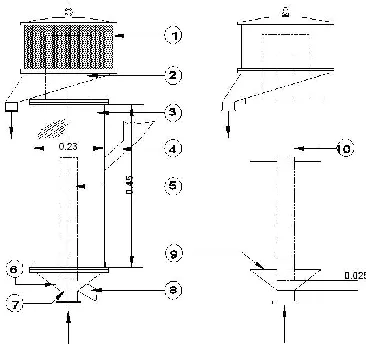
A laboratory size unit of spouted bed roaster designed and developed at Central Food Technological Research Institute, India for roasting of food grains and coffee beans (Nagaraju 2004). was employed for the study and is shown in Fig. 1. The roaster consisted of a cylindrical glass-roasting chamber made of Borosil glass, with a 90o conical angle stainless steel bottom. The apex of the cone was modified into a spouting nozzle for hot air circulation of 0.050m in diameter. The glass chamber of 0.270m diameter and 0.450 m length was fitted with conical bottom and connected to a hot air generator. The chaff separation and collection after roasting was done through a simple air classification technique, fitted at the outlet of the roasting chamber. Thermo-couples were positioned at different
places to measure the inlet, outlet and finished product temperatures respectively.
Fig.1. Classical Bed Roaster
2.2.3. Experimental set up
180
Fig.2. Draft tube assisted Spouted Bed Roaster chamber detail
1.Air classifier 2.Spent air duct 3.Glass roaster chamber 4.Feeder chute 5.Glass draft tube 6.cone
7.Spout aperture 8.Discharge chute 9.Fixture for draft tube 10.Metal wire fixture
2.2.4. Minimum spouting velocity
Minimum spouting velocity was calculated as a function of particle, fluid properties and column geometry. Although there are numerous correlations on the minimum spouting velocity in the literatures (Bi 2004, Wei 2006, Zhong 2006). those considering the effect of both fluidizing gas and draft tubes are very limited. In the present study the optimum minimum spouting velocity for non-porous draft tube has been estimated using the proposed correlation of (Altizibar 2009). as a functions of dimensionless modulli. Since the entrainment zone and the static bed height significantly influence the minimum spouting velocity, roasting experiments were conducted by varying entrainment heights and sizes of draft tubes. The correlation for calculating the minimum spouting velocity for nonporous draft tube is as follows:
R
ems =135 . 0 168 . 0 24 . 1 475 . 0
2
tan
204
.
0
T H O OD
L
D
H
Ar
…………..(4)In order to establish suitable and effective size of the draft tube with the existing spouted bed cone angle of 90° and a D/d ratio of 5.4 was attempted. The hydrodynamic parameters such as static bed height, minimum spouting velocity and the heat transfer coefficient of draft tubes during roasting of groundnut were estimated to optimize the draft tube size.
2.2.5. Heat transfer coefficient
The following correlation proposed by (Rahaman 1995). for particulates of irregular shapes (sphere) , heated by a fluid flowing past it was used to predict the heat transfer coefficient
p p ed
R
……..5(a)k
C
P
r p
…….5(b)k
hd
N
u
p ……..5(c)4 . 0 5 . 0
60
.
0
0
.
2
e ru
R
P
N
……..(6)(for heating Pr, n=0.4)
3. Results and discussions
3.1. Minimum spouting velocity
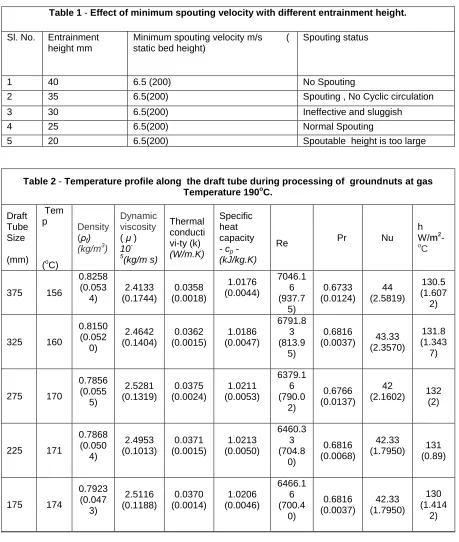
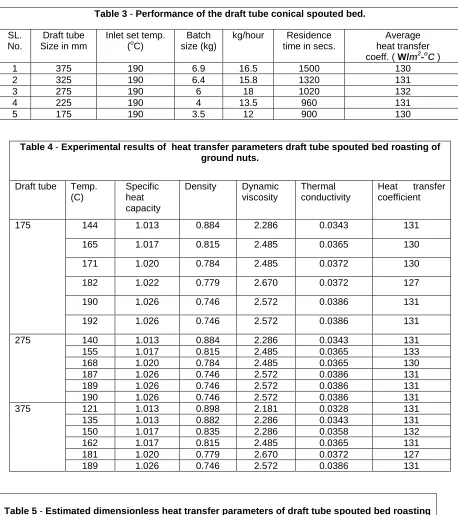
Table 1, shows the relationship between minimum spouting velocity and entrainment height. and Figs. 3 & 4 show the effect of static bed height and the corresponding minimum spouting velocity on the roasting process of groundnuts. The entrainment height plays a major role during spouting for particulate solids like groundnuts as observed from the present study. If entrainment increases minimum spouting velocity increases, but still the spouting is sluggish due to the tendency of escape of spouting gas through the annulus causing ineffective spouting of materials. The reason for this change could be due to the difference in mass of the individual particulate solids, more resistance to spout due to heaviness of the solid body and requirement of higher power to lift the spouted bed in the draft tube. It can be seen that the minimum spouting velocity increases with increasing static bed height. The reason for this variation is attributed to increased static bed height due to increased resistance of bed material. Similarly, in Fig. 5. it was observed that the minimum spouting velocity decreased with decreased residence time of roasting. Table 2, presents the heat transfer coefficients and temperature profile along the draft tubes during the spouted bed roasting of groundnuts at inlet temperature 190°C. Observations were similar for other temperatures. Fig.6. shows the estimated heat transfer coefficients for groundnuts which was found to be 132 W/m2-oC. The values were in good agreement with the reported values (Hallstrom 1988). for fluidised beds between 20-120 W/m2
-°
Fig.3. Photographic sequence of roasting process with spouting showing static bed height of different draft tube sizes
Fig.4. Heat Transfer Coefficint v/s Residence Time
Fig.5. Static Bed Height, Residence Time v/s Minimum Spouting Velocity
Fig.6. Specific Heat and Thermal Conductivity v/s Temperature
Fig.7(a). Batch size and Corresponding Draft tube size
Fig.7(b). Residence time and Corresponding Draft tube size
182
Fig.7(c). Residence time and corresponding static bed time
4. Conclusions
The optimum size of the draft tube was determined based on the hydrodynamic parameters and the heat transfer coefficient during the spouted bed roasting of groundnuts. The entrainment zone and static bed height were found to have major influence on spouted bed roasting of groundnuts. The optimal processing conditions were found to be the draft tube size of 0.275 m length with heat transfer coefficient of 132 W/m2-oC. The studies showed draft tube assisted spouted bed roasting is a versatile roaster design for processing of groundnuts. The design be further validated for similar heat sensitive particulate materials that have slow intra -particle heat transfer coefficients such as coffee beans and Bengal gram.
Acknowledgements:
The authors wish to sincerely thankful to the encouragement of Director, CSIR-CFTRI, Mysore. Also wish to thank Mr. K. Girish Giwari for his help during the experiments.
Nomenclature
Ar Archimedes number, gdp 3
ρ(ρp- ρf)/ µ2
Cp Specific heat capacity (kJ/kg.K) DT diameter of draft tube (m)
DO diameter of gas inlet nozzle for spouting-gas (m)
dp arithmetic mean diameter of particle (m)
Dc column diameter (m)
g Acceleration due gravity (m2/s)
h Convective heat transfer coefficient ( W/m2-oC ) HO Static bed height(m)
LH distance from gas inlet nozzle to bottom of draft
tube
(=length of entrainment zone) (m)
Nu Nusselt number Pr Prandlt number Re Reynolds number
(Re )ms Reynolds number of minimum spouting refers to Do, ρp dp ums/ µ
ums minimum spouting velocity (m/s)
kf Thermal conductivity of the gas ( W/m-K)
kp Thermal conductivity of the particle ( W/m-K)
Greek symbols
cone angle of conical base (◦)
µ gas viscosity (Pa s)
ρf gas density (kg/m3)
ρp particle density (kg/m3)
References
[1]. Altzibar H., Lopez G., Aguado R., Alvarez S., San Jose M.J. and Olazar M. 2009. Hydrodynamics of conical spouted beds using different types of internal devices, Chem. Eng. Technol. 32, No. 3., 463–469.
[2]. Epstein N. & Grace J.R. 1984. Spouting of particulate solids, Hand Book of Powder Sci. and Technol, Editions Chapman and Hall, New York, chapter-11, 507-536.
[3]. Follansbee D.M., Paccione J.D. and Martin L.L. 2008. Globally optimal design and operation of a continuous photo catalytic advanced oxidation process featuring moving bed adsorption and draft-tube transport, Ind. Eng. Chem. Res. 47, 3591– 3600.
[4]. Freitas L.A.P. & Freire J.T. 2000. Heat transfer in a draft tube spouted bed with bottom solids feed, J. Powder Technol. 114(2001), 152-162.
[5]. Hallstrom B., Skjoldebrand C. and Tragardh C. 1988. Heat transfer and food products, Elsevier science publishers Ltd.
[6]. Hiroshi Nagashima., Toshifumi shikura. rand Mitsuharu Ide. 2011. Flow regimes and vertical solids conveying in a spout–fluid bed with a draft tube, Can. J. Chem. Eng. 64, 264-273.
[7]. Khoe G.K. & Van Brakel J. 1983. Drying characteristics of a draft tube spouted bed, Can. J. Chem. Eng. 61, 411-416.
[8]. Mathur K.B. and Epstein N. 1974. Spouted beds, New York , USA ; Accademic Press.
[9]. Mohsenin N.N. 1976. Physical properties of plant and animal materials, Gordon and Breach Science Publishers Ltd. London.
[10]. Nagaraju V.D., Ramalakshmi K. and Srinivasa Rao P.N. 1995. Studies on roasting of low grade Indian coffee(blacks, browns and bits) using spouted bed roaster, Proceedings of International Conference on Coffee Science, April 9-14, Kyoto, Japan, 487-491.
[11]. Nagaraju V.D. & Bhattacharya S. 2004. Roasting green coffee beans using spouted bed roaster: changes in physical characteristics, Proceedings of the International Conference on Coffee Science, Bangalore, India, held from Oct.11-15.
[13]. SAS Institute Inc. 1990. SAS/STAT User's guide, 4th Ed. Version 6, Cary, NC.
[14]. Saadevandi B.A. & Turton R. 2004. Particle velocity and voidage profiles in a draft tube equipped spouted-fluidised bed coating device, Chem. Eng. Communications. 191, 1426-1447.
[15]. Saeeid Firouzi., Mohammad Naghi Safarzad Vishgaei. and Behzad Kaviani. 2009. Some physical properties of groundnut(Arachis hypogaea L), American-Eurasian J. Agricultural & Environmental Sci. 6(6), 675-679.
[16]. Wei W., Bao X., Bi H.T. and Lim C.J. 2006.. Prediction of minimum spouting velocity at elevated pressures and temperatures, Pet. Sci. 3, 82–84.
[17]. Wang Z., Bi H.T., Jim Lim C. and Peng Cheng Su. 2004. Determination of minimum spouting velocities in conical spouted beds, Canadian J. Chem. Eng. 82, 11-19.
[18]. Zhong W., Chen X. and Zhang M. 2006. Hydrodynamic Characteristics of Spout-Fluid Bed: Pressure Drop and Minimum Spouting/ Spout-Fluidizing Velocity, Chem. Eng. J. 118,37–46.
Table 1 - Effect of minimum spouting velocity with different entrainment height.
Sl. No. Entrainment height mm
Minimum spouting velocity m/s ( static bed height)
Spouting status
1 40 6.5 (200) No Spouting
2 35 6.5(200) Spouting , No Cyclic circulation
3 30 6.5(200) Ineffective and sluggish
4 25 6.5(200) Normal Spouting
5 20 6.5(200) Spoutable height is too large
Table 2 - Temperature profile along the draft tube during processing of groundnuts at gas Temperature 190oC.
Draft Tube Size (mm) Tem p
(oC)
Density (ρf) (kg/m3)
Dynamic viscosity ( μ ) 10 -5 (kg/m s) Thermal conducti vi-ty (k) (W/m.K) Specific heat capacity - cp - (kJ/kg.K)
Re Pr Nu h W/m2
-o
C
375 156
0.8258 (0.053 4) 2.4133 (0.1744) 0.0358 (0.0018) 1.0176 (0.0044) 7046.1 6 (937.7 5) 0.6733 (0.0124) 44 (2.5819) 130.5 (1.607 2)
325 160
0.8150 (0.052 0) 2.4642 (0.1404) 0.0362 (0.0015) 1.0186 (0.0047) 6791.8 3 (813.9 5) 0.6816
(0.0037) (2.3570) 43.33
131.8 (1.343 7)
275 170
0.7856 (0.055 5) 2.5281 (0.1319) 0.0375 (0.0024) 1.0211 (0.0053) 6379.1 6 (790.0 2) 0.6766 (0.0137) 42
(2.1602) 132 (2)
225 171
0.7868 (0.050 4) 2.4953 (0.1013) 0.0371 (0.0015) 1.0213 (0.0050) 6460.3 3 (704.8 0) 0.6816 (0.0068) 42.33
(1.7950) 131 (0.89)
175 174
184
* n=3; values in parenthesis shows standard deviation
Table 3 - Performance of the draft tube conical spouted bed.
SL. No.
Draft tube Size in mm
Inlet set temp. (oC)
Batch size (kg)
kg/hour Residence time in secs.
Average heat transfer coeff. ( W/m2-oC )
1 375 190 6.9 16.5 1500 130
2 325 190 6.4 15.8 1320 131
3 275 190 6 18 1020 132
4 225 190 4 13.5 960 131
5 175 190 3.5 12 900 130
Table 4 - Experimental results of heat transfer parameters draft tube spouted bed roasting of ground nuts.
Draft tube Temp. (C)
Specific heat capacity
Density Dynamic viscosity
Thermal conductivity
Heat transfer coefficient
175 144 1.013 0.884 2.286 0.0343 131
165 1.017 0.815 2.485 0.0365 130
171 1.020 0.784 2.485 0.0372 130
182 1.022 0.779 2.670 0.0372 127
190 1.026 0.746 2.572 0.0386 131
192 1.026 0.746 2.572 0.0386 131
275 140 1.013 0.884 2.286 0.0343 131
155 1.017 0.815 2.485 0.0365 133
168 1.020 0.784 2.485 0.0365 130
187 1.026 0.746 2.572 0.0386 131
189 1.026 0.746 2.572 0.0386 131
190 1.026 0.746 2.572 0.0386 131
375 121 1.013 0.898 2.181 0.0328 131
135 1.013 0.882 2.286 0.0343 131
150 1.017 0.835 2.286 0.0358 132
162 1.017 0.815 2.485 0.0365 131
181 1.020 0.779 2.670 0.0372 127
189 1.026 0.746 2.572 0.0386 131
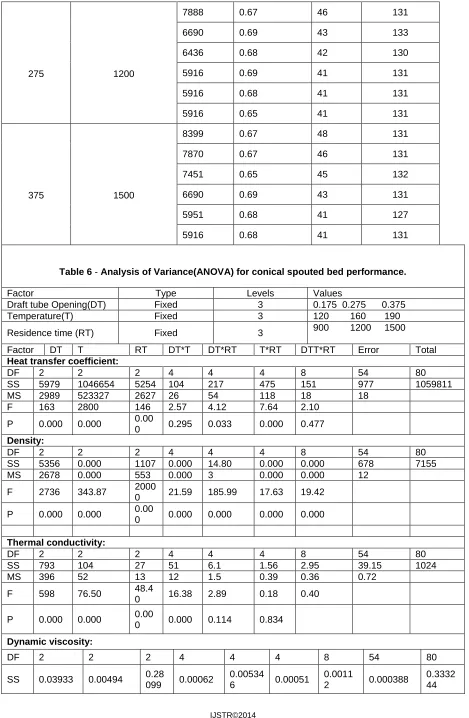
Table 5 - Estimated dimensionless heat transfer parameters of draft tube spouted bed roasting of ground nuts.
Draft tube Residence time Re Pr Nu h
175 900
7888 0.68 46 131
6690 0.68 43 130
6436 0.69 42 130
5951 0.68 41 127
5916 0.68 41 131
275 1200
7888 0.67 46 131
6690 0.69 43 133
6436 0.68 42 130
5916 0.69 41 131
5916 0.68 41 131
5916 0.65 41 131
375 1500
8399 0.67 48 131
7870 0.67 46 131
7451 0.65 45 132
6690 0.69 43 131
5951 0.68 41 127
5916 0.68 41 131
Table 6 - Analysis of Variance(ANOVA) for conical spouted bed performance.
Factor Type Levels Values
Draft tube Opening(DT) Fixed 3 0.175 0.275 0.375
Temperature(T) Fixed 3 120 160 190
Residence time (RT) Fixed 3 900 1200 1500
Factor DT T RT DT*T DT*RT T*RT DTT*RT Error Total
Heat transfer coefficient:
DF 2 2 2 4 4 4 8 54 80
SS 5979 1046654 5254 104 217 475 151 977 1059811
MS 2989 523327 2627 26 54 118 18 18
F 163 2800 146 2.57 4.12 7.64 2.10
P 0.000 0.000 0.00
0 0.295 0.033 0.000 0.477
Density:
DF 2 2 2 4 4 4 8 54 80
SS 5356 0.000 1107 0.000 14.80 0.000 0.000 678 7155
MS 2678 0.000 553 0.000 3 0.000 0.000 12
F 2736 343.87 2000
0 21.59 185.99 17.63 19.42
P 0.000 0.000 0.00
0 0.000 0.000 0.000 0.000
Thermal conductivity:
DF 2 2 2 4 4 4 8 54 80
SS 793 104 27 51 6.1 1.56 2.95 39.15 1024
MS 396 52 13 12 1.5 0.39 0.36 0.72
F 598 76.50 48.4
0 16.38 2.89 0.18 0.40
P 0.000 0.000 0.00
0 0.000 0.114 0.834
Dynamic viscosity:
DF 2 2 2 4 4 4 8 54 80
SS 0.03933 0.00494 0.28
099 0.00062
0.00534
6 0.00051
0.0011
2 0.000388
186 MS 0.019 0.0024 0.01
4 0.0001 0.0013 0.0001
0.0001
4 0.000007
F 2736.96 343.87 2000
0 21.59 185.99 17.63 19.42
P 0.000 0.000 0.00