Some Computational Results on MPI Parallel
Implementation of Derived Subgraph Algorithm
E. M. Badr
Scientific Computing Department, Faculty of Computer Science and Informatics, Benha University,
Benha, Egypt.
ABSTRACT
The aim of this paper is to present an experimental evaluation of a parallel derived subgraph algorithm PDSA using MPI. The performance of the algorithm PDSA is verified by computational experiments on some special graphs with different size, run in a cluster of workstations. MPI seems to be appropriate for these kind of experiments as the results are reliable and efficient.
Keywords
Union closed sets conjecture, induced graphs, derived subgraphs, parallel algorithms, parallel processing.
1.
INTRODUCTION
A union-closed family of sets A is a finite collection of sets not all empty such that the union of any two members of A is also a member of A . The following Conjecture is due to Peter Frankl [1, 2, 3].
Conjecture1. Let A = { A1, A2, . . . , An } be a union-closed
family of n distinct sets. Then there exists an element which belongs to at least n / 2 of the sets in A.
Let A =
A
i. If we replace each set Ai by Bi = A - Ai thenwe get an intersection-closed family of sets, which we call the dual family of A. Therefore Conjecture 1 is equivalent to the following.
Conjecture2. Let B = { B1, B2, . . . , Bn } be an
intersection-closed family of n distinct sets. Then there exists an element which belongs to at most n / 2 of the sets in B .
An induced subgraph S of a graph G is called a derived subgraph of G if S contains no isolated vertices. An edge e of
G is said to be residual if e occurs in more than half of the derived subgraphs of G otherwise e is non-residual. Let D(G) denote the set of derived subgraphs of G and put nd(G) =
|D(G)|. A graph-theoretic version of the union-closed sets conjecture due to El-Zahar [4]. He formulated a weaker
B. Llano et al proved that the every simple graph with at least one edge contains a non-residual edge (Conjecture 3) [5]. In this paperwe examine the computational performance of a parallel version of the sequential derived subgraph algorithm
SDSA [6] on some special graphs with different size. We perform experiments using the communication package Message Passing Interface (MPI) [7]-[8]-[9] . Our preliminary results reveal that if the parallel version of the derived subgraph algorithm run in 16 processors then we can achieve a speed-up factor of about 3.5 times faster comparing with the sequential version of the derived subgraph algorithm. The paper is organized as follows: In Section 2 we introduce a serial derived subgraphs for a given graph G. The parallel derived subgraphs algorithm PDSA is presented in Section 3. To continue with, some preliminary computational results on some special graphs are reported in Section 4. Finally, we present the conclusion in Section 5.
2.
Serial Derived Subgraph Algorithm
In this Section, we introduce a serial derived subgraphs algorithm SDSA [6] which calculates the number of derived subgraphs for a given graph G . The algorithm also determines the residual and non-residual edges. The parameters of the algorithm are :
A[i, j] :the adjacency matrix of G. S [i] : all of the subsets of V(G).
(i,j) : the entry of the matrix E(i,j) which is equal to the number of derived subgraphs that contain vivj
total : the number of all derived subgraphs of G.
Let G be a graph which has n vertices and m edges. We can represent the graph G by the Adjacency-Graph class, where
Algorithm 1: A serial derived subgraphs algorithm SDSA
Input : A[i][j] the adjacency matrix of G.
Output : ( total ) the number of all derived subgraphs of G.
1: Call Algorithm2 ( Initialize-Subset ) 2: while Not Done do
3: Call Algorithm3 ( Get-Next-Subset ) 4: Call Algorithm4 ( Check-Subset ) 5: if DERIVED then
6: total
total + 17: for i=1
n do8: for j=i+1
n do9: ifS[i] = S[j] = 1 then
10: E[i,j]
E[i,j] + 111: endif
12: endfor
13: end for
14: endif
15: end while
16: Return total
17: For each e =(vi, vj) if E[i,j] > total / 2 the edge e is
residual otherwise is non-residual.
The Initialize-Subset procedure initializes the initial subset of
V(G) as array S[j] = 0. The subgraph induced by the initial S
is the empty derived subgraph. We outline below the initialize-Subset procedure which considers the empty subgraph as the first derived one.
Algorithm 2: Initialize-Subset
1: Take the empty set to be the initial subset S
2: Set the value of total = 1
3: For every edge e = ( i, j ) let E[i,j] = 0
4: Done
FalseThe Get-Next-Subset procedure generates all subsets of V(G) by the method is known as a binary counting representation.
Algorithm 3: Get-Next-Subset
1: j
n + 12: repeat
3: j
j – 14: until (( S[j] = 0) or ( j = 0)
5: ifj
0 then6: S[j]
17: MAX
j8: fori= MAX +1
ndo9: S[i] = 0 10: end for
11: else
12: Done
True 13: end ifThe Check-Subset verifies the current subset S as a derived subgraph or not. A precise description of this process is the following.
Algorithm 4: Check-Subset
1: DERIVED
False2: count
13: fork = 1
n do4: ifS[k] = 1 then
5: sum = 0
6: forj = 1
ndo7: sum = sum + a[k][j] *S[j]
8 : ifsum
0 then9: sum
110: count
count * sum11: endif
12: endfor
13: endif
14: endfor
15: ifcount
0 then16: DERIVED
True3.
MPI Parallel Version of the Derived
Subgraph Algorithm.
We introduce a parallel derived subgraphs algorithms PDSA
which cluclates the number of derived subgraphs for a given graph G. The main idea in this algorithm is that each processor generates 2n/NPRS subsets such that NPRS is the number of processors and n is the size of a adjacency matrix of a graph G.
Parallel Derived Subgraph Algorithm
Begin
1- /* All processors read the adjacency matrix A[ ] [ ] */
for 1 ≤ i ≤ n do for 1 ≤ j ≤ do
Read A[i][j]
2- /* All processors initialize the set S[ ] and the matrix E[ ] [ ] */
for 1 ≤ i ≤ n do
Set S[i]=0 for 1 ≤ j ≤ n do
for 1 ≤ k ≤ n do
Set E[j][k]=0
3- /* for 2n subsets each processor generates q =
2n/NPRS subsets */ for 0 ≤ i ≤ NPRS pardo
Each processor generates q subsets only. 4- /* Each processor check their subsets */
Set Derived = 0 Set COUNT = 1 for 1 ≤ k ≤ n do
Begin
if S[k] = 1 begin
Set SUM = 0 for 1 ≤ k ≤ n do
Set SUM = SUM + A[k][j]*S[j]
If ( SUM<>0 Set SUM = 1 Set COUNT = COUNT * SUM End
Else
Set DERIVED = 0 If (DERIVED = 1 ) Begin
Set mytotal = mytotal + 1 for 1 ≤ i ≤ n do
for i+1 ≤ j ≤ n do
if ( S[i] = 1 and S[j] = 1 )
Set E[i][j] = E[i][j] + 1 End
5- Combine the values " mytotal " from all processors and put it in "total".
6- /* Each processors checks all the edges are residual or not */
Set myresidual = 0 for 1 ≤ i ≤ n do
Begin
for i+1 ≤j≤ n do
Begin
if ( A[i][j] = 0 and E[i][j] > total/2) Set myresidual = myresidual + 1
End End
7- Reduce the values " myresidual" on all processors to a single value " residual".
4 Computational Results
The algorithm described in Section 3 has been experimentally implemented. In this Section, the numerical experiments are presented. It must be mentioned that the computational results demonstrate a speedup for the PDSA algorithm on some special graphs ( path graph, the cyclic graph, complete graph and bipartite graph ).
TABLE 1
P18
No_DS = 1 7991 & No_NRE = 17
No.
Processors
Time (secs.) Speed up
1 4.318319 1.0000
2 3.299953 1.3086
4 2.823169 1.5296
8 2.439094 1.7705
16 1.290226 3.3469
TABLE 2
P20
No_DS = 55405 & No_NRE = 19 No.
Processors
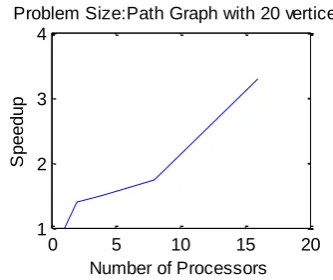
Time (secs.) Speed up
1 20.275985 1.0000
2 14.582843 1.3904
4 13.490342 1.5030
8 11.733871 1.7280
16 6.151799 3.2959
Fig.1PDSA on a path graph with 18 vertices
Fig.2 PDSA on a path graph with 20 vertices
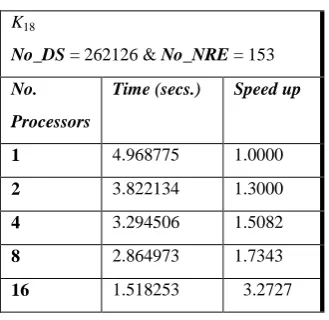
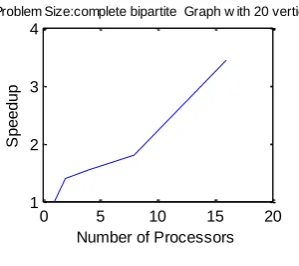
Figure 1 to 8 show the computation performance of various problem sizes over various numbers of CPUs. The problem sizes are the path graph with 18 and 20 vertices, the cyclic graph with 18 and 20 vertices, the complete graph with 18 and 20 vertices and the complete bipartite graph with 18 and 20 vertices. Each data set was executed 3 times so we reported the average time.
TABLE 3
C18
No_DS = 24914 & No_NRE = 18
No.
Processors
Time (secs.) Speed up
1 4.139703 1.0000
2 3.275599 1.2638
4 2.790309 1.4836
8 2.489729 1.6627
16 1.303223 3.1765
TABLE 4
C20
No_DS = 76725 & No_NRE = 20 No.
Processors
Time (secs.) Speed up
1 20.632824 1.0000
2 14.860864 1.3884
4 13.642449 1.5124
8 11.845963 1.7418
16 6.209620 3.3227
0 5 10 15 20
1 2 3 4
Number of Processors
S
p
e
e
d
u
p
Problem Size:Path Graph with 18 vertices
0 5 10 15 20
1 2 3 4
Number of Processors
S
p
e
e
d
u
p
Someone may ask, why then not using smaller problem sizes? Well the answer to this, is that if we use the smaller problem size, we can not get a good speed up because the communication time is greater than the computation time.
Fig.3 PDSA on a cycle with 18 vertices
Fig.4 PDSA on a cycle with 20 vertices
First of all it is well understandable that for 1 CPU, as a separate source code was developed, communication time does not exist, because the master does not send anything to any worker. It does all the computation on its own. It had to be done using this pattern, for having accurate results and the reason was that the same computer architecture should be used. If the code for excution on 1 CPU was executed on machine with a newer CPU the times should be quite different. As a result this should be executed on the head of the cluster called as " master".
TABLE 5
K18
No_DS = 262126 & No_NRE = 153 No.
Processors
Time (secs.) Speed up
1 4.968775 1.0000
2 3.822134 1.3000
TABLE 6
K20
No_DS = 1048556 & No_NRE = 190
No.
Processors
Time (secs.) Speed up
1 24.708195 1.0000
2 17.700548 1.3959
4 16.143871 1.5305
8 13.893427 1.7784
16 7.212622 3.4257
Fig.5 PDSA on K18
Fig.6 PDSA on K20
Looking at Table 8, comparing the time for 1 CPU and the time for 16 CPUs, we can understand the difference in time, and how many times faster the results occur with parallelization. To be more specific with 16 CPUs and the complete bipartite graph with 20 vertices, we can achieve a speed up of 3.4 times ( timecpu[1] / timecpu[16] ).
0 5 10 15 20
1 2 3 4
Problem Size:Cyclic Graph with 18 vertices
S
p
e
e
d
u
p
Number of Processors
0 5 10 15 20
1 2 3 4
Number of Processors
S
p
e
e
d
u
p
Problem Size:Cyclic Graph with 20 vertices
0 5 10 15 20
1 2 3 4
Problem Size:complete Graph with 18 vertices
Number of Processors
S
p
e
e
d
u
p
0 5 10 15 20
1 2 3 4
Problem Size:complete Graph with 20 vertices
Number of Processors
S
p
e
e
d
u
TABLE 7
K9,9
No_DS = 261122 & No_NRE = 81
No.
Processors
Time (secs.) Speed up
1 4.987248 1.0000
2 3.590531 1.3890
4 3.296264 1.5130
8 2.863984 1.7414
16 1.509900 3.3030
TABLE 8
K10,10
No_DS = 1046530 & No_NRE = 100
No.
Processors
Time (secs.)
Speed up
1 24.832957 1.0000
2 17.753043 1.3988
4 16.174660 1.5353
8 13.834818 1.7950
16 7.245751 3.4272
Fig.5 PDSA on K9,9
Fig.6 PDSA on K10,10
5. Conclusion
We have presented a parallel implementation of the derived subgraphs algorithms PDSA. The proposed implementation has an advantage. It leads to important reduction in total solution time of a derived sungraphs problem. The performance analysis also, shows that the speed up obtained is highly sensitive to communication among the processors.
6. References
[1] I. Rival (Ed.), Graphs And Order, Reidel, Dordrecht-Boston,(1985), p.25.
[2] R. P. Stanley, Enumerative Combinatorics, vol. I, Wadsworth & Broks/Cole, Belmont, CA, (1986). [3] B. Poonen, Union-Closed Families, J. Combin. Theory,
A 59 (1992), 253-268.
[4] M. H. El-Zahar , A Graph-Theoretic Version Of The Union-Closed Sets Conjecture, J.Graph Theory 26 (1997), no. 3, 155-163.
[5] B. Llano, J. Montellano-Ballesteros, E. Rivera-Campo and R. Strauz " On Conjecture of Frankl and El-Zahar" J. Graph Theory 57: 344-352 (2008).
[6] M. I. Moussa and E. M. Badr, A Computational Study for the Graph-Theoretic Version of the Union-Closed Sets Conjecture, International Journal of Computer Applications, Volume 50 – No.12,July 2012.
[7] I. Foster, Desiging and Building Parallel Programs: Concepts and Tools for Parallel Software Engineering. Addison-Wesley, 1995.
[8] W.Groop, E. Lusk, and A. Skjellum, Using MPI: Portable Parallel Programming with the Message Passing-Interface. MIT Press, 1994.
[9] E. M. Badr, M. I. Moussa, K. Paparrizos, N. Samaras and A. Sifaleras, Some Computational results on MPI Parallel Implementations of Dense Simplex Methods, Transactions on Engineering, Computing and Technology, vol. 17, pp. 228-231, 2006.
0 5 10 15 20 1
2 3 4
Problem Size:complete bipartite Graph w ith 18 vertices
Number of Processors
S
p
e
e
d
u
p
0 5 10 15 20
1 2 3 4
Problem Size:complete bipartite Graph w ith 20 vertices
S
p
e
e
d
u
p