Facial Expression Recognition Algorithm Based
On KNN Classifier
1
Prashant P Thakare, 2 Pravin S Patil
1
Department of Communication Engineering, S.S.V.P.S B.S.D. College of Engineering Dhule, North Maharashtra University, Maharashtra, India
2
Department of Electronics and Communication Engineering, S.S.V.P.S B.S.D. College of Engineering Dhule, North Maharashtra University, Maharashtra, India
Abstract - This paper presents the comparison between
the methodologies used for human emotion recognition from face images based on textural analysis and KNN classifier. Automatic facial expression recognition (FER) plays an important role in Human Computer Interaction (HCI) systems for measuring people’s emotions has dominated psychology by linking expressions to a group of basic emotions (i.e., anger, disgust, fear, happiness, sadness, and surprise).The comparative study of Facial Expression Recognition involves Curvelet transform based Robust Local Binary Pattern (RLBP) and Distinct LBP (DLBP) features and features derived from DLBP and GLCM. The objective of this research is to show that features derived from RLBP with DLBP is superior to the features derived from DLBP and GLCM. To test and evaluate their performance, experiments are performed using Japanese Female Expressions Model (JAFEE) database in both techniques. The comparison chart shows that, the DLBP and RLBP based feature extraction with KNN classifier gives much better accuracy than other existing methods.
Keywords - Curvelet Transform, Distinct LBP, RLBP,
GLCM, KNN Classifier, JAFEE Database.
1. Introduction
The foundational studies on facial expressions was studied in 17th century and that becomes helpful to forming the basic of today’s research. John Bulwer in 1649 gave a detailed note on the various expressions and movement of head muscles in his book “Pathomyotomia“. Le Brun gave a lecture at the Royal Academy of Painting in 1667, which was later reproduced as a book in 1734. Moving on to the 19th century, one of the important works on facial expression analysis was done by Charles Darwin. In 1872, Darwin wrote a treatise that established the general principles of expression and the means of expressions in both humans and animals. Another important milestone in the study of facial expressions and human emotions is the work done by psychologist Paul Ekman and his colleagues since the 1970s [19]. Ekman and Friesen developed the
Facial Action Coding System to code facial expressions where movements on the face are described by a set of action units (AUs) [7].
Human face is a very useful and powerful source of communicative information about human behavior. It provides information about human personality, emotions and thoughts. Facial expression provides information about emotional response and plays a major role in human interaction and non-verbal communications [1]. Facial expression recognition is very interesting and challenging topic in Digital Image Processing and computer Vision. It is the task of identifying mental activity, facial motion and facial feature deformation from still images and classifying them into abstract classes based on the visual information only this is possible because human facial gestures are similar [2]. Researcher says that the message conveyed by the verbal part or spoken is only 7%, the vocal part contributes for 38%, while facial expression of the speaker contributes for 55% to the effect of the spoken message. This implies that the facial expressions form the major modality in human communication [1].
In general, there are three important stages: Face detection, Feature extraction and. The robustness of face recognition could be improved by treating the variations in these stages. Feature extraction is a very important step for face recognition which reduces the number of features, removes irrelevant, noisy and redundant data, and results in acceptable recognition accuracy.
2. Literature Survey
Donoho which is known as curvelet transform. Curvelet transform is a multi-scale pyramid with many directions, positions at each length and fine scales. The new transform was developed to find a way to represent edges and other singularities along curves. This was more efficient than existing methods because less coefficients are required to reconstruct an edge to a given degree of accuracy [4].
Ojala et al introduced Local binary patterns as a fine scale texture descriptor. In its simplest form, an LBP description of a pixel is created by thresholding the values of a 3x3 neighborhood with respect to its central pixel and interpreting the result as a binary number [5]. LBP is not so robust to the noise present in images when the gray-level changes resulting from the noise are not monotonic, even if the changes are not significant [2]. To overcome this issue, we propose a new descriptor based on LBP, i.e., robust local binary pattern (RLBP)
[6]. First, the original image is decomposed into curvelet
sub-bands, and then on the approximate sub-band RLBP is applied to extract the texture features of facial images
that form feature vector [3].
An improved method of LBP is Discret Local Binary Pattern (DLBP). It describes the details of face expression more effectively, and also reduces the extracted feature’s dimension, thereby lowering the facial expression recognition time. Through experiment, it proves that the improved method is effective by adopting block DLBP feature extraction for the face expression image on the JAFFE database. DLBP gives better recognition than LBP. It can overcome the variance of different facial expression, and in the other hand, DLBP can extract the detail changes of facial expression, so it can distinguish different facial expressions [8].
The occurrence of the grey level pixel of an image is called as GLCM. Haralick in 1973 proposed GLCM. To extract the texture features GLCM is the simplest method. By converting the generated gray-level co-occurrence matrix (GLCM) to a vector, a feature vector for each face image is formed and then classification is done [11]. This statistical approach provides useful information about the relative position of the neighboring pixels in an image [10]. Here the texture features of images are extracted and stored in a matrix. The co-occurrence matrix is useful in a variety of image analysis applications such as in biomedical, remote sensing, industrial defect detection systems, etc. Gray Level Matrix is used to extract features based on the gray level value of pixels [9].
3. Proposed Method
The proposed system is divided into: Pre-processing, Face detection, Curvelet transform (CT), DLBP, RLBP and K-NN Classifier. Initially we had applied
pre-processing on test image like rgb to gray conversion, filtering and face detection, later we had applied Curvelet transform after applying curvelet transform we will get four sub bands like Low and High. In that we had taken Low frequency for applying DLBP and RLBP, at last we had used KNN classifier for classification. Same process is applied for database images.
Fig.1 block diagram of proposed method
3.1 Preprocessing
In Preprocessing Gray scale conversion and Noise removal is involved. In computing, an image in which the value of each pixel is a single sample is called as a gray scale digital image, it carries only intensity information. They also known as black-and-white images and are composed exclusively of gray shades, varying from black at the weakest intensity to white at the strongest. Gray scale images are distinct from one-bit bi-tonal black-and-white images, which in the context of computer imaging are images with only the two colors, black and Gray scale images have many shades of gray in between. Gray scale images are often the result of measuring the intensity of light at each pixel in a single band of the electromagnetic spectrum, and in such cases they are monochromatic proper when only a given frequency is captured. And the gray scale conversion of image is given by [17].
gray (i, j) = {0.29∗rgb (:,:, 1) +0.59∗rgb (:,:,2) +0.11∗rgb :,:,3}
Generally to suppress the noise we are using median filter. First arrange matrix pixel value in the form of ascending order. Find the median value of that matrix. And finally replace that value into that noisy pixel location [3].
3.2 Face Detection
parts apart from face is eliminate. Cropping changes the aspect ratio of image. The Gray scale facial image is cropped based on the two eye location [5].
3.3 Curvelet Transform
The transformation is a process that transforms an object from a given domain to another which can be used for its recognition [6]. The multi resolution tool curvelet transforms offers improved directional capability, better ability to represent edges and other singularities along curves as compared to wavelet transforms. For one-dimension Wavelets works fine, but to represent higher dimensional singularities especially curved singularities wavelet fails. Curvelet transform is used in applications like image compression, image de-noising, image fusion, contrast enhancement, high quality image
restoration, image de-convolution etc. [8]. Curvelet
transform has been recently proved to be a powerful tool for multi-resolution analysis of images. The scientists have contributed techniques for facial expression recognition based on curvelet transform [18] [19] [20]. The combination of curvelet transforms with LBP yields good feature vector than using the curvelet transform alone. The curvelet based LBP texture operator is a good feature extractor [9].
3.4 DLBP
To avoid illumination effect problem of LBP, the present paper combined structural and statistical methods using the proposed DLBP. Conversion of 5×5 window into 3×3 window.
STEP 1: Formation of nine overlapped sub 3 x 3 neighborhoods from a 5 x 5 neighborhood: A neighborhood of 5x5 pixels is denoted by a set containing 25 pixel elements: P= {P11… P15: P21….. P25:P31 ...P35: P41… P45: P51…. P55}, here P33 represents the intensity value of the central pixel and remaining values are the intensity of neighboring pixels as shown in Fig.2.
P11 P12 P13 P14 P15
P21 P22 P23 P24 P25
P31 P32 P33 P34 P35
P41 P42 P43 P44 P45
P51 P52 P53 P54 P55
Fig 2: Representation of 5x5 neighborhoods
P11 P12 P31 P12 P13 P14 P13 P14 P15
P21 P22 P23 P22 P23 P24 P23 P24 P25
P31 P32 P33 P32 P33 P34 P33 P34 P35
n1 n2 n3
P21 P22 P23 P22 P23 P24 P23 P24 P25
P31 P32 P33 P32 P33 P34 P33 P34 P35
P41 P42 P43 P42 P43 P44 P43 P44 P45
n4 n5 n6
P31 P32 P33 P32 P33 P34 P33 P34 P35
P41 P42 P43 P42 P43 P44 P43 P44 P45
P51 P52 P53 P52 P53 P54 P53 P54 P55
n7 n8 n9
Fig 3: Formation of 9 overlapped 3x3 neighborhoods {n1, n2… n9}
STEP 2: Formation of ―First order Compressed Image Matrix (FCIM) of size 3 x 3 from 5 x 5: In step one, from each overlapped 3 x 3 sub matrix, a pixel value for the FCIM of size 3 x 3 is obtained as given in equation 1.1. The FCIM is a 3 x 3 matrix with nine pixel elements (FCP1 to FCP9) as shown in the Fig.4.The FCIM maintains the local neighborhood properties including edge information.
=Avg of () for i=1, 2 …9 (1.1)
FCP1 FCP2 FCP3
FCP4 FCP5 FCP6
FCP7 FCP8 FCP9
Fig 4: Representation of grey level FCIM
STEP 3: LBP on FCIM: The FCIM is converted into binary based on LBP method as given the equations 1.2 and 1.3
= 0 if < (1.2)
= 1 if >= (1.3)
STEP 4: Formation of two given Distinct LBPs (DLBP) on FCIM: From the binary FCIM of 3x3 neighborhoods four Triangular LBP unit values are derived as shown in Fig5. Each Triangular LBP unit value contains only three pixels, thus it can have a maximum value of seven. To have rotationally invariance the minimum value is chosen for each Triangular LBP. The Upper TLBPs (UTLBP) i.e. TLBP1 and TLBP2 are formed from the combination of pixels FCP1, FCP2, FCP4 and, FCP2, FCP3, FCP6 respectively.
The Lower TLBPs (LTLBP) i.e. and are formed from the combination of pixels FCP4, FCP7, FCP8 and, FCP6, FCP8, FCP9 respectively. Based on this, two DLBPs are formed from sum of UTLBP (SUTLBP) and sum of LTLBP (SLTLBP) values of FCIM as given in equations 1.4 and 1.5
SUTLBP = + (1.4) SLTLBP = + (1.5)
3.5 RLBP
The code which RLBP produces is invariant to monotonic gray scale transformation and insensitive to noise. The gray value of centre pixel in 3x3 local area is replaced by its average local gray value of the neighborhood pixel values instead of the gray value of centre pixel value, in which the RLBP is calculated. The Average Local Gray value (ALG) is defined as
=∑ 9+
Where g is the gray value of the centre pixel and (i=0, 1…8) represents the gray value of the neighbor pixels. ALG is the average gray level of local area, which is obviously more robust to noise than the gray value of the centre pixel. This can be defined as
RLBP,= !(#− %)2 (
#)
= ! *#−∑/-01+,-.+,
2 3 2#
(
#)
The LBP process is applied by using ALG as the threshold instead of the gray value of central pixel, named as Robust Local Binary pattern (RLBP). where gc is the gray value of central pixel and (p=0,1,…P- 1) represents the gray value of the neighbor pixel on 3x3 local area of radius R, P is the number of neighbors and (i=0,1,…8) is the gray values of the neighbor pixel of gc Average local gray level of pixel is used as threshold, therefore RLBP is insensitive to noise and also two different patterns with same LBP code may have different RLBP code, because that neighbors of each neighbor pixel are considered.
3.6 KNN Classifier
K-nearest neighbor algorithm [12, 13] is a method for classifying objects based on closest training examples in the feature space. K-nearest neighbor algorithm is among the simplest of all machine learning algorithms. In the classification process, the unlabeled query point is simply assigned to the label of its k nearest neighbors.
Typically the object is classified based on the labels of its k nearest neighbors by majority vote. If k=1, the object is simply classified as the class of the object nearest to it. When there are only two classes, k must be an odd integer. However, there can still be times when k is an odd integer when performing multiclass classification. After we convert each image to a vector of fixed-length with real numbers, we used the most common distance function for KNN which is Euclidean distance:
4(5, 6) = ‖5 − 6‖
= (5
− 6
)
8
4. Result
There are six basic expressions and their results as follows:
4.1 Happy
a) Test image b) Cropped image
c) Curvelet Transform sub bands
d) DLBP e) RLBP
g) Final Result
4.2 Angry
a) Test image b) Cropped image
c) Curvelet Transform sub bands
d) DLBP e) RLBP
f) Histogram Features g) Final Result
4.3 Surprise
a) Test image b) Cropped image
c) Curvelet Transform sub bands
d) DLBP e) RLBP
f) Histogram Features g) Final Result
4.4 Fear
a) Test image b) Cropped image
C) Curvelet Transform sub bands
d) DLBP e) RLBP
f) Histogram Features g) Final Result
4.5 Disgust
c) Curvelet Transform sub bands
d) DLBP e) RLBP
f) Histogram Features g) Final Result
4.6 Sad
a) Test image b) Cropped image
c) Curvelet Transform sub bands
d) DLBP e) RLBP
f) Histogram Features g) Final Result
5. Comparison
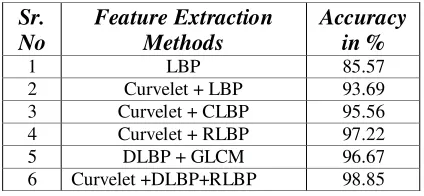
The comparison chart below shows that the proposed method of facial feature extraction is better than the existing methods.
Table 1: Accuracy (%) of proposed method & existing method
Sr.
No
Feature Extraction
Methods
Accuracy
in %
1 LBP 85.57
2 Curvelet + LBP 93.69
3 Curvelet + CLBP 95.56
4 Curvelet + RLBP 97.22
5 DLBP + GLCM 96.67
6 Curvelet +DLBP+RLBP 98.85
6. Conclusion
In this paper, we compare the proposed method with the existing method. A proposed technique for facial expression recognition is the combination of curvelet transform, DLBP and RLBP. The features are extracted from still images. Thus the proposed integrated method represents complete information of the facial image. The proposed DLBP & RLBP of FCI is a three phase model for recognizing facial expressions. In the first Phase it, reduced the 5x 5 image in to a 3x 3 sub image without losing any significant information. In the second and third phases Curvelet transform, Distinct LBP. Then apply RLBP at last we had used KNN classifier to find the expression of input image. The proposed method overcomes the unpredictable distribution of the face images in real environment caused by statistical methods and illumination problems caused by LBP. The existing method extracts the features derived from distinct LBP and GLCM. The comparison chart shows that, the DLBP and RLBP based feature extraction with knn classifier gives much better accuracy with lesser algorithmic complexity than other facial expression recognition approaches.
7. Future Work
To improve the accuracy we have to use shift in-variant technique transform like SWT or NSCT, also those transform will give better recognition in low light condition also. We also have to use the video sequence of images rather than using still images.
References
[1] Alaa Eleyan, Hasan Dem˙irel, “Co-occurrence matrix and its statistical features as a new approach for face recognition”, Turk J Elec Eng & Comp Sci, Vol.19, No.1, 2011.
Face Recognition”, Department of Computer Science, Pontificia Universidad Cat´olica de Chile. [3] Dr. S. Vijayarani, S. Priyatharsini, “Facial Feature
Extraction Based On FPD and GLCM Algorithms”, International Journal of Innovative Research in Computer and Communication Engineering, Vol. 3, Issue 3, March 2015.
[4] G.Hemalatha, C.P. Sumathi, “A Study of Techniques for Facial Detection and Expression Classification”, International Journal of Computer Science & Engineering Survey (IJCSES), Vol.5, No.2, April 2014.
[5] Gorti Satyanarayana Murty, “Facial Expression Recognition Based on Features Derived From the Distinct LBP and GLCM”, I.J. Image, Graphics and Signal Processing, 2014, 2, 68-77Published Online January 2014 in MECS.
[6] Hua Lu, Mingqiang Yang, Xianye Ben, Peng Zhang, “Divided Local Binary Pattern (DLBP) Features Description Method for Facial Expression Recognition”, Journal of Information & Computational Science, (2014) May 1, 2014. [7] Ira Cohen, Nicu Sebe, Yafei Sun, Michael S. Lew,
Thomas S. Huang, “Evaluation of Expression Recognition Techniques”, Beckman Institute, University of Illinois at Urbana-Champaign, USA, Faculty of Science, University of Amsterdam, the Netherlands, Leiden Institute of Advanced Computer Science, Leiden University, The Netherlands. [8] M. Madhu, R. Amutha, “Face Recognition using
Gray level Co-occurrence Matrix and Snap Shot Method of the Eigen Face”, International Journal of Engineering and Innovative Technology (IJEIT), Volume 2, Issue 6, December 2012.
[9] Muzhir Shaban Ani1 and Alaa Sulaiman Al-waisy, “Face Recognition Approach Based on Wavelet - Curvelet Technique”, Signal & Image Processing: An International Journal (SIPIJ), Vol.3, No.2, April 2012.
[10] Nagaraja S. and Prabhakar C.J, “Curvelet Based Multiresolution Analysis of Face Images for Recognition using Robust Local Binary Pattern Descriptor”, Proc. of Int. Conf. on Recent Trends in Signal Processing, Image Processing and VLSI, Association of Computer Electronics and Electrical Engineers, 2014.
[11] Nagaraja S., Prabhakar C.J. and Praveen Kumar P.U., ”Complete Local Binary Pattern for Representation of Facial Expression Based on Curvelet Transform”, Proc. of Int. Conf. on Multimedia Processing, Communication & Info. Tech., MPCIT Association of Computer Electronics and Electrical Engineers, 2013.
[12] Nagaraja S., Prabhakar C.J., “Extraction of Curvelet based RLBP Features for Representation of Facial Expression”, International Conference on Contemporary Computing and Informatics, 2014. [13] Nidhi N. Khatri Zankhana H. Shah, Samip A. Patel,
“Facial Expression Recognition: A Survey”, (IJCSIT) International Journal of Computer Science and Information Technologies, Vol. 5 (1) , 2014. [14] Prashant P. Thakare, Pravin S. Patil, “An Efficient
Facial Expression Recognition Using Curvelet Transform Based RLBP and Distinct LBP Feature”, International Journal of Innovative Research in Electrical, Electronics, Instrumentation and Control Engineering, Vol. 4, Issue 5, May 2016.
[15] Shalini Mahto, Yojana Yadav, “A Survey on Various Facial Expression Recognition Techniques”, International Journal of Advanced Research in Electrical, Electronics and Instrumentation Engineering, Vol. 3, Issue 11, November 2014. [16] Shyna Dutta, V.B. Baru, “Review of Facial
Expression Recognition System and Used Datasets”, IJRET: International Journal of Research in Engineering and Technology, Volume: 02 Issue: 12, Dec-2013.
[17] S.Seedhana Devi, S.Jasmine Rumana, G.Jayalakshmi, “Robust Human Emotion Analysis Using LBP, GLCM and PNN Classifier”, International Journal for Trends in Engineering & Technology, Volume 4 Issue 2 – April 2015. [18] S.Yamuna, S.Abirami, “Feature Extraction of Face
Value through Gray- Level Co-Occurence Matrix”, International Journal of Open Information Technologies, vol. 3, no. 6, 2015.
[19] Vinay Bettadapura, “Face Expression Recognition and Analysis: The State of the Art”, College of Computing, Georgia Institute of Technology.