Page 191 www.ijiras.com | Email: [email protected]
The Influence Of Copyright Laws On Digitization Projectsin Public
Libraries In Kenya, A Case Study Of Kenya National Library
Services
Jean-Marcel Martin Mwanza
School of Entrepreneurship, Procurement and Management, Jomo Kenyatta University of Agriculture and Technology,
Dr. Joseph Mwangi Gichure, PhD.
Lecturer, Jomo Kenyatta University of Agriculture and Technology
I. INTRODUCTION
A. BACKGROUND INFORMATION
According to the International Federation of Library Association (2004), a public library is a library that is accessible by the general public and is generally funded through public resources. The IFLA/UNESCO Public Library
Page 192 www.ijiras.com | Email: [email protected] elaborate. Coupled with the continual dependence of users on
digital platforms it has become more and more apparent that libraries need to transverse their traditions and fuse most of their practices with the current technological breakthroughs. Such predicaments have forced most information depositories to embrace digitization as a standard modern day practice rather than a futuristic phenomenon. Over time this trend has led to the transformation of libraries to become what is presently known as Automated/digital Libraries.
Currently most digitized libraries don’t operate independently as even the most modern libraries still embrace aspects of the conventional paper library. They continue to use both systems to complement each other as the paper based resources have proven too beneficial to be done away with. But in an era when online discovery and access to information and knowledge is not only desirable but often an expectation, access to resources stewarded by digital platforms is of critical importance for several reasons. To start with, such digital technologies can hold significant amounts of information resources in small mediums of space. Not only are they efficient to manage, they also hold several other advantages over paper based systems making them a necessity in this day and age. Digitization has as a result become a norm in the modern day attributes of librarianship. Libraries are increasingly prioritizing the creation of digital facilities over paper based resources. These trends are increasingly being driven with a specific objective of making digital and automated systems fundamental functions. In retrospect libraries are looking at a situation where some or all of the holdings are made available in electronic and digital formats, library services are offered electronically – frequently over online library networks and users do not always need to physically visit the library to access information resources (Donald 2001). Such practices have seen libraries easily increase their holdings while at the same time save on floor space within the library which would be put to better use.
Digitization of information resources in libraries come with several benefits both in the short and long terms. For one, digitization enables libraries to avail information resources more centrally and makes them accessible to multiple users simultaneously. Such wouldn’t be possible with the use of paper based resources which often require libraries to purchase several copies of the same work, a very expensive venture. Users of digital material often don’t need to be within the library vicinity to be able to access resources when they are digitized and placed on electronic online platforms. In contrasts digitization allows the libraries to offer users remote access which in turn allows libraries to prevent congestion within their premises. With this in mind money spent on extra furniture to accommodate more users can be saved and put to better use. Digitization also allows for libraries to save on floor space as digital resources require very little media compared to paper based resources such as card catalogues. More importantly digital resources are normally less prone to damage compared to paper based resources, not only that, they are also less susceptible to loss and deterioration. This in essence saves the libraries from the need to replace resources every so often.
While the adoption of such systems has been fast and successful in the west and other developed countries, the trends have been quite uneven and slow in Africa. For instance, according to the Digital Public Library of America (DPLA) 92% of public libraries in America have locally significant, unique digital collections, 37.6% of these libraries have successfully engaged in digitization activities in the last three years while all state library agencies reported that digitizing and providing online access to local and unique digitized material aligns with their missions explicitly. According to Kendra (2017) there are many ongoing efforts to advance the growth and development of America’s National Digital Platform (NDP), including establishing a national network of digital libraries that brings together digitized and born-digital contents into a single access point for end users. On the same note, public library involvement in DPLA has doubled since 2014 giving a strong indication of their commitment to digitization.
In Europe, digitization of library and archived resources has been part of most library activities for about 15 years, (Nielsen, 2007). Many national libraries and big university libraries, not to mention archives and other cultural institutions, have had huge parts of their collections digitized. In Britain, a good percentage of the British Libraries have been at the forefront of digitisation and digital preservation projects for over two decades. They are able to offer their users with a wide range of digitised services and materials most of which can be accessed virtually through independent client terminals, (British Library, 2015).
In Africa, such trends seen in the west aren't being replicated in the same wavelength save for in a few countries such as South Africa. Most libraries in in these parts of the world still rely heavily on the conventional paper based library systems. The situation in Kenya depicts the same trend despite several efforts being made in the recent past to make digital platforms a priority in libraries. An interesting observation is that several institutional libraries in the country have made significant progresses while their public counterparts continue lagging behind. Of deep concern is the fact that these lags are being experienced in the backdrop of various efforts by KNLS and other players to adopt several ICT projects on digitization. Of the 60 plus public libraries in the country, only a handful can boast of having adequate digital resources in place let alone robust plans to have them installed in the near future (Yusuf, 2009).Understandably, incorporation of automated and digital systems in any large institution cannot be done overnight (Wagner, 2005). It entails a chain of processes that would usually take plenty of time and effort to make them a reality. The processes involved are intricate and need good managerial commitments and pragmatic operational logistics.
B. STATEMENT OF THE PROBLEM
Page 193 www.ijiras.com | Email: [email protected] available to their users. There is a very large disparity between
the progresses made by private, academic and other special libraries in digitization compared to public libraries. There is also a very huge disparity on digitization initiatives done in public libraries in urban areas compared to those in rural areas.
According to Amollo (2011) Kenya’s ICT sector is more active in urban areas although the government, in keeping with its Vision 2030, is tackling the regional disparity by setting up digital centers countrywide. But in essence that is still a pipe dream on paper. It is in fact accurate to point that most libraries in marginalized areas such as Wajir still depend on unorthodox forms of information services such as the use of camel libraries at a time where they should be benefiting from novel automated and digitized resources. Very few public libraries in Kenya have managed to digitize their collections successfully. Most of them are newer libraries that were in fact conceptualized to be ultra-modern libraries from the onset. The Buruburu public library gives an exemplary testament, the institution during and after its establishment has managed to ward through mammoths of perennial challenges by implementing and using innovative automated and digital facilities to offer services to its users. An even more promising story is the ultra-modern Upper Hill library project in Nairobi which is meant to host KNLS’s headquarters. Commissioned in April 2012,the complex, with a sitting capacity of 5000 users will offer a comprehensive digital national reference service to all sectors of the economy and contribute to literacy development and research(Kiganda 2017). Users will be able to access full list of books and digital resources and borrow or make reservation remotely over the internet. Through such initiatives KNLS is introducing communities to basic telecommunication technologies and giving impetus to innovative initiatives and knowledge development for children, youth, adult and the aged (Muia, 2017).
Other such public libraries boasting considerable levels of digitization include the Nakuru and the Kisumu public libraries which have both to some good extents been able to facilitated the use of digital systems. Unfortunately this is where the platitudes stop as most other public libraries have little or nothing to show in respect to digitization. And that is not likely to change any time soon with the existing challenges hanging above them like thick dark clouds. According to Amollo (2011), despite the zeal with which the government is supporting and implementing this ICT related changes, the pace in digitization of libraries and national records offices or departments still remains slow and strained. There is need for more action to ensure that libraries are incorporated in the national digitization policies and plans. Initiatives for library digitization remain scattered all over with the university, academic, private and institutional libraries showing the greatest progressions. Despite the fact that public libraries in Kenya operate under one umbrella body there are no indications yet to indicate that they have a common resource sharing platform. One of the most significant deliverable of library digitization would be the establishment of interlibrary virtual networks to facilitate resource sharing. Among other benefits, such networks would enhance operational efficiencies, minimize resource duplications, lower the operational costs, increase flexibility and enhance effective tracking of information resources. To date most peer public
information resource centers don’t have the capacity to share resources despite several initiatives supported by the African Virtual Library-Kenyan Chapter project. According to Atuti (2014) less than fifteen percent of public libraries in Kenya are adequately equipped with the appropriate and required digital facilities. Others still operate jumbled up book rooms, manual cataloguing systems, and other traditional paper based facilities. Among the obstacles straining the digitization in these libraries copyright laws are sited to be among the significant issues that need to be addressed.
C. OBJECTIVES OF THE STUDY
The general objective of this study was to establish the influence of copyright laws ondigitization projects in public libraries in Kenya. The specific objective was to determine how copyright laws are affects the successful implementation of digitization projects in public libraries in Kenya. Among the issues sited in the study on copyright law are intellectual property rights, fair use, royalties, copyright infringement, digital access control structures and copyright exceptions among others.
D. SIGNIFICANCE OF THE STUDY
This study is expected to highlight how copyright laws are hampering digitization projects in Kenyan public libraries. The management of Kenya National Library Services can use its findings to come up with appropriate ways to counter such challenges and streamline the projects in ways that will ensure their sustainability. The government through the relevant authorities will find the findings beneficial in making better policies that will support such projects. The findings are also expected to open-up related areas for further research by other academicians and experts.
E. SCOPE OF THE STUDY
Page 194 www.ijiras.com | Email: [email protected] The management staff of KNLS was also involved in the
study. The findings of this study were expected to give a depiction of all other public libraries under KNLS since they operate under the same guidelines.
II. LITERATURE REVIEW
A. THEORETICAL FRAMEWORK
This study was guided by the Utilitarian Theory of intellectual Property coined by William Fischer, it asserts that Intellectual Property Rights through copyright laws make the public good a private, the non-exclusive – exclusive, and the non-scarce scarce which are not scarce by nature. It goes further to state that copyright laws create artificial scarcity of knowledge because creators do not have the necessary incentives unless they have been accorded some means to control their knowledge. Unless this is done people will lack the necessary economic incentive to create innovative works. The essence of intellectual property rights should be assessed in the economic success they bring to the society. As supported by the Incentive (bargain) theory, it is perceived that the protection given to intellectual property is an incentive to individuals not only to create works of the mind but also to publicize and disseminate them into the public. Works of the mind are very important to a given society for its social, cultural and economic development. The economic incentives given to an inventor enforce others to invent further rather than rely on the existing inventions. In support of this it is argued by many that digitization of copyrighted information resources poses great risks on control of such materials by their proprietors.
As propounded by F. Hegel, a person would be more self-assertive when she/he owns his/her property. It is believed that the work is the personal expression of the author’s or the inventor’s thoughts. So he should be given the right to decide when and how his work may be produced or performed in public, and the right to prevent mutilations and changes. Intellectual property laws are to be there to protect the author’s or the inventor’s manifestation of his personality. According to Fisher (2001), this approach employs the familiar utilitarian guideline that lawmakers’ beacon when shaping property rights should be the maximization of net social welfare. Lawmakers are required to strike an optimal balance between, on one hand, the power of exclusive rights to stimulate the creation of inventions and works of art and, on the other, the partially offsetting tendency of such rights to curtail widespread public enjoyment of those creations. B. EMPIRICAL REVIEW
The World Intellectual Property Organization (WIPO) defines copyright as a legal term describing rights given to creators for their literary and artistic works. It is that exclusive and legal right ascribed to the creator of an intellectual work for a fixed number of years, to print, publish, perform, film, or record his or her literary, artistic, or musical material. In essence it balances the rights of authors with the rights of the public to use the work without seeking permission or paying
royalties. In Kenya copyright is listed under the intellectual property and is administered under the copyright Act of the Laws of Kenya. The Kenya copyright board defines it as the exclusive bundle of rights granted by law to authors of literary works such as producers of audio-visual works and films, architects, performers, broadcasters and other creators of literary, musical, artistic, audio- visual, sound recordings and broadcasts. The works covered by copyright under the copyright Act of Kenya include literary, musical, audio-visual, sound recordings and broadcasts. These would therefore encompass novels, poems, plays, computer programs, databases, films, musical compositions, broadcasts, photographs, sculptures, architectural drawings and maps amongst others. To protect the owners the Act offers three types of rights which include economic rights, related rights and moral rights. In Kenya copyright protection varies from work to work and that is dependent on their authorship as well as their nature. According to the Kenya copyright board protection is usually available for 50 years in the majority of instances. That is to say, protection will last for the life of the author plus fifty more years after his death. If the author is unknown the period of protection is 50 years from date of its publication. On the other hand, Audio-visual works, photographs, sound recordings and broadcasts are protected for 50 years from the date of first publication.
The owners of the copyrighted material reserve the right to control their material albeit subject to exceptions permitted under the law. Such exceptions include but are not limited to fair dealing, face-to-face instruction and virtual instruction. It is however important to note that such dealings provisions are more stringent when it comes to computer programs, one of the core faculties in digitization. Some works however are considered to be works in the public domain. They include all works that never had copyright protection and those that no longer have copyright protection. They may also include most works created by the government or government institutions. Such works are normally free for the public to use.
Page 195 www.ijiras.com | Email: [email protected] there are several copyright laws and regulations governing the
copying and photocopying of print-based information resources, provision of access to digital collections via electronic networks, especially the Internet, is presenting bigger challenges to library digitization (Abby, 2001). Digital-based information resources can be accessed from anywhere via electronic networks, copied several times, manipulated (edited, modified, and repackaged,) or deleted, and most librarians do not know how to deal with this situation.
It is a key element for digital library projects to have appropriate recognition and protection of legal rights such as copyright, publicity, privacy, matters of obscenity, defamation intellectual property protection (Donald, 2001). They also need to consider other less legalistic but serious concerns associated with the ethics of sharing or providing access to folk or ethnographic materials. According to Anderson (1986), the vision for digital libraries includes fluid, easy access to a wide variety of materials. This is often in conflict with the conventional duties of libraries and archives which have to provide care and management of materials that may be subjected to privacy rights or other needs of security. Efforts to formulate digital libraries are delayed or frustrated due to the absence of a common, responsible framework of rights, permissions, and restrictions that acknowledges the mutual needs of rights-holders and users of materials in digital libraries. The challenge here is, in part, to develop mechanisms with technical means that will allow acceptable levels of access, and perhaps meeting social expectations. With digitization, libraries are required to put in place adequate copyright and intellectual property rights policies which in essence require proper skilled personnel, such personnel are not available in most of these libraries.
By far the biggest obstacle to digitization apart from financing is the present legal situation and the possibilities of negotiating and acquiring the rights to digitize contents within the 70 year limit of the death of the copyright holder (Kolding, 2007). He further says, the extension of the copyright limit from 50 to 70 years after the death of the copyright holder was simply a catastrophe and an enormous obstacle to developing relevant, adequate and comprehensive digital library content with material of sufficient importance. The legal demands of investigating and finding the heirs of these intellectual rights owners are extremely prohibitive for mass digitization projects with contents from the 20th century. The sooner the relevant authorities understands this and act accordingly, the better the chances of developing comprehensive and relevant library digital content (Nielsen, 2007).
III. METHODOLOGY A. RESEARCH DESIGN
This study utilized descriptive research survey design, this was chosen because it gives the description of the state of affairs as they exist giving specific insights on issues at hand.
B. TARGET POPULATION AND SAMPLING FRAME The target population in the study comprised the library staff in the public libraries and at Kenya National Library Services. The sampling frame comprised Kenya National Library Services staff at the headquarters, library staff from the two national libraries in Nairobi, Nakuru County public library, Murang’a county public library and Thika public library. The five libraries were chosen because they were able to give a good representation of the public library population. The table below presents the sampling frame.
SAMPLING FRAME
Serial Number
Study Center Population Percentage (%)
1 KNLS HQ 26 15.1
2 Buruburu
Library
62 36.0
3 Upper Hill
Library
34 19.8
4 Thika Library 14 8.1
5 Murang’aLibray 12 7.0
6 Nakuru Library 24 14.0
Total 172 100
Source: KNLS
Table 1
C. SAMPLE AND SAMPLING TECHNIQUE
The research used fifty percent of the target population, this was equivalent to a sample of 86 respondents. To find the total size for each stratum, the researcher took 50% of the population from each center. The distribution of the sample in each stratum is represented in table below.
Serial Number
Study Center Population Sample size
1 KNLS HQ 26 13
2 Buruburu Library 62 31
3 Upper Hill
Library
34 17
4 Thika Library 14 7
5 Murang’aLibray 12 6
6 Nakuru Library 24 12
Total 172 86
Table 2
D. RESEARCH INSTRUMENTS
Page 196 www.ijiras.com | Email: [email protected] E. VALIDITY OF THE INSTRUMENTS
Construct Validity was used to ensure that the instruments accurately measured what they intended to. Two management staff from KNLS and eight library staff from Buruburu library’s research and development department and ICT department examined the questionnaires to establish that the constructs were valid and appropriate for the study. Corrections and rectifications given were made before the questionnaires were distributed to the respondents.
F. RELIABILITY OF THE INSTRUMENT
To test the reliability of the questionnaires the study adopted Chronbach’s alpha with the aid of SPSS version 23.0. Cronbach’s alpha determines the internal consistency or average correlation of items in a survey instrument to gauge its reliability. According to Reynaldo and Santos (2014) it is a measure of internal consistency, that is, it measures how closely related a set of items are as a group. In essence, high reliability means the constructs measure what they are meant to while low reliability means they measure something else (or possibly nothing at all).
IV. RESEARCH FINDINGS AND DISCUSSION A. RESPONSE RATE
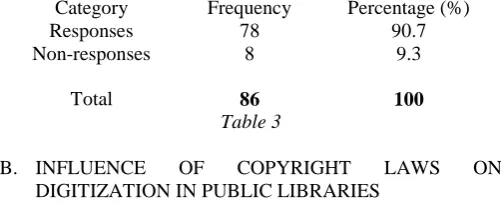
A total of eighty six (86) questionnaires were administered to the respondents from which a total of 78 were returned sufficiently completed. This represented a response rate of 90.7%, this was satisfactory for the research since it was above the threshold of 70% required according to Mugenda and Mugenda (2003). Only 8 of the questionnaires given out were not sufficiently filled and returned back translating to a non-response rate of 9.3%. This information is illustrated in the table below.
Category Frequency Percentage (%)
Responses 78 90.7
Non-responses 8 9.3
Total 86 100
Table 3
B. INFLUENCE OF COPYRIGHT LAWS ON
DIGITIZATION IN PUBLIC LIBRARIES
To establish the influence of copyright laws on digitization in public libraries the respondents were asked to indicate how certain elements on copyright influenced digitization in the libraries. A five point Likert Scale was used where: 1 = Very large extent, 2 = Large extent, 3 = Moderate extent, 4 = Little extent, 5 = Insignificant. The responses were summarized and presented in table below.
Influence of Copyright Law on Digitization
Element Response (%) Mean SD
1 2 3 4 5
Untraceable rights owners
28.75 15 12.5 15 13.75 2.65 1.49
Stringent intellectual
property rights
31.25 13.7
5
11.25 13.7
5
15 2.62 1.53
Fear of copyright infringement
37.5 20.0 10.0 7.5 10.0 2.21 1.39
Insufficient content control structures
35.0 22.5 11.25 6.25 10.0 2.22 1.36
Inadequate copyright
skilled library staff
30.0 25 13.75 7.5 8.75 2.29 1.31
Table 4
Form the table above the means and standard deviations of the data set were used to describe the responses given in the study. According to Lund &Lund (2013) Standard deviation is the measure of dispersion of a set of data from its mean. It measures the absolute variability of a distribution; the higher the dispersion or variability, the greater the SD hence the greater the magnitude of deviation of the value from their mean. The lower the dispersion or variability, the lower the SD translating to a lower magnitude of deviation from the mean.
From the table the SD values computed were relatively low with the highest element having an SD of 1.53. This indicated very slight deviations from their means thus asserting that the given elements had strong influences on digitization. Of more importance, the study indicated that-- fear of copyright infringement, insufficient content control structures and inadequate copyright skilled staff had higher influences on digitization as they had the lowest SD values with their means dwelling significantly towards 2.
From these findings it was demonstrated that copyright laws present significant drawbacks to library digitization projects in a variety of ways. These findings were consistent with Rosati (2013) who asserted that copyright related considerations have adversely affected the choice of whether certain digitization projects should even be undertaken in the first place. It is noted that there have been significant instances in which the copyright status of various works along with difficulties arisen in clearing the relevant rights have either impeded or significantly altered the scope of digitization projects. Rosati (2013) also notes that due to copyright-related difficulties, there is a widespread concern that a good number of materials might never be digitized in most libraries.
Page 197 www.ijiras.com | Email: [email protected] The respondents were asked to indicate whether they
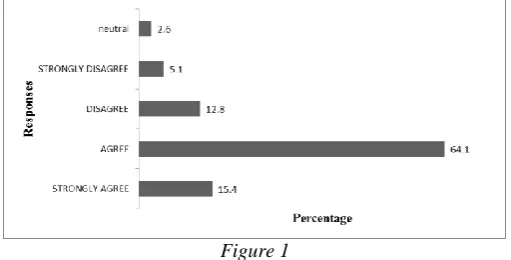
thought copyright laws were a hindrance to these projects. A Likert scale was used to demonstrate the responses on a five point scale where 1=strongly agree, 2 = agree, 3 = strongly disagree, 4 = disagree and 5 = neutral. The responses are summarized in the figure below.
Figure 1
COPYRIGHT LAWS HINDER DIGITIZATION
From the figure the majority (64.1%) of the respondents agreed that copyright laws are a hindrance to digitization.15.4% of the respondents strongly agreed with the observation. Subsequently the majority of the respondents (79.5%) concurred that copyright laws were challenging digitization projects in libraries. This observation was in concurrence with Chepesuik (1997) who had indicated that copyright is the "single most vexing barrier to digital library development". The observations also concurred with Cleveland (1998) who had indicated that it is unlikely that libraries will ever be able to freely digitize and provide unlimited access to copyrighted materials without effective meditative structures against the existent stringent copyright laws.
In the study 12 8% of the respondents disagreed that copyright laws presented challenges to digitization while only 5.1% of them strongly disagreed. The other 2.6% of the respondents stayed neutral on the subject. Since the majority of the respondents (79.5%) either strongly agreed or agreed on this the researcher concluded that indeed copyright laws pose significant challenges to digitization in libraries.
C. INFERENTIAL ANALYSIS
According to Stephanie (2018) inferential statistics is used to make inferences using data drawn from the population. It allows one to make predictions (“inferences”) from that data in regard to the entire population.
CORRELATION ANALYSIS
Spearman’s Rank correlation coefficient was calculated to assess the relationship between the independent variable (copyright laws) and the dependent variable, digitization in public libraries. Two tailed correlation analysis was performed at 95% confidence level. Spearman’s Rank Correlation was used for its suitability for ordinal data. The results were summarized and presented in the table below.
Spearman’s Correlation Coefficients
Independent Variable
Spearman’s
rho Significance
Copyright Laws 0.65 0.012
Table 5
The results of correlation analysis in the table revealed existence of a relationship between the independent variable and the responsive variable, digitization of public libraries. The correlation values were significant at 95% confidence level.
LINEAR REGRESSION ANALYSIS
Linear Regression Model (LRM) of the form of Y= β0 +
βiXi + e was used to determine existence of a relationship
between the independent variable (Xi) and the dependent variable, digitization in public libraries in Kenya (Y). The analysis was done using SPSS Version 23 at 95% confidence and the results presented in subsequent tables.
LINEAR REGRESSION MODEL FOR COPYRIGHT LAWS
Linear Regression Analysis for copyright laws in relation to digitization of public libraries was performed at 95% confidence level and the results summarized and presented in table below.
Relationship between Copyright Laws and Digitization of Libraries
Model R R
square
Adjusted R square
Std. Error
Sig
1 0.583 0.34 0.30 0.021 0.008
a. Predictors: (Constant) Intellectual property rights,
Royalties, Content access policies
b. Dependent Variable: Digitization in public libraries Table 6
The results from the table revealed a positive relationship between copyright laws and digitization of public libraries. The coefficient of was found to be 0.583 with a standard error 0.021.
D. INFLUENCE OF COPYRIGHT LAW ON
DIGITIZATION OF PUBLIC LIBRARIES
Page 198 www.ijiras.com | Email: [email protected] would always be made availlable form KNLS or recieved
directly from donors.
Despite the fact that these libraries own much of their resources through purchaces and other forms of acquisition they are often unable to digitize most of them as converstion of such analogue material to digital formats may often infringe on the exclusive rights of reproduction of the owners. Acquiring the consent to digitize such materials from their owners often comes with financial implications, and that’s if such owners can be traced in the first place. The research observed that for those public libraries embarking on digitization the digitized contents available for users are often limited to specific works which are not under copyright, those aquired in digitial formats with prenegotiated rights or those acquired from donors who’ve already acquired the rights from their owners. Public librareis in kenya don’t have adequate copyright specialists stationed whithin their jusrisdictions to assist during digitization. The study further established that individual libraries would often depend on copyright personnel centralised at KNLS or specific regional libraries when in need of assistance on matters copyright. Individual libraries carrying out digitization need easily accesible copyriht specialists on demand for several reasons. Such personnel are vital to assist in the interpretation of copyright Acts, tracking and negotiating with owners, finding and defining exemptions that are availlable and generally advising such libraries on how to avoid cases of infringment. In essence copyright issues are too weighty for these individual libraries, they often require legal teams in place to offer support.
The study observed that several anormallies and restrictions on copyright law often significantly affect the advancement of digitization in public libraries. Most works require licences from owners before their are digitised or made availlable online, these licences are often very expensive to acquire by individual libraries. This often places very stringent administrative and financial constraints on such libraries who normally opt against digitizing such works. It was also observed that most public libraries in kenya lack efficient content control structures that would help to avoid copyright infringement when certain works are placed in digitizal formats. Libraries as custodians of information resources are required to protect intellectual works of authers from unfair use by users through several mechanisms. One such way is the creation of adequate content control structures, unfortunately such mechanisms are not easy to create due to the financial constraints existent in most public libraries. Creatioin of such structures would require ICT support staff who are often inexistent in most individual public librareis in kenya.
These findings were consistent with Rosati (2013) who asserts that copyright-related considerations have adversely affected the choice of whether certain digitization projects should even be undertaken in the first place. There have been significant instances in which the copyright status of various works that could be potentially included in digitization projects, along with difficulties arisen in clearing the relevant rights, have either impeded or significantly altered the scope of digitization projects. Due to copyright-related difficulties, there is also widespread concern that a good and relevant number of materials might not be digitized at all (Rosati, 2013). The findings were also consistent with Hargreaves
(2011) who held the view that copyright laws have failed to keep up with technological and social changes in the society. This has in the longest time led to widespread difficulties in sufficient information dissemination not just in librarianship but equally in many other disciplines. While technology has expanded the potential for communication, research, learning and access to resources, copyright enforces restrictions such that this potential hasn’t been fully realized.
V. SUMMERY, CONCLUSIONS AND RECOMMENDATIONS A. SUMMERY
The study revealed that copyright laws negatively influence the implementation of digitization projects in a variety of ways. Among the observations made was that copyrightlaw significantly determines what materials can be digitized in these libraries, it was demonstrated that during digitization libraries are often denied the freedom to digitize all their collections despite the fact that they might own such works in alternative formats. Even when such materials are made digital, it has also been observed that copyright often defines if such works can be made available online and how they are made accessible for users. Making resources available online requires that such libraries create security structures to prevent unfair use of the same. The creation of these control structures often requires proficient technical intervention from ICT professionals. This is a resource most public libraries in Kenya do not have for several reasons the main one being lack of adequate funds to hire them. It was also clear that these libraries lack copyright management functions that would help track, identify, and authenticate users accessing their collections under copyright. The libraries are also unable to provide most of the copyright statuses of all their digital collections and identifying the restrictions on their uses or the fees associated with using them.
Restrictions not only in the copyright laws have for the longest time hindered developments in digital librarianship. Except for institutional libraries which have control over their works public libraries are normally only custodians of such works meaning they have very limited rights on how to manage them. Conversion of such works to digital formats often requires the acquisition of rights through licenses which are often too expensive to obtain. As a result copyright continues to prevent them from providing open access of digital information in store to users. In essence questions of copyright aren’t being managed effectively so as to allow digital information to be created and distributed in a manner that is equitable for both intellectual property owners and users.
Page 199 www.ijiras.com | Email: [email protected] libraries in Kenya lack adequate staff on copyright law to
effectively handle all these and other related issues when it comes to digitization.
B. CONCLUSION
The study concluded that copyright law has significant negative impacts on digitization projects in the public libraries. As much as it affects all other informational institutions, public libraries can be said to suffer more for several reasons. While other institutions such as academic libraries have the resources to address copyright at great lengths, public libraries don’t have these resources at their disposal. This conclusion is consistent with Cleveland (1998) who indicated that it is unlikely that libraries will ever be able to freely digitize and provide unlimited access to copyrighted materials without effective meditative structures against stringent copyright laws. The study found that these libraries often select items that are perceived to incur little risk of copyright or those that require few or no resources to investigate copyright status or obtain copyright authorizations. As a result their digital selection decisions are more restrictive so as to avoid copyright law implications.
C. RECOMMENDATIONS
a. COPYRIGHT LAW EXCEPTIONS AND REVIEWS
According to an empirical research into the digitization of collections in Australia, copyright law affects what material is digitized and how it is made accessible. As such, major copyright reforms need to be done in the Copyright Acts of Kenya and other countries to encourage digitization of materials. Such amendments should include technical amendments to the libraries and archives provisions making them more flexible to support digitization. Systems of copyright exceptions and limitations in the region also need to be reviewed in numerous jurisdictions to consider the introduction of more flexible and wider exceptions for libraries. The government should also launch structured stakeholder consultations to address timely issues on how to mitigate the effects of territoriality of copyright laws; how to agree to appropriate levels of harmonization; how best to reduce the fragmentation of regional and global copyright market and improve legitimacy of copyright enforcement; and how to reform the set of copyright exceptions and limitations that are currently envisaged.
Copyright legislations should also be encouraged to keep up with technological and social changes keeping in mind that technology has expanded the potential for communication, research, learning and access to resources. This would be a good way for libraries engaging in digitization activities to benefit from extended exceptions for during digitization. As such there is a legitimate need to amend our copyright legislation to suit the electronic environment. A solution would be for institutions to take initiatives and hold workshops on digital libraries and digital technologies on matters of copyright in consultations with the legislative arms concerned.
Information centers also need to come up with technological ways to avoid and limit abuse of intellectual property in digital format by users. This will go a long way not just to give contributors of such materials the assurance they need, but also provide such institutions with the confidence they need to tackle infringement by end users. Information centers could also encourage scholars to have their work digitized in the library by introducing associated incentives and accommodating copyright concerns by licensing their content and distributing them on commercial bases. The contributors could then be paid royalties whenever users subscribed to acquire these licenses from the libraries. Libraries could also create departments dealing with digital rights management, digital library security and digital content management as foolproof ways of dealing with copyright law and intellectual property rights.
b. CONTINUOUS DIGITAL LIBRARY SURVEYS
With several digital library initiatives being executed, it will be useful to have continuous surveys on the effects of copyright vis-à-vis digitization in libraries in Kenya and across the world. A survey would not only help to understand the present situation, it will also assist in drawing up future action plans on how issues on copyright can be addressed to encourage digitization. Such studies are of paramount importance, among other things they would also help draw out the existing gaps, outline individual needs faced and more importantly facilitate growing interests towards digitization and in regard to copyright law.
c. INTERLIBRARY COOPERATION
The new information environment creates demands for libraries to be less confined to resources within their establishments. In view of the liberalization of information through ICT, libraries need to shift their focus from accumulation and ownership of information resources to providing virtual access for users. They need to develop gateways that will help refer users to information irrespective of the location where that information is physically located. This can best be done through interlibrary cooperation involving defined alliances of serious partners looking to gain from digital resource sharing. These alliances will also help libraries bring down the costs of acquiring rights to digitize certain materials. It is expensive for each individual library to purchase the rights to digitize works and make them accessible for users, when libraries acquire such rights collectively such expenses can be shared among parties. The alliances need not be confined within public libraries, they should also involve academic, private, university, and other special libraries. Policies on interlibrary cooperation with regard to copyright law should also be established to forge clear guidelines on terms of engagement by participating libraries.
d. RECRUITMENT OF COPYRIGHT PERSONNEL
Page 200 www.ijiras.com | Email: [email protected] would be able to advice these libraries on the best copyright
practices, guide them on copyright issues, advise them on the existing exemptions, help in tracking and negotiating with owners of copyright among other things. Individual public libraries carrying out digitization also need to retrain more of their employees on copyright law so that they can have better grasps on the subject. This will give such libraries autonomy on decision making and give them more confidence on copyright issues during digitization.
REFERENCES
[1] Amollo, B (2011).Digitization for libraries in Kenya. Australian Studies Institute (AUSI) Nairobi: Kenya [2] Alistair B. (2006). Libraries and the modern world: The
Cambridge history of libraries. New York: Cambridge University Press.
[3] Anyira, I .E. (2011).One among the twelve: how library professionals constitute a serious challenge to the provision of library services in the 21st century. UNLLIB [4] Arms, W.Y. (2000).Digital Libraries. Cambridge: MIT
Press.
[5] Crane, Gregory, et al. The Symbiosis Between Content and Technology in the Perseus Digital Library. Culture Interactive, no. 2 (October 2000).
[6] Donald, W. (2001).New Horizons; Developing Digital Libraries. Scholarly Communications New York City: Educause.
[7] Fabunmi, B.A., Paris, M., & Fabunmi, M. (2006).Digitization of library resources: Challenges and implications for policy and planning: International Journal of African & African American Studies
[8] Feather, J. (2003).International encyclopedia of information and library science. London: Rutledge. [9] Greenstein, D. (2001). Digital Library Standards: From
Yours and Mine to Ours. CLIR Issues 24: 1, 4–5.
[10]Hong, W., Thong J.Y.L, Tam K.Y. (2002). Understanding user acceptance of digital libraries. International Journal of Human-Computer Studies.
[11]Hopkinson, A. (2009). Library automation in developing countries: The last 25 years. Information Development. [12]Kavulya, J.M. (2004). The Provision of Library Services
for Distance Education in Kenya: African Journal of Library, Archives and Information Science
[13]Kavulya, J. M. (2003), Challenges facing information literacy efforts in Kenya. Library Management Vol 24 No 4,pp. 216-222
[14]Kenya National Library Service, (2002), Historical Background, Kenya National Library Service: Nairobi: Government Press.
[15]Kline, P. (2000). An easy guide to factor analysis. London: Routledge.
[16]Kothari C. R. (2003). Research methodology Method and techniques. Second edition. New Delhi: Wishwa Prakashan.
[17]Morgan, K.& MerrileeP. (2017).Advancing the National Digital Platform: The State of Digitization in US Public and State Libraries. Dublin, Ohio: OCLC Research. [18]Mugenda.A. & Mugenda O. (2003).Research Methods.
Quantitative & Qualitative Approaches. African Centre for Technology Studies. Nairobi: ACTS Press.
[19]Mutula, S. (2004).IT diffusion in Sub-Saharan Africa: implications for developing and managing digital libraries. New Library World.
[20]Otando, R. M. (2011). Building institutional repositories in KLISC member institutions in Kenya: Current status and emerging challenges. Proceedings of the 14th International Symposium on Electronic Theses and Dissertations. Cape Town: South Africa.
[21]Peters, D. & Pickover, M. (2001).Insights of an African model for digital library development. D-Lib Magazine, 7(11), 1082–9873.
[22]Pitschmann, Louis A. (2001). Building Sustainable Collections of Free Third- Party Web Resources. Washington, D.C.: Council on Library and Information Resources.
[23]Rosati, E. (2013). Copyright issues facing early stages of digitization projects, Mobile Collections Project: University of Cambridge
[24]Smith, A.(2001). Strategies for Building Digitized Collections. Washington, D.C.: CLIR.
[25]Statnikova, K. (2005). Information Technology Implementation: What Works and What Does Not. Vanderbilt University.
[26]Covey, T. (2002). Survey of Methods for Assessing Use and Usability of Online Collections. Washington, D.C.: Council on Library and Information Resources.