Adaptive Modulation Performance In
Mimo-OSTBC Over Rayleigh Fading Channel
(1)
R.O. Abolade
(2)Z. K. Adeyemo
(1, 2)
Electronic and Electrical Engineering Department,
Ladoke Akintola University of Technology, Ogbomoso. Oyo State. Nigeria. (1)e-mail: [email protected] or [email protected] (2)e-mail: [email protected] or [email protected]
Abstract-- This paper presents the performance of adaptive modulation with multiple input multiple output orthogonal space time block coding MIMO-OS TBC over frequency selective Rayleigh fading channel using Bit Error Rate (BER) and spectral efficiency (S E) as performance measures. The increase in demand for communication networks has turned the spectrum into a precious resource, which leads to channel impairment that increases the BER and reduces the S E of the M-ary Quadrature Amplitude Modulation (M-QAM) transmitted signal. The channel model for OS TBC for 2x2, 3x3 and 4x4 transmit antenna is developed. The system model is formulated using the constellation sizes of 4-QAM, 16-QAM, 32-QAM and 64-QAM at different signal-to-noise ratio (S NR). S imulation approach using randomly generated data is carried out to determine the performance of the system with MATLAB application package. The results show that S E and BER improve significantly as the S NR increases for all the antenna configurations.
Index Term-- Bit Error Rate, S pectral Efficiency, Adaptive Modulation, Frequency S elective , Multiple input Multiple Output.
I. INTRODUCTION
The wireless communication which involves the transmission of information from one point to another via electromagnetic waves in free space is changing the way people interact in their daily lives. In fact, the wireless industry has developed and deployed infrastructures that provide diverse services. The diverse service offers people the possibility of being connected to any location. This requires high speed wireless data transmission for efficient communication which must be robust and spectrally efficient. But the wireless channel faces a lot of problem of channel impairments such as signal fading and interference which result in distorted received signal [1]. During signal propagation, the radio frequency signal may be obstructed by other obstacles like tall buildings, human beings, mountains or any other natural or artificial obstacles which make the signal to experience reflection, refraction, diffraction or superposition. Consequently, copies of the transmitted signal arrive at the receiver at different times and result in inter-symbol interference (ISI) distortion when the delay spread is greater than the symbol period of the modulation scheme [5, 6, 7, 8 and 9].
Many of the previous methods used to reduce this effect are based on diversity combining of various forms to improve the impairment due to frequency selective fading channel but cannot solve the problem of ISI [2]. Fixed link margin and coding to maintain acceptable performance in deep fades are also being employed but are not effective in
solving this problem and result in insufficient utilization of the full channel capacity [3].
Conventional MIMO is another method which is also in existence for solving this problem, here the use of multiple antennas at the transmitter and receiver introduces spatial degree of freedom that can increase the capacity and reduce the bit error rates [10, 11 and 12]. This technique is good but didn’t make use of channel state information to completely eliminate the effect of fading [4].
This paper proposes a method which contain the adaptive modulation with MIMO orthogonal space time block coding over frequency selective Rayleigh fading channel, this method is evaluated using Bit Error Rate (BER) and Spectral Efficiency (SE) to determine its performance using M-QAM signaling schemes. In this paper, the feedback signal which contains the channel state information changes the constellation sizes of M-QAM (among which are 4QAM, 16QAM, 32QAM and 64QAM) modulation schemes in accordance with the magnitude of the fading. That is the constellation size is increased and as the channel quality becomes worst, which indicates that as the receiver enters a deep fade, the constellation size is decreased to a value which provides an acceptable BER.
The OSTBC is accommodated by MIMO coding and decoding, the MIMO channel is converted into 2x2, 3x3 and 4x4 parallel sub-channels. The proposed model is realized by the simulation using MATLAB application package and has greatly improved the Spectral Efficiency (SE) and the Bit Error Rate (BER) as Signal to Noise Ratio (SNR) increases and antenna configuration increases.
II. METHODOLOGY
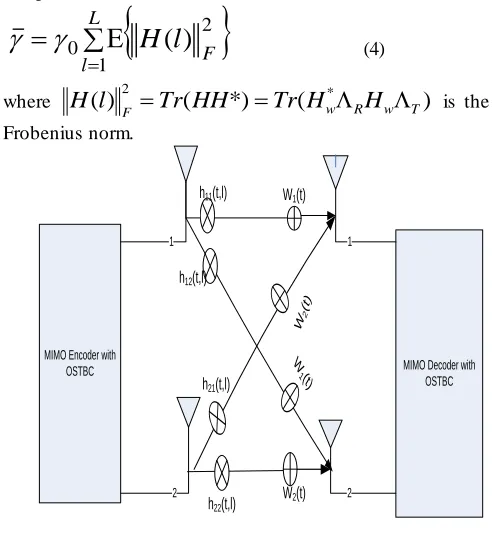
A. Channel Model DevelopmentRayleigh fading is a good approximation of realistic radio channel in which there is no line of sight path between the transmitting anten na and receiving antenna. Fig. 1 shows the 2x2 transmit and receive antennas which later increase to 3x3 and 4x4 MIMO channels.
The impulse response h (t, τ) for each of the 2x2 and 4x4 entries of the channel matrix can be expressed by [13] as
t,l 41C
t,l t 1
h i (1)
where C(t, l) is the independent zero-mean complex Gaussian process representing the frequency -selective Rayleigh fading coefficient.
The total signal seen by the mth receive antenna will be LNT, which is expressed as
, , () )( 1
4 1
4
1h t ls t w t
t
where m = 1, 2, n = 1,2, and
s
n
t
,
1 - = delayed signal.With 2x2 MIMO transmission over frequency selective Rayleigh fading channel, the resulting matrix is
l
t
w
l
t
w
l
t
s
l
t
s
l
t
h
l
t
h
l
t
h
l
t
h
l
t
y
l
t
y
,
,
,
,
,
,
,
,
,
,
2 1 2 1 22 21 12 11 2 1 (3)B. System model
Fig. 2 shows the model for the adaptive MIMO OSTBC. At the transmitter, the transmit data are encoded and divided into two, three, four parallel channels which are orthogonal to each other for onward transmission through the antenna to the channel understudy. The system is simulated using MATLAB application package.
C. Development of the model over frequency selective fading channel
The combined average SNR ̅ for all the multipath components can be obtained from [14] and [15] as
L l Fl
H
1 20
(
)
(4)where
H
(
l
)
2F
Tr
(
HH
*)
Tr
(
H
*w
RH
w
T)
is the Frobenius norm.MIMO Encoder with
OSTBC MIMO Decoder with
OSTBC
2
1 1
2
h11(t,l)
h12(t,l)
h21(t,l)
h22(t,l)
W1(t)
W 2 (t) W 1 (t)
W2(t)
Fig. 1. 2x2 MIMO channel
Equation (4) leads to
2 1 2 1 2 2 0l i i i
h
(5)where 2
2
i
h
is the Euclidean norm,
NR
diag
1,
2,
,
are the eigen values and0
is SNR per receive antenna under unity channel gain.The effective SNR which is a function of the OSTBC coding rate
R
is expressed asT i
RN
(6)For full rate, that is 2x2 Alamouti code, R = 1 and for
2
T
N
, R = ½ or ¾ [14].The average spectral efficiency, (SE) for the adaptive MIMO – OSTBC is given as
i k i i K k T kOSTBC i i
k
e
d
R
SE
2 1 1
)
(
(7)
and the approximated number of bit received in error, ( ̅̅̅̅̅̅ ) is obtained as
21 1 0 0
0 n K k N N N i N a k k ostbc T R T T T N i i k
G
e
e
c
d
NEB
(8) where
is the upper incomplete Gamma function,
N
N
L
G
R
T
1
,R
N
is the number of receive antenna,T
N
is the number of transmit antenna, L is the number of path,k
d
is the number of bits assigned to the subchannel when
i falls within
k,
k1
k
is the SNR threshold ,i
is the effective SNR on the
i
thsub-channel, 0
is the average SNR per receive antenna under unity channel gain,
k
a
andc
k are parameters found numerically by curve-fitting methods.Therefore, the average bit error rate, ABER, is then obtained by dividing equation (8) by (7).
III. SIMULAT ION RESULT AND ANALYSIS
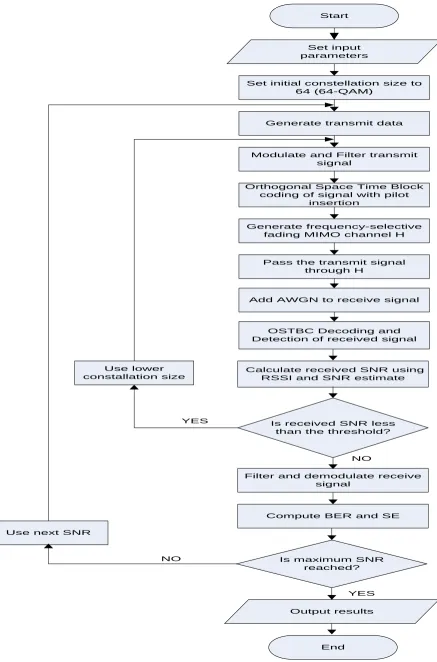
The transmitted M-QAM signaling is first mapped into a constellation size, gray encoded, modulated, filtered and the resulting signal waveform is then sent through the fading in frames. The frames include pilot symbols for channel estimation. At the receiver, the signal strength is calculated, the channel is estimated and the SNR calculated. The estimator selects the appropriate constellation size of the M-QAM signaling scheme that suites the channel condition. The transmitter adapts the data rate of the modulation by changing the modulation levels based on the received SNR value. The received SNR then correspond s to the Received Signal Strength Indicator (RSSI) value. The amount of information to be fedback is minimized by feeding back only the sum of the squares gains rather than the module of each channel multipath, its phase and time-delay. The flow chart developed for the simulation is shown in Fig. 3.
A. Simulation parameters and configuration
B. Results and Discussion
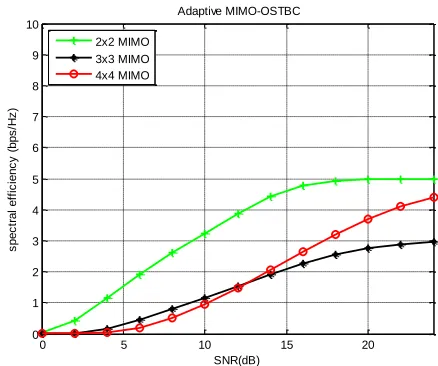
The results obtained using the simulation approach is presented in Fig.s 4 and 5. Fig. 4 shows the performance of 2x2, 3x3 adaptive MIMO –OSTBC in term of spectral efficiency. The gives a better performance as a result of its ability to achieve full
TABLE I
SIMULATION P ARAMETERS AND CONSTRAINTS
Parameters Type
Modulation 4-QAM, 8-QAM, 16-QAM,
32-QAM, 64-QAM
MIMO antenna configuration 2x2; 3x3; 4x4 Signal-to-noise ratio 0:2:14 dB Average transmit power 1 dB
Fading Frequency-selective
Rayleigh fading
Carrier frequency 900MHz
Bandwidth of signal Bs 200kHz
Symbol period 1/Bs
Time delay [0.1e-4 - 0.2e-4]
Filter square-root raised
cosine filter
Roll-off factor of filter 0.25 Number of samples per symbol 16
Frame length 100
Maximum number of packets 3000
BER target 10-2
Channel knowledge channel state information at
the transmitter (CSIT) Antenna
configuration NT = NR = 2, 3, 4.
SNR threshold 1.22
coding rate as compared to the and with a coding rate of half. At lower SNR, the performs better than the . However, at an SNR of 12dB, the spectral efficiency of the begins to rise significantly exploiting antenna diversity.
The results of all MIMO antenna configurations are presented on a single plot as shown in the Fig. 5. At lower SNR, the lower order antenna performs better, while as the number of antenna increases, the BER also increases. However, at an SNR of 8dB, the BER improves significantly with antenna diversity.
The results obtained are justifiable in that RSSI is used as a switching criterion to control the modulation modes. The RSSI offers a slightly higher number of bit/symbol at low SNR for some BERs. This is due to its switching ability to select a lower number of levels before any errors occurred.
The results obtained in this paper is in agreement with the experimental work of Mohammadreza et al (2009), in which the effects of phase noise on the adaptive modulation MIMO wireless system are investigated with a MIMO testbed. A variable rate variable p ower (VRVP) adaptation scheme is considered in his work in contrast to this paper in where frequency-selected Rayleigh fading is investigated with different MIMO configurations. The results obtained from his studies show the performance degradation of MIMO wireless systems due to phase noise effects.
Fig. 4. A Comparison of the Spectral Efficiencies of Adaptive MIMO OST BC in Frequency selective Rayleigh Fading
Channel.
Fig. 5. A comparison of BER performance of Adaptive MIMO OST BC in 2×2, 3×3, and 4×4 Frequency selective Rayleigh Fading Channel.
IV. CONCLUSION
In this paper, the performance of 2x2, 3x3, 4x4 adaptive modulations MIMO-OSTBC over frequency selective Rayleigh fading channel has been evaluated using spectral efficiency (SE) and bit error rate (BER).
The system model has been developed and simulated using MATLAB application package with the appropriate parameters and configurations.
The closed form expressions of the discrete rate spectral efficiency and BER have been presented for OSTBC. The results show that as SNR increases, the spectral efficiency increases while the BER reduces at SNR of about 8dB. Also, it can be seen that the higher the number of MIMO antenna configurations, the better the performance for the MIMO-OSTBC under adaptive modulation for higher SNR.
REFERENCES
[1] Goldsmith, A. (2005), Wireless Com munications, first edition, Cambridge University Press, Cambridge, England.
[2] Foschini, G. J. and Gans, M. J., (1998), “On limits of wireless communications in a fading environment when using multiple antennas,” Wireless Communications, vol. 6, pp.311-335. [3] Chen-nee C., David N. C., Joseph M. K. and Reinaldo A. V., (2002) “Capacity Scaling in MIMO Wireless Systems under
0 5 10 15 20
0 1 2 3 4 5 6 7 8 9 10
Adaptive MIMO-OSTBC
SNR(dB)
s
p
e
c
tr
a
l
e
ff
ic
ie
n
c
y
(
b
p
s
/H
z
)
2x2 MIMO 3x3 MIMO 4x4 MIMO
0 5 10 15 20 25
10-6 10-5 10-4 10-3 10-2 10-1 100 101
Adaptive MIMO OSTBC
SNR(dB)
BER
Correlated Fading” IEEE Transactions on Information T heory, Vol. 48, No. 3, pp 657-649.
[4] T obias W., Alexandros S., and Michael M., (200 6) “ Imperfect Channel–State Information in MIMO T ransmission” IEEE transactions on communication. Vol.54, NO3, pp 543-552. [5] David T . and Pramod V., (2005), “Fundam entals of Wireless
Com m unications”, Cambridge University Press, United Kingdom, pp. 49 -111, 166 – 217 and 290 -483.
[6] Okh, V., Naguib, A., Seshadri, N., and Calderbank, A.R. (1999), “Space-time codes for high data rate wireless communication: Performance criteria in the presence of channel estimation errors, mobility, and multiple paths,”Communications, IEEE T ransactions, Volume: 47, Issue 2, pp. 199-207.
[7] T arokh, V., Jafarkhani, H. and Calderbank, A. R. (1999), “Space-time block coding for wireless communications: performance results”, IEEE Journal of select ed areas in Communications, Vol. 17, No. 3, pp. 451 -460.
[8] Ganesan, G and Stoica, P (2002), “Differential detection based on space-time block codes,” Wireless Personal Communications, vol. 21, pp. 163–180.
[9] Golden, G. D, Foschini, C. J, Valenzuela, R. A and Wolniansky, P. W, (1999), “Detection algorithm and initial laboratory results using V-BLAST space-time communication architecture,” IEEE Letters, Vol. 35, No. 1, pp. 14-16.
[10] Lai T .X., T ran T .A. and Sessay A.B. (2006),”Performance Analysis of Space T ime Block Coded Systems over Frequency Selective Rayleigh Fading Channels,” IEEE transactions on wireless communications, pp 1480-1485.
[11] Alamouti, S. M., (1998), “A simple transmit diversity technique for wireless communications,” Selected Areas in Communications, IEEE Journal, 16(8):1451–1458.
[12] Cortes-Pena L, (2009) “ MIMO Space-T ime Block Coding (ST BC): Simulation and Results” ECE6604 Personal and Mobile Communications, April 2009.
[13] Rappaport, T.S. (2006), Wireless Com m unications - Principles and Practice. Second edition, Asoke k.Ghosh publisher, Prentice-Hall of India private limited, New Delhi.
[14] Huang, J and Signell, S (2008) “ On Performance of Adaptive Modulation in MIMO Systems Using Orthogonal Space-T ime Block Codes,” in submission to IEEE Transactions on Vehicular T echnology, August.
[15] Huang, J and Signell, S (2009), “Adaptive Modulation and Power Allocation for OST BC”, submitted to IEEE WCNC. [16] Mohammadreza, K., Abbas, M., Abdolah, A. and Hossein, H.,
(2009), „Characterization of Adaptive Modulation MIMO systems in the presence of phase noise, IWCMC 09, Leipzig, Germany.
M-QAM Modulater
OSTBC Decoder OSTBC
Encoder Raised
Cosine Filter Data
Input
Constellation Size Selector
Raised Cosine Received
Filter
Compute SE
M-QAM Demodulator Compute
BER
Data Output
Start
Set input parameters
Set initial constellation size to 64 (64-QAM)
Generate transmit data
Modulate and Filter transmit signal
Generate frequency-selective fading MIMO channel H
Is maximum SNR reached?
Output results
End
Pass the transmit signal through H
Add AWGN to receive signal
Use next SNR
YES NO
Orthogonal Space Time Block coding of signal with pilot
insertion
Calculate received SNR using RSSI and SNR estimate
Filter and demodulate receive signal
Compute BER and SE Is received SNR less
than the threshold? Use lower
constallation size
YES
NO OSTBC Decoding and Detection of received signal