Observer Based Controller for Magnetic Levitation System
Engr. Muhammad Junaid1 and Engr. Sadaqat Ur Rehman2
1, 2
Department of Electrical Engineering, SARHAD University of Science & Information Technology, Peshawar, KPK Pakistan
1
[email protected],[email protected],[email protected]
ABSTRACT
This paper explains Magnetic Levitation system of a train which comprises of guidance track made with magnets. The main objective is to design a proper controller that can suspend and propelled the train on a guidance track made with magnets. To perform the desired task state space model of Magnetic Levitation system is derived. The response of the system is simulated in MATLAB. The open loop response showed that the derived model is unstable. Observer Based Controller (OBC) is designed to analyze the system in closed loop. The controller showed improved performance for different tracks. Different types of realization techniques (minimal realization, balanced realization, modal realization, observer canonical realization) are compared for minimum fragility in controller implementation. The difference among the different realization controllers has been analyzed in detail for rounding off error or truncation error and an optimal non fragile controller design has been presented. Different disturbances were imposed upon the simulated model. All the results are analyzed in open and closed loops. The closed loop response showed that the vehicle is suspend and propelled on the track and the desired results were achieved successfully.
Keywords: OBC, Magnetic Levitation System, Realization
techniques, Bullet Train, MATLAB Simulink.
1. INTRODUCTION
Magnetic levitation systems have many varied uses such as in friction less bearing, high speed Maglev passenger trains, levitation of wind tunnel model, vibration isolation of sensitive machinery levitation of molten metal in induction furnaces and the levitation of metal slabs during manufacture (Laithwaite 1965, Jayawant and Rea 1965) [1]. Here our objectives are to design such a controller which can suspend and propelled the Maglev train on the track. The maglev train is based on three type of systems which control the train moves on the track Guidance system, Propulsion system and levitation system [2]. Guidance system refers to the sideward force that requires moving the train on the track. Propulsion system uses an electrically powered motor in the guide way which
appears to be the favored option for high speed Maglev trains. Levitation system keeps the train suspended against the gravity by forces of magnetic field. These systems have unstable open loop response, to make the response of the system stable feedback path was used. Observer Based Controller was used to make the closed loop response of the system stable [3].
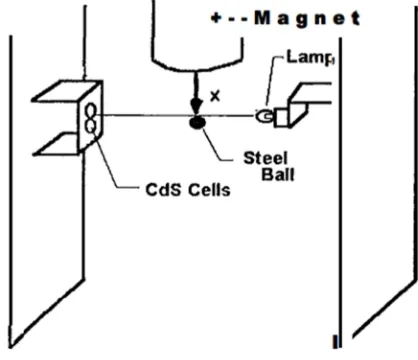
Valer and Lia build a nonlinear model for magnetic levitation system and proposes systems linearization principle (the expansion in Fourier series and the preservation of the first order terms) in order to linearize the acquired nonlinear model [4-5]. Our interest here is to design a Non-fragile optimal controller so a linear controller was designed to give safety and ride comfort to passengers inside the cabin of a train. The complete mathematical derivation for the Magnetic Levitation train model in state space form is simulated in MATLAB / SIMULINK [6]. Magnetic levitation is very useful in High Voltage insulation testing [7]. The block diagram of the Magnetic Levitation train is shown in the figure 1.
2. MATHEMATICAL MODEL OF
MAGNETIC LEVITATION SYSTEM
State space model of Magnetic Levitation is derived as given in [4].
v= dx/dt (1)
u= Ri + dL(x)i/dt (2)
mẍ = mg-c(i/x)2 (3)
Equation (2) indicates that L(x) is a nonlinear function. Various approximate values are used to determine the value of inductance for the Magnetic Levitation. If we take the assumption that the inductance of the system varies with the inverse of the ball position
L(x) = L + L0x0/x (4)
Where L is the constant Inductance of the coil in the absence of the ball, L0 is the additional inductance contributed by the presence of the ball
u(t)= iR+ d/dt (Lc + L0x0/x)i
u(t)= iR+ Ldi/dt - (L0x0i/x2)dx/dt
Substituting L0x0 =2C [4], we get
u(t)= iR+ Ldi/dt – C(i/x)2dx/dt (5)
3. METHODOLOGY
By taking the Open loop response of the system, open loop response of the system shows that the system is unstable. Observer Based Controller is used to overcome the disturbance effect and overcome the disturbing effect and to improve the performance parameter and make the close loop response of the system stable. Different realization techniques are used to obtain a reduced and non-fragile model [3].
3.1 Realization Techniques
In order to obtain a reduced and non-fragile optimal controller different realization techniques are used. Minimal realization (The realization is known as "minimal" as it defines the system with least number of states). Balanced realization, Modal realization and
Observer based canonical realization are the other different techniques used to obtained a reduced and non- fragile model.
4. RESULTS AND CONCLUSION
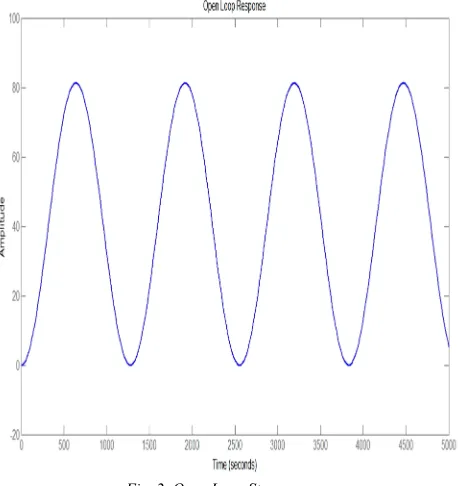
This work was carried out on considering a magnetic levitation system. The mathematical derivations were done in state space form. For simulation MATLAB/SIMULINK software was used. The open loop response in MATLAB shows oscillations, large overshoot and required large settling time to damp. To obtain the desired response observer based controller (OBC) was designed. After adding the observer gain to observer based controller the performance of the system was improved significantly Different realization techniques were then used, by applying these techniques the controllers action was made more efficient and the system was made highly stable and non-fragile.
4.1 Open Loop response
Fig. 2. Open Loop Step response
4.2 Observer based Controller response
Fig. 3. observer based Controller Response
Thus the Observer Based Controller gives a better response and settled the oscillations in the vehicle body quickly. After the addition of Observer Based controller the system becomes stable.
4.3 Minimal Realization
For observer based controller three states have been reduced, the controlled response has six states and after minimal realization the states were reduced to three.
4.4 Balanced realization
Difference between the Observer Based controller and balanced realization response was plotted as shown in Figure 5.
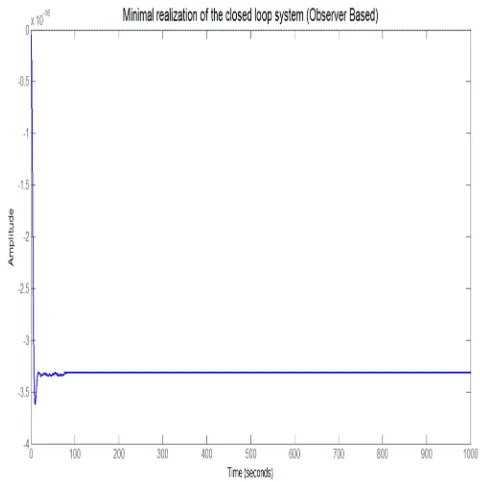
Fig. 4. difference between Minimal Realization and observer based controller response
4.5 Modal realization
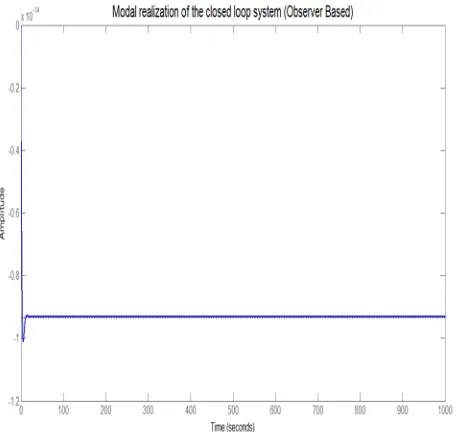
Difference between the Observer Based controller and modal realization response was plotted as shown in Figure 6.
Fig. 6. Difference between Modal Realization of Observer Based controller response.
4.6 Observer Canonical Realization
Difference between the Observer Based controller and Observer Canonical realized response was plotted as shown in Figure 7.
Fig. 7. Difference between Observer canonical realization and Observer Based controller response
A brief summary of all types of realization techniques was given below in table 1. This table shows that balanced realization gives the least error to controller which represents the most optimal and most non-fragile optimal controller technique.
Table 1: Realization analysis for different controllers:
Realization type Observer based controller
Minimal Realization 10-16
Balanced Realization 10-17
Modal Realization 10-14
Observer canonical Realization
10-16
For different input disturbances the LQR controller shows better response. The LQR controller settles the oscillations more quickly, reducing the oscillation and overshoot. The designed LQR controller provides better handling ability for wide range of disturbances and provides better ride comfort for passengers.
Also observer canonical realization gives the least error to controller which represents the most optimal and most non-fragile optimal controller technique.
REFERENCES
[1] Walter Bariet and John Chiassont, “Linear and Non Linear State space controller for magnetic levitation”, International Journal of System Sciences, 1996.
[2] NASA Florida Space Institute, “Magnetic Levitation Space Propulsion”.
[3] Rehman, Engr Sadaqat Ur, Engr Muhammad Junaid, and Engr Obaid Ur Rehman. "Linear Quadratic Regulator controller for Magnetic Levitation System."
[4] Ishtiaq Ahmad and Muhammad Akram Javaid, “Nonlinear Model & Controller Design for Magnetic Levitation System”, University of Engineering and Technology Taxila Pakistan, International Conference on signal Processing, robotics and automation, 2010.
[5] Valer Dolga, Lia Dolga “Modeling and Simulation of a Magnetic Levitation System” ANNALS of the ORADEA UNIVERSITY. Fascicle of Management and Technological Engineering, Volume VI (XVI), 2007.
[6] Carnegie Mellon, “Control Tutorial for Mat lab”, The University of Michigan, 1997.
AUTHOR PROFILES:
Engr. Muhammad Junaid is currently serving as a Lecturer
(Power Engineering) and member/team leader, Quality Enhancement Cell (QEC) at the Department of Electrical Engineering, SARHAD University of Science & IT Peshawar, KPK Pakistan. He is a Power Engineering Specialist having done MS in Electrical Engineering with the Specialization in Power System Engineering in 2015 recently & B.Eng in Electrical Power Engineering in 2011 respectively. His Area of Research is in High Voltage Engineering/ Power System Engineering.He is an active member of IAENG HONG KONG, IEEE PES, IJENS-RPG Researchers Promotion Group, Pakistan Engineering Council (PEC) & Institute of Engineers Pakistan (IEP).
Cell: +92-345-9150634
Engr. Sadaqat Ur Rehman is currently serving as a Lecturer &
member, QEC at the Department of Electrical Engineering, SARHAD University of Science & IT Peshawar, KPK Pakistan. He has done MS in Electrical Engineering with a Specialization in Electronics & Communication Engineering in 2014 & BSc in Computer Systems Engineering in 2011. His Area of Research is Image/Video Processing. He is an active member of Pakistan Engineering Council (PEC)