A Review on Development of Real Time
Algorithm using Mobile Adhoc Networks for
Disaster Management
1
Moresh M Mukhedkar, 2 Dr. Uttam Kolekar
1
Department of Electronics
University of Mumbai, Ramrao Adik Institute of Technology, Nerul, Navi-Mumbai, ZIP - 400706, Maharashtra, India.
2
Principal, A. P. Shah Institute of Technology, Ghod bandar Road, Thane, Mumbai, ZIP – 400615,
University of Mumbai, Maharashtra, India.
Abstract - The Mobile ad hoc Network (MANET) increasingly uses Real Time algorithms for handling the critical situations at disaster as well as by the strategic defense department. In such situation the essential fixed infrastructure based communication networks break down due to various atmospheric, natural and artificial manmade conditions. In such situations the information connectivity in the remote area is establish using MANET. The real time connectivity is highly desirable for getting immediate response from the control station for avoiding further casualties as well as the loss of important establishments. The MANET will be implemented in advance Network Simulator 2 (NS2) software environment for achieving essential highest Quality of Service (QoS), parameters, essential for high QoS. The primary focus will be towards achieving highest quality of Real Time communication and improving the throughput, minimizing the delay.
Keywords -Mobile Ad Hoc Network; Disaster Management; Real Time Communication; Security.
1. Introduction
Today there are various real time situations where maintaining uninterrupted fixed infrastructure based communication network is essential. Due to loss of the fixed infrastructure based network signal or loss of mobile communication, loss of human lives as well as loss of well established infrastructures may be possible. Although (now-a-day’s) wireless fixed infrastructure based communication network is very strong due to the rapid
development in fixed infrastructure based network communication technology including development in Mobile Tower system, Spectrum utilization system, Satellite technology etc. In few crucial situations like natural disaster and defense, it may possible that the above fixed infrastructure based network might collapse.
1.1 Flood in Jammu and Kashmir
to sent immediately at the affected location but due to non availability of information such as how many lives are trapped in the said area and how much damage has occurred and without knowledge of above information sending teams is waste of crucial time. The fixed infrastructure based communication network plays a very important role for rescue operations and due to collapse of above fixed infrastructure based communication network and unavailability of advanced satellite based communication medium at common level the chances of increasing casualties remain high.
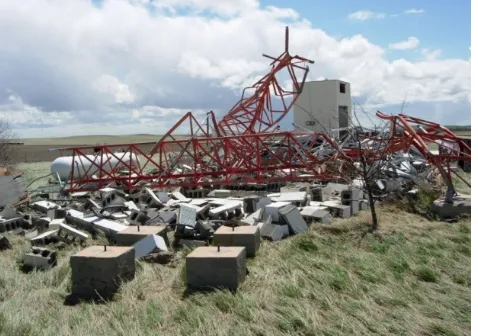
Fig 1: - Collapsed fixed infrastructure based communication network tower and damaged base station.
1.2 Secure Communication Network for Defense in
Disaster
Defense of the nation is one of the major responsibilities. Kargil War started in Jammu and Kashmir state in year 1999, was one of the well known examples. In that war, enemy country taken advantage of disaster situation like very cold atmospheric condition and top hill location for doing anti national activities. Now a day’s enemy countries and their intelligence agencies always tries to get the crucial information of its counterpart for making use of it in strategic planning of its own. Information like movement of the soldiers near border area, commanding order to soldiers for transferring from one place to another place, establishment of confidential base station, missile launcher at confidential place, communication between control station and higher authorities. Similarly at the time of war such information or commands have important significance; it may possible that counterpart forces try to steal such communication and use it for their purpose opposite to the country. Even though at the time of flood in Jammu and Kashmir state major rescue operation carried out by defense forces, they have
deployed various rescue teams at the remote location those disconnected due to the flood, but due to unavailability of exact information of how many people’s get trapped due to that rescue operation become very hard.
The communication must be get sustained in above situation and that also secure, so that apart from commanding officer and rescue team no one able to get information about the conversation. Even though at the war situation it is highly recommended to decide the strategy and pass it on to every solder. So that solder will follow the correct direction. Without security to the communication it can be easily get taped and used for defeating.
Fig 2: - Secure Communication between solders and Head- quarter.
1.3 Mobile ADHOC Network
A mobile ad hoc network (MANET), sometimes called a mobile mesh network, is a self-configuring network of mobile devices connected by wireless links. The Ad hoc networks are a new wireless networking paradigm for mobile hosts. Unlike traditional mobile wireless networks, ad hoc networks do not rely on any fixed infrastructure. Instead, hosts rely on each other to keep the network connected. It represent complex distributed systems that comprise wireless mobile nodes that can freely and dynamically self-organize into arbitrary and temporary, ‘‘ad-hoc’’ network topologies, allowing people and devices to seamlessly internetwork in areas with no pre-existing communication infrastructure.
helping enable eventual commercial MANET deployments outside the military domain. These recent evolutions have been generating a renewed and growing interest in the research and development of MANET.
Wireless cellular systems have been in use since 1980s. We have seen their evolutions to first, second and third generation's wireless systems. Wireless systems operate with the aid of a centralized supporting structure such as an access point. These access points assist the wireless users to keep connected with the wireless system, when they roam from one place to the other. The presence of a fixed supporting structure limits the adaptability of wireless systems. In other words, the technology cannot work effectively in places where there is no fixed infrastructure. Future generation wireless systems will require easy and quick deployment of wireless networks. This quick network deployment is not possible with the existing structure of current wireless systems.
Recent advancements such as Bluetooth introduced a new type of wireless systems known as mobile ad-hoc networks. MANETs or "short live" networks operate in the absence of fixed infrastructure. They offer quick and easy network deployment in situations where it is not possible otherwise. Ad-hoc is a Latin word, which means "for this or for this only." MANET is an autonomous system of mobile nodes connected by wireless links; each node operates as an end system and a router for all other nodes in the network.
An Ad-hoc network is a collection of wireless mobile nodes which dynamically forming a temporary mobile nodes which dynamically forming a temporary network without the aid of any established infrastructure or centralized administration.
The proliferation of mobile computing and communication devices (e.g., cell phones, laptops, handheld digital devices, personal digital assistants, or wearable computers) is driving a revolutionary change in our information society. We are moving from the Personal Computer age (i.e., a one computing device per person) to the Ubiquitous Computing age in which a user utilizes several electronic platforms at a single instance through which he can access all the required information whenever and wherever needed. Mobile users can use their cellular phone to check e-mail, browse internet; travelers with portable computers can surf the internet from airports, railway stations, Starbucks and other public locations; tourists can use Global Positioning System (GPS) terminals installed inside rental cars to locate driving maps and tourist attractions, researchers can
exchange files and other information by connecting portable computers via wireless LANs while attending conferences; at home, users can synchronize data and transfer files between portable devices and desktops. Not only are mobile devices are getting smaller, cheaper, more convenient, and more powerful, they also run more applications and network services, commonly fueling the explosive growth of mobile computing equipment market. The exploding number of Internet and laptop users driving this growth further. Projections show that in the next two years the number of mobile connections and the number of shipments of mobile and Internet terminals will grow yet by another 20–50%. With this trend, we can expect the total number of mobile Internet users soon to exceed that of the fixed line Internet users. Among all the applications and services run by mobile devices, network connections and corresponding data services are without doubt the most demanded service by the mobile users.
According to a study, the number of subscribers to wireless data services will grow rapidly from 2.6 billion worldwide in 2009 to more than 3.3 billion in 2010, and the number of wireless messages sent per month will rise continuously. Currently, most of the connections among these wireless devices are achieved via fixed infrastructure-based service provider, or private networks.
Fig. 3: Mobile Network
more important, the technology solutions used to support more critical and significant future research and development efforts can be expected in industry and academy.
Inside the ad hoc networking field, wireless sensor networks take a special role. A sensor network is composed of a large number of small sensor nodes, which are typically densely (and randomly) deployed inside the area in which a phenomenon is being monitored. Wireless ad hoc networking techniques also constitute the basis for sensor networks. However, the special constraints imposed by the unique characteristics of sensing devices, and by the application requirements, make many of the solutions designed for multi-hop wireless networks (generally) not suitable for sensor networks. This places extensive literature dedicated to sensor networks beyond the scope of this paper; however, the interested reader can find an excellent and comprehensive coverage of sensor networks in a recent survey.
1.4 Evolution of MANET
• In 1970, Norman Abramson and his fellow researchers at the University of Hawaii invented ALOHAnet.
• In 1972 DARPA Packet Radio Network (PRNet).
• In 1980 Survivable Radio Networks (SURAN).
• During 1980 emergence of Internet Emerging Task Force (IETF), termed the mobile ad hoc networking group.
• In 1994 emergence of Bluetooth by Ericsson.
1.5 Characteristics of MANET
• Network does not depend on any fixed infrastructure for its operation.
• Ease of deployment
• Speed of deployment
• Dynamic Changing Topology of nodes
• Multi-hop network
• Each node is working as intelligent node
• Not any mediator networking device is required
for communications
• Each node works as a Data Terminal Equipment
and Data Communication Equipment
1.6 Ad-hoc Applications
• Tactical networks : Military Communication automated Battle fields
• Sensor Network : Remote weathers for sensors,
earth activities
• Emergency Services : Disaster recovery,
earthquakes, crowd control and commando operations
• Educational Applications : Setup virtual class and conference rooms
• Entertainment: Multi-user games, robotics pets.
• Location Aware Services: Automatic Call
forwarding, advertise location specific services, Location–dependent travel guide.
Ad hoc networks can be classified, depending on their coverage area, as: Body (BAN), Personal (PAN), Local (LAN), Metropolitan (MAN) and Wide (WAN) area networks. Ad-hoc single hop BAN, PAN and LAN wireless technologies are already common on the market, these technologies constituting the building blocks for constructing small, multi-hop, ad hoc networks that extend their range over multiple radio hops. For these reasons, BAN, PAN and LAN technologies constitute the Enabling technologies for ad hoc networking.
The success of a network technology is connected to the development of networking products at a competitive price. A major factor in achieving this goal is the availability of appropriate networking standards. Currently, two main standards are emerging for ad hoc wireless networks: the IEEE 802.11 standard for WLANs, and the Bluetooth specifications 3 for short-range wireless communications.
1.7 Challenges in MANET
Following are the major challenges for the continued technology evolution in wireless Mobile ad-hoc Networks.
• Topology
• Band width
• Wireless range
• Hidden terminals
• Packet loss
• Battery Energy Constraints
• Processing
• Degree of Mobility
• Security
1.8 Parameters Affecting QoS In Wireless
MANET
In wireless Mobile Ad hoc networks, the transmission channel is exposed to the air and for attackers it easier to intrude the transmission information. Security is the major concern form the point of view of QoS. Following are the parameters which are affecting the QOS in Mobile Ad hoc networks.
• • •
• Consumption of the bandwidth
• • •
• Additional delay by proceeding of encryption
• • •
• Authentication Latency
• • •
• The call dropping probability
• • •
• End to end delay
• • •
• Throughput of communication
• • •
• Key generation time
2. Literature Survey
The Wireless Mobile Ad hoc Network (MANET) is used in the development of Real time wireless communication algorithms and which will be useful at the situation when fixed infrastructure based communication network get collapsed. The recent flood in Jammu and Kashmir had destroyed major portion of fixed infrastructure based communication networks so that interrupted the relief operation. Similarly in Defense secure communication is highly desirable. The above literature review mainly focused on used of MANET at the time of disaster situation, Quality of Service for MANET and Real Time communication using MANET.
Mounir T.A., Samia M., [1] Mohamed S. and Bouabdellah K. in their paper entitled “A routing Ad Hoc network for disaster scenarios” wireless networks without infrastructure especially in emergency situations where groups of rescuers must be on site to accomplish emergency tasks. Author used MANET (Mobile Ad Hoc network) and it is suitable in the context of emergencies when the existing infrastructure is down or severely overloaded. In emergency situations by increasing life
time of nodes, individuals can communicate longer and give more chance to rescuers. The main objective of their paper was to achieve Energy efficiency in emergency scenario.
Andersson K. and Kafle V.P. [2] in their paper “Disaster-resilient mobile network architecture” discussed about the issue of conventional cellular mobile networks which are likely to get disturbed easily when a natural disaster (earthquake, tsunami, flooding, etc.) hits an area because of its centralized control and high-power requirements. They addressed this issue by proposing a new mobile network architecture having distributed controls and ad-hoc configurations. The author presents its design and use cases in this paper.
Kumar D., Srivastava A. and [3] Gupta S.C. has presented the paper “Routing in Ad Hoc Networks under Reference Point Group Mobility”. Authors discussed about rapid deployment of MANET which is the infrastructure less network makes it suitable in disaster management and emergency situations. They analyse the scenarios like modeling of node movement, random waypoint, random walk, Manhattan grid model etc. in this paper they compared three routing protocols viz. AODV, OLSR, ZRP for Reference point group mobility model (RPGM) based on attraction level using Qualnet.
Nakamura T., Kogo K., [4] Fujimura J. and Tsudaka K. in their invited paper “Development of Emergency Rescue Evacuation Support System (ERESS) in Panic-Type Disasters: Disaster Detection by Positioning Area of Terminals” proposed the Emergency Evacuation Support System (ERESS) for reducing disaster damage and it primarily aims to reduce the number of victims in panic-type disasters. Their system uses ERESS Mobile Terminals (EMT) which are mobile terminals assuming Smartphone’s and tablets. Author shows the effectiveness of the proposed method by panic-type experiments.
Iokawa T., Yonamine Y., Wang J., [5] Kodama E. and Takata T. in paper entitled “Supporting Communication in Time of Disaster” discussed about the functioning and problems of communication supporting systems using the existing mobile ad hoc network technique at the disaster-hit area. These authors proposed a routing-based approach to solve problem of time to time interruption between two end users.
Vidwans A., Shrivastava A. K. [6] and Manoria M. in their paper entitled “QoS Enhancement of AOMDV Routing Protocol Using Queue Length Improvement” discussed about difficulty in the quality of service (QoS) guarantee for mobile ad hoc networks. They proposed AOMDV (Ad hoc On Demand Multipath Distance Vector) for a better routing protocol for efficient data delivery. In this paper author improved the QoS performance of AOMDV protocol and it called Enhanced AOMDV (EAOMDV) on the basis of queue length, which enhances the routing capability of AOMDV protocol.
Pandit C.M., and Ladhe S.A. in their [7] paper “Secure routing protocol in MANET using TAC” discussed about the use of MANET in emergency services and during natural calamities due to it’s self-organized and distributed system with no central administration and requires no infrastructure. These authors focused on Security which is the major challenge for MANET. In this paper they used the scheme that evaluates the trusted communication path with the help of Trust Allocation Certificate TAC.
Enciso Quispe L.and Mengual Galan L. [8] presented the paper entitled “Assessment of Throughput Performance under NS2 in Mobile Ad Hoc Networks (MANETs)” discusses provision of QoS in the context of Ad Hoc networks includes a very wide field of application from the perspective of every level of the architecture in the network. These authors studied the throughput performance in MANETs and compares emulated test bed results with simulation results from NS2 (Network Simulator). They compared the throughput of Mobile Ad Hoc Networks using three different scenarios: 97, 100 and 120 users (nodes)
Vajsar P. Fac., Masek P., Hosek J., [9] Makhloufu N. and Jenq-Shiou Leu in their paper entitled “Design of QoS model for mobile Ad-hoc network” deals with the characteristics of MANET and issues of the quality of service support with using the DSDV routing protocol. In their paper, the creation of the process model of MANET with DSDV routing protocol in a simulation environment NS-3 and its complement of QoS support are elaborated. The implementation of QoS support algorithms is verified by the functional simulation model and consequently analyses of achieved results. Comprehensive evaluation including enunciation effectiveness of the implemented QoS method is mentioned at the end of this paper.
Lal C., Laxmi V. and Gaur M.S. in [10] their paper entitled “QoS-aware routing for transmission of H.264/SVC encoded video traffic over MANETs”
discusses the requirement of QoS support for challenging task of efficient and reliable video streaming over mobile ad-hoc networks (MANETs) due to the varying characteristics of wireless networks and video traffic. Author proposed an efficient QoS-aware routing protocol (QARP) which used the cross-layer communication (CLC) and session admission control (SAC) methods to provide QoS guarantees in terms of network bandwidth. Furthermore, two methods are proposed to handle the QoS violations caused by dynamic characteristics of video traffic and network mobility during data communication. To stress the network with real time multimedia traffic, they used trace files generated from real time video files that are encoded using H.264/SVC encoder.
Bagwari A., Jee R., Joshi P. and [11] Bisht S. in their paper entitled as “Performance of AODV Routing Protocol with Increasing the MANET Nodes and Its Effects on QoS of Mobile Ad Hoc Networks” discussed about the use of MANET highly desirable for the present day multimedia communications. Traditional routing protocols may not suffice for real time communications it depends upon the conditions and our requirements. In this paper author analyzed the performance of reactive routing protocol via increasing number of nodes and observing its effect on Quality of Service (QoS) of Mobile Ad hoc Network. The QoS depends upon several parameters like end-end delay, throughput, date drop and network load. Authors have observed performance of Routing Protocol via enhancing the network size on the basis of following parameters: delay, throughput, traffic sent, traffic received, data dropped and network load. Network simulation tool used in simulation is OPNET Modeler (Ver. 14.0).
Narsimha G., Reddy A.V. and [12] Kumar B.S. in their invited paper entitled “QOS Multicast Routing Based on Bandwidth and Resource Availability in Mobile Ad hoc Networks” discussed about the essential need for supporting real time and multimedia applications for users of mobile ad hoc network (MANET) it can provide multimedia users with mobility they demand, if efficient QoS multicast strategies were developed. Author defined the building blocks of an ad hoc QoS multicasting (AQM) protocol and proposed a cross layer framework to support QoS multicasting.
3. Problem Definition
The fixed infrastructure based communication network having various limitations, due to loss of the signal or loss of mobile contact at the time of disaster situation due to delay in rescue operation human casualties as well as loss of well established infrastructures may be possible.
Following problems can be arising due to fixed infrastructure based communication network.
3.1 Jammu and Kashmir Disaster Situation
In September 2014 Jammu and Kashmir state of India seen a massive flood. In that fixed infrastructure based communication network completely collapsed. At remote places people get trapped. The disaster relief team as well as peoples trapped at remote location cant able to make contact with each other. So rescue teams didn’t able to reach at remote location to reuse the lives due to lack of information availability. The communication towers, base stations, leased line network completely collapsed.
3.2 Secure Communication for Defense While
Handling War Or Disaster Situation
In year 1999 India had a war with its neighbor at Kargil, Jammu and Kashmir state. The above war was known because of the main two reasons one was related with the very rough cold weather of Kargil and second was the geographical area of Kargil where enemy forces was on Hill top and Indian forces at bottom of hill. Enemy had taken advantage and they intruded in Indian Territory. It is very easy to catch wireless fixed infrastructure based communication network signal (from base station to army soldiers and vice versa) in above condition.
The secure communication between commanding station to front line solders at the time of war as well as at the time of disaster relief operation must be required.
3.3 Quality of Service (QoS)
Providing QoS, other than best effort, is a very complex problem in MANETs, and makes this area a challenging area of future MANET research. Networks ability to provide QoS depends on the intrinsic characteristics of all the network components, from transmission links to the MAC and network layers. MANET characteristics generally lead to the conclusion that this type of network provides a weak support to QoS.
4. Methodology
The problem of damage and collapse of fixed infrastructure based communication network can be solved up to certain extent by using Mobile Ad hoc Network (MANET), it have a significant advantage due to its features, it might be possible to make contact at remote locations using MANET, each rescue terms called as remote nodes having a fixed communication range.
4.1 Use of Real Time Wireless Communication Protocol
To meet the real time requirement for getting better QoS the use of Real time wireless communication protocol is useful. It may possible to exchange the information for hard real time as well as soft real time. The wireless multi hop protocol is suitable for MANET. For real time communication approximately less than 600 micro seconds delay is permissible. The above protocol reduces the delay further up to certain extent. By reducing the delay and increasing the throughput it can be easily possible to achieve good QoS.
4.2 Security Provision to Real Time
Communication
The secure communication in MANET using real time wireless communication protocol will be established by implementing security algorithms, in defense scenario the real time information will be in the form of voice call, video conference etc. (some time it will be hard real time or soft real time.) By using Advance Encryption Standard (AES) algorithm it can be secure up to certain extent. The AES – 128 provides security for node to node communication using various key sizes which will be indentified by only source and destination nodes.
4.3 Simulation Environment
Robot and each robot will be acting as a separate node in the network.
4. Conclusion
The above report, discussed effective deployment of Wireless Mobile Ad hoc Network (MANET) for development of Real Time secure communication algorithm. Various types of disaster situations like Jammu and Kashmir flood where fixed infrastructure based communication network completely collapsed, MANET can play a crucial role. In Defense secure communication is highly desirable by providing MANET with AES it can be easily achieved. The algorithm developed for real time wireless communication will be capable to handle both the situations. Information security and quality of services is the prime concern. In the literature survey, discussed various papers and thesis on MANET, Real time wireless security, advances and new technological aspects in ad-hoc network technology were studied. Further problem definition and methodology to solve the problem is also discussed.
References
[1] Mounir T. A., Samia M., Mohamed S. and Bouabdellah K. “A routing Ad Hoc network for disaster scenarios”. In the 1st IEEE International Conference on Information and Communication Technologies for Disaster Management (ICT-DM), 2014.
[2] Andersson K. and Kafle V.P. “Disaster-resilient mobile network architecture”. In the 11th IEEE conference on Consumer Communications and Networking Conference (CCNC), Page 1 – 8, March 2014.
[3] Kumar D., Srivastava A. and Gupta S.C. “Routing in Ad Hoc Networks under Reference Point Group Mobility” In IEEE Modeling Symposium (EMS), Page 595 – 598, Nov 2013 European”
[4] Nakamura T., Kogo K., Fujimura J. and Tsudaka K. “Development of Emergency Rescue Evacuation Support System (ERESS) in Panic-Type Disasters: Disaster Detection by Positioning Area of Terminals”. In 42nd International Conference on Parallel Processing (ICPP), Page 931 – 936, Oct 2013. [5] Iokawa T., Yonamine Y., Wang J., Kodama E. and
Takata T. “Supporting Communication in Time of Disaster”. In 7th IEEE international conference on Broadband, Wireless Computing, Communication and Applications (BWCCA).Nov 2012.
[6] Vidwans A., Shrivastava A. K. and Manoria M. “QoS Enhancement of AOMDV Routing Protocol Using Queue Length Improvement”. In 4th international conference on Communication Systems and Network Technologies (CSNT). April 2014.
[7] Pandit C.M., and Ladhe S.A. “Secure routing protocol in MANET using TAC”.In 1st international conference on Networks and Soft Computing (ICNSC), Aug 2-14.
[8] Enciso Quispe L.and Mengual Galan L. “Assessment of Throughput Performance under NS2 in Mobile Ad Hoc Networks (MANETs)”. In 5th International conference on Computational Intelligence, Communication Systems and Networks (CICSyN), June 2013.
[9] Vajsar P. Fac., Masek P., Hosek J., Makhloufu N. and Jenq-Shiou Leu “Design of QoS model for mobile Ad-hoc network”. In 36th IEEE International conference on Telecommunications and Signal Processing (TSP). Pages 111 to 117, July 2013
[10] Lal C., Laxmi V. and Gaur M.S. in their paper entitled “QoS-aware routing for transmission of H.264/SVC encoded video traffic over MANETs”. In 19th Asia-Pacific Conference Communications (APCC), Pages 104 to 109, Aug 2013.
[11] Bagwari A., Jee R., Joshi P. and Bisht S. “Performance of AODV Routing Protocol with Increasing the MANET Nodes and Its Effects on QoS of Mobile Ad Hoc Networks”. In International conference on Communication Systems and Network Technologies (CSNT), Pages 320 to 324, May 2012. [12] Narsimha G., Reddy A.V. and Kumar B.S. “QOS
Multicast Routing Based on Bandwidth and Resource Availability in Mobile Adhoc Networks”. In 7th IEEE International conference on Networking (ICN), Pages 24 to 29, April 2008.
Author Profile:
Moresh Mukhedkar received his B.E. in
Electronics and Telecomm-unication
Engineering from Dr. Babasaheb Ambedkar Marathwada University Aurangabad, M.Tech in Electronics from SGGS IEandT, SRT University Nanded, Maharastra, India. He is research student at Ramrao Adik Institute of Technology, sector 7, Nerul Navi Mumbai, Maharashtra India. He has 12 years of experience in industrial as well as educational field; His
research interest includes Mobile Ad Hoc Networks, Wireless Network Security. He has also interest in Image Processing and Mobile communication.
Dr Uttam Kolekar received his Ph.D.
degree from Bharathi Vidyapeeth
University, Pune in Electronics
Engineering. He has been working as Principal at A.P. Shah Institute of Technology, Thane, Mumbai. He has total 24 years teaching experience at
various posts such as Lecturer,
He is research guide at various universities in India and more than 7 candidates are working under him as research scholars from different institutes and Industries like TCS.
He has more than 35 papers in national and international Journals and conferences against his name. He is also reviewer for international journals like IEEE transactions.
He is fellow member of (IETE), Life member of ISTE and ISNT also he is senior member of international association of Computer science and information technology.