www.orientjchem.org
Est. 1984
An International Open Free Access, Peer Reviewed Research Journal CODEN: OJCHEG
2012, Vol. 28, No. (2): Pg. 867-879
A Comparative Study on the Phytoextraction of
Five Common Plants against Chromium Toxicity
B. DHEEBA and P. SAMPATHKUMAR
Department of Chemistry and Biosciences, Srinivasa Ramanujan Centre, SASTRA University, Kumbakonam - 612 001 (India).
(Received: April 12, 2012; Accepted: June 04, 2012)
ABSTRACT
Phytoextraction is a remediation technology that uses plants to remove heavy metals from soil. The success of a phytoextraction process depends on adequate plant yield (aerial parts) and high metal concentrations in plant shoots. A paper towel experiment was conducted to investigate the effects of plants sunflower (Helianthus annuus), maize (Zea maize), pearl millet ( Sorghum bicolour), green gram (Vigna radiata) and ground nut (Arachis hypogaea). Seeds of these plants were exposed to five different concentrations (10, 20,30,40,50 ppm ) of Cr as potassium dichromate. The ecotoxicological effects of hexavalent Chromium (Cr) on germination, early seedling growth and chlorophyll content of five plants were investigated. Cr accumulating capacity of those plants was compared. Different species showed different levels of tolerance to Cr pollution. Total chlorophyll content declined progressively with increasing concentrations of heavy metals. The maximum chromium accumulation capacity of roots was in the order of Zea mays > Sorghum bicolour > Helianthus annus > Arachis hypogaea > Vigna radiata and the amount is 5.56 , 3.65, 3.56, 0.8 and 0.08 ppm respectively.
Key words: Phytoremediation, Hexavalent chromium, Root and shoot length, Chlorophyll.
INTRODUCTION
In recent decades there has been increasing concern with heavy metal contamination, because of their toxicity to microorganisms, plants and animals. Unlike most organic contaminants are non-biodegradable and can accumulate in living tissues ( Srivastava et al., 2003). A variety of anthropogenic sources, such as mining processing, electroplating, wood preservation, iron and steel production, pigment manufacture, smelters, power station industry, production and application of metal-containing pesticides, can lead to soils acquiring heavy metal
such as plants. Chromium is an important metal that is usually encountered in the environment at oxidation states of (+III) and (+VI) ( Kotas and Stasika, 2000). Each of these oxidation states has very different biological and toxicological properties ( Kimbrough et al., 1999). Hexavalent chromium has a high solubility, being a well-established carcinogen based upon animal, human, and in vitro assessment data( Costa,1997; Gheju, 2005). On the contrary, the reduced form of chromium, Cr(III), is much less toxic and usually precipitates as hydroxides ( Rai et al., 1987)
Increased world population has resulted in the pollution of the environment. The main factors responsible for pollution and other type of environmental degradation in any community caused by combined effects of effluents and due to modern technology (Meadows et al., 1992) Chromium enters the food chain through consumption of plant material. A high concentration of Cr has been found to be harmful to vegetation. As the chromium concentration in plants increases, it adversely affects several biological parameters. Ultimately there is loss of vegetation, and land some times becomes barren ( Dube et al., 2003). In recent years, contamination of the environment by chromium has become a major concern. Chromium is used on a large-scale in many different industries, including metallurgy, electroplating, production of paints and pigments, tanning, wood preservation, chemical production, and pulp and paper production ( Zayed and terry, 20030). These industries have be-come especially large contributors of Cr pollution, which can ultimately have significant adverse biological and ecological effects. Symptoms of Cr phytotoxicity include inhibition of seed germination or of early seedling development, reduction of root growth, leaf chlorosis and depressed biomass ( Sharma et al., 1995). There are many studies on Cr toxicity in crop plants. Chromium significantly affects the metabolism of plants such as barley Ali et al.,2004), citrullus (Dube et al.,2003) , cauliflower (Chatterjee and Chaterjee, 2000) ,vegetable crops ( Zayed et al., 1998) , wheat ( Sharma et al., 1995) and maize (Sharma and Sharma, 1994).
Chromium is highly toxic non-essential element for microorganism and plants (Cervantes
et al., 2001). The source of chromium in environment are both natural and anthropogenic, natural source include burning of oil and coal, petroleum from ferro chromate refractory material, chromium steels, pigments oxidants, catalyst and fertilizers. This element is also used in metal plating tanneries and oil well drilling ( Abbassi et al., 1998) . Sewage and fertilizers are also the sources of chromium ( Pillay et al., 2003). Chromium has its effect on certain enzymes such as catalase, peroxidase, a cytochrome oxidase, which have iron as constituent. Agarwala and Kumar (1962) has reported that stimulation of catalase activity at excess supply of chromium occurred. Marked toxicity of chromium was found with respect to photosynthetic pigment, photosynthesis, nitrate reductase activity and protein content of some alga (Rai et al., 1992). The direct interaction of metal with cellular components can initiate variety of metabolic responses final y leading to a shift in the development of the plant (Assche Van and Clijsters,1990). Chromium toxicity produces chlorosis and necrosis in plants (Cervantes et al.,2001) . Several polluting metal and compounds are discharged into the water streams by tanneries.
Plant species have different responses to heavy metal pollution of soils. Although it may exist a relationship between heavy metal accumulation and plants tolerance, many plant species grow on contaminated soils and yet do not accumulate metals (Gabberielli et al., 1990). Plants that possess the ability to tolerate, uptake and accumulate high levels of metals in their biomass are termed as hyperaccumulators (Brown et al., 1995). The technique in which plants are used for the removal of heavy metals is known as phytoremediation. With these aspects, the present investigation was made to study the effect of different concentrations of chromium on the growth, chlorophyll content and phytoremediation property of Zea mays, Helianthus annus, Sorghum bicolour, Vigna radiata and Arachis hypogaea.
MATERIALS AND METHODS
Test plants
centre and authenticated by Dr. S.Kalavathy, Associate professor of Botany, Bishop Heber college, Trichy. Seeds were surface sterilized in 0.5 % sodium hypochlorite solution for 20 minutes and washed thoroughly with distilled water.
Experimental setup
Potassium dichromate solution was used as a source of Cr(VI). The experimental design was completely randomized with 6 replications The treatments were randomized in order to eliminate experimental bias. Five Cr levels ranging from 10,20,30,40 and 50 ppm including distilled water (control) were selected. Applications of chromium up to 50ppm had nominal effect, while there was no plant survival beyond 50 ppm therefore Cr levels selected for this study were 0(control)10,20,30, 40 and 50ppm. The paper towels were made by using filter papers in the size of 15X15 cm and wet with distilled water. Surface sterilized seeds (6) were placed in the middle of the paper and rolled by having a plastic sheet in same size for support. Then rolled towel is kept in 20ml of different concentrations of Cr in a cup and seedling were allowed to grow for 12days, after which they were removed from paper towel. The physical parameters such as root length, shoot length and fresh weight were analysed by using appropriate methods.
Plant analysis
Chlorophyll (a, b, and total) analysis
Pigment contents of 12 days old plants were extracted by using the formula of Arnon, 1949. The leaves were chopped into small pieces that were extracted with 80%acetone. The absorbance was measured at 645 nm and 663 nm for chlorophyll a,b and total chlorophyll respectively by using spectrophotometer (Hitachi Model-U 2001 Japan). Then chlorophyll a, b & total chlorophyll were calculated. ( Lichtenthaler and Wellburn, 1983)
Chl a (mg g-1 leaf fresh weight) =
[12.7(OD663) -2.69 (OD645)] × V/1000 × W. Chl b (mg g-1 leaf fresh weight) =
[22.9(OD645) -4.68 (OD663)] × V/1000 × W. Total Chl (mg g-1 leaf fresh weight) =
[20.2(OD645)-8.02(OD663)] ×V/1000 × W.
where OD = Optical Density. V = Volume of sample. W = Weight of sample.
Extraction of metal from plant samples
The harvested plant was separated out as root and shoot, crushed into powder and incinerated at high temperature. The ash obtained from the incinerated plant samples were treated with concentrated HCl and the metals analyzed using Atomic Absorption Spectrometer (AAS) (APHA, 1990).
RESULTS AND DISCUSSION
Physical parameters Shoot length
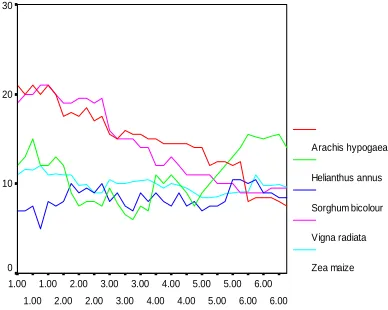
Under various experimental conditions, the shoot lengths of Zea mays, Helianthus annus, Sorghum bicolour, Vigna radiata and Arachis hypogaea were analysed. The shoot lengths of three plant species (Helianthus annus, Vigna radiate and Arachis hypogaea ) were reduced by more than 50% when compared to control (without Cr ). In Vigna radiata and Arachis hypogaea plants, root and shoot growth were similarly sensitive. For example, the shoot lengths of all plants are represented in the following graph which supports significant alteration. In particular it is reduced more than 60% when it is compared the other treatments with controlled treatment. ( Fig. 1 ).
Further, the
X
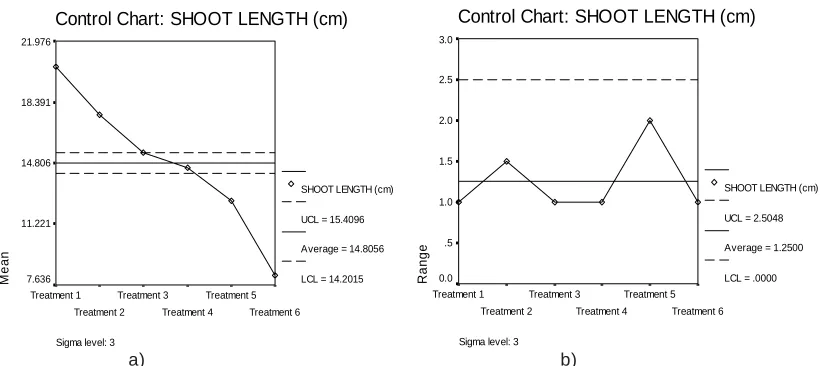
- chart, R-chart for shootlength in Arachis hypogaea under 6 treatments are obtained. The - chart shows that the shoot lengths
TREATMENT
6.00 6.00 6.00 5.00 5.00 5.00 4.00 4.00 4.00 3.00 3.00 3.00 2.00 2.00 2.00 1.00 1.00 1.00 30
20
10
0
Arachis hypogaea
Helianthus annus Sorghum bicolour
Vigna radiata Zea maize
are not control but the R-chart indicated that the ranges are with in the control limits. (Fig 2 a and b)
Moreover, the ONE WAY ANOVA for Shoot length (cm) is obtained which is shown in the Table 1. The calculated F value is 427.692. But the tabulated F value at (5, 30) degrees of freedom at 1% and 5% level of significance is 3.70 and 2.53 respectively. Hence calculated F Value > tabulated F value at both level of significances. Therefore, the difference between the shoot lengths is highly significant. Also the Karl Pearson’s correlation coefficient and Spear man’s rank correlation coefficients between the treatments and shoot lengths are – 0.973 and – 0.987 respectively. Hence they are negatively correlated and correlation is significant at the 0.01 level (2-tailed).
Root length
The root lengths of Zea mays, Helianthus annus, Sorghum bicolour, Vigna radiata and Arachis hypogaea in different experimental conditions
decreased when Cr concentration is increased. In Arachis hypogaea the root length is reduced to 66% and shoot length is also markedly reduced to 60 %
Control Chart: SHOOT LENGTH (cm)
Sigma level: 3
Treatment 6 Treatment 5 Treatment 4 Treatment 3 Treatment 2 Treatment 1
Ra
ng
e
3.0
2.5
2.0
1.5
1.0
.5
0.0
SHOOT LENGTH (cm)
UCL = 2.5048 Average = 1.2500
LCL = .0000
Fig. 2. Mean chart (a) and Range chart (b) of shoot length of experimental plants under various experimental conditions.
Control Chart: SHOOT LENGTH (cm)
Sigma level: 3
Treatment 6 Treatment 5 Treatment 4 Treatment 3 Treatment 2 Treatment 1
Me
a
n
21.976
18.391
14.806
11.221
7.636
SHOOT LENGTH (cm)
UCL = 15.4096 Average = 14.8056 LCL = 14.2015
a) b)
TREATMENT
6.00 6.00 6.00 5.00 5.00 5.00 4.00 4.00 4.00 3.00 3.00 3.00 2.00 2.00 2.00 1.00 1.00 1.00 40
30
20
10
0
Arachis hypogaea
Helianthus annus
Sorghum bicolour
Vigna radiata
Zea maize
Fig. 3. The root length( cm) of experimental plants under various experimental conditions
Table 1: ONE WAY ANOVA for Shoot length (cm) of experimental plants under various experimental conditions.
Sum of Squares Degrees of freedom Mean Square F
Between Groups 540.556 5 108.111 427.692
Within Groups 7.583 30 .253
at 50 ppm Cr concentration when compared to control plants. Among five plants Zea mays is more tolerant to Cr toxicity followed by Sorghum bicolor in which only upto 13% reduction in root and shoot length was noticed in 50 ppm Cr concentration when compared to control. For example, the root lengths
of Arachis hypogaea are represented in the
following graph which shows that the shoot lengths are decreased gradually with respect to the treatments. In particular it is reduced more than 60% when it is compared the other treatments with controlled treatment. (Fig. 3 )
Further, the - chart, R-chart for root length
in Arachis hypogaea under 6 treatments are
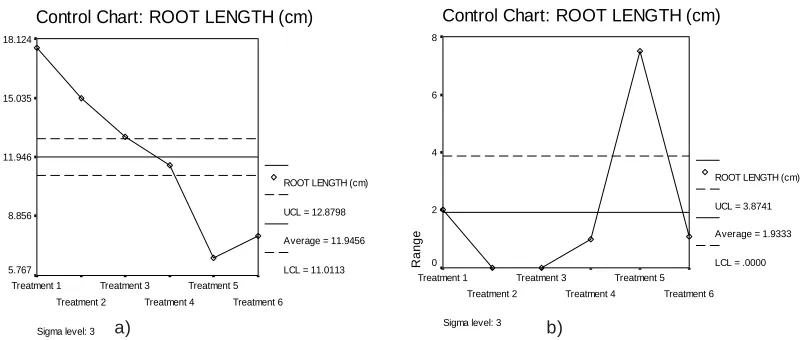
obtained. The - chart shows that the root lengths are not control but the R-chart indicated that the ranges are with in the control limits. ( Fig. 4 a and b)
The one way anova for root length (cm) is obtained which is shown in the Table 2. The calculated F value is 63.507. But the tabulated F
value at (5, 30) degrees of freedom at 1% and 5% level of significance is 3.70 and 2.53 respectively. Hence calculated F Value > tabulated F value at
Control Chart: ROOT LENGTH (cm)
Sigma level: 3
Treatment 6 Treatment 5 Treatment 4 Treatment 3 Treatment 2 Treatment 1
Me
a
n
18.124
15.035
11.946
8.856
5.767
ROOT LENGTH (cm) UCL = 12.8798 Average = 11.9456 LCL = 11.0113
Control Chart: ROOT LENGTH (cm)
Sigma level: 3
Treatment 6 Treatment 5 Treatment 4 Treatment 3 Treatment 2 Treatment 1
Ra
n
g
e
8
6
4
2
0
ROOT LENGTH (cm) UCL = 3.8741 Average = 1.9333 LCL = .0000
Fig. 4. Mean chart (a) and Range chart (b) of root length of experimental plants under various experimental conditions.
a) b)
Fig. 5. The fresh weight (g) of experimental plants under various experimental conditions
TREATMENT
6.00 6.00 6.00 5.00 5.00 5.00 4.00 4.00 4.00 3.00 3.00 3.00 2.00 2.00 2.00 1.00 1.00 1.00 4
3
2
1
0
Arachis hypogaea Helianthus annus
Sorghum bicolour
Vigna radiata Zea maize
Table 2: ONE WAY ANOVA for root length (cm) of experimental plants under various experimental conditions.
Sum of Squares Degrees of freedom Mean Square F
Between Groups 528.104 5 105.621 63.507
Within Groups 49.894 30 1.663
both level of significances. Therefore, the difference between the root lengths is highly significant. The Kar l Pearson’s correlation coefficient and Spearman’s rank correlation coefficients between the treatments and root lengths are also – 0.922 and – 0.967 respectively. Hence they are negatively correlated and correlation is significant at the 0.01 level (2-tailed). But, the Karl Pearson’s correlation coefficient and Spear man’s rank correlation coefficients between the shoot lengths and root lengths are 0.844 and 0.943 respectively. Hence they are positively correlated and correlation is significant at the 0.01 level (2-tailed).
The higher concentration of effluent having heavy metals decrease enzyme dehydrogenase activity that is considered as one of the biochemical change which may have disrupt germination and seedling growth ( Murkumar and Chauan, 1987). Studies on heavy metal tolerance in plants indicate that root growth is particularly sensitive to heavy metals ( Punz and Sieghardt, 1993). Copper toxicity affected the growth of Alyssum montanum ( Ouzounidou, 1994) and Brassica juncea ( Singh and Tiwari, 2003). Reduction in root growth due to heavy metals has also been reported in wheat seedlings ( Oncel et al., 2000). The number of leaves and branches, root and shoot length and biomass decreased as concentration of Cr increased in egg plant and tomato (Purohit et al., 2003) and in barley ( Arey and Rana, 2003). Reduced growth in terms of root and shoot lengths at increasing doses of
chromium might be due to adverse effect of this metal on auxin synthesis in plants more during early stages of their growth. Increasing concentrations of chromium caused significant reduction in root length and shoot length.
Fresh Weight
Fresh weight of plants are not much affected at 10 and 20 ppm Cr concentration but affected at higher concentration of Cr in all five species of plants. When compared to control plants at 50ppm, fresh weight of Vigna radiata and Arachis hypogaea plants were reduced to 50%. In all plants at 5ppm concentration, fresh weight is increased. Presence
TREATMENT
6.00 6.00 6.00 5.00 5.00 5.00 4.00 4.00 4.00 3.00 3.00 3.00 2.00 2.00 2.00 1.00 1.00 1.00 .16
.14
.12
.10
.08
.06
.04
.02 0.00
Arachis hypogaea Helianthus annus Sorghum bicolour Vigna radiata Zea maize
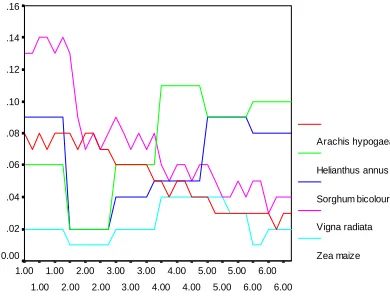
Fig. 7. The chlorophyll a ( mg/g) of experimental plants under various experimental conditions. Control Chart: FRESH WEIGHT (g)
Sigma level: 3
Treatment 6 Treatment 5 Treatment 4 Treatment 3 Treatment 2 Treatment 1
M
ean
3.20
2.87
2.54
2.21
1.88
FRESH WEIGHT (g)
UCL = 2.7228 Average = 2.5383 LCL = 2.3539
Control Chart: FRESH WEIGHT (g)
Sigma level: 3
Treatment 6 Treatment 5 Treatment 4 Treatment 3 Treatment 2 Treatment 1
Ran
g
e
1.0
.8
.6
.4
.2
0.0
FRESH WEIGHT (g) UCL = .7648 Average = .3817 LCL = .0000
Fig. 6. Mean chart (a) and Range chart (b) of fresh weight of experimental plants under various experimental conditions.
of Zn at higher concentrations retarded the growth and development of plants by interfering with certain important metabolic processes ( Alia., 1995) . The following are the sample for the analysis in Arachis hypogaea. ( fig 5 ).
Moreover, the calculated F value is 48.151. But the tabulated F value at (5, 30) degrees of freedom at 1% and 5% level of significance is 3.70 and 2.53 respectively. Hence calculated F Value > tabulated F value at both level of significances. Therefore, the difference between the fresh weights is highly significant. (Table 3)
Plant pigments
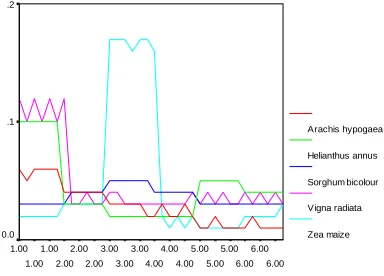
Increasing concentrations of chromium caused significant reduction in Chl a, b and total chl. In all five variety of plants pigment levels significantly decreased at 10, 20, 30, 40 and 50 ppm of chromium as compared to control. In Zea mays, Sorghum bicolour and Helianthus annus plants chlorophyll a is reduced at higher
concentration of Cr than chlorophyll b. In Vigna radiata and Arachis hypogaea group both chlorophyll a and chlorophyll b are reduced more than 50% at higher concentration of chromium treatment when compared to control group plants.(Fig 8 -12).
Photosynthesis was reduced significantly by increasing Cr(VI) concentrations in the growth medium. The modification of total chlorophyll content and the chl a/b ratio is noted under toxic conditions. chlorophyll a and b content decreased significantly in the 50 ppm, showing the negative effect of Cr(VI) on processes of chlorophyll biosynthesis. The increase in chlorophyll a and b content at the 10ppm Cr(VI) dose was noticed and that suggested that low concentrations of Cr(VI) increases chlorophyll synthesis in all five plant species. The decrease in chlorophyll content with increasing Cr(VI) dose has been described in the literature repeatedly (Liu et al., 2008) It is thought to be related to direct inhibition of chlorophyll pigment synthesis. Other
Table 3: ONE WAY ANOVA for fresh weight (g) of experimental plants under various experimental conditions.
Sum of Squares Degrees of freedom Mean Square F
Between Groups 5.279 5 1.056 48.151
Within Groups .658 30 .022
Total 5.937 35
Control Chart: CHLORAPHYLL A (mg/g)
Sigma level: 3
Treatment 6 Treatment 5 Treatment 4 Treatment 3 Treatment 2 Treatment 1
Me
a
n
.079
.066
.053
.039
.026
CHLORAPHYLL A (mg/g )
UCL = .0573 Average = .0525 LCL = .0477
Control Chart: CHLORAPHYLL A (mg/g)
Sigma level: 3
Treatment 6 Treatment 5 Treatment 4 Treatment 3 Treatment 2 Treatment 1
R
a
nge
.03
.02
.01
0.00
CHLORAPHYLL A (mg/g )
UCL = .0200 Average = .0100 LCL = .0000
Fig. 8. Mean chart (a) and Range chart (b) of chlorophyll a of experimental plants under various experimental conditions
authors have reported a decrease in chlorophyll content correlated with metal concentration (Panda and Choudhury, 2005; Scoccianti et al., 2006). Chromium possesses the capacity to degrade ´-aminolevulinic acid dehydratase, an important enzyme involved in chlorophyll biosynthesis, thereby affecting ´-aminolevulinic acid (ALA) utilization; this results in the buildup of ALA and reduction of the level of chlorophyll ( Vajpayee et al., 2000) . Chromium, mostly in its hexavalent form, can replace Mg ions from the active sites of many enzymes. Cr(VI) also causes Fe deficiency in stressed plants, disrupting chlorophyll biosynthesis ( Liu et al., 2008). The chl a/b ratio decreased when the plants were exposed to 40 ¼M and 100 ¼M Cr(VI), perhaps due to faster breakdown or decreased synthesis of chl a as compared to chl b, although chl b also decreased ( Vajpayee et al.,
2000).
The decrease in the concentrations of chlorophyll a and b and total chlorophyll in plants exposed to excess supply of Cr is similar to the effects of other pollutant elements (Lee et al., 1993).The decrease in chlorophyll concentration may be the result of an inhibited photosynthetic electron transport ( Bohner et al., 1980) and decomposition of the chloroplast membrane with excess Cu ( Sandmann and Boger,1980). The adverse effects of heavy metals in excess in plants may be because these metals interfere in the formation of chlorophyll either through the direct inhibition of an enzymatic step or through the induced Fe deficiency (Van Assche and Clijsters, 1990). Heavy metal induced reduction in total chlorophyll has been reported in pigeon pea due to Cd and Ni stress ( Shooran et al., 1990) and in Brassica juncea due to Cd stress ( Singh and Tiwari,2003). Reduction in chlorophyll content due to its degradation and unfavourable effect on photosynthetic electron transport has been reported due to copper toxicity in sensitive species of Silene
compecta and Thalpsi ochrolucum (
Ouzouidou,1994).
Chromium accumulation in plants
The maximum chromium concentration in shoot was found in 50 ppm chromium treated Zea mays plants i.e 2.86 ppm and the lowest amount is in the shoot of Vigna radiata plants (0.061ppm) in 50ppm concentration.
TREATMENT
6.00 6.00 6.00 5.00 5.00 5.00 4.00 4.00 4.00 3.00 3.00 3.00 2.00 2.00 2.00 1.00 1.00 1.00 .2
.1
0.0
Arachis hypogaea Helianthus annus Sorghum bicolour Vigna radiata Zea maize
Fig. 9. The chlorophyll b ( mg/g) of experimental plants under various experimental conditions.
Control Chart: CHLOROPHYLL B (mg/g)
Sigma level: 3
Treatment 6 Treatment 5 Treatment 4 Treatment 3 Treatment 2 Treatment 1
M
ean
.0607
.0448
.0289
.0130
-.0029
CHLOROPHYLL B (mg/g) UCL = .0329 Average = .0289 LCL = .0249
Control Chart: CHLOROPHYLL B (mg/g)
Sigma level: 3
Treatment 6 Treatment 5 Treatment 4 Treatment 3 Treatment 2 Treatment 1
R
ange
.02
.01
0.00
CHLOROPHYLL B (mg/g) UCL = .0167 Average = .0083 LCL = .0000
Fig. 10. Mean chart (a) and Range chart (b) of chlorophyll b of experimental plants under various experimental conditions
In all five varieties of plants the accumulation of chromium is higher in roots than shoots this is because of poor translocation from root to shoot. While comparing five group of plants Zea mays, Sorghum bicolour and Helianthus annus plants uptake more chromium than other two species. The maximum chromium accumulation capacity of roots was in the order of Zea mays > Sorghum bicolour > Helianthus annus > Arachis hypogaea> Vigna radiata and the amount is 5.56 , 3.65, 3.56, 0.8 and 0.08 ppm respectively. (Fig 13 -16)
Chromium produced a significant reduction in the growth of P. juliflora. The effect was
Control Chart: TOTAL CHLOROPHYLL (mg/g
Sigma level: 3
Treatment 6 Treatment 5 Treatment 4 Treatment 3 Treatment 2 Treatment 1
Me
an
.1393
.1102
.0811
.0520
.0229
TOTAL CHLOROPHYLL (m g/g)
UCL = .0884 Average = .0811 LCL = .0739
Control Chart: TOTAL CHLOROPHYLL (mg/g
Sigma level: 3
Treatment 6 Treatment 5 Treatment 4 Treatment 3 Treatment 2 Treatment 1
R
ange
.04
.03
.02
.01
0.00
TOTAL CHLOROPHYLL (m g/g)
UCL = .0301 Average = .0150 LCL = .0000
Fig. 12. Mean chart (a) and Range chart (b) of total chlorophyll of experimental plants under various experimental conditions.
a) b)
mainly observed on root and shoot and to a lesser extent on seedling length. The inhibition of growth by chromium could be mainly due to the accumulation of chromium in the roots. Bishoni et al., ( 1993) observed that hexavalent chromium applied as potassium di chromate did not affect the percentage germination of pea seed but the growth of radicles and plumule were significantly suppressed above 20 ppm concentration and the deleterious effect of chromium was more pronounced on the growth of roots than on shoots. The present study showed the deleterious effect of chromium on roots due to its accumulation in the roots which was extremely limited in the shoots .Accumulation of chromium in roots was 100 fold higher than that by shoot regardless of the
TREATMENT
6.00 6.00 6.00 5.00 5.00 5.00 4.00 4.00 4.00 3.00 3.00 3.00 2.00 2.00 2.00 1.00 1.00 1.00 .4
.3
.2
.1
0.0
Arachis hypogaea Helianthus annus Sorghum bicolour Vigna radiata Zea maize
Fig. 11. The total chlorophyll (mg/g) of experimental plants under various
experimental conditions
TREATMENT
6.00 6.00 6.00 5.00 5.00 5.00 4.00 4.00 4.00 3.00 3.00 3.00 2.00 2.00 2.00 1.00 1.00 1.00 8
6
4
2
0
Arachis hypogaea Helianthus annus Sorghum bicolour Vigna radiata Zea maize
Fig. 13. Shoot Chromium (mg/g) content of experimental plants under various
Control Chart: CHROMIUM IN ROOT (mg/g)
Sigma level: 3
Treatment 6 Treatment 5 Treatment 4 Treatment 3 Treatment 2 Treatment 1
Mea
n
.0520
.0385
.0250
.0115
-.0020
CHROMIUM IN ROOT (mg /g)
UCL = .0274 Average = .0250 LCL = .0226
Control Chart: CHROMIUM IN ROOT (mg/g)
Sigma level: 3
Treatment 6 Treatment 5 Treatment 4 Treatment 3 Treatment 2 Treatment 1
R
ang
e
.03
.02
.01
0.00
CHROMIUM IN ROOT (mg /g)
UCL = .0100 Average = .0050 LCL = .0000
Fig. 16. Mean chart (a) and Range chart (b) of root chromium content of experimental plants under various experimental conditions.
a) b)
TREATMENT
6.00 6.00 6.00 5.00 5.00 5.00 4.00 4.00 4.00 3.00 3.00 3.00 2.00 2.00 2.00 1.00 1.00 1.00 16
14
12
10
8
6
4
2 0
Arachis hypogaea Helianthus annus Sorghum bicolour Vigna radiata Zea maize
Fig. 15. Root Chromium (mg/g) content of experimental plants under various experimental conditions
Control Chart: CHROMIUM IN SHOOT (mg
Sigma level: 3
Treatment 6 Treatment 5 Treatment 4 Treatment 3 Treatment 2 Treatment 1
Mean
.013289
.009839
.006389
.002939
-.000511
CHROMIUM IN SHOOT (m g/g)
UCL = .0080 Average = .0064 LCL = .0048
Control Chart: CHROMIUM IN SHOOT (mg/g
Sigma level: 3
Treatment 6 Treatment 5 Treatment 4 Treatment 3 Treatment 2 Treatment 1
Ra
n
g
e
.012
.010
.008
.006
.004
.002
0.000
CHROMIUM IN SHOOT (m g/g)
UCL = .0067 Average = .0033 LCL = .0000
Fig. 14. Mean chart (a) and Range chart (b) of shoot chromium content of experimental plants under various experimental conditions.
chromium supplied. Low concentration of chromium was stimulatory to the plant growth while other workers contradicted it and observed that chromium is inhibitory and toxic to plant growth. Chromium toxicity manifested itself in plants by inhibiting the growth more or less, showing chlorosis with small brownish-red or purple leaves and necrotic lesions. High chromium concentration inhibits photosynthesis and greatly inhibits the root growth. It is therefore evident that chromium affects the plant growth mainly by damaging the root while its translocation into other parts of the plant is of minor importance.
Deleterious effect of chromium on plants suggests that chromium is very much toxic in nature and considered inhibitory to plant ( Sharma and Arey, 2000). It is concluded that among the five plants studied Zea mays and Sorghum bicolour shown better chromium accumulation when compare with other plants with reference to growth. Hence these plants can be suggested for phytoremediation with further studies.
REFERENCES
1. Abbassi SS, Abbassi N, Soni R. Heavy
metals in the environment, Mittal Publication, New Delhi, India. (1998).
2. Aery C, Rana DK. Growth and cadmium
uptake in barley under the cadmium stress. Journal of Environ Biology. 24: 117-123. (2003)
3. Agarwala SC, Kumar A. The effect of heavy
metals and bicarbonate excess on sun flower plants grown in sand culture with special reference to catalase peroxidase. J. Ind. Bot. Soc., 41: 72-77.(1962)
4. Ali NA, Ater , Sunahara, Robidoux PY.
Phytotoxicity and bioacuumulation of copper and chromium using barley (Hordeum Vulgare L.) in spiked artificial and natural forest soils. Ecotoxicology and environmental safety. 57: 363-374. (2004)
5. Alia KVSK, Prasad SK,. Pardha Saradhi P.
Effect of zinc on free radicals and praline in Brassica juncea and Ca janus caj anas. Phytochemistry. 39: 45-47.(1995)
6. APHA Standard methods for the examination
of waste and waste water (14 th Edition) American Public Health Association, New York. (1990).
7. Arnon DT. Copper enzymes in isolated
Chloroplast polyphenol oxidase in Beta vulgaris. Plant Physiol. 24: 1-15. (1949)
8. Assche Van F, ClijstersH. Effects of metals
on enzyme activity in plants. Plant Cell Environ., 13: 195-206 . (1990)
9. Bishoni NR, Dua A, Gupta VK, Sawhney
SK. Effects of chromium on seed germination, seedling growth and yield of
peas. Agriculture Ecosystem .and
Environment. 47: 47-57. (1993)
10. Bohner H, Bohme H, Boger P. Reciprocal
formation of cytochrome C-553 and the infuence of cupric ions on photo- synthetic electron transport. Biochimica et Biophysica Acta. 592: 103-12. (1980)
11. Brown SL, Chaney RL, Angle JS, Baker
AJM. Soil Science Society of America Journal.
59: 125. (1995)
12. Cervantes C, Campos-Garcia J, Debars S,
Gutierrez-Corona F, Loza-Tavera H. Carlos-Tarres-Guzman, Moreno-Sanchez R . Interaction of chromium with Microgenesis and plants. FEMS Microbiol. Rev. 25: 335-347. (2001)
13. Chatterjee J, Chatterjee C. Phytoxicity of
cobalt, chromium and copper in Cauliflower. Environ. Pollut. 109: 69-74. (2000)
14. Costa M . Critical Reviews in Environmental
Science and Technology. 27: 431. (1997)
15. Covelo EF, Vega FA, Andrade ML. Journal
of Hazardous Materials. 140: 308. (2007)
16. Dube BK, Tewari K, Chatterjee J, Chaterejee
C. Excess chromium alters uptake and translocation of certain nutrients in citrullus. Chemosphere. 53: 1147-1153. (2003)
17. Gabbrielli R, Pandolfini T, Vergnano O,
18. Gheju M. Chromium and the environment. Politehnica” Publishing House, Timisoara. (2005)
19. He ZL, Yang XE, Stoffella PJ. Journal of Trace
Elements in Medicine and Biology . 19: 125. (2005)
20. Kimbrough DE, Cohen Y, Winer AM. Critical
Reviews in Environmental Science and Technology. 29: 1. (1999)
21. Kotas J, StasickaZ. Environmental Pollution.
107: 263. (2000)
22. Lee CV, Pak CH, Choi JW, Self JR. Induced
micro-nutrients toxicity in Petunia hybrida. Journal of Plant Nutrition . 15: 32-339. (1993)
23. Lichtenthaler HK,. Wellburn AR.
Determination of total carotenoids and chlorophylls a, b in leaf extracts in different
solvents. Biochem.soc.Trans. 11: 591-592.
(1983)
24. Liu DH, Zou JH, Wang M, Jiang WS.
Hexavalent chromium uptake and its effects on mineral uptake, antioxidant defence system and photosynthesis in Amaranthus viridis L. Bioresource Technology. 99: 2628– 2636. (2008)
25. Meadows DH, Meadows DL, Randers.
Beyond the limits Earthscan publication, London. (1992).
26. Mur Kumar CV, Chauan PD. Influence of
water pollution on germination of gram (Cicer arietinum L.)In: Current pollution Research in India. (Eds: Triveni pk,. Goel PK). (1987).
27. Naimo TJ. Ecotoxicology . 4: 341. (1995)
28. Oncel I, Kele Y, Ustun AS. Interactive effects
of temperature and heavy metal stress on the growth and some biochemical compounds in wheat seedlings. Environmental Pollution. 10: 315-320. (2000)
29. Ouzounidou G . Copper induced changes
on growth, metal content and photosynthetic functions of Alyssum montanum L.plants. Environmental Experimental Botany. 34: 165-172. (1994)
30. Panda SK, Choudhury S. Chromium stress
in plants. Brazilian Journal of Plant
Physiology. 17: 95–102. (2005)
31. Pillay AE, Williams JR, EL Mardi MO,
AI-Lawati SMH, AI-Hadabbi MH, Hamdi AAI.Risk assessment of chromium and arsenic in date palm leaves used as livestock
feed. Environ. Intl., 1048: 1-5. (2003)
32. Punz WF, Sieghardt H. The responses of root
of herbaceous plants species to heavy metals. Environmental Experimental Botany.
33: 85-98. (1993).
33. Purohith S, Varghese TM, Kumari M. Effect of
Cr on morphological features of tomato and brinjal. Indian Journal of Environmental Biology. 8: 17-22. (2003)
34. Rai D, Sass BM, Moore DA., 26: 345. (1987)
35. Rai UN, Tr ipathi RD, Kumar N.
Bioaccumulation of chromium and toxicity on growth, photosynthetic pigments, photosynthesis, in vivo nitrate reductase activity and protein content in chlorococcalear green alga, Glaucocystis nostochinearum ltzigsohn. Chromosphere.
25: 721-732. (1992)
36. Sandmann G, Boger P. Copper deficiency
and toxicity in Scenedesmus. Zeitschrift fur Planzenphysiologie. 98: 53-59. (1980)
37. Scoccianti V, Crinelli R, Tirillini B, Mancinelli
V, Speranza A. Uptake and toxicity of Cr(III) in celery seedlings. Chemosphere. 64: 1695– 1703. (2006)
38. Sharma A, Aery NC. Studies on the
phytoremidiation of zinc tailings. I. Growth performance of wheat. Vasundhara. 6: 45-50. (2000)
39. Sharma DC, Chatterjee C, Sharma CP.
Chromium accumulation by barley seedlings (Hordeum vulgare L,). Journal of experimental botany. 25: 241-251. (1995)
40. Sharma DC, Sharma RC. Pant Chromium
uptake its effects on certain plant nutrients in maize (Zea mays L. CV Ganga 5). Journal of environmental science and health, Part A .29: 941-948. (1994)
41. Sheoran IS, Single HR, Singh R.Effect of Cd
and Ni on photosynthesis and the enzymes of photosynthetic carbon reduction cycle in pigeon pea (Cajanus cajan). Photosynthesis Res., 23: 45-35. (1990)
42. Shrivastava R, Upreti RK, Chaturvedi UC.
FEMS Immunology and Medical Microbiology . 38: 65. (2003)
43. Singh PK, Tewari SK. Cadmium toxicity
24: 107-117. (2003)
44. Vajpayee P, Tripati RD, Rai UN, Ali MB, Singh
SN. Chromium (VI) accumulation reduces chlorophyll biosynthesis, nitrate reductase activity and protein content in Nymphaea alba L. Chemosphere. 41: 1075–1082. (2000)
45. Yamaji S, Tennant J, Tandy S, Williams M, .
Srai SKS, Sharp P. FEBS Letters 507: 137.
(2001)
46. Zayed A, Lytle CM, Qian JH, Terry N.
Chromium accumulation, translocation and chemical speciation in vegetable crops, Planta. 206: 293-299. (1998)
47. Zayed AM, Terr y N. Chromium in the
environment: factors affecting biological
remediation. Plant and soil. 249: 139-156.