IJEDR1802028
International Journal of Engineering Development and Research (
www.ijedr.org
)
154
Optimization of Performance Metrics in Routing
Protocols of Wireless Sensor Networks
Abhay Kumar1, Ankur Goel2 1M. tech Scholar, 2HOD
Roorkee College of Engineering, Roorkee, Uttarakhand, India
____________________________________________________________________________________________
Abstract: In this paper, a technique is proposed to improve parameters in wireless sensor networks. The base technique is LEACH protocol, and t is improved by using intermediate nodes as cluster heads, giving a varied level of energy. The performance metrics considered are energy, network lifetime and stability period.
Keywords: WSN, LEACH, Improved LEACH
____________________________________________________________________________________________
1. Introduction
Recent advancement in electronics has enabled the development of low-cost, low-energy multifunctional miniature devices to be used in remote sensing applications. Such sensors can be extensively deployed for business, civil and military packages which includes surveillance, vehicle tracking, weather and habitat tracking intelligence, medical and acoustic statistics amassing. A WSN consists of large variety of sensor nodes which include sensing, records processing and conversation competencies. commonly sensor nodes are scattered within the sensing area. They coordinate amongst themselves to get records about the physical surroundings. The records are routed to the bottom Station both directly or through other sensor nodes. The BS is both a set or cellular node that is capable to connect the sensor community to the internet in which user can get admission to and technique facts. The important thing in sensor networks is to maximize the life of sensor nodes due to the truth that it is not feasible to replace the batteries of thousands of sensor nodes. consequently, computational operations of nodes and communique protocols ought to be made as energy efficient as viable.
This paper is organized as follows: section 1 consists of brief introduction of Wireless sensor networks and protocols. Section 2 consists of working of LEACH protocol Section 3 presents the improved or proposed technique and section 4 consists of graphs and simulated results on MATLAB 2015. Hence, paper is concluded in the conclusion after results.
2. LEACH Protocol
LEACH considers all sensors inside the community have the identical quantity of initial strength i.e. they are homogeneous with appreciate to power which isn't sensible technique. So the nodes which right now speak with the BS (i.e. the CHs) will die in advance than the everyday cluster member nodes, lowering the general lifespan of the network. To make the community greater power inexperienced we classify the sensors into 3 types: ordinary node, intermediate node and superior node relying on their preliminary power diploma. The superior node has the satisfactory power diploma at the equal time because the regular node possesses the bottom degree of energy. The ordinary nodes may be the cluster members. They ship their statistics to their CH with the intention to be elected from the institution of intermediate nodes. The machine used to select out CH is identical as that of LEACH. The intermediate nodes can even experience statistics from the environment. they will combination the sensed and received statistics and each ship it to one of the superior nodes positioned nearer to BS or send without delay to the BS if no such superior node is discovered. the development node communicates immediately with the BS. It moreover senses records and aggregates all the facts it received from specific intermediate nodes with its very very own facts. in the end it transmits the information right now to the BS.
3. Proposed Technique & Results
A variety of simulation works / experiments are occurring within the studies subject of WSN to make routing protocols increasingly more electricity green. here, we propose a modified model of LEACH known as advanced LEACH that may boom power performance than authentic LEACH. The basic concept worried in increasing power efficiency is to preserve radio communique distance as minimal as possible. The famous technique used to reduce communication distance is the formation of clusters between nodes as opposed to direct conversation but as the space among the CH and BS cross past a sure level single hop conversation concept of LEACH routing protocol is not appropriate.
Our proposed algorithm gives higher connectivity and successful facts rate as evaluate to LEACH. The motive in the back of this enhancement is multi-hop communique adopted through cluster-heads. As member nodes save electricity via sending records to cluster-head in LEACH as opposed to Base station, in addition in stepped forward LEACH cluster-head at longer distance from Base station transmit statistics to superior nodes toward the bottom station instead of direct transmission to Base station. it's miles greater powerful electricity efficient routing protocol whilst community diameter is larger. energy performance of progressed LEACH can be higher complex with the example of linear network having two cluster heads A and B which are communicating to Base station. A is at a distance ’m’ from B and B is at a distance m from the bottom station. EdirAB = EeleTX X LA + Eamp X LA X 2m2 + EeleTX X LB + Eamp X LB X m2
IJEDR1802028
International Journal of Engineering Development and Research (
www.ijedr.org
)
155
2.to start with Cluster-heads are decided on as in LEACH from the set of intermediate nodes.3.After cluster formation every CH will broadcast a quick message containing its identification to find its neighbors.
four. Each non-cluster-head node from the set of regular nodes determines to which cluster it belongs through selecting the cluster-head that calls for the minimal conversation energy, based on the acquired signal energy of the advertisement from every cluster-head.
5.the selected CH will create a TDMA agenda defining the time slot for every member in its cluster to ahead information to it. Steady-state Phase:
Like LEACH all of the cluster contributors (normal nodes) will send facts to their corresponding cluster-heads (intermediate node).
in contrast to LEACH after aggregation cluster-heads will send the aggregated statistics to a sophisticated node that is closer to the BS than the CH. To discover this type of node CH will evaluate the gap between advanced node and BS with that among itself and the BS. Whichever is smaller will be used to transmit facts to the BS. If no such advanced node is determined then it'll send the data directly to the base station.
the advance nodes will once more mixture the sensed records and the records acquired from the CHs. After that it's going to ahead the result to the bottom station.
Simulation Results:
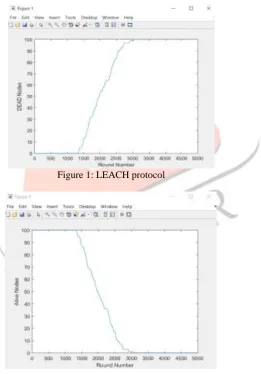
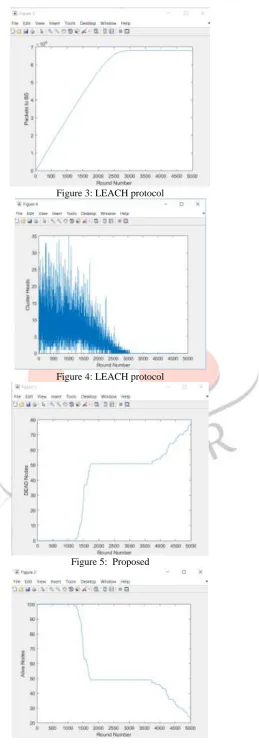
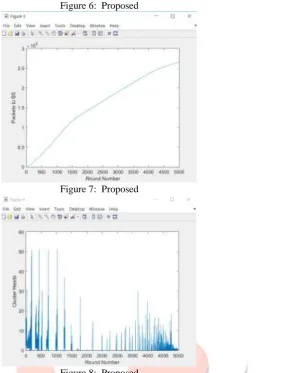
Figure 1, 2 3 and 4, show the LEACH protocol Number of dead nodes, alive nodes packets to base station and cluster heads respectively, same parameters are display on Figure 5, 6,7 and 8 for the proposed protocol.
Figure 1: LEACH protocol
IJEDR1802028
International Journal of Engineering Development and Research (
www.ijedr.org
)
156
Figure 3: LEACH protocolFigure 4: LEACH protocol
IJEDR1802028
International Journal of Engineering Development and Research (
www.ijedr.org
)
157
Figure 7: ProposedFigure 8: Proposed
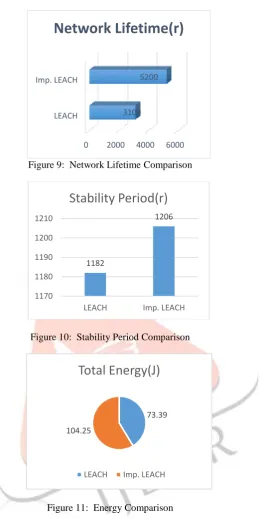
Table 1, 2 and 3 show Network lifetime and energy in the network, and stability period respectively and Figure 9, 10 and 11 show them in graphical format.
Table 1: Comparison of LEACH and improved LEACH protocol Protocol Rounds when
nodes start dying
Rounds when all nodes are
dead
LEACH 1182 3100
Improved LEACH
1206 >5000
Table 2: Energy Comparison of LEACH and improved LEACH protocol
LEACH Imp. LEACH
Total Energy(J) 73.39 104.25
Table 3: Stability Period Comparison of LEACH and improved LEACH protocol
LEACH Imp. LEACH
IJEDR1802028
International Journal of Engineering Development and Research (
www.ijedr.org
)
158
Figure 9: Network Lifetime ComparisonFigure 10: Stability Period Comparison
Figure 11: Energy Comparison
4. Conclusion
Hence, as discussed in this paper improved parameters like Network Lifetime, Energy and Stability Period as shown in the simulation results. An improved Network Lifetime gives us opportunity of low data loss rates and higher packet delivery ratio.
5. References
[1] D. Agrawal N. Shrivastava, C. Buragohain and S. Suri. Medians and beyond: new aggregation techniques for sensor networks. Proceedings of the 2nd international conference on Embedded networked sensor systems, pages 239{249, 2004. ACM Press.75 Bibliography
[2] Xiuli Ren and Haibin Yu1. Security mechanisms for wireless sensor networks. IJCSNS International Journal of Computer Science and Network Security, VOL.6(No.3):100{107, March 2006.
[3] S. Setia S. Zhu and S. Jajodia. Leap: efficient security mechanisms for large scale distributed sensor networks. Proceedings of the 10th ACM conference on Computer and communications security, pages 62-72, 2003. ACM Press.
[4] Y. Xu, J. Heidemann, D. Estrin,\Geography-informed Energy Conservation for Ad-hoc Routing," In Proceedings of the Seventh Annual ACM/IEEE International Conference on Mobile Computing and Networking 2001, pp. 70-84.
[5] Y. Yu, D. Estrin, and R. Govindan, \Geographical and Energy-Aware Routing: A Recursive Data Dissemination Protocol for Wireless Sensor Networks", UCLA Computer Science Department Technical Report, UCLA-CSD TR-01-0023, May 2001.
0 2000 4000 6000 LEACH
Imp. LEACH
3100 5200
Network Lifetime(r)
1182
1206
1170 1180 1190 1200 1210
LEACH Imp. LEACH
Stability Period(r)
73.39 104.25
Total Energy(J)
IJEDR1802028
International Journal of Engineering Development and Research (
www.ijedr.org
)
159
sensor networks. Proceedings of the IEEE Third International Conference on Information Technology and Applications (ICITA'05).[7] K. Sohrabi, J. Pottie, "Protocols for self-organization of a wireless sensor network", IEEE Personal Communications, Volume 7, Issue 5, pp 16-27, 2000.
[8] Ismail H. Kasimoglui Ian .F. Akyildiz. Wireless sensor and actor: research challenges. (Elsevier) Journal, 2(38):351- 367, 2004.
[9] S. Tilak et al., “A Taxonomy of Wireless Microsensor Network Models,” in ACM Mobile Computing and Communications Review (MC2R), June 2002.
[10] B. Krishnamachari, D. Estrin, S. Wicker, "Modeling Data Centric Routing in Wireless Sensor Networks," in the Proceedings of IEEE INFOCOM, New York, NY, June 2002.
[11] W. Heinzelman, “Application specific protocol architectures for wireless networks”, PhD Thesis, MIT, 2000.
[12] C. Schurgers and M.B. Srivastava, “Energy efficient routing in wireless sensor networks,” in the MILCOM Proceedings on Communications for Network-Centric Operations: Creating the
Information Force, McLean, VA, 2001.