R E S E A R C H
Open Access
A numerical approach for the solution of
a class of singular boundary value problems
arising in physiology
Mohamadreza Mohsenyzadeh, Khosrow Maleknejad
*and Reza Ezzati
*Correspondence: [email protected]
Department of Mathematics, Karaj Branch, Islamic Azad University, Karaj, Iran
Abstract
The purpose of this paper is to introduce a novel approach based on the operational matrix of orthonormal Bernoulli polynomial for the numerical solution of the class of singular second-order boundary value problems that arise in physiology. The main thrust of this approach is to decompose the domain of the problem into two subintervals. The singularity, which lies in the first subinterval, is removed via the application of an operational matrix procedure based on differentiating that is applied to surmount the singularity. Then, in the second subdomain, which is outside the vicinity of the singularity, the resulting problem is treated via employing the proposed basis. The performance of the numerical scheme is assessed and tested on specific test problems. The oxygen diffusion problem in spherical cells and a
nonlinear heat-conduction model of the human head are discussed as illustrative examples. The numerical outcomes indicate that the method yields highly accurate results and is computationally more efficient than the existing ones.
MSC: 34L30; 34L16
Keywords: orthonormal Bernoulli polynomials; differential operational matrix; physiology problems
1 Introduction
The aim of this paper is to introduce a new approach for the numerical solution of the following class of singular boundary value problems (SBVP) arising in physiology:
y+m
xy
=f(x,y) ()
defined on the interval [, ] and subject to the following boundary conditions:
αy() +βy() =γ, ()
αy() +βy() =γ. ()
linear and nonlinear functionsf(x,y). For instance, SBVP ()-() withm= and
f(x,y) = ny
y+k, n> ,k>
arises in the modeling of steady state oxygen diffusion in a spherical cell with Michaelis-Menten uptake kinetics (see [, ]). Another case of physical significance is whenm= and
f(x,y) = –le–lky, l> ,k> ,
which occurs in the formulation of the distribution of heat sources in the human head (see [, ]).
In recent years, finding numerical solutions of singular differential equations, partic-ularly those arising in physiology, has been focused by several authors. Ravi Kanth and Bhattacharya [] used a quasi-linearization technique to reduce a class of nonlinear SBVP arising in physiology to a sequence of linear problems; the resulting set of differential equa-tions is modified at the singular point, then spline collocation is utilized to obtain the nu-merical solution. Pandey and Singh [] described a finite difference method based on a uniform mesh for the solution of a class of SBVP arising in physiology; it was shown that the method is of second-order accuracy under quite general conditions. Caglaret al.[] used B-spline functions to develop a numerical method for computing approximations to the solution of nonlinear SBVP associated with physiological science. The original differ-ential equation was modified at the singular point, then the boundary value problems were treated by using the B-spline approximation. Asaithambi and Garner [] presented a nu-merical technique for obtaining pointwise bounds for the solution of a class of nonlinear boundary-value problems appearing in physiology. Gustaffsson [] presented a numerical method for solving SBVP. Ravi Kanth and Reddy [] presented a numerical method for solving a two-point boundary value problem in the interval [, ] with regular singularity atx= . Ravi Kanth and Reddy [] presented a numerical method for singular two-point boundary value problems via Chebyshev economization. A number of papers discussed the existence of solutions for the given problem, for instance, existence and uniqueness of the solution of SBVP ()-() for the special casem= ,α=α=γ andβ= were given in []. In the past decade, there has been a great deal of interest [–] in applying the de-composition method for solving a wide range of nonlinear equations, including algebraic, differential, partial-differential, differential-delay and integro-differential equations.
This paper is organized as follows. In Section , we are going to introduce Bernoulli polynomials and their properties; also we will show the operational matrix of derivative for orthonormal Bernoulli polynomials. In Section , the operational matrix of derivative of the proposed basis together with collocation method are used to reduce the nonlinear singular ordinary differential equation to a nonlinear algebraic equation that can be solved by Newton’s method. Section illustrates some applied models to show the convergence, accuracy and advantage of the proposed method and compares it with some other existing method. Finally Section concludes the paper.
2 Definition of Bernoulli polynomials
orthonor-mal polynomials, we orthonororthonor-mal these polynomials by Gram-Schmidt algorithm. The operational matrix constructed by this new basis is sparser than the operational matrix which is made by Bernoulli polynomial, which can be the advantage of normalization of Bernoulli polynomials. Also, by this new basis, we construct a new approach to solve SBVP, which can get better approximation for numerical solution of these equations in compar-ison with other methods.
2.1 Bernoulli polynomials
The recurrence formula for Bernoulli polynomials of degreenis defined as []
n
SinceMis a lower triangular matrix with nonzero diagonal elements, it is nonsingular and henceM–exists. Thus, the Bernoulli polynomials in vector form can be given directly from
B(x) =M–X. ()
By using Gram-Schmidt algorithm, we obtain orthonormal Bernoulli polynomials to con-struct a new basis, this new basis is introduced byOBn(x). For instance, forn= ,
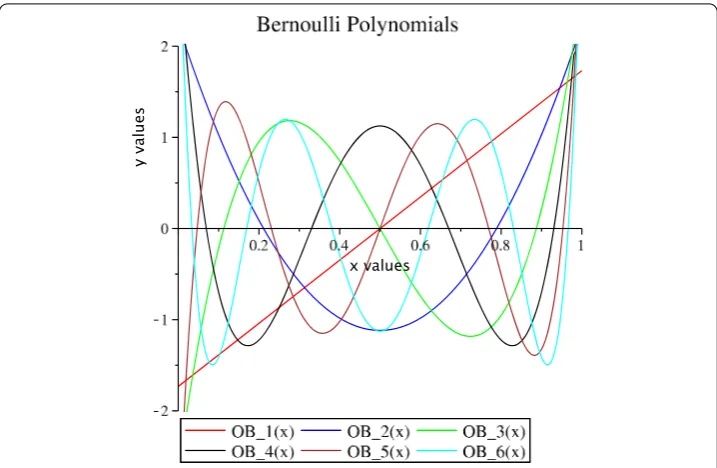
Figure 1 The graph of the first six of orthonormal Bernoulli polynomials.
and
OB(x) = x– x+ x– x+ .
Thus, the proposed basis is
OB(x),OB(x), . . . ,OBn(x)
.
So, we can approximate the functions by using this basis. The orthonormal Bernoulli poly-nomials considered in this paper have special properties and applications in different fields of mathematics apart from analytic theory of numbers to the classical and numerical anal-ysis [, ]. In the following, we mention some properties of the Bernoulli polynomials which will be of fundamental importance in the sequel.
• Property (Integral means conditions):
OBi(x)dx= , i= , , . . . ,n.
• Property (Norm):
OBi(x)= , i= , , . . . ,n.
2.2 Function approximation
SupposeH=L[, ] and{OB(x),OB(x), . . . ,OBn(x)} ⊂H, also
Y=spanOB(x),OB(x), . . . ,OBn(x)
andf(x) is an arbitrary element inH. SinceYis a finite dimensional vector space,f(x) has the unique best approximation [] out ofYsuch asf(x)∈Y, that is,
∀y(x)∈Y, f(x) –f(x)≤f(x) –y(x).
Sincef(x)∈Y, there exist the unique coefficientsc,c, . . . ,cnsuch that
f(x)f(x) = n
i=
ciOBi(x) =CTOB(x), ()
where
OB(x) =OB(x),OB(x), . . . ,OBn(x)
()
and
C= [c,c, . . . ,cn]T, ()
where the constant coefficientcifori= , , . . . ,nis
ci=
f(x),OBi(x) OBi(x),OBi(x)
. ()
2.3 Error bounds
In this section, the error bound and convergence are established by the following lemma.
Theorem [] Let H be a Hilbert space and W be a closed subspace of H such that dimW<∞and{w,w, . . . ,wn}is any basis for W.Let g be an arbitrary element in H and
gbe the unique best approximation to g out of W.Then g–g=Gg,
where
Gg=
F(g,w, . . . ,wn)
F(w, . . . ,wn)
,
and F is introduced in[].
Lemma [] Suppose that g∈Cm+is an m+ times continuously differentiable function such that g=nj=gj,and let Y=span{OB(x),OB(x), . . . ,OBn(x)}.If CTj OBj(x)is the best
approximation to gjfrom Y,then CTOB(x)approximates g with the following error bound: g–CTOB(x)≤ δ
nm+(m+ )!√m+ , δ=xmax∈[,]
Proof The Taylor expansion for the functiongj(x) is
for which it is known that
gj(x) –g˜j(x)≤g(m+)(η)
By taking the square roots, we have the above bound.
2.4 Operational matrix of derivative
The derivative of the vectorOB(t) can be expressed by
By using Eq. (), it is clear that
dnOB(x)
dxn =
D() nOB(x), ()
wheren∈Nand the superscript in D()denotes matrix powers. Thus
D(n)=D() n, n= , , . . . . ()
The presented operational matrix is a sparse matrix, so it can reduce the error of solving Eq. ().
3 Implementation of operational matrix of orthonormal Bernoulli polynomials on physiology problems
In this section we solve nonlinear singular boundary value problem of the form Eq. () with the mixed conditions Eq. () and Eq. () by using the operational matrix of derivative [] based on orthonormal Bernoulli polynomials. From Eq. () we can approximate an unknown function as
y(x) =CTOB(x), () whereOB(x) andCare defined in Eqs. ()-(). By using Eqs. ()-() we have
y(x) =CTOB(x) =CTD()OB(x), () and
y(x) =CTOB(x) =CTD() OB(x). () By substituting Eqs. ()-() in Eq. (), we have
CTD() OB(x) +
m x
CTD()OB(x) =fx,CTOB(x). ()
Also, by using Eqs. ()-() and Eqs. ()-(), we have
αCTOB() +βCTD()OB() =γ, ()
αCTOB() +βCTD()OB() =γ. ()
Eqs. ()-() give two linear equations. Since the total unknowns for vectorCin Eq. () is (n+ ), we collocate Eq. () in (n– ) Newton-Cotes pointsxiin the interval [, ], then
we have
CTD() OB(xi) +
m xi
CTD()OB(x) =fxi,CTOB(xi) ()
4 Illustrative examples
To show the efficiency of the proposed method, we implement it on three nonlinear singu-lar boundary problems that arise in real physiology applications. Our results are compared with the results in Refs. [, ]. The austerity of our method in implementation in analogy to other existing methods and its trusty answers is considerable.
Example Consider the following oxygen diffusion problem:
y(x) +
xy
(x) = .y
y+ ., with boundary conditions
y() = , y() +y() = .
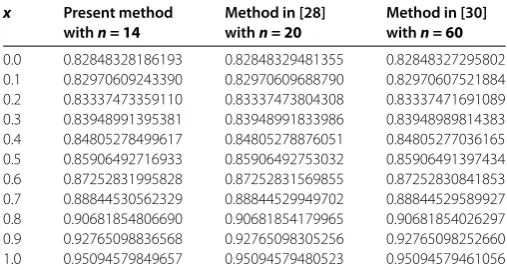
Table shows the numerical results for various number of meshes, and present method solutions are compared with the results in Refs. [] and [].
Example Consider this problem that coincides by heat conduction model of the human head
y(x) +
xy
(x) = –e–y,
we consider the solution of this problem with conditions as follows:
y() = , y() +y() = .
Table illustrates the results for this example by the proposed method alongside numerical solutions for this example that were given in Refs. [] and [].
Example Consider the following singular two-point boundary value problem:
y(x) +
xy
(x) = –ey,
y() = , y() = ,
Table 1 Approximate solutions for Example 1
x Present method withn = 14
Method in [28] withn = 20
Method in [30] withn = 60
Table 2 Approximate solutions for Example 2
x Present method withn = 14
Method in [27] with forth-order
Method in [29]
0.0 0.3675152742 0.3675181074 0.3675169710
0.1 0.3663623292 0.3663637561 0.3663623697
0.2 0.3628940661 0.3628959378 0.3628941066
0.3 0.3570975457 0.3570991429 0.3570975842
0.4 0.3489484206 0.3489499903 0.3489484612
0.5 0.3384121487 0.3384136581 0.3384121893
0.6 0.3254435224 0.3254450019 0.3254435631
0.7 0.3099860402 0.3099878567 0.3099860810
0.8 0.2919711030 0.2919789654 0.2919711440
0.9 0.2713170101 0.2713185637 0.2713170512
1.0 0.2479277233 0.2479292837 0.2479277646
Table 3 Numerical errors for Example 3
x Present method withn = 10
Present method withn = 14
Approach II [28] withn = 20
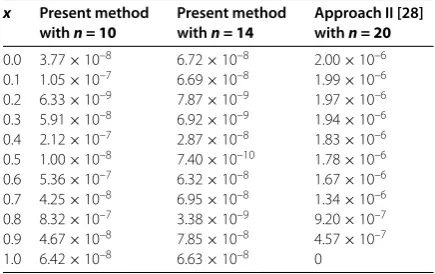
0.0 3.77×10⁻⁸ 6.72×10⁻⁸ 2.00×10⁻⁶ 0.1 1.05×10⁻⁷ 6.69×10⁻⁸ 1.99×10⁻⁶ 0.2 6.33×10⁻⁹ 7.87×10⁻⁹ 1.97×10⁻⁶ 0.3 5.91×10⁻⁸ 6.92×10⁻⁹ 1.94×10⁻⁶ 0.4 2.12×10⁻⁷ 2.87×10⁻⁸ 1.83×10⁻⁶ 0.5 1.00×10⁻⁸ 7.40×10⁻¹⁰ 1.78×10⁻⁶ 0.6 5.36×10⁻⁷ 6.32×10⁻⁸ 1.67×10⁻⁶ 0.7 4.25×10⁻⁸ 6.95×10⁻⁸ 1.34×10⁻⁶ 0.8 8.32×10⁻⁷ 3.38×10⁻⁹ 9.20×10⁻⁷ 0.9 4.67×10⁻⁸ 7.85×10⁻⁸ 4.57×10⁻⁷ 1.0 6.42×10⁻⁸ 6.63×10⁻⁸ 0
with the exact solutiony(x) = ln(cxc++), wherec= – √
. Table shows numerical errors of this example in analogy to errors for this example in [].
5 Conclusion
This paper presents a new approach based on the operational matrix of derivative of the orthonormal Bernoulli polynomials for the numerical solution of a class of singular boundary value problems arising in physiology. By use of orthonormal Bernoulli polyno-mials as basis and the operational matrix of derivative of these functions, we convert such problems to an algebraic system. The implementation of current approach in analogy to existing methods is more convenient and the accuracy is high, and we can execute this method in a computer in a speedy manner with minimum CPU time used. The numerical applied models that have been presented in the paper are compared with other methods.
Competing interests
The authors declare that they have no competing interests.
Authors’ contributions
Each of the authors contributed to each part of this work equally and read and approved the final version of the manuscript.
Acknowledgements
The authors are grateful to the anonymous referees for their constructive comments and helpful suggestions to improve this paper greatly.
References
1. Lin, HS: Oxygen diffusion in a spherical cell with nonlinear oxygen uptake kinetics. J. Theor. Biol.60, 449-457 (1976) 2. McElwain, DLS: A re-examination of oxygen diffusion in a spherical cell with Michaelis-Menten oxygen uptake
kinetics. J. Theor. Biol.71, 255-263 (1978)
3. Flesch, U: The distribution of heat sources in the human head: a theoretical consideration. J. Theor. Biol.54, 285-287 (1975)
4. Gray, BF: The distribution of heat sources in the human head: a theoretical consideration. J. Theor. Biol.82, 473-476 (1980)
5. Ravi Kanth, ASV, Bhattacharya, V: Cubic spline for a class of non-linear singular boundary value problems arising in physiology. Appl. Math. Comput.174, 768-774 (2006)
6. Pandey, RK, Singh, AK: On the convergence of a finite difference method for a class of singular boundary value problems arising in physiology. J. Comput. Appl. Math.166, 553-564 (2004)
7. Caglar, H, Caglar, N, Ozer, M:B-Spline solution of non-linear singular boundary value problems arising in physiology. Chaos Solitons Fractals39, 1232-1237 (2009)
8. Asaithambi, NS, Garner, JB: Pointwise solution bounds for a class of singular diffusion problems in physiology. Appl. Math. Comput.30, 215-222 (1989)
9. Gustaffsson, B: A numerical method for solving singular boundary value problems. Numer. Math.21, 328-344 (1973) 10. Ravi Kanth, ASV, Reddy, YN: The method of inner boundary condition for singular boundary value problems. Appl.
Math. Comput.139, 429-436 (2003)
11. Ravi Kanth, ASV, Reddy, YN: A numerical method for singular two point boundary value problems via Chebyshev economization. Appl. Math. Comput.146, 691-700 (2003)
12. Hiltmann, P, Lory, P: On oxygen diffusion in a spherical cell with Michaelis-Menten oxygen uptake kinetics. Bull. Math. Biol.45, 661-664 (1983)
13. Adomian, G: Solving Frontier Problems of Physics: The Decomposition Method. Kluwer Academic, Dordrecht (1994) 14. Deeba, E, Khuri, SA: Nonlinear equations. In: Wiley Encyclopedia of Electrical and Electronics Engineering, vol. 14,
pp. 562-570. Wiley, New York (1999)
15. Deeba, EY, Khuri, SA: A decomposition method for solving the nonlinear Klein-Gordon equation. J. Comput. Phys.
124, 442-448 (1996)
16. Khuri, SA: A new approach to Bratu’s problem. Appl. Math. Comput.147, 131-136 (2004)
17. Khuri, SA: A numerical algorithm for solving the Troesch’s problem. Int. J. Comput. Math.80, 493-498 (2003) 18. Khuri, SA: On the solution of coupledH-like equations of Chandrasekhar. Appl. Math. Comput.133, 479-485 (2002) 19. Khuri, SA: An alternative solution algorithm for the nonlinear generalized Emden-Fowler equation. Int. J. Nonlinear
Sci. Numer. Simul.2, 299-302 (2001)
20. Khuri, SA: On the decomposition method for the approximate solution of nonlinear ordinary differential equations. Int. J. Math. Educ. Sci. Technol.32, 525-539 (2001)
21. Khuri, SA: A Laplace decomposition algorithm applied to a class of nonlinear differential equations. J. Appl. Math.1, 141-155 (2001)
22. Lehmer, DH: A new approach to Bernoulli polynomials. Am. Math. Mon.95, 905-911 (1988)
23. Costabile, FA, Dell’Accio, F: Expansions over a rectangle of real functions in Bernoulli polynomials and applications. BIT Numer. Math.41, 451-464 (2001)
24. Natalini, P, Bernaridini, A: A generalization of the Bernoulli polynomials. J. Appl. Math.3, 155-163 (2003) 25. Kreyszig, E: Introductory Functional Analysis with Applications. Wiley, New York (1978)
26. Behiry, SH: Solution of nonlinear Fredholm integro-differential equations using a hybrid of block pulse functions and normalized Bernstein polynomials. J. Comput. Appl. Math.260, 258-265 (2014)
27. Rashidinia, J, Mohammadi, R, Jalilian, R: The numerical solution of non-linear singular boundary value problems arising in physiology. J. Appl. Math. Comput.185, 360-367 (2007)
28. Khuri, SA, Sayfy, A: A novel approach for the solution of a class of singular boundary value problems arising in physiology. Math. Comput. Model.52, 626-636 (2010)
29. Pandey, RK, Singh, AK: On the convergence of a finite difference method for a class of singular boundary value problems arising in physiology. J. Comput. Appl. Math.166, 553-564 (2004)