
Application of correlated basis to a description of continuum states
W. Horiuchi1,a and Y. Suzuki2,b
1 Graduate School of Science and Technology, Niigata University, Niigata 950-2181, Japan
2 Department of Physics, Faculty of Science and Graduate School of Science and Technology, Niigata University, Niigata 950-2181, Japan
Abstract. In this contribution, we present a simple approach to the scattering problem using the technique for discrete states, particularly developed for a basis expansion method. An idea is very simple and the following: First, we calculate a spectroscopic amplitude (SA) between two subsys-tems from the “discretized” wave function obtained in the bound-state calculation. When one uses square-integrable basis, the asymptotics of the SA shows ill behavior. The behavior is easily cor-rected by use of the Green’s function, and then phase shift is accurately determined from the SA with “correct” asymptotics. Test examples confirm the accuracy of the method. Theα+nscattering is described using realistic nucleon-nucleon potentials. The 1/2+
phase shifts are in reasonable agree-ment with experiagree-ment, and gain contributions both from the tensor and central components of the nucleon-nucleon potential. The 3/2−and 1/2−phase shifts obtained in a single-channel calculation
are too small in comparison with experiment and point out the importance of including distorted configurations of theαparticle.
1 Introduction
A study of many-nucleon system using a realistic in-teraction is very important because the inin-teraction employed is tested strictly in comparison with exper-iment and thus the nuclear structure can be under-stood without ad hoc assumptions, and some impor-tant ingredients such as a three-body force are re-vealed. Of course this is not an easy task because of the complexities of the interaction and many-body prob-lem.
Accurate solutions for discrete states of few-nucleon systems interacting via a realistic potential have been obtained with various sophisticated methods [1]. In contrast to the bound-state problem, a microscopic description of reactions using a realistic potential has been hampered by the difficulties related to contin-uum states as well as scattering boundary conditions. Some progress has recently been made towards the application of an ab initio approach to the problem of scattering and resonances [2,3]. The study in this direction should be further pursued as it may provide more detailed information on the characteristics of the interaction as functions of partial waves and incident energies and on the dynamics of the participating nu-clei.
Because of their apparently different natures, con-tinuum and discrete states are obtained separately us-ing different methods. Since, however, both of them
a
e-mail:[email protected]
b e-mail:
are solutions of the same Schr¨odinger equation, it would be nice if they could be obtained on an equal footing, namely if the correlation of the constituent particles could be included in the scattering problems as well as in the bound-state problems. Several meth-ods have in fact been proposed using square-integrable (L2) basis functions for continuum problems in atomic and nuclear physics [4–9].
One of the methods for solving many-body prob-lems is an expansion of the wave function in explicitly correlated bases. Recently we have extended the corre-lated Gaussian basis with two global vectors in order to describe more general structure [10]. The method has been applied to light nuclei and succeeded to re-produce, for example, all the observed levels of 4He below 26 MeV in a full four-body calculation using realistic nucleon-nucleon interactions [11]. It is very interesting to extend this approach to low-energy re-actions and continuum problems.
In this contribution, we present a method for calcu-lating scattering phase shifts which utilizes continuum-discretized states obtained in a bound-state type cal-culation [12]. Since we use L2 basis functions for de-scribing continuum state, the state is discretized and shows ill behavior when one goes to the asymptotic region. The wrong asymptotic behavior of the dis-cretized state is remedied by means of the Green’s function formalism.
The present approach has some similarity to that of Ref. [6], where the stochastic variational method [13– 15] is used in conjunction with stabilization ideas to DOI:10.1051/epjconf/20100304015
calculate the low energy phase-shifts for positronium-atom scattering. The basis set for describing the con-figuration space of the interaction region is spanned by the stochastic variational method. In Ref. [6], the phase shift is extracted by fitting the wave function in the scattering region to sin(kr+δ). We instead use the Green’s function approach to describe the wave function in the scattering region.
The basic quantity in the scattering of nuclei is the overlap integral between the product of the two inter-nal wave functions of the nuclei and the scattering wave function of the composite system. This overlap integral is called a spectroscopic amplitude (SA) here. The phase shift is determined from the asymptotic behavior of the SA. This type of overlap integral was studied long time ago for extracting spectroscopic in-formation from single-particle transfer reactions [16, 17].
In Sec. 2, we briefly explain our approach to few-body problems using an explicitly correlated basis. In Sec. 3, we discuss the equation of motion which the SA satisfies, and we derive a formula to calculate the phase shift. The accuracy of the present approach is tested in Secs. 4.1 and 4.2. Section 4.3 presents an ap-plication toα+nscattering using a realistic nucleon-nucleon potential model. Summary and outlook are given in Sec. 5.
2 Variational calculation using an explicitly
correlated basis
A variational calculation using a basis expansion method is a standard method to solve a many-body Schor¨odinger equation. In the basis expansion method, the wave function is expanded into finite number of non-orthogonal basis functions
Ψ = K X
i=1
CiΦ(Λi), (1)
whereΛidenotes a set of variational parameters ofith basis function. The A-nucleon system is specified by the following Hamiltonian
H= A X
i=1
Ti−Tcm+ A X
j>i=1
vij. (2)
A three-body force is neglected in the present calcu-lation though its inclusion does not cause any prob-lem [10]. We believe that its inclusion would not change the basic features concerning the phase-shift of the
α+nscattering studied here.
For the two-nucleon interaction we use AV8 type, the G3RS[18] and AV8′[19] potential models. Both of them contain central (Vc), tensor (Vt) and spin-orbit (Vb) terms. TheL2and (L·S)2terms of the G3RS po-tential are ignored. The ground-state properties ofd,
3H,3He, and4He given by these potentials are similar to each other[10].
The quality of the variational solution depends on the choice of the basis functions. A realistic nucleon-nucleon potential contains strong tensor components which induce the coupling of different orbital and spin angular momenta in the wave function of a few-nucleon system. Short range repulsive core makes convergence of a variational solution slow. The variational solu-tion for the system faces complexities in describing the orbital motion due to these properties. One of the methods which can treat the complexities is to ex-pand the orbital part of the wave function into an explicitly correlated bases. A variational solution for the Schr¨odinger equation is obtained by taking a lin-ear combination of many basis states, which has the following form
Φ(LS)JMJT MT(A, u1, u2)
=Ae−1 2x˜Ax[[Y
L1(uf1x)YL2(uf2x)]LχS]JMJηT MT ,
(3)
where Yℓ(r) = rℓYℓ(rb) is a solid spherical harmonic. Here A is the antisymmetrizer for nucleons, xa col-umn vector and A is a (N −1)×(N −1) positive-definite, symmetric matrix. Forxi, we can choose any relative coordinate set, for example, Jacobi coordi-nate. The inner product fu1x, which we call a global vector. The global vector representation for the rota-tional motion used in Eq. (3) is found to be very use-ful. Nice property is that the basis form is unchanged under any coordinate transformations. A reader is re-ferred to Refs. [10,20,21] for more details. The spin function χSMS in Eq. (3) is specified in a successive
coupling. All possible intermediate spins are taken into account in the calculation. The isospin functionηT MT
is also treated in exactly the same way as the spin function. The variational parametersA, u1, andu2are determined by the stochastic variational method[14, 15]. The number of basisKis increased until the con-verged energy is attained.
3 Green’s function method for calculating
phase-shift
Here we give the formulation of calculating phase-shift from L2 basis functions. Let c stand for a channel including a pair of nuclei denoted α1 and α2 whose normalized wave functions, ψI1(α1) andψI2(α2), are
assumed to be given. The wave function of the total system with energyE generally takes the form
ΨJM = X
c
ΨcJM + X
γ
ΞγJM. (4)
that are needed to take account of the effects of reso-nances, distorted states, etc., not included in the first term. The termΞγJMis thus assumed to represent the configurations in which all the nucleons are confined in the interaction region. It is assumed thatΨJM sat-isfies the antisymmetry requirement for the exchange of the nucleons.
A key in the present method is the SA
y(r) =hΦcJM(r)|ΨJMi, (5)
whereΦcJM(r) is a test function for the channelc
ΦcJM(r) = [[ψI1(α1)ψI2(α2)]IYℓ(ˆrc)]JM
δ(rc−r)
rcr
.
(6) The coordinatercdenotes the relative distance vector of the two nuclei. The angular momentaI1 and I2 of the two nuclei are coupled to the channel spinI, which is then coupled with the orbital angular momentumℓ
of the relative motion to the total angular momentum
JM. In the test function (6), the two nuclei are pinned down at the relative distance specified byr.
The phase shift for the scattering of nucleiα1and
α2is calculated from the asymptotic behavior ofy(r). When ΨJM is obtained in a bound-state approxima-tion, the SA calculated from it has ill behavior at large distances, and hence the asymptotics ofy(r) is usually not good enough to enable one to calculate the phase shift accurately. To resolve this problem, we derive an equation of motion whichy(r) calculated using the ex-actΨJM should satisfy. For this purpose we start from the equation
hΦcJM(r)|H|ΨJMi=EhΦcJM(r)|ΨJMi. (7)
The Hamiltonian of the system can be decomposed into
H =Hα1+Hα2+Tc+Vc, (8)
whereHα1andHα2are, respectively, the internal
Hamil-tonians of nucleiα1and α2,
Tc=− ~2 2µc
∂2
∂r2 c
(9)
is the kinetic energy of the relative motion between them, and
Vc= X
i∈α1, j∈α2
vij (10)
is the interaction acting between the two nuclei. If the Hamiltonian contains a three-body force, the poten-tial Vc acting between the nuclei should include the following terms of the three-body potentials,
X
(i∈α1)<(j<k∈α2)
vijk+
X
(i<j∈α1)<(k∈α2)
vijk. (11)
Substituting Eq. (8) into Eq. (7) and introducing a local potential Uc(r) which acts between nucleiα1 and α2 makes it possible to transform Eq. (7) to the
following inhomogeneous differential equation fory(r) (the subscriptcin Uc andµc is suppressed hereafter)
d2
dr2 + 2
r d dr −
ℓ(ℓ+ 1)
r2 − 2µ
~2U(r) +k 2
y(r)
=2µ
~2[z(r) +w(r)], (12) where
k=p2µ(E−Eα1−Eα2)/~
2, (13) with
Eαi=hψIiMi|Hαi|ψIiMii, (14)
is the wave number for the relative motion, and the functions z(r) andw(r) are, respectively, defined by
z(r) =hΦcJM(r)|Vc−U |ΨJMi, (15)
and
w(r) =hΦcJM(r)|Hα1−Eα1+Hα2−Eα2 |ΨJMi.
(16) The functionw(r) vanishes ifψIiMi are the
eigenfunc-tions ofHαi, that is,HαiψIiMi=EαiψIiMi.
Equation (12) is apparently equivalent to Eq. (7), which is the Schr¨odinger equation projected to the space spanned by the test functionΦcJM(r). The equiv-alence does hold for an arbitrary choice of U(r). Let
v(r) andh(r) denote, respectively, the regular and ir-regular solutions of the homogeneous equation with
z(r) +w(r) being set to zero in Eq. (12). They are de-fined to satisfy the Wronskian relation,W(v, h)(r)≡
v(r)h′(r)−v′(r)h(r)=1/(kr2). A general solution of Eq. (12) that is regular at r=0 and has the asymp-totic behavior appropriate to the scattering solution reads
y(r) =λv(r) +2µ ~2
Z ∞
0
G(r, r′)[z(r′) +w(r′)]r′2dr′, (17) where λ is a constant. Here the Green’s function G
which is a solution of the following equation
d2
dr2 + 2
r d dr −
ℓ(ℓ+ 1)
r2 − 2µ
~2U(r) +k 2
G(r, r′)
= 1
rr′δ(r−r
′), (18)
is given by [22]
G(r, r′) = (
kv(r)h(r′) r ≤r′
kh(r)v(r′) r
≥r′. (19)
By expressing the integral in Eq. (17) as Z ∞
0
with
p(r) = Z r
0
v(r′)[z(r′) +w(r′)]r′2dr′, (22)
q(r) = Z ∞
r
h(r′)[z(r′) +w(r′)]r′2dr′, (23) the SA (17) takes the form
y(r) =
λ+2µk ~2 q(r)
v(r) +2µk
~2 p(r)h(r). (24) Taking the asymptotics of this y(r) determines the phase shiftδℓ as
tanδℓ= tanδℓ(0)− 2µk
~2λp(∞), (25) whereδ(0)ℓ is the phase shift corresponding to the po-tential scattering by U(r). Let y(r) of Eq. (24) (or Eq. (17)) be called SAGF (SA solved with the Green’s function).
Equation (25) shows that we can obtain the phase shift accurately if λandp(∞) are known to high ac-curacy. The value of p(∞) consists of two terms, one involving the function z(r′) and the other involving the function w(r′). As was already mentioned, w(r′) vanishes if ψIiMi are the eigenfunctions of the
inter-nal HamiltonianHαi. As we will see later, even though
ψIiMi are not completely identical with the
eigenfunc-tions, the magnitude of w(r′) turns out to be much smaller than that ofz(r′). The functionz(r′) consists of the sum of various pieces ofVc such as central, ten-sor and spin-orbit forces, and thus tanδℓ can be de-composed into the contributions of those terms.
In a practical calculation of a phase shift, we have only an approximate solution for ΨJM, and because of this y(r) as well as z(r) and w(r) are all approx-imately evaluated. The value of λ is determined by comparing the two SAs, Eqs. (5) and (24), as will be discussed later. Evaluating p(∞) to a good approxi-mation depends on a choice ofU(r). We assume that
U is chosen in such a way that Vc approaches U for larger, namelyVc−U is an operator that is non-zero only in the interaction region. If U is chosen to sat-isfy this condition, z(r) can be accurate even though
ΨJM does not have a correct tail in the region where
Vc−U is negligibly small. The function w(r) is ac-curate as well in the interaction region. Then we may assume that bothp(r) andq(r) can be evaluated fairly accurately providedU is suitably chosen.
The functionsz(r) andw(r) (andy(r) of Eq. (5)) are calculated using a code for bound-state calcula-tions in so far as the Diracδ-function in the test func-tion (6) is approximated as
δ(rc−r)
rcr ≈ X
ν
fν(r)fν(rc), (26)
where {fν} is an L2 ‘pseudo-complete’ set with hfν |
fν′i= δνν′ [23]. The expansion like Eq. (26) is used
also in Ref. [3] in the basis of harmonic-oscillator func-tions. Because a more precise evaluation of y(r) is in general desirable, an analytical method is shown in Ref. [12] to calculate the SA (5) for the corre-lated Gaussian basis functions [10,14,15] which are employed here. The accuracy of the series expansion (26) in the calculation of functions of the type ofz(r) was discussed in Ref. [24] by comparing it to the exact calculation for the α+t system where the two frag-ments are assumed as the lowest shell-model states with a common oscillator parameter.
An equation similar to Eq. (12) was proposed to improve the overlap integrals which appear in nucleon transfer reactions or virtual nucleon decay [25,26] and
α decay [27]. To our knowledge, no one has yet used Eq. (12) to obtain the phase shift in a microscopic calculation.
In a microscopic reaction theory such as the res-onating group method (RGM) [28],ΨcJM of Eq. (4) is expressed as
ΨcJM = Z ∞
0
uℓ(r)AΦcJM(r)r2dr, (27) where Ais the internucleus antisymmetrizer, and the phase shift for the elastic scattering is calculated from an integro-differential equation foruℓ(r) [29]. We stress that y(r) is used in the present approach instead of
uℓ(r). The functiony(r) is subject to the simple dif-ferential equation, and it is determined uniquely re-gardless of whether or not Pauli-forbidden state exist, which is in contrast to the case ofuℓ(r).
The accuracy of the phase-shift calculation cru-cially depends on how accuratelyλis determined. We tested two ways to determine λ. The first is to fit the SAGF (24) which is a function ofλto the SA (5) with the least squares method in the interval [r0, r1] where the SA (5) is expected to be accurately obtained:
minimize overλ: X i(r0≤ri≤r1)
[ySAGF(ri)−ySA(ri)]2. (28) We found that λ determined in this way remains virtually unchanged within moderate choices of the interval. The second is to calculate the Wronskian
W(y, h)(r) using bothySA(r) andySAGF(r). The lat-ter reads
W(ySAGF, h)(r) = (λ/kr2) + (2µ/~2r2)q(r). (29) Equating the two Wronskians leads to the following expression forλ:
squares fitting to thisλ(r) in the interval [r0, r1], minimize overλ: X
i(r0≤ri≤r1)
[λ(ri)−λ]2, (32)
yields again a stableλvalue, which is in good agree-ment with that determined by the first method. We use the first one mostly in what follows because it re-quires no differentiation of y(r). Interestingly, unlike the R-matrix theory [30,31], our phase-shift calcula-tion requires no channel radius.
As shown in Ref. [22], the construction of the Green’s function is easy even for coupled-channel problems ifUis local. It is thus noted that the present approach can be straightforwardly extended to the scattering including coupled-channels.
4 Examples
4.13S
1 n+pscattering
A first example to test the present approach is the 3S
1 n+p scattering phase shift calculated with the Minnesota potential [32,33]. This is just a potential scattering of the two particles, and a numerically ex-act phase shift can easily be obtained. Diagonalizing the n+pHamiltonian with the Minnesota potential
v(r) in appropriateL2 basis functions produces, be-sides the deuteron ground state, continuum discretized states and corresponding energiesE. The phase shifts are calculated using these states. The L2 basis func-tions used for theS wave are Gaussians, exp(−1
2βr 2) with different falloff parametersβ, where β is real or complex with Reβ >0 [34]. In this potential problem,
ySA(r) for the discretized energyE takes the form
ySA(r) = K X
i=1
Ci(E) e−
1 2βir
2
, (33)
and the functionz(r) reduces tov(r)ySA(r), andw(r) vanishes. The potentialU(r) is set to zero.
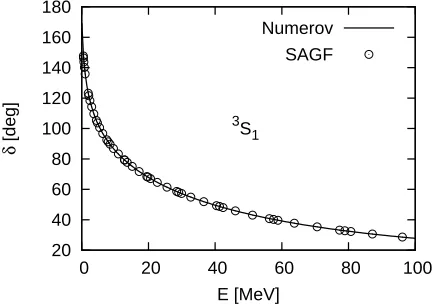
Table 1 compares the phase shifts calculated us-ing Eq. (25) with those obtained with the Numerov method, which is virtually exact. The comparison shows that the present method produces very stable phase shifts which are rather insensitive to the choice of the method of determining λ as well as the inter-val used for the minimization of the error. To gen-erate the discretized states for different energies, we repeated the calculation by changing K and the set of (β1, β2, . . . , βK). Figure 1 displays the phase shifts obtained in this way. The phase shifts obtained with our method almost perfectly agree with those of the Numerov method in a wide range of incident energies.
4.2α+nscattering with an effective nucleon-nucleon potential
In this and the following subsections we calculate the
S- andP-wave phase shifts of theα+nscattering in
20 40 60 80 100 120 140 160 180
0 20 40 60 80 100
δ
[deg]
E [MeV]
3
S1
Numerov SAGF
Fig. 1.Comparison of the3
S1phase shifts ofn+p
scatter-ing between SAGF and Numerov methods. The Minnesota potential [32, 33] is used.
a microscopic approach. The nucleon-nucleon interac-tion employed in this subsecinterac-tion is the Minnesota po-tential [32,33] which consists only of the central and spin-orbit potentials. The uparameter of the central potential is set equal to 0.98, and the spin-orbit po-tential adopted is −591.1 e−3r2
ℓ·σ in MeV (set IV of Reichstein and Tang). This potential is known to reproduce the empiricalα+nphase shifts of Refs. [35, 36]. The phase-shift difference between the 3/2− and 1/2− states is particularly well reproduced by this spin-orbit potential, and in this sense the Minnesota potential can be regarded as an effective potential.
Only a singleα+nchannel is included in the phase-shift calculation. The wave function of theαparticle,
ψ0(α), is obtained by diagonalizing the Hamiltonian
Hαin a basis of a number of Gaussians. The binding energy with the Coulomb potential being included is 29.90 MeV and the root-mean-square matter radius is 1.41 fm.
The relative motion function uℓ(r) in Eq. (27) is taken as a combination of Gaussians:
uℓ(r) = K X
i=1
Cirℓe−
1 2βir
2
. (34)
We have calculated the phase shifts using two different methods, the microscopic R-matrix theory [37] and the present method. The accuracy of the R-matrix theory is well tested, and it is considered to produce virtually exact results to which the phase shifts of SAGF are to be compared. In the SAGF calculation the parameters bi = 1/√βi with real βi are chosen to form a geometric progression to cover 0 < bi . 10 fm. The numberK of the basis functions is about 10-15. The Gaussian basis used in Eq. (34) can also be employed to construct the pseudo-complete set in Eq. (26). We obtained all the matrix elements needed in SAGF using the method developed in Ref. [10].
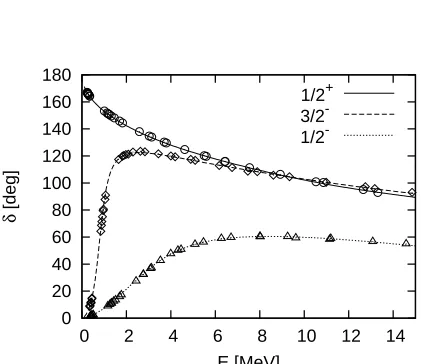
Figure 2 compares the SAGF phase shifts with the
Table 1.Comparison of the3
S1 phase shifts, given in degrees, ofn+pscattering between Numerov and SAGF methods.
Theλvalue is determined using Eq. (28) (Method 1) or (32) (Method 2) with the use of different intervals [r0, r1] (fm).
The Minnesota potential [32, 33] is used.
E Numerov Method 1 Method 2
[MeV] [0,5] [1,6] [2,6] [2,6]
0.4986 147.7 147.7 147.8 147.7 147.7
1.959 123.2 123.3 123.2 123.2 123.3
4.395 105.3 105.2 105.3 105.3 105.3
7.948 91.2 91.4 91.2 91.2 91.1
12.87 79.2 79.0 79.2 79.2 79.4
19.54 68.5 68.7 68.5 68.5 68.3
28.49 58.5 58.2 58.6 58.6 58.8
40.42 49.3 49.6 49.3 49.3 49.1
56.28 40.8 40.4 40.8 40.8 40.8
77.31 33.2 33.6 33.1 33.2 33.3
0 20 40 60 80 100 120 140 160 180
0 2 4 6 8 10 12 14
δ
[deg]
E [MeV] 1/2+ 3/2- 1/2-
Fig. 2. Comparison of the phase shifts ofα+nscattering between the microscopic R-matrix and SAGF methods. Solid, dashed and dotted lines are the phase shifts calcu-lated with theR-matrix theory, while symbols are those by SAGF. The Minnesota potential [32, 33] is used.
by the first method using the interval [1,5] (fm). The agreement is excellent. Both of z(r) and w(r) are in-cluded in the SAGF calculation. We switched off the functionw(r) and found that the phase-shift change is negligible: The largest change of a few percent oc-curs in the resonance region at around 1 MeV of the 3/2−phase shifts. Except for this case the phase-shift change is smaller by one order of magnitude. Thus we may safely neglect the contribution ofw(r).
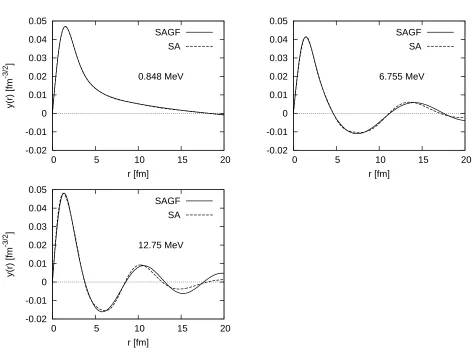
It is interesting to see how much the SAGF changes from the SA. Figure 3 compares the two SAs for the 3/2− state at three different energies. In each case, the SA curve agrees very well with the correspond-ing SAGF in the region of r <5 fm, which indicates that the expansion (34) is good enough to describe to a good approximation the α-n relative motion func-tion in the interacfunc-tion region. The peak posifunc-tion and the amplitude of the SA curve begin to deviate from those of the SAGF curve forr >5 fm. The deviation becomes larger as the energy increases.
4.3α+n scattering with realistic nucleon-nucleon potentials
In this subsection we take the same model as in the previous subsection but employ the realistic nucleon-nucleon potentials of AV8 type, AV8′ [19] and G3RS [18]. In what follows we use slightly truncated wave functions for the α particle to save computer time. The truncation is done by ignoring the small component with total orbital and spin angular mo-menta L= 1, S= 1 the magnitude of which is of the order of 0.3% or by optimizing the wave function in a smaller basis set whose size is approximately one third of the converged solution. The change of the phase shift due to the truncation is estimated to be at most a few percent.
Figure 4 displays the S- andP-wave phase shifts obtained in an α+n single-channel calculation. The difference due to the nucleon-nucleon potential is not very large. The agreement between theory and experi-ment is quite reasonable for the 1/2+phase shifts. Our phase shifts agree fairly well with those of the Quan-tum Monte Carlo calculation obtained using only the two-body potential of AV18 [2]. In a sharp contrast to the S-wave phase shift, the calculatedP-wave phase shifts are by far smaller than experiment, and consid-erably smaller than those obtained in Ref. [2]. We have coupled an inelastic channel of4He(0+
2) +n with the elastic channel, but the effect of coupling is negligible below E=15 MeV.
-0.02 -0.01 0 0.01 0.02 0.03 0.04 0.05
0 5 10 15 20
y(r) [fm
-3/2
]
r [fm]
0.848 MeV SAGF
SA
-0.02 -0.01 0 0.01 0.02 0.03 0.04 0.05
0 5 10 15 20
r [fm]
6.755 MeV SAGF
SA
-0.02 -0.01 0 0.01 0.02 0.03 0.04 0.05
0 5 10 15 20
y(r) [fm
-3/2
]
r [fm]
12.75 MeV SAGF
SA
Fig. 3. Comparison between the SA and the SAGF for the α+n scattering (3/2−) at three different energies. The
Minnesota potential [32, 33] is used.
central forces found in the binding energies ofA= 3,4 nuclei [10].
The experiment shows a 3/2− sharp resonance around E = 0.9 MeV and a 1/2− broad resonance. The single-channel calculation apparently misses some important configurations which are relevant to the res-onances, for example the inelastic channels including the excited states of4He withJπ6= 0+, as indicated in Ref. [3]. Other configurations which could be more im-portant than these inelastic channels include the chan-nels of different cluster partitions,3H+dand3He+2n, where 2ndenotes a di-neutron cluster. The threshold energies of these channels are lower than those of the inelastic channels. The clusters 3H, d, and 3He may not necessarily be in their ground states but can be in their pseudo-excited states. This is plausible because the strong tensor component included in the realis-tic potential brings about a mixing of different orbital and spin angular momenta of the participating nuclei. When we include the different cluster partitions of 3H+d and 3He+2n, we have to note the old, un-resolved problem that the threshold energies of dif-ferent channels are not usually reproduced well. The difference of the threshold energies betweenα+nand 3H+d is 17.6 MeV experimentally, but the
theoreti-cal value turns out to be about 15 MeV for both the AV8′ and G3RS potentials. To quantify the effects of the 3H+d and 3He+2n channels properly, the in-consistency in the threshold energy should be settled beforehand. The inclusion of three-body forces is im-portant in this respect. In the calculation of Ref. [2] including the three-body force of the Illinois-2 model, the threshold problem does not appear, and some of the distorted configurations are certainly included plicitly. However, it is not very clear whether the im-provement in the phase shifts obtained with the use of the three-body force indicates simply the predom-inant importance of the 3H+dor 3He+2nchannel or the necessity of including further configurations other than the elastic channels ofα+nand3H+d. Clarify-ing this point will certainly be very important, but it is beyond the present work because such calculations require an expensive computation.
0 20 40 60 80 100 120 140 160 180
0 2 4 6 8 10 12 14
δ
[deg]
E [MeV] AV8’
1/2+
3/2- 1/2-
0 20 40 60 80 100 120 140 160 180
0 2 4 6 8 10 12 14
E [MeV] G3RS
1/2+
3/2- 1/2-
Fig. 4. α+nscattering phase shifts calculated using the AV8′ and G3RS potentials. Solid, dashed and dotted lines are
the empirical phase shifts [35, 36]. Circle, diamond and triangle symbols denote the calculated phase shifts for 1/2+
,3/2−
and 1/2−, respectively.
-10 0 10 20 30 40
0 2 4 6 8 10 12 14
tan
δ0
E [MeV] AV8’
Total
Central Tensor
-10 0 10 20 30 40
0 2 4 6 8 10 12 14
E [MeV] G3RS
Total
Central Tensor
Fig. 5. Contributions of the components of the nucleon-nucleon potential to tanδ0 for S-wave α+n scattering phase
shifts. The contribution of the spin-orbit force is negligibly small.
a repulsive behavior similarly to the α+ncase. The 3He+pphase shifts have recently been calculated in a microscopicR-matrix method using the G3RS poten-tial [38]. The result of the single-channel calculation is very similar to the α+n case. The S-wave phase shifts are accounted for fairly well in the3He+p single-channel calculation, but the calculatedP-wave phase shifts turn out to be too small compared to the em-pirical ones. A calculation of including the channels of d(1+,0+) + 2p(0+) has significantly improved the discrepancy in the phase shifts and a further inclusion of the inelastic channels of3He+phas reproduced the empirical phase shifts reasonably well. We understand this as follows. In theP-wave scatterings of bothα+n
and3He+p, the nucleon can penetrate close to the nu-cleus and the nucleon-nunu-cleus interaction, particularly the tensor force distorts the nuclear state. Thus the
single-channel assumption becomes rather poor. On the other hand, in the S-wave case the nucleon can-not come close to the nucleus because the two identical nucleons occupying theS-orbit repel the incoming nu-cleon due to the Pauli principle, and thus the nucleus receives little distortion.
5 Summary and outlook
nu-cleons are assumed to interact via an effective nucleon-nucleon potential.
Using a sophisticated wave function for theα par-ticle, we have applied the present method to α+n
scattering described by realistic nucleon-nucleon po-tentials. The 1/2+ phase shifts for theS-wave show-ing a repulsive behavior of the underlyshow-ing αn inter-action are in reasonable agreement with the empirical phase shifts. The missing attraction needed to repro-duce the data more perfectly is attributed to the effect of three-body forces [2]. We have analyzed how much theS-wave phase shifts are affected by the terms of the nucleon-nucleon potential. Both the tensor and central forces contribute significantly but the spin-orbit force has a negligible contribution.
The P-wave phase shifts for the 3/2− and 1/2− states are too small with respect to experiment. This unexpected result indicates that a good reproduction of the α+n phase shifts attained using an effective interaction such as the Minnesota potential is an ad hoc description and may not be very realistic. Based on the comparison with the result of Ref. [2], the dis-crepancy in theP-wave phase shifts could be reduced by taking into account some distorted configurations which are especially important to form the 3/2− reso-nance as well as the three-body force. A careful study on the effects of the distorted configurations will be important to pin down the contribution of the three-body force.
Finally, we would like to mention possible appli-cations of our Green’s function approach. As men-tioned in the text, the method has the advantage that it can be used with ease to scattering problems of coupled-channels. Another interesting application in-cludes a calculation of the dipole response function. Very recently we have extended our method for treat-ing three-body continuum in the hypersperical har-monics formalism and compared in some simple cases with widely used methods usingL2basis functions, for example, the Lorentz integral transform method and the complex scaling method [39]. A study of more real-istic cases and four-body continuum is very interesting and will be reported elsewhere.
Acknowledgments
W. H. is supported by a Grant-in Aid for Scientific Research for Young Scientists (No. 19·3978) as a JSPS Research Fellow for Young Scientists.
References
1. H. Kamadaet al., Phys. Rev. C64(2001) 044001. 2. K.M. Nollet, S.C. Pieper, R.B. Wiringa, J. Carl-son, and G.M. Hale, Phys. Rev. Lett. 99 (2007) 022502.
3. S. Quaglioni and P. Navr´atil, Phys. Rev. Lett.101 (2008) 092501.
4. F.E. Harris, Phys. Rev. Lett.19(1967) 173; H.H. Michels and F.E. Harris, Phys. Rev. Lett. 19 (1967) 885.
5. A.U. Hazi and H.S. Taylor, Phys. Rev. A1(1970) 1109.
6. I.A. Ivanov, J. Mitroy, and K. Varga, Phys. Rev. Lett.87(2001) 063201.
7. I.M. Savukov, Phys. Rev. Lett.96(2006) 073202. 8. J. Mitroy and M.W.J. Bromley, Phys. Rev. Lett.
98(2007) 173001.
9. A.T. Kruppa, R. Suzuki, and K. Kat¯o, Phys. Rev. C75(2007) 044602.
10. Y. Suzuki, W. Horiuchi, M. Orabi, and K. Arai, Few-Body Syst.42(2008) 33.
11. W. Horiuchi and Y. Suzuki, Phys. Rev. C78 (2008) 034305.
12. Y. Suzuki, W. Horiuchi, and K. Arai, Nucl. Phys. A 823(2009) 1-15.
13. V.I. Kukulin and V.M. Krasnopolsky, J. Phys. G3 (1977) 795.
14. K. Varga and Y. Suzuki, Phys. Rev. C52(1995) 2885.
15. Y. Suzuki and K. Varga, Stochastic Varia-tional Approach to Quantum-Mechanical Few-Body Problems, Lecture Notes in Physics Mono-graphs(Springer, Berlin, 1998), Vol. m54. 16. T. Berggren, Nucl. Phys.72(1965) 337.
17. W.T. Pinkston and G.R. Satchler, Nucl. Phys.72 (1965) 641.
18. R. Tamagaki, Prog. Theor. Phys.39 (1968) 91. 19. R. B. Wiringa, V. G. J. Stoks, and R. Schiavilla,
Phys. Rev. C51(1995) 38.
20. Y. Suzuki, J. Usukura, and K. Varga, J. Phys. B31(1998) 31.
21. K. Varga, Y. Suzuki, and J. Usukura, Few-Body Systems24(1998) 81.
22. Y. Suzuki, T. Ando, and B. Imanishi, Nucl. Phys. A 295(1978) 365.
23. R. Beck, F. Dickmann, and R.G. Lovas, Ann. Phys.173(1987) 1.
24. R.G. Lovas, K.F. P´al, and M.A. Nagarajan, Nucl. Phys.A 402(1983) 141.
25. M. Kawai and K. Yazaki, Prog. Theor. Phys. 38 (1967) 850.
26. N.K. Timofeyuk, Nucl. Phys. A 632 (1998) 19, and references therein.
27. H. Horiuchi and Y. Suzuki, Prog. Theor. Phys.49 (1973) 1974.
28. K. Widermuth and Y.C. Tang, A Unified Theory of the Nucleus(Vieweg, Braunschweig, 1977). 29. M. Hesse, J. Roland, and D. Baye, Nucl. Phys.
A 709(2002) 184.
30. A.M. Lane and R.G. Thomas, Rev. Mod. Phys. 30(1958) 257.
31. R.F. Barret, B.A. Robson, and W. Tobocman, Rev. Mod. Phys.55(1983) 155.
32. D.R. Thompson, M. Lemere, and Y.C. Tang, Nucl. Phys.A 286(1977) 53.
34. E. Hiyama, Y. Kino, and M. Kamimura, Prog. Part. Nucl. Phys.51(2003) 223.
35. J.E. Bond and F.W.K. Firk, Nucl. Phys. A 287 (1977) 317.
36. Th. Stammbach and R.L. Walter, Nucl. Phys. A 180(1972) 225.
37. D. Baye, P.-H. Heenen, and M. Libert-Heinemann, Nucl. Phys.A 291(1977) 230.
38. K. Arai, S. Aoyama, and Y. Suzuki, arXiv:0812.4732.
39. Y. Suzuki, W. Horiuchi, D. Baye,
![Fig. 4. α+n scattering phase shifts calculated using the AV8′ and G3RS potentials. Solid, dashed and dotted lines arethe empirical phase shifts [35,36]](https://thumb-us.123doks.com/thumbv2/123dok_us/9040646.1440310/8.595.80.541.325.522/scattering-shifts-calculated-potentials-solid-arethe-empirical-shifts.webp)
