A PARAMETRIC STUDY ON EFFECT OF
TRAPEZOIDAL WEB PROFILE ON THE ANGLE OF
TWIST OF STEEL I-BEAM FOR ECCENTRIC
LOADING
Amit S. Chaudhary
1, Subim N. Khan
2 1P. G. Student, Department of Mechanical Engineering, ACEM, Pune, (India)
2
Professor, Department of Mechanical Engineering, RSCOE (JSPM), Pune, (India)
ABSTRACT
The term lateral torsional buckling belongs to deflection and angle of twist of a beam. The structural action of a
regular beam under loading is predominantly bending, with other effects such as, warping, rotation and lateral
torsional buckling. Different cross sectional web profiles are used to eliminate the lateral torsional effect of
beam. Corrugated steel plate is a widely used structural element in many fields of application because of its
numerous favorable properties. This paper presents a parametric study of trapezoidal web profile on the angle
of twist of steel I beam for eccentric loading. Comparison is made with conventional beams with same
dimensioned flat web. The study only includes angle of twist.
It is concluded that steel beam with trapezoidal web section have higher resistance to angle of twist. The result
shows that not only the thickness, but also the corrugation angle, length of infill corrugated plate and
corrugation width influences the resistance to the angle of twist.
Keywords: Angle Of Twist, Bending, Lateral Torsional Buckling, Trapezoidal Web, Web
Thickness, Corrugation Angle, Corrugation Width And Length Of Infill Corrugated Plate.
I. INTRODUCTION
When a cantilever beam is loaded, it will deflect vertically. If the beam does not have sufficient lateral stiffness
or lateral support along its length, the beam will also deflect out of the plane of loading. These two deformations
are interdependent: when the beam deflects laterally, the applied moment exerts a component torque about the
deflected longitudinal axis which causes the beam to twist. This behavior, which is important for long
unrestrained, I-beams whose resistances to lateral bending and torsion are low, is called lateral torsional
buckling [2].
The conventional method which uses intermediate stiffeners welded to the web to allow the use of thin webs has
two disadvantages i.e. high cost of fabrication and reduced service life of the element. The use of corrugated
sheets to replace flat sheets as webs of a beam eliminates both disadvantages. In addition, it reduces the total
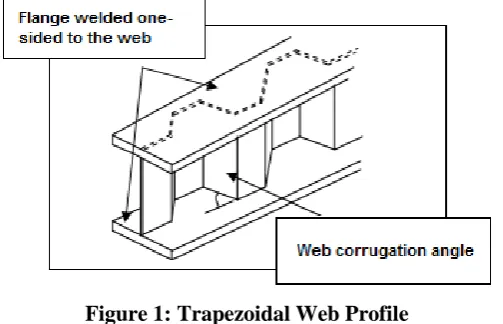
A trapezoid web steel section is built up by welding flanges and a web of trapezoidal corrugated profile (Figure
1). The main purpose in particular is to increase the out-of-plane stiffness and shear buckling strength without
the use of vertical stiffeners. It allows the use of thin plate webs without the need of stiffeners, thus considerably
reducing the cost of fabrication. Since there is no standard design method for the new section, this research has
been carried out to develop a complete design guide based on analytical and experimental study [1].
Figure 1: Trapezoidal Web Profile
The design concept of TWP sections is not much different from the design of conventional welded steel
sections. In almost all cases, the webs for both sections are classified as slender while the flanges are
semi-compact section. The derivation of the design shear capacity of TWP sections is based on the results of
experimental and theoretical study, and is the major part of the research program [1].
II PARAMETER SELECTION FOR STUDY
1. Web thickness (tw) – 5.7, 6.7 mm
2. Corrugation angle (θ) – 300, 450, 600, 750
3. Corrugation plate length (b) – 300, 350 mm
4. Corrugation web width (h) – 20, 30 mm
Figure 2: Geometrical Nomination of Trapezoid Web
III. METHODOLOGY
A literature study performed in order to understand the mechanism behind bending & lateral-torsional buckling.
Failure analysis of regular I beam for direct & eccentric loading. Study & analysis of various parameters of
trapezoidal web for the evaluation of angle of twist by CAE software.
IV. FINITE ELEMENT ANALYSIS
This section explains the assumptions on finite element (FE) modeling and evaluates the methodology selected
for validation of simulation in the software modeling.
4.1 Assumptions of Modeling
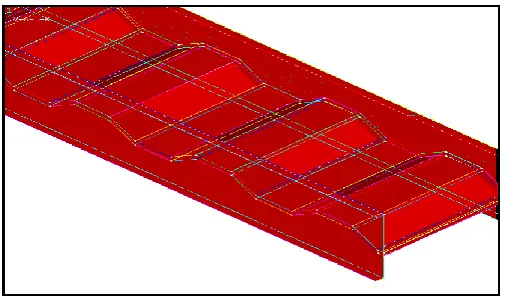
In this part of the study, the beam with trapezoidal web plate is investigated under point loading at free end. The
geometric properties of the beam with trapezoidal web on software are shown in Figure 4 and Table I & II.
ANSYS is used to create the models and are defined in terms of geometric features that must be subdivided into
finite elements for a solution. This process of sub division is called meshing. Mesh datasets contain information
about element types, element discretisation and mesh type. The I-beam models were assigned ungraded mild
steel for its material property with Young’s modulus, E= 2.1x10⁵ N/mm2, shear modulus, G = 79x103 N/mm2
and Poisson ratio of 0.3. The convergence of the mesh was established by independently increasing the mesh
density in each part of the model beam section.
Figure 3: Model of Trapezoidal Web Section
4.2 Eigen value Buckling Analysis
A finite element study was carried out on the trapezoidal and straight web sections using ANSYS. In this study,
all models were assumed to buckle under perfect conditions, where there is no initial imperfectness and
eccentric load. Loading conditions are also same for all models, two types of loads are considered, one is point
load at the free end and self weight of the beam. To ensure the load is applied through the web, the nodes for the
support will be constrained in its x, y, and z translation at the support. The assumptions used in the linear
buckling analysis are that the linear stiffness matrix does not change prior to buckling and that the stress
stiffness matrix is simply a multiple of its initial value.
The main objective of an Eigen value analysis is to obtain the values of lateral torsional buckling resistance,
bending capacity. Without considering membrane tensile and flange capacity, the modeling techniques used in
the Eigen value buckling analysis were employed. This technique is reliable to be used in the study of shear
capacity of triangular web compared to the normal flat web. Eigenvalue buckling analysis is a linear analysis
that may be applied to relatively stiff structures in order to estimate the maximum load that can be supported to
Figure 4: FEA of Straight Web Section Figure 5: FEA of Trapezoidal Web Section
4.3 FEA Results
Table 1 FEA Results of LTB in Z-axis (mm) for Beams with Trapezoid & Straight Web for
Eccentric Loading (e = 100 mm).
Span (mm) CP length (mm) WC width (mm) Web Thk (mm)
Lateral Torsional Buckling in Z-axis (mm)
Trapezoidal Beam
FW
TW 300 TW 450 TW 600 TW 750
5000
300
40
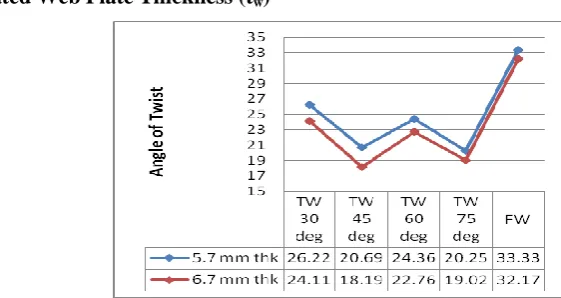
5.7 26.22 20.69 24.36 20.25 33.33
6.7 24.11 18.19 22.76 19.02 32.17
50
5.7 24.18 18.65 22.32 18.21 33.33
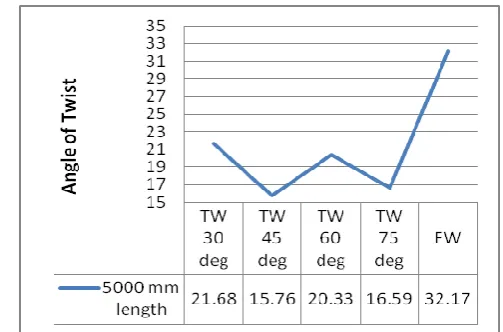
6.7 21.68 15.76 20.33 16.59 32.17
350 40 5.7 27.97 22.44 26.11 22 33.33
6.7 25.96 20.04 24.61 20.87 32.17
V. RESULTS AND DISCUSSION
The effect of some geometric properties on the performance of cantilever beam loaded with eccentric point load
at free ends such as effect of web thickness (tw), corrugation angle (θ), length of Infill Corrugated Plates (b), and
width of the corrugated web (h), and web openings were investigated and the other geometric parameters such
as B = 100 mm, D = 200 mm and tf= 10 mm are kept constant. In the following paragraphs, the results of these
parameters are presented in detail.
5.1 Corrugated Web Plate Thickness (t
w)
5.2 Width of Corrugated web (h)
Figure 7: Effect of Width of Corrugated Web on the Angle of Twist
5.3 Length of Infill Corrugated Plates (b)
Figure 8: Effect of Infill Corrugated Plate Length on the Angle of Twist
5.4 Corrugated Web Angle (θ)
VI. CONCLUSION
A finite element analysis is done on the behavior of trapezoidal web steel section and compared the same with
regular steel section when applied a load at the free end, and the following points are concluded:
1. The trapezoidal web steel section has higher resistance to angle of twist compared to that of section with
flat web section cantilever beam.
2. Trapezoidal web thicknesses, web angle, length of infill corrugated plate, width of the corrugated web
influences the resistance to twist of a cantilever beam,
a. Higher trapezoidal web thickness gives the highest resistance to angle of twist.
b. With trapezoidal web angle 450 and 750 will get higher resistance to angle of twist.
c. Increasing size of the length of infill corrugated plate reduces the resistance to angle of twist.
d. Increasing size of the width of the corrugated web increases the resistance to angle of twist.
REFERENCES
[1] A Akos Sapkas, Laszlo P. Kollar, 2002, "Lateral-torsional buckling of composite beams", International
Journal of Solids and Structures 39, Science Direct, Elsevier, 2939–2963.
[2] Andrade et al, 2010, "Elastic lateral-torsional buckling of restrained web-tapered I-beams", Computers
and Structures 88, Science Direct, Elsevier, 1179–1196.
[3] B Asgarian et al, 2013, "Lateral-torsional buckling of tapered thin-walled beams with arbitrary
cross-sections", Thin-Walled Structures 62, Science Direct, Elsevier, 96–108
[4] Boksun Kim et al, Nov. 2013, “Bending Stresses of Steel Web Tapered Tee Section Cantilevers”, Journal
of Civil Engineering and Architecture, ISSN 1934-7359, USA, Volume 7, No. 11 (Serial No. 72), pp.
1329-1342.
[5] Fatimah De’nan et al, 2013, “Effect of Triangular Web Profile on the Shear Behavior of Steel I-Beam”,
Iranica Journal of Energy & Environment 4 {(3) Geo-hazards and Civil Engineering)}: 219-222, ISSN
2079-2115
[6] Fatimah De’nan, Nor Salwani Hashim, 2011, “The effect of web corrugation angle on bending
performance of triangular web profile steel beam section”, International Journal of Environmental Protection, IJEP Vol.1 No.5, PP.53-56
[7] Fatimah Denan et al, March 2010, “The study of lateral torsional buckling behavior of beam with
trapezoid web steel section by experimental and finite element analysis”, IJRRAS 2 (3)
[8] H. Ozbasaran, 2014, “A parametric study on lateral torsional buckling of European IPN and IPE
cantilevers”, International Journal of Civil, Architectural, Structural and Construction Engineering Vol:8,
World Academy of Science, Engineering and Technology, No:7.
[9] J. THUMRONGVUT and S. SEANGATITH, 2011, "Experimental Study on Lateral-Torsional Buckling
of PFRP Cantilevered Channel Beams", Procedia Engineering 14, Science Direct, Elsevier, 2438–2445.
[10] Kerem Murat O¨ zdemir, Cem Topkaya, 2006, "Lateral buckling of overhanging crane trolley monorails",
[11] N.S. Trahair, 2014, “Bending and buckling of tapered steel beam structures”, Engineering Structures 59,
Science Direct, Elsevier, 229–237
[12] R. Drazumeric, F. Kosel, 2012, "Shape optimization of beam due to lateral buckling problem",
International Journal of Non-Linear Mechanics 47, Science Direct, Elsevier, 65–74
[13] Wei-bin Yuan et al, 2013, “Lateral–torsional buckling of steel web tapered tee-section cantilevers”,
Journal of Constructional Steel Research 87, Science Direct, Elsevier, 31–37
[14] Zhang Lei, Tong Geng Shu, 2008, "Lateral buckling of web-tapered I-beams: A new theory", Journal of