342 |
P a g e
PERFORMANCE ANALYSIS OF CONTENT BASED
VIDEO RETRIEVAL SYSTEM USING CLUSTERING
Poonam O.Raut
1, Nita S.Patil
21
Research scholar, Department of Computer Engineering, Datta Meghe College of Engineering
Airoli, Navi Mumbai (India)
2
Assistant Professor, Department of Computer Engineering, Datta Meghe College of Engineering
Airoli, Navi Mumbai (India)
ABSTRACT
The multimedia storage grows and the cost for storing multimedia data is cheaper. So there is huge number of videos available in the video repositories. It is difficult to retrieve the relevant videos from large video repository as per user in-terest as users shift from text based retrieval systems to content based retrieval systems. Video retrieval is very important in multimedia database management. This paper offers an overview of the landscape of general strategies in visual content-based video retrieval, focusing on methods for video structure analysis, including shot boundary detection, key frame extraction, extraction of features including static key frame features, object feature, video retrieval including similarity measures and the proposed procedure consists of the unique aspect of clustering techniques.
Keywords--
Content-Based Video Retrieval; Video Structure Analysis; Shot Boundary Detection; Key FrameExtraction; Similarity Measure; Video Retrieval
1 INTRODUCTION
Due to the increase of available network bandwidth, many users access the videos from large video repositories like
YouTube. For example, in YouTube, over 48 h of new videos are uploaded to the site every minute, and more than
14 billion videos were viewed in May 2010. It is difficult to manually index and retrieve from large video
repositories. It is also difficult to search with in long video clips in order to find portions of segments that the user
might interested and all these data are almost not usable in the absence of a proper search method.
The demand for intelligent processing and analysis of multimedia information has been rapidly growing in
recent years. Researchers have actively developed different approaches for intelligent video management, including
shot transition detection, key frame extraction, video retrieval. Among these approaches, shot transition detection is
the first step of content-based video analysis and key frame is a simple yet efficient form of video abstract. It can
help users to understand the content at a glance and is of practical value.
Content-based Video Retrieval (CBVR) systems appear like a natural extension (or merge) of Content-based Image
Retrieval, “Content-based” means that the search will analyze the actual content of the video. The term „Content‟ in
this context might refer colours, shapes, textures. However, there are a number of factors that are ignored when
dealing with images which should be dealt with when using videos. In visual content-based video retrieval, focusing
on methods for video structure analysis, including shot boundary detection, key frame extraction and extraction of
343 |
P a g e
2 REVIEW OF LITERATURE
The first step for video-content analysis, content based video browsing and retrieval is the partitioning of a video
sequence into shots. A shot is defined as an image sequence that presents continuous action which is captured from a
single operation of single camera. Shots are joined together in the editing stage of video production to form the
complete sequence. Shots can be effectively considered as the smallest indexing unit where no changes in scene
content can be perceived and higher level concepts are often constructed by combining and analyzing the inter and
intra shot relationships.[2] Almost all shot change detection algorithms reduce the large dimensionality of the video
domain by extracting a small number of features from each video frame. These are extracted either from the whole
frame or from a subset of it, which is called a region of interest (ROI). Such features include Luminance/color,
.Luminance/color histogram, Image edges, Transform coefficients (DFT, DCT, wavelet).Luminance/color where
The simplest feature that can be used to characterize a ROI is its average grayscale luminance. This, however, is
susceptible to illumination changes. A better choice is to use some statistics of the values in a color space. In
Luminance/color histogram, A richer feature for a ROI is the grayscale or color histogram. It is quite discriminant,
easy to compute and mostly insensitive to translational, rotational and zooming camera motion, for the above
reasons it is widely used. In Image edges, An obvious choice of feature is edge information in a ROI .Edges can be
used as is, be combined into objects or used to extract ROI statistics. They are invariant to illumination changes and
most motion, and they correspond somewhat to the human visual perception. Their main disadvantage is
computational cost, noise sensitivity and high dimensionality. In Transform coefficients (DFT, DCT, wavelet),
These are a classic way to describe the texture of a ROI. The DCT coefficients are also present in MPEG encoded
video streams or files. Their greatest problem is that they are generally not invariant to camera zoom and Other
features such as the color anglogram.[3]
Key-frames are still images extracted from original video data that best represent the content of shots in an
abstract manner. Key-frames have been frequently used to supplement the text of a video log, though they were
selected manually in the past .Key-frames, if extracted properly, are a very effective visual abstract of video contents
and are very useful for fast video browsing. A video summary, such as a movie preview, is a set of selected
segments from a long video program that highlight the video content, and it is best suited for sequential browsing of
long video programs. Apart from browsing, key-frames can also be used in representing video in retrieval video
index may be constructed based on visual features of key-frames, and queries may be directed at key-frames using
query by retrieval algorithms. key frames extraction can be done usisng Sequential comparison based Approach,
Global comparison based Approach, Reference frame-based Approach, Clustering based Approach, Curve
simplification-based Approach, Object/event-based Approach[2].
Once key frames are extracted next step is to extract features. The features are typically extracted off-line
so that efficient computation is not a significant issue, but large collections still need a longer time to compute the
features. Features of video content can be classified into low-level and high-level features. Low-level features such
as object motion, color, shape, texture, loudness, power spectrum, bandwidth, and pitch are extracted directly from
video in the database. High-level features are also called semantic features. Features such as timbre, rhythm,
instruments, and events involve different degrees of semantics contained in the media. High-level features are
344 |
P a g e
The key frames of a video reflect the characteristics of the video to some extent. Traditional image retrievaltechniques can be applied to key frames to achieve video retrieval. The static key frame features useful for video in
retrieval are mainly classified as color-based, texture-based, and shape-based.
Color-based features include color histograms, color moments, color correlograms , a mixture of Gaussian
models, etc. The exaction of color-based features depends on color spaces such as RGB, HSV, YCbCr and
normalized r-g, YUV, and HVC[5].
In Shape-Based Features,Shape-based features that describe object shapes in the image can be extracted
from object contours or regions. A common approach is to detect edges in images and then describe the distribution
of the edges using a histogram.
In Texture features in common use include Tamura features, simultaneous autoregressive models,
orientation features, wavelet transformation-based texture features, co-occurrence matrices, etc[2].
3 PROPOSED SYSTEM
3.1 Shot Boundary Detection
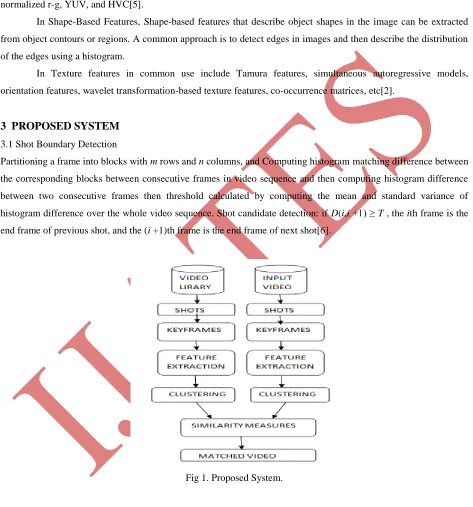
Partitioning a frame into blocks with m rows and n columns, and Computing histogram matching difference between the corresponding blocks between consecutive frames in video sequence and then computing histogram difference
between two consecutive frames then threshold calculated by computing the mean and standard variance of
histogram difference over the whole video sequence. Shot candidate detection: if D(i,i +1) ≥ T , the ith frame is the end frame of previous shot, and the (i +1)th frame is the end frame of next shot[6].
Fig 1. Proposed System.
3.2. Key Frame Extraction
Computing the difference between all the general frames and reference frame with the above method, Searching for
the maximum difference within a shot, Determining “ShotType” according to the relationship between max(i) and
MD: Static Shot (0) or Dynamic Shot, Determining the position of key frame: if ShotTypeC=0, with respect to the
345 |
P a g e
number, any one frame between the two frames in the middle of shot can be chose as key frame. If ShotTypeC=1,the frame with the maximum difference is declared as key frame[6].
3.3. Feature Extraction
3.3.1. Color Extraction
Color descriptors of images and video can be global and local. Global descriptors specify the overall color content of the image but with no information about the spatial distribution of these colors. Local descriptors relate to
particular image regions and, in conjunction with geometric properties of these latter, describe also the spatial
arrangement of the colors. In particular, the MPEG-7 color descriptors consist of a number of histogram descriptors,
a dominant color descriptor, and a color layout descriptor (CLD).
• RGB Moment
The frame is divided into 5x5 blocks and the
first, second, and third central moments of RGB
components are calculated for each block. And
then all the moments are concatenated in order of blocks to form a feature with 255 dimensions.
3.3.2. Shape Feature
A common approach is to detect edges in images and then describe the distribution of the edges using a histogram.
use the edge histogram descriptor (EHD) to capture the spatial distribution of edges for the video search. The EHD
is computed by counting the number of pixels that contribute to the edge according to their quantized directions. To
capture local shape features, first divide the image into 4×4 blocks and then extract a edge histogram for each block. Shape-based features are effective for applications in which shape information is salient in videos[2].
3.3.3.Texture Feature
In LBP operator method, the image is divided into a set of blocks and for each block, the LBP operator labels the
pixels by applying threshold operation over the 3x3-neighbourhood of each pixel with the center value. For every
pixel in a block, the pixel to each of its 8 neighbors (on its left-top, left-middle, left-bottom, right-top, etc.) is
compared. Then, the pixels along a circle, i.e. clockwise or counter-clockwise is followed and we put "1" if the
center pixel's value is greater than the neighbor; otherwise, we put “0". This gives an 8-digit binary number which is
converted into decimal value and the procedure is repeated for every pixel in the block. Subsequently, the histogram
is computed over the block according to its frequency of each "number" occurring and finally, normalized
histograms of all blocks are concatenated. This provides the texture feature vector for the input frame[2].
3.4. Region Thesaurus
Generally, a thesaurus combines a list of every term in a given domain of knowledge and a set of related terms for
each term in the list. Here the constructed Region Thesaurus contains all the Region Types that are encountered in
the training set. These region types are the centroids of the clusters and all the other feature vectors of a cluster are
their synonyms. It is important to mention that when two region types are considered to be synonyms, they belong
to same cluster, thus share similar visual features, but do not necessarily share the same semantics. By using a
significantly large training set of keyframes, our thesaurus is constructed and enriched[8].
346 |
P a g e
3.5. ClusteringSuppose we don't have a clear idea how many clusters there should be for a given set of data. Subtractive clustering,
is a fast, one-pass algorithm for estimating the number of clusters and the cluster centers in a set of data. The cluster
estimates obtained from the subclust function can be used to initialize iterative optimization- based clustering
methods and model identification methods. The subclust function finds the clusters by using the subtractive
clustering method. This algorithm can have a large reduction on the number of training samples, based on the
density of surrounding data points. Namely, all data points in a small dense zone of one point center will be
replaced by this typical one. On the other hand, the sparse points in the input space will remain as cluster centers
themselves. So this algorithm is noise robust, outliers have little influence on the choice of cluster centers[9].
3.6. Similarity Measures
Similarity measurement plays an important role in retrieval. A query frame is given to a system which retrieves
similar videos from the database. The distance metric can be termed as similarity measure, which is the
key-component in Content Based Video Retrieval. In conventional retrieval, the Euclidean distances between the
database and the query are calculated and used for ranking. The query frame is more similar to the database frame if
the distance is smaller.
3.8. Quantitative Analysis
The performance of the proposed CBVR system is evaluated on the input dataset using the precision, recall and
F-measure. For quantitative analysis, videos from each category are given to the proposed system and results are
evaluated with the defined measures as follows: Precision(P) and Recall(R)
P= (Similar video)∩(Retrieved video)
(Retrieved video)
R= (Similar video)∩(Retrieved video)
(Similar video)
F-measure={2*PR}/(P+R)
Recall reflects the system‟s ability of retrieval related videos, while the precision reflects the ability of rejecting the
unrelated videos. The evaluation results obtained by employing the input parameters shows the performance of the
proposed system in retrieving the relevant videos and it clearly differentiate the results obtained for two different
input parameters[8].
Support vector machines (SVMs) are a kind of machine learning method for both classification and regression
problems. They base on the structural risk minimization principle. SVMs have been applied to deal with a wide
range of problems due to their high generalization ability and good classification precision. At present, SVMs have
been applied to many classification and recognition fields, such as handwriting recognition, text classification, face
recognition, and speech recognition, etc. Support vector machines outperform conventional classifiers especially
when the number of training data is small. However, for the large and high dimensional data sets, the kernel
347 |
P a g e
4 CONCLUSION
Video retrieval is very important in multimedia database management. Video stream will become the main stream in
the years to come. Better off if we had a efficient CBVR search engine ready. Still many area needs to be improved.
To overcome the problem video is divided into shots n shot boundary detection technique use statistical difference
method, key frame extraction method use reference frame-based method and feature extraction based on color,
texture and shape and we use clustering methods to cluster the frame based on their low level visual features. Here
the number of comparisons is reduced. Then the similarity measure between the clustered frames and the query
frames is found and get the retrieved results. It works faster than the previous approaches.
5 FUTURE SCOPES
1) Most current video indexing approaches depend heavily on prior domain knowledge. This limits their
extensibility to new domains. The elimination of the dependence on domain knowledge is a future research
problem.
2) Fast video search using hierarchical indices are all interesting research questions.
3) Video indexing and retrieval in the cloud computing environment, where the individual videos to be searched
and the dataset of videos are both chang-ing dynamically, will form a new and flourishing research direction in
video retrieval in the very near future.
4) Fusions of multiple model information in multiple levels are all difficult issues in the fusion analysis of
integrated models.
REFERENCES
[1] B. V. Patel, B. B. Meshram (2007), “Retrieving and Summarizing Images from PDF Documents”, International
Conference on Soft computing and Intelligent Systems(ICSCSI-07), Jabalpur, India.
[2] Weiming Hu, Senior Member, IEEE, Nianhua Xie, Li Li, Xianglin Zeng, and Stephen Maybank “A Survey on
Visual Content-Based Video Indexing and Retrieval” IEEE TRANSACTIONS ON SYSTEMS, MAN, AND CYBERNETICS—PART C: APPLICATIONS AND REVIEWS, VOL. 41, NO. 6, NOVEMBER 2011.
[3] Purnima.S.Mittalkod, Dr.G.N.Srinivasan “Shot Boundary Detection Algorithms and Techniques” Research Journal of Computer Systems Engineering- An International Journal http://technicaljournals.org ISSN: 2230-8563; e-ISSN-2230-8571
[4] B V Patel and B B Meshram “content based video retrieval systems” International Journal of UbiComp (IJU), Vol.3, No.2, April 2012.
[5] S.Padmakala, Dr.G.S.AnandhaMala, M.Shalini “An Effective Content Based Video Retrieval Utilizing Texture, Color and Optimal Key Frame Feature” 2011 International Conference on Image Information Processing (ICIIP 2011)
[6] ZHAO Guang-sheng “A Novel Approach for Shot Boundary Detection and Key Frames Extraction” 2008 International Conference on MultiMedia and Information Technology
[7] David G. Lowe, Proc. of the International Conference on Computer Vision, Corfu, September, 1999. “ Object Recognition from Local ScaleInvariant Features
348 |
P a g e
[9] Xianglin Zeng, WeimingHu, Wanqing Liy, Xiaoqin Zhang, Bo Xu “Key-Frame Extraction UsingDominant-Set Clustering” NSFC (Grant No. 60672040