Licensed under Creative Common Page 1
http://ijecm.co.uk/
ISSN 2348 0386
ONLINE RETAILING: RELATIONSHIP AMONG E-TAILING
SYSTEM QUALITY, E-SATISFACTION, E-TRUST AND
CUSTOMERS COMMITMENT IN CHINA
Ziaullah, Muhammad
School of Management and Economics
University of Electronic Science and Technology of China, Sichuan, P. R. China [email protected]
Feng, Yi
School of Management and Economics
University of Electronic Science and Technology of China, Sichuan, P. R. China
Akhter, Shumaila Naz
School of Management and Economics
University of Electronic Science and Technology of China, Sichuan, P. R. China
Abstract
The purpose of this study is to propose and demonstrate an integrative model of e-tailing
system quality, e-satisfaction, e-trust and commitment in China. Customer’s commitment is
fundamental to the survival and profitability of e-tailing. Perhaps, study variables have
considerable importance on e-tailers performance. The data were collected from a sample of
383 students at universities in China during the first quarter of 2014. We used confirmatory
factor analysis (CFA) and structural equation modeling (SEM) to evaluate the hypotheses about
the relationship among model constructs. Thus all the hypotheses developed in the study were
positively confirmed except one, reinforcing the theory and previous research in this field. The
result indicates that system quality is positively associated with e-trust and e-satisfaction,
similarly e-trust influences positively to both types of commitment. However, e-satisfaction has
positive effect on affective commitment, but it has not significant positive connection with
continuance commitment in our study. This study reveals interesting implications that are useful
to both academicians and practitioners.
Licensed under Creative Common Page 2 INTRODUCTION
In response of e-commerce market competitiveness commitment has great recognition and importance in the literature of relationship marketing. It is a key precursor to the accomplishment of valuable outcomes for instance, future intentions (Kim et al., 2005), and profitability (Anderson and Weitz, 1992). Customer commitment refers as an attitude that reflects the desire to maintain a valued relationship (Moorman, 1992; Morgan and Hunt, 1994). Moreover, it is also conceptualized as a “pledge of continuity” form one party to another (Dwyer et al., 1987). Consequently, it is argued that the commitment lies potential for scarifies or sacrifice that one party faces in the event that the relationship ends (Anderson and Weitz, 1992), or for the sake of alternative seeking from the market (Gundlach et al., 1995). Sometimes commitment refers as a resistance to change (Pritchard et al., 1999), and a sort of attitude change (Ahluwalia, 2000). Particularly, marketing scholars and researchers used various definitions and perspective to characterize two important components of commitment (Gundlach et al., 1995). The first component of commitment is based on liking and identification and second component is based on dependence and switching cost that are called affective and continuance commitment respectively (Allen, N. J., & Meyer, 1990).
The affective commitment is based on the “affective or emotional attachment to the organization such that the strongly committed individual identifies with, is involved in, and enjoys membership in the organization” (Allen, N. J., & Meyer, 1990). Thus the essence of affective commitment is that customers indulge to acquire an emotional attachment to their partner in a consumption relationship. As customer like to any specific brand or service providers (e-tailers), at that movement they are experiencing the psychological state of affective commitment (Fullerton, 2003). While continuance commitment in exchange relationship is built on the side bets, switching costs and scarcity of alternatives (Allen, N. J., & Meyer, 1990).
The core concept of marketing paradigm has been investigated by researchers in both business to business (Morgan and Hunt, 1994), and consumer’s context (Verhoef et al., 2002). In recent years, internet has had a profound impact on the subject of marketing. Recently most of the consumers feel comfortable buying products through online mechanism. Therefore, e-tailers have attempted to design website to attract customers to visit and revisit their sites. Some studies have investigated the factors that could affect customers purchase behavior on the Web (Poddar et al., 2009).
Licensed under Creative Common Page 3 consumer’s e-satisfaction, e-trust which in turn leads to customer’s commitment. This study begins with the introduction, proposed model and the hypotheses. We then describe the research methodology, present our research results and discussion, and conclude with managerial implications, limitations and suggestions for future research.
LITERATURE REVIEW AND RESEARCH HYPOTHESES
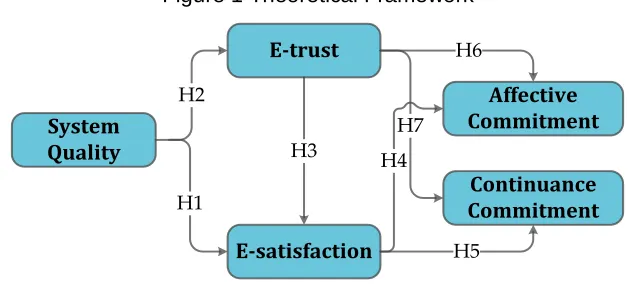
This study draws from previous theories to develop hypotheses with regard to the impact of e-tailing system quality on e-satisfaction, e-trust and commitment. We derive a structural equation model (Fig.1), which illustrates the hypothesized relationships discussed in the subsequent sections.
Figure 1 Theoretical Framework
System Quality
E-trust
E-satisfaction
Affective Commitment
Continuance Commitment
H2
H1
H6
H5 H7
H4 H3
Fig.1 Theoretical Framework
Relationship between e-tailing system quality, e-trust and e-satisfaction
Licensed under Creative Common Page 4 satisfaction in context of online shopping. It is recommended that high system quality provide custoemers more convenience, faster response and privacy (Ahn et al., 2007). These sorts of system characteristics and capabilities had more influcence on percievid ease of use and usefulness of e-tailer website (Lederer et al., 2000; Liao and Cheung, 2001).
System design quality such as security is the most critical concern of online customers (Shankar, 1996), Anderson and Bezuidenhoudt pointed that system reliability is vital role in the success of e commerce. Corritore et al. (2003) introduced the Website as an object of trust and suggest that system quality i.e navigational architecture, functionality and design element have significant effect on customers trust. Kim and Prabhakar (2004) suggested that system trust is important for acceptance of ecommerce. It is found that system quality has been played important role and effects on customer satisfaction with internet shopping (Kim and Lim, 2001; Liu et al., 2000; Bai et al., 2008). Bharati and Chaudhury (2004) argue that system quality is positively and directly correlated with customer’s e-satisfaction. As increase in system quality of online retailer has been enhanced customers decision making satisfaction (Bharati and Chaudhury, 2004). Lin (2007) found that system quality is the most determinant of customer satisfaction in internet shopping. Therefore, we propose subsequent hypothesis.
H1: System quality positively influences e-satisfaction
H2: System quality positively influences e-trust
The relationship between e-trust and e-satisfaction
In the context of e-tailing, online customer satisfaction is quite difficult before gain their trust. Therefore, trust also affects e-satisfaction in this regard. According to Berry (2000), trust is very essential for satisfaction. In fact, online consumer who trusts on e-tailers will be satisfied and more willing to commit on it. Yoon (2002) stated that satisfaction is the antecedent of trust. Researchers have been considered trust as critical determinants of developing relationship between buyers and sellers (Sirdeshmukh et al., 2002; Verhoef et al., 2002). It is also investigated that trust has direct influence on the post purchase satisfaction. Specifically in the context of online shopping trust might be the fundamental element for initiating the transaction. Thus customer perceives a higher level of risk in e-tailing than in traditional retailing in the shape of delivery, information disclosure and payment. In this regard online customer prefers to make transaction with those e-tailers they can trust more (Singh and Sirdeshmukh, 2000). It is found that trust is the predictor of e-satisfaction in e-commerce (Harris and Goode, 2004; Jin and Park, 2006). Therefore, we propose subsequent hypothesis.
Licensed under Creative Common Page 5 The relationship between e-satisfaction and commitment
Satisfaction refers as “an overall evaluation based on the total purchase and consumption experience with a good or service over time” (Anderson et al., 1994). Thus, e-satisfaction is the precursor of customers’ commitment; actually it is the result of customer’s evaluations regarding the product and the key elements of their decision to repurchase (Kasmer, 2005). Consequently, customer satisfaction is one of values for customers that they expect from firm to deliver in the context of exchange. We would expect that commitment is one of the favorable consequences of satisfaction (Bansal et al., 2004). Similarly online customers over all evaluations of satisfactory consumption experiences make a positive impact on the degree of commitment in the relationship (Brown et al., 2005). Previously, it is observed that satisfaction has positive influence on commitment (Vasudevan et al., 2006; Abdul-Muhmin, 2005). In line with these authors, we propose that in the context of online shopping e-satisfaction is positively associated with affective and continuance commitment. Thus, we propose subsequent hypotheses.
H4: E-satisfaction positively influences affective commitment
H5: E-satisfaction positively influences continuance commitment
The relationship between e-trust and commitment
Trust refers as “a willingness to rely on an exchange partner in whom one has confidence” (Moorman et al., 1992). Practically it is observed that expectation of trustworthiness results from the ability to expertise, reliability and intentionality. Morgan and Hunt (1994) defined trust as the confidence in the exchange partner’s ability, reliability and integrity (Allen and Meyer, 1990). Trust is the determinant of commitment and successful business relationship (Morgan and Hunt, 1994). It is found that trust influenced positively on commitment (Tellefsen, 2002). Therefore, it is suggested that trust influenced firms to focus on the positive motivation to stay in the relationship based on the feeling of connectedness and identification with each other (affective commitment), less due to continuance (continuance commitment) reasons to stay with the supplier (De Ruyter et al., 2001). Thus, we propose subsequent hypotheses.
H6: E-trust positively influences affective commitment
H7: E-trust positively influences continuance commitment
Licensed under Creative Common Page 6 Questionnaire design
In this study we have reviewed the literature to explore valid measures for this study related constructs and adapted existing scales to measure e-tailing system quality (Ahn et al. 2005) influence on e-satisfaction (Fornell et al. 1996; Kim et al. 2009), e-trust (Garbarino and Johnson 1999; Ribbink et al. 2004) and commitment (Fullerton, 2003). Firstly, scales from literature were explored in English, therefore initial questionnaire was developed in English. Then, English version questionnaire were translated into Chinese by two Chinese Master and Ph. D students. Further, Chinese version questionnaire were translated back into English, hence this version of questionnaire was counter checked against the original English version for discrepancies and their rectification. This approach has been adopted to facilitate appropriate measurement development and to confirm meaning consistency, to improve understandability of the survey and proper use of terminology in Chinese.
In this study all the indicators in the questionnaire were measured using a 7-Point Likert scale ranging from strongly disagree to strongly agree ( 1= strongly disagree; 7= strongly agree).
Sampling and data collection
Fung Business Intelligence Center reported that Chinese online customers are young people and over 60% were aged 30 or below in 2012. It is highlighted that middle aged customers preferred to buy online due to more buying power (Fung Business Intelligence Center 2013). Particularly, it is recommended that universities students are likely to be the first and more attractive potential consumers segment of e-commerce due to their high education level and income (Lightner et al. 2002).
In our study respondents were selected using convenience sampling method, therefore data for this study were obtained through survey from universities different locations such as libraries, research labs, canteens and mini markets in mainland China. In our study 430 respondents have completed the survey, after sorting and removing errors 383 valid and usable questionnaires left for data analysis. The response rate was 89 percent. The profile of respondents and their characteristics are stated in Table 1.
Licensed under Creative Common Page 7
Demographics Variable Category Sample Percentage
Gender Male
Female
222 161
58.0 42.0
Age (Years) Below-20
20-29 30-39 79 299 5 20.6 78.1 1.3 Education Level High School
Bachelor Master Ph. D 3 218 147 15 0.8 56.9 38.4 3.9
Profession Students 383 100
Shopping Experience (Years) Under 1 1-4 Over 4 48 239 96 12.5 62.4 25.1 Construct development
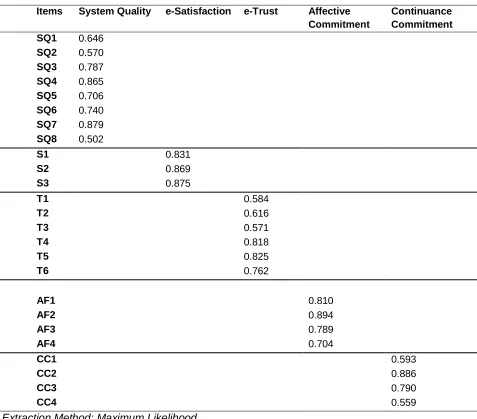
In this study we used Kaiser-Meyer-Olkin (KMO) to measure sampling adequacy and the Bartlett test of sphericity. The results that showed KMO value of 0.885 with the significance of Bartlett’s test at 0.000 level, indicates the data for exploratory factor analysis (EFA) fitting. We used maximum likelihood analysis for data reduction and promax rotation with Kaiser Normalizations for clarifying the factors. Hence EFA was conducted with specifying four numbers of factors. The cumulative variance explanation reaches 62%. All the items have strong loadings on the construct in the pattern matrix which are >0.30 (Hair et al., 1998). The results of EFA are shown in Table 2.
Licensed under Creative Common Page 8 (continuance commitment) which exceed the recommended level of 0.70. The average variance extracted (AVE) measure ranges from 0.76 (e-satisfaction) to 0.53 (system quality) which is better than recommended value of 0.50 (Hair et al. 1998). The higher value of AVE, CR and factor loadings results, therefore adequately demonstrates the convergent validity of the measurement items.
Table 2- Results of exploratory factor analysis (EFA) Items System Quality e-Satisfaction e-Trust Affective
Commitment
Continuance Commitment SQ1 0.646
SQ2 0.570 SQ3 0.787 SQ4 0.865 SQ5 0.706 SQ6 0.740 SQ7 0.879 SQ8 0.502
S1 0.831
S2 0.869
S3 0.875
T1 0.584
T2 0.616
T3 0.571
T4 0.818
T5 0.825
T6 0.762
AF1 0.810
AF2 0.894
AF3 0.789
AF4 0.704
CC1 0.593
CC2 0.886
CC3 0.790
CC4 0.559
Extraction Method: Maximum Likelihood.
Rotation Method: Promax with Kaiser Normalization. a. Rotation converged in 6 iterations.
*(SRQ: Information Quality, S: Satisfaction, T: Trust, AF: Affective Commitment, CC:
Continuance Commitment)
Licensed under Creative Common Page 9 Internal Reliability Convergent Validity
Construct
items
Cronbach
α
Item Total
Correlation Standardized Factor Loadings Composite Reliability Variance Extracted Sy s te m Q u a li ty
SQ1 0.89 0.695 0.728 0.90 0.53
SQ2 0.645 0.724
SQ3 0.723 0.774
SQ4 0.728 0.745
SQ5 0.657 0.706
SQ6 0.713 0.751
SQ7 0.753 0.776
SQ8 0.518 0.647
E
-Sa
t
S1 0.90 0.813 0.881 0.90 0.76
S2 0.808 0.866
S3 0.810 0.868
E
-T
ru
s
t
T1 0.86 0.642 0.627 0.88 0.57
T2 0.638 0.698
T3 0.567 0.651
T4 0.687 0.805
T5 0.694 0.907
T6 0.670 0.819
A ff. C o m m itm e n t
AF1 0.88 0.680 0.658 0.88 0.64
AF2 0.818 0.823
AF3 0.765 0.867
AF4 0.743 0.842
C o n t. C o m m itm e n
t CC1 0.84 0.648 0.751 0.87 0.62
CC2 0.751 0.867
CC3 0.756 0.840
Licensed under Creative Common Page 10 Convergent Validity
We used CFA to test convergent validity. In CFA, convergent validity can be assessed by testing each individual item’s standardized coefficient greater than the twice its standard error shows that measurement model is significant (Anderson and Gerbing, 1988). In this study all the factor loadings for the indicators measuring the same construct are statistically significant (i.e. greater than twice their standard error), that reflects as evidence supporting the convergent validity of those indicators. In our study all t-tests were significant showing that all indicators are effectively measuring the same construct in the presence of high convergent validity.
Discriminant validity
Discriminant validity measures the extent to which individual items intending to measure one latent construct do not at the same time measure a different latent construct (DeVellis, 1991). In the study Tab.3 can be seen that the average communalities (Average Variance Extracted-AVE) used to measures the each construct are greater than the variance shared with other constructs. Therefore, it is demonstrated that the discriminant validity of all scales is adequate. Moreover, all AVE exceeded 0.50, which indicating strong construct validity. In overall, the measurement results are satisfactory and recommend that it is appropriate to proceed with the investigation and evaluation of the theoretical framework.
ANALYSIS AND RESULTS
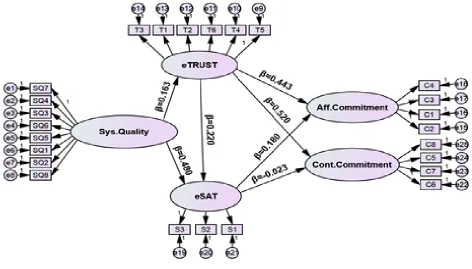
We used SPSS AMOS-IBM version 21 to analyze the data and demonstrate structural equation modeling (SEM) of this study. It is a powerful multivariate analysis technique used to measure latent variables and investigate causal relationship among proposed model variable. Specifically, SEM allows conducting confirmatory analysis (CFA) for theory development and testing.
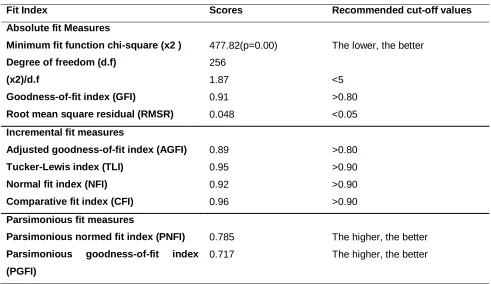
Licensed under Creative Common Page 11 Table 4- Fit indices for structural model
Fit Index Scores Recommended cut-off values
Absolute fit Measures
Minimum fit function chi-square (x2 )
Degree of freedom (d.f)
(x2)/d.f
Goodness-of-fit index (GFI)
Root mean square residual (RMSR)
477.82(p=0.00) 256
1.87 0.91 0.048
The lower, the better
<5 >0.80 <0.05 Incremental fit measures
Adjusted goodness-of-fit index (AGFI)
Tucker-Lewis index (TLI)
Normal fit index (NFI)
Comparative fit index (CFI)
0.89 0.95 0.92 0.96
>0.80 >0.90 >0.90 >0.90 Parsimonious fit measures
Parsimonious normed fit index (PNFI)
Parsimonious goodness-of-fit index
(PGFI)
0.785 0.717
The higher, the better The higher, the better
Table 5- Factor Correlation Matrix
Factor System
Quality E-Trust Aff.
Commitment E-Satisfaction
Cont.
Commitment
System Quality 1.000
E-Trust 0.092 1.000
Aff. Commitment 0.194 0.486 1.000
E-Satisfaction 0.581 0.253 0.363 1.000
Cont. Commitment -0.102 0.433 0.546 0.036 1.000 Extraction Method: Maximum Likelihood.
Rotation Method: Promax with Kaiser Normalization.
Licensed under Creative Common Page 12 Table 6- Standardized parameter estimates of hypothesized paths
Path Hypotheses Co-efficient
Estimate
Standard
Error
t-value p-value
System Quality => E-satisfaction H1 0.480 0.046 10.474 P<0.001 System Quality => E-trust H2 0.163 0.053 3.071 P<0.005 E-trust=> E-satisfaction H3 0.220 0.042 5.292 P<0.001 E-satisfaction => Affective
commitment
H4
0.180 0.059 3.035 P<0.005
E-satisfaction => Continuance commitment
H5 -0.023 0.072 -.314 P=0.754
E-trust => Affective commitment H6 0.443 0.056 7.970 P<0.001 E-trust => Continuance
commitment
H7 0.520 0.067 7.798 P<0.001
H1: System quality positively influences e-satisfaction (β=0.480; p<0.001). The result
Licensed under Creative Common Page 13
H2: System quality positively influences e-trust (β=0.163; p<0.005). This study results
support the findings of Corritore et al. (2003). This study confirms the belief that as system quality increases on e-tailers website it will enhanced the online customers trust.
H3: E-trust positively influences e-satisfaction (β=0.220; p<.005). This study supports the
finding of (Harris and Goode, 2004; Jin and Park, 2006; Singh and Sirdeshmukh, 2000) and confirms that e-trust is essential for e-satisfaction.
H4: E-satisfaction positively influences affective commitment (β=0.180; p<0.005). This
study found that e-tailing satisfaction is significantly associated with affective commitment. As Bansal et al. (2004) explained that online shopping customers’ commitment is the consequence of satisfaction. The result of study supports the findings of (Vasudevan et al., 2005; Abdul-Muhmin, 2005).
H5: E-satisfaction positively influences continuance commitment (β=0-.023; p>0.005). In
our study e-satisfaction has not significantly associated with continuance commitment.
H6: E-trust positively influences affective commitment (β=0.443; p<0.001). In this study
trust play more important role against e-satisfaction in the context of online customers affective commitment. E-trust has stronger relationship with affective commitment but at the same time it is the prerequisite for e-tailing customer’s satisfaction. This study supports the findings of De Ruyter et al. (2001).
H7: E-trust positively influences continuance commitment (β=0.520; p<0.001). This study
supports the findings of De Ruyter et al. (2001). E-trust is the strongest antecedents of continuance commitment in the context of online shopping.
MANAGERIAL IMPLICATIONS
Licensed under Creative Common Page 14 We suggests that a great success in the context of e-tailing will be the result from a strategy that identified one targeted aspect of system quality, rather than from one in which the e-retail firm can improves marginally on all the aspects. The explanation of the research model has the potential to help tailers better understand and assess how system quality influences on e-satisfaction, e-trust and commitment. Learning the unexplored relationship between e-tailing system quality, e-satisfaction, e-trust and commitment, e-tailers can effectively allocate their resources and develop a rational plan and strategies to improve their e-tail system quality under specific business circumstances.
CONCLUSION, LIMITATIONS AND FUTURE RESEARCH DIRECTIONS
In fact several authors have focused on multidimensional aspect of e-tailers product quality & delivery services and the relationship between customer satisfaction, e-trust and customer loyalty. This research sought to establish the bridges between system quality, satisfaction, e-trust and commitment of e-tailing. Empirical tests of the model, using a sample of young retail customers, were conducted to support the proposed hypotheses. Specifically, this research contributes to the progress of establishing and measuring the constructs of system quality, e-satisfaction, e-trust and commitment.
This study has several limitations. Firstly, sampling frame includes universities students that may lead to loss of generalizability of results. Secondly, dependent variable in the hypothesized model, e-satisfaction, e-trust and commitment are likely to be influenced by some other variables other than system quality of e-tailing, which were not the specific object of this study. Therefore, future studies might be conducted to explore the role of e-tailing system quality in the specific brand or product category and it’s influenced on customer’s commitment.
REFERENCES
Abdul-Muhmin, A. G. (2005). Instrumental and interpersonal determinants of relationship satisfaction and commitment in industrial markets. Journal of Business Research, 58(5), 619−628.
Ahluwalia, R. (2000). Examination of psychological processes underlying resistance to persuasion. Journal of Consumer Research, 27(2), 217-232.
Ahn, T., Ryu, S., & Han, I. (2005). The impact of the online and offline features on the user acceptance of Internet shopping malls. Electronic Commerce Research and Applications, 3(4), 405-420.
Ahn, T., Ryu, S., & Han, I. (2005). The impact of the online and offline features on the user acceptance of Internet shopping malls. Electronic Commerce Research and Applications, 3(4), 405-420.
Ahn, T., Ryu, S., & Han, I. (2007). The impact of Web quality and playfulness on user acceptance of online retailing. Information & Management, 44(3), 263-275.
Licensed under Creative Common Page 15 Allen, N. J., & Meyer, J. P. (1990). The measurement and antecedents of affective, continuance and normative commitment to the organization. Journal of Occupational Psychology, 63(1), 1-18.
Anderson, E. W., Fornell, C., & Lehmann, D. R. (1994). Customer satisfaction, market share, and profitability: findings from Sweden. The Journal of Marketing, 53-66.
Anderson, E., & Weitz, B. (1992). The use of pledges to build and sustain commitment in distribution channels. Journal of Marketing Research, 18-34.
Anderson, J. C., & Gerbing, D. W. (1988). Structural equation modeling in practice: A review and recommended two-step approach. Psychological bulletin,103(3), 411.
Anderson, R. J., & Bezuidenhoudt, S. J. (1996). On the reliability of electronic payment systems. Software Engineering, IEEE Transactions on, 22(5), 294-301.
Bai, B., Law, R., & Wen, I. (2008). The impact of website quality on customer satisfaction and purchase intentions: Evidence from Chinese online visitors. International Journal of Hospitality Management, 27(3), 391-402.
Bansal, H. S., Irving, P. G., & Taylor, S. F. (2004). A three-component model of customer to service providers. Journal of the Academy of Marketing Science,32(3), 234-250.
Berry, L. L. (2000). Cultivating service brand equity. Journal of the Academy of Marketing Science, 28(1), 128-137.
Bharati, P., & Chaudhury, A. (2004). An empirical investigation of decision-making satisfaction in web-based decision support systems. Decision support systems, 37(2), 187-197.
Brown, T. J., Barry, T. E., Dacin, P. A., & Gunst, R. F. (2005). Spreading the word: Investigating antecedents of consumers’ positive word-of-mouth intentions and behaviors in a retailing context. Journal of the Academy of Marketing Science, 33(2), 123-138.
Chuan-Chuan Lin, J., & Lu, H. (2000). Towards an understanding of the behavioural intention to use a web site. International journal of information management, 20(3), 197-208.
Corritore, C. L., Kracher, B., & Wiedenbeck, S. (2003). On-line trust: concepts, evolving themes, a model. International Journal of Human-Computer Studies,58(6), 737-758.
De Ruyter, K., Moorman, L., & Lemmink, J. (2001). Antecedents of commitment and trust in customer– supplier relationships in high technology markets. Industrial Marketing Management, 30(3), 271−286. Delone, W. H. (2003). The DeLone and McLean model of information systems success: a ten-year update. Journal of management information systems,19(4), 9-30.
DeVellis, R.F., 1991. Scale Development: Theory and Applications. Sage Publications, Newbury Park, CA.
Dwyer, F. R., Schurr, P. H., & Oh, S. (1987). Developing buyer-seller relationships. The Journal of Marketing, 11-27.
Fornell C, Johnson MD, Anderson EW, Cha J, Bryant BE (1996) The American customer satisfaction index: Nature, purpose, and findings. Journal of Marketing, 60(4).
Fullerton, G. (2003). When does commitment lead to loyalty? Journal of Service Research, 5(4), 333-344. Fung Business Intelligence Center (2013) Online retailing in China 2013. Online: <http://www.funggroup.com/eng/knowledge/research/china_dis_issue111.pdf >
Garbarino, E., & Johnson, M. S. (1999). The different roles of satisfaction, trust, and commitment in customer relationships. The Journal of Marketing, 70-87.
Gundlach, G. T., Achrol, R. S., & Mentzer, J. T. (1995). The structure of commitment in exchange. The Journal of Marketing, 78-92.
Licensed under Creative Common Page 16 Hair JF, Tatham RL, Anderson RE and Black W (1998) Multivariate data analysis. (Fifth Ed.) Prentice-Hall:London.
Harris, L. C., & Goode, M. M. (2004). The four levels of loyalty and the pivotal role of trust: a study of online service dynamics. Journal of Retailing, 80(2), 139-158.
Ives, B., Olson, M. H., & Baroudi, J. J. (1983). The measurement of user information satisfaction. Communications of the ACM, 26(10), 785-793.
Jin, B., & Park, J. Y. (2006). The moderating effect of online purchase experience on the evaluation of online store attributes and the subsequent impact on market response outcomes. Advances in Consumer Research, 33, 203.
Kasmer, H. (2005), Customer relationship management, customer satisfaction study and a model for improving implementation of the maritime transport sector, Systems Engineering Program of the U.S. prepared YTU FBE Master's thesis in Industrial Engineering, Istanbul
Kim, J., Jin, B., & Swinney, J. L. (2009). The role of etail quality, e-satisfaction and e-trust in online loyalty development process. Journal of Retailing and Consumer Services, 16(4), 239-247.
Kim, K. K., & Prabhakar, B. (2004). Initial trust and the adoption of B2C e-commerce: The case of internet banking. ACM sigmis database, 35(2), 50-64.
Kim, S. Y., & Lim, Y. J. (2001). Consumers' perceived importance of and satisfaction with internet shopping. Electronic Markets, 11(3), 148-154.
Kim, W. G., Leong, J. K., & Lee, Y. K. (2005). Effect of service orientation on job satisfaction, organizational commitment, and intention of leaving in a casual dining chain restaurant. International Journal of Hospitality Management, 24(2), 171-193.
Lederer, A. L., Maupin, D. J., Sena, M. P., & Zhuang, Y. (2000). The technology acceptance model and the World Wide Web. Decision support systems, 29(3), 269-282.
Liao, Z., & Cheung, M. T. (2001). Internet-based e-shopping and consumer attitudes: an empirical study. Information & Management, 38(5), 299-306.
Lightner NJ, Yenisey MM, Ozok AA, Salvendy G (2002) Shopping behaviour and preferences in e-commerce of Turkish and American university students: implications from cross-cultural design. Behaviour & Information Technology, 21(6), 373-385.
Lin, H. F. (2007). The impact of website quality dimensions on customer satisfaction in the B2C e-commerce context. Total Quality Management and Business Excellence, 18(4), 363-378.
Liu, C., & Arnett, K. P. (2000). Exploring the factors associated with Web site success in the context of electronic commerce. Information & management,38(1), 23-33.
Liu, C., Arnett, K. P., & Litecky, C. (2000). Design quality of websites for electronic commerce: Fortune 1000 webmasters' evaluations. Electronic Markets, 10(2), 120-129.
Moorman, C., Zaltman, G., & Deshpande, R. (1992). Relationships between providers and users of market research: The dynamics of trust. Journal of Marketing Research, 29(3), 314-328.
Morgan, R. M., & Hunt, S. D. (1994). The commitment-trust theory of relationship marketing. The Journal of Marketing, 20-38.
Nunnally JC (1978) Psychometric Theory (2) McGraw-Hill. New York.
Palmer, J. W. (2002). Web site usability, design, and performance metrics. Information systems research, 13(2), 151-167.
Poddar, A., Donthu, N., & Wei, Y. (2009). Web site customer orientations, Web site quality, and purchase intentions: The role of Web site personality. Journal of Business Research, 62(4), 441-450.
Licensed under Creative Common Page 17 Ranganathan, C., & Ganapathy, S. (2002). Key dimensions of business-to-consumer web sites. Information & Management, 39(6), 457-465.
Ribbink, D., Van Riel, A. C., Liljander, V., & Streukens, S. (2004). Comfort your online customer: quality, trust and loyalty on the internet. Managing Service Quality, 14(6), 446-456.
Selz, D., & Schubert, P. (1997). Web Assessment–Some evidence from successful interactive WWW applications. International Journal of Electronic Markets, 7(3), 1-4.
Shankar, B. (1996). Electronic commerce will be a big business.Telecommunications, 30(7), 24.
Singh, J., & Sirdeshmukh, D. (2000). Agency and trust mechanisms in consumer satisfaction and loyalty judgments. Journal of the Academy of Marketing Science, 28(1), 150-167.
Sirdeshmukh, D., Singh, J., & Sabol, B. (2002). Consumer trust, value, and loyalty in relational exchanges. Journal of Marketing, 66(1), 15-37.
Tellefsen, T. (2002). Commitment in business-to-business relationships: The role of organizational and personal needs. Industrial Marketing Management, 31(8), 645−652.
Vasudevan, H., Gaur, S. S., & Shinde, R. K. (2006). Relational switching costs, satisfaction and commitment: A study in the Indian manufacturing context. Asia Pacific Journal of Marketing and Logistics, 18(4), 342−353.
Verhoef, P. C., Franses, P. H., & Hoekstra, J. C. (2002). The effect of relational constructs on customer referrals and number of services purchased from a multiservice provider: does age of relationship matter? Journal of the Academy of Marketing Science, 30(3), 202-216.