Licensed under Creative Common Page 1
http://ijecm.co.uk/
ISSN 2348 0386
AN INVESTIGATION INTO THE IMPACT OF TRAINING AND
DEVELOPMENT ON THE PERFORMANCE OF PUBLIC
SERVANTS AT THE PASSPORT OFFICE
IN BULAWAYO, ZIMBABWE
Manzini, Sibongile
Lupane State University, Department of Business Management, Bulawayo, Zimbabwe [email protected]
Shumba, Victor
Lupane State University, Department of Business Management, Bulawayo, Zimbabwe [email protected]
Abstract
In the 21st Century the extent to which an organisation mitigates operational challenges may
depend upon the extent to which organisations and employees develop requisite skills,
knowledge and attitudes. Several researchers are agreed that the human resource is the only
differentiating factor in organisations which brings about competitive advantage, hence the need
to continuously train and develop it. This study sought to investigate the extent to which training
and development have impacted on the performance of employees at the Registrar General
department through a case study of Matabeleland North and Bulawayo Metropolitan Provinces.
Using a sample of eight district offices and two Provincial offices the results led to the
conclusion that financial constraints in the public sector has negatively impacted on the Training
and Development of Employees in this sector. The 56 public service training centres were
adversely affected by the brain drain which occurred during the economic meltdown at the turn
of the millennium. The fundamentals of the principle of goal setting theory is that a government
department sets goals and objectives and these are aligned to direct performance of the
organisation. The agency theory purports that the responsibility and authority for the production
of public goods and public services are delegated to public managers.
Licensed under Creative Common Page 2
INTRODUCTION
The importance of training and Development is increased by the rapid change in technology and the fact that we live in a knowledge age. Sharing this knowledge can be facilitated through training employees. The public service has a wealth of experienced workers who might end up retiring without sharing tacit knowledge with those of a younger generation and it goes without saying that training and development helps ensure that organisation members possess the requisite: knowledge, skills and attitudes. The public often expresses dissatisfaction with the quality of service they receive at government institutions through the media. The Public service commission has fifty six training centres nationwide, which should cater for the manpower development of government departments, however the harsh economic climate that prevailed in the period from 2005 to 2009 saw the loss of qualified trainers from these training institutions to neighbouring countries and resources for training dwindled. This scenario rendered the training centres incapable of providing frequent training at least once every six months as had been the norm prior to the economic meltdown. The Registrar General department went on a strategy of hiring employees with higher qualifications to circumvent the training problem. The assumption was that these would need less training, however, according to Reid et al (1992:334) no matter how carefully job applicants are screened, typically a gap remains between what the employee does and what they should know.
Civic society has made the public more conscious of their rights in terms of the quality of service they should expect. Accordingly, the government is required to restructure its functions and operations and enhance its employee’s performance levels in order to keep its social system working, hence, the government needs to be able to predict reforms in order to provide civil servants with the skills necessary to master and assimilate the political, economic and technological progress of a rapidly changing society. The researchers intend to review the training and development systems in place in the two mentioned provinces and compare them with what authorities on the subject deem appropriate.
Statement of the problem
Licensed under Creative Common Page 3 The general public is disgruntled by the service provision of this department as employees are accused of being arrogant, insensitive, poor communicators and corrupt. The operatives who deal with the public are said to lack adequate information to address queries from the public as perhaps they are not properly oriented and inducted when they join the department.
Research objectives
To evaluate the impact of training and development on the performance of employees in the Public sector.
To establish management’s attitude towards training and development.
To assess the extent to which employees are allowed to apply skills, knowledge and attitudes after training to improve efficiency.
To explore the various theories of learning as a basis for understanding the discrepancies in the training methods used by the training practitioners of the organisation.
Research questions/ sub-problems
Do newly recruited employees receive orientation and induction?
Doesthein-house training carried out by the Registrar General department equip employees with requisite skills, knowledge and attitudes?
How has the reduction in frequency of training courses offered by the Public Service training centre impacted on the performance of employees?
What is management’s attitude towards training and retraining and is there a training policy?
Are employees given feedback on their performance to allow for improvement in performance?
Are employees empowered to utilise the skills, knowledge and attitudes gained to work situations in view of the organisation’s culture of secrecy?
Do training and development have an impact on the performance of employees.
Main hypothesis
Training and development do not affect the performance of public servants.
Licensed under Creative Common Page 4
Sub-hypothesis
Null hypothesis
There is no association between the management view that training and development improves organisational performance and the existence of a training and development policy.
Alternate hypothesis
There is an association between management view that training and development improves organisational performance and the existence of a training and development policy.
The significance of the study
The findings and recommendations from this research will be of importance to the organisation as management may assess whether training and development contributes to organisation performance. The organisation will be enlightened on ways of retaining staff through training and development and also find out ways of stimulating and creating a versatile workforce. It is the research expectation that the organisation will begin to take a holistic approach to performance instead of taking the traditional narrow approach.
Theoretical framework
Weigner, (1998:16) viewed a theoretical framework as a developed conceptual model that discusses the interrelationships among variables that have been identified as important in the dynamics of the problem. The development of a conceptual framework helps the researcher to hypothesize and test certain relationships in order to improve human understanding of the dynamics of the situation under study. The dependent variable of performance is influenced by the independent variables of training and development.
Independent variable dependent variable
Learning
Training
Licensed under Creative Common Page 5 Learning is the intervening variable. Since the objective of training is to assist the learner acquire the behaviour necessary for effective work performance, it is essential to have a clear grasp of learning theories when designing training programs. According to Bramley (1996:19) there are requirements for learning to occur: firstly, the learner must be motivated through recognition of relevant cues and associates them with desired responses. Secondly, training must be followed immediately with positive reinforcement to enable the learner feel the response and the learner must receive feedback indicating the quality of their response.
REVIEW OF RELATED LITERATURE Theories of learning
Social learning
According to Reid et al (1992: 77) newly employed workers can learn from observing other senior employees performing duties, this is known as social learning. Most public service organisations resort to this type of training whereby the newly employed are assigned to senior employees for coaching. According to Hodges (2002:22) behaviour is affected by its antecedents and consequences must be processed cognitively before they can have an impact on the individual’s behaviour. According to this social learning theory also called observational learning, vicarious learning or modelling, behaviour is learned simply through observation of other people’s behaviour, without necessarily performing the behaviour. It is remembered visual images that later appear in applicable situations. The researchers, however, are of the opinion that if this kind of learning is encouraged it might mean that bad habits can easily be perpetuated as the models themselves might be sending the wrong cues about ways of doing things.
Five categories of learning outcomes
Licensed under Creative Common Page 6 state what trainees will know, while performance objectives state what a trainee will be able to do.
Descombe (2000), states that once objectives have been specified a training programme can then be developed. This entails selecting a blend of learning principles and techniques that are based on the task the trainees have to perform. Although it is not always feasible to apply all the learning theories to all training situations, certain valuable learning principles can be identified to improve the effectiveness of training programmes. Different theories on the way people learn should be incorporated in the training process.
According to Goldstein (1993:15) some of the important learning principles to facilitate the acquisition of knowledge, skills, abilities and orientations during training are as follows:
Trainee readiness-which refers to the extent of the strength of the trainee’s motivation to pursue the goal of learning, and also to the intellectual ability of the trainee.
Thorndike formulated a Law of exercise on the strength of his experiments with animals, which posits that learning and retention (memory) of a response depends on how recently the response has been paired with the stimulus situations. The more frequently it is practised, the better the chances that the correct response will be learned.
Reinforcement theories
The basic concept in learning is that of ‘conditioning’ or ‘shaping’ behaviour, the main exponent being Skinner (1965), who tested his theory by carrying out numerous experiments, one being that carried out on pigeons and rats. By means of rewarding his experimental subjects with corn every time they made an appropriate movement, he was able to teach them many things. This experiment has the implication to training that trainees can be motivated to assimilate data through positive reinforcement. Although behaviour in animal experiments cannot be considered an infallible and accurate reflection of complicated and sophisticated human conduct, it has been claimed that conditioning is an essential ingredient in many types of training (Child, 1985).
Punishment or negative reinforcement
Licensed under Creative Common Page 7 According to Reid et al (1994) research indicates that if information has to be learned and if the learners must recite the materials, and if the training is focused on the acquisition of skills, the learners must also demonstrate the skill. Findings further indicate that over-learning can be highly effective and efficient in the learning of complex skills. Over-learning means that practice should continue past the point where additional gains are made, however, it has the disadvantage of being repetitive leading to boredom.
Transfer of Learning
Reid, Barrington and Kennedy(1992:84) posit that knowledge of conditions necessary for transfer of learning is crucial when designing a training programme. Thus the generalising of training from the training situation to the work environment is of utmost importance. Experiments by theorists such as Pavlov in his experiments with the conditioning ofdogs showed that association triggered by conditioned stimulus can be transferred to other similar stimuli which elicit a same response. In an analogous way, learning can be transferred from one situation to another. Transfer is regarded as positive when what is learned in training improves performance in the workplace.
Experiential learning
Experiential learning occurs when a person engages in some activity, looks back at the activity critically, abstracts some useful insight from the analysis, and puts the result to work through a change in behaviour; of course, this process is experienced spontaneously in every one’s ordinary life. This is called an inductive process: proceeding from observation rather than from
apriori as in the deductive process (Reid, Barrington and Kennedy, 1992).
What experiential learning does best is to instil a sense of ownership over what is learned. This is most easily achieved by making certain that each stage of the learning cycle is developed adequately. The implication of the model stresses the necessity for adequate planning and sufficient time for each step. An appropriate structure is especially important for processing, generating and applying. These researchers believe that the benefits from training would be as follows:
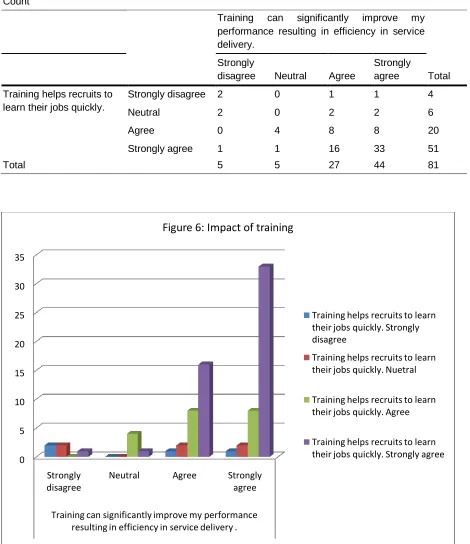
Training helps recruits to learn their jobs more quickly;
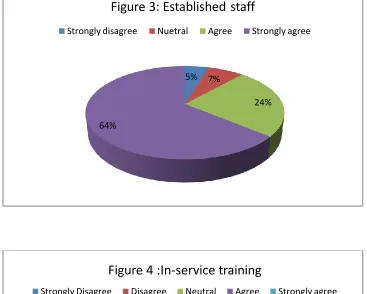
Established staff need training to keep up to date in a changing world, and at times to improve their performance;
Licensed under Creative Common Page 8
Training can help to minimise labour turnover in times when labour is scarce and ‘poaching’ rife;
An organisation with a reputation for good training attracts recruits;
Regular training in safe working practices reduces accidents, which are costly in both financial and morale terms.
Training can significantly stimulate the creation of a versatile workforce, that is, one in which workers can efficiently carry any of several jobs, and hence provide flexible resources.
Training strategies
Goldstein (1980:44) noted that there are almost as many different ‘systems’ approaches to training as there are authors on the subject. Systems approach to training views the organisation as a complex set of sub- systems, and expect changes in one sub-system to yield potential needs in another. It is therefore, organisational- but it can produce individual or group plans aimed at long- or short-term objectives. A systems approach can identify whether learning transfers easily between off-the-job training events and the work place; redefining trainer roles. It can be seen however that this approach cannot normally replace others: it will seek to refine and improve those others by continually reviewing them.’
Systematic approach to training
Reid et al (1992) state that in order to achieve better results in training the systems approach to training should be adopted. The basic assumptions of this approach are that training must consist of an orderly, planned sequence of events in order to be effective. The first phase of the training process is an assessment of training needs and the development of training objectives. The second phase consists of the training- development phase and the third phase is the evaluation phase. A task analysis is conducted through compilation of a job description in behavioural terms.
Licensed under Creative Common Page 9 necessary to perform the job; and employee orientation refers to specific temperaments or attitudes needed for the job.
Effectiveness of training
Training can be a useful tool in helping to resolve significant organisational or management‘s problems. Management often recognise that training in technical skills derives real benefits. If it could be proved that training in for example, inter-personal skills or problem solving skills results in efficient service delivery, it is these researcher’s opinions that organisations would be eager to invest to improve human capital. These researchers are of the opinion that training will not automatically provide the answer to all organisations or management problems, to be effective; it must be part of an appropriate solution to specific kinds of problems and that training must be resorted to only after other options such as counselling, motivation etc. have been tried.
Evaluating effectiveness of training
Upon checking the effectiveness of training, Kennedy et al (1992:11) stated that the training program is reviewed during and after its completion by the training officer, the line manager, and if necessary, by the trainees themselves. Evaluation differs from validation in that it attempts to measure the overall cost benefit of the training program and not just the achievement of its laid objectives. Robbins, (1999) advocates that until control measures are taken to correct any deficiencies after the training, evaluation has not been completed and thereby ineffective, evaluation is an integral feature of training, but it could be difficult because it is often hard to set measurable objectives.
The question which arises is to how the effectiveness of training can be evaluated? Ultimately the only criteria that make sense are those which are related to on-the-job behaviour change. The real driving force for training must be whether the training makes an individual or group of people more productive, efficient, or useful to an organisation? This may be common sense, especially if the training is linked to operational or business performance.
Licensed under Creative Common Page 10
RESEARCH METHODOLOGY The research design
The research design that was used was that of a case study. According to Ziel et al (2000:44) research design is the overall or broad approach incorporating the type of research being utilised. In survey designs as was used in this research, people are asked on questionnaires and interviews how they feel about or perceive issues, their attitudes and views, what complaints they have, what they are satisfied with and so on. This type of research which utilises qualitative and quantitative methods is the triangulation. Qualitative research uses subjective methods, with the interpretation consisting of subjective opinions and descriptions. Quantitative research uses ‘hard’ objective measurements such as standardised tests and ratings to gather data, with statistical procedures and norms to find and interpret findings. For research findings to be accepted as valid the researcher must do sampling to obtain a representative sample of cases or measurements that form the population. Bryman and Bell (2003:53) defined a case study as‘an in-depth investigation of an issue at a specific instance and location.’ They further argued that a case study research is concerned with the complexity and particular nature of the case in question.
Coolican (1994:4) defined a research design as a method for gathering empirical data with which to test a hypothesis or develop a theory. In this instance, the focus of the analysis is the Registrar General department’s two provinces: Bulawayo Metropolitan and Matebeleland North. Bryman and Bell (2003:53) defined a case study design as the detailed and intensive analysis of a single case. They concurred with other authors that case studies gather a great deal of qualitative and quantitative data to illuminate a particular perhaps unique, condition or set of experiences.
The research sought to establish whether training and development did indeed impact on organisation performance. It is important to note that to note that the research was done at the backdrop of the fact that the Public Service had scaled its course offering to government organisations; hence these organisations were carrying out their own internal training albeit without qualified trainers.
Population and Sample
The period before 2005 when the Public Service training centre was actively involved in training there were less public complaints. The researchers tallied research questions to the questionnaire extracts to make sure that the research objectives are all met.
Licensed under Creative Common Page 11 well as the eight District Registrars for Matabeleland North and Bulawayo Metropolitan were interviewed. Ten questionnaires were distributed per district and leaving twenty questionnaires which were administered on the employees of the two provinces since they are housed in the same building. The lottery method was an ideal method used for the sample to be representative. The main method used was the stratified random sampling technique.
Data collection procedures
The questionnaire was administered on employees of various grades whilst the interview was reserved for management. The questionnaires for employees for the seven districts were given to the District registrars when they attended their monthly meeting and those that were successfully completed were received a week later.
For Bulawayo district it was possible to collect the questionnaires on the same day. Some of the questionnaires administered at the province were not returned as the respondents could not spare time to go through it due to pressure of work. The overall distribution according to designation was as follows: the two human resources officers received; forty senior processing officers; thirty processing officers; twenty assistant processing officers and eight general hands. A total of one hundred employees received the questionnaire. However due to the distance and time constraints it was not possible to return to the districts to collect the remaining samples, as a result eighty responses were received which was a fairly representative sample.
Newspaper cuttings of public complaints on poor service delivery were analysed at the department’s policy and planning section in Harare. The suggestion box contents were read one by one and those complaints with bearing on the performance of staff were noted.
Data presentation and analysis plan
Licensed under Creative Common Page 12
ANALYSIS & FINDINGS Age of respondents
The study needed to ascertain the age distribution of respondents to help categorise employees in terms of age. It was interesting to analyse views with reference to training from different age groups. The 36-45 age groups constituted 34.5% of the respondents. The 46-55 age groups had 10.3% representation and the rest of the age group 18-25 and 26-35 had 14.9% and 55.2% respectively. Below is graphical presentation of the age of respondents.
Item-wise analysis
Item nine: After joining an organisation is it important to undergo orientation and induction?
17%
45% 38%
FIGURE 1 age of respondents
18-25 years 26-35 years 36-45 years
Strongly disagree
6%
Disagree 2% Neutral2%
Agree 90%
Licensed under Creative Common Page 13
Item ten: Training helps recruits to learn their jobs quickly.
Hypothesis testing
A hypothesis test was conducted and this became possible with the use of an SPSS programme. The hypothesis formulated in chapter one was used to test the association between views management views that training and development improves organisational performance and the existence of a training development policy.
5% 7%
24%
64%
Figure 3: Established staff
Strongly disagree Nuetral Agree Strongly agree
9%
7%
42% 24%
18%
Figure 4 :In-service training
Licensed under Creative Common Page 14
Null hypothesis
There is no association between the management views that training and development improves organisational performance and the existence of a training and development policy in the organisation.
Cross tabulation
DO Bulawayo Metropolitan and Matabeleland Provinces have a training and development policy which is aligned to the strategic plan* Training and development improves motivation and individual performance and organisational performance.
Table 1 Training and Development policy to strategy Count Training & development improves motivation,
individual and organisation performance.
Total
Does Bulawayo Metro. and Matebeleland
North provinces have a training and development policy aligned to the strategic plan?
Yes No
Yes 2 4
No 11 3
6
14
Total 13 7 20
Table 2 Conclusion on managers’ responses: Chi-square test
Value df Asymp.sig
(2-sided)
Exact (2-sided)
Exact (1-sided)
Pearson’s chi-square 3.778 1 .052 -
Conclusion on managers’ responses
International Journal of Economics, Commerce and Management, United Kingdom
Licensed under Creative Common Page 15
0 2 4 6 8 10 12 14 16 Strongly Agree
Disagree Neutral Agree Strongly
Agree
My organisation has not been offering frequent in-service training at least once in six months since 2005.
Figure 5: Training before 2005
The period before 2005 when the Elangeni Public Service training centre was active involved in staff training, public complaints were fewer. Strongly Disagree
The period before 2005 when the Elangeni Public Service training centre was active involved in staff training, public complaints were fewer. Disagree
The period before 2005 when the Elangeni Public Service training centre was active involved in staff training, public complaints were fewer. Neutral
The period before 2005 when the Elangeni Public Service training centre was active involved in staff training, public complaints were fewer. Agree
The period before 2005 when the Elangeni Public Service training centre was active involved in staff training, public complaints were fewer. Strongly agree
Table 3: Cross tabulation 1
Count Training has no impact on my performance
Total Strongly
disagree Disagree Neutral Agree
Strongly Agree Feedback of performance
is not made available frequently to allow for change in behaviour .
Strongly
disagree 1 0 1 2 1 5
Disagree 4 3 0 0 0 7
Neutral 6 4 2 1 1 14
Agree 11 11 4 4 0 30
Strongly agree 16 4 0 0 7 27
Licensed under Creative Common Page 16
0 5 10 15 20 25 30 35
Strongly disagree
Neutral Agree Strongly
agree
Training can significantly improve my performance resulting in efficiency in service delivery .
Figure 6: Impact of training
Training helps recruits to learn their jobs quickly. Strongly disagree
Training helps recruits to learn their jobs quickly. Nuetral
Training helps recruits to learn their jobs quickly. Agree
Training helps recruits to learn their jobs quickly. Strongly agree
Table 4: Cross tabulation 2 Count
Training can significantly improve my performance resulting in efficiency in service delivery.
Total Strongly
disagree Neutral Agree
Strongly agree Training helps recruits to
learn their jobs quickly.
Strongly disagree 2 0 1 1 4
Neutral 2 0 2 2 6
Agree 0 4 8 8 20
Strongly agree 1 1 16 33 51
Licensed under Creative Common Page 17
SUMMARY OF FINDINGS
The study attempted to establish a relationship between training and development and individual performance by postulating the hypothesis that training and development activities at Bulawayo Metropolitan and Matabeleland North Provinces have largely failed to positively impact on worker performance and productivity. This relationship was examined in terms of training contribution to respondents’ ....
a) Motivation
b) Opportunity to identify potentials for performance c) performance and
d) Attainment of higher skills for performance.
The findings were that many respondents did not feel motivated by the training offered by the organisation and indeed many have never even participated in job related training and development activities. It was also established that the respondents do not feel that training offered the organisation has provided them with required knowledge, skills and attitudes. Indeed results revealed that training had not impacted on job skills of the majority of respondents. All the facts go to support the hypothesis that training and development activities at Bulawayo Metropolitan and Matabeleland North Provinces have largely failed to positively impact on individual performance on their jobs.
The department has a staff development programme whereby employees can apply and receive authority to go and study at institutions of their choice provided
For the department job related courses are: customer care; record keeping; computer operation and stress management, however the interview with management revealed that only customer care has been made available to employees.
The organisation is not scheduling training to take place frequently hence it is not enjoying the benefits of continuous training.
The employees were aware that training could significantly improve their performance unfortunately the organisation tended to provide training to introduce new regulations or to introduce new performance management systems.
The Civil Service training centres do not carry out training for employees as frequently as they used to prior to the economic meltdown , hence there is a training gap.
Licensed under Creative Common Page 18
Feedback on performance is only given at the end of the year when the final appraisal is conducted, thus the erring employee is permitted to operate poorly throughout the year only to be penalised at the end. According to Reid et al (1992), an organisation’ success depends upon its people. If the organisation is to become successful, employee learning must be stimulated and managed not specifically and separately, but constantly- in relation to work activities.
RECOMMENDATIONS
As a result of the research findings given above the following recommendations are made to the organisation:
That the organisation should be committed to the continuous development of employees and spend considerable time in identifying training and development needs;
Introduce way in which operational aims and objectives are communicated to all employees;
Put employees through sponsored training and development programs through establishing ‘ who carries responsibility for what’ in the identification of learning activity;
Give employees challenging, interesting and skills stretching assignments and introduce constant job rotation to curtail monotony.
Motivate the employees by encouraging learning through rewarding those who upgrade themselves and that the organisation should commit itself to acknowledge improved performance.
The whole organisation should consider re-engineering the training function so that a radical redesign of the operations is dramatically improved through allocating duties according to knowledge, skills and abilities. This will have the consequence that the training function will focus on how the future should be and offer relevant constant training;
Give employees the opportunity to practise new knowledge and skills gained through decision making;
FURTHER STUDIES
Licensed under Creative Common Page 19
REFERENCES
Allan, K. (2006) a critical reflection on local government performance: A learning journal for Public Manages, 5(2): 34-35
Baley, J. (2008) the training Instruction ASTD handbook for workplace learning professionals 235-250 Barder, J. C Bloom, A.E. (1995) making your training results last: a practical guide to successful training follow- through, London: Kogan 350-352
Daft, J. (2005) Managing change. Boston: McGraw-Hill 74-75
Erasmus, B.J. &Van Dyk,P.S. (1996). Training management: a practical approach. Johannesburg: International Thomson
Durden, C. (2007) towards a socially responsible Management control system, Accounting, Auditing and Accountability journal 21(5) 671-694
Evans, J.R& Lindsay, W.M. (2008) The management and control of quality 215-216 Experiential learning activities, vol. 21. 1994 San Diego: Pheiffer. (Training Technologies)
Hackman, Oldham, J.R.(1975) Development of the job diagnostic survey . journal of Applied Psychology 60. 159-170
Kelly, L, 1995.The ASTD Technical and skill training handbook.Newyork :Mcgraw-Hill.
Nadler, L. Designing training Porgrammes: the critical events model. 5thedition , Reading, Mass: Addison- Wesley.
Nel, P.S, Gerber, P.D., Van Dyk, P.S. (2001) Human Resource Management. Capetown Oliver, C. (1998) How to train outcomes-based. Pretoria: Van Schalk. 124-126