INTRODUCTION
The oil industry is characterized by an inten-sive impact on the environment, which inevitably causes its change. In the process of production, the existing environmental condition in the areas of industrial facilities is completely or partially violated. These changes are manifested in vari-ous combinations of negative phenomena, the most important of which are: the removal of for-est land for the placement of objects; depletion and pollution of groundwater and surface water; flooding and waterlogging of worked areas; de-hydration and salinization of soils; pollution by harmful substances and chemical elements of at-mospheric air; hydrogeological and geochemical changes unfavorable for local ecological systems [Timofeeva S.S. 2018].
Oil and oil products as pollutants of sub-soil and environment are evaluated mainly by
the degree of toxicity and geochemical stability. When these petroleum products get into the soil, they downward under the influence of gravita-tional forces and spread in breadth under the ac-tion of surface and capillary forces. The speed of oil movement depends on its properties, soil properties and the ratio of oil, air and water in a multiphase moving system. Oil entering the soil, causing significant and sometimes irrevers-ible changes: the formation of bituminous and sa-line, hydronization, cementation, etc. [Ryazanov. 2015, Golubev and Soromotin. 2010]
In the process of drilling oil wells there is con-sistent destruction of rocks, mainly drilling tools, followed by removal of the products of destruc-tion with drilling agent. However, the removal of drilled rock (drill cuttings) is not the only purpose of drilling agent. In this connection, dif-ferent solutions are used, difdif-ferent composition, properties and scope.
Accepted: 2019.05.31 Available online: 2019.06.20
Volume 20, Issue 7, July 2019, pages 26–30 https://doi.org/10.12911/22998993/109764
The Environmental Impact of Drilling Sludge
and Ways of Their Utilization
Elena Gaevaya
1, Svetlana Tarasova
1*, Anastasia Bytsko
11 Federal State Budget Educational Institution of Higher Education «Industrial University of Tyumen»,
Volodarskogo 38, 652000 Tyumen, Russia
* Corresponding author’s e-mail: [email protected]
ABSTRACT
Drilling sludge formed in the process of drilling wells using a drilling agent on a hydrocarbon basis looks like soft pasty mass of black color, with a distinct smell of petroleum products. Oil-based drill sludge has a high oil and chloride ions content, identified excessive concentrations of chromium 2.67 times. According to the degree of accumulation of heavy metals, that were distributed in the following order: manganese (Mn) > zinc (Zn) > copper (Cu) > chromium (Cr) > lead (Pb) > cobalt (Co) > arsenic (As) > mercury (Hg) > cadmium (Cd). The results of the particle size distribution indicate a significant proportion of physical clay, which peaks for the silt fraction –
63.60 %. During the study of the waste drilling agent was found that it includes oil products which reached level
of 9000 mg/kg, while the hydrogen index refers to a neutral medium – 6.5 pH. The evaluation of the toxic effect of drilling waste according to the test-results has an acute toxic effect on the environment (hazard class IV). The significance of the research indicates the relevance of environmental assessment of drilling waste for the optimal
choice of their subsequent disposal.
Currently, the practice of drilling with hy-drocarbon-based solutions is increasing, used in drilling wells with complex profiles, provid-ing stabilization of unstable, swellprovid-ing or ex-panding rocks in the water environment, low accident rate during drilling.
The main technical construction of the accu-mulation of these types of waste is a slurry barn. A sludge barn is a construction as a part of a well pad intended for centralized collection of oil well drilling waste (drilling mud, waste drilling agent and drilling waste water) in order to prevent the ingress of harmful substances into the envi-ronment. Sludge barns occupy an area of up to 2500 m2 with one drilling rig and have a different
volume depending on the number of wells on the bush, depth and duration of drilling [Gaevaya et al. 2017a, Skipin et al. 2014].
The main types of impact on the objects of the environment during the accumulation and place-ment of drilling cuttings in slurry barns are: direct impact associated with the «alienation» of land; penetration of the liquid phase of drilling waste into the soil, with poor waterproofing of slurry barns or the flow of the liquid phase of drilling through the top of the embankment; change in re-lief and violation of the component structure of landscapes associated with the padding of slurry barns; violation of the micro relief, surface run-off; deformation of the soil and vegetation cover; destruction of the vegetation cover; groundwater pollution; changes in the existing hydrological conditions due to drainage [Skipin et al. 2015].
To date, one of the methods of disposal of drill slurries on a hydrocarbon basis is neutraliza-tion with the use of installaneutraliza-tions such as UZG-1M or their analogues. This method consists of the thermal disposal of sludge at a temperature of 800–900 ˚C to obtain secondary products. The neutralizing effect while drilling slurries utiliza-tion is reached due to oil products evaporautiliza-tion (burning out); vapour of oil products burns and nonflammable inert materials (components) in the form of sand, soil are released. Sand, neutral-ized soil as building material is used in reclama-tion and construcreclama-tion works.
The disadvantages of this method are: ad-ditional removal of the territory for placing the plant for neutralization; air pollution with exhaust gases; additional introduction of clean soil into the drilling wastes in order to ensure its greater den-sity and improve the operation of the installation.
This article presents the analysis of drilling waste – liquid phase (waste drilling agent) and solid phase (drilling mud), which are the prod-ucts of transformation of mining with the use of hydrocarbon-based drilling agent [Tarasova et al. 2017]. Liquid waste is a colloidal system based on hydrocarbons where solid particles of drilled rock and other organic compounds that are part of drilling fluids are suspended. Drilling sludge formed in the process of drilling wells, using hydrocarbon-based drilling fluid, is soft pasty mass of black color, with a distinct smell of pe-troleum products [Tarasova et al. 2018]. Drilling cuttings have negative water-physical properties: complete structureless, low aeration, weak filtra-tion capacity, etc. [Gaevaya et al. 2017b, Skipin et al. 2016a]. This direction in the field of waste management of drilling on a hydrocarbon basis is poorly studied, and therefore the question arises about the choice of methods for handling these types of waste.
In this regard, the purpose of the research was the environmental assessment of drilling waste on a hydrocarbon basis for the development of na-ture-saving technology aimed at minimizing the negative effects on the environment.
MATERIAL AND METHODS
In the course of the study, tests were carried out on the basis of the laboratory of the Depart-ment of Technosphere safety of the Industrial University of Tyumen, an accredited testing labo-ratory, in accordance with the methods included in the state register of quantitative chemical anal-ysis techniques.
To determine the compliance of drill cuttings samples to the soil variety the laboratory tests were carried out using a laser particle analyzer «Analysette 222» Micro Tec Plus.
The concentration of heavy metals in the samples of drilling mud and spent drilling mud was determined by the following methods: atomic absorption spectrophotometry, inversion voltam-metry, flame atomic absorption spectrometry [Federal environmental regulatory documents 31–11/05. 2005, Federal environmental regu-latory documents F 16.1:2.2:2.3.36–02. 2002, Federal environmental regulatory documents 16.1:2.3:3.10–98. 1998].
acute toxic effects on biological test objects Daph-nia magma Straus and Chlorella vulgaris Beijer [Federal environmental regulatory documents 14.1:2:4.12–06. 2006, Federal environmental regulatory documents 14.1:2:3:4.10–04. 2004].
RESULTS
According to the obtained particle size distri-bution of drill slurries, is presented in Figure 1, there was a prevalence of fine dust and silt frac-tion, which allowed to identify the slurry to the gradation of the clay heavy [National Standard 25100. 2011].
A significant proportion of physical clay ac-counts for the silt fraction – 63.60%, a high con-tent of silt fraction (particle diameter less than 0.001 mm) are typical for the alluvial horizon. The agent content of the mud fraction in the drill cuttings is due to the drilled rock and the hydro-carbon-based drilling agent used.
In the composition of the drill cuttings oil-based notes increased chromium content of 2.67 times in compare with maximum concentra-tion limit (roughly allowable concentraconcentra-tion) for soil clay groups. It is well-known that chemical contamination of soils with heavy metals is the most dangerous type of degradation of soil cover, since the self-cleaning ability of soils from heavy metals is minimal, soils accumulate them firmly [State regulatory 2.1.7.2511.2009, Public health regulations 42–128–4433–87. 1988]. Thus, the soil becomes one of the most important geo-chemical barriers for the majority of toxicants on the way of their migration from the atmosphere to the ground and surface waters. In this aspect, chromium is the brightest representative of this
group of chemical elements, the migration char-acteristics of which, the ability to bioaccumulate and biomagnify are not only the basis of the char-acteristics of the xenobiotic profile of biogeoce-nosis, but, also, determine the picture of chronic (delayed) and acute toxic effects.
The cadmium content was at the level of the established maximum permissible concentration (MPC) and corresponded to 5 mg/kg. The maxi-mum value was observed for manganese and amounted to 332 mg/kg, which did not exceed the maximum permissible concentrations for this element. The content of other heavy metals was below the established standards. By the degree of accumulation of heavy metals in descending order were distributed in the following sequence: manganese (Mn) > zinc (Zn) > copper (Cu) > chromium (Cr) > lead (Pb) > cobalt (Co) > arsenic (As) > mercury (Hg) > cadmium (Cd) (Table 1).
In the study of the effect of drilling fluids on hydrocarbon-based components of the natural environment, chemical and analytical tests were carried out to characterize the possible negative impact on the environment. The content of gross forms of the heavy metals in the sample of drill-ing mud is presented in Table 2.
The concentration of the heavy metals in most variants was below the limit of detection of existing techniques. Arsenic average values were 1.9 mg/kg, chromium – 22 mg/kg and zinc – 35 mg/kg. There is no regulatory document for the definition of MAC of this type of drilling waste and, therefore, it is not possible to assess the level of pollution with heavy metals.
In determining the chemistry of salinity drill-ing waste by anionic composition – are chloride salinity. The content of oil products in drilling sludge and drilling mud are 1800 and 9000 mg/kg,
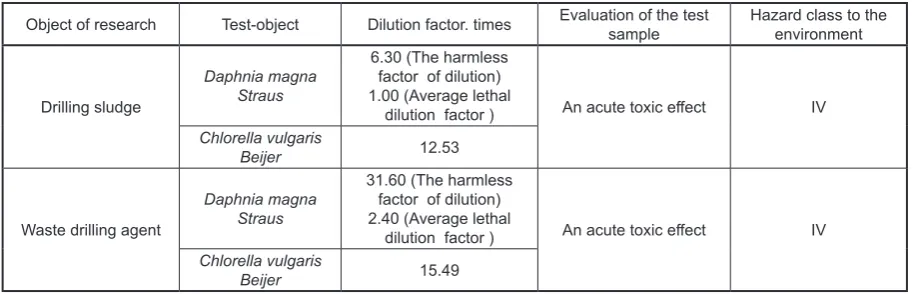
respectively. The pH value refers to the neutral environment and amounted to 7.31 pH units, of 6.5 pH units, respectively (Table 3). The degree of toxic effects of drilling waste on the compo-nents of the environment, due to the high content of petroleum products and salts (Table 4).
CONCLUSIONS
At present, the issue of development of non-waste and low-non-waste, environmentally-friend-ly technologies for disposal of drilling waste
(drilling sludge) based on physical and chemical methods by introducing natural mineral com-ponents (sorbents) with a high sorption capac-ity in relation to petroleum products and heavy metals is acute.
The results of studies of drilling waste on a hydrocarbon basis indicate an increased content of petroleum products and chloride ions, belong to the IV class of danger and have an acute toxic effect on the environment. The significance of these studies shows the relevance of environ-mental assessment of drilling waste for the opti-mal choice of their subsequent disposal.
Table 1. Content of gross forms of heavy
metals in drill cuttings samples
Indicator Unit Test results, mg/kg
Maximum permissible concentration,
mg/kg
Cadmium mg/kg <0.10 2.00
Cobalt mg/kg <5.00 5.00
Manganese mg/kg 332.00 1500.00
Copper mg/kg 23.00 132.00
Arsenic mg/kg 2.87 10.00
Nickel mg/kg <50.00 80.00
Mercury mg/kg 0.24 2.10
Lead mg/kg <10.00 130.00
Chromium mg/kg 16.00 6.00
Zinc mg/kg 29.00 220.00
Table 2. The content of gross forms of heavy
metals in the sample of drilling fluid
Indicator Unit Test-results. mg/kg
Cadmium mg/kg <0.1
Cobalt mg/kg <5.0
Manganese mg/kg <200
Copper mg/kg <20
Arsenic mg/kg 1.90
Nickel mg/kg <50
Mercury mg/kg <0.10
Lead mg/kg <10
Chromium mg/kg 22
Zinc mg/kg 35
Table 3. Chemical analysis of drilling wastes
Indicator Unit Object of research
Drilling sludge Drilling mud
Petroleum products mg/kg 1800 9000
Sulfate-ion (water-soluble form of anions) mg/kg 140 25
Phosphate-ion (water-soluble form of anions) mg/kg <3.0 4.10
Chloride-ion (water-soluble form of anions) mg/kg 4049 1734
Hydrogen index unit of рН 7.31 6.5
Table 4. Evaluation of the toxic effect of samples of drill sludge and drilling mud spent on test-objects
Object of research Test-object Dilution factor. times Evaluation of the test sample Hazard class to the environment
Drilling sludge
Daphnia magna Straus
6.30 (The harmless factor of dilution) 1.00 (Average lethal
dilution factor ) An acute toxic effect IV
Chlorella vulgaris
Beijer 12.53
Waste drilling agent
Daphnia magna Straus
31.60 (The harmless factor of dilution) 2.40 (Average lethal
dilution factor ) An acute toxic effect IV
Chlorella vulgaris
REFERENCES
1. Federal environmental regulatory documents
16.1:2.2:2.3.36–02. Quantitative chemical analysis of soils. Methods of measuring the gross content of copper, cadmium, zinc, lead, nickel and manganese
in soils, bottom sediments and sewage sludge was
conducted by the method of flame atomic absorp -tion spectrometry. 2002.
2. Federal environmental regulatory documents
16.1:2.3:3.10–98. Quantitative chemical analysis of soils. Method of measurement of mercury con -tent in solid objects was made by atomic absorption
spectrophotometry (“cold steam”method). 1998.
3. Federal environmental regulatory documents
14.1:2:4.12–06. Toxicological control methods. Methods of toxicity determination of drinking,
fresh natural and waste water, water extracts from soil, drill sludge and waste mortality Daphnia
(Daphnia magma Straus). 2006.
4. Federal environmental regulatory documents
14.1:2:3:4.10–04. Toxicological control methods]. Method of measuring the optical density of Chlo
-rella algae (Chlo-rella vulgaris Beijer) was con
-ducted to determine the toxicity of drinking water,
fresh natural and wastewater, water extracts from soils, soils, sewage sludge, waste production and consumption. 2004.
5. Fedorov O.V., Dikunets V.N., Zhegalin L.P. 2010. Reclamation – an incentive for self-cleaning (oil production). Technical supervision, 10.
6. Gaevaya E.V., Bogaychuk Y.E., Tarasova S.S., Skipin L N., Zakharova E.V. 2017a. Utilization
of drilling cuttings with extraction of ground for
reclamation of disturbed soils. IOP Conf.: Series. Earth and Environmental Science, 87, 042003. 7. Gaevaya E.V., Bogaychuk Y.E., Tarasova S.S.,
Skipin L.N., Zakharova E.V. 2017b. IOP Conf. Se
-ries: Earth and Environmental Science, 87, 042004.
8. Golubev E.V., Soromotin A.V. 2010. Composition
and properties of drilling waste of Western Siberia.
World of Science, Culture, Education, 6–2, 319–320.
9. Guidelines 31–11/05 quantitative chemical analy -sis of soil samples, greenhouse soils, silt, bottom
sediments, sapropels, solid waste. Method of mea -surement of mass concentrations of zinc, cadmium, lead, copper, manganese, arsenic, mercury was conducted by inversion voltammetry was on
ana-lyzers of TA TYPE. 2005.
10. Kryuchkov V.N. 2012. Assessment of the impact of drilling wastes on hydrobionts. Bulletin of As
-trakhan State University, 1, 61–65.
11. National Standard 25100. Soils. Classification.
2018.
12. Public health regulations 42–128–4433–87. Sani -tary norms of permissible concentrations of chemi-cals in the soil. 1988.
13. Ryazanov A.Y. 2015. Encyclopedia of drilling flu
-ids. Chronicle, Orenburg.
14. Skipin L.N., Galyamov A.A., Gaevaya E.V., Zakha
-rova E.V. 2014. Technogenic impact of slurry barns on the environment of the Yamal Peninsula. Bul
-letin of Krasnoyarsk state agrarian University, 11 (98), 146–150.
15. Skipin L.N., Petukhova V.S., Eremin D.I. 2016a. Influence of meliorants on the granulometric com
-position of the bore mud. Collected reports of the XVIII International Scientific and Practical Conference: in 3 volumes, 154–160.
16. Skipin L., Petukhova V., Gaevaya E., Zakharova E., Mitrikovskiy A. 2016b. Comparative effect of different coagulants on physical properties of drill cuttings.Solid State Phenomena. Т. 871, 233–241. 17. Skipin L.N., Skipin D.L., Petukhova V.S., Kusty
-sheva I.N. 2015. Effectiveness of the influence of
coagulants on physical properties of bore muds.
Bulletin of Kemerovo State University, 4–3 (64)), 88–92.
18. State regulatory 2.1.7.2511. Approximate permis
-sible concentrations (APC) of chemicals in the soil.
2009.
19. Tarasova S.S., Bytsko A.A., Druz J.P. 2018. Char -acterization of drilling mud on hydrocarbon
ba-sis and its influence on the properties of cuttings.
Energy Saving and innovative technologies in the fuel-energy complex: proceedings of the National
with international participation scientific and prac -tical conference of students, postgraduates, young scientists and experts dedicated to the 10th anni-versary of the establishment of the Institute of
in-dustrial technologies and engineering, 326–329.
20. Tarasova S.S., Gaevaya E.V., Bogaichuk Ya.E., Turnaeva A.E. 2017. Change of water-physical
properties of drilling mud in the process of its
uti-lization in man-made soil. Problems of river basin
management in the development of Siberia and the Arctic in the context of global climate change in
the XXI century: Collection of reports of the XIX International scientific and practical conference, 3, 270–274.
21. Timofeeva S.S. 2018. Technosphere safety of the
Baikal region: the current state and problems. XXI century. Technosphere safety, vol. 3, № 4 (12), 75–90.
22. The order on approval of Federal classificatory