Latin Square Trial Plan Applications on
Observation Values Having Various
Mathematical Features
Senol CelikDepartment of Animal Science, Biometrics and Genetic, Faculty of Agriculture Bingol University Bingol, Turkey
Abstract—In this study, the various features of Latin squares were investigated through the data consisting of the values concerning arithmetic sequence, geometric sequence, Fibonacci sequence and Catalan numbers, and statistical analysis was made through a numerical example. The F test of Latin square trial was made. The group effects of data found ranging as arithmetic sequence, as a result of the test, cannot be calculated according to the analysis of variance. The row and column effects of the data were found undefined. In this case, the Latin square trial is not appropriate for the data having arithmetic sequence feature. The variance analysis can be applied to arithmetic sequence, geometric sequence, and Catalan numbers, for Latin square trial.
Keywords—Latin square; arithmetic sequence; geometric sequence; Catalan numbers; Fibonacci sequence
I. INTRODUCTION (Heading 1)
The number of row, column and group to be equal requires in Latin square trial plan. It’s not preferred when the number of treatment is less than 12 {1}. When one or more observations are missing, the missing observations are estimated with appropriate methods.
In Latin square trials, in compliance to the Galois Theory, standard Latin square plans equal to the number of treatment are created. If the number of treatment is t, a total of t!(t-1)!different plans are created from these standard Latin squares and one of them are picked randomly {1}.
A Latin square design is a method of placing treatments so that they appear in a balanced fashion within a square block or field. Treatments appear once in each row and column. Treatments are assigned at random within rows and columns, with each treatment once per row and once per column. There are equal numbers of rows, columns, and treatments {2}. There are studies conducted in different areas related to Latin square trial. But, failure to find any Latin square plan -related study done on the data having mathematical feature, in consequence of the literature review, increases the importance of this study.
The aim of this study is to apply Latin square trial on the data consisting of the values concerning arithmetic sequence, geometric sequence, Fibonacci sequence, Catalan numbers and logarithmic function.
II. MATERIAL AND METHOD
Latin square is a design in which the number of rows (r), the number of columns (c) and the number of applications (a) are equal. In every cell of each row and column, there is only one trial unit {3}. Since r=c=a, the number of observations is r2 {4}.
If the homogeneity of the trial material has been broken by two factors, it is divided into blocks as row and column according to the two factors that broke the homogeneity. The trial error is reduced by creating homogeneity. In this case, Latin Square Trial Plan is applied {5} . Latin square trial plan has been developed by Fisher in 1925 in order to keep two factors under control while researching the effect of the third factor such as application {6}.
The arithmetic sequence, geometric sequence, logarithmic function, Fibonacci numbers and Catalan numbers used in the study are defined.
A. Arithmetic series
An arithmetic series is the sum of a sequence {𝑎𝑘},
k=1, 2, ..., in which each term is computed from the previous one by adding (or subtracting) a constant d. Therefore, for k>1,
𝑎
𝑘= 𝑎
𝑘−1+ 𝑑 = 𝑎
𝑘−2+ 2𝑑
= ⋯ = 𝑎
1+ 𝑑(𝑘 − 1)
The sum of the sequence of the first n terms is then given by Sn{7, 8}.
𝑆𝑛= ∑ 𝑎𝑘 𝑛
𝑘=1
= ∑[𝑎1+ (𝑘 − 1)𝑑] 𝑛
Vol. 3 Issue 10, October - 2017
= 𝑛𝑎1+ 𝑑 ∑(𝑘 − 1) 𝑛
𝑘=1
= 𝑛𝑎1+ 𝑑 ∑(𝑘 − 1) 𝑛
𝑘=2
= 𝑛𝑎
1+ 𝑑 ∑ 𝑘
𝑛−1
𝑘=1
B. Geometric series
A geometric series ∑ 𝑎𝑘 𝑘 is a series for which the
ratio of each two consecutive terms 𝑎𝑘+1/𝑎𝑘 is a
constant function of the summation index k. The more general case of the ratio a rational function of the summation index k produces a series called a hypergeometric series.
For the simplest case of the ratio 𝑎𝑘+1
𝑎𝑘 = 𝑟 equal to a constant r, the terms 𝑎𝑘 are of the form 𝑎𝑘= 𝑎0𝑟𝑘.
Letting 𝑎0= 1, the geometric sequence {𝑎𝑘𝑘 =}𝑘=0𝑛
with constant |𝑟| < 1 is given by
𝑆𝑛= ∑ 𝑎𝑘= ∑ 𝑟𝑘 𝑛
𝑘=0 𝑛
𝑘=0
is given by Sn{9, 10}.
𝑆𝑛= ∑ 𝑟𝑘= 1 + 𝑟 + 𝑟2+ ⋯ + 𝑟𝑛 𝑛
𝑘=0
C. Fibonacci numbers
The Fibonacci numbers are the sequence of numbers {𝐹𝑛}𝑛=1∞ defined by the linear recurrence
equation
𝐹𝑛= 𝐹𝑛−1+ 𝐹𝑛−2 (1)
with 𝐹0= 𝐹1= 1. As a result of the definition (1), it is conventional to define 𝐹0= 0 .
The Fibonacci sequence is therefore 1, 1, 2, 3, 5, 8, 13, 21, 34, 55, 89, 144, ... {11}.
D. Catalan numbers
The Catalan numbers on nonnegative integers n are a set of numbers that arise in tree enumeration problems of the type, "In how many ways can a regular gon be divided into n-2 triangles if different orientations are counted separately?" The solution is the Catalan number Cn-2 {12, 13}. Catalan numbers are commonly denoted Cn{14, 15, 16}.
The first few Catalan numbers for n=1, 2, ... are 1, 2, 5, 14, 42, 132, 429, 1430, 4862, 16796, ...
Explicit formulas for Cn include
𝐶𝑛= 1 𝑛 + 1(
2𝑛 𝑛)
The mathematical model which is used the statistical analysis of the Latin square trials as in Equation 2.
𝑦𝑖𝑗𝑘= 𝜇 + 𝛼𝑖+ 𝛽𝑗+ 𝛾𝑘+ 𝜀𝑖𝑗𝑘, i, j, k=1, 2, ..., r (2)
Here,
𝑦𝑖𝑗𝑘: the observation value of row j, column k, trial i, 𝜇: general mean,
𝛼𝑖: the effect of trial i, 𝛽𝑗: the effect of row j, 𝛾𝑘: the effect of column k,
𝜀𝑖𝑗𝑘: random error terms {17}. In model (2), the statistical significance of the effects of trial, row and column are tested. For every situation, the hypotheses are stated below respectively.
01
:
1 2...
r0
H
02
:
1 2...
r0
H
03
:
1 2...
r0
H
The hypotheses are tested using the test statistics obtained by decomposing as grand sum of squares, trial sum of squares, row sum of squares, column sum of squares and error sum of squares. Grand sum of squares are stated as
𝑆𝑆𝑇 = ∑ ∑ ∑(𝑦𝑖𝑗𝑘− 𝑦̅…) 2 𝑟
𝑘=1 𝑟
𝑗=1 𝑟
𝑖=1
Trial sum of squares, row sum of squares, column sum of squares and error sum of squares are as follows.
𝑆𝑆𝑇𝑡𝑟𝑖𝑎𝑙= 𝑟 ∑(𝑦̅…− 𝑦̅…)2 𝑟
𝑖=1
𝑆𝑆𝑅 = 𝑟 ∑(𝑦̅𝑖..− 𝑦̅…)2 𝑟
𝑖=1
𝑆𝑆𝐶 = 𝑟 ∑(𝑦̅.𝑗− 𝑦̅…)2 𝑟
𝑖=1
𝑆𝑆𝐸 = 𝑟 ∑ ∑ ∑(𝑦𝑖𝑗𝑘− 𝑦̅𝑖..− 𝑦̅.𝑗− 𝑦̅..𝑘+ 2𝑦̅…) 2 𝑟
𝑘=1 𝑟
𝑗=1 𝑟
𝑖=1
To test the hypotheses, test statistics given below are used.
𝐹𝑡𝑟𝑖𝑎𝑙 =
𝑆𝑆𝑇𝑡𝑟𝑖𝑎𝑙/(𝑟 − 1) 𝑆𝑆𝐸/(𝑟 − 1)(𝑟 − 2)=
𝑀𝑆𝑇 𝑀𝑆𝐸
𝐹𝑟𝑜𝑤=
𝑆𝑆𝑅/(𝑟 − 1) 𝑆𝑆𝐸/(𝑟 − 1)(𝑟 − 2)=
𝐹𝐶𝑜𝑙𝑢𝑚𝑛=
𝑆𝑆𝐶/(𝑟 − 1) 𝑆𝑆𝐸/(𝑟 − 1)(𝑟 − 2)=
𝑀𝑆𝐶 𝑀𝑆𝐸
The ANOVA table for the Latin square trial according to this information has been given in Table 1 {4}.
TABLE 1. ANOVA table for Latin square trial
Source df Sum of
squares
Mean square
F
Treatments r-1 𝑆𝑆𝑇𝑡𝑟𝑖𝑎𝑙 MST 𝐹𝑡𝑟𝑖𝑎𝑙
Rows r-1 SSR MSR 𝐹𝑟𝑜𝑤
Columns r-1 SSC MSC 𝐹𝐶𝑜𝑙𝑢𝑚𝑛
Error (r-1)(r-2) SSE MSE
General N-1 SST
df: Degrees freedom,
SST
trial: Trial sum of squares,SSR: Row sum of squares, SSC: Column sum of squares, SSE: Error sum of squares, MST: Trial mean of squares, MSR: Row mean of squares, MSC: Column mean of squares, MSE: Error mean of squares
III. RESULTS
For the Latin square trial, 4x4 Latin square was created, and analyzed in various conditions, and the results obtained were compared. The values used in the study are not the results of any study, but only those randomly given by writer in order to perform a sample application.
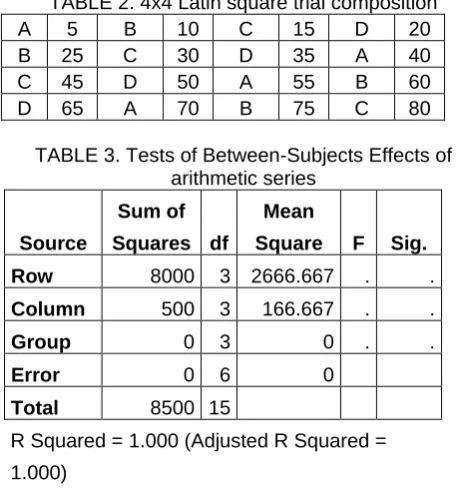
In the Latin square trial, when the rows are consecutively ranged as 5, 10, 15, ..., in the form of an arithmetic sequence (for a row); then, the image given in Table 2 arises. Here, each value in the row was increased by adding 20. Each value in the column was increased by adding 5. The variance analysis results of this trial are given in Table 3.
TABLE 2. 4x4 Latin square trial composition A 5 B 10 C 15 D 20 B 25 C 30 D 35 A 40 C 45 D 50 A 55 B 60 D 65 A 70 B 75 C 80
TABLE 3. Tests of Between-Subjects Effects of arithmetic series
Source
Sum of Squares df
Mean
Square F Sig.
Row 8000 3 2666.667 . .
Column 500 3 166.667 . .
Group 0 3 0 . .
Error 0 6 0
Total 8500 15
R Squared = 1.000 (Adjusted R Squared =
1.000)
As seen in Table 3, as a result of analysis of variance, group and error squares total, and group and error
squares averages were found zero (0). Therefore, F test concerning group effect cannot be calculated. Because F = MSG / MSE = 0/0 uncertainty is obtained. Such a result cannot be statistically valid. Besides, F test becomes undefined for row and column effects.
𝐹 =𝑀𝑆𝑅 𝑀𝑆𝐸=
𝑀𝑆𝑅 0 =∞
In other words, such a trial cannot be evaluated for the results given above. This suggests that trial error equals to zero (0). Accordingly, R2=1, coefficient of determination, is obtained, which is a situation that will never occur in any trial.
In the Latin square trial, when the columns are consecutively ranged as 5, 10, 15, ..., in the form of an arithmetic sequence (for a column), then, the image given in Table 4 arises. The variance analysis results of this trial are given in Table 5.
TABLE 4. Latin square trial composition A 5 B 25 C 45 D 65 B 10 C 30 D 50 A 70 C 15 D 35 A 55 B 75 D 20 A 40 B 60 C 80
TABLE 5. Tests of Between-Subjects Effects of arithmetic series
Source
Sum of Squares df
Mean Square F
Si g.
Column 8000 3 2666.667 . .
Row 500 3 166.667 . .
Group 0 3 0 . .
Error 0 6 0
Total 8500 15
a. R Squared = 1.000 (Adjusted R Squared = 1.000)
As seen in Table 5, as a result of analysis of variance, group and error squares total, and group and error squares averages were found zero (0). Therefore, F test concerning the group effect cannot be calculated. Because F = MSG / MSE = 0/0 uncertainty is obtained. Such a result cannot be statistically valid.
In short,
𝐹 =𝑀𝑆𝑅 𝑀𝑆𝐸=
𝑀𝑆𝑅 0 =∞ 𝐹 =𝑀𝑆𝐶
𝑀𝑆𝐸= 𝑀𝑆𝐶
0 =∞
Such a trial cannot be evaluated for the results obtained in this way. Therefore, the trial error can never be zero (0).
Vol. 3 Issue 10, October - 2017
of geometric sequence. If the row values change 2 times, and column values change 3 times, the created trial plan in this case is given in Table 6. The results of this trial are given in Table 7.
TABLE 6. 4X4 Latin square trial composition in the form of geometric sequence
A 5 B 15 C 45 D 135 B 10 C 30 D 90 A 270 C 15 D 45 A 135 B 405 D 20 A 60 B 180 C 540
TABLE 7. Tests of Between-Subjects Effects of geometric series
Source Sum of Squares
df Mean Square
F Sig.
Row 50000 3 16666.67 2.941 0.121 Colum
n
262500 3 87500.00 15.441 0.003
Group 18500 3 6166.667 1.088 0.423 Error 34000 6 5666.667
Total 365000 15
The F values for the row, column and treatment (Latin) effects were 2.941, 15.441 and 1.088 respectively, and p significance values were 0.121> 0.05, 0.003 <0.01 and 0.423>0.05 respectively. In this case, a statistically significant difference was found between column effects, while there was no statistically significant difference between row and treatment (Latin) effects. This suggests that a Latin square trial consisting of the observation values in the form of geometric sequence can be designed.
In the Latin square trial, when the observation values are consecutively ranged in the form of geometric sequence as 5, 10, 20, 40, 80, …, then, the trial plan is designed as in Table 8. The results of variance analysis of such trial are given in Table 9.
TABLE 8. 4X4 Latin square trial composition in the form of geometric sequence
A 5 B 10 C 20 D 40 B 80 C 160 D 320 A 640 C 1280 D 1560 A 5120 B 10240 D 20480 A 40960 B 81920 C 163840
TABLE 9. Variance Analysis Table of Latin square consisting of geometric sequence elements
Source Sum of
Squares
df Mean Square F Sig.
Row 16974799804.6
9
3 5658266601.5
6 5.90
9 0.032
Column 3429903929.69 3 1143301309.9
0 1.19
4 0.389
Group 2930552929.69 3 976850976.56 1.02
0 0.447
Error 5745455859.38 6 957575976.56
Total 29080712523.4
4 15
The F values for the row, column and group effects were 5.909, 1.194 and 1.020 respectively, and p significance values were 0.032<0.05, 0.389>0.05 and 0.447>0.05, respectively. In this case, a statistically significant difference was found between row effects, while there was no statistically significant difference between column and group effects. Actually, this result is a symmetry of the previous application, even though various applications have been performed on different values. While the row-effect was insignificant, and column-effect was significant in the previous application; in contrast to this, the column -effect was found insignificant, and row-effect was found significant in this application. Briefly, it is seen that the Latin Square trial consisting of the values with geometric sequence feature, can be designed.
The Latin square trial designed as a result of that observation values range in the form of a Fibonacci sequence 1, 1, 2, 3, 5, 8, 13, 21, 34, 55, 89, 144, 233, 377, 610, 987,...,is given in Table 10, the results of this trial is given in Table 11.
TABLE 10. 4X4 Latin square trial composition in the form of Fibonacci sequence
A 1 B 1 C 2 D 3 B 5 C 8 D 13 A 21 C 34 D 55 A 89 B 144 D 233 A 377 B 610 C 987
TABLE 11. Variance Analysis Table of Latin square consisting of Fibonacci sequence elements
Source Sum of Squares
df Mean Square
F Sig.
Row 827204.687 3 275734.90 11.407 0.007 Colum
n
111214.687 3 37071.562 1.534 0.300
Group 75787.188 3 25262.396 1.045 0.438 Error 145039.375 6 24173.229
Total 1159245.94 15
respectively, and p significance values were 0.007<0.01, 0.300>0.05 and 0.438>0.05 and 0.423> 0.05, respectively. In this case, a statistically significant difference was found between row effects, while there was no statistically significant difference between column and treatment (Latin) effects(p<0.01). As in the application performed on geometric sequence data; a similar result will be obtained when its symmetry is taken. In contrast to the previous application, row- effect will be found as insignificant; the column- effect will be found as significant in this application. The group effect will be insignificant in all cases.
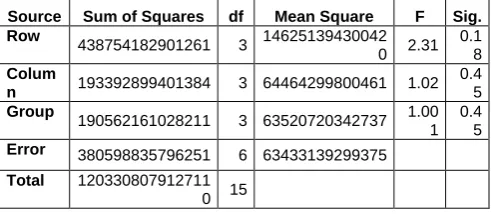
The Latin square trial plan, in which the observed values range in the form of Catalan numbers is given in Table 12. These trial results are given in Table 13.
TABLE12. 4X4 Latin square trial composition in the form of Catalan numbers
A 1 B 2 C 5 D 14 B 42 C 132 D 429 A 1430 C 4862 D 16796 A 58786 B 208012 D 742900 A 2674440 B 9694845 C 35357670
TABLE 13. Variance Analysis Table of Latin square consisting of Catalan numbers
Source Sum of Squares df Mean Square F Sig. Row
438754182901261 3 14625139430042 0 2.31
0.1 8
Colum
n 193392899401384 3 64464299800461 1.02
0.4 5
Group
190562161028211 3 63520720342737 1.00 1
0.4 5
Error 380598835796251 6 63433139299375
Total 120330807912711
0 15
The F values for the row, column and treatment (Latin) effects were 2.31, 1.02 and 1.001 respectively, and p significance values were 0.18>0.05, 0.45>0.05 and 0.45>0.05, respectively. There is no statistically significant difference between row, column and treatment (Latin) effects.
IV. CONCLUSION
In this study, the Latin square trial was applied to the observation values concerning the series with some mathematical features, and the results were comparatively evaluated. In the 4x4 Latin square trial, an analysis was carried out on the values consisting of the values concerning arithmetic sequence, geometric sequence, Fibonacci sequence, and Catalan numbers. As a result of the analysis performed, it was found that the group effects couldn’t be calculated according to the variance analysis ranging as an arithmetic sequence. The group and error squares total and quadratic mean were obtained as zero (0).The row and column effects were found
undefined. Therefore, Latin square trial is not appropriate, and cannot be applied to data ranging as an arithmetic sequence. This issue should be taken into consideration while making an investigation. While the group effects on the data concerning geometric sequence and the Fibonacci sequence was found insignificant as a result of Latin square trial; one of the row and column effects was found significant, and the other one was found insignificant. When the symmetry of these trials is taken, the results of row and column effects displace. As a result of the variance analysis of the Latin square trial; row, column and group effects were found insignificant. Consequently, while it is not possible to use Latin Square trial for arithmetic sequence data; Latin square can be applied to the values of geometric sequence, Fibonacci series and Catalan numbers. But, as a result of these applications, the effect of group effects is found statistically insignificant.
REFERENCES
[1] Efe, E., Bek, Y. and Şahin, M. 2000. SPSS’te Çözümleri ile İstatistik Yöntemler II. Kahramanmaraş Sütçü İmam Üniversitesi Rektörlüğü Yayın No: 10. http://www.ksu.edu.tr/kisisel/eefe/spss.pdf(15 Ağustos 2011).
[2] Gao, 2005. Latin Squares in Experimental Design. Michigan State University
(http://compneurosci.com/wiki/images/9/98/Latin_squa re_Method.pdf).
[3] Banks, S. 1965. On methods: Latin square experiments. Journal of Advertising Research, 5(3): 37-46.
[4] Şenoğlu, B., Acıtaş, Ş. 2010. İstatistiksel Deney Tasarımı. Sabit Etkili Modeller. Nobel Yayınları, Ankara.
[5] Mendeş, M. 2013. Uygulamalı Bilimler için İstatistik ve Araştırma Yöntemleri. Kriter Yayınevi, İstanbul, 626 p.
[6] Montgomery, D. C. 2009. The Latin square design. In: Design and Analysis of Experiments, 7th Edition, USA, John Wilwy and Sons Inc., 138-148.
[7] Burton, D. M. 1989. Elementary Number Theory, 4th ed. Boston, MA: Allyn and Bacon.
[8] Hoffman, P. 1998. The Man Who Loved Only Numbers: The Story of Paul Erdős and the Search for Mathematical Truth. New York: Hyperion.
[9] Beyer, W. H. 1987. CRC Standard Mathematical Tables, 28th ed. Boca Raton, FL: CRC Press.
[10] Courant, R., Robbins, H. 1996. The Geometric Progression. §1.2.3 in What Is Mathematics?: An Elementary Approach to Ideas and Methods, 2nd ed. Oxford, England: Oxford University Press.
[11] Bazaraa, M. S., Sherali, H. D. and Shetty, C. M. 1993. Nonlinear Programming Theory and Algorithms. John Wiley and Sons, Inc., New York. p638.
Vol. 3 Issue 10, October - 2017
[14] Graham, R. L., Knuth, D. E. and Patashnik, O. 1994. Exercise 9.8 in Concrete Mathematics: A Foundation for Computer Science, 2nd ed. Reading, MA: Addison-Wesley.
[15] Stanley, R. P. 1999. Enumerative Combinatorics, Vol. 2. Cambridge, England: Cambridge University Press, pp. 219-229.
[16] Pemmaraju, S. and Skiena, S. 2003. Computational Discrete Mathematics: Combinatorics and Graph Theory with Mathematica. Cambridge, England: Cambridge University Press.