Ecclesiology
Today
I
SSUE37
C
o n t e n t s
Ecclesiology
Today
Issue 37 for December 2006 published January 2007
Hon. Editor John Elliott, MA, PhD
ISSN: 1460–4213
ÓThe Ecclesiological Society 2006
All rights reserved
Society website: www.ecclsoc.org
Charity No: 210501
Journal of the
Ecclesiological Society
Front cover illustration:
Salisbury cathedral, seen from the north-east.
Articles
From the Editor
John Elliot 4
‘Worthy of the age in which we live’: churches and chapels in Salisbury
Trevor Cooper 5
It’s all a question of numbers:
Salisbury and the Religious Census of 1851
John Elliott 45
Women stained glass artists in Victorian England:
the case of Helen Matilda, Countess Dowager of Radnor (1846–1929)
Sarah Brown 57
The restoration of Salisbury Cathedral by George Gilbert Scott, 1862–78
Suzanna Branfoot 67
Architects and clergy in early-Victorian Britain: a useful alliance or a threat to the profession?
Christopher Webster 81
VIEWPOINT:The position of the traditional altar in
contemporary liturgical practice
Paul Velluet 93
Regular Features
Chairman’s Letter 2
Book Reviews 105
DEAR FELLOW MEMBER, first some important Society news, then a word about our book on Comper, and finally an update on some recent developments concerning the future of church buildings.
Editorship of Ecclesiology Today
If you have glanced ahead, you will already have seen that this is John Elliott’s last issue as Editor of Ecclesiology Today. He took up the role in 1997, and over the last ten years has done a tremendous job, building it up to a periodical of which the Society can be proud. For those of you who have joined since 1997 – and given the Society’s rate of growth since the early 90s, this is a high proportion – it may be worth giving a potted history. In 1980 a newsletter was started. In 1993, under Professor Kenneth Murta’s editorship, the contents were expanded and the publication was launched as Ecclesiology Today.At that stage the format was lo-tech, corner-stapled A4 with no facility for illustrations.
In 1997 John took over. He converted the format to A4-booklet, and introduced illustrations. Later he shrank the page size (and increased the number of pages) and recently the journal has undergone a complete redesign, to its present airy and spacious layout.
Fom the beginning, John was cajoling and persuading people to write articles, and where necessary filling in the gaps himself. It is not easy to grow a journal, but he managed to establish a virtuous circle, where the increasing quality of the contents attracted new contributors. Looking back to 1997, his first issue had three very short articles, and just one substantial one – and that from John’s own pen! There were only five illustrations. Comparison of that issue with recent ones shows just how far he has taken us.
Until recently, John not only commissioned and copy-edited the contents, but also typeset them, a significant task but one which helped keep our costs down, and provided very good value for money to members.
As a thank you for his work over the years, members of Council volunteered to write the articles for his final issue. It was pleasing to discover that three of us had things to say about John’s adopted city, Salisbury, and that all of the topics dealt with here are close to his heart. I do not know whether this falls within the formal definition of a festschrift, but the thought is the same.Thank you, John.
Whilst your Council considers whom to appoint as the next editor, we are inviting guest editors to look after each issue. Andrew Derrick has kindly agreed to be our first guest editor, and his edition will be concentrating on Catholic churches. As I have explained previously, we are moving to two editions of Ecclesiology Today per year (this is the second one for 2006), and the next issue (the first for 2007) should be out in Spring or early Summer.
Sir Ninian Comper
were a member at that date, and did not receive a copy, could you drop a note to John Henman, whose address is on the inside rear cover.
Additional copies can be purchased from our co-publishers, Spire Books.Their phone number is 01189 471 525.
Keeping church buildings
As many of you will know, I have a particular interest in the future of church buildings, and thought a brief update may be of interest.
There has been a lot going on. In early 2006 the Select Committee of DCMS (the Department of Culture, Media and Sport) looked into the country’s heritage (I was able to give both written and oral evidence regarding church buildings). The Committee had some interesting things to say in its report, but the response from the Department was, I fear, anodyne and disappointing. More positively, in October a report commissioned by DEFRA (the Department for the Environment, Food and Rural Affairs) showed how important the life of the church is to rural communities – no surprises there, but government policy-making has been singularly blind to this in the past. And there is now an All Party Parliamentary Group on Historic Churches and Chapels which is meeting regularly.
Also in 2006, English Heritage launched its Inspired! campaign, and the Church of England issued a ‘Next Steps’ document, following its earlier Building Faith in our Future.
In November there was a conference on church tourism which attracted some high-powered speakers, and a strategy for encouraging such tourism has now been published. (And who could argue with the need for that? Surely, for example, our East Anglian parish churches should be as well known to the overseas tourist as French Romanesque ones are to us.)
In December, there was an informed debate in the House of Lords, in which the government was urged to consider the level of support it gives to church buildings. Later in the month, our Vice-President Sir Patrick Cormack, MP secured an adjournment debate in the Commons, and made some telling points to the relevant minister, David Lammy, who, it is good to see, has consistently shown himself to be interested in pursuing the issues.
There have been two particular pieces of good news. In the Spring, the scheme for recovering VAT for repairs to listed places of worship was extended by the Chancellor.And in December the Heritage Lottery Fund (HLF) announced that funding for places of worship will remain a priority, with a dedicated funding programme through to the year 2013.This is not the place for figures, but the HLF gives many millions of pounds per year to repair churches (far more than the government does through English Heritage), so the continuation of this at similar levels is very welcome news indeed.
You can find out more about these developments on our website.
AFTER 10 YEARS EDITING Ecclesiology Today I have very mixed feelings about relinquishing the task, but as the walrus said ‘the time has come for a change’. What started as a collection of A4 sheets held together with a staple has become a small printed book. I would also like to think that the contents have changed and become more learned without becoming acrid or boring. My great regret is that we never went to colour, but as the Treasurer will quickly point out, the annual subscriptions do not pay for the current
Ecclesiology Today let alone a colour version; the changes which have
been made being financed from special funds. I have done my best and it is now time to move on, and more importantly for Ecclesiology
Today to move on, with a new Editor who will bring his or her own special flair to the task.
If you liked what you have read then I am pleased, if you didn’t then I am sorry.
After three score years and five I feel very fortunate to have found myself in Salisbury.The absence of an adjacent motorway means that life here is more civilised and somewhat slower than in many more advanced areas where it has been my misfortune to live. In addition, the Cathedral not only dominates the skyline, it also inspires the local culture, providing a rich source of musicians and learned clerics. The result is an abundance of local choirs and musical groups along with an equal abundance of excellent theological courses in the born
again Salisbury Theological College which now caters for a secular audience of those with a
faith which is seeking an understanding.
It has been a great honour to edit a final version of Ecclesiology Today that is largely devoted to Salisbury with articles exclusively contributed by members of the Society’s Council. Work started on Salisbury Cathedral in 1220, it was consecrated in 1258 and work was largely completed by the 1330s. The result is an architectural gem that is stylistically largely of one piece. The succeeding centuries have extracted their toll as successive architects have improved matters, till in the 1860s G .G. Scott tried to undo some of the worst excesses and more recently Michael Drury has given the structure a much needed structural overhaul. The result is one of the wonders of British architecture and a machine for praying in that makes the process thoroughly enjoyable. One of the unsung wonders of Salisbury is an opportunity (available every day) to climb the internal staircases and roof spaces to the base of the spire. If all this were not enough the local Roman Catholic church was designed by Pugin and the major part of the ex-Theological College was designed by Butterfield.
Local history has often been ignored by the supposedly learned but it is through the local that many are able to come to terms with the wider scene. Uncovering the numbers who attended a specific church in Salisbury in 1851 makes more sense to many than national statistics. I am therefore particularly pleased that my last foray as Editor of Ecclesiology Today is largely concerned with local issues and I hope that it will encourage others to find out how things differed elsewhere.
John Elliott December 2006
AUTHOR’S NOTE: This is not an architectural study, but an attempt to look at Salisbury’s churches and chapels as a group – why were they built? how are they being used today? and what might this mean for their future? I have only scratched the surface of a long and complex story, but I hope it is not only of interest in itself, but provides more general food for thought, especially regarding the outlook for church and chapel buildings in urban areas.1
1. The early days
The original church
es
Salisbury is a planned settlement.2 It was founded by Bishop Richard Poore in 1220 on land owned by the church authorities, and laid out with the new cathedral to the south and a grid of streets to the north (Fig. 1). Its position on level ground at the confluence of the Rivers Nadder and Avon made the city an important junction, with two river crossings, one to the west at the village of Fisherton, and the other to the south where the road leads through Harnham. Both of these villages have become suburbs, Fisherton some centuries ago, Harnham much more recently.
From early days, three parish churches were provided. One was St Martin’s to the south-east, where an existing hamlet and its church were taken into the new settlement. In this area the original street pattern remains, and even now the church feels a little out of the way, describing itself as ‘Salisbury’s best kept secret’.This building, older than the cathedral, was enlarged in the mid fifteenth century, and given a smart spire (Fig. 2). In 1886 it was the first Anglican church in Salisbury to use vestments, and today it serves Anglo-Catholics from the city and beyond.3
Close to the market place is St Thomas’s.This was built in the city’s early years, and was the first church on the site. It was already a large building by 1447, when the chancel roof and part of a side chapel collapsed. During the rebuild the church was further enlarged, and modifications later in the century led to the fine building we see today (Fig. 3). The church is famous for its associations with the medieval wool-merchants who lived in Salisbury, and for its post-Reformation painting of the Doom or Last Judgement over the chancel arch.4 It is the principal city church and the venue for many civic events.
The street pattern of the northern part of the city suggests this area may have been developed a few decades after the original
Trevor Cooper makes his living in business. He is Chairman of Council of the Society, and has an especial interest in the future of church buildings.
‘Worthy of the age in which we live’:
churches and chapels in Salisbury
Fig. 1 John Speed’s miniature map of Salisbury of about 1610, the first map of the city, here shown actual size. Note that north is diagonally upwards and to the left. The cathedral is to the south, with the spire of the medieval bell-tower (demolished 1789) visible adjacent to the north side of the cathedral. Due north is St Thomas’s church, close to the market place with its stocks. At the north-east corner of the city is St Edmund’s with its central tower, located in a large churchyard. Due east of the cathedral on the edge of the city is St Martin’s.
Fig. 2 The church of St Martin in 1979.The building on the right was a school.This recently closed and is now used for community purposes.
foundation as an expansion of the city northwards. Here was built the church of St Edmund, set up as a college for twelve priests – though in fact it rarely if ever had that number – some of whom served the parish. It was effectively two buildings, one for the parish, one for the college, and was of great size, its churchyard taking more than the width of one tenement block. This church too suffered an accident when in 1653 the tower fell down and destroyed the nave. The parish rebuilt the (clearly important) tower in the Gothic style, and replaced the bells, though raising the money for repairs was not without difficulty, and an extra churchwarden, a ‘gentilman of honour and respect in the city’, had to be drafted in as fund-raiser. The nave was not rebuilt. The building seen today is the early fifteenth-century chancel, with a Victorian eastward extension by Scott who also undertook a fairly thorough restoration of the rest of the fabric (Fig. 4).5The church was closed for worship in 1974 and is now an Arts Centre.
The cathedral need hardly figure in our discussion of church provision for the ordinary citizen of Salisbury. Its primary purpose has never been as a parish church, and until relatively recently it has drawn its congregation mainly from the five hundred or so people living in the Close. Lately, like many other cathedrals, it has seen increasing congregations, and today attracts about 250 people each Sunday.6
These days the cathedral is a major tourist attraction, said to have 500,000 visitors each year. But there seems to be little promotion of other church buildings as places of interest. Market research shows that visitors to Salisbury enjoy ‘historic aspects of the city’, so there is surely potential to encourage visits to the other churches, perhaps by marketing them from within the
Fig. 4 Left, the interior of
St Edmund’s before Scott’s restoration of 1865–7. Note the tall central three-decker pulpit with canopy, the westward-facing gallery in the south aisle and the benches for the poor in the wide central aisle.
Below, in order:
Top, the interior in 1972 before the church was closed for worship.
Middle, recent view of the restaurant in the Arts Centre, occupying Scott’s east end.
cathedral, as at Lincoln. Experience elsewhere shows this can benefit all parties.7
This, then, is our first snapshot of church provision within Salisbury, showing it with just three parish churches. The earliest surviving drawing of the city, made in 1588, shows churches and cathedral dominating the skyline, a physical and institutional presence impossible to ignore, remaining so well into the following centuries (Fig. 5).8 But was there enough room in the churches for everyone?
Fitting everyone in
By the late fourteenth century the three Salisbury parish churches served a population of about 5,000 people, and this had risen to around 7,000 by the time of the Reformation. At this time, both St Edmund’s parish and St Thomas’s parish are calculated each to have had about 1,700 adult communicants. Were these thousands of people able to fit into just three churches? (This assumes they wanted to go to church: we seem not to have much evidence for the frequency of church going in the late middle ages).9
An estimate based on the published plan of St Thomas’s indicates that if everyone was standing, and the nave was entirely empty, then it would probably have just held the required 1,700 people. But not everyone was standing: another church, St Edmund’s, is known to have had a number of pews for hire from at least 1456, and the same was probably true of all three churches in Salisbury. Nor was all the floor space available, some being taken up with chantry chapels. On the other hand, these two factors were probably more than balanced by the fact there was a choice of Masses to attend on Sunday morning (assuming parishioners did not feel obligated to attend the parish Mass celebrated at the high altar). With multiple masses the churches probably were large enough for everyone.10
But what happened after the Reformation, when there was probably just a single service on Sunday? Did the removal of chantry altars from the nave miraculously produce just enough additional space for everyone to squeeze into a single service? Possibly.11
However as seating became more common in the decades following the Reformation, galleries had to be introduced. St Thomas’s put in a south gallery in 1615 – sensibly, children were not allowed in the front seats, to avoid annoying those sitting underneath – and St Martin’s inserted one in 1632. Even St Edmund’s, a very large church, planned a gallery in 1636 for
Fig 6 Salisbury and Fisherton from a map of 1885, showing churches and chapels of all periods. Fisherton with its railway terminus lies on the west. Comparison with John Speed’s earlier map shows how little the centre has changed by this date. On this map buildings which no longer (2006) exist are shown in black, and buildings no longer used for religious purposes in grey. Anglican and Catholic buildings with dedications:
Cathedral of St Mary, 27; St Clement, Fisherton, 5; St Edmund, 16; St Martin, 24; St Mary Magdalene (chapel of ease), 22; St Osmund (Roman Catholic), 26; St Paul, 2; St Thomas, 12.
Other buildings by alphabetical order of modern street name, showing original denomination:
school children,‘principal inhabitants’ and others. In the same year ‘portable seats’ were set up ‘in the middle row and body of the church’.12
Space for seating was becoming more scarce, and it must be questionable whether there was enough room. For example, in 1715, by when additional galleries had been added, St Thomas’s could only seat an estimated seven hundred people, with possibly a couple of hundred extra folk in the unpewed eastern chapels. This is nowhere near the required number.13 It seems that the introduction of seating may have led to a problem of accommodation in the century after the Reformation, a period when dissenting congregations made up only a small percentage of the population and church attendance was expected of all.14
In fact, non-attendance was a problem commonly remarked upon by post-Reformation churchwardens. For example, in 1620 some 115 people in St Edmund’s parish were named as having avoided Easter Communion, an occasion for which there was a three line-whip. A larger number are likely to have been absent on routine Sundays. Was this the time when the labouring classes began to absent themselves from Sunday church going?15
Not all services were on Sunday. Before the Reformation it was normal for town churches to hold masses on weekday mornings. For example, ‘first Mass’ or ‘Jesus Mass’ was said at St Edmund’s at 6.00 a.m. each morning. Surprisingly, at this church the tradition continued: after the Reformation and until the 1640s, Morning Prayer was read at 6.00 a.m. every weekday. Attendance at this service may have been low, as the minister was happy for the Clerk to read the service.16
2. After the Reformation
Old Dissent
In late 1662 the bishop ordered a major rearrangement of the east end of St Edmund’s church, demanding the removal of pews from under the east window and the placing there of a railed-in communion table.This symbolised a change in regime and a shift Fig. 7 The Salt Lane meeting house
of 1702.
Top left, external view, the white gable of the building visible immediately behind the Salvation Army foyer entrance.
Top right, in use as a Sunday School when owned by the Methodists (photograph of about 1882).There is a gallery of 1737 on the short wall opposite the entrance, and two axial posts support the roof. No doubt the pulpit had originally been on one of the long walls.
in churchmanship, for earlier that year the puritan John Strickland had lost his job as minister. Along with some two thousand other clergymen across the country he had refused to accept the Act of Uniformity, imposing the modified Prayer Book.17
But Strickland stayed in the city, and continued to preach. He and others founded a Presbyterian meeting, worshipping in private houses with congregations of up to two hundred.With the 1689 Act of Toleration allowing the building of dissenting places of worship, a meeting house was erected in about 1702 in Salt Lane, set back from the street front (for location, see Fig. 6). This is the first purpose-built dissenting building in Salisbury, and is still there, in use today by the Salvation Army (Fig. 7).
As elsewhere, the Presbyterian cause in Salisbury dwindled, and it had disappeared by 1815, when the Methodists bought the disused Salt Lane meeting house for use as a school room. Particular damage to the Presbyterian meeting was done in 1757 when a group of members rejecting Unitarian theology broke away to form an Independent or Congregational church.18 Ten years later the breakaway group built their own meeting room at the back of two houses which they had been given in Scots Lane. Sadly, in 1806, some fifty years after its foundation, this congregation also split, apparently unable to agree whether to call the extremely youthful Samuel Sleigh as pastor. The anti-Sleigh faction took themselves off and four years later built a new chapel
around the corner in Endless Street, fronting directly onto the road. However, Sleigh was a long-lasting success, and half a century later the congregations re-merged: but that part of the story comes later.19
The Quakers were the second dissenting group to build.They were meeting regularly in the city by the end of the seventeenth century, and they put up a meeting house in 1713, tucked away with its burial ground behind the street frontage on the west side of Gigant Street. A meeting continued in Salisbury until 1827. Their building had various subsequent uses, and it survived as part of a brewery until a few decades ago. Quakers have since returned to Salisbury, and are meeting in rented accommodation whilst they refurbish recently-purchased premises on the Wilton Road.20 The Baptists were next. Baptists of various persuasions worshipped in private houses in Salisbury through much of the seventeenth century, from 1626, if not before.Their first purpose-built chapel went up in Brown Street in 1719, and Baptists are still there today, representing continuous occupation of the site for nearly three hundred years, almost as long as medieval Catholic worship took place in the town’s parish churches (Fig. 8). There have been many major changes since then – in 1795, 1829, 1882, 1935, and 1989. A history of significant rebuilding and extension is quite common for successful nonconformist congregations; not least, it seems likely that a fine new chapel helped draw congregations in.21
Thus in the first half of the eighteenth century, four new places of worship appeared, set up by congregations of the ‘Old Dissent’ – Presbyterians, Quakers, Baptists, and Independents.
The Methodists and Roman Catholics
What was later to become the ‘New Dissent’ arrived in June 1738 when John Wesley visited his mother in Fisherton, the momentous religious experience he had undergone in May still fresh in his mind. By this date, Fisherton was joined to the city by ribbon development along Fisherton Street. Wesley’s brother-in-law, Westley Hall, was the curate in Fisherton, and he set up a Methodist group which met in the coach-house of a public house, the earliest meeting of Methodists in Salisbury. Methodists then regarded themselves as being activist members of the Anglican church, rather than a separate dissenting denomination. (There are groupings in the Church of England today which some would say have the potential to become separate denominations. Nothing changes.)
shop in 1750, building a chapel in St Edmund’s Church Street nine years later – Wesley called the chapel ‘the most complete in England’. This was rebuilt in 1811, and enlarged in 1835; the Methodists are still there today, having worshiped on the same site for nearly 250 years (Fig. 9). Towards the end of the nineteenth century they acquired more land around their chapel, and put up a set of halls and meeting rooms, now hired by eighty different community organisations.22
The early nineteenth century saw a pair of competing Methodist chapels being built in Fisherton. In 1826 the Primitive Methodists opened a chapel on the south side of Fisherton Street, tucked away behind houses. It is still there, and still tucked away, though now converted to flats (Fig. 10).23 The other new building was Wesleyan Methodist, erected six years later in what is now Mill Road, roughly where the station car park is.24
What of the Roman Catholics? For many years they had to be discreet and meet in private houses, often fitted up with purpose-built chapels.The first public Roman Catholic chapel in Salisbury was built in 1814, on the upper floor of a building near St Martin’s church, and it was here in 1835 that Augustus Welby Pugin was received as a Catholic, and assisted at Mass the next day. This chapel closed in 1848 when Pugin’s St Osmund’s church was opened (Fig. 11), strategically placed directly opposite the (Anglican) cathedral, in which lies the shrine of St Osmund. The new church was largely paid for by John Lambert, a distinguished member of the congregation.Two years later the Roman Catholic hierarchy was restored to England and Wales, and, in Salisbury, effigies of the Pope, a Cardinal, and various Roman Catholic Bishops, dressed in vestments and labelled with their names, were paraded around the city to chants of ‘No Popery’ and then burnt one by one on a huge bonfire in front of a crowd of five hundred, whilst a band played the National Anthem. Four years later, John Lambert became mayor of the city.25
Fig. 9 The Methodist church in St Edmund’s Church Street (1811; extended towards the road, 1835). Above left, the building before 1835. Above right, the building today, with its porch of 1889.
Above, the large hall at the rear of the building, stretching to the other side of the block.
It is now 1851. In the three and a half centuries since our previous snapshot, Salisbury has acquired one Catholic church, and four nonconformist chapels, during a period when its population increased from about 7,000 to approximately 9,000. Fisherton, becoming more and more an extension of the city, has gained a further two Methodist chapels.26
3. The second half of the nineteenth century
Census year
As discussed by John Elliott elsewhere in this issue, on Sunday 30 March 1851 a religious census was taken, recording both attendance and the number of seats in each church and chapel building.27
By today’s standards, church attendance was extraordinarily high. On the morning of the census, almost 35% of the population of central Salisbury and Fisherton attended church. This proportion is four times higher than in Salisbury today, and is considerably higher than even the present-day percentage of Americans in church on a given Sunday. No wonder that when he published the results of the census, Horace Mann could say that ‘regular church-attendance is now ranked amongst the recognised proprieties of life’.28
Even so the census underestimated general levels of churchgoing, because it took no account of those who attended church only once every few weeks and happened not to be in church that particular Sunday. One guess, made by Horace Mann in 1855, was that twice as many people attended church sometimes as were in church on any particular Sunday. (It is interesting that approximately the same correction applies today in England for Anglican churchgoers.) If Mann’s estimate was broadly right, then church attendance in mid nineteenth-century England was much more widespread than is usually assumed.29
How full were the churches at their best-attended services? St Thomas’s and St Edmund’s were each about three-quarters full at their busiest times (74% and 79%). St Martin’s, on the edge, was only half full even when most busy (53%). Of the nonconformists, the Endless Street Congregational church was more than three-quarters full (78%), whilst all the others were half full or less, with the Primitive Methodist chapel on the south of Fisherton Street being no more than one third occupied even at its fullest (33%).30
Fifty years of church extension
In 1851, then, many Salisbury churches and chapels were no more than half full on Sundays, even at their most popular services.Yet, as everywhere else, the next fifty years saw a flurry of church building in central Salisbury.Why was this?31
As John Elliott points out, this was a period of fast-growing population and urbanisation.The population of Salisbury grew by almost exactly 50% between 1850 and 1900. Not unreasonably, it must have seemed that new church buildings were required, and that there would always be people to fill new pews, even if they were half-empty to start with. Horace Mann himself set the national mood in his best-selling summary of the census by stating that 2,000 new churches were needed nationally, and referring to the situation as an ‘emergency’. His starting point was the assumption that there needed to be 580 church seats per thousand population (in fact, Salisbury and Fisherton already had well over this number (Fig. 12), at around 700 seats per thousand population) and although he argued strongly for more church teachers,‘by whose persuasions the reluctant population might be won’, there was little notion in his report that church seats should only be provided to the extent they were actually needed.32
Competition between denominations also led to church building. ‘Even in religious matters,’ it was said at the opening of one northern chapel in 1863, ‘we are none of us the worse for a little wholesome and salutary competition’. Denominations kept an eye on their market share, and it was not unknown for them to move into an area to pre-empt potential competitors. Internal
competition might also generate new buildings, with congregations splitting to go their seperate ways.33
However, all this was happening at a time when the proportion of the population attending church was starting to drop, perhaps coupled with less frequent attendance by individual churchgoers. For a few decades, population growth more than matched this decreasing proportion, so the total number of people in church each Sunday increased until (probably) the final decades of the nineteenth century, or perhaps a little later. The number of attendees then started to decline and this has continued ever since. (The Roman Catholic decline in absolute numbers attending started much later, probably in the 1960s.) The Victorians overdid their church building, and left us with a problem.34
Central Salisbury
We can see these general trends working themselves out in Salisbury. In 1852, the year after the census, the ancient parish church of St Clement’s, Fisherton closed and was pulled down: it had become too small for the fast-growing suburb.A new church, St Paul’s, was built (Fig. 13). This church became strongly evangelical in the 1860s, and remains so today, an example of continuity of churchmanship over 150 years.35
Fig. 13 St Paul’s church, built 1851–3 in the expanding suburb of Fisherton (T. H.Wyatt; north aisle added 1876).
In 1860 the Wesleyan Methodists in Mill Road close to the station built themselves a smart new chapel a few hundred yards away in Wilton Road (Fig. 14). This building retains its gallery. The Primitive Methodists nearby in Fisherton Street responded nine years later, crossing the street to erect their new building; this cost £1,700, half of which had been raised by the time the chapel was opened (Fig. 15). As so often, there was a wealthy patron, a Mr Yates, who had ‘long been a liberal and valued friend of the body’. Described as ‘a neat little building in the Italian style’, it seated about four hundred people, and as usual had a hall and meeting room, and a place for ‘boiling water for tea meetings’. Their first chapel had been hidden away; this new one was visible to all.36
The building was to have an interesting life. After use as a chapel for nearly fifty years, the Methodists decided to build themselves a new 450-seater Gothic chapel in Dews Road (Fig. 16). The Trustees of the old chapel sold it to a local cinema entrepreneur ‘on the understanding that he is going to convert them [the premises] into a motor garage’. They were less than amused when the building was in fact converted to a ‘Picture House’ showing silent movies, the purchaser demolishing the original front of the chapel, and pushing a new and not entirely restrained frontage over the forecourt. Later, as the Playhouse, the building became the city’s much-loved theatre, until replaced in 1976.37
To return to nineteenth-century Fisherton, also in 1860 a group of Christian Brethren opened a meeting house near the railway station (now gone).Then in 1875 a group of Baptists who had seceded from the Brown Street church built a chapel in what is now Cranebridge Road.Their cause faded away before the end
Fig. 14 Emmanuel church, Wilton Road. Built by the Wesleyan Methodists (1860).
Left, the exterior, described by Pevsner as ‘debased Italianate’. Note the school room projecting from the rear of the building.
Below, the galleried interior.
of the century, but the building, after reincarnation as a furniture repository, was not demolished until 1971.38
In central Salisbury the Wesleyan Methodists suffered a split in 1852, part of a national tearing apart. There were speeches and meetings, and the budding off of a separate congregation, who
proceeded to build a chapel in Milford Street. It held 800 people, but had poor lighting, poor acoustics and poor ventilation, so a new building was put up in 1897, holding 450 people, with a school hall and seven other rooms. This is now the Chapel Nightclub (Fig. 17).
In a reverse move, the two Congregational groups who had separated at the beginning of the century over Samuel Sleigh’s calling re-merged in 1860. According to one account, the Endless Street congregation were facing difficulties, including an outstanding mortgage.39The combined congregations moved to the Endless Street building, which was refronted; their other chapel, in Scots lane, was kept on for the time being as Sunday School rooms, and later for use as a British Day School.
In 1879 this merged congregation built an impressive new chapel to seat 650 people in Fisherton Street. Later a lecture hall and school rooms were built. This was the first nonconformist building in Salisbury to be built in the Gothic style, and is of notably high quality, with a spire which dominates the entrance to the town from the railway station along Fisherton Street (Fig. 18).40 Whether consciously or no, the Congregationalists announced their presence in a way which not only marked their position at the top of the nonconformist pecking order, but matched anything offered by the Anglicans.40
It took them some fourteen years to clear the debt.To help pay for the new building they quickly sold their Endless Street chapel, and this was later used as the first Salisbury Free Library, and probably lies behind the façade of the present Royal British Legion building.41
Fig. 18 The United Reformed church in Fisherton Street.
Margin top, built in 1879 (Tarring & Wilkinson), the building dominates the approach to the town along Fisherton Street.
Later their old Scots Lane meeting house was also sold, and this was acquired (complete with chairs, heating stoves and gas brackets) by Edward Ware, one of the leaders and effectively a patron of an Open Brethren group who until then had been worshipping in an iron mission hut in Guilder Lane. Looking ahead, although thirty years later the Brethren left the Scots Lane building and moved into rented accommodation, this old hall was to be used by one more church, for in 1932 the Elim Pentecostals, then relatively new to the city, took it over as the Elim Four Square Gospel Hall: new wine in an old wineskin. They moved out of the building in the late 1950s, and it was finally pulled down in 1960, after two centuries of intermittent use as a nonconformist meeting house.42
During the last quarter of the nineteenth century several working men’s mission rooms were set up. St Edmund’s erected an iron building at the east end of Winchester Street, where the bypass now is. St Martin’s bought the iron building in Guilder Lane, and re-erected it at the southern end of the Friary, a rough area, and also put up a tin chapel-of-ease in Gigant Street, dedicated to St Mary Magdalene (Fig. 19).These three have now gone. In 1876 there was ecumenical co-operation when five of the free churches and St Paul’s, Fisherton built a mission chapel in Barnard Street, mainly but not entirely for children.This building continues as a church today, having been bought in 1929 by the Open Brethren. St Paul’s also built the Maundrel Hall alongside Fisherton Bridge, a building which is now open to the public as the Hog’s Head public house.All of this represented a determined effort to reach out to the working class.43
Meanwhile, the Salvation Army arrived. It was in Salisbury market-place in 1879 that the drawing power of a brass band was first discovered – in this case, two cornets, a euphonium and a valve trombone, played by Charles Fry and his sons Fred, Ernest and Bert. The Army met considerable resistance: at one stage its street marches were pelted with eggs and tomatoes by a crowd of a thousand, organised by the Society for the Suppression of Street Parading (probably a front for the city’s innkeepers). The city authorities forbade the Army to meet, and 60 special constables were appointed to deal with unrest. But the Army stuck to their guns, and in 1883 acquired the old Salt Lane meeting rooms (Fig. 7). As we have seen, this was the original eighteenth-century Presbyterian building, the first nonconformist building in Salisbury, which had later been acquired by the Methodists as a school room.The Army is still there today.44
Since our last snapshot in 1851, central Salisbury and its Fisherton suburb have seen the replacement of one parish church, and acquired one chapel-of-ease, four mission rooms, and a net Fig. 19 Top, St Mary Magdalene,
increase of three nonconformist chapels (from four to seven). In addition, the Roman Catholics have expanded St Osmund’s church by adding a north aisle and chapel. There has, however, been substantial loss of seating when the parish churches took down their galleries. During this period, the number of people who can be accommodated for worship in central Salisbury and Fisherton has increased by an estimated one thousand.This is the high-water mark of church provision in central Salisbury.45
Alongside space for Sunday worship was the provision of rooms and halls for Sunday Schools and other activities. To take one example, in 1882 the Brown Street Baptists had 24 rooms for
Fig. 20 Churches and chapels outside the centre of Salisbury.Those marked in black are medieval, those in grey nineteenth-century, those of the twentieth-century in white.The demolished Methodist church in Harnham is not shown.
Anglican and Catholic buildings with dedications:
All Saints, East Harnham, 7; The Most Holy Redeemer, Bishopdown, 13; St Andrew, Bemerton, 5; St Andrew, Laverstock, 11; St Francis, 15; St George, West Harnham, 6; St Gregory, Bemerton, 2; St John, Bemerton, 4; St Mark, 10; St Michael, Bemerton Heath, 1.
Other buildings, in numerical order:
Fig. 21 Top, St Andrew’s, Bemerton, one of George Herbert’s churches. Bottom, the exterior and interior of St John’s, Bemerton (T. H.Wyatt, 1860–61).
Sunday School pupils, with more than 400 on the roll. Typically such rooms and halls are attached to nonconformist chapels, but detached from Anglican ones.46 They play an important role in contemporary life – more than a third of Salisbury’s halls for hire belong to churches and chapels, and the proportion is higher in the centre of the city.47
The nearby villages
It was not until the twentieth century that Salisbury sprawled over the surrounding villages – Laverstock to the east, Harnham to the south, Bemerton to the west (Fig. 20).Yet in the 1850s, well before suburbanisation, there was extensive church building in these villages. At Laverstock the old church was pulled down and replaced by a larger building in 1858, and two Anglican churches were built on completely new sites, at East Harnham (1854) and Bemerton (1861). The architect for all three buildings was T. H.Wyatt.This raised the number of Anglican churches in these villages from three to five.48
The two latter buildings were both ‘gift’ churches, paid for by rich donors. Were they fulfilling a personal vision, rather than meeting an established need? Did they over-provide? It is noteworthy that the nonconformists, who had to finance themselves, seem not to have had free-standing chapels in these villages until mid twentieth-century suburbanisation.49
Bemerton village now has two churches (Fig. 21). St John’s, the Victorian one, is of high quality, and is blessed with a nearby car park. But the church is large for today’s needs. The medieval building, St Andrew’s, is tiny and of no particular architectural value. But it is much visited for its association with George Herbert who was parish priest there for three years until his death in 1633. He is famous for his evocation of the role of the country parson, the shepherd of his flock and spiritual father to each member of his parish. However, this may have been easier for him than for a modern-day parson, as he had a mere 200 parishioners to care for and a curate to help.50
The city expands to the north
In 1871 Wyndham Park, to the immediate north of the city, was sold as green land for development and within twenty years 750 houses had been built. The Primitive Methodists responded by building a chapel to seat about 200 people. After later being taken over by Christian Scientists this is now a Kingdom Hall for Jehovah’s Witnesses.51
church was being considered by a local committee, when Bishop Wordsworth, who ‘wished to have a church erected worthy of the age in which we live’, imposed himself as Chairman (‘I ask to join the Building Committee ... the meeting will take place at the Bishop’s Palace’) and brought in important folk from outside the parish. He wanted ‘a magnificent church at the London Road entry, which will rank architecturally with any of the fine churches in this Cathedral City’. Perhaps the Congregational church and its dominating spire in Fisherton Street had rankled. And there had been a long-running row with the nonconformists about schooling in the city, in which an ill-judged remark by the Bishop had recently been subject to press ridicule.The Bishop was also well aware that this was the first new Anglican church in the (expanding) city for more than 600 years.52
A ‘magnificent’ church was indeed commissioned (Fig. 22), though with some grumbling that it was too ambitious, and the dedication stone was laid by the Archbishop of Canterbury. The
grumblers had their day, as St Mark’s eventually cost twice the estimated £7,000, and left the parish in debt for more than twenty years. Even so the dominating tower and spire were never built (Fig. 23). No doubt the Congregationalists in Fisherton Street, sitting in their splendid yet debt-free building with its landmark spire, were suitably sympathetic.53
St Mark’s is a large building, the grand and formal architecture a reminder of how both the social order and approaches to worship have changed in the last century (Figs. 24, 25). Its size makes it expensive: the roof has recently needed work, and the replacement heating system has just cost the congregation nearly £80,000. Remarkably for a congregation of about one hundred people, they have also donated a similar amount to charities working in the Sudan, under their voluntary ‘fifty-fifty’ fund-raising scheme. Unfortunately, although Bishop Wordsworth foresaw that the city would be expanding even further northwards, he did not allow for the advent of the motor car, and his landmark church has no car park, a significant restriction in its use for large events.
After St Mark’s, it was nearly forty years before any more new churches or chapels were planted in Salisbury. The church-building boom was over. The twentieth century was to be rather different.54
Fig. 23 St Mark’s church as built, without tower or spire.The nave was completed in 1915 after a two-phase building campaign (photograph of 1962).
4. The twentieth and twenty-first century
Suburbs and centre
In the twentieth and twenty-first centuries, the population of the city much more than doubled as the suburbs spread, though parts of the centre saw some falling off in their population. On the other hand the proportion of people attending church was dropping. A further complicating factor is that the city is small enough to allow people with cars to travel in for worship to the church of their choice.55
The results are complex. In summary although the first half of the twentieth century saw the closure of the mission chapels in the centre of the city, there was enough confidence for new churches of some size to be erected in the suburbs. In contrast, the second half of the century saw a general drawing in of horns, especially from the 1960s (though this was not true of the Roman Catholics). During this period there was a sharp reduction in seating capacity in the centre, whilst in the suburbs the traditional method of church-planting – build a hall and follow it with a ‘proper’ church later – seems to have got stuck at stage one, and the most recent housing estate has no church buildings at all. On the other hand, a number of ‘New Church’ groups have started to meet in rented buildings, with no plan to possess their own building.56
In the 1930s there was extensive house-building on the high open ground above Bemerton. The newly-merged Methodists built a chapel there on a good-sized plot of land, and the Roman Catholics followed suit, with the church of St Gregory and the English Martyrs (Fig. 26). Despite the increase in population, this was the first new Catholic church in Salisbury for eighty years, reflecting the fact that Catholic buildings are worked hard, with many services per church. Indeed, although nationally the Roman Catholic Church has about the same number of worshippers as
Fig. 25 St Mark’s church interior looking east, after Sunday morning service.The church was reordered in the 1980s, and an altar introduced under the tower.
the Church of England, it only has about one fifth as many buildings.57
In 1933 the Church of England built a mission hall and later, on gifted land, put up a church by the noted architect Nugent Cachemaille-Day (St Michael and All Angels, 1957). Although relatively small, the church stands proudly on a hilltop, and internally creates an effective and intriguing space (Figs. 27, 28). The ground plan, however, is entirely conventional for its period, designed with a processional choir in mind. Times change: there is now no choir and no processing, but the top-lit chancel, with choir-stalls removed, makes an ideal platform for this informal family church. The church has a small car park, and a range of ancillary buildings, though most are now occupied by a local charity giving direct help to those in need.58
To the north, another fine Anglican building was erected in what had been more or less open fields. This is the church of St Francis, consecrated in 1940, the congregation following the traditional route of first meeting in a tin hut. Externally there is fine detailing (Fig. 29); internally some aspects of the planning are Fig. 27 The church of St Michael and
All Angels, Bemerton Heath (Nugent Cachemaille-Day, 1957).
Below, the Resurrection, by Kate Parbary, on the east end of the apse.
Fig. 28 The interior of St Michael and All Angels, before Sunday morning service. A simple but effective interior. Below, looking upward and eastwards into the toplit tower. Behind the altar are boxes of toys collected for East European orphans.
imaginative (Fig. 30).There is a car park, and a largish plot of land with various halls and meeting rooms, an important local facility. This congregation is at present (November 2006) spending four hundred thousand pounds to repair the roof, reorder the nave, and add a kitchen at the back of the church.At the same time they are donating ten percent of the money they have raised to build a a school in the Sudan.
In the 1950s and 1960s the city surged further north-east to Bishopdown. The Brown Street Baptists and St Mark’s each built a dual-purpose hall, and the Roman Catholics put up a church and presbytery (Fig. 31), these three buildings facing each other from the corners of a triangular sports field (ecumenical cooperation in such matters then being in its infancy). It is notable that after a good start, the two halls have not led to more substantial buildings; perhaps the younger local worshippers in the area are prepared to drive to established churches of their choice. The Catholic building, the church of the Most Holy Redeemer (1962), was the last new church to be built in Salisbury; at this period and for the next thirty years the Catholic Church
Fig. 29 The church of St Francis. (Robert Potter, 1936–9)
Left, from the south-west, showing the apse, window-less aisles, and top-lit nave (Robert Potter, 1936–9). Below, a painting of the church imagined in its original surroundings, and detailing of the high-quality brick work where the nave joins the apse.
Fig. 30 The interior of St Francis before the current reordering.
nationally was building quite extensively. Another housing estate has since been put up even further north at Bishopdown Farm, but there are no church buildings there.59
In the 1950s, the various Methodist congregations in the centre began a period of consolidation and centralisation, and by 1987 all of them had merged and were worshipping at St Edmund’s Church Street.60
The Methodists thus vacated four buildings.That at Harnham was pulled down for redevelopment. The Wilton Road building was taken over by Emmanuel church, a Reformed Baptist congregation then meeting in a hall nearby. They have inserted a baptistery into the building.61The Milford Street chapel was taken over by the Elim Pentecostals, but they moved out a generation later, when the Dews Road building became available, and the Milford Street chapel then lay unused and mouldering for a number of years. There was a plan for it to be dismantled, and rebuilt at Pangbourne College as a memorial to those who died in the Falklands conflict, but this fell through and finally it was converted to the Chapel Nightclub.62
Following a report in 1972, the Anglican churches in the city also cut back, by closing St Edmund’s church. It became a successful Arts Centre (Fig. 32), and the building was recently restored and enlarged.There was some dismay early in 2006 when the Local Authority threatened to cut its grant; although the proposal was later withdrawn, it is a reminder of the relatively uncertain future faced by some redundant church buildings. One proposal in the 1972 report which was not taken forward was to replace St Paul’s by a smaller, possibly ecumenical, building. As St Paul’s is now bursting at the seams, this does emphasise how hard it is to do strategic planning for churches.63
In the one hundred and ten years since our last snapshot (1895), the city has expanded its boundaries and has more than doubled its population, from 17,000 to about 40,000, an increase of 23,000 people. The centre has lost one Anglican church, three nonconformist meeting places, and all but one of its mission chapels. With the other changes discussed later, seating in the centre has dropped by much more than a half, down from an estimated 8,700 to less than 4,000 (Fig. 12).64
In the suburbs, the city has gained eight buildings: two Catholic churches, two Anglican churches, two nonconformist chapels, and two dual-purpose halls. These buildings, relatively modest in size and probably not seating more than 2,000 people between them, were built to provide for the spiritual needs of the additional 23,000 people. It is a far cry from Mann’s certitudes of 1851, which would have demanded six of seven times this increase in seating space.
Fig. 31 The Roman Catholic church of the Most Holy Redeemer at
Bishopdown (1962), seen across the playing field.
Although our focus is on buildings, we must not overlook the so-called ‘New Churches’, deliberately worshipping in hired premises. There are at least four in Salisbury, all of them part of national or international groupings. In fifty years time, will these churches have acquired their own buildings, fed up with restricted availability, the lack of storage space, and the need constantly to rearrange furniture? Maybe: they would be following an honourable tradition. Already they seem to be acquiring offices.65 Or will we see the opposite? – old, established congregations leaving their listed buildings for others to worry about, and finding the freedom which comes with having no responsibility for historic fabric?
The buildings in use today
In this final snapshot of the churches and chapels today, let us zoom in to some of the central churches. The Anglicans in the centre of the city are offering a range of choices. To the west is St Paul’s, Fisherton, an open evangelical church.The building has been re-ordered in a style typical for this type of churchmanship, with chairs fanning out from a chancel platform (Fig. 34). In the centre, both metaphorically and physically, is St Thomas’s, the ‘city church’. This has a nave altar (Fig. 33) – a common arrangement for those of central churchmanship, befitting a church where worship is shaped by a historic but developing Anglican liturgy.To the east is St Martin’s, with worship in the Anglo-Catholic
Fig. 34 St Paul’s church, Fisherton, view from the roof showing reordered interior, with chairs fanning out from the platform.
tradition, where a new marble altar was dedicated in April 2006 (Fig. 35): surrounded by clear space in the chancel, with hanging pyx above, it makes a powerful statement about the meaning of the Eucharist for this worshipping community.
Many of the nonconformist groups in the centre have radically altered the interior of their buildings by partitioning them into smaller spaces. The United Reformed church was first, in 1978. They lowered the floor and inserted a new storey, providing a room for worship on the upper storey, and widely-used meeting rooms and a hall below.66 It would be generous to describe the new interior as architecturally sensitive, but these days it is better understood how difficult it is to pull off this type of two-storey adaptation – indeed one denomination (the Methodist church) now actively discourages such changes to their chapels.67
The Baptist church has also put the worship space on the upper floor. In design terms, this is more successful, perhaps made easier by the lack of pillars or an ‘east’ window in the original building (Fig. 36). In line with Baptist principles, the apse has been used to provide defining space around the preacher, rather than highlight the communion table. The downstairs rooms include a café area, and are used for a range of purposes, including community counselling.
A second type of conversion is to introduce a vertical partition at the back of the church, to divide off space. Often the Fig. 35 The medieval chancel of
partitioned area at the back will have a room above. An example is the Dew’s Road Pentecostal church. Here the remaining worship area includes the shallow transepts, so that there is now a feeling of width in the congregational seating, with no-one too far from the front. The partitioned area provides offices upstairs, rented out to a local charity, and the space underneath is used as entrance and coffee lounge. This church is notable because it has been acquiring ancillary buildings, not disposing of them, and has recently converted a neighbouring warehouse to provide a modern sports hall and meeting rooms (Fig. 16).68
A third way to convert a chapel is to strip it out and start again, as in the Methodist church. Except for the gallery at the ‘west’, the old galleries have gone, though their panelled backs have been retained (Fig. 36). The worship area has been turned through ninety degrees, creating a room full of space and light. The area underneath the west gallery is screened off to provide a place for coffee, open to the public every morning. There are various meeting rooms and a hall, all recently refurbished and extensively used.
Overall, church buildings today present a more welcoming face, with glass doors and foyers.They are physically warmer than they used to be. Chairs have often replaced pews and benches. Distant east end altars have been disappearing from Anglican and
Fig. 36 Two nonconformist interiors. Top left, Brown Street Baptist church before the changes of 1989 (date of photo unknown, but before 1935). Top right, the worship area in the same church today, in the upper storey. Note the baptismal pool in the far corner, the fourth on this site.
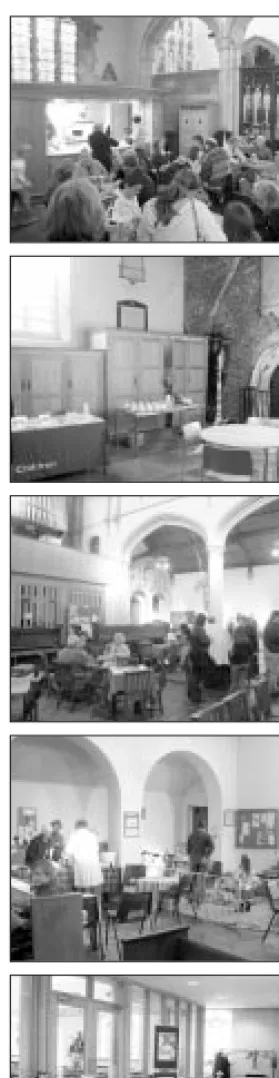
Roman Catholic churches, and high and lofty pulpits from nonconformist ones. Pipe organs and choirs and hymn books have also been in retreat; and bands and singing groups and projection screens have been replacing them. Corporate worship is now followed with fellowship over coffee, and although this is not always easy to accommodate in old buildings designed for a different purpose, virtually every church in Salisbury has made a space for refreshments (Fig 37).
The churches today have had to adapt: they can no longer rely on regular church-attendance being ‘amongst the recognised proprieties of life’.What, then, is the level of current attendance?
Attendance in 2006
About 4,000 people attended church in central Salisbury and Fisherton on Sunday morning in March 1851, from a population of approximately 11,500.Today, some one hundred and fifty years later, the total number going to church on a given Sunday over the whole city is a few hundred less, but is drawn from a population some three and a half times larger, at about 40,000.69 Approximately 9% of the Salisbury population are in church, chapel or cathedral on any given Sunday. This is somewhat higher than the national average. (As discussed earlier, this understates commitment, because not all church-goers attend church every Sunday).70
On Sunday, the churches in the centre are (on average) about fifty percent full.This is much the same as in 1851 as capacity has been drastically cut since then. Many of them attract worshippers from the suburbs and further afield, so churches on the periphery tend not to be so full.
Over the past one hundred years, church attendance has been trending down, and if this were to continue it is unlikely that Salisbury would be immune. This would put some of Salisbury’s church buildings under pressure. Perhaps some already are, though the general level of threat seems less acute than in some other urban areas.Would the loss of buildings matter? Who would mind if Salisbury’s churches and chapel buildings disappeared?
5. Keeping what matters
We know that in general people do value their local church buildings, and for a variety of reasons.71 But how – if at all – should this be translated into action?
As we have seen, the story of churches and chapels in central Salisbury is one of continual gain and loss (see Fig. 6). There are many ghosts in the city centre. Nonconformists have moved around.Anglicans have opened and closed buildings.There can be no point in time at which it is obvious that from then on, everything should be kept. Preservation means choice.
And here we hit the nub of the problem.Whose choice? What has any of this to do with the non-church-going Salisbury citizen, who may like the buildings, but does not pay for them? Why should the future of these buildings not be entirely driven by the volunteers (congregations) who put their hands in their pockets? At the moment, public concern for the preservation of the buildings is spoken for mainly through the statutory ‘listing’ of the most important examples.72But listing is imperfect in its coverage, with large gaps, especially for nonconformist and Roman Catholic buildings.73And although listing does confer eligibility for VAT refunds on many repairs, and allows entry into an annual competition for grants for certain repairs, it does not of itself ensure that congregations are able to look after their churches or maintain them for public use.74
An example is the chapel in Milford Street (Fig. 17). The Grade II listing description refers to its ‘fine interior’. But that did not prevent the building being closed for worship in the late 80s.
Fig. 39 Recent pictures of the interior of the Chapel nightclub in Milford Street. Considerable care has gone into preserving and restoring the interior. Bottom left, the organ and the pulpit. The pulpit is now the DJ’s rostrum, and there are railed dancing podia on either side.
Bottom right, looking over the DJ’s rostrum to the body of the building, showing gallery, pews and dance floor. The central area has been cleared of pews; the remaining pews have been alternately reversed, to provide seating areas.
It then came close to being moved lock, stock and barrel to Pangbourne College as a war memorial chapel – a drastic form of preservation – but was finally put up for sale at open auction. Being listed provided protection, and the owner of what is now the Chapel Nightclub has taken considerable care to restore and maintain the interior, and the organ, pulpit, gallery and many of the pews remain in place (Figs. 38, 39). Dancing of an energetic character takes place many nights of the week in a cleared area in the centre of the chapel, the whole space being appropriately lit and decorated.The space is popular with customers.The venue is also used from time to time for quieter events, including training courses. Thus although no longer used for worship, the interior has been preserved, with an owner who cares about it, in a context which appears to be commercially sustainable. Does it matter that much of its current use might be thought to go against the grain of the building (Fig. 40)?75
Listing is not intended to capture all aspects of the value which the general public place on church buildings in towns. For example, the frontage of the nonconformist (Emmanuel) building in Wilton Road figures heavily in the listing description (Grade II), and rightly so (Fig. 14). Yet the church’s public provision of a hall for a mothers and toddlers group and similar activities may also be worth preserving (Fig. 41).
Again, how much would St Michael’s, Bemerton Heath (Figs. 27, 28) be missed for the sense of place it gives, high on a downland rise, probably valued even by those who have never been inside? Yet it is not listed. And which of the two other Bemerton churches are more important to the general public? – the tiny St Andrew’s, with its Herbert associations, and steady flow of visitors? or the somewhat-too-large St John’s, a fine building by a competent architect, and popular for weddings (Fig. 21). Both are listed at the same high grade (Grade B). St John’s has needed expensive repairs in the recent past, and has in the past been considered for closure; and St Michael’s has a long-standing problem with its brickwork, not yet fully sorted out. Whatever importance is notionally attached to these three Bemerton buildings by the general public, the fact remains that just ninety people have signed up to take full financial responsibility for them.76
We have to ask, what aspect of their churches and chapels is it that the citizens of Salisbury – and not just Salisbury, but town and city dwellers in general – might wish to act to preserve? Is it the contribution to the streetscape and the monumentality of the buildings? the embedded history? the sense of place? the community aspects of the work centred on the buildings? the public space? the values implied by the presence of religious Fig. 42 Forthcoming events open to
the public shown on the Methodist church notice board.
Fig. 40 The Chapel Nightclub in use.
amongst secular buildings? the ability to enjoy fine architecture in its original state? rooms and halls for hire (Fig.42)? places for rites of passage and civic ceremonies and carol services? the signs of continuity? the tourism value (Fig. 43)?
Salisbury shows that we need a debate to clarify what is valued about urban church buildings, and how best to shape the future of those we set store by. Perhaps we will need fresh forms of local engagement between citizens and church congregations, defining shared responsibilities, and putting new partnerships in place. As patterns of church-going change, we must take care not to lose treasured buildings by accident. Surely we too must show ourselves to be ‘worthy of the age in which we live’?
Acknowledgments
The views expressed here are my own, not those of the Ecclesiological Society.The faults are mine also and I welcome corrections. I am grateful to Sarah Brown,Thomas Cocke, John Elliott, and Christopher Wakeling for discussions on various points in this paper, and for advice and help received from Anthony Hudson (previously Headmaster of Pangbourne College), Tony Whale of the Chapel Nightclub, Bruce Purvis of the Salisbury Reference Library, Paul Connell of the Wiltshire Local Studies Library, and Martyn Henderson and his colleagues in the Wiltshire and Swindon Record Office. I have also received both information and kindness from members of many of the churches discussed here. Except where stated below, the photographs are my own.
I am grateful to the following for permission to reproduce illustrations (Fig. numbers shown in brackets): the British Library (5); the Chapel Nightclub (39a & b, 40); Elim church (Dews Road) (16b); Incorporated Church Building Society (22); Michael Drury Architects (35a); National Monuments Record (1, 3, 4b, 7b, 18b & c, 36a); St Edmund’s Arts Centre (4c); St Francis’s church (30a & b); St Martin’s church (35b); St Paul’s church, Fisherton (34); Salisbury Baptist church (Brown Street) (36a); Salisbury Museum (13); Salisbury Reference Library (9a, 15, 32); Swindon and Wiltshire Record Office (4a, 19a, b, & c, 29b); University of London (23); Wiltshire Local Studies Library (2, 4d, 11, 29a).
Notes
1 Constraints of time mean I have largely relied on secondary sources. There is significant primary material which I have not inspected, and I am also uneasily aware that I have not taken full account of relationships between the different denominations and congregations, the impact of individual clergy, the wider political and social context, the symbiosis between school and church, and the various ways in which church premises were used. I have excluded chapels in almshouses and other institutions, and have restricted discussion to those Christian denominations accepting the Trinitarian formula, thus excluding the Spiritualist Church, Jehovah’s Witnesses, the Church of Jesus Christ of Latter-day Saints, the Church of Christ, Scientist, the Swedenborgians, and the Christadelphians. Of the