An Exploratory Investigation on the
Challenges to the New Brazilian
Automotive Suppliers
Giancarlo Medeiros Pereira
Universidade do Vale do Rio dos Sinos (UNISINOS) São Leopoldo, RS, Brazil
E-mail: [email protected]
Albert Geiger
Instituto Gaúcho de Estudos Automotivos (IGEA) Porto Alegre, RS, Brazil
E-mail: [email protected]
Abstract
This paper analyzes the B2B (business-to-business) relationships between big and small or medium-sized enterprises in the automotive sector in Brazil to tentatively identify the challenges that hinder the insertion of SMEs (small and medium-sized nterprises) in this supply chain. This multiple case study analyzed the largest car part manufacturers and the largest car assembly plants located in the state of Rio Grande do Sul, Brazil. This was followed by studies of small and medium-sized businesses that had been indicated by the executives of the large companies studied. The objective was to answer the question: why are very few SMEs successful in their attempts at inserting themselves in the automotive supply chain. As identified, the main challenges faced by SMEs that do not operate in the auto chain are: the differences in the organizational objectives and the little know-how about the reality of B2B transactions in this sector.
Keywords: supply chain management, automotive industry, SMEs
Introduction
a part, with low technical requirements (simple brackets, shafts, frameworks and others). As a result, many SMEs (small- and medium- sized enterprises) previously inactive in this productive chain have become responsible for the production of non-strategic items.
Usually neglected by researchers, non-strategic items represent around 40% of the total items assembled in a car, but only 8% of the cost of the vehicle (Pereira and Geiger, 2005). Considering that there are over 15,000 components in an “average” automobile (Pérez and Sanchez, 2001) and the low impact on the cost of those items, it is reasonable to say that SMEs have an important role in enabling the new productive strategies of first- and second-tier suppliers (Krause, 1997; Humphrey et al., 2000; Tan and Wisner, 2003).
However, the actual majority of buyer-supplier relationships concerning non-strategic items is not marked by a cooperative attitude. On the contrary, it has been considered, by authors such as Cousins and Crone (2003); and Kozan et al. (2006), as “unilateral”, and marked by the power of the “contractor”.
Considering that this situation may be influenced by other elements not yet thoroughly investigated, this article presents the results of an exploratory case study developed aiming to identify: Which other constraints hinder the inclusion of SMEs in this productive chain? Answering this question will shed new light in the challenges that the new entrants in the chain have to face.
Theoretical Framework
The high level of complexity, dynamism and uncertainty that large companies have been facing in the last years has forced firms to review their competitive priorities, triggering a transition process in which they are giving up traditional manufacturing models, adopting new organizational forms, new management practices and new strategies on all levels (Vázquez-Bustelo and Avella, 2006). In the automotive industry, companies have “organized” their suppliers into structured tiered networks, as reported by Takeuchi and Nonaka (1986) and Imai et al. (1985), namely: “primary” (or first tier) and “secondary” (or second tier) subcontractors. The second tier group is supposed to supply the first tier, which is supposed to supply an auto assembler, which plays the role of a focal company of the array. Based on cost–benefit analysis (between in-house and contracted-out production), many manufacturing functions have been transferred to the independent operators and subcontractors (Kotabe and Murray, 2004; Alves Filho et. al., 2002; Rachid et al., 2001).
models has also forced them to outsource a share of their activities to smaller organizations (Mudambi and Helper, 1998).
This outsourcing process eliminates the need for specific investments in the first- and second-tier part suppliers (Canez et al., 2001), while reducing the risks of obsolescence of a specific technology. Actually, production technology obsolescence is a potential problem in low-cost, customized items, with small or medium production volumes, and low technical requirements (such as simple brackets, shafts, frameworks and others). In this context, those “simple” items are classified as non-strategic and are delegated by the large part manufacturers to SMEs, most of them selling their surplus capacity to large organizations in different supply chains.
Considering the facts about non-strategic items assembled in a vehicle it is possible to identify the importance of the role played by SMEs in enabling the new productive strategies of large part manufacturers in the automotive sector (Krause, 1997; Humphrey et al., 2000; Tan and Wisner, 2003). On the other hand, Tuten and Urban (2001) have pointed out that SMEs benefit from this process, as this relationship provides a better use for their productive capacity, while Hondai (1992), Hayashi (2000) and Hayashi (2002) claim that such interaction leads to greater technological and managerial development in SMEs, as a result of the paradigms required by large global corporations.
Analyzing the elements described, it is possible to identify another level of the automotive supply chain that is usually ignored by researchers of this sector, namely a level made up of a large number of small- and medium-sized enterprises that are also active in other business fields, and which sell their excess capacity to large manufacturers of car parts. These SMEs are an essential constituent of the decentralization strategy of the large part producers, particularly during periods of uncertainty.
Relationship between companies in the auto chain
declarations of friendship and faithfulness, the fundamental rules of economics cannot be ignored or broken.
The interaction of elements described above has led to a situation that Kamp (2005) called the “instability of B2B relationships”, which in turn resulted in a lack of confidence by the suppliers and the buyers in the longevity of standing business relationships. The author also recognizes that the instability in the network composition may generate new costs, whereas substituting suppliers offering insufficient added value improves a network’s overall competitiveness.
Another problem in the relationship developed among large part producers and SMEs is the imbalance of power, which in turn may enhance the SMEs’ fear of unilateral dependence, thus reducing its autonomy and power (St-John and Heriot, 1993). This perception is supported by the fact that a supplier of non-strategic items, even when their quality is considered as outstanding, may find it strategically unattractive to be a dependent partner in an arrangement owned by the buying company (Freytag and Mikkelsen, 2007). In this situation, the SME owner-manager is likely to adopt a defensive attitude toward integrated logistics into the auto chain, because of the risk of losing freedom and being imposed standards.
Outline of the scientific opportunity of this research
Reflecting on the topics described above, it is possible to conclude that the imbalance of power described may be insufficient to explain the rejection by some SMEs of the large companies’ proposals, especially if we consider the strategic importance of those small units to their operational strategies. Aiming to identify elements that are influencing the decision of SMEs not to take part in automotive supply-chains, we have performed a full revision of the articles published through the last ten years in the Journal of Business and Industrial Marketing and the Industrial Marketing Management. This analysis has revealed articles focused on issues such as value creation, value measurement, B2B relationships, CRM, trust, commitment, relationship quality, power, conflict management, channel management, reverse auctions, governance, and others.
Research Method
The question that had guided this study was: Why are very few SMEs successful in their attempts at inserting themselves in the automotive supply chain, in spite of all good perspectives identified? In order to answer this question, and bearing in mind the importance of the direct involvement of the researcher in the data collection process, this study was designed as an investigation based on the method of multiple holistic case study as proposed by Yin (2001) and Miguel (2007). The study will have an exploratory character, since a theory about the challenges has not been consolidated yet.
Internal validity
Observations made over a period of three years, during which the researchers took part in the Automotive Marketing Committee of the Federation of Industries, have been coupled with an analysis of documents, which made up the additional source of evidence used to collect information for the research, as instructed by Yin (2001) and Miguel (2007).
Construct validity
As proposed by Strauss and Corbin (1990), the information gathered at all stages has been cross-checked in order to consolidate the adopted constructs, before data analysis, which followed Eisenhardt’s model (1989). First, the data collected from each of the cases is analyzed. This is followed by an analysis along the range of cases investigated. The final analysis was based on the dynamic matrix proposed by Miles and Huberman (1994). The final result obtained by this process has also been carried out in accordance with the research guidelines for case study research proposed by Voss et al. (2002) and Miguel (2007).
External validity and generalizability
The results of this study are limited to companies and the surrounding conditions described. In this case, the results presented can not be generalized beyond these domains. In fact, generalizability can only be claimed through a large number of replications in different contexts and industries, at different times, which is not the case.
Data collection
Table 1 presents a description of the large companies interviewed.
The interviews followed a common protocol: people from the large companies were first asked to answer some introductory questions. After that, more specific questions were asked about the problems in the supply chain and the relationship with SMEs. The results of the interviews were then sent back to the respondents in order to give them the opportunity for factual corrections.
The second stage of the research was performed before processing data from the interviews and involved 20 SMEs recommended by the executives of the large companies. The first ten SMEs have already been active in the chain and had been shortlisted by the large companies as reference suppliers, while the remaining ten were considered as potential suppliers, which for a number of reasons had been rejected in the qualification processes. In all SMEs, the interviews were conducted directly with the owners or general managers.
Table 2 presents a description of the SMEs interviewed.
Reliability
In order to ensure the reliability of this study, a written document describing the constructs to be measured was developed and tested with the managers. However, the replications verified through the process did not require a revision of this document. All information gathered during the study was saved on a database.
Constructs and propositions
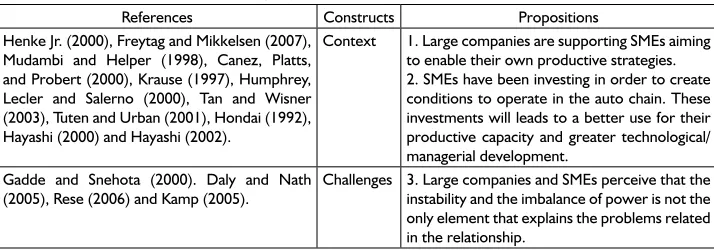
The analysis of the references presented in the theoretical framework leads to the conclusion that two groups of constructs emerge from the literature, namely: “context” and “challenges”.
Table 1 - The large companies interviewed.
Company Number of companies interviewed
Product
Manufacturers of the First and Second tier
of suppliers of the automotive industry 6 Pumps, shafts, engine components or drive trains
Truck manufacturer 1 Trucks for special purposes
Bus manufacturer 1 Customized units
Tractor manufacturers 2 Tractors for general and special purposes
Table 2 - The SMEs interviewed.
Product or service Companies active in chain Companies not active in chain
Machining 3 2
Forging 1 2
Die cast mould 2 1
Rubber 2 3
The construct “context” is related to the mutual benefits presented in the literature, which could suggest that both groups of companies are investing their own resources aiming to optimize the relationship in focus. In this context, is reasonable to make the following propositions:
• Large companies are supporting SMEs aiming to enable their own productive strategies; and
• SMEs have been investing in order to create conditions to operate in the auto chain. These investments will leads to a better use for their productive capacity and greater technological/managerial development.
Besides that, the construct “challenges” emerge of the references that relate several problems in the relationship between large companies and SMEs. Since these problems may act as a barrier to the SMEs in the auto chain, it is reasonable to propose:
• Large companies and SMEs perceive that the instability and the imbalance of power are not the only elements that explain the problems related in the relationship. The references that lead to the constructs and propositions described are presented in Table 3.
In order to investigate the propositions yet described, an investigation protocol was organized. The introductory questions of this protocol are presented in the Appendix.
The next section presents a summary of the information gathered.
Data Gathering
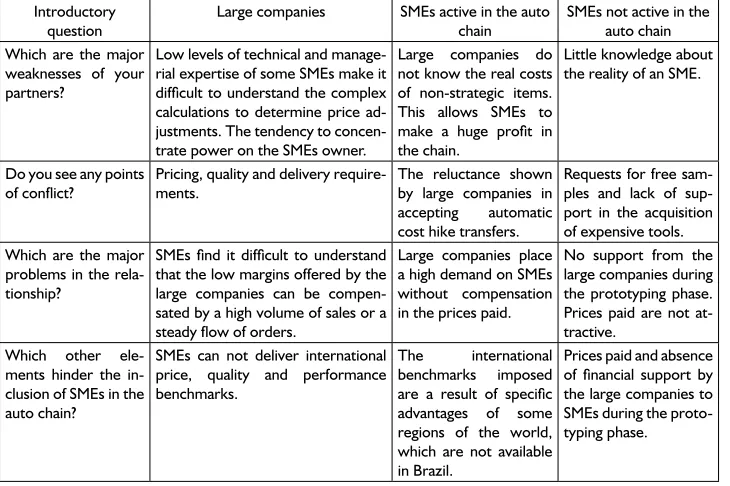
Data gathered was grouped by the authors in constructs (context and challenges) as presented in the Tables 4 and 5. As may be seen in these tables, both groups of companies have different visions regarding the questions proposed. Actually, this was already expected by the researchers. Nevertheless, the most surprising aspect identified is the difference in perceptions between SMEs that are active in the auto chain and the SMEs that are not active. As showed in the analysis presented in the next chapter, this difference in perception may also represent a challenge to the SMEs that are not active in the chain. Table 4 presents a summary of the data gathered.
Table 3 - References, constructs and propositions.
References Constructs Propositions
Henke Jr. (2000), Freytag and Mikkelsen (2007), Mudambi and Helper (1998), Canez, Platts, and Probert (2000), Krause (1997), Humphrey, Lecler and Salerno (2000), Tan and Wisner (2003), Tuten and Urban (2001), Hondai (1992), Hayashi (2000) and Hayashi (2002).
Context 1. Large companies are supporting SMEs aiming to enable their own productive strategies. 2. SMEs have been investing in order to create conditions to operate in the auto chain. These investments will leads to a better use for their productive capacity and greater technological/ managerial development.
Gadde and Snehota (2000). Daly and Nath (2005), Rese (2006) and Kamp (2005).
Data Analysis
The analysis of the data gathered suggested that the important challenges result from the differences in the objectives of each group of companies and the little know-how of inactive SMEs about the reality of B2B transactions in the chain. Considering the number of “non-strategic” items assembled in a car and its impact on the vehicle’s cost (see the Theoretical Framework chapter), it is reasonable to admit that the SMEs active in the chain are correct when they say that some large companies do not know the true costs of all
Table 4 - Data gathered – construct context.
Introductory questions Large companies SMEs active in the auto chain
SMEs not active in the auto chain What is the main objective
that guides the actions of your company when interact-ing with your partners?
To identify new cheap SME sup-pliers for low-cost customized items with small or medium production volumes and low technical requirements.
To reduce the pro-duction idleness with an attractive profit margin.
To have a profit margin and a standard of ser-vice similar to those practiced in other pro-ductive chains. How do you see the
perspec-tives of this relationship? The large companies will keep pressing SMEs for better in-dexes on low-cost, customized items with small or medium production volumes, and low technical requirements, until the imports become attractive for those items.
Good, if the SMEs do not allocate the full production capacity of their units to the large companies.
Unattractive since SMEs can find other business opportuni-ties that offer better returns.
Table 5 - Data gathered – construct challenges.
Introductory question
Large companies SMEs active in the auto chain
SMEs not active in the auto chain Which are the major
weaknesses of your partners?
Low levels of technical and manage-rial expertise of some SMEs make it difficult to understand the complex calculations to determine price ad-justments. The tendency to concen-trate power on the SMEs owner.
Large companies do not know the real costs of non-strategic items. This allows SMEs to make a huge profit in the chain.
Little knowledge about the reality of an SME.
Do you see any points
of conflict? Pricing, quality and delivery require-ments. The reluctance shown by large companies in accepting automatic cost hike transfers.
Requests for free sam-ples and lack of sup-port in the acquisition of expensive tools. Which are the major
problems in the rela-tionship?
SMEs find it difficult to understand that the low margins offered by the large companies can be compen-sated by a high volume of sales or a steady flow of orders.
Large companies place a high demand on SMEs without compensation in the prices paid.
No support from the large companies during the prototyping phase. Prices paid are not at-tractive.
Which other ele-ments hinder the in-clusion of SMEs in the auto chain?
SMEs can not deliver international price, quality and performance benchmarks.
The international benchmarks imposed are a result of specific advantages of some regions of the world, which are not available in Brazil.
“non-strategic” items assembled in their auto parts. In this context, only the SMEs active in the chain can capitalize in the profitable items to subsidize the non-profitable ones and keep the relationship going.
With time, the SMEs that are active in the chain will try to convince large companies to offer those items to SMEs that are not active in the chain. Faced with non-profitable items, the SMEs that are not active will prefer to refuse the offer, reinforcing and even consolidating their false perception about the low attractiveness of the chain, in circular thinking. In fact, these obstacles are responsible for many small indigenous firms viewing the inclusion into the auto chain with great skepticism, as well as neophyte entrants developing a negative attitude toward the practices in the sector. At the same time, this context also reinforces the position and price policies of SMEs active in the chain, since the refusals force the large companies to buy those items from their traditional SME suppliers.
The expectation for financial support expressed by SMEs that are not active in the chain is also another important challenge. Indeed, the prices, the request for free samples and the lack of financial support from large companies for the purchase of expensive tools clashes with the desire for “quick profits” voiced by owners of this group of SMEs.
Besides that, the global presence of large part manufacturers exposes local SMEs to international price benchmarks. This pressure does not take into account that the benchmarks considered are a result of the very specific competitive advantages of some regions of the world, which might not apply to the situation in Brazil. The lack of technical and managerial expertise of some SMEs, associated with high performance demands regarding pricing, dictated by global benchmarks, can drive away many local organizations.
However, this challenge is in some cases merely a result of the lack of information by SMEs, which may be unaware of the real intentions of large companies. Actually, some large corporations resort to these approaches with the sole objective of pressing local SMEs for lower costs not having intention of importing items, because of the requirements made by foreign suppliers (especially in terms of quantities and accuracy of forecasts). In fact, these requirements are sometimes in direct opposition to the need for flexibility dictated by the oscillating Brazilian market. Accordingly, a procurement manager states that what large organizations wish for is a local SME that can handle the production of a given item according to “favorable” price conditions. Again, this situation generates a challenge to the SMEs not active in the chain, since those companies do not know the rules of the game.
Proposition’s Analysis
Regarding the second proposition, only the SMEs that are active in the chain will invest to develop new business in the sector. SMEs that are not active in the chain do not plan to invest, since this group of enterprises does not know the unwritten rules of the game in the auto sector. The proposition focused on instability and imbalance of power was confirmed.
Conclusions
Aiming to answer the question “Why are very few SMEs successful in their attempts at inserting themselves in the automotive supply chain, in spite of all good perspectives identified?” this investigation analyzed large buyers of the auto industry and small and medium-sized suppliers that are active or inactive in this chain.
As identified, SMEs that do not operate in the auto chain may face some difficulties to find a point of insertion in the automotive chain as a result of the following challenges: differences in the organizational objectives and little know-how about the reality of B2B transactions in this sector. The non-profitable items offered by large companies to SMEs that are not active in the chain, the lack of financial support from large companies, the high performance demands regarding prices imposed by the big buyers and the lack of technical and managerial expertise of SMEs are some of the elements associated to these challenges that were identified in this study.
Indeed, these challenges unveil some pending questions that must be solved in order to create a more attractive scenario to small and medium-sized companies in this chain.
References
ACS, Z.J. (1992), “Small Business Economics, A Global Perspective”, Challenge, Vol. 35, No. 6, pp. 38–44.
Alves Filho, A.G. & Rachid, A. & Donadone, J.C. et al. (2002), “Assembler control of the supply chain, the case of an engine plant in Brazil”, Actes du GERPISA, Vol. 33, No. 1, pp. 49-60.
Alves Filho, A. G. & Cerra, A.L. & Maia, J.L. et al. (2004), “Pressupostos da Gestão da Cadeia de Suprimentos, evidências de estudos sobre a indústria automobilística”, Gestão e Produção, Vol. 11, No. 3, pp. 275-288.
Canez, L. & Platts, K. & Probert, D. (2001), Make or Buy: A Practical Guide to Industrial Sourcing Decisions, Institute for Manufacturing, University of Cambridge, Cambridge. Collins, R. et al. (1997), “Outsourcing in the Automotive Industry, from JIT to Modular
Consortia”, European Management Journal, Vol. 15, No. 5, pp. 498-508.
Daly, S., Nath, P. (2005), “Reverse auctions for relationship marketers”, Industrial Marketing Management, Vol. 34, No. 2 , pp. 157-166.
Eisenhardt, K.M. (1989), “Building theory from case study research”, Academy of Management Review, Vol. 14, No. 4, pp. 532-550.
Freytag, P. and Mikkelsen, O. (2007), “Sourcing from outside, six managerial challenges”, Journal of Business & Industrial Marketing, Vol. 22, No. 3, pp. 187-195.
Gadde, L. and Snehota, I. (2000), “Making the Most of Supplier Relationships”, Industrial Marketing Management, Vol. 29, No. 4, July, pp. 305-316.
Grisi, C.C. and Ribeiro, A.H. (2004), “Supplier manufacturer relationships in the Brazilian auto industry, An exploration of distinctive elements”, Journal of Business & Industrial Marketing, Vol. 19, No. 6, pp. 415-420.
Hayashi, M. (2000), “Support mechanisms for the development of SMEs in Indonesia, the case of automotive and motorcycle parts industry”. In: Harvie, C. and Lee, B. (Eds.), SMEs in East Asia in the aftermath of the Asian financial crisis: Proceedings for SMEs in a Global Economy Conference, Wollongong, University of Wollongong.
Hayashi, M. (2002), “The role of subcontracting in SME development in Indonesia: Micro level evidence from the metalworking and machinery industry”, Journal of Asian Economics, Vol. 13, No. 1, pp. 1-26.
Henke Jr., J. (2000), “Strategic Selling in the Age of Modules and Systems”, Industrial Marketing Management, Vol. 9, No. 3, pp. 271-284.
Hondai, S. (1992), Dai-kigyo to Chusho-kigyo no Doji Seicho, Kigyo-kan Bungyo no Bunseki (The simultaneous growth of large- and small/medium-scale firms: analysis of inter-firm specialization), Tokyo, Dobunkan.
Humphrey, J. & Lecler, Y. & Salerno, M.S. (2000), Global strategies and local realities, the auto industry in emerging markets, Macmillan, London.
Imai, K. & Nonaka, I. & Takeuchi, H. (1985), “Managing the new product development process, How Japanese companies learn and unlearn”. In: K. Clark, R. H. and Lorentz, C. (Ed.), The uneasy alliance, Managing the productivity-technology dilemma, Harvard Business School Press, Cambridge, MA, pp. 337-381.
Kamp, B. (2005), “Formation and evolution of buyer supplier relationships, Conceiving dynamism in actor composition of business networks”. Industrial Marketing Management, Vol. 34, No. 7, pp. 658-668.
Kotabe, M. and Murray, J. (2004), “Global sourcing strategy and sustainable competitive advantage”, Industrial Marketing Management, Vol. 33, No. 1, pp. 7-14.
Kozan, M.K. & Wastis, S.N. & Kuman, A. (2006),“Management of buyer–supplier conflict, The case of the Turkish automotive industry”, Journal of Business Research, Vol. 59, No. 6, pp. 662-670.
Light, L. (1993), “Small Businesses, The Job Engine Needs Fuel”, Business Week, March 1, 78 pages.
Miguel, P.A.C. (2007), “Estudo de caso na engenharia de produção, estruturação e recomendações para sua condução”, Produção, Vol. 17, No. 1, Jan- Abril.
Miles, H. and Huberman, M. (1994), Qualitative Data Analysis, A Sourcebook, Sage Publications, Beverly Hills.
Mudambi, R. and Helper, S. (1998), “The close but adversarial model of supplier relations in the U.S. auto industry”, Strategic Management Journal, Vol. 19, pp. 775-792. Pereira, G. and Geiger, A. (2005), “Complexidade do produto e volume de produção como
determinantes da estratégia de desenvolvimento de fornecedores automotivos”, Gestão & Produção, Vol. 12, No. 2, pp. 1-20 (in Portuguese).
Pérez, M. and Sánchez, A. (2001), “Supplier relations and flexibility in the Spanish automotive industry”, Supply Chain Management, An International Journal, Vol. 6, No. 1, pp. 29-38.
Pires, S.R.I. (1998), “Managerial Implications of the Modular Consortium model in a Brazilian Automotive Plant”, International Journal of Operations and Production Management, Vol. 18, No. 3, pp. 221-232.
Rachid, A. & Bresciani Filho, E. & Gitahy, L. (2001), “Relações entre grandes e pequenas empresas de autopeças e a difusão de práticas de gestão da produção”, Gestão & Produção, Vol. 8, No. 3, pp. 319-333.
Rese, M. (2006), “How to select the right partners”, Industrial Marketing Management, Vol. 35, No. 1, pp. 72-82.
Strauss, A. and Corbin, J. (1990), Basics of Qualitative Research, Grounded Theory Procedures and Techniques, Sage Publications, Newbury Park.
Takeuchi, H. and Nonaka, I. (1986), “The new product development game”, Harvard Business Review, January/February, pp. 137- 146.
Tan, K. and Wisner, J. (2003), “A study of operations management constructs and their relationships”, International Journal of Operations and Production Management, Vol. 23, No. 11, pp. 1300-25.
Tuten, T. and Urban, D. (2001), “An Expanded Model of B2B Partnership Formation and Success”, Industrial Marketing Management, Vol. 30, No. 2, pp. 149-164.
Vázquez-Bustelo, D. and Avella, L. (2006), “Agile manufacturing, Industrial case studies in Spain”, Technovation, Vol. 26, No. 10, pp. 1147-1161.
Voss, C. & Tsikriktsis, N. & Frohlich, M. (2002), “Case research in operations management”, Journal of Operations and Production Management, Vol. 22, No. 2, pp. 195-219. Yin, R. (2001), Case study research, Sage, London.
Biography
Giancarlo Medeiros Pereira is a professor at Universidade do Vale do Rio dos Sinos (UNISINOS). He received his master degree from the Universidade Federal do Rio Grande do Sul (UFRGS) and his Ph.D. from the Universidade de São Paulo (USP). His researches are focused on Operations Management, Industrial Marketing and Supply Chain Management and Innovation.
Appendix
Table1 – Introductory questions.
Constructs Propositions Introductory Questions
Context 1. Large companies are supporting SMEs aim-ing to enable their own productive strategies. 2. SMEs have been investing in order to create conditions to operate in the auto chain. These investments will leads to a better use for their productive capacity and greater technological/ managerial development.
What is the main objective that guides the actions of your company when interacting with your partners?
How do you see the perspectives of this relation-ship?
Challenges 3. Large companies and SMEs perceive that the instability and the imbalance of power is not the only element that explains the prob-lems related in the relationship.
Which are the major weaknesses of your partners? Do you see any points of conflict?
Which challenges hinder SME inclusion into the auto chain?
Which are the mechanisms used for hindering the inclusion of SMEs in the auto chain?
The concept of the challenge adopted by the authors and proposed to the participants was: constraint that hinders the firm’s ability to initiate, to develop, or to sustain business relationships in the auto chain.
All questions listed were proposed to both groups of companies. The following questions were also proposed to the executives of the large companies at the end of the meetings:
• Can you provide a list of your best SME suppliers?