(UDC:624.073.132)
Vibrations of isotropic, orthotropic and laminated composite plates with
various boundary conditions
M. Ćetković 1*, Đ. Vuksanović2
1Faculty of Civil Engineering, University of Belgrade, Bul. kralja Aleksandra 73, 11000 Belgrade, Serbia
2Faculty of Civil Engineering, University of Belgrade, Bul. kralja Aleksandra 73, 11000 Belgrade, Serbia
Abstract
In this paper Generalized Layer Wise Plate Theory of Reddy (GLPT) is used to formulate an isoparametric finite element model for free vibrations of isotropic, orthotropic and laminated composite plates. With the assumed displacement field, linear strain displacement relations and linear elastic orthotropic material properties for each lamina, governing differential equations of motion are derived using Hamilton‘s principle. Virtual work statement is then utilized to formulate isoparametric finite element model. The original MATLAB computer program is coded for finite element solution. The parametric effects of plate aspect ratio b/a, side-to-thickness ratio a/h, degree of orthotropy E1/E2 and boundary conditions on free vibration response of isotropic, orthotropic and anisotropic plates are analyzed. The accuracy of the present formulation is demonstrated through a number of examples and by comparison with results available from the literature.
Keywords: free vibration analysis, layerwise finite element, boundary conditions
1. Introduction
Structural members made of fiber reinforced laminated composite plates, like those in automobile, bridge, submarine and aircraft industry are often subjected to dynamic loads. In structural applications two types of dynamical behavior are of primary importance: free vibrations and forced response. Free vibrations are motions resulting from specified initial conditions in the absence of applied loads, while forced vibrations are motions resulting from specified inputs to the system from external sources [Cook et. al. 2002]. Since forced vibrations response strongly depend on the values of free vibration parameters, like natural frequencies and mode shapes of vibration, and for given amplitude of loading, dynamic response may sometimes be greater than static response, in this paper only free vibrations are considered.
M. Šetkoviš and Đ.Vuksanoviš: Vibrations of Isotropic, Orthotropic and Laminated Composite Plates
84
etc.), which may require natural or geometric, homogeneous or no homogeneous boundary conditions, nature of boundary conditions in composite laminates depend also on level of analysis (linear, nonlinear), as well as on lamination scheme.
In order to mathematically describe complex anisotropic nature of composite laminates and find most computationally efficient solution, different approaches are reported in literature. Most of them are restricted to simply supported boundary conditions, specific lamination schemes and linear mechanical problem, which enable use of analytical methods in finding appropriate solution. However, when solution of mathematical model for different lamination schemes and different boundary conditions is needed, approximate methods should be used. Indeed, literature lacks relevant studies for three dimensional analyses involving boundary conditions which are different from simply supported ones along with multilayered architecture. More ever it is worth mentioning that a simply supported boundary condition is far from an easy realization in laboratory. The real model often needs an identification of true boundary conditions which are usually in the middle of the other classical boundary conditions, such as simply supported, clamped, free or their combination [Messina A. 2011].
Free vibration response of composite plates is closely related to the assumed shear deformation pattern. It has been shown that Equivalent Single Layer (ESL) theories yield good predictions when material properties of adjacent layers do not differ significantly. However, since they use continuously differentiable function of thickness coordinate, they are unable to account for severe discontinuities in transverse shear strains that occur at the interfaces between the layers with drastically different stiffness properties. In these cases, the local deformations and stresses, and sometimes even the overall laminate response, such as fundamental frequencies are not well predicted. In wish to overcome the shortcomings of ESL theories, and reduce the computational cost of 3D elasticity theory, discrete layer or layer wise (LW) theories have been proposed. These theories are based on unique displacement field for each layer and with the use of post processing procedure may enforce the interlaminar continuity of transverse shear stresses.
2 Theoretical formulation 2.1 Displacement field
A laminated plate composed of
n
orthotropic lamina is shown on Fig 1. The integer kdenotes the layer number that starts from the plate bottom. Plate middle surface coordinates are
x,y,z
,while layer coordinates are
xk,yk,zk
. Plate and layer thickness are denoted as h andh
k, respectively. It is assumed that 1) layers are perfectly bonded together, 2) material of each layer is linearly elastic and has three planes of materials symmetry (i.e., orthotropic), 3) strains are small, 4) each layer is of uniform thickness and 5) inextensibility of normal is valid.The displacements components
u1,u2,u3
at a point
x,y,z
can be written as:
. ) , ( ) , , ( , ) , ( ) , , ( , ) , ( ) , , ( 3 1 1 2 1 1 1 y x w z y x u z y x V y x v z y x u z y x U y x u z y x u N I I I N I I I
, (1)
where
u,v,w
are the displacements of a point
x,y,0
on the reference plane of the laminate,I
U and VI are undetermined coefficients, and I
z are layerwise continuous functions ofthe thickness coordinate. In this paper linear Lagrange interpolation of in-plane displacement components through the thickness is assumed.
2.2 Strain-displacement relations
The Green Lagrange strain tensor associated with the displacement field Eq.(1) can be computed using linear strain-displacement relation as follows:
1 1 2 3 1 2 1 N I I I xx x U x u x u x u ,
1 1 2 3 2 2 1 N I I I yy y V y v y u y u ,
1 1 3 3 2 1 N I I I I xy x V y U x v y u y u x u x u y u, (2)
x w dz d U x u z
u N I
I I xz
1 1 3 1 , y w dz d V y u zu N I
I I yz
1 1 3 2 .2.3 Constitutive equations
M. Šetkoviš and Đ.Vuksanoviš: Vibrations of Isotropic, Orthotropic and Laminated Composite Plates
86
k
yz xz xy yy xx k k yz xz xy yy xx Q Q Q Q Q Q Q Q Q Q Q Q Q 55 45 45 44 33 23 13 23 22 12 13 12 11 0 0 0 0 0 0 0 0 0 0 0 0
. (3)
where σ k
xx yy xy xz yz
kTand
kT yz xz xy yy xxk
ε are stress
and strain components respectively, and k ij
Q are transformed elastic coefficients, of k-th lamina in global coordinates.
2.4 Equilibrium equations
Equations of motions are obtained using Hamilton‘s principle, by neglecting the body forces as:
y w Q x w Q x v y u N y v N x uN x y
t xy yy xx 0
w w v v u u I V Q U Q x V y U N y V N x UN I I
y I I x I I I xy I I yy I N I I
xx 0
1
01 1 1
dt d V V U U I V v v V U u u U I N I N J J I J I IJ N I I I I II (4)
where
2 / 2 / 2 / 2 / 2 / 2 /
0 , ,
h h J I IJ h h I h h
I dz I dz
I dz
I and is mass density, while internal
force vectors are:
I 0 I 0 ε ε D B B A N N N 1 J JI I I (5)3 Finite element model
Fig. 1. Plate finite element with n layers and m nodes
The GLPT finite element consists of middle surface plane and I 1,N1 planes through the plate thickness Fig. 1. The element requires only the C0 continuity of major unknowns, thus in each node only displacement components are adopted, that are
u,v,w
in the middle surfaceelement nodes and
UI,VI
in the I-th plane element nodes. The generalized displacementsover element e can be expressed as:
m j e j e j e m j j j m j j j m j j j e w v u w v u 1 1 1 1 d Ψ ,
m j e I j e j e m j j I j m j j I j e I I V U V U 1 11 Ψ d
. (6)
where
I
Tj I j e I j T e j e j e j e
j u v w d U V
d , are displacement vectors, in the middle
plane and I-th plane, respectively, e j
are interpolation functions, while
Ψj e,
Ψj eare interpolation function matrix for the j-th node of the element
e, given in [Cetkovic et al. 2009].Substituting assumed displacement field (6) into equation (4) the finite element model is obtained:
M e
Δ e
K e Δ e 0. (7)M. Šetkoviš and Đ.Vuksanoviš: Vibrations of Isotropic, Orthotropic and Laminated Composite Plates
88
4. Numerical results and discussion
Using previous derived finite element solutions, the MATLAB computer program was coded, for free vibration of isotropic, orthotropic and laminated composite plates. Element stiffness and mass matrix were evaluated using 2x2 and 3x3 Gauss-Legendre integration scheme for 2D linear and quadratic in-plane interpolation, respectively. Consistent element mass matrix was implemented, in order to preserve the total mass of the element [Vuksanoviš 2000]. The parametric effects of plate aspect ratio b/a, side-to-thickness ratioa/h, degree of orthotropy
2 1/E
E and boundary conditions on free vibration are analyzed. The accuracy of the present formulation is demonstrated through a number of examples and by comparison with results available from the literature.
The following boundary conditions at the plate edges are analyzed:
Simply supported (S)
S:
1 0
0 0
0
N 1, I 0 N N U w u b:
0, y
0 N N V w v a:
0, x
I yy yy I
I xx xx I
, (8)
Free (F)
F:
1
N 1, I 0 N N b:
0, y
0 N N a:
0, x
I yy yy
I xx
xx
, (9)
Clamped (C)
C: 1
0 0 0
0 0
0
N 1, I 0 V U w v u b:
0, y
0 V U w v u a:
0, x
I I
I I
(10)
In the following examples boundary conditions will have the following general form XYxy, where first and third letter denotes edges y0,yb, while second and fourth letter denotes edges x0,xa, respectively, each of those corresponding to one of the classical edge boundary conditions S (mixed), F (natural) and C (geometrical), defined in Eqs. (8), (9) and (10), Fig. 2.
Fig. 2. Middle plane fundamental mode shapes for simply supported, free and clamped boundary conditions
Example 4.1. Isotropic plate under various boundary conditions
The free vibration response of isotropic square plate with a250mm and Poisson‘s ratio
3 . 0
is analyzed for different thickness-to-side ratio h/a0.1,0.2,0.3,0.4,0.5 and different boundary conditions: SSSS, CFCF, SCSC, CCCC. Results are presented in Table 1 in terms of nondimensional frequency:
E h /
(11)
In Table 1 present GLPT results are compared with higher order shear deformation theory (MLPG) and brick finite element (FEM) of Quian et al. 2003. It may be observed that increasing plate stiffness either by applying constrains on plate edges or by increasing plate thickness with h/a ratio, present GLPT model gives more flexible response, compared to HSDT model. This response for isotropic plates is however still in very close agreement with results from other researches.
Table 1. Natural frequencies h /Eof thin and thick isotropic square plates with 0.3 for different boundary conditions
Example 4.2. Orthotropic plate under various boundary conditions
The free vibration response of orthotropic square plate made of E-glass/epoxy material ( 23 . 0 , 23 . 0 , 0 . 12 ,
0 . 12 ,
8 . 24 ,
7 .
60 2 12 13 12 13
1 GPa E GPa G GPa G GPa
E ) with
100 /h
a is analyzed for different aspect ratio b/a0.5,1.0,2.0 and different boundary conditions: SSSS, CSCS, SCSC, CCCC. Results are presented in Table 2 in terms of nondimensional frequency:
4
2 / 12 /
1 h E
a
(12)
B.C. h/a
Present Quian et al. 2003 Quian et al. 2003
B.C. h/a
Present Quian et al. 2003 Quian et al. 2003
SSSS 0.1 0.1
0.0580 0.05800 .2142
0.0578 0.05780.21
22
0.0578 0.0578
SCSC 0.1 0.1
0.0818 0.0816 0.0812 0.2
0.2 0.2142 0.2142
0.2122 0.2122
0.2
0.2
0.2792 0.2747 0.1740
0.3 0.4345 0.4273 0.3 0.5273 0.5134 0.5129
0.4 0.6908 0.6753 0.4 0.7953 0.7697 0.7696
0.5 0.9429 0.9401 0.9401 0.5 0.9433 0.9741 0.9742
CFCF 0.1 0.1
0.0633 0.0633 0.0629 CCCC 0.1
0.1
0.0993 0.0999 0.0578
0.0992 0.2
0.2
0.2191 0.2158 0.2152 0.2 0.3313 0.3272
0.2122
0.3260
0.3 0.4159 0.4047 0.4038 0.3 0.6153 0.5975 0.5965
0.4 0.6254 0.6254
0.6029 0.6024 0.4 0.8435 0.8780 0.8775
M. Šetkoviš and Đ.Vuksanoviš: Vibrations of Isotropic, Orthotropic and Laminated Composite Plates
90
Table 2. Natural frequencies 4
2 / 12 /
1 h E
a
of thin orthotropic square plates
with a/h100 for different boundary conditions
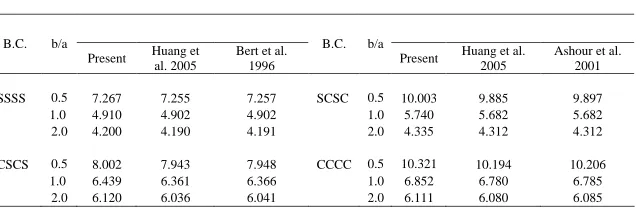
In Table 2 present GLPT results are compared with first order shear deformation theory (FSDT) using Green function for discretization of Huang et al. 2005 and semi-analytical approach of Bert et al. 1996. It may be observed that present results are in very close agreement with results from other two researches.
Example4.3.Cross ply 0/90 plate under various boundary conditions-Material I
The free vibration response of cross ply 0/90 square plate, with layers made of following orthotropic material (E125E2,G12 G130.5E2,G230.2E2,12130.25E2) is analyzed for different side-to-thickness ratio a/h5,10,20,50 and different boundary conditions: SFSF, SSSS, SCSC. Results are presented in Table 3 in terms of nondimensional frequency:
2
2/h /E
a
(13)
In Table 3 present GLPT results are compared with Levy-type analytical solution using second and third order shear deformation theory of Kheider et al. 1999 and Librescu et al. 1989, respectively. Present results are in very close agreement with results from other two researches for both thin and thick plates.
Table 3. Natural frequencies a2/h /E2 of thin and thick cross ply 0/90 square plate for different boundary conditions
Example 4.4. Cross ply 0/90 plate under various boundary conditions-Material II
The free vibration response of cross ply 0/90 square plate, with layers made of following orthotropic material (E140E2,G12 G130.6E2,G230.5E2,12 130.25E2) is analyzed for different plate aspect ratio b/a2,3, different side-to-thickness ratio
B.C. b/a
Present Huang et al. 2005
Bert et al. 1996
B.C. b/a
Present Huang et al. 2005
Ashour et al. 2001 SSSS 0.5
0.1
7.267 7.255 7.257 SCSC 0.5
0.1
10.003 9.885 9.897
1.0 4.910 4.902 4.902 1.0 5.740 5.682 5.682
2.0 4.200 4.190 4.191 2.0 4.335 4.312 4.312
CSCS 0.5 0.1
8.002 7.943 7.948 CCCC 0.5
0.1 10.321
9
10.194 10.206
1.0 6.439 6.361 6.366 1.0 6.852 6.780 6.785
2.0 6.120 6.036 6.041 2.0 6.111 6.080 6.085
B.C SFSF SSSS SCSC
a/h Present Huang et al. 2005
Bert et al. 1996 Present
Huang et al. 2005
Bert et al. 1996 Present
Huang et al. 2005
Bert et al. 1996
5 5.039 5.046 7.609 7.609 9.1430 9.377
10 5.828 5.818 5.796 9.015 8.997 8.944 12.4863 12.959 12.673
20 6.122 6.080 7.609 9.504 14.793 15.015
Journal of the Serbian Society for Computational Mechanics / Vol. 6 / No. 1, 2012 91 10
, 5 /h
b and different boundary conditions: SFSF, SSSS, SCSC. Results are presented in Table 4 and Table 5 in terms of nondimensional frequency:
2
2/h /E
b
(14)
Table 4. Natural frequencies b2/h /E2 of thick cross ply 0/90 square plate for different boundary conditions
In Table 4 present GLPT results are compared with first order shear deformation theory (FSDT) and classical plate theory (CPT) of Reddy et al. 1989, for different aspect ratio b/a2,3 and different boundary conditions. It may be observed that increasing the plate stiffness either by applying constrains on plate edges or increasing plate aspect ratiob/a, CPT over predicts natural frequencies. Namely, thin plate assumption in CPT increases the stiffness of the plate, thus yielding to lower deflections and greater fundamental frequencies [Cetkovic M. 2011]. Present GLPT results are in very close agreement with FSDT results of Reddy.
Table 5. Natural frequencies b2/h /E2 of thick cross ply 0/90 square plate for different boundary conditions
In Table 5 present GLPT results are compared with first order shear deformation theory (FSDT) and classical plate theory (CPT) of Reddy et al. 1989 for different side to thickness ratio
3 , 2 /h
b and different boundary conditions. The same conclusions from previous paragraph remain valid for results presented in Table 5.
Example 4.5. Cross ply 0/90 plate under various boundary conditions-Material II
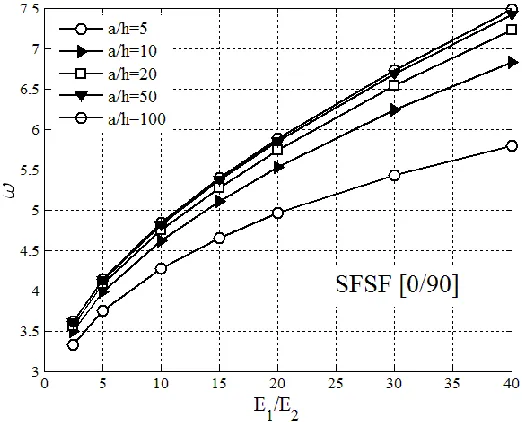
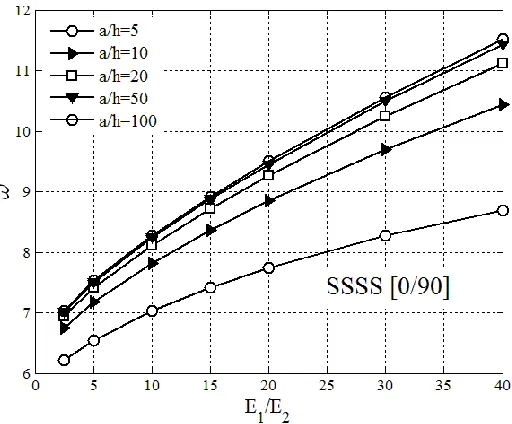
The free vibration response of cross ply 0/90 square plate, with layers made of following orthotropic material (E1/E2open,G12 G13 0.6E2,G23 0.5E2,12 13 0.25E2) is analyzed for different level of orthotropy E1/E2 2.5,5,10,15,20,30,40 and different boundary conditions: SFSF, SSSS, SCSC. Results are presented on Figs. 2, 3, 4 in terms of nondimensional frequency:
2
2/h /E
a
(15)
B.C SFSF SSSS SCSC SFSF SSSS SCSC
Solution type b/a=2 b/a=3
Present 6.833 24.732 36.300 6.832 42.666 59.501 FSDT (Reddy et al. 1989) 6.881 25.608 36.723 6.881 46.360 59.293 CPT (Reddy et al. 1989) 7.267 30.468 64.832 7.267 63.325 137.71
B.C SFSF SSSS SCSC SFSF SSSS SCSC
Solution type b/h=5 b/h=10
Present 5.794 8.694 10.788 6.833
0.435 10.435
SSFF a/h
E1/E2 5 10 20 50 100
15.105
FSDT (Reddy et al. 1989) 5.952 8.833 10.897 6.881 10.473 15.152
CPT(Reddy et al. 1989) 7.124 10.721 17.741 7.267 11.154 18.543
M. Šetkoviš and Đ.Vuksanoviš: Vibrations of Isotropic, Orthotropic and Laminated Composite Plates
92
From Figs. 3, 4, 5 it is observed that fundamental frequency increase with increase of degree of orthotropy for all types of boundary conditions. As reported from other researchers these increases are greater for plates with more constrained edges such as SCSC compared to SSSS or SFSF [Aydogdu et. al. 2003]. Also, with the increase of orthotropy ratio, the differences between natural frequencies for thick and thin plates become more pronounced for plates with more constrained edges such as SCSC than for SSSS or SFSF.
M. Šetkoviš and Đ.Vuksanoviš: Vibrations of Isotropic, Orthotropic and Laminated Composite Plates
94
Fig. 5. The effect of orthotropy on fundamental frequency of 0/90 cross-ply plates with SCSC for various a/h ratio
5. Conclusion
In this paper finite element solution for free vibration analysis of isotropic, orthotropic and laminated composite plates is developed using layer wise theory of Reddy (GLPT). The generality of present model has shown capability to analyze both thick and thin isotropic and anisotropic plates with arbitrary boundary conditions. Definition of boundary conditions in present layer wise model obviate need for rotational degrees of freedom [Setoodeh et. Al. 2003], unlike in ESL models (CPT, FSDT or HSDT). Compared to 3D elasticity solution, present approach does not exhibit shear locking phenomenon, when analyzing thin plate behavior. Thin plate behavior is well predicted with both ESL and layer wise theories, while CPT becomes inadequate for free vibration analysis of thick plates, particularly those with more constrained edges. Namely, thin plate assumption increases the stiffness of the plate and therefore yields to lower deflections and higher fundamental frequencies. Finally, present layerwise finite element model has shown the importance of different parameters on natural frequencies of both thin and thick isotropic, orthotropic and laminated composite plates, which may be used as the guideline for their optimal design in the laboratory.
Извод
Вибрације изотропних, ортотропних и ламинатних композитних
плоча са различитим граничним условима ослањања
М. Ћетковић1*, Ђ. Вуксановић2
1Грађевински факултет, Унивезитет у Београду, Бул. краља Александра 73,11000 Београд, Србија
2Грађевински факултет, Унивезитет у Београду, Бул. краља Александра 73,11000 Београд, Србија
Резиме
У овом раду применом Опште ламинатне теорије плоча (Генерализед Лаyерwисе Плате Тхеорy-ГЛПТ), коју је поставио Реддy, формулисан је изопараметарски модел коначног елемента за проблем слободних вибрација изотропних, ортотропних и ламинатних композитних плоча. Основне диференцијалне једначине кретања изведене су применом Хамилтон-овог принципа, користећи претпостављено поље померања, линеарне везе деформација и померања и линеарно еластичан ортотропан материјал за сваку од ламина. Принцип виртуелног рада потом је искоришћен за формулисање изопараметарског модела коначног елемента. Оригинални рачунарски програм написан је за решење по Методи коначних елемената, користећи МАТЛАБ програмски језик. Анализиран је параметарски утицај односа страна плоче , стране према дебљини плоче , степена ортотропије и граничних услова на слободне вибрације изотропних, ортотропних и анизотропних плоча. Тачност представљене формулације потврђена је кроз низ примера и њиховим поређењем са решењима из литературе.
Кључне речи: слободне вибрације, слојевити коначни елемент, гранични услови
6. References
Aydogdu, M. and Timarci, T. (2003), ―Vibration analysis of cross-ply laminated square plates with general boundary conditions‖, Composites Science and Technology, 63, 1061-1-70. Šetkoviš, M. (2005), Application of finite element method on generalized laminated plate
theory, Master Thesis, in serbian, Faculty of Civil Engineering in Belgrade, Serbia. Šetkoviš, M. (2011), Nonlinear behavior of laminated composite plates, PhD Thesis, in
serbian, Faculty of Civil Engineering in Belgrade, Serbia.
Šetkoviš, M., Vuksanoviš Đ. (2009), ―Bending, Free Vibrations and Buckling of Laminated Composite and Sandwich Plates Using a Layerwise Displacement Model, Composite Structures, 88(2), 219-227.
M. Šetkoviš and Đ.Vuksanoviš: Vibrations of Isotropic, Orthotropic and Laminated Composite Plates
96
Huang, M., Ma, X. Q., Sakiyama, T., Matuda, H., Morita, C. (2005), ―Free Vibration Analysis of orthotropic rectangular plates with variable thickness and general boundary conditions‖,
Journal of Sound and Vibration, 288, 931-955.
Khdeir, A. A., Reddy, J. N. (1999), Free vibrations of laminated composite plates using second-order shear deformation theory, Computers & Structures, 71, 617-626.
Messina, A. (2011), ―Influence of the edge-boundary conditions on three-dimensional free vibrations of isotropic and cross-ply multilayered rectangular plates‖, Composite Structures, 93, 2135–2151.
Qian, L. F., Batra, R. C., Chen, L. M. (2003), ―Free and Forced Vibrations of Thick rectangular Plates using Higher-Order Shear and normal Deformable Plate theory and Meshless Petrov-galerkin (MPLG) Method‖, CMES, 4 (5), 519-534
Reddy, J. N., Barbero EJ, Teply JL. (1989), ―A plate bending element based on a generalized laminated plate theory‖, International Journal for Numerical Methods in Engineering, 28, 2275-2292.
Reddy, J. N., Khdeir, A. A. (1989), Buckling and vibration of laminated Composite Plates Using Various Plate Theories, AIAA Journal, 27(12), 1808-1817.
Setoodeh, A. R., Karami, G. (2003), ―A solution for the vibration and buckling of composite laminates with elastically restrained edges, Composite Structures, 60, 245-253.