Volume-7 Issue-1
International Journal of Intellectual Advancements
and Research in Engineering Computations
Stain quashing rover
Dr.K.Sivasubramanian
1,
K.Karthika
2, S.Nandhini
2, P.Nithyanantham
2, S.Pavithra
21
Associate Professor, Department of ECE, K.S. Rangasamy College of
Technology(Autonomous), Tiruchengode, Tamil Nadu, India.
2
UG Students, Department of ECE , K.S. Rangasamy College of Technology(Autonomous),
Tiruchengode, Tamil Nadu, India.
ABSTRACT
In this advanced modern technology most of the systems are automated. Now a day, the people are living in an uncleaned and unhygienic circumference. They do not have sufficient time to keep the surroundings clean by using manual cleaning process. Hence there is a necessity to use machines to clean the surroundings. The proposed machine, Stain Quashing Rover can be used to automate the cleaning process. The product consists of two modules those are mopping module and sweeping module. Both the modules are controlled by using ATmega controller. The heart of this project is Arduino mega board which ATmega controller, input and output ports. By using these ports different sensors and actuators like ultrasonic, water level indicator, Motor drivers and Buzzer are interfaced with controller. The motor driver is connected to the direct current (DC) gear motor which is used for moving, sweeping and mopping operations. The water level indica tor is used to identify the level of water in the tank. Ultrasonic sensor is used to find the obstacles around it on transmitting the sound waves. While cleaning the floor manually, there is a possibility that the operator will leave some portion of the floor unclean. This product is an eco-friendly. Easy to maintain, low power consumption, fast cleaning are the advantages of Stain Quashing Rover.
Keywords: Eco-Friendly, Cleaning Robot, Stain Quashing, Arduino.
INTRODUCTION
In recent day, the homes, hotels, restaurants, offices, hospitals, workshops are in the need of cleaning the floors using automatic robot instead of manual clean. They are used for floor mopping, dry vacuum cleaning. In this work, “Stain Quashing Rover” have been designed. The rover is fully automatic and making decisions with the help of sensors which are used in this cleaning robot. These sensors are controlled by Arduino controller also controls the DC motors with the help of driving circuitry. It works on 12V supply. Initially the robot starts it moves forward and perform cleaning action. For obstacle detection and to avoid hurdle Infrared(IR) sensor have been used. If
any hurdle detected then robot change the lane automatically. The Automatic water sprayer is interfaced with the rover which automatically spray water for mopping, therefore no need to attach wet cloth. The main objective of this project is to provide a substantial solution to the problem of manufacturing robotic cleaner utilizing local resources while keeping it low costs. Manual work is taken over the robot technology and many of the related robot appliances are being used extensively also. Here represents the technology that proposed the model of robot for Floor cleaning.
OBJECTIVES
To implement automatic sweeping and mopping floor cleaner.
B. To implement a cost effective and cleaning efficiency product .
METHODOLOGY
The Stain Quashing Rover is the Arduino Microcontroller product. The Block diagram of the proposed work is shown in figure 1.1.
Fig. 1.1 Block diagram of the proposed system
Stain Quashing Rover consist of major components. They are,
Arduino Mega Controller
IR sensor
Water Level Indicator
DC Gear Motor
Arduino Mega
The Arduino Mega 2560 is a microcontroller board. It has 54 digital pins which are used as general input and output pins out of these 15 pins are PWM outputs, 16 analog inputs, 4 UARTs, a 16 MHz crystal oscillator, a USB connection, a power jack, an ICSP header, and a reset button. It contains several peripherals.
Microcontroller can be interfaced with computer using USB cable or ADC adapter or battery to get started.
Pin details of Arduino Mega
LED: Arduino has a built-in LED driven by
digital pin 13. When the pin is HIGH value, the LED will glow and when the pin is LOW, the LED turn’s off.
VIN: The input voltage to the Arduino from the
power source through the USB cable is 5 Volt.
3V3: A 3.3 Volt supply generated by the on-board regulator. Maximum current draw is 50 mA.
GND: Ground pins.
IOREF: This pin on the Arduino board provides
the voltage reference for microcontroller operations. A properly designed shield can read the IOREF pin voltage and select the power source or enable voltage translators on the outputs to work with the 5V or 3.3V.
IR Sensor
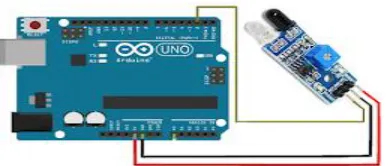
Infrared sensor can be used for detecting the obstacles in the lane. It consists of transmitter and receiver for processing the light rays. It has 3 pins, they are supply (Vin), ground (GND) and digital output pin. The sensor outputs a logic one(+5V) at the digital output when an object is placed in front of the sensor and a logic zero(0V), when there is no object in front of the sensor.
Water Level Indicator
Initially there is no voltage applied to the base of the Transistor BC547 and the transistor is in OFF state and no current is flowing through collector-emitter and LED is OFF. When the water level reaches to Point in the tank, the positive side
of the battery gets connected to the base of the Transistor through the water. When a positive voltage has been applied to the base of the Transistor, it gets into ON state and current starts flowing from collector to emitter and the LED glows.
Figure 1.3 Interfacing diagram of Water Level Indicator
DC Gear Motor
DC gear motor uses the principle of conservation of angular momentum. The smaller radius gear covers high RPM than larger radius gear. Similarly, the larger gear will produce more torque than the smaller gear. The ratio between the angular velocity of input gear and output gear gives the gear ratio. When multiple gears are
connected together, conservation of energy takes place. The adjacent gears rotate in opposite directions. In any DC motor, RPM and torque are inversely proportional. In a geared DC motor, the concept of pulse width modulation is applied.
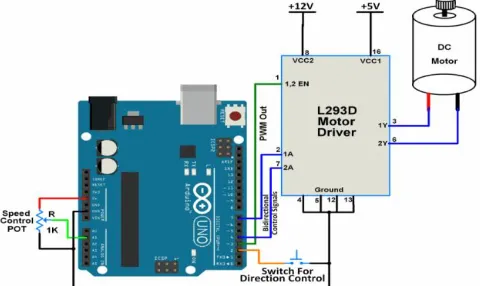
L293D motor driver is used to convert the appropriate voltage for the dc gear motor.
Working and Hardware Setup
The product consists of two modules those are mopping and sweeping modules. The heart of this product is Arduino mega board which has AT mega controller, input and output ports. By using these ports different sensors and actuators like ultrasonic sensor, water level indicator, motor driver, motor, Buzzer, Battery, mopping part and sensing part. The four-dc gear motor driver is connected to Arduino board and the motor is interfaced with it. The ultrasonic sensor is connected to the Arduino and it transmits the sound waves. When the waves hit the object and then it sends the reflected waves to receiver. The distance is calculated by transmitting time and receiving time. When the range of the distance is less than 10 cm, the direction of motor and the wheel will be changed. This product contains separate micro water tank and it is monitored using water level indicator. When the water is empty
then the buzzer starts sounding. While sweeping, the dusts are stored in separate container. So, it is used to remove the dust and it is followed by mopping the floor using water and cleaning agent. It is fully battery operated. When the power supply is on the voltage flows into the Arduino and peripherals connected with it. Initially it moves forward path, in case of obstacle detection it changes its lane automatically. For user convenience automatic water sprayer is attached which automatically spray water for mopping, water level in the tank is indicated by water level indicator. The sweeping part consists of brush which is used to take off the dust and the dusts are stored in a separate container. The mopping process is followed by the sweeping process. This product helps to keep the surroundings with hygienic and healthy way. It product is eco-friendly and every consumer can buy for efficient and fast cleaning.
Tabulation 1.1 Pin details sensor and motor interface
Components Pin Details
IR Sensor D2
Motor Driver (M1 input) D15
Motor Driver (M1 input) D16
Motor Driver (M1 Enable) D2
Motor Driver (M2 input) D17
Motor Driver (M2 input) D18
Motor Driver (M2 Enable) D3
Motor Driver (M3 input) D19
Motor Driver (M3 input) D20
Motor Driver (M3 Enable) D4
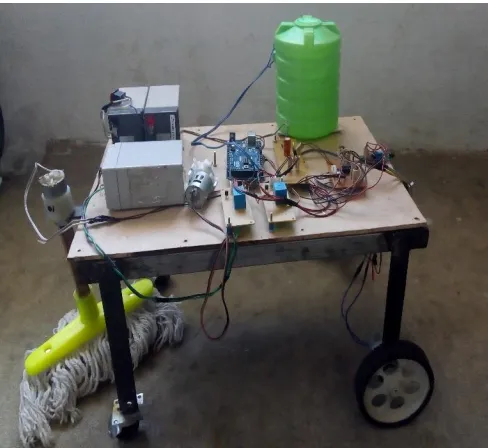
The Figure 1.5 shows the hardware setup of Top view of Stain Quashing Rover and Figure 1.6
Figure. 1.5 Top view of Stain Quashing Rover
Figure 1.6 Side view of Stain Quashing Rover
CONCLUSION
The hardware setup of Stain Quashing Rover is made up of Arduino mega and peripherals which is used for mopping and sweeping the floor. It
provides better accuracy and it operates automatically which reduces Manpower. It is designed at Low cost.
REFERENCES
[1]. Ariyan M. Kabir, Krishnanand N. Kaipa, Jeremy Marvel, and Satyandra K. Gupta “Automated Planning for Robotic Cleaning Using Multiple Setups and Oscillatory Tool Motions” IEEE Transaction On Automation Science and Engineering, 14(3), 2017.
[3]. Xueshan Gao, Kejie Li, Yan Wang, Guangliang Men, and Dawei Zhou “A Floor Cleaning Robot Using Swedish Wheels” IEEE International Conference on Robotics and Biomimetics, 12(1), 2017.
[4]. Ricardo Cruz, Luis Garrote, Ana Lopes and Urbano J. Nunes “Modular Software Architecture for Human-Robot Interaction to the InterBot Mobile Human-Robot” IEEE International Conference on Autonomous Human-Robot Systems and Competitions, 23(6), 2018.
[5]. Shripad Malavadikar, Swapnil Journal, Toshika Johri and Harshad Lokhande “Automatic Cleaner Robot” International Engineering Research Journal, 2(8), 2017, 2617-2620.
[6]. Humayun Rashida, Akash Mahmoodb, SarjahanShekhac, S M TaslimRezad, and Md. Rasheduzzamane “Design and Development of a DTMF Controlled Room Cleaner Robot with Two Path-Following Method “ International Conference on Computer and Information Technology, 18(7), 2016.
[7]. Zheng Zhao, Weihai Chen, Chen C.Y. Peter and XingmingWu” A Novel Navigation System for Indoor Cleaning Robot”,International Conference on Robotics and Biomimetics, 32(3), 2016.
[8]. Aishwarya Pardeshi, Shraddha More, Dhanashri Kadam and V.A.Patil”Automatic Floor Cleaner”,IJECT, 8(1), 2017.
[9]. Ajith Thomas, Rohith M.S, Febin Jolly, JeesonCheriyan and Ms.Renu Mary George”An Advanced Mobile Robot for Floor Cleaning”,International Journal of Advanced Research in Electrical, Electronics and Instrumentation Engineering, 5(3), 2016.