A Study of Mobile Payment Behavior in Four Countries
Ørjan Elverum Holm University of San Francisco
California, USA Shangchia Liu Fu Jen Catholic University
No. 510, Chung Cheng Rd., New Taipei City, Taiwan Gwo-Hau Ding
Fu Jen Catholic University
No. 510, Chung Cheng Rd., New Taipei City, Taiwan Corresponding Author: [email protected]
ABSTRACT
This paper examines the growth, possibilities, and limitations of mobile payments and analyzes global trends and consumer behavior across three continents (Europe, Asia, and North America). It considers four case studies (in the United Kingdom, Germany, China, and the United States) pertaining to different methods of payment for goods and services, particularly with regard to mobile payments. A detailed analysis compares similarities and differences between the two countries in Europe, which are dominant regional players; and between the two dominant global players (the United States and China). The paper also examines mobile payment behavior on a continental level.
1. INTRODUCTION
This section provides background information, discusses the motivation for the current study, and presents the study objective and outline.
1.1. Background
The aim of this paper is to compare behaviors pertaining to mobile payments in four countries. Mobile payment has been defined as, “Money rendered for a product or service through a portable electronic device such as a cell phone, smartphone or PDA. Mobile payment technology can also be used to send money to friends or family members” (Investopedia, 2017). The trend toward mobile payment is considered the new standard of payment for goods and services.
The introduction of mobile commerce and mobile payments began in 1997 when Coca-Cola set up several vending machines that accepted payment through text messages (Inuit Inc., 2017). In 1998, the online payment system PayPal was established. By 2015, it was the biggest online payment system in the world, with more than 4 billion payments (Mercer, 2015). In 2017, PayPal had nearly 10 million monthly transactions (Blockchain.info, 2017). Subsequently, global players such as Google, Apple, Samsung, and Alibaba have all released their own service for handling mobile payments.
1.2. Motivation for Study
A second reason for undertaking this study is the fact that mobile payment systems are regularly in the news and are constantly under development. New features are being added daily, and the number of services that one can perform with mobile payments is continually increasing.
1.3. Objective and Outline
The objective of this paper is to understand the development of mobile payment solutions in different countries and compare similarities and differences across countries. The objective will be accomplished using three approaches:
1. Literature Review. This stage will include a review of prior studies on mobile payments and different methods that allow for payment to be made through mobile devices. It will also include a review of studies on consumer behavior.
2. Case Studies. This stage will focus on an in-depth examination of mobile payments in four selected countries on three continents – Europe, Asia, and North America. In Europe, mobile payments will be examined in the two dominant economic powers, Germany and the United Kingdom. In Asia, mobile payments will be examined in China, based on its prominent economic position and its large population. In North America, the examination will focus on the United States because of its dominant position in the global economy.
3. Analysis and Comparison. In this stage, the study will compare differences and similarities among the four countries with regard to mobile payments.
2. LITERATURE REVIEW
2.1. Definition of Mobile Payment
In an article in Computers in Human Behaviour, Kim, Mirusmonov, and Lee (2010) considered mobile payment to be a natural evolution of traditional electronic payment methods. Mobile devices can be used to facilitate payment between clients and businesses for a multitude of purposes. Examples include the purchase of digital content, airline tickets, and bus fares, in addition to general payments for goods and services. Because new systems of payment are constantly being developed for an increased number of products, it is difficult to imagine the impact of these payments on business-to-consumer (B2C) transactions in the future. These payment systems are not limited to the B2C-scenario, but could also be used by private customers to send or receive money from one another and by private and corporate users to pay their bills.
2.2. Types of Mobile Payments
This section identifies and describes six types of mobile payment systems now in use and discusses possibilities for future mobile payments.
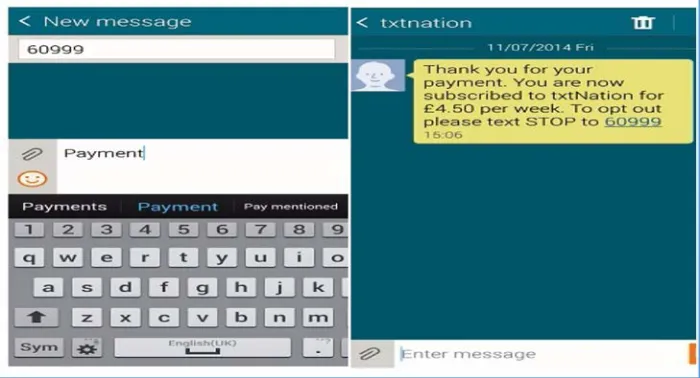
1. Short Message Services (SMS). SMS payments work like a standard SMS where the user sends a specific sequence of numbers, letters, or symbols to a predetermined number. The transaction cost is either deducted from a pre-paid balance or added to a monthly telephone bill. This is a quick, easy, safe, and secure method to pay for goods and services (Roberts, 2013). Private customers do not have to enter any bank details or remember a username or password. The process is considered very secure because no personal data or account details are released during the transaction (Roberts, 2013).
to strengthen customer loyalty. In addition, the risk of the payment not going through is also eliminated because billing is handled by the mobile operator (Roberts, 2013). An example of SMS payment is shown in Figure 1.
Figure 1: A Representation of a Sale Made by SMS Payment
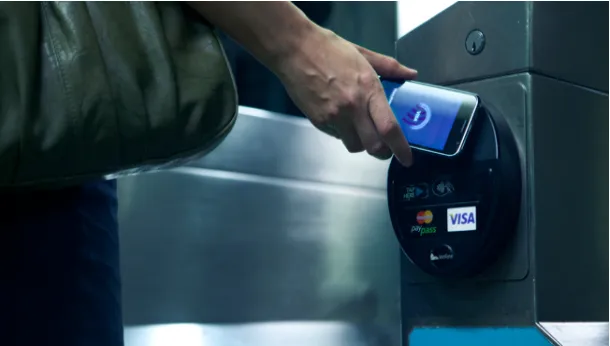
NFC technology is considered significantly more secure than magnetic-strip cards. The latter are considered static because the card owner’s data is found physically on the back of the card. With an NFC device, however, the information is encrypted and dynamic and constantly changing. If thieves or hackers manage to access the data on an NFC device, it would quickly become useless because, within a short time, it would no longer be linked to the device (Square, Inc., 2017). A photograph of a payment made through NFC is shown in Figure 2.
Figure 2. Use of NFC Technology for Mobile Payment
(Futurehandling.com, 2013)
within centimeters of each other). Another benefit of the Bluetooth system is that it could create a hands-free experience since the user would not have to take out his or her phone to perform a transaction. Although Bluetooth technology is faster than that of NFC, the difference is only a couple of microseconds; hence, for the average customer, the two would seem quasi-identical. One of the biggest advantages of Bluetooth technology is that it allows for multiple transactions from a single payment terminal, whereas NFC is limited to one-to-one interaction between one reader and one payment device (Meola, 2016).
4. Quick Response (QR). Quick response (QR) codes are two- dimensional barcodes that can be read using either a smartphone or QR reading device (whatisaqrcode.co.uk, 2017). To use QR codes as part of a mobile payment system, the user must have an application that contains the user’s card details that generate dynamic QR codes on the user side, as well as a QR recognition system that is linked to the same database as the application. The QR reader then reads the QR code from the device and translates it into binary data before sending it to the database to see which card is linked to that QR code. Alternatively, the vendor creates a QR code that has to be scanned by the device before the money is transferred. Both options are shown in Figure 3.
one or several cards. Once the application is installed, the payment information would have to be entered. The wallet would store all information in an encrypted format, allowing the user to switch between all cards inside the application. To execute payment, the store would most likely use NFC or QR payment technology (Investopedia, 2017).
Figure 3. Two Ways to Make Mobile Payments with QR Scanning
(Alba, 2015)
to log into the website of one’s bank and, from there, enter a bank-account number (Murakami-Fester, 2016).
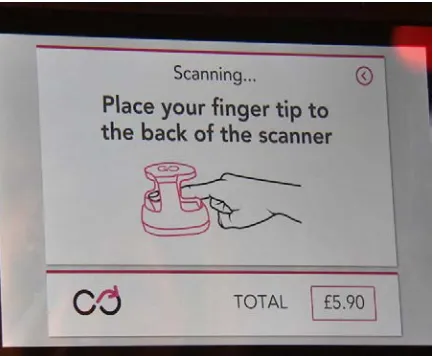
Predicting the future trends of any service is difficult. There are so many possibilities. In terms of mobile payments, a promising new approach that is in the early stages of testing involves the use of biometric payment to eliminate the need for cash, cards, or gadgets (Parsons, 2017). Instead, payment would be made using a device that scans the veins in the finger of the user. The chances of one person having the same layout of veins as another person is considered to be 1 in 3.4 billion, making this a secure method of payment. All a user needs to do is link a bank card to the layout of his or her veins. After that, the user can pay for anything with a quick scan of his or her finger (Parsons, 2017). A visual representation of biometric payment is shown in Figure 4.
Figure 4. Biometric Payment Through Vein Layout (Parsons, 2017)
2.3. Definition of Consumer Behavior
this paper will be related, therefore, to how individuals and groups use monetary systems in today’s society, to what degree they accept mobile payments, and the types of variations in use of mobile payments.
2.4. Main Applications of Consumer Behavior
Since users of mobile payments can be considered customers of mobile applications, it is important to understand their behavior. The company that is able to best predict consumer behavior trends could, through skills and analysis, end up dominating the mobile payment market.
According to Perner (2010), there are three main applications of consumer behavior; namely, marketing strategies, social marketing, and improved consumerism. Marketing strategies are essential to better marketing campaigns. For example, it is known that people are more receptive to advertisements relating to food or snacks when they are hungry. Companies selling food, snacks, or drinks take advantage of this fact by scheduling advertisements related to these products late in the afternoon (Perner, 2010).
Social marketing focuses on advancing an idea rather than selling a product. As an example, a marketing professor aimed to reduce the transmission of diseases through illegal drug use. Since it is difficult to make users simply stop using drugs, he decided that the best option was to figure out the consumer behavior of the users. He found that people involved in drug use often share needles, thus spreading disease. Through the application of consumer behavior research, the users were encouraged to clean the needles in bleach for their own safety. Selling this idea helped reduce the chance of diseases being spread (Perner, 2010).
Improved consumerism can also derive from the study of consumer behavior. For instance, if a consumer knows that some companies charge an extra cost (size premium) for the large size of a product instead of several small ones, the consumer may begin checking the unit cost, thus potentially saving money (Perner, 2010).
common thought or idea. The idea could be beneficial to consumers and help them improve quality of life, or it could be used to steer the subconscious thoughts of consumers toward actions or ideas that benefit the company directly or indirectly.
3. CASE STUDIES
This section examines four case studies relating to methods of mobile payment for goods and services. The studies involve four countries on three continents: the United Kingdom and Germany in Europe, China in Asia, and the United States in North America. The United Kingdom and Germany were chosen because they are the two major economies in Europe (Statistic Times, 2017). China was chosen because it is the largest country in Asia in terms of population and because it is also a major economic power. The United States was chosen because of its dominant position in the global economy.
The research method used in this study compares data found online. It does not involve the use of questionnaires or interviews because the expected number of respondents during the study period would fall short of the required number to make statistically valid assumptions. To ensure that the study contains valid data and information, the researchers based their reading, analysis, and findings on existing resources, either in print or online.
3.1. Case Studies in Europe
ways of paying for goods and services. The report suggests that the trend of m-payments clearly points toward a further increase in which growth will “continue to accelerate” (Visa Europe, 2016).
3.1.1. United Kingdom
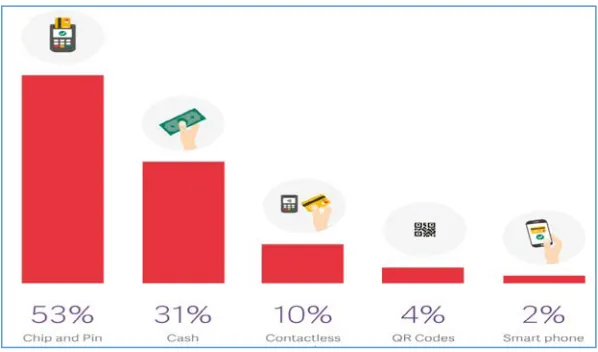
According to the Worldpay Consumer Behaviour and Payments Report 2016 (2016a), the preferred methods of payment when making an in-store purchase in the United Kingdom are the “chip and pin,” followed by cash. These two options account for 84% of in-store transactions, as shown in Figure 5.
Figure 5. Preferred Method of Payment for In-Store Purchases in United Kingdom
(Worldplay, 2016a)
participants said they would like to pay from any point in the store through a mobile device. More than half of the customers said that, ideally, they would like to leave home without a wallet and be able to pay for products through smartphone or other means (WorldPay, 2016a). Some of the future trends that customers in the UK prefer are shown in Figure 6.
Figure 6. Future Trends Preferred by Customers in the United Kingdom
(WorldPay, 2016a)
Figure 7. Adopter Technologies in the United Kingdom Related to Payment Methods
(TSYS, 2016a)
Figure 8. Response Rate of UK Participants on How They Use In-App Payments
The biggest gap between use and awareness was related to the technology of in-store m-payments. Although 81% of respondents were aware of this technology, only 24% have used it. Of those, 74% reported a “good” to “excellent” level of satisfaction with the technology. In the UK, the number of payment terminals accepting NFC-payments through Apple Pay or other applications is increasing rapidly. It is likely that, in future, the percentage of people paying in-store using m-payments will increase (TSYS, 2016a). As shown in Figure 9, the most popular in-store m-payment is for the purchase of coffee. This can be related to the loyalty program of coffee stores in the UK as well as to their own digital wallets.
Figure 9. Areas of Use of In-Store m-Payments in United Kingdom
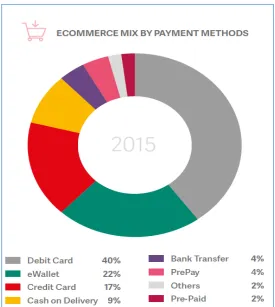
From a purely e-commerce point of view, Worldpay (2016b) conducted an analysis on the British market to determine the different payment methods used. The data in Figure 10 indicate that the most popular methods of payment in the United Kingdom are debit card, which is responsible for about 40% of transactions, and eWallet, which is used in 22% of the transactions.
Figure 10. Payment Methods Used in e-Commerce in the United Kingdom
(Worldpay, 2016b)
3.1.2. Germany
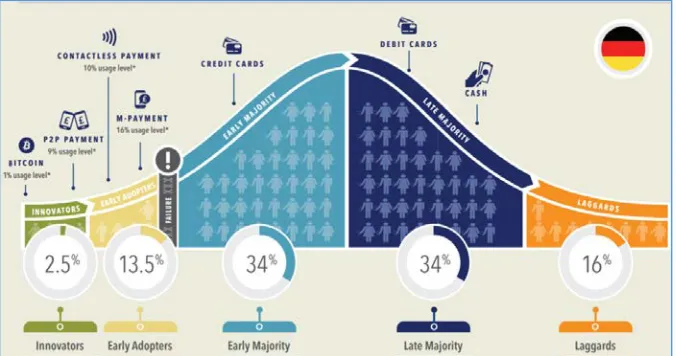
(P2P) and contactless payments was more common, accounting for 9% and 10%, respectively. They also found that the most used type of mobile payment in Germany is m-payment. These data are shown in Figure 11.
Figure 11. Adopter Categories in Germany Related to Payment Methods
(TSYS, 2016b)
The TSYS survey (2016b) found that 65% of Germans had heard about contactless-payment technology, but that two-thirds of them did not know whether their cards allowed them to perform a contactless payment. The survey also found that one out of five who were aware of contactless payments had a contactless card, but had never used it as a method of payment (TSYS, 2016b).
Figure 12. Perceived Benefits/Concerns in Germany About Contactless Payments
(TSYS, 2016b)
One part of the TSYS consumer behavior report touched on the use of smartphones to pay for content in stores. As shown in Figure 13, only 16% had used this method,
In a study of e-commerce in Germany, Worldpay (2016b) looked at methods of payment used by Germans when buying goods or services online. As shown in Figure 14, the study found that the major payment method is bank transfer, accounting for 38% of all e-commerce transactions in Germany. The second most commonly used payment method is eWallet, used in 22% of transactions. Together, these two methods account for six out of every ten transactions in Germany. Credit cards (15% of transactions) and debit cards (6% of transactions) together account for 21% of e-commerce transactions in Germany.
Figure 14. Payment Methods Used in E-Commerce in Germany
3.2. Case Study in Asia (China)
Across the Asia Pacific, the number of smartphones now exceeds 1 billion units (Guo, 2016). The use of mobile payments in Asia can be linked to the evolution of Asian chat apps that include payment options and to the lack of legacy banking structures in the region. Recently, popular applications like WeChat and LINE have developed payment services such as WeChat Pay, Line Pay, and Alipay. All of these facilitate payment for services ranging from taxi bookings to e-commerce sales. Mobile payment options inside these apps allow consumers to make purchases using only their phones. Convenience is the main reason mobile payment behaviors are so well established in the Asian market.
In its market research on predicted trends of payment methods in the Asia Pacific, Worldpay (2016b) found that the relative importance of eWallet applications in the region is expected to decrease by 2020, whereas the use of debit cards, bank transfers, and cash on delivery are expected to increase. (Figure 15).
The current study selected China for its case study in Asia. Research shows that China is the number one mobile payment market in the world (Guo, 2016). In 2016, it was found that 40% of consumers connected to the Internet in China make mobile payments on a weekly basis and that 77% had at some point in the past used mobile payments. Use is highest for the age group 16-35 years, where half complete weekly transactions using mobile payments. For the elder population (45-65 years), 22% engage in mobile payments weekly and 60% have tried this technology (Guo, 2016).
One of the reasons for the high proportion of users in China is the increasing market penetration of smart mobile phones (Guo, 2016). The majority of mobile transactions in China involve smaller amounts usually paid in restaurants, convenience stores, and taxis. WeChat is the most popular among younger consumers, whereas Alipay is more popular among older customers (Guo, 2016).
Mobile payments are likely to help facilitate the growth of e-commerce in China and throughout Asia. However, prognoses suggest that e-commerce will be responsible for a small proportion of total sales. The main barrier to e-commerce in China is the concern among consumers about the security of mobile payments and e-commerce overall (Guo, 2016). Consumers worry that they could lose their device and thus expose their personal financial information. They are also concerned that payments cannot be made when connection to the Internet is lost.
Figure 16. GMV Values and YoY Growth in China, 2011-2019
(iresearchchina.com, 2016)
According to eMarketer.com (2016), the number of people in China who used proximity payments with their phones to execute in-store transactions for goods and services more than doubled from 2014 to 2015. Proximity mobile payments can be defined as payments made at the point-of-sale (in-store) by tapping, swiping, or checking in with a mobile phone (eMarketer.com, 2016). As indicated in Figure 17, the absolute change in percentage from 2015 to 2016 more than halved, to 45.8%. The estimated change is expected to drop every year until the end of 2020, when there will be a projected positive change of 6.9% from the year before. The number of users through this period is estimated to increase from 63.1 million in 2014 to 323.3 million in 2020 (eMarketer.com, 2016).
Figure 17. Mobile Payments Made in China Using Mobile Proximity Technology, 2014-2020 (eMarketer.com, 2016)
According to Worldpay (2016b), mobile payment was the fastest growing segment of online payments in China, increasing 33% from 2014 to 2015. As indicated in Figure 18 on the previous page, eWallet dominates with a 60% share. The most popular payment methods are AliPay and WeChat pay (Worldpay, 2016b), which is coherent with Guo’s statements (Guo, 2016) mentioned earlier. 3.4. Case Study in North America (United States)
In North America, 52% of consumers said they were “extremely aware” of mobile payments in 2015, which was 9 percentage points higher than in 2014 (Accenture, 2015). Despite the broad awareness, only 18% said they made mobile payments on a regular basis, which is only 1 percentage point higher than in the previous year. Research found that mobile payment users were interested in receiving assurance that fraud would be covered and in receiving instant notification when a payment was initiated or executed (Accenture, 2015).
Research also found that 46% of North Americans had used P2P payment applications to pay other individuals in 2015, but that only 15% had used it on a regular basis. In addition, 42% said they used checks for person-to-person payments (Accenture, 2015).
Blue line = Use in 2015; Purple Line = Estimated use in 2020
Figure 19. Methods of Payments in North America, 2015 and 2020 (Accenture, 2015)
The United States of America (USA) was chosen as the case study for North
America. In the USA, the number of people who use their phones to purchase goods and services through proximity payments is increasing steadily. According to eMarketer (2015), the total value of transactions is expected to increase by 210% in 2016, by 128.3% in 2017, by 85.6% in 2018, and by 83.6% in 2019 (Figure 20). The number of users is also expected to increase, from 16.4 million in 2014 to 69.8 million in 2019 (eMarketer.com, 2015).
In a 2016 consumer survey that asked Americans why they do not use their phone to make in-store payments, Deloitte (2016) found that 40% do not consider the method secure enough. As indicated in Figure 21, this response was a drop of 14 percentage points from the previous year. The survey found that 38% (up 2 percentage points from 2015) did not perceive any benefits from using the method. Among those using m-payments, however, most felt that the service is becoming more and more valuable. With regard to which scenarios users felt it was beneficial to use m-payments over other means of payment, all proposed scenarios increased from the previous year (Deloitte, 2016).
Figure 21. Scenarios Perceived Beneficial for M-Payment by Mobile Phone in USA
(Deloitte, 2016)
Figure 22. Payment Methods Used in E-Commerce in the United States
(Worldpay, 2016b)
4. ANALYSIS
This section presents an analysis of global trends and discusses similarities and differences among the four case studies (Germany and the United Kingdom; United States and China).
4.1. Global Trends
The Asia Pacific region is leading the world in mobile payments, with 53% of connected consumers using mobile devices to pay for goods or services at point-of- sale through apps. In comparison, only 33% of consumers in North America and 35% in Europe do so (Guo, 2016).
to decline 5 percentage points, from 25% to 20%. As shown in Figure 23, the biggest growth in payment methods globally between 2015 and 2020 is projected to be for bank transfers and pre-paid cards. In all cases, the primary concern is for security of payment.
Figure 23. Global Trends in Payment Methods, 2015 to 2020 (Worldpay, 2016b)
4.2. Germany and United Kingdom
TSYS (2016b) also examined differences between the two countries regarding payment behavior. One major difference pertained to the awareness and use of contactless cards. In Germany, 65% of respondents were aware of contactless payments, but only 10% used this technology. In the United Kingdom, 97% were aware of contactless payments, and 51% used this method (TSYS, 2016b). Respondents in both countries said that security was their main concern about using this payment method. In Germany, the level of concern was higher, with 76% citing security issues, compared with 60% in the United Kingdom.
The second difference pertained to m-payments. In the United Kingdom, 29% of participants indicated that it was a payment method they used regularly, compared with only 16% in Germany.
The third major difference pertained to P2P payments. In Germany, 57% said they were aware of the method, compared with 70% in the United Kingdom. In terms of use, 9% of Germans said they regularly use m-payments, compared with 21% in the UK.
In terms of payment methods used in e-commerce, these two countries are very different. The major payment method in Germany is bank transfer, accounting for 38% of all transactions. In the United Kingdom, however, this method ranks 5th, accounting for only 4% of transactions. The main payment method in the UK is the debit card, which accounts for 40% of transactions. In Germany, the debit card ranks 4th, accounting for 6% of transactions.
What the two countries have in common is the use of eWallet, which is the second most popular payment method in both Germany and the UK, accounting for 22% of all payments in each country.
4.3. China and United States
The second difference relates to credit and debit cards. In China, credit cards and debit cards together account for only 19% of transactions, each representing about half the total. In contrast, payments by cards are by far the most popular means of payment in the United States, accounting for 59% of all transactions (34% by credit card, plus 35% by debit card).
The third difference pertains to proximity mobile payments. In 2014, the United States had 16.4 million users of proximity mobile payments, comprising 6.4% of mobile phone users in the country. In the same year, China had 63.1 million users, comprising 14.5% of smartphone users in the country. In 2015, the number of users in China rose 112.2%, increasing the percentage of smartphone users who use proximity payments to 28%. In the United States, the growth rate was 41.4%, which increased the percentage of smartphone users using this payment method to 9.6%. In terms of relative growth in proximity payment users, the United States is expected to have 69.8 million users by 2019, representing 18.6% of mobile phone users. Although China’s relative growth is slower, the absolute increase in the number of proximity payment users will be greater every year until 2019, when China will have 332.2 million users representing 49% of all smartphone users.
5. CONCLUSIONS
This section presents concluding remarks and a discussion of the limitations of the current study.
5.1. Discussion
payments is expected to increase. In the meantime, companies must develop services that ensure users that the payments they make are secure and that their personal data is safe. Research has shown that there is a large market for these services across all continents, which suggests a rich potential for companies that provide a platform that eliminates or reduces consumer risk to a bare minimum.
This study has discussed a variety of payment methods that can be performed using a mobile phone. Although there are some concerns that hinder the fast expansion of mobile payments, people seem to find the use of such services quick and convenient. In many ways, the near future of payments will rely on mobile technology and thus mobile payments. The use of Bluetooth technology seems to be a promising development in the near or mid-term future. This technology would allow people to pay from any point inside a store, without having to stand in line. This approach not only facilitates mobile payment, but also makes the in-store experience more convenient for the user.
5.2. Limitations
One limitation of this study is that it used existing sources relating to mobile payments in a country or region. Because these sources generally touched on only one small aspect of the payment structure rather than the whole, it was difficult to find truly comparable features among the four countries included in this study.
A second limitation was limited access to certain resources. For instance, some of the resources that seemed suitable for this study were reports prepared by professional companies that required thousands of dollars in fees to access their material. Since this study did not include a budget for such purposes, these materials could not be used.
APPENDIX
Definition of Payment Methods
(Source: Worldpay, 2016b)
Term Definition
Cash on Delivery This is a transaction in which a payment-for-goods is made at
the time of delivery. Although popular in some regions, cash on delivery is specific to particular countries and suppliers. It is not a scheme that can be used globally.
Direct Debits Direct debits are not relevant to all merchants. They are limited
mainly to low-value or recurring transactions. They are popular for regular, predictable payments such as subscriptions, although they carry the risk of charge-backs.
eWallets Easy and secure to use, this is a quickly growing payment
method, becoming increasingly popular across all sectors. Consumers can either use stored value or take funds from a payment type linked to their eWallet, giving them choice and convenience.
PostPay When a consumer selects a product online, he or she pays for
it later at an affiliated outlet or store. The delay between the initial order and the consumer completing payment means that this method does not always suit perishable goods and time-sensitive purchases.
PrePay In this method, consumers need to buy a card or voucher before
starting a transaction. These cards are not usually run on scheme networks (such as Visa and Mastercard) and are usually authorized immediately. Most prepay products have a funding limit, and some do not allow multiple cards/vouchers to fund a single transaction.
Pre-Paid Cards These cards run on scheme networks such as Visa and
Mastercard. They can be used to make purchases or withdraw cash in the same way as a debit or credit card. The key difference is that they need to be loaded with cash in advance – the balance then operates as the spending limit. They are often offered to the un/under-banked, younger people, or people with a poor credit history.
Other These include mobile carrier billing, cryptocurrencies and
REFERENCES
Accenture. (2015). 2015 North America consumer digital payments survey. From http://cdn.pymnts.com/wp-content/uploads/2015/11/Accenture-Digital-Payments-Survey-North-America-Accenture-Executive-Summary.pdf
Alba, D. (2015, October 12). Walmart Pay is going to stick it to Apple Pay with … QR Codes? From https://www.wired.com/2015/12/walmart-pay-is-going-to-stick-it-to-apple-pay-with-qr-codes/
Blockchain.info. (2017, February). Total number of transactions. From https://blockchain.info/charts/n-transactions-total?timespan=30days
Deloitte. (2016). 2016 Global mobile consumer survey: US edition. From https://www2.deloitte.com/content/dam/Deloitte/us/Documents/technology-media-
telecommunications/us-global-mobile-consumer-survey-2016-executive-summary.pdf
eMarketer.com. (2016, June 7). China boasts world's largest proximity mobile payments market. From https://www.emarketer.com/Article/China-Boasts-Worlds-Largest-Proximity-Mobile-Payments-Market/1014053
eMarketer.com. (2015, October 26). Mobile payments will triple in the US in 2016. From
https://www.emarketer.com/Article/Mobile-Payments-Will-Triple-US-2016/1013147
Futurehandling.com. (2013). Hong Kong gets NFC-enabled mobile payments from Hang Seng Bank. From http://futurehandling.com/2013/07/30/hong-kong-gets-nfc-enabled-mobile-payments-from-hang-seng-bank/
Guo, M. (2016, December 13). Survey: China leads world in mobile payments. From Kantar: http://cn-en.kantar.com/media/mobile/2016/survey-china-leads-world-in-mobile-payments/
Inuit Inc. (2017). The history of money and payments. From https://payments.intuit.com/history-of-money-and-payments/ Investopedia. (2017). Mobile payment. From
http://www.investopedia.com/terms/m/mobile-payment.asp Investopedia. (2017). Mobile Wallet. From
http://www.investopedia.com/terms/m/mobile-wallet.asp
Kim, C.; Mirusmonov, M.; & Lee, I. (2010). An empirical examination of factors influencing the intention to use mobile payment, Computers in Human Behavior, 310-322.
Meola, A. (2016, December 21). Mobile payments technology and contactless payments explained. From Business Insider: http://www.businessinsider.com/mobile-payment-technology-contactless-payments-explained-2016-11
Mercer, C. (2015). History of PayPal: The history of the biggest online payment system in the world. From http://www.techworld.com/picture-gallery/e-commerce/history-of-paypal-1998-now-3630386/
Murakami-Fester, A. (2016). Venmo, PayPal, Square Cash and more: What are peer-to-peer payments? From Nerdwallet: https://www.nerdwallet.com/blog/banking/p2p-payment-systems/
Parsons, A. (2017, February 25). Paying for a pint with your finger: The tech that could kill off cards. From Sky News: http://news.sky.com/story/paying-for-a-pint-with-your-finger-the-tech-that-could-kill-off-cards-10780629
Perner, D.L. (2010). Consumer behavior: The psychology of marketing. From https://www.consumerpsychologist.com/
Roberts, J. (2013, April 7). What are SMS payments? From MobileTransaction: https://www.mobiletransaction.org/what-are-sms-payments/
Square, Inc. (2017). Intro to NFC. From https://squareup.com/guides/nfc
Statistic Times. (2017, February 22). List of European countries by GDP. From http://statisticstimes.com/economy/european-countries-by-gdp.php
TSYS. (2016b). 2016 German consumer payment study. From
http://tsys.com/Assets/TSYS/downloads/rs_2016-de-consumer-payment-study-english.pdf
TSYS. (2016a). 2016 U.K. M-payment and P2P payment. From
http://tsys.com/Assets/TSYS/downloads/rs_2016-uk-m-payment-and-p2p-payment-consumer-study.pdf
Visa Europe. (2016, October 12). Mobile payments soar as Europe embraces new ways to pay. From https://www.visaeurope.com/media/pdf/40172.pdf
Worldpay. (2016b, November). Global Payments Reports. From https://worldpay.globalpaymentsreport.com/report/download
WorldPay. (2016a). WorldPay consumer behaviour and payments report 2016. From http://payanyway.worldpay.com/wp-content/uploads/2016/09/Consumer-behaviour-report-2016.pdf
ABOUT THE AUTHORS
Ørjan Elverum Holm is working as a graduate at DNB, Norway’s largest financial services group, providing a strong platform for both Norwegian and international corporate customers. He received his master’s degree in global entrepreneurial management from the University of San Francisco in the USA, and the degree is also accredited by IQS in Spain and Fu Jen Catholic University in New Taipei City, Taiwan. He was awarded lifetime membership in the Beta Gamma Sigma Society. He received his bachelor’s degree in electronic engineering from the University of York in the United Kingdom.
Shang-Chia Liu is an associate professor in the Department of Business Administration at Fu Jen Catholic University, Taiwan. He obtained his MBA degree in marketing from Our Lady of the Lake University at San Antonio, Texas, USA. He received his M.S. degree in information management and his Ph.D. in business administration from Fu Jen Catholic University. His teaching and research interests include production scheduling, project scheduling, relationship marketing, and database marketing.
Contact Information:
No.510, Zhongzheng Rd., Xinzhuang Dist., New Taipei City 242, Taiwan Telephone: +886-2-29052887
Fax: +886-2-29010673
Gwo-Hau Ding received his master’s degree in mass communications at Iowa State University in the USA. Currently, he is a Ph.D. candidate in business administration at Fu Jen Catholic University in Taiwan. He operates his own business in marketing and education in Taiwan and is also a part-time teacher at Fu Jen Catholic University. His teaching and research interests include public relations, marketing, and education. Contact Information:
No.510, Zhongzheng Rd., Xinzhuang Dist., New Taipei City 242, Taiwan. Telephone: +886-2-27210186/+886-978503716
Fax: +886-2-29219752