Mejora de la comprensión auditiva mediante
el uso de adivinanzas en grupo
Sasan Baleghizadeh [email protected] Shahid Beheshti University, G.C., Iran
Fatemeh Arabtabar [email protected] Khatam University, Iran
The present paper is an attempt to introduce an innovative technique for a more effective teaching of L2 listening comprehension through a process-oriented approach. Much of what is traditionally known as listening practice is in fact testing material in which students are required to listen to a recording and answer a number of comprehension questions. However, as a preliminary step, teachers should focus on the process of listening comprehension by encouraging students to employ efficient learning strategies during the listening process and cooperatively evaluate them in the class. The suggested technique in this article provides students with appropriate metacognitive strategies, which pave the way for successful L2 listening practice.
Key words:Cooperation, guessing, games, knowledge, learning, metacognitive, strategies
estudiantes estrategias metacognitivas apropiadas que garanticen el éxito en la práctica auditiva en L2.
Palabras clave:adivinanzas, conocimiento metacognitivo, cooperación, estrategias de aprendizaje
Introduction
It is a well-attested fact that the listening skill plays a crucial role in the process of learning a second language yet it is probably one of the least understood skills in that it is not clear what goes on in a person’s mind while listening to a story, for example, a news item or political debate. Recent research in listening instruction has attempted to clarify what learning to listen means and how teachers can help students “learn to listen” so that their students, in turn, can better “listen to learn.” This article, therefore, begins with a very brief overview of the importance of listening and of recent research on listening instruction, followed by an innovative technique in practicing listening, which has proved to be highly effective with our students. Moreover, the rationale behind this technique for L2 listening instruction and a number of ways to possibly apply it are subsequently clarified.
The Importance of Listening
In recent years the image of L2 listening instruction has changed. At one time, listening was assumed to be a passive activity, meriting little classroom attention. Nunan (2002, p. 238) called it “the Cinderella skill in second language learning” and argued that proficiency in L2 has tended to be viewed in terms of the ability to speak and write the language in question, with listening (and reading) relegated to a secondary position. Nevertheless, listening gained a new importance in language classrooms in the 1980s, largely as a result of Krashen’s (1982) claims on second language acquisition through comprehensible input and Asher’s (1988) methodological innovations, which were based on the belief that students are likely to benefit from a “silent period” if not forced to produce the target language for some time and just listen to it. However, it could be argued that these new developments tended to focus on listening as a means of learning a second language, rather than listening as a skill in its own right.
Successful spoken communication depends not just on one’s ability to speak, but also on the effectiveness of the way one listens (Harmer, 2007).
The ear is the key organ to language learning. There is a close link between speech perception and speech production and the ear can be trained or reeducated to perceive and analyze sounds through an auditory selection process (Kaunzuer 2001, cited in Vandergrift, 2004).
Hence, an awareness of the importance of listening and its contribution to language proficiency is fundamental to a well grounded L2 pedagogy. Presently, there appears to be little effort in bringing this kind of awareness to the students’ attention and teaching them how to listen and manage their comprehension more efficiently. Therefore, listening should be approached as a skill requiring strategy use so that students can handle listening tasks more comfortably.
The process approach to listening helps students develop metacognitive knowledge, which is crucial to the development of strategic learning. Given the importance of the role of metacognitive knowledge in the process of strategic listening, there is a need to briefly discuss the concept of learning strategies.
Learning Strategies
For a better understanding of listening strategies in general and metacognitive strategies in particular, it is necessary to explain and categorize language learning strategies first. There are various definitions given for the concept of learning strategies. Chamot (1987), for example, defines learning strategies as “techniques, approaches, or deliberate actions that students take in order to facilitate the learning and recall” (p. 71). Likewise, Oxford (1989) has defined them as “behaviors or actions which learners use to make language learning more successful, self-directed, and enjoyable” (p. 235). There are three main types of listening strategies, which are categorized according to O’Malley and Chamot (1990) as follows:
1. Cognitive strategies (e.g. repeating, translation, grouping, note taking, deducting, imagery, auditory representation, key word, contextualization, elaboration, transfer)
2. Metacognitive strategies (e.g. planning for learning, thinking about the learning process as it is taking place, monitoring of one’s production or comprehension, and evaluating learning after an activity is completed) 3. Socioaffective strategies (e.g. social-mediating activity and interacting with
others)
The technique described in this paper involves all three types of the learning strategies: cognitive strategies (note taking, key word, using one’s prior knowledge), socioaffective strategies (cooperating with peers on the language learning task) and most important of all, metacognitive strategies through (a) planning for learning and thinking about the learning process, (b) monitoring one’s production or comprehension, and (c) evaluating learning after the task is performed.
A key principle for the successful implementation of the suggested technique in this paper is to explicitly train students for the steps to come and make them aware of the metacognitive strategies involved. Moreover, they could even be provided with the rationale behind the stages and the strategies so that they take more responsibility for their own learning. The explicit instruction of the strategies coupled with ample practice would help students understand how to use the strategies better and eventually make them independent and strategic listeners in the future.
What follows is a description of the recommended listening technique with an outline of its major features and justifications, as well as a range of alternatives for its implementation in different contexts.
The Suggested Technique: A Group Work Guessing Game
It is worth noting that playing the audio three or four times will suffice but it depends on the context and the type of the audio. The students are supposed to compete with the others to guess and comprehend the listening exercise more fully. All the groups work simultaneously within specific time limits for each stage. The teacher also has a dynamic role and continually monitors students to make sure all of the group members are contributing to the reconstruction of the main points of the audio material. Below, we shall look at the steps in more detail.
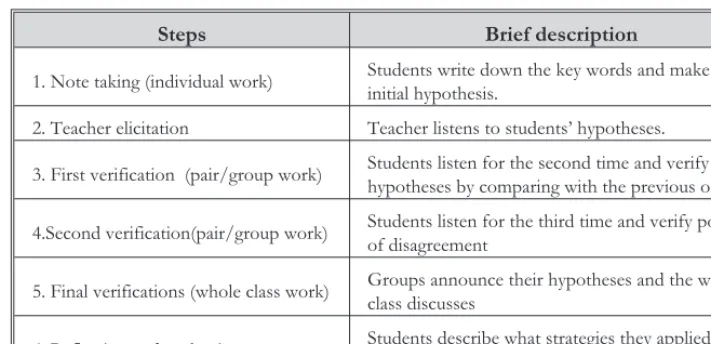
1. Note taking (individual work). Students individually write down possible words they hear and make an initial hypothesis. They do not receive any warm-up by the teacher and have to discover the association of the words and make the initial hypothesis by employing their prior knowledge.
2. Teacher elicitation. The teacher elicits a number of words from the students and listens to their initial hypotheses but does not offer “right” or “wrong” judgments.
3. First verification (group/pair work). After the teacher finishes eliciting students’ predictions, they will listen to the recording for a second time and either verify or nullify their initial hypotheses by comparing what their peers have written. Then they will decide on details that require further attention, and listen for additional information.
4. Second verification (group/pair work).Students listen to the recording for a third time and verify points of disagreement, make corrections, and write down additional details through negotiation.
5. Final verification (whole class work). At the end of the fourth step, each group is required to announce their hypotheses. Then, the whole class discusses and tries to reach a nearly unanimous piece of information about the listening material based on the contributions made by all the groups.
6. Reflection and evaluation. Finally, one or more groups share their experience with the class and describe the strategies they applied as well as how they proceeded in the comprehension process. Other groups can pass judgments in a cooperative manner and try to complete what those groups mentioned under the teacher’s supervision and guidance.
Steps Brief description
1. Note taking (individual work) Students write down the key words and make an initial hypothesis.
2. Teacher elicitation Teacher listens to students’ hypotheses.
3. First verification (pair/group work) Students listen for the second time and verify initial hypotheses by comparing with the previous ones
4.Second verification(pair/group work) Students listen for the third time and verify points of disagreement
5. Final verifications (whole class work) Groups announce their hypotheses and the whole class discusses
6. Reflection and evaluation Students describe what strategies they applied and how they proceeded in the comprehension process
The Rationale behind the Technique
This technique is process- rather than product-oriented. It is not concerned with the immediate answer but with the listening process i.e. how students arrived at comprehension by going through different stages. It changes the listening practice into a task-based activity in which students learn how to listen, rather than being tested. An important aspect of the teacher’s role is to help students develop strategies that enable them to become independent learners so as to take more responsibility for their own learning. The ultimate goal of this technique is for students to gradually reach a level of autonomy and avoid depending on their teachers by employing useful strategies which facilitate listening comprehension. The rationale behind each step is briefly discussed below.
No warm-up. Students should be trained to depend on themselves and become autonomous inasmuch as in real life they are expected to listen to news or watch TV programs on their own without any warm-up. They should become autonomous and try to use their prior knowledge as a cognitive strategy to handle their comprehension problems and not depend on their teachers so much.
Individual elicitation of words and initial predictions. At the first stage of this technique, the students are individually required to write as many words as they
can and make their initial assumptions, which are elicited by their teacher. This is to ensure that all the students are listening attentively. In addition, this procedure is not done for the sake of evaluating them, which simply fosters anxiety, but to make sure all the students are engaged in the activity. The teacher does not judge as “right” or “wrong” when s/he listens to the initial guesses since the idea is to engage students in the listening activity through this initial individual stage. Later on, at the time of group discussion, they will be eager to share their assumptions. After this individual stage, the teacher can divide them into groups.
Bridging gaps in the students’ listening comprehension ability. By developing strategies to compensate for gaps in understanding, the students are less uncomfortable while encountering unknown words or an unfamiliar variant of the target language. Their anxiety during the listening task is greatly reduced since they share what they comprehended and try to learn how to fill in the gaps from one another under the teacher’s supervision and guidance and, thus, gradually improve their comprehension.
Cooperation. When students are individually faced with a challenging listening material or an unfamiliar variant of the target language, the task might become discouraging. Cooperation plays a central role in making the listening activity more interesting, motivating and hence engaging by reducing the amount of stress or boredom as mentioned above.
Guessing, sharing and verifying hypotheses with peers. This is the key feature of this process-oriented listening technique by which students take responsibility for the development of their listening ability. As the stages proceed and the audio is played for a number of times, students are required to improve their hypotheses and negotiate them with their classmates. This happens through a cooperative guessing game, which establishes a true communicative situation in that “the person guessing has a real urge to find out something” (Klippel, 1984, p.31). Similarly, Field (2000) argues that the formation of hypotheses is part of the process of L2 listening that can help L2 listeners experience success in real-life listening. Teachers also understand how listeners arrived at (incorrect) answers, which helps them decide on the macro or micro listening skills the students are weak in and may need immediate or future remedial action.
Vandergrift (2004), the use of metacognitive strategies is crucial for self-regulation of listening when students need to redirect attention or critically evaluate what they hear. Moreover, the use of metacognitive strategies plays a crucial role in confidence-building and enhances comprehension in L2 listening skill (Vandergrift, 2004). Finally, collaboration with peers for discussing the metacognitive strategies used leads to a more conscious application of such strategies in next session listening activities to be done by the students.
This technique can be done in more or less different ways, depending on a number of factors such as the students’ level of language proficiency or the level of difficulty of the input material. Ideally, it is recommended for intermediate level students, particularly when the teacher wishes to change an ordinary activity in the textbook into a task-based, process-oriented one. However, it is equally possible to use this technique with elementary level students, but the amount of teacher’s help might vary, and the “no warm-up” principle will be altered to a couple of directions given by the teacher.
This technique is also recommended when the listening material is very demanding and the teacher wants to change the listening task into a group work activity and encourage the students to be engaged in the listening task. If the listening material is too complex for the learners, the teacher should intervene and give some directions so that the comprehension process does not break down. The help should be offered very meticulously so that the students do not forget about their responsibility for their own learning. The help could be given in the form of a few sentences about the listening exercise or stopping the audio recording and attracting the students’ attention towards an important part in the audio recording or even providing them with visual or written supports. The amount of help might vary depending on the degree of complexity of the diverse listening tasks.
It is worth noting that this technique is heavily context-dependent and some students might not be ready for it. In such cases, the teacher can offer some help at the beginning and try to reduce the amount of help in other sessions.
Conclusion
also suggested that the listening activity needs to be task-based and attractive for the students by getting them to make and verify hypotheses through discussion, negotiation and cooperation. Similarly, we have argued that L2 listeners need to be encouraged to take more responsibility for the development of their listening ability through learning to listen by employing various metacognitive strategies. It is worth mentioning that a clearer understanding of the interaction among processing, proficiency level, and task will help teachers know what to emphasize and how much help to offer at different language levels for different tasks. Research into the components of L2 listening will help teachers better understand what needs to be emphasized in listening instruction in various situations.
References
Anderson, N. J. (1991). Individual differences in strategy use in second language reading and testing.Modern Language Journal, 75(4), 460-472.
Asher, J. (1988). Learning another language through actions: The complete teacher’s guidebook. (Third Edition). Los Gatos, Ca: Sky Oaks Productions.
Arnold, J. (2000). Seeing through listening comprehension exam anxiety.TESOLQuarterly, 34(4), 777–786.
Chamot, A. U. (1987). The learning strategies of ESL students. In Wenden, A. & Rubin, J. (Eds.),
Learning strategies in language learning, (pp. 71-83). Englewood Cliffs: Prentice-Hall.
Field, J. (2000). Finding one’s way in the fog: Listening strategies and second language learners.
Modern English Teacher,9(1), 29–34.
Harmer, J. (2007).How to teach English(New Edition). Harlow: Pearson Education Limited. Hauck, M. (2005). Metacognitive knowledge, metacognitive strategies and CALL. In Egbert, J. &
Petrie, G. (Eds.),CALL research perspectives, (pp. 65-58). Mahwah, NJ: Lawrence Erlbaum. Klippel, F. (1984). Keep talking: Communicative fluency activities for language teaching. Cambridge:
Cambridge University Press.
Krashen, S. (1982).Principles and practice in second language acquisition. Englewood Cliffs, NJ: Prentice Hall.
Mendelsohn, D. (2001). Listening comprehension: We’ve come a long way, but . . .Contact, 27(2),
33–40.
Morley, J. (2001). Aural comprehension instruction: Principles and practices. In Celce-Murcia, M. (Ed.),Teaching English as a second or foreign language, (pp. 69-85). Boston, MA: Heinle and Heinle. O’Malley, M. & Chamot, A. U. (1990). Learning strategies in second language acquisition. Cambridge:
Cambridge University Press.
Nunan, D. (2002). Listening in language learning. In Richards, J. & Renandya, W. A. (Eds.),
Methodology in language learning: An anthology of current practice (pp. 238-241). Cambridge: Cambridge University Press.
Vandergrift, L. (2003). From prediction through reflection: Guiding students through the process of L2 listening.Canadian Modern Language Review,59(3), 425–440.
Vandergrift, L. (2004). Listening to learn or learning to listen?Annual Review of Applied Linguistics,24, 3-25.
Yang, C. (2009). A study of metacognitive strategies employed by English listeners.International Education Studies,2(4), 134-139.
The Authors
Sasan Baleghizadeh is an Assistant Professor of TEFL at Shahid Beheshti University, G.C. of Iran, where he teaches applied linguistics, syllabus design, and materials development. He is the author ofTales from Rumi,Tales from Men of Wisdom, and a number of other simplified readers all published by the Iran Language Institute. His recent research papers have appeared in TESL Reporter, ELT Journal,
Novitas-ROYAL, andStudies in Literature and Language.
Fatemeh Arabtabarholds anMAdegree inTEFLfrom Khatam University in Tehran, Iran. She has extensive experience in teaching English as a foreign language at different levels of language proficiency. She is interested in doing research in language learning strategies.