Devanshi et al. World Journal of Engineering Research and Technology
STUDY ON TEXT DATA MINING FOR CARE LIFE LOG USING KEY
GRAPH
Devanshi Nayak*1 and Prof. S. R. Yadav2 1
M.Tech. Scholar, CSE, MITS Bhopal.
2
A. P., CSE, MITS Bhopal.
Article Received on 01/12/2019 Article Revised on 22/12/2019 Article Accepted on 12/01/2020
ABSTRACT
Text data mining is a process of extracting interesting and nontrivial patterns from huge amount of text documents. There exist different techniques and tools to mine the text and discover valuable information for future prediction and decision making process. The selection of right and appropriate text mining technique helps to enhance the speed and decreases the time and effort required to extract valuable information. Care Life Log is used to integrate and analyze the level of care required. There are five levels of care, with Level 1 vocabulary including recreation, toilet, morning, afternoon, etc. The level of care gradually increases from Level 1 to Level 5, which has vocabulary that includes tube, danger, treatment, removal, and discovery. The higher the level, the worse the health condition and therefore the greater care required. These levels allow for a clear analysis of a patient’s condition. This analysis has led to an improvement in Quality of Life as well as a decrease in mismatches between the level of care required for patients and the level of care given by care takers. Rapid progress in digital data acquisition techniques have led to huge volume of data. More than 80 percent of today’s data is composed of unstructured or semi-structured data. The discovery of appropriate patterns and trends to analyze the text documents from massive volume of data is a big issue. A text data mining technique identified the relations between feature vocabularies seen in past in-patient records accumulated on the University of Miyazaki Hospital’s Electronic Medical Record, and extractions were made.The qualitative analysis result of in-patient nursing records used a text data mining technique to achieve the initial goal: a visual record of such information. The analysis discovered vocabularies relating to proper treatment methods and concisely
World Journal of Engineering Research and Technology
WJERT
www.wjert.org SJIF Impact Factor: 5.924
*Corresponding Author
Devanshi Nayak
M.Tech. Scholar, CSE,
summarized their extracts from in-patient nursing records. Important vocabularies that characterize each nursing record were also revealed. The results of this research will contribute to nursing work evaluation and education.
KEYWORDS: Text Data Mining, Care Life Log, Nursing Records, Qualitative Analysis, Data Acquisition, Electronic Medical Records.
1. INTRODUCTION
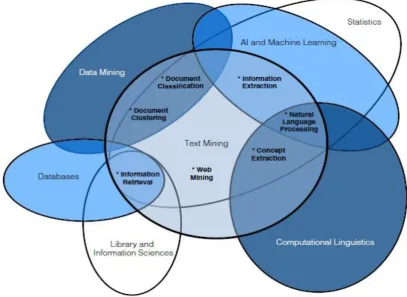
Text mining is a process to extract interesting and significant patterns to explore knowledge from textual data sources.[3] Text mining is a multi-disciplinary field based on information retrieval, data mining, machine learning, statistics, and computational linguistics.[3] Figure 1 shows the Venn diagram of text mining and its interaction with other fields.
Several text mining techniques like summarization, classification, clustering etc., can be applied to extract knowledge. Text mining deals with natural language text which is stored in semi-structured and unstructured format.[4] Text mining techniques are continuously applied in industry, academia, web applications, internet and other fields.[5] Application areas.
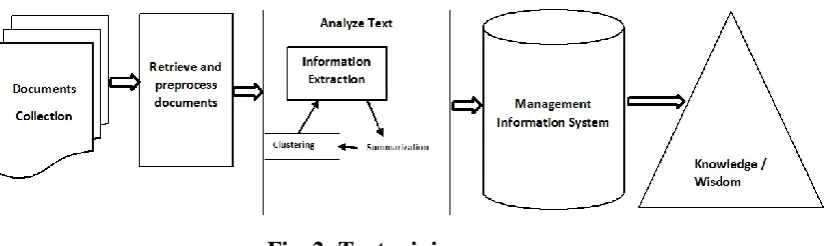
like search engines, customer relationship management system, filter emails, product suggestion analysis, fraud detection, and social media analytics use text mining for opinion mining, feature extraction, sentiment, predictive, and trend analysis.[6] Generic process of text mining performs the following steps (Figure 2).
_ Collecting unstructured data from different sources available in different file formats such as plain text, web pages, pdf files etc.
_ Pre-processing and cleansing operations are performed to detect and remove anomalies. Cleansing process make sure to capture the real essence of text available and is performed to remove stop words stemming (process of identifying the root of certain word) and indexing the data.[7]
_ Processing and controlling operations are applied to audit and further clean the data set by automatic
processing.
_ Pattern analysis is implemented by Management Information System (MIS).
_ Information processed in the above steps are used to extract valuable and relevant information for effective and timely decision making and trend analysis.[8]
Fig. 2: Text mining process.
Extraction of valuable information from a corpus of different document is a tedious and tiresome task. The selection of appropriate technique for mining text reduce the time and effort to find the relevant patterns for analysis and decision making.
1. LITERATURE REVIEW
Kenji Araki and Muneou Suzuki, IAENG International Journal of Computer Science· August
2011, 38:3, IJCS_38_3_05, Text Data Mining of In-patient Nursing Records Within
to proper treatment methods and concisely summarized their extracts from in-patient nursing records.
S.-H. Liao, P.-H. Chu, and P.-Y. Hsiao, “Data mining techniques and applications–a decade review from 2000 to 2011,” Expert Systems with Applications, vol. 39, no. 12, pp. 11 303–11 311, 2012. described that gathering, extracting, pre-processing, text transformation, feature extraction, pattern selection, and evaluation steps are part of text mining process. In addition, different widely used text mining techniques, i.e., clustering, categorization, decision tree categorization, and their application in diverse fields are surveyed.
N. Zhong, Y. Li, and S.-T. Wu, “Effective pattern discovery for text mining,” IEEE transactions on knowledge and data engineering, vol. 24, no. 1, pp. 30–44, 2012. Highlighted the issues in text mining applications and techniques. They discussed that dealing with unstructured text is difficult as compared to structured or tabular data using traditional mining tools and techniques. They have shown the applications of text mining process in bioinformatics, business intelligence and national security system. Natural language processing and entity recognition techniques has reduced the issues that occur during text mining process. However, there exist issues which need attention.
A. Henriksson, H. Moen, M. Skeppstedt, V. Daudaraviˇcius, and M. Duneld, “Synonym extraction and abbreviation expansion with ensembles of semantic spaces,” Journal of biomedical semantics, vol. 5, no. 1, p. 1, 2014. explored MEDLINE biomedical database by integrating a framework for named entity recognition, classification of text, hypothesis generation and testing, relationship and synonym extraction, extract abbreviations. This new framework helps to eliminate unnecessary details and extract valuable information.
B. Laxman and D. Sujatha, “Improved method for pattern discovery in text mining,” International Journal of Research in Engineering and Technology, vol. 2, no. 1, pp. 2321– 2328, 2013. analyzed the text using text mining patterns and showed term based approaches cannot analyze synonyms and polysemy properly. Moreover, a prototype model was designed for specification of patterns in terms of assigning weight according to their distribution. This approach helps to enhance the efficiency of text mining process.
Scientists 2017 Vol I, IMECS 2017, March 15 - 17, 2017, Hong Kong. Text Data Mining of Care Life Log by the Level of Care Required Using KeyGraph. This analysis has led to an improvement in Quality of Life as well as a decrease in mismatches between the level of care required for patients and the level of care given by caretakers.
Muneo Kushima, Tomoyoshi Yamazaki and Kenji Araki, Proceedings of the International Multi Conference of Engineers and Computer Scientists 2019 IMECS 2019, March 13-15, 2019, Hong Kong. Text Data Mining of the Nursing Care Life Log from Electronic Medical Record. The analysis results have potential to clarify the work content of care workers. As the nursing field requires efficiency in health care services, improvement and continuous data collection are important for the long-term building of health care services as well as large-scale data collection.
2. METHODOLOGY Key Graph
Key Graph consists of three major components derived from construction metaphors. Each component is described as follows:
1) Foundations: sub-graphs of highly associated and frequent terms that represent basic concepts in the data. A foundation is defined as a cluster that consists of black nodes linked by solid lines. The foundations are underlying common contexts because they are formed by a set of items that frequently co-occur in the data set.
2) Roofs: terms that is highly associated with foundations.
3) Columns: associations between foundations and roofs that are used for extracting keywords, i.e., the main concepts in the data. A column is a dotted line that connects foundations.
Example of Key Graph Performance
Figure 3 shows an example when it is applied to text data.
1. Black nodes indicate items that frequently occur in a data set.
2. White nodes indicate the items that occur less frequently overall but frequently occur with black nodes in a data set.
3. Double-circled nodes indicate items whose co-occurrence frequency with black nodes is especially high. Double-circled nodes are considered keywords.
5. Solid lines form a foundation, which dotted lines connect. Foundations, which are circles of dotted lines, are obtained from the text data.
●: High frequency terms
○: Connect high frequency “foundations” ◙: Keywords of ●
©: Keywords of ○
“Foundation (Cluster)”
: Mass of black nodes and links
“Roof”: Connect with the “foundation” “Column”: ---
: Significant “roofs” between “foundations”
Solid lines (-): Strongly correlated terms of “foundations” ---: Strongly correlated terms
Fig. 3: Key Graph example when applied to text data. Key Graph Algorithm
Key Graph was originally an algorithm for extracting assertions based on the co-occurrence graph of terms from text data.
1) Document preparation: Before processing document D, stop words [29] with little meaning are discarded from, the words in D are stemmed [30], and the phrases in D are specified [31]. Hereafter, a term means a word or a phrase n processed D.
2) Extracting foundations: Graph G for document D is made of nodes representing terms and links representing the co-occurrence (term-pairs that frequently occur in the same sentences throughout D). Nodes and links in G are defined as follows:
Nodes: Nodes in G represent high-frequency terms in D because they might appear frequently for expressing typical, basic concepts in the domain. High-frequency terms are a set of terms above the 30th highest frequency. This set is denoted by HF.
Links: nodes in HF are linked if the association between the corresponding terms is strong. The association of terms between wi and wj in D is defined as assoc (wi, wj) =
(1)
Where |x|s denotes the count of x in sentence s. Pairs of high-frequency terms in HF are sorted by assoc and the pairs above the (number of nodes in G) -1th tightest association are represented in G by links between nodes.
Extracting columns: The probability that term w appears is defined as key (w), and key (w) is defined by
Key (w) = 1 −Πg⊂G [1 – based (w, g) / neighbors (g)], (2)
Based (w, g) = Σs∈D |w|s |g − w|s, (3)
Neighbors (g) =Σs∈D Σ w∈s |w|s |g − w|s. (4)
|g − w|s = {|g|s − |w|s, w ∈ g, (5) {|g|s, w!∈g
Extracting roofs: The strength of a column between high key term wi and high-frequency term wj ⊂ HF is expressed as
Columns touching wi are sorted by column (wi, wj) for each high key term wi. Columns with the highest column values connecting term wi to two or more clusters are selected to create new links in G. Finally, the nodes in G are sorted by the sum of the column of the touched columns. Terms represented by the nodes of higher values than a certain threshold are extracted as the keywords for document D.
3. RESULTS AND ANALYSIS
Table 1: Relationship between Top Ten Words and Their Frequency for Internal Medicine.
Rank Internal
Medicine 1 Frequency
Internal
Medicine 2 Frequency
Internal
Medicine 3 Frequency
1 Doctor 172 Internal use 136 Description 13 2 Direction 140 Medication 84 Charge 13 3 Principal 139 Connection 72 Alcer 13 4 patient 139 Urine 70 Acne 13 5 Internal use 131 Feeling 60 Skin 12 6 Report 130 Today 59 Toady 11 7 Hope 102 Principle 54 Use 10 8 Consent 92 Attending
Physician 54 Entire body 9 9 Observation 91 Progress 91 Plan 9 10 Use 89 Hope 51 Exchange 9
1 2 3 4 5 6 7 8 9 10 0 20 40 60 80 100 120 140 160 180 RANK FR E Q U E N C Y INTERNAL MEDICINE
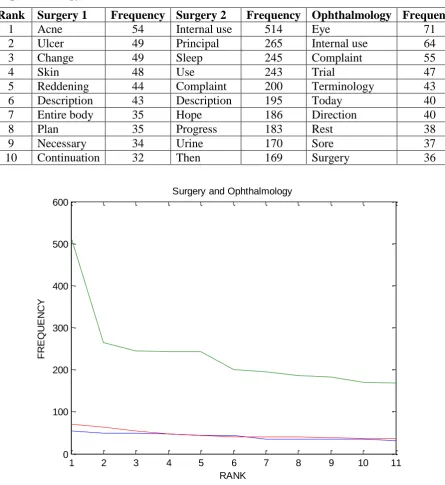
Table 2: Relationship between Top Ten Words and Their Frequency for Surgery and Ophthalmology.
Rank Surgery 1 Frequency Surgery 2 Frequency Ophthalmology Frequency
1 Acne 54 Internal use 514 Eye 71 2 Ulcer 49 Principal 265 Internal use 64 3 Change 49 Sleep 245 Complaint 55
4 Skin 48 Use 243 Trial 47
5 Reddening 44 Complaint 200 Terminology 43 6 Description 43 Description 195 Today 40 7 Entire body 35 Hope 186 Direction 40 8 Plan 35 Progress 183 Rest 38 9 Necessary 34 Urine 170 Sore 37 10 Continuation 32 Then 169 Surgery 36
1 2 3 4 5 6 7 8 9 10 11
0 100 200 300 400 500 600
RANK
FR
E
Q
U
E
N
C
Y
Surgery and Ophthalmology
Fig 5: Surgery and Ophthalmology.
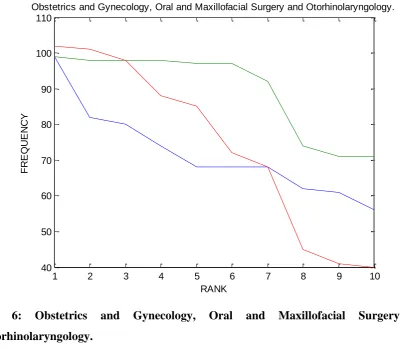
Table 3: Relationship between Top Ten Words and Their Frequency for Obstetrics and Gynecology, Oral and Maxillofacial Surgery and Otorhinolaryngology.
Rank
Obstetrics and
Gynecology
Frequency
Oral and Maxillofacial Surgery
Frequency Otorhinolaryngology Frequency
4 Direction 74 Connection 98 Right 88 5 Today 68 Leakage 97 Neck 85 6 Bleeding 68 Nursing 97 Left 72 7 Doctor 68 Reference 92 Blood 68 8 Report 62 Infection 74 Chest 45 9 Above 61 Plan 71 Progress 41 10 Uterus 56 Attachment 71 Reference 40
1 2 3 4 5 6 7 8 9 10
40 50 60 70 80 90 100 110
RANK
FR
E
Q
U
E
N
C
Y
Obstetrics and Gynecology, Oral and Maxillofacial Surgery and Otorhinolaryngology.
Fig 6: Obstetrics and Gynecology, Oral and Maxillofacial Surgery and Otorhinolaryngology.
Table 4: Relationship between Top Ten Words and Their Frequency for Pediatrics, Orthopedics, and Psychiatry.
Rank Pediatrics Frequency Orthopedics Frequency Psychiatry Frequency
1 Medical treatment 23 Internal use 431 Internal use 239 2 Description 22 Sleep 186 State 208 3 Nursing 20 Hope 119 Sleep 193 4 Doctor 20 Principal 117 Arousal 173 5 Suffer 19 Medicine 110 Then 167 6 State 19 Complaint 99 Check 156 7 Necessary 17 Above
mentioned 71
Inspection
tour 136
8 Mother 17 Use 74 Night 107
1 2 3 4 5 6 7 8 9 0
50 100 150 200 250 300 350 400 450
RANK
FR
E
Q
U
E
N
C
Y
Pediatrics, Orthopedics, and Psychiatry
Fig. 7: Pediatrics, Orthopedics, and Psychiatry.
Table 5: Relationship between Top Ten Words and Their Frequency for Neurosurgery, Urolog and Dermatology.
Rank Neurosurgery Frequency Urology Frequency Dermatology Frequency
1 2 3 4 5 6 7 8 9 10 0
20 40 60 80 100 120 140
RANK
FR
E
Q
U
E
N
C
Y
Neurosurgery, Urology and Dermatology
Fig. 8: Neurosurgery, Urology and Dermatology.
Table 6: Relationship between Top Ten Words and Their Frequency for Radiology, Anesthesiology and Rheumatology and Infections.
Rank Radiology Frequency Anesthesiology Frequency
Rheumatology and Infectious Diseases
Frequency
1 2 3 4 5 6 7 8 9 10 20
40 60 80 100 120 140 160
RANK
FR
E
Q
U
E
N
C
Y
Radiology, Anesthesiology and Rheumatology and Infections
Fig. 9: Radiology, Anesthesiology and Rheumatology and Infections. 4. CONCLUSIONS
The selection of right and appropriate text mining technique helps to enhance the speed and decreases the time and effort required to extract valuable information. The analysis results have potential to clarify the work content of care workers. As the nursing field requires efficiency in health care services, improvement and continuous data collection are important for the long-term building of health care services as well as large-scale data collection.
5. Scope of Future work
In the future, we aim to develop an Electronic Medical Record that can be created semi-automatically in accordance with the level of care required.
REFERENCES
2. A. Henriksson, J. Zhao, H. Dalianis, and H. Bostr¨om, “Ensembles of randomized trees using diverse distributed representations of clinical events,” BMC Medical Informatics and Decision Making, 2016; 16(2): 69.
3. A. Kaklauskas, M. Seniut, D. Amaratunga, I. Lill, A. Safonov, N. Vatin, J. Cerkauskas, I. Jackute, A. Kuzminske, and L. Peciure, “Text analytics for android project,” Procedia Economics and Finance, 2014; 18: 610–617.
4. A. Kumaran, R. Makin, V. Pattisapu, and S. E. Sharif, “Automatic extraction of synonymy information:-extended abstract,” OTT06, 2007; 1: 55.
5. A. M. Cohen and W. R. Hersh, “A survey of current work in biomedical text mining,” Briefings in bioinformatics, 2005; 6(1): 57–71.
6. B. A. Mukhedkar, D. Sakhare, and R. Kumar, “Pragmatic analysis based document summarization,” International Journal of Computer Science and Information Security, 2016; 14(4): 145.
7. B. L. Narayana and S. P. Kumar, “A new clustering technique on text in sentence for text mining,” IJSEAT, 2015; 3(3): 69–71.
8. B. Laxman and D. Sujatha, “Improved method for pattern discovery in text mining,” International Journal of Research in Engineering and Technology, 2013; 2(1): 2321–2328.
9. C. Ding and H. Peng, “Minimum redundancy feature selection from microarray gene expression data,” Journal of bioinformatics and computational biology, 2005; 3(02): 185–205.
10.C. P. Chen and C.-Y. Zhang, “Data-intensive applications, challenges, techniques and technologies: A survey on big data,” Information Sciences, 2014; 275: 314–347.
11.D. S. Dang and P. H. Ahmad, “A review of text mining techniques associated with various application areas,” International Journal of Science and Research (IJSR), 2015; 4(2): 2461–2466.
12. E. A. Calvillo, A. Padilla, J. Mu˜noz, J. Ponce, and J. T. Fernandez, “Searching research papers using clustering and text mining,” in Electronics, Communications and Computing (CONIELECOMP), 2013.
13.F. Fatima, Z. W. Islam, F. Zafar, and S. Ayesha, “Impact and usage of internet in education in pakistan,” European Journal of Scientific Research, 2010; 47(2): 256–264. 14.G. King, P. Lam, and M. Roberts, “Computer-assisted keyword and document set
15.H. Solanki, “Comparative study of data mining tools and analysis with unified data mining theory,” International Journal of Computer Applications, 2013; 75(16).
16. I. Alonso and D. Contreras, “Evaluation of semantic similarity metrics applied to the automatic retrieval of medical documents: An umls approach,” Expert Systems with Applications, 2016; 44: 386–399.
17. I. H. Witten, K. J. Don, M. Dewsnip, and V. Tablan, “Text mining in a digital library,” International Journal on Digital Libraries, 2004; 4(1): 56–59.
18. K. Sumathy and M. Chidambaram, “Text mining: Concepts, applications tools and issues-an overview,” International Journal of Computer Applications, 2013; 80(4).
19.N. Samsudin, M. Puteh, A. R. Hamdan, and M. Z. A. Nazri, “Immune based feature selection for opinion mining,” in Proceedings of the World Congress on Engineering, 2013; 3: 3–5.
20.N. Zhong, Y. Li, and S.-T. Wu, “Effective pattern discovery for text mining,” IEEE transactions on knowledge and data engineering, 2012; 24(1): 30–44.
21. P. J. Joby and J. Korra, “Accessing accurate documents by mining auxiliary document information,” in Advances in Computing and Communication Engineering (ICACCE), Second International Conference on. IEEE, 2015; 634–638.
22. R. Agrawal and M. Batra, “A detailed study on text mining techniques,” International Journal of Soft Computing and Engineering (IJSCE) ISSN, 2013; 2231–2307.
23. R. Al-Hashemi, “Text summarization extraction system (tses) using extracted keywords.” Int. Arab J. e-Technol., 2010; 1(4): 164– 168.
24. R. Rajendra and V. Saransh, “A Novel Modified Apriori Approach for Web Document Clustering,” International Journal of Computer Applications, 2013; 159–171.
25.R. Sharda and M. Henry, “Information extraction from interviews to obtain tacit knowledge: A text mining application,” AMCIS Proceedings, 2009; 283.
26. R. Steinberger, “A survey of methods to ease the development of highly multilingual text mining applications,” Language Resources and Evaluation, 2012; 46(2): 155–176.
27. S. Ayesha, T. Mustafa, A. R. Sattar, and M. I. Khan, “Data mining model for higher education system,” Europen Journal of Scientific Research, 2010; 43(1): 24–29.
28.S.-H. Liao, P.-H. Chu, and P.-Y. Hsiao, “Data mining techniques and applications–a decade review from 2000 to 2011,” Expert Systems with Applications, 2012; 39(12): 303–11-311.
30.W. He, “Examining students online interaction in a live video streaming environment using data mining and text mining,” Computers in Human Behavior, 2013; 29(1): 90–102.
31.Y. Zhao, “Analysing twitter data with text mining and social network analysis,” in Proceedings of the 11th Australasian Data Mining and Analytics Conference (AusDM 2013), 2013; 23.