Published online December 30, 2012 (http://www.sciencepublishinggroup.com/j/ajmp) doi: 10.11648/j.ajmp.20120101.12
The linguo –combinatorial simulation in modern physics
Mikhail Ignatyev
St-Petersburg State University of Aerospace Instrumentation, St-Petersburg, Russia
Email address:
[email protected] (M. Ignatyev)
To cite this article:
Mikhail Ignatyev. The Linguo –Combinatorial Simulation in Modern Physics. American Journal of Modern Physics. Vol. 1, No. 1, 2012, pp. 7-11. doi: 10.11648/j.ajmp.20120101.12
Abstract:
It is considered the systems with structured uncertainty which is determined by mean of number of the arbi-trary coefficients. The arbiarbi-trary coefficients defines the chaotic behavior. Any complex system interacts with its changing environment and its viability depends on its adaptability. The number of arbitrary coefficients in the structure of equivalent equations of complex system changes in the process of learning. In systems with more than six variables, the number of arbitrary coefficients increases first, and then, passing through the maximum, begins to decrease. This phenomenon makes it possible to explain the processes of system growth, complication and death in biological, economical and physical-engineering systems. We use the linguo-combinatorial method for investigation of complex systems, in taking key words for building equivalent equations. This phenomenon is able to investigate the adaptability of different atoms and astrophys-ical systems. The contemporary physics must use the concept of control and information.Keywords:
Adaptability, Combinatorial Simulation, Uncertainty, Appearance, Essence, General Systems Theory, Physics, Atoms, Astrophysics1. Introduction
The natural language is the main intellectual product of mankind. The structure of the natural intellect is reflected in natural language that is accessible for investigation. Some scientific experiments can be expensive and danger-ous. The simulation techniques permit to decrease the cost for investigating these systems. The simulation must accu-rately reflect the characteristics of the real world. Combi-natorial simulation allows studying the full set of system variants including uncertainty. Any system contains some types of uncertainty, which are determined by their exis-tence in real world. Humans interact with both physical objects and their descriptions in terms of natural language, mathematics or tables. Descriptions often only partially represent the essence of real processes. The inaccuracy of description introduces uncertainty. More often the uncer-tainty of systems is, however, inherent to the real world. This study is aimed toward such types of uncertainty in mental processes. Physical laws, the balance of energy and matter, and information limit the systems behavior. Within these limits, systems interact and adapt to other systems and environment, and undergo destructive actions.
2. Linguo-combinatorial Simulation
Frequently we use the natural language to describe sys-tems. We propose to transfer this natural language descrip-tion to mathematical equadescrip-tions.
For example, we have a sentence
WORD1 + WORD2 + WORD3 (1)
where we assign words and only imply meaning of words, the meaning (sense) is ordinary implied but not designated. We propose to assign meaning in the following form
(WORD1).(SENSE1) (WORD2). (SENSE2) (WORD3).(SENSE3) 0 (2)
This equation (2) can be represented in the following form
A1.E1 + A2.E2 + A3.E3 = 0 (3)
where Ai, i = 1, 2, 3, will denote words from English Appearance and Ei will denote senses from English Es-sence. The equations (2) and (3) are the model of the sen-tence (1). This model is an algebraic ring and we can re-solve this equation with respect to the appearances Ai or the essences Ei [4,5,6]:
A2 = − U1.E1 + U3.E3 (4) A3 = − U2.E1 – U3.E2
or
E1 = U1.A2 + U2.A3
E2 = − U1.A1 + U3.A3 (5)
E3 =− U2.A1 – U3.A2
where U1, U2, U3 are arbitrary coefficients, can be used for solution of different tasks on the initial manifold (2 ) or (3) and can to define the chaotic behavior. In general if we have n variables in our system and m manifolds, restric-tions, then the number of arbitrary coefficients S will be defined as the number of combinations from n to m+1 [2], as shown in Table 1
S =
C
nm+1,n
>
m
(6)Table 1. The number of arbitrary coefficients depending on the number of variables n and the number of restriction m.
n /m 1 2 3 4 5 6 7 8
2 1 3 3 1 4 6 4 1 5 10 10 5 1 6 15 20 15 6 1 7 21 35 35 21 7 1 8 28 56 70 56 28 8 1 9 36 84 126 126 84 36 9 1
The formula (6) is the basic law of cybernetics, infor-matics and synergetics for complex systems. The number of arbitrary coefficients is the measure of uncertainty. Usually, when solving mathematical systems, the number of variables is equal to the number of equations. In practice we frequently do not know how many constraints there are on our variables. Combinatorial simulation makes it possi-ble to simulate and study the systems with uncertainty on the base of incomplete information. The problem of simu-lation of condition, guaranteeing the existence of maximum adaptability is investigated.
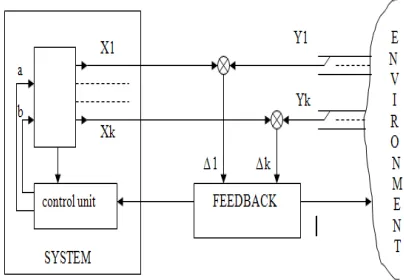
It is supposed that the behavior of a system with n va-riables is given with an accuracy of m intersecting mani-folds, n > m. If the system is considered as a multidimen-sional generator (Fig.1) where at least a part of the va-riables interact with environment vava-riables, and if the ob-jective of the system is to decrease the functional of dis-coordination between them (
∆
1…∆
k), the system con-trol unit has two instruments of impact, a and b, upon the system. First, this is the tuning – the changing of uncertain coefficients in the structure of the differential equations of the system, taking account that the greater number of these coefficients implies more accurate system response to changing environment. Second, this is the learning – the imposing new restrictions on the system behavior. The number of arbitrary coefficients, in the structure ofequiva-lent equations, changes in the process of learning, of con-secutive imposing new and new restrictions on the system behavior. In the systems with more than six variables the number of arbitrary coefficients increases first, and then, passing through the maximum begins to decrease. This phenomenon makes it possible to explain the processes of system growth, complication and death. The existence of maximum adaptability phenomenon is observed in and proved by numerous biological, economical and physical-engineering systems.
Fig. 1 shows the interaction between system and envi-ronment. It is important that we describe a system with a full sum of combinations and have all the variants of deci-sions. The linguo-combinatorial simulation is a useful heu-ristic approach for investigation of complex, poorly forma-lized systems.
Fig. 1. Model of “System - Environment”.
Natural language is the main intellectual product of mankind; the structure of natural language reflects the structure of natural intellect of mankind and its separate representatives on the level of consciousness and uncons-cious. Linguo-combinatorial simulation is the calculation, which permits to extract the senses from texts. Wittgenstein wanted to have the calculation of senses [1]. In our calcula-tion we have the three groups of variables: the first group – the words of natural language Ai, the second group – the essences Ei, which can be the internal language of brain [1]; we can have the different natural languages, but we have only one internal language of brain; this hypothesis opens a new way for experimental investigation; the third group of variables – the arbitrary coefficients, uncertainty in our model, which we can use for adaptation in translation processes and etc.
discoordination between them, the system control unit has two instruments of influence of the system. First, this is the tuning – the change of underdeterminated coefficients in the structure of the differential equations of system taking account that more is these coefficients the more accurate are the responses of the system to the change of environ-ment. Second, this is the learning – the imposition of new restriction on the systems behavior. The amount of arbi-trary coefficients in the structure, of equivalent equations is changing in the process of learning, of consecutive imposi-tion of new and new restricimposi-tions on the system behavior. In the systems with the number of variables more than six the amount of arbitrary coefficients increase first and then going through the maximum begin to decrease. This phe-nomenon permits to explain the processes of growth, com-plication and death of a system. The existence of adapta-tional maximum phenomenon is proved by numerous bio-logical, economical and physical-technical systems.
We use the linguo-combinatorial method of investigation of the poorly formalized complex system, then we use the key words for creation of equivalent equations. The study of adaptational phenomenon in complex systems permit to increase the adaptational possibility in different systems and to resolve a lot of paradoxes.
3. Combinatorial Model of Atoms
For example we consider the problem of atom simula-tion. For Hydrogen we have the key words
Atom + Proton + Electron (7)
Then the equivalent equation will be (4, 5), where A1- characteristic of Hydrogen atom in particular his spectral characteristic, E1 – variation of this characteristic, A2 – characteristic of proton, E2 – variation of this characteristic, A3 – characteristic of electron, E3 – variation of this cha-racteristic.
For simulation of Deuterium we will have the key words
Atom + proton + electron + neutron (8)
After polarization operation
А11*Е1 + А12*Е2 + А13*Е3 + А14*Е4 = 0 (9)
And equivalent equations will be
E1 = U1*A1
2 + U2*A13 + U3*A14
E2 = - U1*A1
1 + U4*A13 + U5*A14
E3 = - U2*A11 – U4*A12 + U6*A14 (10)
E4 = - U3*A11 – U5*A12 – U6*A13
where U1, U2, U3, U4, U5, U6 – the arbitrary coeffi-cients, A11- characteristic of Deuterium atom, E1- variation of this characteristic, A12-characteristic of proton, E2 – variation of this characteristic, A13- characteristic of elec-tron, E3- variation of this characteristic, A14- characteristic
of neutron, E4 – variation of this characteristic. In case of nuclear reaction it is possible to conversion of Deuterium in Hydrogen by means of transformation of equations (10) to (5).
After covering the additional restriction on the system variables
А2
1*Е1 + А22*Е2 + А23*Е3 + А24*Е4 = 0 (11)
the equivalent equations will be (12)
Е1 = U1*D123 + U2*D124 + U3*D134
E2 = - U1*D213 – U2*D214 + U4*D234 (12)
E3 = U1*D3
12 – U3*D314 – U4*D324
E4 = U2*D4
12 + U3*D413 + U4*D423
where U1, U2, U3, U4 – arbitrary coefficients,
D123 = A12*A23 – A13*A22
and etc.
The same way it is possible to create the combinatorial models of all atoms from Mendeleev table and molecules. The superconductivity zone is the zone of adaptational maximum. It is way for computer simulation&modeling of chemical reactions and anticipation of the new property of substance. By means of these models it is possible to re-solve the Paradox in Cyber-Physical Systems and nano-technology.
In Mendeleev table it is necessary to include the addi-tional characteristic – the adaptaaddi-tional possibility of atoms and its isotopes. The elements, which are in 1, 2, 3, 4 pe-riods, are found in adaptational maximum zone, but the elements of the next periods are found far off the adapta-tional maximum zone and among them we have the ra-dioactive elements. Linguo-combinatorial simulation per-mits to explain the different properties of atoms and mole-cules.
4. Space-Time problem
The linguo-combinatorial approach is a universal me-thod for simulation and modeling. For simulation of space-time relation we must designate the key words –
Space + Time + Matter + Energy (11)
The space-time equation will consist four variables (9, 10).
astrono-my objects, but the big problem is astronoastrono-my objects inter-dependency. For example we examine the linguo-combinatorial simulation of solar system, where used how key words the names of planets, and detect the structural uncertainty in equivalent equations systems, which can used for adaptation in flow of changes. The constructed self-organized system is the basic building block, which can create collective on different levels – planetary, galac-tics etc. Star clasters are the basic blocks for creation of equivalent equations with structural uncertainty, which can use for stabilization of systems.
Today the understanding of asteroid hazard for mankind is confirmed by means of big amount of experimental facts
and theoretical simulation results. The size of asteroids increase the degree of danger, it is obviously impossibility of catastrophe for big asteroids if we will be stay on old scientific paradigm[12, 13].
5. Cybernetical Astronomy and
Astro-physics
If we shall take the key words – Sun, Mercury, Venus, Earth, Mars, Jupiter, Saturn, Uranus, Neptune, Pluto – 10 variables, we shall have the equivalent equations with 45 arbitrary coefficients-
E1=U1*A2 +U2*A3 +U3*A4 +U4*A5 +U5*A6 +U6*A7 +U7*A8 +U8*A9 +U9*A10
E2=U1*A1+U10*A3+U11*A4+U12*A5+U13*A6+U14*A7+U15*A8+U16*A9+U17*A10
E3=-U2*A1-U10*A2+U18*A4+U19*A5+U20*A6+U21*A7+U22*A8+U23*A9+U24*A10
E4=-U3*A1-U11*A2-U18*A3+U25*A5+U26*A6+U27*A7*+U28*A8+U29*A9+U30*A10
E5=-U4*A1-U12*A2-U19*A3-U25*A4+U31*A6+U32*A7+U33*A8+U34*A9+U35*A10 (12)
E6=-U5*A1-U13*A2-U20*A3-U26*A4-U31*A5+U36*A7+U37*A8+U38*A9+U39*A10
E7=-U6*A1-U14*A2-U21*A3-U27*A4-U32*A5-U36*A6+U40*A8+U41*A9+U42*A10
E8=-U7*A1-U15*A2-U22*A3-U28*A4-U33*A5-U37*A6-U40*A7+U43*A9+U44*A10
E9=-U8*A1-U16*A2-U23*A3-U29*A4-U34*A5-U38*A6-U41*A7-U43*A8+U45*A10
E10=-U9*A1-U17*A2-U24*A3-U30*A4-U35*A5-U39*A6-U42*A7-U44*A8-U45*A9
In this equations system A1 – characteristics of Sun, E1 – variation of this characteristics, A2 – characteristics of Mercury, E2 – variation of this characteristics,…, U1, U2,…,U45 – arbitrary coefficients, which are the structural uncertainty. For stability the sun system must be in the adaptation maximum zone.
For retaining the system within maximum
adaptability zone, we have the different
instru-ments – increasing the variables number,
impos-ing new restrictions or removimpos-ing the old ones etc.
For example, we can joint different systems in an
integral system to increase or decrease the
adap-tability of systems. So, from the two following
systems
S1
1 1 1
+ m n
C
And S2 1 2 2
+ m n
C
(13)we can joint them in imposing new restrictions, mcol, in view of obtaining the new collective system
Scol = m m mcol n n
C
1++ 2+2
1 (14)
where the adaptability of this new system can be either Scol > S1 + S2 or Scol < S1+ S2 depending upon concrete parameters. We can only see the collective, total effect. By means of these models it is possible to create the adaptive chemistry and the adaptive nuclear physics and to resolve
the paradoxes of approaching complexity and global colla-boration.
For example, the dark energy and dark matter can be considered how result of the external control that can be the indirect proof of the existence of another smart worlds [11,12,13].
6. Conclusion
References
[1] Morick, H. (Ed): Wittgenstein and the problem of other mind. N.Y.(1967).
[2] Ignatiev, M.B.: Golonomical automatic systems.(in Russian) Publ..AN USSR, Moscow-Leningrad , 204 p.(1963).
[3] Ignatiev, M.B., Kulakov, F.M., Pokrovskij, A.M.:Robots-manipulators control algorithms.(in Russian) Leningrad, 248 p.(1972).
[4] Ignatiev, M.:Simulation of Adaptational Maximim Pheno-menon in Developing Systems. Proceedings of The SIM-TEC’93 - 1993 International Simulation Technology Confe-rence, San Francisco, USA.(1993).
[5] Ignatyev, M., Makina, D., Petrischev, N., Poliakov, I., Ul-rich, E., Gubin, A.: Global model of organism for decision making support. Proceedings of the High Performance Computing Symposium – HPC 2000, Ed. A. Tentner, 2000 Advanced Simulation Technologies Conference, Washing-ton D.C. USA p.66-71(2000).
[6] Ignatyev, M.B.: Linguo-combinatorial method for complex systems simulation. Proceedings of the 6th World Multicon-ference on Systemics, Cybernetics and Informatics, vol.XI, Computer science II, Orlando, USA p.224-227.(2002).
[7] Ignatyev, M.B.: Seven-blocks model of city for decisions making support .(in Russian) Proceedings of the seminar “Computer models of urban development” St-Petersburg, Russia, p.40-45.(2003).
[8] Ignatyev, M.B.: The study of Adaptation Phenomenon in Complex Systems. AIP Conference Proceedings, Melville, New York, vol.839, p.322-330.(2006).
[9] Ignatyev, M.B.: Information technology in micro-,nano- and optoelectronics.(in Russian) Monograph, St-Petersburg, 200 p.(2008).
[10] Ignatyev, M.B.: Linguo-combinatorial simulation of com-plex systems. Journal of Mathematics and System Science, vol.2, Number 1, January 2012, p.58-66.(2012).
[11] Ignatyev, M.: Asteroid Hazard Prevention Problem Analy-sis.(in Russian) Proceedings of the International Conference of Asteroids Hazard – 2009, St-Petersburg.(2009).
[12] Ignatyev, M., Pinigin, G.: Linguo-combinatorial simulation of Universe. XXV General Assembly of International As-tronomical Union, July 2003, Sydney, Australia, Simposium 216, Maps of the Cosmos, IAU 01105 , (2003).
[13] Ignatyev M. “Cybernetical picture of world. Complex sys-tems theory” ( In Russian) St-Petersburg, 448 p., (2011).