© UniversitiTun Hussein Onn Malaysia Publisher’s Office
JTET
http://penerbit.uthm.edu.my/ojs/index.php/jtet ISSN 2229-8932 e-ISSN 2600-7932
Journal of Technical Education and
Training
Developing an E-Portfolio Model for Malaysian Skills
Certification
Mohd Bekri Rahim
1*, Faizal Amin Nur Yunus
2, Saiful Hadi Masran
3, Mohd
Fairuz Marian
4, Jamil Abd Baser
5, & Mohammad Musab Azimat Ali.
61,2,3,4,5Faculty of Technical and Vocational Education, UniversitiTun Hussein Onn Malaysia, BatuPahat, 86400, Johor,
MALAYSIA
6Department of Modern Language and Human Sciences, Universiti Malaysia Pahang, Kuantan,26600, Pahang,
MALAYSIA
DOI: https://doi.org/10.30880/jtet.2019.11.01.016
Received 15th September 2018; Accepted 7th November 2018; Available online 31stMarch 2019
1.
Introduction
In accordance with the statement in Assessment and Teaching of 21st Century Skills (2011), that encourage vocational training should concentrate on the role of technology in teaching and learning processes to match the challenges of globalization. The field of engineering education is an area that has become priority (Hashim, 2012). This study is also in response to the Ministry of Education (2011) recommendation to strengthen the delivery system of vocational education through the use of ICT, so that it is more relevant to the latest developments. As information and
Abstract: The rapid development of ICT nowadays demands that the vocational education system in Malaysia needs to change for improvement in the quality of technology-based learning systems. The Malaysia Skills Certification (MSC) E-portfolio model was developed in this study to improve the existing portfolio used for MSC purposes. This study was conducted to verify the MSC E-portfolio measurement model. Respondents involved in this study were 350 MSC instructors from Institute of Public Skills Training in Malaysia, where 200 respondents were selected from institution under the Ministry of Human Resources and 150 respondents were under the Ministry of Youth and Sports in Malaysia. The total size of the respondent is based on the sample size formula of Krejcie and Morgan and the sample was determined using a stratified random sampling method. A questionnaire was used to obtain the research data. Rasch measurement model approach using Winsteps software was used to carry out questionnaire checks in terms of reliability and the validity of the instrument. Verification of content validity and reliability is done by 7 experts through a modified Delphi method. All 38 indicators that measure the MSC E-portfolio elements have high reliability and validity based on internal consistency analysis, indicator reliability, convergent validity and discriminant validity. This shows that a combination of all these four elements can produce an E - portfolio system that is more systematic and multi-purpose, as the concept of e-portfolios are still least applied in the education system. Overall, it can be concluded that the E-portfolio MSC constructs influenced by four major factors which are, operating systems, assessment of competence, Recognition of Prior Achievement (RPA) and virtual learning space. This study also directly gives a new dimension to the MSC system from the aspect of student competency assessment, interactive learning, safety safer storage of learning materials and provide a more systematic knowledge management space.
communication technology becomes a regular feature of the educational environment, it may be difficult for teaching and learning activities especially in TVET institution to remain unchallenged (Mohd Hashim & Abu Bakar (2017).
E-portfolio is an ideal platform for application in teaching and learning programs. It helps to increase students’ potential and skills (Oner &Adadan, 2016), support learning activities (Koraneekij & Khlaisang, 2015), managing knowledge with more systematic (DiMarco, 2006; Yang et al., 2016), reflecting on learning activities easily and quickly (Kilbane & Milman, 2005; Yastibas &Yastibas, 2015), creating an active learning environment (Carroll et al., 2007; Chantanarungpak, 2015) and assisting the process of recognizing previous learning experiences (Ahmed & Ward, 2016). Hence, the use of E-portfolios clearly enhances the quality and innovation in the education system through the use of ICT to create an interactive education system. It offers great potential in enhancing the quality of vocational education in Malaysia, and an alternative way that can be used to develop ICT usage in vocational education.
However, E-portfolio development requires a framework and model that is specific to meeting the needs of an education system (Young & Morriss, 2007). This is supported by, Ku and Chang (2011) that developed a special E-portfolio model for learning and assessment activities, while Balaban et al. (2011) developed an E-E-portfolio for lifelong learning and job applications. However only having these two E-portfolio models only shows there is still a shortage of developed models. The emphasis is only given to external systems, namely the main content of the system, such as elements of learning management system, social space, and learning and exhibition space. However, the internal process elements that is how the system operates is not addressed. E-portfolio internal processes are important to illustrate the journey of a system to meet the needs of consumers. Both of these models also do not include Accreditation of Prior Experiential Learning (APEL) elements to be applied in an educational system. APEL is an important evaluation process in Malaysia Skills Certification (MSC) system. Hence an E-portfolio model needs to be developed to meets the Vocational education system in Malaysia. Yasin et al, (2012) said that the field of engineering education is an area that has become a priority in the education centre.
Malaysian Skills Certification System was developed by the Department of Skills Development in 1993 to enable the certificate holders to advance from semi-skilled levels to advanced levels comparable to current industry needs. There are five levels of MSC hat have been developed, namely Malaysian Level Skills Certificate Level 1, Malaysia Skills Certificate Level 2, Malaysian Skills Certificate Level 3, Malaysian Skills Diploma Level 4 and Malaysian Skills Advanced Diploma Level 5.
The Malaysian Skills Certification can be obtained through three methods which are Accreditation through Certified Centres, Prior Achievement Accreditation, and Accreditation through Non-Destructive Testing. Recognition of Prior Achievement is defined as the process of verifying the achievement of an individual for a set of learning outcomes obtained through formal, non-formal and informal learning without regard to time and place (Malaysian Qualifications Agency, 2012). It is a process of identification, documentation and assessment of learning based on past experience to determine the level of individual achievement in achieving the desired learning outcome (Halligan, 2011; Masran et al.,2017). One of the methods of assessment in the process of recognizing previous learning experiences is the use of portfolio. Candidates need to set up a portfolio to qualify for recognition. It is used to show evidence to support individual qualifications for credit recognition (Ashikin, 2015; Bateman & Knight, 2003; Firssova & Brinke, 2007; Harrison, 2005).
In the Malaysian Skills Certification system, the portfolio is used as a document to assess the level of knowledge and student achievement, whereas the traditional paper-based portfolio is limited merely to storage of artefacts. The use of printed portfolios is not relevant to the present application. This is because the printed portfolio is static, limited to sharing information with others, difficult to manage, also evaluate and update and cannot improve students’ professional skills (Oner & Adadan, 2016; Stefani et al., 2007). In contrast, the e-portfolio has many advantages: It can store and organise material more easily, share information, enhance professional skills to improve employability skills of graduates and facilitate searches for information (Yang et al., 2016). Thus, the e-portfolio has great potential in improving the Malaysian Skills Certification system.
2.
Methodology
A survey was conducted to develop the MSC E-portfolio measurement model. Respondents involved in this study were 350 MSC instructors from the Institute of Public Skills Training in Malaysia. 200 respondents from institutions under the Ministry of Human Resources (Industrial Training Institute 100 respondents & Advance Technology Training Centre 100 respondents) and 150 respondents under the Ministry of Youth and Sports in Malaysia (National Youth Skills Institute). The total size of the respondents is based on the sample size formula of Krejcie and Morgan. The sample selection for this survey was determined using stratified sampling method. The advantage of stratified sampling procedures is that the sampling error is smaller than the errors inherent in randomized and random sampling procedures (Chua 2006). The questionnaire instrument consisting of 54 items and five-point Likert scale was used to measure the perception of vocational teachers towards MSC E-portfolio indicators.
Questionnaire was developed through process modified Delphi to identify the appropriate E-portfolio concepts and indicators in the context of Malaysia skill certification. Researchers use this method because Delphi is a systematic method for identifying, filtering and evaluating an element through expert opinion. Questionnaires are distributed manually. All the data collected, coded and then analysed using the Partial least squares structural equation modelling (PLS-SEM) techniques using SmartPLS software. PLS-SEM is a statistical multivariate analysis technique that assesses the outer model (measurement model) and the internal model (structural model) simultaneously to minimize the variance error (Sang et al. 2010). According to Kline (2011), PLS-SEM estimation is a more predictive modelling and does not require emphasis on theory in developing a model. In this study, the PLS-SEM Model is assessed on measurement models including internal consistency reliability, indicator reliability, convergent validity and discriminant validity. In this study, the data were analysed using the SmartPLS version 2.0.M3 software.
3.
Finding
Data from the study was then analysed to verify the MSC E-portfolio measurement model. Analyses are conducted involving analysis of measurement models involving evaluation; i) internal consistency, ii) indicator reliability, iii) convergent validity and iv) discriminant validity. It is conducted to test the validity and reliability of the constructs in the model.
3.1
Analysis Internal Consistency Reliability
The calculated values for determining internal consistency reliability are Composite Reliability (CR) and Cronbach's Alpha. The CR value is used to assess the consistency between each item in the questionnaire measurement. According to Hair et al. (2014) CR values must be> 0.708 but CR values between 0.6 to 0.7 are acceptable for exploratory studies. The results of this analysis showed that the CR values obtained for each construct exceeded 0.708 and the Cronbach's Alpha values are upwards of from 0.708 as illustrated in Table 1. This clearly shows the CR value and Cronbach's Alpha is satisfactory and acceptable. It can be concluded that all the constructs are reliable.
Table 1 - Test results of internal consistency reliability
No Construct Composite Reliability (CR) Cronbach’s Alpha
1. System operation 0.99675 0.996316
2. Competency assessment 0.870122 0.802222
3. Virtual learning space 0.988012 0.985982
4. Recognition of Prior Achievement
(RPA) 0.961285 0.956769
3.2
Analysis Convergent Validity
Table 2- Test results of convergent validity
No Construct AVE CR
1. System operation 0.971499 0.99675
2. Competency assessment 0.626948 0.870122 3. Virtual learning space 0.892375 0.988012 4. Recognition of Prior
Achievement (RPA) 0.623732 0.961285
3.3
Analysis of Discriminant Validity
In terms of discriminant validity assessment, cross loadings and Fornell-Larcker criterion need to be executed. This test is conducted to see the extent to which the constructs differ from other constructs according to empirical standards. The findings of this study show that the cross-loading assessment confirms the discriminant validity test. In addition, the Fornell-Larcker Criterion rating is performed by comparing the value of AVE square root of the latent variable correlation. AVE square root values need to be higher than the value of any element's correlation. This clearly shows the results of this Fornell-Larcker Criterion assessment confirming the discriminant validity test.
Table 3 - Test results of Fornell-Larcker criterion
No Construct System
operation
Competency assessment
Virtual learning space
Recognition of Prior Achievement
1. System operation 0.98565
2. Competency
assessment 0.521118 0.7918
3. Virtual learning
space 0.669949 0.772627 0.94466
4. Recognition of Prior
Achievement (RPA) 0.481885 0.300151 0.455311 0.78977
Overall, all the assessments of the measurement model have been discussed. Through the all consistency and reliability assessments, showing all the constructs to all the elements are reliable. Subsequently convergent validity and discriminate validity assessments show that all constructed constructs having good validity values.
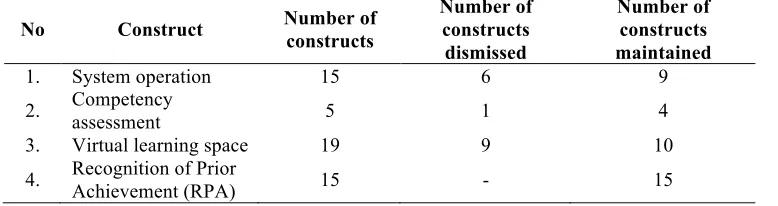
Table 4 - Details of the removal of the construction model of the MSC E-portfolio measurement
No Construct Number of
constructs
Number of constructs dismissed
Number of constructs maintained
1. System operation 15 6 9
2. Competency
assessment 5 1 4
3. Virtual learning space 19 9 10
4. Recognition of Prior Achievement (RPA) 15 - 15
In conclusion, the result of the analysis of the Smallest Secondary Power Consumption analysis on the survey data finds that a total of 16 constructs have been eliminated. This makes 38 constructs successful to form the MSC E-portfolio measurement model. Details of the removal of constructs for the MSC E-E-portfolio measurement model are described in Table 4.
4.
Discussion
E-portfolio can be used as a benchmark for executives in designing the E-portfolio system for vocational education in Malaysia.
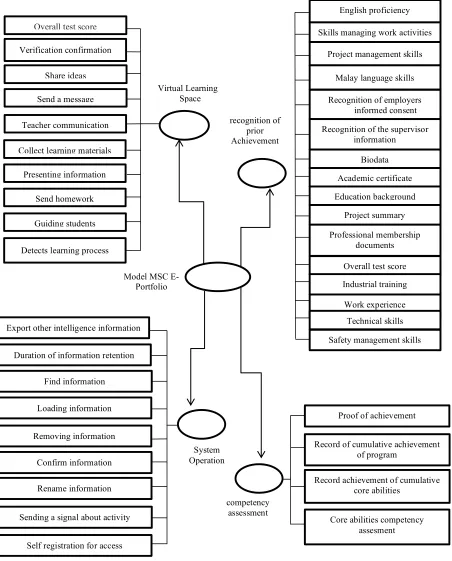
Fig. 1 - MSC E-portfolio model
According to Bennett (2005) the operation of a web system is important in controlling system trips in order to operate properly. E-portfolios can be used in an educational system as a platform, for competency assessment to see the progress of students in any field involved (Rezgui et al., 2017; Shepherd & Hannafin 2008). This clearly demonstrates that E-portfolio has a strong relationship with competency assessment, in determining the level of knowledge and skills of students. Using E-portfolio, the process of identification, documentation and assessment of learning based on previous experience to determine the level of individual achievement can be done more easily (Halligan, 2011;
Model MSC E-Portfolio
Overall test score
Verification confirmation Share ideas Send a message
Teacher communication with students Collect learning materials
Presenting information Send homework Guiding students
Detects learning process
Virtual Learning Space
English proficiency Skills managing work activities
Project management skills Malay language skills Recognition of employers
informed consent Project management skills Recognition of the supervisor
information Project management skills
Biodata
Project management skills Academic certificate Academic certificate Education background Academic certificate Project summary Professional membership documents ect summary Overall test score Project summary Industrial training Project summary Work experience Project summary Technical skills Project summary Safety management skills
Project summary recognition of
prior Achievement
Export other intelligence information
Duration of information retention
Find information
Loading information
Removing information
Confirm information
Rename information
Sending a signal about activity
Self registration for access
System Operation
Proof of achievement
Record of cumulative achievement of program
Record achievement of cumulative core abilities
Core abilities competency assesment competency
Theodosiadou & Konstantinidis, 2015). Hence, Ku & Chang (2011) believe that E-portfolio is suitable for learning platform and learning management system. they added that E-portfolio could provide learning materials, learning resources, homework delivery, project delivery and provide various dimensions of online assessment. This is because ICT provides facilities in the process of learning. ICT facilities create a more engaging learning experience and make students explore more knowledge (Carrington, 2016). This clearly demonstrates that if the concept of learning space is included in E-Portfolios systems, it certainly provides a lot of advantages to learning activities.
5.
Conclusion
The rapid development of ICT, demands that the vocational education system in Malaysia need to change in order to improve the quality of technology-based learning system. It needs to be done to produce skilled, competent and skilled workforce and meet market demands. This is in line with the strategic objectives of the vocational education transformation, planned by the Malaysian Education Ministry in 2011. This is done, in order to empower the vocational education delivery system in producing competitive, professional-looking, skilled workforce and accepted by the job market. The creation of MSC E-Portfolio model developed in this study, is a process of improving the existing portfolio used for MSC purposes. It is important to define the required indicators, when an educational institution chooses to use the E-portfolio. This is to understand and determine the features of E-portfolio needed to meet the needs of an institution. Hence the model formed through the survey done in the study is a confirmation of the new system to meet the needs of MSC system.
The E-portfolio also provides a platform for learning space, competency assessment and more secure online evidence storage, with ubiquitous accessibility. Overall, the indicators and models developed in this study are in line with the MSC requirements. Additionally, it can be concluded that an MSC E-Portfolio is influenced by four main constructs: system operation, competency assessment, recognition of prior achievement and virtual learning space. The findings of this study will also give a new dimension to the MSC system in terms of student competency assessment, interactive learning, safer storage of learning materials and provide a more systematic knowledge management space. Hence, the implementation of the model can indirectly enhance digital literacy skills and enhance professional development of vocational stream students.
References
Ahmed, E., & Ward, R. (2016). Analysis of factors influencing acceptance of personal, academic and professional development e-portfolios. Computers in Human Behaviour, 63, 152-161.
Ashikin, H. T., Ruhizan, M. Y., &Rohani, S. (2015). E-portfolio model development for the professional practice bachelor of teaching (PISMP) in Malaysia. Procedia-Social and Behavioural Sciences, 174, 1262-1269.
Assessment and Teaching of 21st Century Skills (2011) What are 21st-century skills? Retrieved on February 2015 at http://atc21s.org/index.php/about/what-are-21st-century-skills/
Balaban, I., Divjak, B., & Mu, E. (2011). Meta-model of e-portfolio usage in different environments. International Journal of Emerging Technologies in Learning (iJET), 6(3), 35-41
Bateman, A., & Knight, B. (2003). Giving Credit a Review of RPL and Credit Transfer in the Vocational Education and Training Sector, 1995 to 2001. Australia: NCVER.
Batson, T. (2002). The electronic portfolio boom: what's it all about? Campus technology. Retrieved on March 2015 at http://www.campustechnology.com/articles/39299/
Bennett, J. G. (2005). Design Fundamentals for New Media. Clifton Park, NY: Thomson.
Bullock, A. A. & Hawk, P. P. (2005). Developing a Teaching Portfolio. 2nd edition. United State: Pearson.
Carroll, N. L., Markauskaite, L., & Calvo, R. A. (2007). E-portfolios for developing transferable skills in a freshman engineering course. Education, IEEE Transactions, 50(4), 360-366.
Carrington, A. (2016). The Pedagogy Wheel V4.0 the Next Generation, Retrieved on March 2015 at http://padagogy.net/?p=1525
Chua, Y. P. (2006). Research Methodology. Malaysia: McGraw Hill.
Chantanarungpak, K. (2015). Using e-Portfolio on social media. Procedia-Social and Behavioural Sciences, 186, 1275-1281
Firssova, O., & Brinke, D. J. T. (2007). Portfolio for assessment of prior learning: design issues. EPortfolio Conference Maastricht, (pp. 109-113).
Halligan, U. (2011). Developing recognition of prior learning: the role of rpl in the context of the national skills strategy upskilling objectives. Retrieved on February 2015 at http://www.skillsireland.ie/media/egfsn110411-developing_recognition_of_prior_learning.pdf
Handa, J., Arame, M., Goda, Y., Naganuma, S., & Gondo, T. (2011). Using e-portfolios: The Impact of Online Group Work. International Journal, 5(1), 75-85.
Hashim, M. H. M. (2015). Using technology and instructional e-material among technical teacher and student into teaching and learning: A qualitative case study. International Education Studies, 8(3), 175.
Hashim, M. H. M. (2012). Group blogs as toolkits to support learning environments in statistics subject: A qualitative case study. International Education Studies, 5(3), 199-204.
Harrison, C. (2005). Best Practices in Prior Learning Assessment and Recognition (PLAR) Handbook. Alberta: Barrington Research Group, Inc.
Kilbane, C. R., & Milman, N. B. (2005). The Digital Teaching Portfolio Workbook: Understanding the Digital Teaching Portfolio Process. United State: Pearson.
Kline, R. B. (2011). Principles and Practice of Structural Equation Modelling. 2nd Edition. New York: Guilford press.
Koraneekij, P., &Khlaisang, J. (2015). Development of learning outcome based e-portfolio model emphasizing on cognitive skills in pedagogical blended e-learning environment for undergraduate students at faculty of education, Chulalongkorn University. Procedia-Social and Behavioural Sciences, 174, 805-813.
Ku, D. T., & Chang, W.C. (2011). Ufolio: a conceptual design framework for a learning platform and assessment system. Networked Computing and Advanced Information Management (NCM), 2011 7th International Conference
(pp. 358-363).
Ministry of Education. (2011). Strategic Plan of Vocational Education Transformation. Retrieved on March 2017 at http://www.bptv.edu.my/v4/images/bahanpdf/pelanstrategiktpv/PelanStrategikTranformasiPendidikanVokasional_1.pd f
Masran, S. H., M. B. Rahim, A. N. Y. Faizal, & M. F. Marian. (2018). Validity and reliability of an e-portfolio indicators instrument for Malaysian Skills Certification (MSC).Pertanika Journal of Social Sciences & Humanities,25(s),47-56.
Malaysian Qualifications Agency. (2012). Good practice guidelines: Accredited learning based on past experience. Retrieved on March 2015 at
http://www.mqa.gov.my/portal2012/garispanduan/APEL/GGP%20APEL%20(Malay%20Version).pdf
Mohd Hashim, M. H., & Abu Bakar, B (2017). The availability of electronic courses using ICT infrastructure in teaching and learning among teachers in Nigeria's TVET institutions. Pertanika Journal of Social Sciences & Humanities. 25 (S): 17-28
Montgomery, K. K., & Wiley, D. A. (2008). Building E-Portfolios Using PowerPoint Using Power Point a Guide for Educator. 2nd Edition. United State: Sage Publication ltd.
Oner, D., & Adadan, E. (2016). Are integrated portfolio systems the answer? An evaluation of a web-based portfolio system to improve preservice teachers’ reflective thinking skills. Journal of Computing in Higher Education, 28(2), 236-260.
Rezgui, K., Mhiri, H., & Ghédira, K. (2017). Ontology-based e-Portfolio modelling for supporting lifelong competency assessment and development. Procedia Computer Science, 112, 397-406.
Sang, S., Lee, J.D., & Lee, J. (2010). E-government adoption in Cambodia: a partial least squares approach. Transforming Government: People, Process and Policy, 4(2), 138-157.
Shepherd, C. E., & Hannafin, M. J. (2008). Examining preservice teacher inquiry through video-based, formative assessment e-portfolios. Journal of Computing in Teacher Education, 25(1), 31-37.
Stefani, I., Mason, R., & Pegler, C. (2007). The Educational Potential of E-Portfolios Supporting Personal Development and Reflective Learning. New York: Routledge.
Yang, M., Tai, M., & Lim, C. P. (2016). The role of e-portfolios in supporting productive learning. British Journal of Educational Technology, 47(6), 1276-1286.
Yasin, R. M., Mohamad, Z., Rahman, M. N. A. B., Hashim, M. H. M. (2012). The formation of indicators on engineering laboratory management. International Education Studies, 5(5); 212-217.
Yastibas, A. E., &Yastibas, G. C. (2015). The use of e-portfolio-based assessment to develop students’ self-regulated learning in English language teaching. Procedia-Social and Behavioural Sciences, 176, 3-13.