http://www.sciencepublishinggroup.com/j/ijass doi: 10.11648/j.ijass.20170503.11
ISSN: 2376-7014 (Print); ISSN: 2376-7022 (Online)
Super Exponential Expansion for Dark Energy Model with
Variable Λ in
f
(
R, T
) Gravity
Mohammad Moksud Alam
*, Mohammad Amjad Hossain, Mohammad Ashraful Islam
Department of Mathematics, University of Chittagong, Chittagong, Bangladesh
Email address:
[email protected] (M. M. Alam), [email protected] (M. A. Hossain), [email protected] (M. A. Islam)
*
Corresponding author
To cite this article:
Mohammad Moksud Alam, Mohammad Amjad Hossain, Mohammad Ashraful Islam. Super Exponential Expansion for Dark Energy Model with Variable Λ in f(R, T) Gravity. International Journal of Astrophysics and Space Science. Vol. 5, No. 3, 2017, pp. 41-46.
doi: 10.11648/j.ijass.20170503.11
Received: March 28, 2017; Accepted: April 13, 2017; Published: June 2, 2017
Abstract:
In this paper, we have studied Friedmann-Robertson-Walker (FRW) cosmological model with quadratic equation of state and cosmological constant in the presence of perfect fluid source in f(R, T) gravity. To obtain an exact solution of the field equations of the theory, we have used quadratic equation of state and time dependent deceleration parameter q(t). The physical and geometrical behavior of the model is also discussed.Keywords:
f(R, T) Gravity, Cosmological Model, Quadratic Equation of State, Cosmological Constant, Deceleration Parameter1. Introduction
The simplest and the most elegant assumption of the universe being homogeneous and isotropic is supported by the observational evidences in the large scale structure (LSS) [1] and cosmic microwave background radiation (CMBR) [2]. The idea, the present universe is expanding with acceleration, put forward by the recent cosmological observations from Supernova [3, 4]. The imposition to the contribution of an exotic component responsible for cosmic acceleration is known as dark energy, which has negative pressure and contributes almost three quarters of the total cosmic density. The most obvious candidate of dark energy is the so-called cosmological constant ( )Λ that plays a crucial role in generating an accelerating scale factor. Though, several approaches have made to study the fundamental nature of the dark energy, such as quintessence, phantom, k-essence, tachyon, chaplygin gas and many more [5, 6].
Our primary interest is to search alternative, modified gravity consistent with observational data when general relativity fails to make a natural interpretation of the dark energy epoch of the universe. We resort to Einstein-Hilbert action to obtain modified theories of Einstein such asf R( )
gravity [7, 8] and f T( )gravity [9] where,R andTare defined as the curvature scalar and the trace of energy momentum tensor respectively. A newly devised theory known as
( , )
f R T gravity [10] has been studied to reconstruct some cosmological models. The gravitational Lagrangian is constituted by an arbitrary function of curvature scalar ( )
and the trace ( ) of the energy momentum tensor. They have investigated FRW model to yield the field equations in this theory of f R T( , )gravity. Very recently, Sahoo et al. [11] studied LRS Bianchi Type-I cosmological model in f R T( , ) theory of gravity with Λ( )T while cosmological models with linearly varying deceleration parameter in f R T( , )theory has investigated by Ramesh et al. [12]. Akarsu and dereli [13] have first introduced a new law for deceleration parameter varying linearly with time which is congruent with Berman’s law where it is constant.
2 0
P=P +
αρ βρ
+ (1)Where, P0 , α and β are parameters. This equation is nothing but the first term of Taylor expansion of any equation of state of the form p= p( )ρ about ρ =0. They have also analyzed the effects of quadratic equation of state in anisotropic homogeneous and inhomogeneous cosmological models in general relativity to isotropize the universe at early times when the initial singularity is approached. Recently, Reddy et al. [15] have thoroughly discussed the Bianchi-I cosmological model with quadratic equation of state in the context of general theory of relativity.
Inspired by the above investigations and discussions, we have studied FRW space-time cosmological model in
( , )
f R T gravity with quadratic equation state and cosmological constant. We have investigated here one particular class of f R T( , ) gravity [10] and solved the surviving field equations satisfying the linearly varying deceleration parameter( )q proposed by Akarsu and Dereli [13]. We have organized this work as follows: In section 2, we reviewed modified f R T( , ) theory of gravity in brief. Sect. 3 presents Einstein field equations in terms of Hubble parameter following f R T( , ) gravity using
( , ) 2 ( )
f R T = +R f T . An explicit solution of the equations is presented in Sect. 4. We summarize this paperwith a brief discussion on the basis of graphical presentation of the results in Sect. 5. The conclusions of the models are given in Sect. 6.
2. A Brief Review of
f
(
R, T
) Gravity
Action for the modified gravity[10] is considered as
4 ( , )
16 m
f R T
S L g d x
G π
= + −
∫
(2)wheref R T( , )is the arbitrary function of Ricci scalar( )R and and trace( )T of the stress energy tensor of the matter Tµυ. The matter
Lagrangian density is defined by Lm. The action for the different theories depend on the choice of f R T( , ). It is to be noted that when f R T( , )= f R( )then (2) represents the action for f R( )
gravity. The stress energy tensor of matter is defined as
( )
2 g Lm
T
g g
µυ µυ
∂ − = −
− ∂ (3)
and its trace by T =gµυTµυ respectively. With the
assumption that Lmof matter depends only on gµυand not on its derivatives, we obtain
2 m
m
L
T g L
g
µυ = µυ − ∂ µυ
∂ (4)
Let us take variation of action (2) with respect to the metric tensor componentsgµυ, so that we obtain the field
equations of f R T( , )gravity as
1
( , ) ( , ) ( ) ( , ) 8 ( , ) ( , )
2
R R T T
f R T Rµν − f R T gµν + gµν−∇ ∇µ ν f R T = πTµν −f R T Tµν − f R T θµν (5)
where,
2
2T g Lm 2glk Lmlk
g g
µν µν µν µν
θ = − + − ∂
∂ ∂ (6)
Here, T( , ) ( , )
f R T
f R T
T
∂ =
∂ ,
( , ) ( , )
R
f R T
f R T
R
∂ =
∂
□= ∇ ∇µ µ is the De Alembert’s operator, and Tµν is the standard matter energy momentum tensor derived from the
LagrangianLm. By contracting (5), we obtain the relation between Rand Tas
( , ) 3
R
f R T R+ □fR( , ) 2 ( , )R T − f R T =8πT− fT( , )R T T− fT( , )R T θ (7)
where,
θ
=gµνθ
µν. From (5) and (7), the gravitational field equations can be written as1 1 1 1
( , )( ) ( , ) (8 ( , ))( ) ( , )( ) ( , )
3 6 3 3
R T T T
f R T Rµν − Rgµν + f R T gµν = π− f R T Tµν − Tgµν −f R T θµν − θgµν + ∇ ∇µ ν f R T (8)
The problem of perfect fluids described by an energy density
ρ
, pressure p and four velocities uµ is more complicated, since there is no unique definition of the matter( )
Tµν = ρ+p u uµ ν −pgµν (9)
and the matter Lagrangian can be taken as Lm= −p and we have,
0 uµ∇ν µu =
, u u 1
µ µ =
Now, with the use of (6), we have
2T pg
µν µν µν
θ = − − (10)
It is to note that f R T( , ) depends on the physical nature of the matter field through tensor θµν . Thus, each choice of
( , )
f R T leads us to different cosmological models. Harko et al. [10] presented three classes of f R T( , )as follows:
1 2
1 2 3
2 ( )
( , ) ( ) ( )
( ) ( ) ( )
R f T
f R T f R f T
f R f R f T
+ = + + (11)
In this present work, we have discussed the class of
( , ) 2 ( )
f R T = +R f T
For this choice and with the help of (9) and (10), (5) reduces to
1
(8 2 ( )) (2 ( ) ( )) 2
Rµν− gµνR= π+ f T T′ µν + pf T′ +f T gµν (12)
which is the gravitational field equation in f R T( , ) modified gravity for the class f R T( , )= +R 2 ( )f T .
The gravitational field equation (12), in f R T( , ) theory, in the presence of cosmological constant( )Λ , is given as
1
(8 2 ( )) (2 ( ) ( ) )
2
Rµν− gµνR= π+ f T T′ µν+ pf T′ +f T + Λ gµν (13)
where prime stands for differentiation with respect to the argument.
3. Model and Field Equations for
f
(
R,
T
)=
R
+2
f
(
T
) Where ( )
f T
=
λ
T
The metric of FRW space-time is given by
2
2 2 2 2 2 2 2
2
( ) ( sin )
1 dr
ds dt a t r d d
kr θ θ φ
= − + + +
−
(14)
which is spatially homogeneous and isotropic in standard spherical co-ordinate( , . , )t rθ φ , where a t( ) is the scale factor and k , the curvature parameter, is used to describe the geometry of the universe with open, flat and closed corresponding to k= −1, 0,1 in some respects.
Perfect fluid energy- momentum tensor can be taken as
( , , , )
Tµν = −
ρ
p p p (15)where
ρ
, the energy density and p, the pressure of the fluid are both functions of cosmic time t.For the choice f T( )=λT , the field equations (13) making a connection with (14) and (15), are given by
2
2 2
3 a k (8 3 ) 5 p
a a π λ ρ λ
+ = − + + + Λ ɺ (16) 2
2 2 2 (8 7 )
a a k
p a
a + +a = π+ λ −λρ+ Λ
ɺ ɺɺ
(17)
For a flat model, (16) and (17) reduce to
2
3H = −(8
π
+3 )λ ρ
+5λ
p+ Λ (18)2
2Hɺ +3H =(8
π
+7 )λ
p−λρ
+ Λ (19)where H a a
= ɺ is the Hubble parameter and an overhead dot
(.) hereafter, denote ordinary differentiation with respect to cosmic time " "t only.
4. Solution of Field Equations
Now, we have a system of two equations (18) and (19) with four unknown functions, namely, a t( ), ρ( )t , p t( )and
( )t
Λ . To obtain an exact solution of the field equations, we consider two physically plausible conditions as:
i. The quadratic equation of state given by
2
p=
αρ
−ρ
(20)where
α
≠0 is a constant quantity to preserve the quadratic nature of the equation.ii. Akarsu and Dereli[13] and Akarsu et al.[16] proposed the linearly varying deceleration parameter as
2 1
aa
q lt m
a
= −ɺɺ = − + −
ɺ (21)
where, l≥0, m≥0 are constants and law of Berman[17] can be obtained for l=0. Various cosmological models have been discussed executing this law with constant deceleration parameter. As we learn that the universe may exhibit Super exponential expansion for q< −1, Exponential expansion for
1 q 0
− ≤ < , Expansion with constant rate for q=0 and Decelerated expansion for q>0. We can solve (21) for scale factor and three different forms of solutions are obtained as
1
1 c t
a=a e for l=0and m=0 (22)
1
2( 2)m
3 2 2 3 3 2 exp arctan 2 2 lt m
a a h
m c l m c l
−
=
− −
for l>0, m≥0 (24)
where, a1, a2, a3, c1, c2, c3 are constants of integration. We will focus on the third one which could be very nice. Particularly, we investigate the solution for l>0 and m>0
because of compatibility with the observed universe. Wechoosec3=0 and the initial time of the universet=0. Now taking a3=1 in (24), the FRW metric can be written in the form
4
arctan 1
2 2 2 2 2 2 2
( sin
lt h
m m
ds dt e dr r dθ θ φd
−
= − + + + (2
5)
From (25), we find the Hubble parameter as
2 ( 2 )
a H
a t lt m
= = − − ɺ
(26)
Now, substituting for the scale factor a t( ) from (25) and making use of (20) in (18) and (19), we obtain the energy density
2
( 2 )
(4 )
lt m t lt m
ρ
α π λ
− =
−
+ (27)
and pressure of the universe
2 2
2
2 ( ) 4 ( 2 ) (4 ) ( 2 )
p lt m t lt m lt m
t lt m α π λ
α π λ
= × − − + − −
+ − (28)
Using (27) and (28) in (18), we obtain
2 2 2 2
12 2(8 3 ) 10
2 ( ) 4 ( 2 )
( 2 )
( 2 ) (4 ) (4 ) ( 2 )
lt m
lt m t lt m lt m
t lt m
t lt m t lt m
π
λ
λ
α
π λ
α π λ
α π λ
+ −
Λ = + − × − − + − −
−
− + + − (29)
The universe has a finite life time according to the assumption of linearly varying deceleration parameter as in equation (21) with l>0 and m>0. It has a big bang singularity at t=0 with large energy density. The scale factor and the energy density
diverge very rapidly with the evolution of cosmic time approaching to a Big Rip singularity [18] at a finite timet 2m l
= . To
obtain a proper energy density, the model must satisfy lt>m for which q< −1(Super exponential expansion). Ricci scalar is found as
2 2
24( 2)
( 2 )
lt m R
t lt m
− + = −
− (30)
Trace of the energy- momentum tensor is given by
2 2
2 6
2 ( ) 4 ( 2 )
( 2 )
(4 ) (4 ) ( 2 )
lt m
T lt m t lt m lt m
t lt m t lt m
α
π λ
α π λ
α π λ
−
= − + × − − + − −
−
+ + − (31)
The function f R T( , )= +R 2 ( )f T for this model is given by
2 2 2 2
24( 2) 4 12
( , ) 2 ( ) 4 ( 2 )
( 2 )
( 2 ) (4 ) (4 ) ( 2 )
lt m lt m
f R T lt m t lt m lt m
t lt m
t lt m t lt m
λ
λ
α
π λ
α π λ
α π λ
− + −
= − − + × − − + − −
−
− + + − (32)
5. Discussions
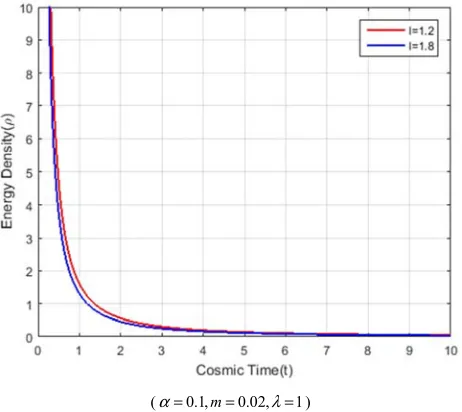
From the Fig-1, we observe that energy density
ρ
is decreasing function of time t andρ
approaches towards zero with the evolution of time.From Fig-2, it can be clearly seen that pressure p is negative and approaches towards zero with the evolution of
time.
(α=0.1,m=0.02,λ=1)
Figure 1. Energy Density vs Cosmic Time.
(α=0.1,m=0.02,λ=1)
Figure 2. Pressure vs Cosmic Time.
(α=0.1,m=0.02,λ=1)
Figure 3. Cosmological Constant vs Cosmic Time.
6. Conclusions
In this work, we have investigated a flat FRW space-time in f R T( , ) gravity with cosmological constant in the presence of perfect fluid, formulated by Harko et al. [10]. The field equations of the theory have been solved by using quadratic equation of state for a perfect fluid and time dependent deceleration parameter proposed by Akarsu and Dereli [13]. The physical behavior of energy density, pressure and time dependent cosmological constant of the universe is discussed. It is observed that all the physical quantities diverse at t=0 and vanishast→ ∞ . The model will also help to explain super exponential expansion of the universein the presence of cosmological constant( )Λ . Here, it should be mentioned that super exponential expansion is rapid rate of expansion if q< −1 under linearly varying deceleration parameter.
References
[1] Tegmark M. et al.: Cosmological parameters from SDSS and WMAP. Phys. Rev. D 69, 103501 (2004).
[2] Speergel, D. N., et al.: First year Wilkinson Microwave Anisotropy Probe (WMAP) observations: determination of cosmological parameters. Astrophys. J. Suppl. Ser. 148, 175 (2003).
[3] Riess, A. G., et al.: Observational evidence from supernovae for an accelerating universe and a cosmological constant. Astron. J. 116, 1009 (1998).
[4] Perlmutter, S., et al.: Measurements of Ω and Λ from 42 high-redshift supernova, Astrophys. J. 517, 565 (1999). [5] Padmanabhan, T.: Accelerated expansion of the universe
driven by tachyonicmatter. Phys. Rev. D 66, 021301 (R) (2002).
[6] Bento M. C., Bertolami O., Sen A. A.: Generalized Chaplygin gas, accelerated expansion, and dark-energy matter unification. Phys. Rev. D 66, 043507 (2002).
[7] Nojiri S., Odintsov S. D.: Modified f R( )gravity consistent with realistic cosmology: From a matter dominated epoch to a dark energy universe. Phys. Rev. D 74, 086005 (2006). [8] Bertolami O. et al.: Extra force in ( )f R modified theories of
gravity. Phys. Rev. D 75, 104016 (2007).
[9] Bengochea G. R., Ferraro R.: Dark torsion as the cosmic speed-up. Phys. Rev. D 79, 124019 (2007).
[10] Harko et al.: f R T( , ) gravity, Phys. Rev. D 84, 024020 (2011).
[11] Sahoo P. K., Sivakumar M.: LRS Bianchi-I cosmological model in f R T( , ) theory of gravity with Λ( )T . Astrophys Space Sci, 357: 60 (2015).
[13] Akarsu, O., Dereli, T.: Cosmological models with linearly varying deceleration parameter. Int. J. Theor. Phys. 51, 612 (2012).
[14] Ananda K. N., Bruni M.: Cosmological dynamics and dark energy with a non-linear equation of state: A quadratic model. Phys. Rev. D 74, 023523 (2006).
[15] Reddy D. R. K., Adhav K. S., Purandare M. A.: Bianchi type-I
cosmological model with quadratic equation of state. Astrophys Space Sci, 357: 20 (2015).
[16] Akarsu, O., et al.: Probing kinematics and fate of the universe with linearly varying deceleration parameter. Eur. Phys. J. Plus 129, 22 (2014).
[17] Berman M. S.: NuovoCimento B 74, 182 (1983).